



Abstract
This quantitative study empirically analyzes the relation between leader humility and innovative behavior by assessing the moderating role of intrapreneurial personality. Cross-sectional data were collected from 498 respondents in Karachi, Pakistan. The study has two purposes. First, on the basis of signaling theory, it investigates the relation between leader behavior (humility) and innovative behavior (at the individual level). Second, on the basis of personality and individual differences it considers follower effects to investigate whether the intrapreneurial personalities of subordinates moderates this relationship, using a PROCESS macro to test two-way interactions. Empirical assessments of the hypotheses show that intrapreneurial personality plays a distinct moderating role between leader humility and innovative behavior. The results of the study have significant implications and open up several avenues for future research.
Keywords


Introduction
Leadership has been studied extensively in the literature [1], but little attention has been given to how it influences innovation (individual, team, and organizational capacity). According to a recent literature review [1], most studies of leadership focus on leadership styles, especially transformational and transactional leadership. Since leadership styles reflect behavior over time, it is logical to examine leaders’ specific behaviors [1]. Most recently, researchers have begun exploring broader theories of leadership, calling attention to leader behaviors, but minimal consideration has been given to humility in leaders [2]. The studies that do consider humility rarely consider its effect on important organizational outcomes, such as followers’ innovative behavior.
Leaders with humility admit their shortcomings, appreciate contributions from followers, and learn from them [3]. These characteristics may support innovative behavior at the individual level: Janssen [4] relates leaders’ supportive behaviors to innovation, as when employees feel supported they participate in more innovative activities benefiting the organization [5]. Putting it all together, the present study has two purposes. First, it investigates the relation between leader behavior (humility) and innovative behavior (at the individual level) based on signaling theory [6]. Second, on the basis of personality and individual differences, it takes into consideration follower effects and investigates whether the intrapreneurial personality [7] of subordinates moderates the aforementioned relation. The results contribute to the literature by illuminating the role of intrapreneurial personality as a moderator in the humility-innovation relationship based on signaling theory and individual differences.
Literature review
Leader humility
Humility lacks conceptual clarity: it has been considered an orientation, virtue, personality trait, a value, or a psychological strength in the literature [3]. It is also often conflated with modesty, honesty, integrity, empathy, and sometimes low narcissism and low self-esteem. Therefore, researchers lack consensus in defining humility [8]. Following Owens et al. [3], this study conceptualizes leader humility as an observable behavior interpreted by followers that is clearly distinct from the aforementioned constructs. Owens et al. (2013) were the first to empirically conceptualize leader humility as a behavior [9] based on three dimensions: (1) accepting one’s own limitations, (2) valuing employees’ strengths, and (3) teachability [3, 10]. During the last decade this concept has gained attention as it is one of the vital determinants of leadership effectiveness [8], but most of the work done is theoretical and still lacks empirical evidence in leadership studies [9]. Since leadership comprises a relational perspective, the current study focuses on the behavioral dimension of humility resulting from interactions between followers and leaders at an individual level.
Innovative behavior
In their study on innovation in business organizations, Gu, Duverger, & Yu [11] describe innovation as the ability to generate new knowledge, adopt serviceable practices and procedures from external environments, and implement and utilize them to solve problems in the organization [12]. Similarly, Korzilius, Bücker, & Beerlage [13] clarify that continuously innovating is crucial: the ability to innovate products, services, and processes is inherent in employees, so continuous improvements and innovations associated with individuals are regarded as innovative behavior [14–16]. Along the same lines, several researchers [5, 17] discuss how individuals initiate innovative behavior for organizations and themselves by improving present conditions or by attempting to generate new solutions to existing problems. Innovative behavior is a multistage process featuring different behaviors at each stage, starting with creativity in the initial stage [18]. Initially, innovative employees recognize problems in work settings and generate new ideas to resolve them. Afterwards, during the mobilizing support stage, others are welcomed to provide support for new ideas. This is followed by the implementation stage, where ideas are turned into reality by producing or generating new products or processes to resolve previously identified problems [12, 18]. Overall, the current study considers innovative behavior as an intentional initiative for the development of new products, services, processes, or a combination of all three.
Intrapreneurship
Intrapreneur is not a new term; it has been popular in academic and business literature for three decades [19, 20]. An intrapreneur is one who is able to act like an entrepreneur in organizational settings [19–21]. Both entrepreneurs and intrapreneurs possess distinct personalities. According to Pinchot [22], the first person to coin the term ‘intrapreneur,’ intrapreneurs are initiators: they do not wait for someone to assign them tasks but instead are self-appointed to their tasks. They are also action-oriented and confident. Additionally, they remain ready to contribute to organizational success through competitive attitudes. For instance, they innovate by formulating new strategies, presenting new services, creating new ventures, introducing technologies, or suggesting novel administrative practices [23]. The literature on intrapreneurship suggests that employees with intrapreneurial personalities demonstrate innovative behavior [7]. Following Åmo & Kolvereid [7], the current study identifies intrapreneurial personality by utilizing the “Are you an intrapreneur test” offered by Pinchot [22] and hypothesizes it as a moderator between leader humility and innovative behavior.
Research framework and hypothesis development
The study utilizes signaling theory [6] to explain how leader humility affects subordinates’ innovative behavior. The theory considers four elements—the signaler, signal, receiver, and feedback—within the signal environment. When signals are disseminated for desired behaviors, the receivers tend to reciprocate through feedback [6]. In the context of this study, we assume that the manager disseminates humility. Once the employees observe and interpret that humility, they tends to reciprocate accordingly in innovative behavior. For instance, managers send a signal of psychological safety and freedom by addressing and accepting their own limitations [10]. This characteristic encourages employees to take risks, address queries, and have open discussions. Similarly, humble managers value employees’ input by appreciating their strengths [10]. This characteristic sends a signal to be creative and provide suggestions. Likewise, humble managers send a signal for openness to learning by modeling teachability [10]. This characteristic makes uncertainty less threatening for employees. Altogether, accepting criticism, remaining openminded, and creating an inclusive atmosphere in the organization makes it easier for employees to generate ideas and produce innovative outputs, consequently portraying innovative behavior [24, 25].
This study also argues that based on personality and individual differences, intrapreneurs are distinct from other employees. They have the ability to leverage their current positions by working beyond their job descriptions. Also, they are able to think and act like an entrepreneur for the benefit of their organizations [26]. Substantial discussion among researchers has considered what triggers an employee to become an intrapreneur but little consensus has been achieved. Elements such as personal attributes, psychological ownership, and personal satisfaction have been studied as potential motivations to transform one into an intrapreneur [27, 28]. However, researchers do agree that an intrapreneur successfully balances vision with action: envisioning an idea and executing steps to make it work is a distinctive ability only found in intrapreneurs [29, 30]. Intrapreneurs achieve this by relying not only on instinct but also on logic; additionally, they can balance instinct and logic according to situational demand [22, 29]. In the same way, the innovation process requires intuition and creativity in early stages followed by rational thought and execution [22, 30]. Therefore, an intrapreneur has an edge over other employees to depict innovative behavior and produce innovative outputs.
On the basis of the above discussion and empirical findings of prior studies, the following hypotheses are postulated and research framework is presented in Fig. 1.
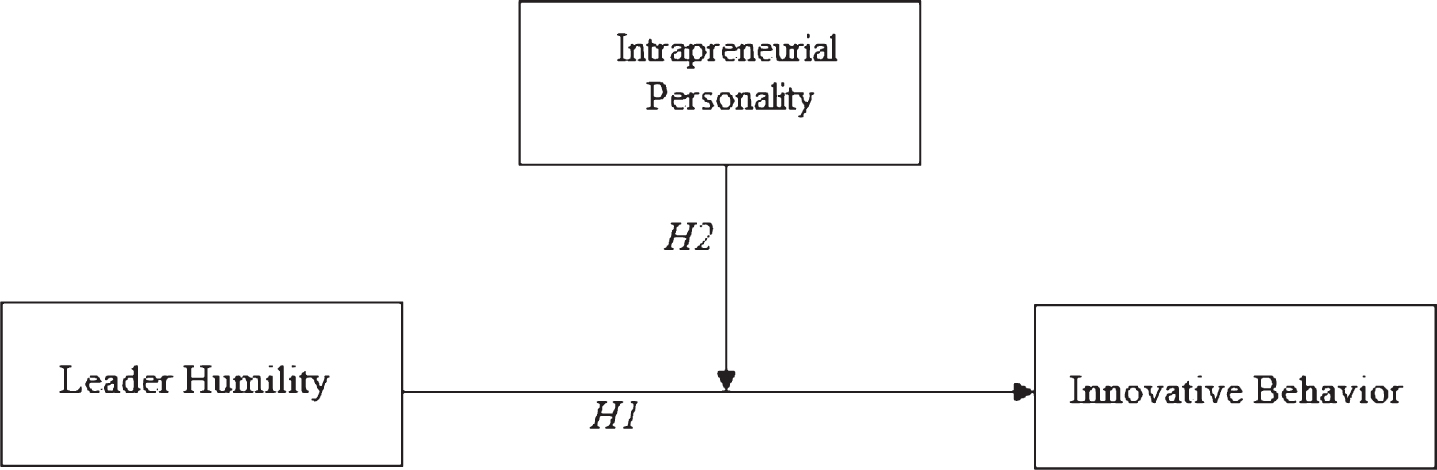
Research framework.
Hypothesis 1 (H1): Leader humility (LH) will positively affect innovative behavior (IB).
Hypothesis 2 (H2): Intrapreneurial personality (IP) will moderate the relation between LH and IB, such that the positive relation between LH and IB will strengthen.
The study is quantitative in nature and employs deductive approach to collect cross-sectional data using a paper and pen questionnaire survey tool [31]. The data were collected from adult university students participating in Executive MBA (EMBA), a weekend program specially designed for on-the-job mid-career professionals and entrepreneurs who have at least four years of experience working in self-owned, family-owned, national or multinational organizations. EMBA is based in Karachi, Pakistan. The study also utilized a single stage sampling design using systematic random sampling for the purpose of sampling the population [31].
Measures
Intrapreneurial personality (IP) was measured by an instrument utilized by Åmo & Kolvereid [7] and originally developed by Pinchot [22], consisting of twelve items. Sample items include “I visualize concrete steps of action when I consider ways to make new idea happen”, and “I desire to make things work better occupy as much of my time as fulfilling my duty to maintain them in the way they are”. Similarly, the innovative behavior (IB) instrument was adapted from Åmo & Kolvereid [7], consisting of five items. Sample items include “To which extent do you contribute to new product development in the organization where you are employed”, and “To which extent do you contribute to development projects in the organization where you are employed”. The instrument for leader humility (LH) was adapted from Owens, Johnson, & Mitchell [3], consisting of nine items. Sample items include “This leader actively seeks feedback, even if it is critical”, and “This leader shows a willingness to learn from others”. In this study all items were measured using a five-point Likert scale ranging from 1 = very little extent to 5 = very large extent for the previously validated variables. In the data sheet, they were coded IP1 to IP12, IB1 to IB5, and LH1 to LH9, respectively, for further analysis.
Procedure
Initially, permission was secured from the relevant university and program coordinators to collect data from their students. They were informed about the purpose of the research and were asked to nominate a focal person to collaborate with our research assistant. The researchers relied on a network of research assistants to collect data from the targeted population. In collaboration with the focal persons, it was mutually decided to distribute questionnaires during the last thirty minutes of lecture on the same day. Course instructors were also briefed, and a list of students was acquired a week ahead of time. The students’ ID numbers were used to identify participants: every alternate odd digit registration or student ID number was selected as a potential respondent.
Later, hard copies of the information sheet, a letter from the researchers, and questionnaire were distributed to the potential respondents. The information sheet contained instructions on how to complete the survey, while the letter from the researchers stated the purpose of research and addressed matters of confidentiality, anonymity, and free-will participation. The questionnaire contained four sections: one for demographics and one for each variable under study. Respondents were all provided with sufficient time to complete the questionnaire and return it as they left the lecture room. All questionnaire data was kept confidential. Since the questionnaire items are simple and straightforward, there was no need for the researchers’ intervention.
Prior to collecting data, a pilot study was conducted on a sample of fifty respondents to test for scale coherence, item clarity, understandability and language simplicity. The pilot questionnaire was evaluated for language and ease of understanding by two professors working in Karachi-based universities and one manager from an industry regularly dealing in innovation. The pilot test responses were not included in the data analysis.
Basic sample description
Initially, research assistants distributed 800 questionnaires and at the end of data collection process 572 were returned, a response rate of 71.5%. Afterwards, the collected data was further scrutinized and entered in a data sheet with a control process to minimize data-entry errors. Part-time employees, self-employed workers/entrepreneurs, employees working in family-owned business, and respondents who submitted incomplete questionnaires were eliminated from consideration, as their responses may influence the results inappropriately. In addition, data screening was also conducted to detect multivariate outliers. The researchers calculated Mahalanobis, leverage, and Cook’s distance for the predicted variables to detect multivariate outliers [32, 33]. In consequence, 498 usable questionnaires were carried forward for further statistical analysis; according to Cohen [34] this sample size is sufficient for a medium-sized effect with a traditional 0.80 power set. Next, the normal distribution of the data was analyzed. The maximum values for skewness and kurtosis was less than 2 and 5 respectively [35]. In the support of assumptions of normal distribution, data were tested for normality and homogeneity of variance using statistical test, such as Shapiro-Wilk’s. The results concluded in failing to reject the null hypothesis, that is p-values were greater than the level of significance (i.e. 0.05). Hence, data set for current study is considered to be consistent with the normal distribution assumptions [35]. The sample contains 308 men and 190 women. In all, 303 respondents were between 30–34 years old, while 401 respondents were married. Table 1 shows the respondents profile.
Respondents profile
Respondents profile
Scale dimensions and reliability
Exploratory factor analysis (EFA) using the maximum likelihood method (ML) [54, 55] with oblique rotation (Promax) [55] was undertaken to verify that the items were loading in the same factor as proposed by the authors. First, sample adequacy was measured through the Kaiser-Mayer-Olkin (KMO) index. The KMO index, 0.872, was found acceptable as it was greater than cut-off level of 0.6 [36]. Secondly, Bartlett’s sphericity test was performed to investigate if the correlation matrix was an identity matrix. The results for Bartlett’s sphericity test were highly significant, i.e. p = 0.000. As this is below 0.05 level of significance [36] it signifies that the matrix is not an identity matrix. Lastly, factors having eigenvalues greater than 1 and factor loadings greater than 0.5 were retained [37]. Subsequently, all items were loaded in respective variables forming three factors and none was dropped. Next, internal consistency was measured using Cronbach’s alpha, a reliability test. The alpha values were 0.807 for IP, 0.846 for IB, and 0.858 for LH, which signifies that items are correlated well with true scores [38]. Altogether, these tests represent proper and thorough scientific analysis, showing that the data satisfactorily meets the content and criterion validity standards proposed by Nunnally [38] and Churchil [39].
Common method bias
Common method variance (CMV) analysis was also conducted because data was collected on a self-reporting basis and potential bias may exist [40]. Podsakoff et al. [41] suggest procedural and statistical remedies to reduce potential bias. Our study has already incorporated procedural remedies by using previously validated scales and providing assurance of confidentiality and anonymity [42]. Doty & Glick [43] note that procedural remedies are less sensitive to potential bias. However, we conducted Harman’s single factor test as a statistical remedy [44]. We allowed all items to load on a single factor with no rotation in EFA, and the results were far below the threshold of 50 percent [45]. Hence, potential bias is not an issue in our data set.
Descriptive statistics, correlation and multicollinearity
The mean value of IP is 3.20, LH is 3.22, and IB is 3.57; however, the standard deviations are 0.63, 0.83, and 0.73 respectively. Also, the bivariate Pearson correlation between variables is moderate [46], statistically positive, and significant at p < 0.01. Further, a multicollinearity diagnostic through variance inflation factor (VIF) was conducted. VIF resulted in values below 1.5 which is substantially lower than the threshold of 10 [47]. Hence, multicollinearity does not exist. Table 2 shows the descriptive statistics and Pearson correlation.
Descriptive statistics and correlation
Descriptive statistics and correlation
SD: standard deviation, **p < 0.01.
The PROCESS macro [48] in SPSS was used to conduct moderation analysis and the variables were mean-centered prior to creating an interaction term. A mean-centering interaction term is preferred for easier interpretability of the results, because it clarifies regression coefficients and the overall model fit criteria remain undisturbed [49]. Additionally, the interactions were probed using standard deviations by plotting conditional effects with±1 standard deviation [48]. Also, the analysis of main effect and moderation analysis was conducted independently to make the interpretations effective. Table 3 shows the main and moderation effect in Models 1 and 2, respectively.
Main and moderation effect
Main and moderation effect
aPredictor, bModerator, cMean centered interaction. ***p < 0.001.
Our first hypothesis proposes that LH would positively affect IB. Table 3 (Model 1) indicates that H1 (b = 0.427, p < 0.001) was accepted. Also, the overall model with the predictor is statistically significant, F(1, 496) = 152.678, p < 0.001. As shown in Table 3 (Model 2), the results of the second hypothesis also indicate that IP has a moderating effect on relation between LH and IB, as the overall model is statistically significant, F(3, 494) = 59.5366, p < 0.001. Similarly, the interaction between LH and IP has accounted for more variance than just LH and IP themselves, ΔR2 = 0.0185, F(1, 494) = 10.6384, p < 0.001. Hence, H2 (b = 0.1772, p < 0.001) is also accepted, and the two-way interaction (LH x IP) is plotted in Fig. 2.
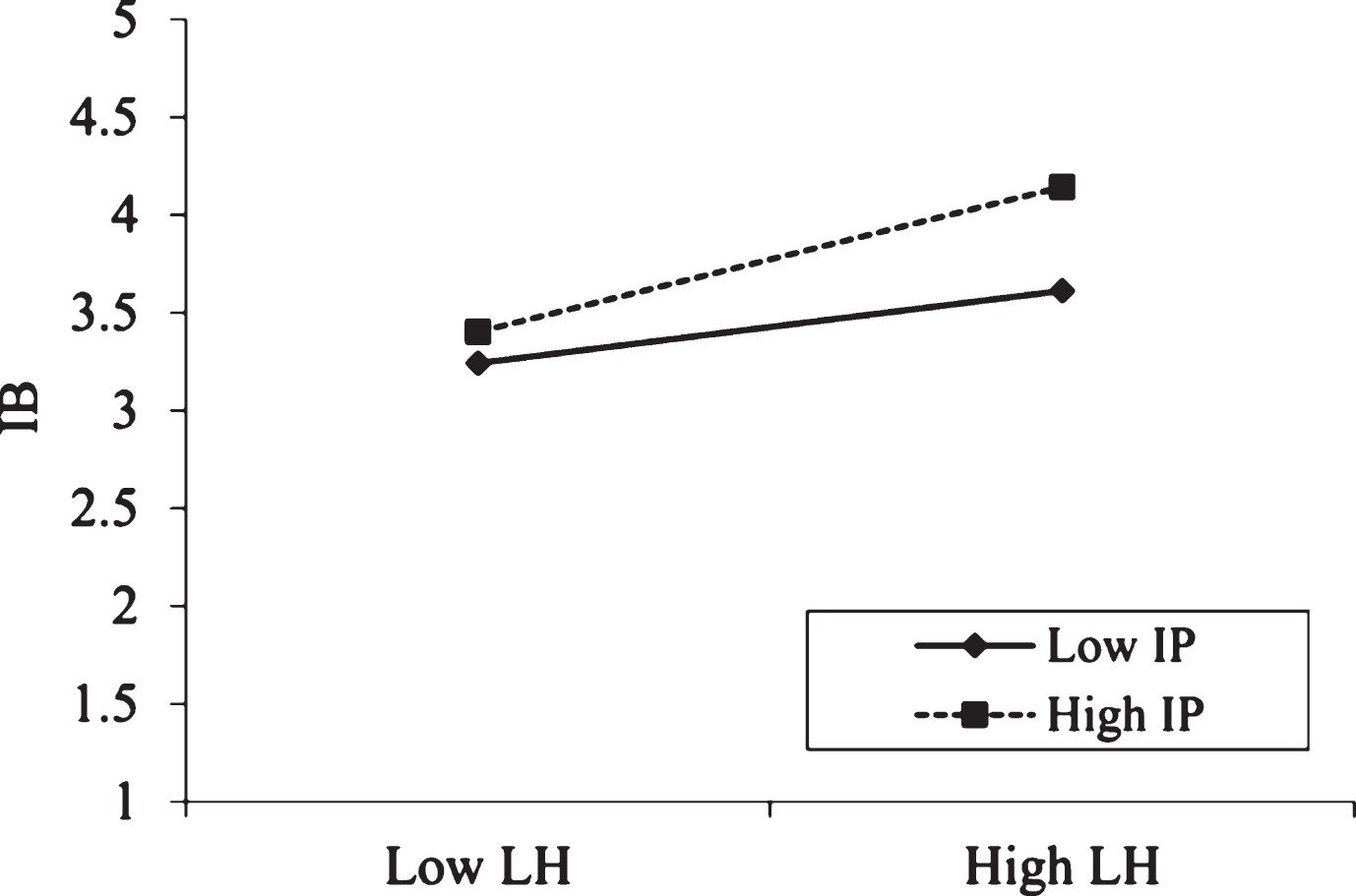
Conditional effect of LH on IB at different levels of IP.
This study attempts to find the relation between leader humility and innovative behavior and moderating role of intrapreneurial personality in strengthening their relation. Findings of the current study reveal that both hypotheses are accepted: there is a positive relation between LH and IB (H1) and IP moderates the relation between LH and IB by strengthening the positive LH-IB relation (H2). The results of the study are consistent with the literature on humble leadership. Zhou & Wu [50] found a positive impact of humble leadership and a partial mediating role of core self-evaluation on employee innovative behavior in fifteen companies based in three Chinese provinces. Wang et al. [2] found that humble leader behavior positively influenced follower creativity in manufacturing companies based in South China. Additionally, it is also consistent with studies pertaining to leadership styles. Gil, Rodrigo-Moya, & Morcillo-Bellido [51] found a positive effect of transformational leadership on innovative capacity in Spanish schools, while Ababneh, Kyung Bae, & Nusair [52] found that a significant percentage of variation in employee innovative behavior was caused by transformational leadership in the Jordanian public sector. Keeping in view the call for empirical research on leader humility [53], the study also contributes to the existing literature by emphasizing the role of intrapreneurial personality as a moderator. According to our results, employees high in intrapreneurial personality show a high level of innovativeness at the individual level.
Theoretical implications
The findings of the study have vital theoretical implications. First, according to signal theory, the findings of the study suggest that expressed humility may also serve as a positive signal which has a significant impact on the behavioral outcomes (innovative behaviors) of recipients (employees). Leader humility has a significant relation with innovative behavior, such that positive signals of collective characteristics of humility result in positive interpretation and reciprocation in terms of innovative behavior by individual employees. Second, the findings of the study also suggest the role of intrapreneurial personality as a moderator based on personality and individual differences. Personality differences have diverse impacts on behaviors. In this study, when intrapreneurial personality interacts with leader humility it impacts innovative behavior at different levels, such that employees at high intrapreneurial personality escalate innovative behavior compared to employees at low levels of intrapreneurial personality.
Practical implications
The study also has practical implications for organizations and managers. First, it underscores the importance of humble leaders and challenges the notion that humble leaders have low self-esteem. Second, managers should instill an environment of listening to employees and creating low-risk spaces, which may help employees come up with new ideas. Third, they should embrace a culture of promoting and acknowledging the efforts of others, which may help provide psychological empowerment and help employees work together from multiple perspectives. Last, they should promote accepting their own shortcomings and model teachability; this may help cultivating learning behaviors among employees.
Limitations
The study has some limitations and should be interpreted accordingly. First, the cross-sectional nature of this study makes it unable to demonstrate reverse causality. Second, the study limits its focus to a single positive leader behavior, i.e., humility. Third, the data was collected from one city in Pakistan, which limits generalizability. Fourth, the current study conceptualizes leader humility and innovative behavior as unidimensional constructs. Future studies may implement experimental or longitudinal designs, as well as considering multiple dimensions of leader humility and innovative behavior to examine their impact.
Conclusion
Innovation in enterprises is a vital component of sustainability in the contemporary business world: having leaders with supportive behaviors and employees with the right personality makes it easier for organizations to achieve innovative outcomes. With these needs in view, this study examined the role of humble leaders in igniting innovative behavior in employees at the individual level and the moderating role of intrapreneurial personality. The findings of the study reveal a significantly positive relation of leader humility with innovative behavior and that intrapreneurial personality strengthens the relation between them. It also offers several suggestions for organizations and managers to maximize innovation.
Ethical consideration
Ethical considerations are adhered to within guidelines of the school, the university and the project committee.
Declaration of conflicting interests
The author(s) declared no potential conflicts of interest with respect to the research, authorship, and/or publication of this article.
Footnotes
Acknowledgments
This work was supported by the National Natural Science Foundation of China (71472055), the National Social Science Foundation of China (16AZD0006), and the Fundamental Research Funds for the Central Universities (HIT. NSRIF. 2019033). Also, the authors are grateful to the universities and their program managers, focal persons, course instructors and research assistants for extending their support in data collection.