



Abstract
BACKGROUND:
The article discusses various approaches to the concept of ‘human capital’.
OBJECTIVE:
In the modern economy, human capital is becoming the most important factor in economic growth and determines the future of the country. The purpose of the research is to analyse the index of human capital in Kazakhstan, what factors have an influence and find ways to increase it.
METHODS:
Various methods were used, including analysis and synthesis, measurement and comparison.
RESULTS:
Based on the analysis of qualitative and quantitative parameters of human capital, the trends in the human development index are revealed. It was shown that human capital is a necessary independent factor determining economic growth. An attempt has been made to solve the problems of valuing human capital and equitable distribution of income in the context of the amortization of human capital.
CONCLUSIONS:
The main areas of human capital formation need to be reformed, in particular education and health, by enhancing investment. An analysis of the values of the human development index clearly shows that for the economic development of states it is necessary to pay more attention to such indicators for the level of education as well as for a decent standard of living for every citizen.
Keywords
In 1969 he entered the Kazakh State Agricultural Institute at the faculty “Organization and technology of repair of machines” and graduated in 1974, receiving the specialty “Mechanical Engineer”. In 1986 he defended his thesis for the degree of Candidate of Economic Sciences. In 2006 he defended his thesis for the degree of Doctor of Economic Sciences. He has published 98 of his scientific papers, including 18 books.

In 1994 she graduated from the Kazakh State Academy of Management with a degree in Accounting and Audit. In 2002 she defended her thesis for the degree of Candidate of Economic Sciences. She is engaged in research activities in the field of economics, accounting and auditing. She has published more than 50 scientific articles. She is also the author of 6 textbooks on economics, in particular on accounting and auditing.
From 1996 to 2010 she worked as a teacher in Abai Kazakh National Pedagogical University at the Department of Accounting and Auditing. In 2005 she defended her thesis. From 2010 to 2012 she worked as an associate professor at Kazakh Economic University named after T. Ryskulov at the Department of Audit and Economic Analysis. Since 2012 she works at the Al-Farabi Kazakh National University at the Department of the Accounting and Audit.

In 2002 she graduated from the Kazakh National Agrarian University, majoring in Economics and Management in the Agro-Industrial Complex. In 2010 she defended her thesis entitled “Improving the mechanism for regulating and developing the telecommunication services market in Kazakhstan in the context of the modernization of the economy.”

From 1988 to 1996 - lecturer in accounting disciplines at Kaplanbek College of Economics. From 1996 to 2005 - Senior Lecturer at the Department of Management and Organization of Agribusiness at the Kazakh National Agrarian University. From 2006 to 2013 - Senior Lecturer, Department of Economics and Management in Industry at the Satbayev University. From 2014 - Senior Lecturer at the Department of Accounting and Auditing of the Higher School of Economics and Management in Al-Farabi Kazakh National University.
Introduction
In the modern economy, there is a growing understanding that the success of the organization’s functioning is determined not by buildings and equipment, but by human capital. Human capital is becoming the most important factor in economic growth and determines the future of the country [1, 2]. The economic category ‘human capital’ was formed gradually. And at the first stage, the composition of human capital included a small number of components – reproduction, education, knowledge, and health. And for a long time, human capital was considered a social factor of development, i.e. cost factor in terms of the theory of economic growth. It was believed that investment in education, in education are non-productive, costly. In the second half of the 20th century, attitudes toward human capital and education gradually changed dramatically [3].
The rapid development of the economies of Japan, Taiwan and other Asian countries over the past decade shows the importance of human capital for the economic growth of the country. Despite the shortage of natural resources (in particular, they import almost all the energy produced), constantly facing difficulties when exporting goods to Western countries, these “Asian tigers” managed to grow so much, relying on well-prepared, educated, hardworking and conscious labor that can use new technology. For example, China’s rapid economic growth is due to the presence of wealthy, hardworking and ambitious citizens [4].
The theory of human capital has accumulated sufficient scientific tools to clearly define the essence, content, types, methods of evaluation and regulation of this active part of the capital of any organization. The issue of human capital is widely discussed in scientific, applied and educational literature. Human capital as an economic category has become one of the main economic concepts that allow us to describe and explain many economic processes through the prism of human interests and actions [5]. The composition of the productive forces and capital, education and income distribution, economic growth and national wealth receive an adequate reflection in economics, using the category of ‘human capital’.
As the President of the Republic of Kazakhstan N. Nazarbayev noted, “We clearly understand that human capital is the basis of sustainable economic development and the main engine of innovation, and from these positions the policy of a sovereign state is built. One of the vectors of development of our country is investing in human capital. Spending on education and professional training of people today, tomorrow the state will receive from them the maximum contribution to GDP. New technologies follow new technologies, and progressive technologies give rise to innovative and successfully sold products” [6].
Literature review
The origins of the study of human capital as an economic category originate in the writings of such classics of political economy as W. Petty, A. Smith, A. Marshall, K. Marx, S. Kuznets, E. Toffler, and other scholars who consider man as a carrier of the labor function, as the most important resource, and labor as part of the measured costs. Later, the concept of human capital was studied by American economists who won the Nobel Prize in 1979 and 1992, respectively – T. Schulz and G. Becker.
One of the first formulations of human capital is found in W. Petty’s “Political Arithmetic”, which substantiated the category as “living acting human forces” and suggested considering them to be an integral part of national wealth [7]. At the scientific level, the first study of the problems of human capital belongs to A. Smith. In his well-known work “A Study on the Nature and Causes of the Wealth of Nations,” he proved that the differences between the possibilities of people with different levels of education and vocational training reflect the differences in their income necessary to pay for the acquisition of these skills [8].
A. Smith considered the category of human capital as a capitalized value of the acquired and useful abilities of all residents and members of society, and the cost of training or educating a person as an investment in his ability to earn in the future similar investments in material capital. According to the teachings of D. Riccardo, the reproduction of human abilities is directly related to “the consumption of vital goods and means”, “and the natural price of labour is equal to the material level of consumption of the worker and his family” [9].
K. Marx contributed to the further improvement of the theory of the human factor, which meant by the concept of “labour” the useful possibilities of indie. At the same time, he concludes that the worker, entering into labour relations with production, offers his own labour force, and not labour. On the basis of Marx’s theory, it can be concluded that it is not labour that is sold, but labour [10].
At the beginning of the twentieth century, A. Marshall, one of the greatest authorities of the neoclassical direction of the time, made a noticeable impact and scientific contribution to the theory of human resources. In “Principles of Economic Science,” he notes that the main goal of economic research is “the qualitative development of humanity — increasing its population, improving its health and strength, increasing its knowledge and capabilities, enriching the qualitative aspects of its nature” [11].
A significant contribution to the emergence of a general theory of development and human capital, in particular, was made by the native of Russia, the Nobel Prize winner in economics, S. Kuznets (1971). Among all the necessary and sufficient factors of development, it is in the quality of the primary level of accumulated national human capital. And he asserted that there exists a certain threshold value of accumulated national human capital, without achieving which the transition to the next technological structure of the economy is impossible [12].
T. Schulz noted that all human abilities are either innate or acquired. Each person is born with a certain set of genes, which determines his character, behavioral characteristics, predisposition to certain types of activity, in other words, his innate abilities. In the process of his growth and development, a person acquires new knowledge, learns to adapt to the surrounding environment. Valuable qualities acquired by a person, which can be strengthened by appropriate investments, T. Schulz called human capital [13].
Table 1 shows the definitions of human capital in the interpretation of various authors. The simplest definition refers to human capital only skills and knowledge that help individuals in obtaining additional income in the labor market. A broader interpretation of human capital, along with innate abilities of individuals, takes into account non-market aspects of human activity.
The concept of ‘human capital’ in various studies
The concept of ‘human capital’ in various studies
Mr. Becker developed the theory of human capital. He made the greatest contribution to this scientific direction and therefore is considered the universally recognized founder of the scientific school within the framework of the concept of human capital. In the book “Investments in human capital”, published in 1962, G. Becker wrote that human capital is formed through investments in man. He considered training, training in production, health care costs, migration, searching for information about prices and income to be the main areas of investment [14]. In his opinion, these expenses in different ways of influence contribute to the development of productive force, intellectual and cultural potential of a person.
Since, in the course of evolution, the modern theory of human capital has experienced the influence of various branches of science, there is a variety of approaches to the concept of the essence of human capital, which is associated with the consideration and actualization of various aspects of this concept (social, economic, demographic, etc.). Therefore, at the present stage, the scientific community does not have a single and unambiguous definition of this economic category; therefore, comprehensive research is continuing.
Thus, some authors (T. Schulz) in the definition of human capital emphasize education, others (G. Becker) speak about the versatility of this concept, calling for investing not only in education, but also in healthcare, migration, i.e. give a broad interpretation of human capital. The interpretation of human capital as the ability to produce goods and services and generate income is very popular (L. Turou, I. Ben-Poret, F. Machlup, S. Fisher, and others). Despite the difference in approaches to the definition of human capital, they are united by the fact that human capital is based on various abilities to generate income, and it is an intensive productive factor of economic growth.
Different scientific approaches to the definition of the concept ‘human capital’ can be divided into three groups. The majority of authors under human capital understand the totality of abilities and qualities that are used in the production of goods and services. Thus, according to V. Bowen, human capital “consists of acquired knowledge, skills, motives and energy that people have and which can be used for a certain period to produce goods and services”. E. Dolan and J. Lindsay as human capital means “capital in the form of mental abilities obtained through formal training or education or practical experience” [15, 16].
Another group of scientists, supporters of the “investment” definition of human capital, emphasizes the fact that certain abilities and qualities have accumulated as a result of investments in a person or human activity in various forms. So, A.I. Dobrynin, S.A. Dyatlov and E.D. Tsyrenkov consider human capital as a set of human qualities (health, education, professionalism), bringing income to the enterprise [19]. E.E. Grishnova defined this category as the ability of people to participate in the production process, the totality of the potential opportunities embodied in them to generate income (individual and public); The author includes in the category of ‘human capital’ natural features and talents, as well as acquired – education, professional knowledge, qualifications and skills [24].
The third group of researchers (in particular, E. Borodin) is based on the basis that defines human capital not as living people and not knowledge in and of itself: “This is a set of socially viable industrial and human skills, knowledge, abilities that a person owns. which belong to him are inseparable from him and are practically used in everyday life. T.I. Ovchinnikova O.V. Goncharova, M.G. Khoreva defines the concept of ‘human capital’ as the ability of people included in socioeconomic relations to activate the production process through personal potentialities based on developed physical and spiritual qualities and human abilities [28]. Thus, modern economists relate to the concept of human capital differently. But they agree that human capital is the main driving force of society and that the state, and not only the individual, should pay special attention to the formation of human capital. At the same time, in the above definitions, human capital serves both as the goal of economic development and as the main productive resource, without which any expedient activity in general is impossible.
‘Human capital’ is a concept that fully falls within the standard definition of capital developed by economics. Investing in it, like any other investment, suggests that a person sacrifices something less today to get something bigger tomorrow. But he will do so only if he expects his expenses to pay off and return with a return. In this sense, investing in a person is one of the forms of resource allocation over time, when real benefits in one or another proportion are “exchanged” for future.
G. Becker put forward a theory about the direct relationship between the growth of investment in human capital and the growth of the profitability of the organization. According to him, “human capital is formed by investing in a person, among which are training, on-the-job training, expenditures on health care, migration and the search for information on prices and incomes”. G. Becker considered the main investments in human capital to be the costs of education and training, and estimated their economic efficiency as the ratio of income to cost, having received about 12–14% of annual profit [14]. According to C. McConnell and S. Brue, they note that “Investing in human capital is any action that enhances the skills and abilities, and thus the productivity of workers. Costs that contribute to the increase in one’s productivity can be considered as investments, because current expenses or costs are realized with the expectation that these costs will be repeatedly compensated by the increased flow of income in the future” [31].
The main results of investing in a person T. Schulz considered the accumulation of people’s abilities to work, their efficient social activity in society, maintaining health, and believed that human capital has the necessary characteristics of a productive nature, is able to accumulate and reproduce. According to Schultz’s estimates, not 1/4 of the total product produced in society for the accumulation of human capital is used, as follows from most of the theories of reproduction of the twentieth century, but 3/4 of its total value [32].
Human capital is the main productive and social factor in the development of a modern economy. Therefore, the main priority in accordance with the Strategic Development Plan of the Republic of Kazakhstan until 2025 for our country is “human development, including increasing well-being, increasing life expectancy, improving the health of citizens and their education” [33]. It is a person with his knowledge, skills and experience who is the generator of ideas and the creator of innovation, and the level of human capital and the effectiveness of its use predetermine the innovative development of the national economy. Developing the definitions proposed by various authors, we formulated: human capital is the aggregate of human knowledge and skills formed as a result of investments, the effective use of which contributes to an increase in income and other benefits.
Unlike the means of production, human capital is not the property of the organization. Human capital is embodied in the identity of its owner. The peculiarity of human capital is that it is inseparable from the person himself. Human capital cannot be the subject of sale; it can only be rented by signing a contract of employment – an employment contract. For the period of employment, the employer buys the right to use the services of the employee’s labor, and not the labor itself, which continues to be owned by the employee. Therefore, when developing strategic plans for the development of an organization, it is necessary to take into account the size and structure of investments in human capital. From the point of view of an organization, an investment in human capital represents the costs that it incurs for the purpose of searching, selecting and training personnel, as well as their subsequent professional retraining.
There are three types of investments in human capital: expenses on education, including general and special, formal and informal, on-the-job training; the cost of health, the sum of the costs of disease prevention, medical care, diet, improving housing conditions; mobility costs, due to which workers migrate from places with relatively low productivity.
The source of investments in human capital can be the state, non-state public funds and organizations, regions, individual organizations, households, international funds and organizations, as well as educational institutions.
Strengthening the value of human capital as a driving factor in the development of the economy has led to the emergence of the concept of sustainable development, in which the formation of a strategy for managing human capital becomes one of the key factors for development. Therefore, the construction of an effective human capital management system, as well as the calculation of the optimal costs associated with education, healthcare, labor protection and contributing to maintaining labor productivity at the appropriate level, begins to play a determining role.
In line with this, the organization’s human capital management can be based on the use of a cyclical interdependence model of employee motivation and the results of an organization’s economic activities. This model is presented in Fig. 1.

Human capital management model.
Human development index (HDI) is inextricably linked with human capital. HDI is compiled by the United Nations Development Program (UNDP) and is used as part of a special series of UN human development reports. The index is a cumulative indicator of human development in the country and measures the country’s achievements in terms of longevity, education and a decent standard of living for its citizens, for whom their indices are assessed [34]:
The index of life expectancy: health and longevity, measured by the indicator of the average life expectancy at birth:
Education index: access to education, measured by the average expected length of education for children of school age and the average duration of education of the adult population:
EYSI = EYS/ 18 – the index of the expected duration of training. Income index: a decent standard of living, measured by gross national income (GNI) per capita in US dollars at purchasing power parity (PPP):
These three dimensions are standardized as numerical values from 0 to 1, the geometric mean of which is a cumulative HDI in the range from 0 to 1. Then the states are ranked based on this indicator.
Human development index:
According to reports of UNDP human development reports for 2010–2017 in Kazakhstan, there was a positive trend in the development of human capital, as evidenced by the human development index (Table 2). It is important to note that if in 2008 Kazakhstan was in the group of countries with an average level of human development, then from 2009 it moved to a group with a high level of development, successfully maintaining its position until today.
Dynamics of indices and human development indicators in Kazakhstan
Dynamics of indices and human development indicators in Kazakhstan
The human development index in Kazakhstan for 2010 is equal to 0.714 and the republic occupies the 66th place out of 169 countries. Compared with 2009 (82 place), Kazakhstan has risen by 16 steps. But here it is necessary to take into account that some countries are not included in the general list. So, if in the general list there were earlier 182 countries, then in 2010 there were 169. Over this period, the HDI of the republic increased from 0.650 to 0.714, i.e. by 10% or by an average of 0.5% per year.
In 2011, Kazakhstan ranked 68th out of 187 countries, according to the UNDP Human Development Report “Sustainable Development and Equal Opportunities: A Better Future for All”, dedicated to the impact of environmental factors on the quality of life, as well as the problem of achieving sustainable and equal opportunities progress. In general, the position of Kazakhstan in the human development index over the past eight years is estimated as stable. In 2012, Kazakhstan took the 69th place from 186 countries (in 2011 – 68th place among 187) with the following values of indicators: life expectancy (67.4 years); the expected duration of training (15.3 years); average duration of study (10.4 years); GNI per capita ($10451). The decline in Kazakhstan’s position in the 2012 ranking, despite progress on the main HDI indicators, was largely due to the rapid growth rates of indicators in other countries and the revision of methods for calculating some indicators.
According to the UNDP Report, Kazakhstan in 2014 was also among the countries with the highest HDI level, ranking 56th in the overall ranking. This result showed a significant improvement over the previous year. The republic has risen in the ranking by 14 positions, having improved the average value of the components from 0.757 to 0.788. The 2015 UN report lists the countries in the world, ordered by human development index. The rating covers 188 countries, of which Kazakhstan occupies the 56th position. Compared with the previous year, the HDI of our republic increased by 6 thousandths, from 0.788 to 0.794.
In 2016, Kazakhstan, rising by 4 positions compared with 2013, took 56th place. HDI in our country is equal to 0.788. The indicators are adversely affected by relatively low life expectancy (primarily among men, which is typical for developing countries), socio-economic inequality among the population, environmental problems. Compared to 2015, positive indicators can be traced for individual indicators of the index, life expectancy was 69.6 years (in 2015 – 69.4 years), the average number of years spent on training – 11.7 years (in 2015 – 11.4 years), the GNI per capita reached $ 22093 ($ 20876 in 2015). In 2017, Kazakhstan ranked 58th in the list of countries in terms of human development. A total of 189 countries were included in the rating. The group of countries with a very high level of human development consisted of 59 states. Further, in order to objectively analyze the dynamics of HDI, it is necessary to consider its indicators.
In Kazakhstan in 2010, life expectancy was 65.4 years, and the corresponding index was 0.766. Among the countries of the Commonwealth of Independent States (CIS), Kazakhstan ranked 3rd in life expectancy after the Republic of Belarus and the Russian Federation. In 2011, this indicator was 67 years old, in 2012 – 67.4 years, which is the lowest among the CIS countries and the lowest in the group of countries with a high level of human development. Between 1980 and 2011 life expectancy at birth increased by 2.1 years, the average duration of training increased by 4.3 positions. The level of GNI increased from 1995 to 2011 by 137% .
According to the UNDP, in the period from 2012 to 2017, there is an increase in life expectancy of 5.5 years, from 67.4 years to 72.9. In 2013, there is a slight decrease to 66.5 years. After 2013, there is a positive upward trend in life expectancy to date. In recent years, the growth of the economy of Kazakhstan has allowed to raise the standard of living of the population. This significantly affected human development – HDI from 2010–2017. Increased from 0.714 to 0.800, or 12% . At the same time, we can note the progress in terms of life expectancy at birth, which increased by 7.5 years. The average number of years of schooling has increased by 1.5 years, and the expected duration of study has not changed. GNI per capita increased 2.3 times.
Further, the influence of various factors on the human development index is considered using a multifactor correlation-regression model, which allows you to effectively analyze the available data and predict their value for the next period in question. Correlation and regression analysis makes it possible to quantify the influence of selected factors on the performance indicator. In addition, knowing the equation of multiple regression and, given certain values of the factors, you can predict the value of the function and, therefore, control the analyzed indicator (Table 3, Fig. 2).
Human development index and affecting factors
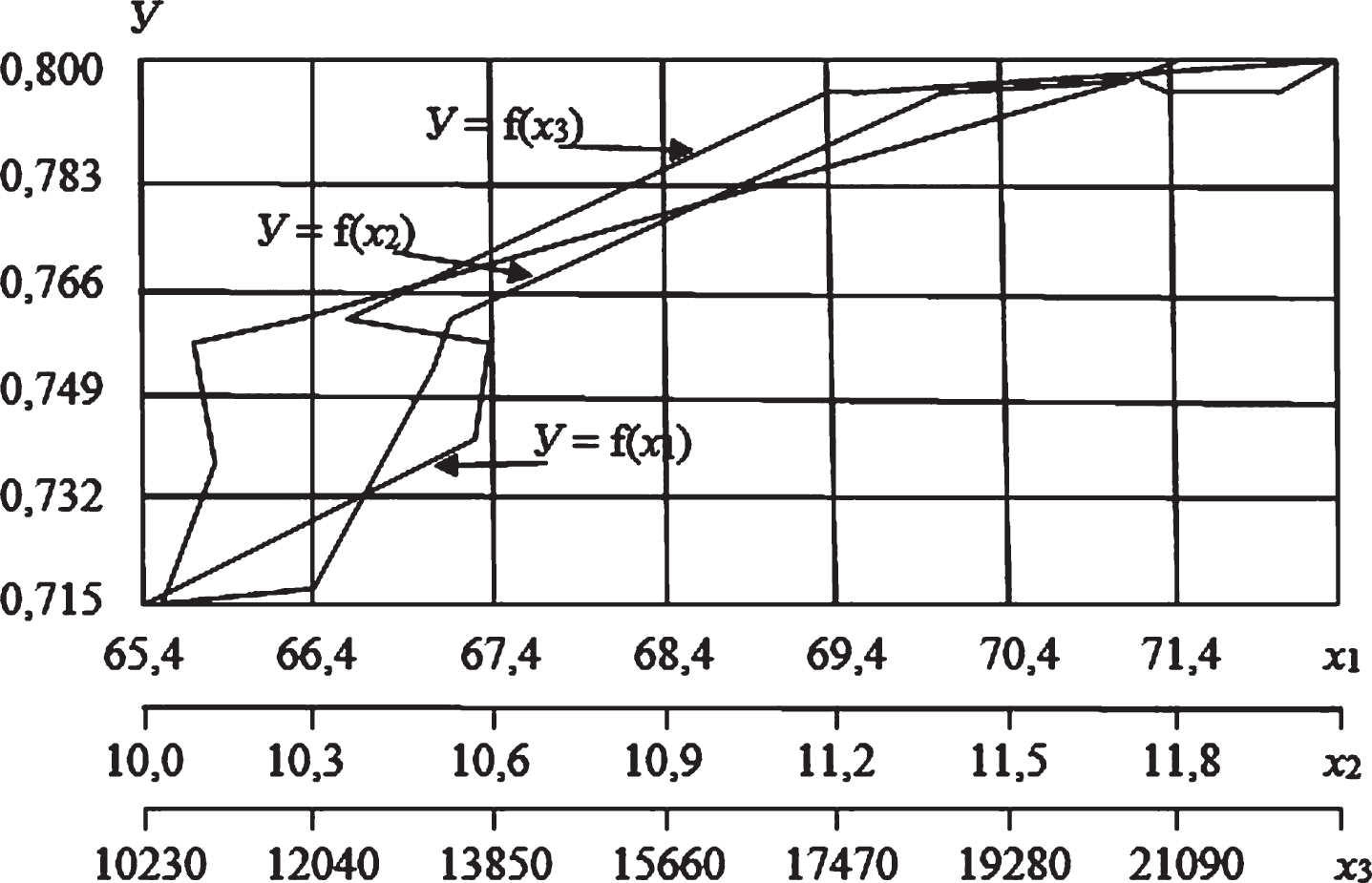
The relationship of the human development index with considered factors.
Calculations of the regression coefficients a0, a1, a2, a3 and multiple correlation R made using the software MS Excel. The resulting multi-factor regression model is:
Let’s consider the problems of the development of such basic components of human capital as education, science, labor market, incomes of the population and health care [41, 42]. Education. Based on the analysis, it can be concluded that in the Republic of Kazakhstan education and training traditionally occupy a key position in the value system: for example, in terms of literacy among persons over 15 years of age, Kazakhstan has taken the 8th place; Improving the quality of education in Kazakhstan depends on the level of state funding for the industry, which remains low (3.6% of GDP). Therefore, it is advisable to increase public funding of education in Kazakhstan to 6% of GDP. Science. The main reasons for the complexity of the development of human capital in the field of research and development are low wages, the impossibility of solving the housing problem. Such an approach to the remuneration of highly skilled science personnel not only reduces incentives for creative work, but also reduces the prestige of the scientist in society, which can lead to irreversible consequences for the republic in the form of a loss of human potential of science and a decrease in the influx of young scientists of a new generation. Labor market. Ensuring the competitiveness of human capital and its successful functioning in the labor market on a new qualitative basis with the creation of high-quality jobs 5 and 6 technological structures. Therefore, in Kazakhstan, an objective forecast of staffing needs is needed for balanced demand and supply of qualified personnel in the labor market, respectively, it is necessary to develop a mechanism for its formation. Incomes of the population. The share of the population with incomes below the subsistence minimum was 2.6% , having decreased by a factor of 1.5 over five years. However, significant income differentiation in urban and rural areas persists. Thus, in urban areas, the share of the population with incomes below the subsistence minimum was 1.3% , and in rural areas – 4.4% . The poverty level in rural areas exceeded the urban level 3.4 times. Health. The main reasons that negatively influenced the development of health care in Kazakhstan are insufficient government protection of public health, preservation of the residual principle of development and financing of health care, lack of highly qualified medical personnel, poor quality of professional training of medical workers, low availability of high-quality medical services for the poor population etc.
Therefore, among the highest priority measures should be noted: improvement of its own advanced education system, covering citizens of all ages and aimed at developing the ability to adapt to constant changes; development of science, including with a priority on applied research in metallurgy, petro chemistry, agriculture, bio-and IT-technologies, and the effective introduction of new developments in production; formation of an effective labor market with a high-quality employment system and a fair social security system, in which everyone could realize their potential; – development of a first-class health care system, aimed primarily at ensuring the prevention of diseases, the management of public health and the formation of a healthy nation; capacity building of the nation through the development of culture and ideology in the framework of the “Ruhanizangyru” program [43, 44].
The implementation of these measures will be aimed at the formation of high-quality human capital, which, in turn, will contribute to the effective modernization of the country [45].
Human capital is gradually amortized, but its amortization is different than amortization of physical capital, real means of production. The process of depreciation of human capital begins, the pace of which is increasing towards the end of the third decade. Therefore, we propose the following mechanism for assessing the value and depreciation of human capital: During the labor period for the work performed, the employee receives part of the surplus value in the form of wages, and the remainder in the form of depreciation of human capital for the year from the net profit of the organization. This provision should be legislated in the country. Expenses for the formation of human capital organizations are the only costs that increase the productive capacity of people, for example, investments in the field of vocational, university and postgraduate education. They consist mainly of direct expenses of the state and private persons in the field of education and the expenses of the students themselves for the production of their qualifications. Expenses for training in a secondary school are not considered, since in Kazakhstan basically everyone has a secondary education and training is carried out at the expense of the state [46]. By the time of the conclusion of the employment contract, the employee coordinates with the employer the value of his human capital in monetary terms. To determine the value of human capital, we need documents confirming the cost and fact of tuition payment; test results [44]. The cost of human capital of an individual worker is equal to:
The cost of the human capital of an individual worker (taking into account the growth in the time spent on the amount of money invested – compounding) is calculated by the formula:
The total human capital of the organization will be equal to:
Annual amortisation of the human capital of an individual employee is determined by the formula:
Human capital is defined in modern science as a set of economic relations for investments in the formation of a highly skilled workforce, as well as production relations for the implementation of the abilities, skills, knowledge and other qualities of the employee in the labor process. Under human capital, we should understand the stock of professional knowledge and skills, innate (natural) and acquired (entrepreneurial) abilities, motivation, energy and health, which a person uses in the course of their activities to create products or services. The formation of human capital must be viewed as a two-way process of interaction between the individual and society. The level of economic development of countries in the modern world is determined by the accumulation and development of human capital, which reflects the new quality of economic growth.
The well-being and sustainable development of any nation depends on human capital, therefore a thought-out and consistent policy in the field of human resources development and balanced investments in human capital is needed, both at the level of an individual organization and generally at the state level. There are several types of investments in human capital, the most important of which are investments in health and education, since these factors increase the efficiency of human labor and increase its working capacity, i.e. Investments in these areas of human life are likely to pay off in the future and bring income.
In the international ranking of 2017 on the human development index, Kazakhstan rose by seven positions compared to 2010, taking 59th place, however, it did not enter the group of countries with a very high level of human development. The main reasons for this are relatively low life expectancy (72.9 years), a small GNI per capita ($23,440), and acute socioeconomic inequality among the population. With a good level of education in general, there is a big difference in accessibility to quality education in the central regions and regions. Based on this, the task of Kazakhstan is to equalize this indicator. This means, along with improving the quality characteristics – improving health, increasing life expectancy, reducing poverty – providing modern education through education and training and retraining of every citizen throughout their lives.
Thus, we can conclude that the modern economy imposes higher requirements on the quality of human capital, namely, on the peculiarities of the individual, his knowledge and professional skills, competence and mobility. An analysis of the values of the human development index clearly shows that for the economic development of states it is necessary to pay more attention to such indicators as the level of education, namely access to education for all segments of the population, as well as for a decent standard of living for every citizen.