



Abstract
BACKGROUND:
As the growth of the Internet continues to impact the way that individuals and businesses interact, companies are forced to bring new online markets to the forefront of their strategic business decisions. In recent years online innovations in Internet content offerings have produced a myriad of highly interactive fantasy sports sites designed to entice users to wage funds on sports team. Although factors such as accessibility and anonymity encourage people to wager online, many hesitate to wager for reasons that must be examined if online fantasy sports (OFS) sites are to innovate and thrive.
OBJECTIVE:
Although research findings suggest that users have questioned the legitimacy and fairness of online fantasy sports sites, issues of trust do not yet appear to be negatively influencing the industry’s growth. Users continue to spend large sums of money without high confidence in OFS sites. To understand why this might be the case, we conducted a preliminary study to examine the nature and role of psychological contract violation (PCV) in OFS sites.Our research examines how OFS users’ past experiences and the perceived reputation of OFS sites influence psychological contract violation (PCV), as well as perceived institutional effectiveness as it pertains to OFS sites’ features and products. We also investigate the effect of institutional effectiveness on users’ concerns and their behavioral intentions.
METHODS:
We implemented previously validated scales to survey OFS users and test our hypothesized model. The original sample size included 198 individuals. After removing the incomplete and non-fantasy sports site user responses, the final sample dropped to 142. PLS-SEM was used to analyze measurement and structural models.
RESULTS:
Initial results suggest that OFS users have concerns about transactional information even though they tend to be less risk adverse than non-OFS users. Our study also found that psychological contract violation minimizes users’ protection perceptions concerning overall OFS structures’ effectiveness.
CONCLUSIONS:
This study creates new knowledge about minimizing risks in online fantasy sports sites, thereby assisting businesses that want to increase user participation and transactions.



Introduction
As the growth of the Internet continues to impact the way that individuals and businesses interact, companies are forced to bring new online markets to the forefront of their strategic business decisions. In particular, the relatively new Internet medium has coupled with the perpetually contentious fantasy sports industry (e.g. FanDuel, DraftKings) to inspire newsworthy debate on a near-daily basis [1]. In 2016, the global online fantasy sports was worth $37 billion and is predicted to have a compound annual growth of 11 percent by 2020. In fantasy sports, fans choose from real players in an online selection process, or a draft, to assemble a fantasy team. The players’ real-game statistics are compiled and compared to see whose fantasy team has done the best. Players track how their fantasy team is doing using various web sites or mobile apps. Some players join leagues with friends and compete against only people they know. Others join public leagues hosted by web sites and compete against strangers.
In fantasy sports industry sites such as DraftKings and FanDuel pay out more than 90% of the fees they collect as prize money in order to attract players to the game. On average, a fantasy football participant spends around $150 on the draft. If an individual is a participant of multiple fantasy sport sites, they may hand hundreds of dollars to someone they do not know and can communicate with only virtually, and, if their money disappears, may have no legal or other recourse to recover it. Despite the oversimplification of such a scenario, millions of U.S. residents participate daily online without the protection of reliable regulatory structures that would ensure age and identity verification, the integrity and fairness of the games, and responsible participation features on the fantasy sports website [2]. Why then do these interactions occur?
The relationship between the confidence that online consumers have in a website and their corresponding website usage is well documented in the e-commerce area [3–5]. Online consumers traditionally are not likely to complete transactions with a website that fails to convey a sense of trust for them. Most of these transactions involve known goods and services—for example, a book, a Bluetooth speaker, or even a vacation getaway purchase—for which consumer risk is minimized by incorporating new ways to enable user reviews, virtual experiences to entice purchases, third-party certifications, etc. [6, 7]. It is within this context we examine how a non-traditional fantasy sports site, which by its function must encourage financial risk for users’ enjoyment, can simultaneously encourage its users to exchange sensitive information—both personal and financial—to wager funds, while creating an atmosphere of trust and customer loyalty by implementing well-known risk reduction strategies.
Research findings suggest that users have questioned the legitimacy and fairness of online sports sites; one survey found that 55 percent of regular fantasy sports participants believe at least somewhat that the sports sites find ways to cheat players [8]. However, issues of trust do not yet appear to be negatively influencing the industry’s growth. Users continue to hand over large sums of money without having great confidence in online fantasy sports sites. To understand why this might be the case, we have implemented a preliminary study to examine the nature and role of psychological contract violation (PCV) in online fantasy sports sites. PCV is defined as a buyer’s perception of having being treated wrongly regarding the terms of an exchange agreement with a seller [7]. PCV with the community of sellers is assumed to minimize buyer transaction behavior on an online fantasy sports site by directly impacting transaction intentions, information misuse risk, privacy risk, and the perceived effectiveness of institutional structures. A large body of research exists that measures the impact of psychological contract and privacy violations, as well as perceived risks on how users interact and maintain relationships with e-commerce websites [9]. Studies have proven that maintaining a strong relationship between the user and the site, whether Amazon.com or eBay, is a critical strategic advantage within the competitive environment of online e-commerce transactions. While PCV has primarily been examined within the context of organizational relationships and buyer-seller relationships in online marketplaces such as eBay and Amazon, this study proposes an extension of PCV as it applies to fantasy sports sites.
Our preliminary model measures how an Online Fantasy Sports site (OFS) user’s experience with a specific fantasy sports website, in addition to the website’s reputation, is impacted by potential psychological trust violations. Much of this is measured via the user’s perceptions of transaction security [6], institutional structures, information use and transparency, and privacy concerns [10]. These factors do increase the OFS user’s overall intent to participate on the site as well as potential repetitive behaviors. However, an OFS user also might be influenced by what others thought of his/her online fantasy sports versus his/her enjoyment of it [11, 12]. Finally, we considered how much risk potential—be it loss or sharing of personal data, site trustworthiness, or external opinion—might be minimized by a fantasy sports site’s use of innovative incentives, resulting in a competitive advantage over other sites by maximizing user loyalty. Implementing this three-pronged approach, we unravel the complex interactions between high-risk sites and risk-seeking individuals.
In the following sections, we first summarize research studies that influenced the constructs we used to create our model. Next, we describe hypotheses that we tested as well as our overall methodology. We conclude with our findings, our limitations, and an appeal for additional focused studies. Ultimately, we suggest how fantasy sports websites can minimize users’ aversion to privacy and other personal risks, and simultaneously encourage users to accept and embrace the risk that comes with wagering funds for enjoyment and potential profit.
Literature review
Psychological contract violation (PCV)
The term “Psychological Contract” was first introduced by Levinson, Price [13] and Schein [14] in the 1960s. Originally it was used to study the employee-organization relationship. Psychological contract violation is defined as the mutual commitment between the organization and the employee. Specifically, it is a set of expectations about which an individual is entitled to receive and under obligation to give in exchange of another party’s contributions [13]. With the advent of e-commerce, there is a renewed interest in the psychological contract between the online buyer and the seller [e.g., 9, 15, 16]. The psychological contract is based on perceived promise, which can be a written document, verbal and organizational practices, and particular policies [17].
Violation of a psychological contract occurs when individuals perceive that they have not received what they expected out of that contract [18, 19]. PCV can occur for two reasons: reneging and incongruence. Reneging happens when an individual or an organization fails to deliver on its promise due to opportunism or incompetence [20]. An example would be a seller not being able to deliver a product on time due to unforeseen circumstance, such as an out-of-stock product or delayed delivery due to bad weather. Reneging also can happen when a seller intentionally delivers a product inferior to the original product shown to the buyer: a seller may not honor an auction price if the winning bid is less than the expected price.
Incongruence happens when two individuals or organizations have different understandings of the contractual obligation [20]. Incongruence happens mostly due to a misunderstanding between the buyer and the seller. A seller might think the entire buyer’s obligations have been fulfilled, while the buyer might think otherwise. Reasons behind such cases include complex and ambiguous contracts, differences in cognitive frameworks, divergent cognitive schemata, and poor communication regarding contract obligations [9]. Both reneging and incongruence greatly contribute to PCV.
Perceived effectiveness of institutional structures
Institutional structures are sets of rules that are expected to be followed by both the buyer and the seller during a transaction [21]. The perceived effectiveness of institutional structures is the belief that favorable conditions are in place for a buyer to successfully complete a transaction with a seller or an organization [22]. Four key structures support these conditions: 1) feedback technology, 2) escrow service, 3) credit card guarantees, and 4) trust in intermediary (Pavlou & Gefen, 2004). These structures aim at increasing trust and reducing the perceived risk both for the buyer and the seller in an online marketplace [23].
Feedback technologies are reputation-based systems that a buyer can use to know the seller’s past trading behaviors. Specifically, they provide information about the seller’s reputation [24] from the feedback received from previous buyers [25]. Escrow services are third party services such as PayPal in which payment is released to the seller only after the buyer receives the product and is satisfied with it [26]. Credit card (e.g., VISA) guarantees are third party structures that are legally supported to protect buyers from fraudulent transactions [26]. The trust in intermediary is the buyer’s belief that an intermediary (e.g., eBay) will enforce fair rules and procedures that are competent, reliable, and honest, and will also provide alternative steps for buyers to protect themselves from an opportunistic seller [22].
In our research, we focus on the three of the four institutional structures: feedback technology, credit card guarantees, and trust in intermediary. We do not consider escrow services because, to our best knowledge, there are no third-party services that authorize payment in online fantasy sports sites.
Online fantasy sports
Fantasy sports sites are not similar to traditional e-commerce websites. Traditional e-commerce sites such as amazon or eBay are used by individuals to buy products or services that can either be utilitarian or hedonistic in nature. On the other hand, fantasy sports sites are purely hedonistic in nature. Online fantasy sports leagues let individuals to be owners, general managers and coaches of professional sports team [27]. According to Greg Ambrosius, president of the Fantasy Sports Trade Association [28], “The Internet has allowed more people to get involved in fantasy sports and it is easier than ever to become a part of it.” Along the same line, the Fantasy Sports Association added that “Fantasy sports is now big business and all of the major sports Web sites are making it easy to transition from sports fan to fantasy sports fan.”
Fantasy sports site usage on the Internet is increasing, especially for younger generations who find fantasy sports a safer way to win quick money [29]. Online fantasy sports existing literature is focused mostly on motivations, different types of fantasy sports users, and privacy management [e.g., 30, 31]. There is limited research on online fantasy sports antecedents [32]. Jolley, Mizerski [33] argue that online users’ satisfactions and fantasy sports habits positively influence online users’ retention. The authors do not elaborate on the antecedents of users’ satisfaction and habitual fantasy sports. This gap in the literature is addressed by our research. Table 1 presents a summary of recent studies on psychological contract violation and online fantasy sports sites.
Summary of Current Literature on PCV and OFS
Summary of Current Literature on PCV and OFS
According to cognitive dissonance theory, individuals tend to seek consistency among their cognitions [34]. When there is inconsistency among individuals’ cognitions, they find various means to minimize the dissonance. One of the approaches individuals use is to change their attitude to minimize the dissonance. In the context of online fantasy sports, users have specific expectations from online fantasy sports sites (OFS).
OFS users have three groups of expectations from OFS (1) game and service quality, (2) website security, and (3) website design [35]. OFSs address these expectations, especially website security expectations, in their agreements. In service industry, entire service ecosystem aim to meet these expectations to satisfy customers [36]. Although some researchers only focused on fun aspects of online gaming [e.g., 37], a huge portion of users’ expectations from online fantasy sport games is related to the extent to which their trust the website [38]. Therefore, we cannot undermine users’ concerns about privacy and security in the context of OFS.
These expectations can be correlated into the Psychological Contract Violation (PCV) construct. PCV refers to how OFS users perceive whether the website treated them in accordance with its agreement with them [9]. Therefore, PCV can be viewed as the dissonance between users’ expectations and their actual OFS experience. Users following an attitude change approach remove the inconsistency between expectation and performance. Thus, perceptions of OFS users are influenced by their PCV.
According to the theory of reasoned action, individuals’ behaviors are influenced by their intentions and attitudes toward the behavior [39]. Therefore, we argue that users’ perceptions of the overall effectiveness within the OFS institutional structures influence their other perceived concerns about the security and privacy of an OFS. Based on the theory of reasoned action, users’ perceptions would impact their intention to wager on these websites. Finally, those users who are more inclined to wager are more likely to complete this behavior. Based on this reasoning, we hypothesized the following research model (Fig. 1).
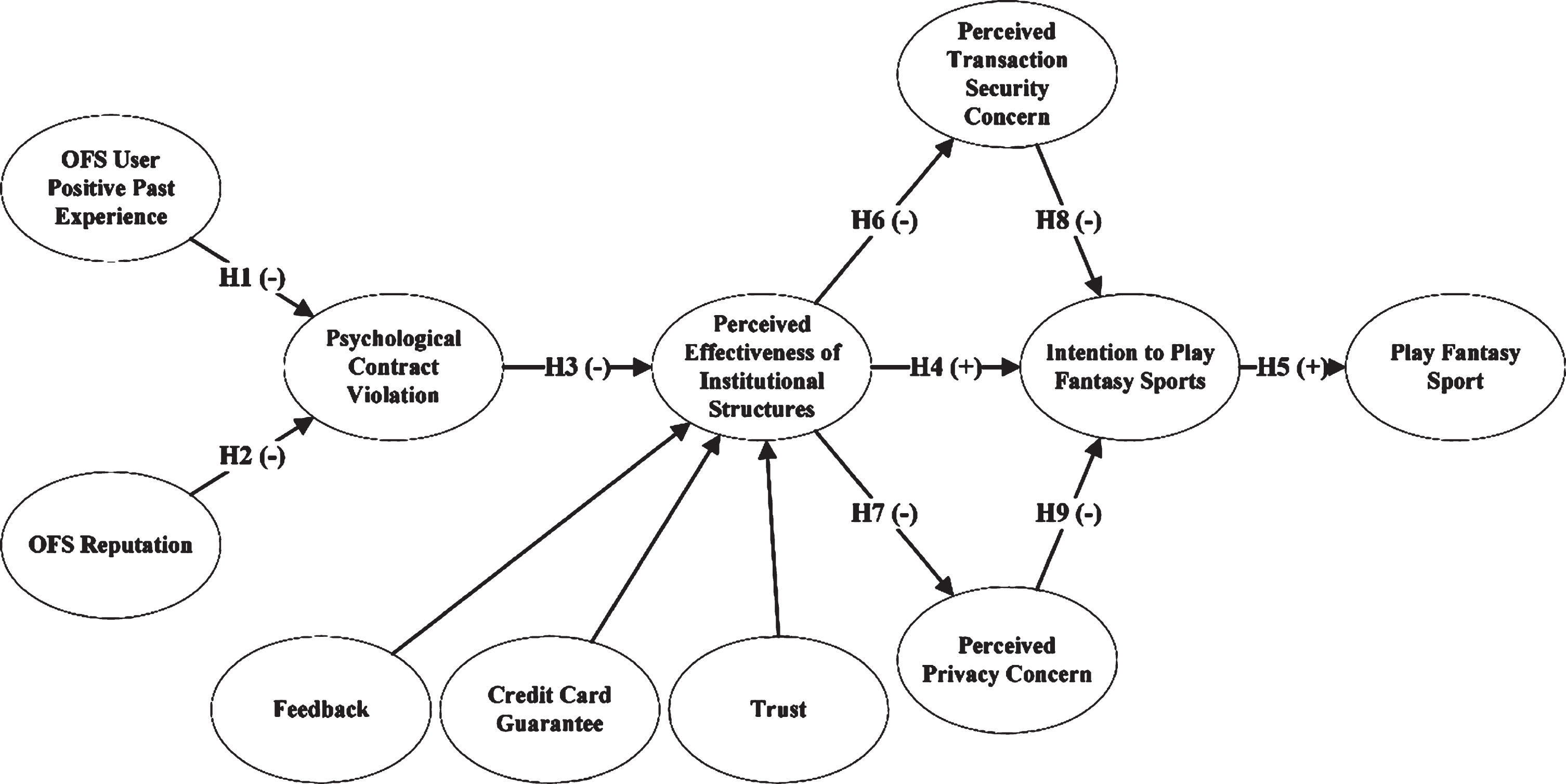
Research Model.
A buyer and seller form a psychological contract regarding each other’s e-commerce environment expectations. Within this agreement, users may notice OFS violations because of past site experiences that influence their perceptions of the site’s reputation. There are many examples for OFS violations that may cause users dissatisfaction. Customers’ expectations will be set based on the contract they receive from OFS. If OFS cannot meet these expectations (e.g., game quality, website quality, website design, and, security [35]), they violate the psychological contract. For example, if an OFS website claims that all transactions are secure and then a breach happens, the OFS website is violating the contract [40].
In addition to the violations, through their past experiences with other e-commerce sites, users tend to form an opinion on other sites [41]. OFS users’ past positive experience refers to the quality of the users’ experience with the site [9, 22]. That is, users who had positive experiences with the OFS tend to trust that the site’s performance will be consistent in other aspects with their past experiences [42]. Therefore, the presence of good past experiences (positive incidents and ethical perceptions) with the online seller increases trust and minimizes psychological contract violation [43, 44]:
An online website’s reputation is a major factor in a user’s decision to use it. Reputation is a proxy used by buyers to determine site quality [45]. The better the site’s reputation, the higher the buyer’s willingness to use the site [46]. The site’s reputation refers to the users’ overall evaluation about all site aspects [47] According to the literature reputation of a company enables the company to axcqure better resources and create more value to stakeholders [48]. Using a site with a good reputation gives buyers a perception that they would not be treated wrongly, and that they would be protected from occurrences of fraud, user agreement default, failure of payment and other unforeseen events. Thus, the site’s reputation influences users’ perception of PCV. A well-reputed site will decrease the buyer’s perception that there would be a seller violation of contract. Therefore, we hypothesize:
Perceived effectiveness of institutional structures refers to the extent that the OFS provides appropriate conditions to ensure successful interactions between it and its users [9]. Users’ perceptions of institutional structures may influence their concerns and consequently their behavior [23]. As a result, PCVs impact the inconsistency or dissonance between users’ expectations from the OFS and their perceived experiences [9]. According to cognitive dissonance theory, individuals who perceive dissonance between expected performance and actual performance change their beliefs to minimize the existing dissonance [49]. OFS users who perceived inconsistency between their expectations and the OFS performance are more likely to have a negative perception about the site’s institutional structures[50]. For example, some sites offer fraudulent content, such as counterfeit products [51], thereby adding to overall user cognitive dissonance. Consequently, we posit:
Institutional structures play a critical role building trust among users in an online site [9]. Institutional trust not only builds trust but also decreases perceived risk among users [23]. OFS users who perceive that the site’s institutional structures are in place to facilitate successful transactions are more likely to wager. These institutional structures (i.e., credit card guarantees, intermediary trust, etc.) protect users from a variety of threats in an online environment [9, 52]. These structures create a cooperative environment between the buyer and the seller [21], and the buyer will assume that supporting conditions are in place to facilitate a successful transaction. As a result, users’ intentions to bet online will increase due to the presence of a site’s institutional structures. Finally, according to the theory of reasoned action, behavioral intent to perform a behavior is the primary antecedent of the actual behavior. Thus, users who have greater intentions to wager online are more likely to wager on the site [53–55]. Therefore, we posit:
Effective institutional structures reduce the individual’s perceived risks during the transaction [22]. Institutional effectiveness also affects users’ perceptions about future possible threats. Users perceive that a particular OFS has effective institutional structures to protect them and should not be concerned about their interactions with the site. According to procedural fairness theory, individuals who perceive fair procedures are in place to protect their information have fewer concerns regarding their interactions [56]. An OFS with effective institutional structures could be viewed by users as a site with fair procedures. Consequently, effective institutional structures decrease users’ perceived concerns. Of course, there are different user concerns during an online interaction; however, the majority of concerns during online fantasy sports tend to be the privacy of user information collected and the security of the transactions. Therefore, we hypothesize that:
As noted above, users are also concerned about transactional security. The security of transaction systems plays a major role in increasing online purchases [57]. Online transactions involve uncertainty but also anonymity, lack of control, and potential opportunism, making it one of the major areas of e-commerce research [58]. Users’ fear of transactional fraud is a major focus in e-commerce research [59]. E-commerce researchers have found that the intent to purchase is heavily influenced by transactional security concerns [60, 61]. Transactional security concern refers to “concerns about potentially malicious individuals who breach technological data protection devices to acquire consumers’ personal, financial, or transaction-oriented information” [62]. Users who perceive that OFS transactions are risky are less likely to perform any transactions online. Therefore, they will not wager:
Privacy violations in an online e-commerce site are troublesome for users and tend to dissuade them from using the site. Users want to keep their personal information private for a plethora of reasons: intrusion (invasion of privacy), disclosure (publicly disclosing embarrassing facts), false public portrayal, and appropriation (use of a person’s name without permission) [63]. Moreover, users are aware that sites monitor their activities and gather information with or without consent for demographics, marketing, and other reasons [64]. Only six percent of U.S. consumers have a high level of trust about how sites handle and protect personal data [65]. Hence, several researchers have suggested that online privacy concern is an important influence in negative outcomes such as low intention in an online environment [62, 67]. Negating such a privacy concern is an important factor for increased site usage [68]:
Methodology
Measurement and data collection
We used previously validated scales for most of the study’s constructs (see Table 2). We applied a convenience sampling method and collected data from students at two U.S. universities in different geographical locations. We chose this demographic because, according to research, most users of online fantasy sports sites are young [29]. The students filled out the survey that was created on Qualtrics. To encourage them class extra credit was offered for those who completed the survey. At the beginning of the survey, we read an explanation about the OFSs and the study purpose. Then, the participants were instructed to how to fill out the survey on qualtrics.com.
Measurement items
Measurement items
1The questions were reverse coded for analysis.
Initially, we received responses from 198 participants. After excluding incomplete responses, non-fantasy sports site user responses (i.e., users who had never participated in an OFS), and those who finished survey very quickly [69], our final sample was 142 respondents. These figures equate to a usable-to-collected response rate of 71.7%, which meets rates in other similar researches. This response rate is high enough and unlikely to cause nonresponse bias [70]. Table 3 displays demographics of the participants.
Demographics
For data analysis we used Partial Least Squares (PLS) with Smart PLS as the Statistical Analysis tool. The analysis was conducted in two steps: (1) we analyzed the measurement model to assess reliability and validity of the measurement items, and (2) we analyzed the structural model to indicate the model’s predictive power and hypotheses’ statistical significances.
We addressed the importance of the measurement model adequacy by analyzing reliability, internal consistency, and discriminant validity [71]. We measured construct reliabilities by analyzing the Cronbach’s alphas and composite reliabilities. According to Nunnally and Bernstein [72], Cronbach’s alphas and composite reliabilities above 0.7 show acceptable reliability (Table 4). To evaluate convergent validity, we used Average Variance Extracted (AVE). AVE values above 0.7 generally show that the latent variable explains more than half of the variation in the indicators (Table 4) [73]. The diagonal values in Table 4 represents the root squares of AVE. These values are another measure of convergent validity.
Measurement Reliability and Validity
Measurement Reliability and Validity
The discriminant validity of the measurement model AVE values on Table 4 should be greater than the off-diagonal correlations. In addition, the factor loading of each associated construct item should be lower within the construct loadings (Table 5). Our findings mostly support this.
Factor Loadings
We assessed the structural model by examining the path coefficients and R-square. Path coefficients explain the strength and the direction of the construct relationships and R-squares indicate the research model’s predictive power (Fig. 2). To evaluate the structural model, we used bootstrapping to estimate the standardized path coefficients and R2 values. We performed two-tail t-tests to measure the significance and effect sizes of the path coefficients. The results (Fig. 2) demonstrate that perceived transaction security (β= –0.187, p < 0.05) and perceived effectiveness of institutional structures (β= 0.323, p < 0.001) explain 27% of the intention to wager variance. These results imply the acceptance of Hypotheses 4 and 8. In addition, OFS user’s past positive experience (β= –0.315, p < 0.01) and the site’s reputation (β= –0.229, p < 0.01) minimize psychological contract violation, which implies acceptance of Hypotheses 1 and 2. We also observed that psychological contract violation had a significant, rather strong, effect on perceived effectiveness of institutional structures (β= –0.444, p < 0.001). Therefore, we accept Hypothesis 3. Finally, having strong perceived OFS institutional structures tends to negate transaction security concerns (β= –0.225, p < 0.05) and privacy concerns (β= –0.194, p < 0.05). These results imply acceptance of Hypotheses 6 and 7. Interestingly, we found that privacy concern was not a deterrence for intention to use an OFS; hence, we reject Hypothesis 9.
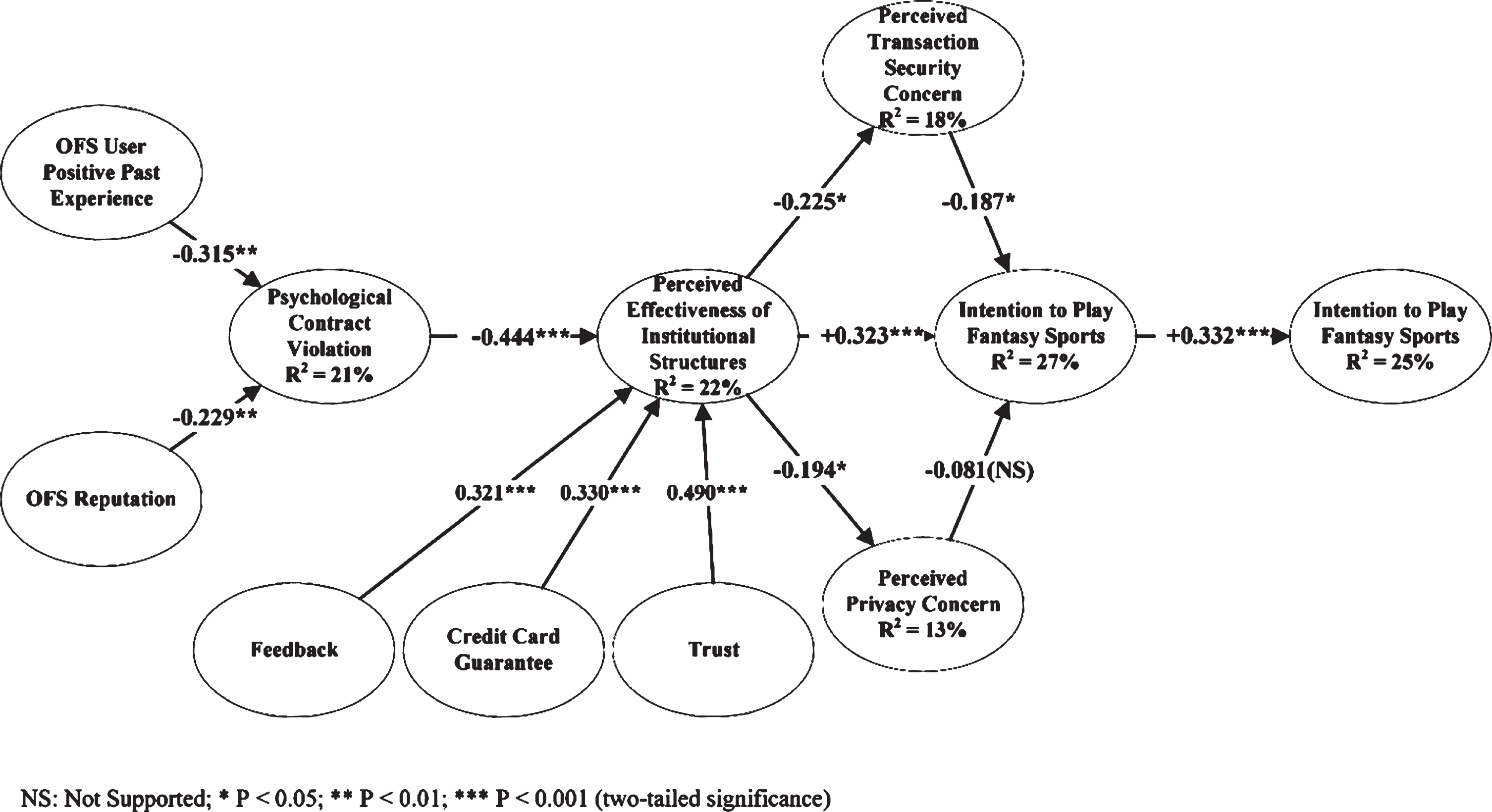
Structural Model Assessment Results. NS: Not Supported; *P < 0.05; **P < 0.01; ***P < 0.001 (two-tailed significance).
Our study results have five major implications. First, we found that users’ past positive experience and the site’s reputation are a critical negative determinant of the site’s psychological contract violation. This is consistent with earlier studies [e.g., 9, 74] where they found that past positive experience and reputation helps in reducing users’ psychological contract violation expectation toward the site. Second, we determined that perceived psychological contract violation minimizes the user’s perceived effectiveness of the OFS’s institutional structures. Minimizing risks by using institutional structures helps to build trust and forms a basis of cooperation between the user and the organization, which helps in reducing anxiety among the users [75, 76]. Third, we demonstrated that perceived effectiveness of institutional structures positively influences an individual’s intention to wager in OFS sites, which ultimately leads to actual usage. This finding is consistent with existing studies that found that the presence of institutional structures in an online site provides assurance to users that the transactions will succeed, mainly through the trust mechanism, which leads user to frequently reuse the website [52, 77]. Fourth, we found that perceived effectiveness of institutional structures negatively influences users’ transaction security and privacy concerns, as suggested by other studies [e.g., 78, 79]. Moreover, users’ transaction security concerns negatively impact their wager intention.
The results offer confirmation to previous studies, such as the study by Rouibah, Lowry [80], which showed that transaction security exerts the strongest effect on an internet based transaction. Finally, we found that privacy concerns minimize a user’s intention to play online fantasy sports. The results offer confirmation to previous studies such as Chen, Huang [81] and Arpaci, Kilicer [82], which showed that minimization of privacy concern among users leads to repeated use of the website.
Contributions and limitations
Theoretical contributions
Although most previous research focused on explain the problems associated with online fantasy sports usage, a limited number of researchers studied the antecedents of online fantasy sports behavior [83–86]. Our study adds to the latter research by adding and clarifying antecedents to behavior that may lead to users’ participation in online fantasy sports. We also contribute to overall research by identifying psychological contract violation, perceived effectiveness of institutional structures, privacy, and transaction security concerns associated with online fantasy sports. Effectively applying and supporting these factors within an online fantasy sports site will contribute to the site’s success and should be considered essential business strategy components.
According to Pavlou and Gefen [9], psychological contract violations in online marketplaces are rooted in violations of product, delivery, payment, and contract expectations. However, in an OFS context, features such as transferring funds are more important than product or delivery. Moreover, in the OFS’s context, “contractual obligations” differ from online marketplaces, making it essential to study OFS psychological contract violation to understand its elements.
Also contributing to research, our findings support how online OFS users’ perception of a site’s institutional structures affect privacy and security concerns. We believe other studies of the effectiveness of institutional structure in online environments have not considered users’ privacy concerns. For example, Pavlou and Gefen [9] study the influence of institutional structures on perceived risk without explaining different risk types that online consumers perceived. However, our findings demonstrate that privacy concern as a major influence of online fantasy sports is not as great as most would believe.
Practical contributions
Finally, a significant managerial implication resulting from this study is that OFS sites should take steps to reduce psychological contract violation. The site should fulfill all expected obligations, such as timely payout of users’ winnings. In addition, the site should ensure its transactional requirements are clear and meet its obligations to users; negligence will hamper the site’s reputation and deter potential users. Interestingly, we found that a loss of privacy was not an issue with OFS users. This contradicts existing privacy research and should be further explored.
Limitations
Our study has limitations. Most participants were college students, so our demographics are skewed toward younger individuals with minimal disposable funds. Although most online OFS users are from younger demographics, limited funds might influence the number of users and fantasy sports site use frequency. In addition, our study is cross-sectional and thus limited to the associational interpretation of results to the exclusion of causal inferences. Other future research may examine the subtleties of fantasy sports behavior with more scrutiny than this exploratory study.
Conclusion
Our study investigated how a user’s experience with a particular online fantasy sports website, along with the site’s reputation, were affected by potential psychological trust violations. In addition, we examined how institutional structures, information use and transparency, and privacy concerns alter a user’s overall online fantasy sports intent, as well as potential repeat behaviors. We surveyed individuals who participated in online fantasy sports sites and found evidence to support all our hypotheses except that online betters are not concerned about their privacy. Ultimately, our study creates new knowledge about minimizing risks in online fantasy sports sites, thereby assisting businesses that want to increase user participation and transactions.