



Abstract
BACKGROUND:
Employee’s trust influences the organizational performance and leads to the accomplishment of organizational goals and objectives within a defined timeframe. Organizational Justice defines how equitably the employees of an organization are treated by their management considering both structural and cultural parameters. Trust is a manifestation of belief the employees have developed in their management in return. Many researchers came up with a verdict in favor of trust within any organization to develop good relationships between employees and top management.
OBJECTIVE:
The aim of this research is to determine the mediating role of trust between organizational justice and employee performance.
METHODS:
Convenient random sampling has been used to gather data from 433 employees working in different departments of the big five commercial banks in Pakistan; Baron and Kenny’s test was used to determine the mediating effect of trust.
RESULTS:
The findings of the research reflected that organizational justice significantly influences the performance of the organization. It has also been determined that employees’ trust fully mediates the impact of organizational justice on employees’ performance.
CONCLUSIONS:
Managers need to pay particular attention to justice as an important motivating factor for employees in order to improve organizational productivity.
Keywords




Introduction
Today, in the presence of a highly competitive business environment, most of the well-known and successful organizations are emphasizing the integration of various processes of organizational justice that directly as well as indirectly enhance the employee’s trust factor and their performances in order to gain a competitive advantage against the competitors. Organizational justice plays a very important role in enhancing an organization’s performance and goodwill [1, 2]. It is true that without putting enough effort, well qualified and technical employees cannot accomplish organizational goals and objectives within define or set time frame. The success of an organization and the performance parameters are based on talented, experienced and well-qualified employees [1]. Employee commitment, contribution and participation play a dynamic role in the success of any organization working. Top executives of the organizations focus on enhancing employee contribution and participation by providing empowerment, effective participative management, control and management of the flow of operational organization works positively designed for more user-friendly and keeping work-life balance [3]. Organizational justice and its various types that are distributive justice, procedural justice, and interactional justice are considered as part of the organization. Procedural justice is used for effective management in the organization which is an effective use of the concept whereas it can be used cognitively but it would highly depend on the level of trust employees have for them, but such a model needs to be studied [4]. Distributive Justice makes countable what people have got from management. Procedural justice promotes the acceptance of decisions and increases their satisfaction with the outcomes. Interactional Justice disseminates across the organization through the formal and informal social exchange [5]. The empirical investigation by Bebenroth, Ismail [6] proposed that procedural justice matters more to employees as compared to interpersonal justice.
The focus of organizational justice is to increase the motivational level and trust factor of employees and their performance if they are distributed equally among working employees. Justice always led towards trust and employee performance [7]. Organizational justice is the independent variable in terms of procedural justice, interactional justice, and distributive justice. Mediating role of trust which directly as well as indirectly affects the employee performance, it covers the diverse approaches to gain greater participation in relevant workplace decisions. There are a number of different organizational concepts that have evolved from the basic concept of performance equity likes performance appraisal, management by objectives, cognitive performance appraisal system, organizational justice, and the newer era of justice climate [8].
Organizations are always using the process of organizational justice based on the approaches of crystal clear than automatically improving the employee performance; motivational level and employee productivity are high in any organization [9]. The term organization justice is not new for well-known organizations. Today, organizational justice perform its functionality according to the situation which is even complex especially in private organizations and governmental organizations where cadres of employees have been created in form of contractual, use outsourced contract model and prefer third party contracts because organizations are trying to reduce administrative costs by avoiding the legal bindings. These factors directly as well as indirectly impact an employee’s motivation which is sometimes good for organization growth and sometimes not.
The existence of a competitive business world and complex working environments have put increased pressures on the companies to gain a competitive advantage against the competitors and get hold of increased market share through the introduction of new products and services. This has led the organizations to put more work burden on the employees and give them enough bonuses and promotions in accordance with their work performance. It is analyzed that often employees complain about the organizations for not doing justice which in turn has overall decreased the retention rates in the organization. This research has focused on examining and investigating the impact of organizational justice on performance through the element of trust.
The main research objective is to investigate the role of distributive justice in bringing improvement on employee performance with the mediating role of trust. Correlating objective is to examine and analyses the role of procedural justice in maintaining the retention rate in the organization and improving levels of employee trust in the organization by considering the mediating role of trust. The originality of this paper relies on organizational justice and covers its different types such as distributive justice, procedural justice and interactional justice leading towards the trust is playing a mediation role. This mediation role control organizational justice and employee performance in the organization. The researcher emphasizes on determining the impact of organizational Justices on performance through the element of trust linked with employees and perform organizational workflow activities.
Literature review
Organizational justice
One of the main determinants of organizational commitment is organizational justice. Thus organizational justice is imperative for the employees, and their perceptions of organizational justice determine their attitudes towards the organization. Imamoglu, Ince [10] examined the relationships among organizational justice, organizational commitment, knowledge sharing, and firm performance and the results suggested that organizational justice positively affects organizational commitment and firm performance.
Well qualified and experienced employees are considered a valuable asset for organizational success in the market. Employee’s positive attitude, behavior, skills, and ability work under the considerations of organization gaining competitive advantage in the market. The proposition of the strategic management of Human resources has been strongly propositioned by strategic human resource management specialists [11].
The researchers [2] suggested that trust plays an important role in building the relationship between organizational justice in terms of employees’ working outcomes and performance. In this research study, the researcher used the social exchange model for the execution of the aspects of organizational justice in any organization. Organization justice directly as well as indirectly increases the employee’s efficiency and productivity level towards organizational accomplished goals with a set time frame [12]. It is examined that the processes of organizational justice are further composed of three types of organizational justice that are interactional justice, procedural justice, and distributive justice use equally for enhancing the employee’s motivation in any organization. The study by Amin and Naqvi [13] shows that Institutional structure and organization justice are positively correlated. Work-related attitudes are affected by organizational citizenship behavior and organizational justice [13, 14]. Fiaz, Ikram [14] investigated the discontented behavior of young doctors in Pakistan through analyzing the impact of organizational justice on organizational citizenship behavior, namely altruism and courtesy. Results show the positive relationship between the two dimensions of organizational behavior and suggest that pervasiveness of organizational justice can curtail depression symptoms among young physicians. The most significant types of organizational justice are found out to be procedural and distributive justice, which is comprehensible as young doctors often complain of procedural loopholes and unsuitable service structure. Subsequently, the root cause of the problem perhaps lies with the complexity and observed unfairness of the system.
Gorenak, Edelheim [15] suggested that there is positive influence of organizational values on job satisfaction. They also advocated positive correlation between organizational value innovation and satisfaction with working surroundings. Thus, it is proposed that personnel feel the impact of stimulated organizational values and that it does influence their affect their job satisfaction. If employers only focus on job descriptions and ignore the psychological well-being of employees; they will limit benefits that can be achieved from the same workforce [16]. The appraisal system is always believed to have great potential which is rarely achieved. The appraiser is expected to be counselor and coach but mistrust, managerialism, and dishonesty leave the appraisee frustrated and have a negative effect on the trustworthiness of management [17]. Employees perceive Performance Appraisal Systems as compulsory routine procedures of organizations and fail to relate them to their careers and there was no significant difference between the perception between employees at a different level of the hierarchy [18]. Performance appraisal systems work effectively in only those organizations where appraisers are formally trained and the appraisee become acquainted with appraisal systems early in their careers. Organizational Justice has a highly positive effect on employee satisfaction [19].
A study conducted in public sector organizations of Khyber Pakhtunkhwa indicated appraise agree on the scales of Organization justice while discussing the appraisal system but disagree with the ratings [20]. Similar to a significant relationship been justice perception and organizational commitment have been proved in India [21]. When procedures are fair, employees have a higher level of trust in their management. Such employees are satisfied which implies they are more committed towards organizations [22].
Zagenczyk, Purvis [23] investigated public organizations by using the social exchange model for the identification of the employees having a positive and negative attitude, perception about work and shows their behavior for organizational success in the market. The researcher has also emphasized that the trust factor is associated with interactional justice based on supervisor attitude for completion of organization work within the given time frame. The result outcomes of this paper are based on hypothesized connecting with the mediated social exchange model for finding the best filter of data collection. The trust factor in any organization has its own importance for the developed best relationship among employees and their top management of the organization [24]. The study by Youssef and Luthans [25] suggests a positive relationship between resilience, hope, and optimism elements of job satisfaction and work happiness.
Trust
The research study revolved around determining and analyzing the various role of trust in terms of organizational settings [2]. The processes of organizational settings were highly dependent upon the discipline which seems to be based on trust factors. Trust factor especially working employee’s positive, neutral, and negative behavior and attitude works under the consideration of organizational benefits and further proceeding agreements with other concerned parties, directly and indirectly, support organization growth in the market [24]. The trust factors rely on positive effect, employees working attitudes, behavior and performance outcomes within the organizational setting goals. The results are based on anomalies in the pay structure of employees where certain people get paid more than others even if the performances are expected to be the same because of different terms of service of difference cadres. HRM practices’ variables training, supervision and pay practices play an important role in enhancing job satisfaction [26]. The performance appraisals have to evolve into something beyond sessions of the interview. The main keywords of this study are trust, organizational setting in terms of employees pays, wages, benefits and other special allowance helpful for accomplished the organizational goals [8]. The conceptual framework model of this paper is revolving around the organizational outcomes based on the organizational justice of the employees. The processes of organizational justice covering the important aspects directly and indirectly connected with various justice types such as distributive, interactional and procedural leading towards the trust factors and employee performance. The worker’s well-being mediates the relationship between organizational performance and job designs/involvement management [27]. If organizations have to strive for efficient functioning then performance appraisal systems have to be adopted by them [28].
Employee performance
Past literature related to organizational justice and trust factors based on employee’s performance considered employee retaliatory behavior and showed a positive attitude towards the organization’s growth [29, 30]. On the other side, the retaliatory employee’s behavior showed the conflict that occurs amongst the employees and due to this, it affects the performance of the employees in a negative way to overcome the overall efficiency of the organization. Studies on private sector organizations have shown higher standards of performance with a lower level of job satisfaction. Fear of layoffs creates better performance in the manufacturing sector at the cost of creativity. Procedural Justice is directly related to job security while downsizing bears fruit only in the environment of justice [31].
Trust is the belief that any action will be beneficial for the future of that person. Interactional justice is the primary source of trust development. However political ambiguity always has a negative effect on the trust of employees in organizations as it would invariably lead to confusion and uncertainty about their leadership [23]. Employees with higher political etiquette and emotional intelligence positively relate to output when the trust factor is high with it. Pressures on the market place and new management policies like downsizing, benchmarking and teamwork have had to change the concept of trust. Now the employees have a lesser number of implicit guarantees from employers and the relationship needs employees to be more proactive, knowledge sharing, and cooperation. In return, the management can expect the employee to show their commitment if they trust the level of support extended to them [32]. The trust level of the employee during the change process was studied which shows that two-thirds of employees related trust to the distributive nature of justice. Employee’s level of trust is not limited to individual targets but has a much larger impact in the shape of affecting the whole organization’s output [33]. However, employees who define interaction with management as a two-way process feel a higher level of trust than those who are not willing to interact with management.
Koon and Ho [34] suggested that workplace well-being promotes work engagement. Furthermore, workplace well-being and organizational justice is the central view of communication between people in social media. The job and organizational engagement are related but are different concepts, and organizational engagement is a much higher predictor of performance as compared to job engagement which is found in employees who perceive higher management support [35]. The level of trust in the employer highly impacts the employees understanding of the appraisal system and moderates the relationship been the performance management practices and organizational justice [36]. Trust as a variable is viewed as a spectrum from distrust to trust. But an individual’s decision to trust an organization involves multiple decisions and highly affected by the similar decisions taken by peers and colleagues [37]. The dimension of justice is separate but highly correlated constructs but practical implications of separating them are questionable n impractical. The supervisor’s different roles in providing justice can be an answer to questions [38]. The unethical climate is a barrier to the implementation of justice in the organization. It affects an employee’s own performance which in turn affects other employees’ performance as a chain reaction. Organizational justice has a significant impact on reducing job burnout in an ethical climate [39]. Al-Douri [29] investigated the employees of the logistics sector of Jordan city and suggested that organizational justice has a significantly positive impact on employees’ job satisfaction. It was further proposed that distributive justice does not exhibit a relationship with job satisfaction, and thus there is no effect of the delegation of authority. Since procedural and interactional justice had an impact on job motivation, the procedures related to work ethics should be properly deliberated.
Hypotheses development
Based on theoretical support and the literature review, the following hypotheses are derived:
H1: Organizational Justice has a significant impact on Trust
H2: Trust has a significant impact on Employee Performance.
H3: Trust mediates between Organizational Justice and Employee Performance
Theoretical framework model
The theoretical framework model of this research paper is designed and developed with the aid of related past literature, model, and theory that directly as well as indirectly are connected with determining the impact of organizational justice on performance through the element of trust. This framework model of a research paper is composed of three variables. The variables are independent, mediation and dependent. In accordance with the research model independent variables are organizational justice, procedural justice, distributive justice, and interactional justice, mediation is trust covering aspects such as organization and another one is a supervisor and the dependent variable is job employee performance. The theoretical framework depicts the variables in Fig. 1.
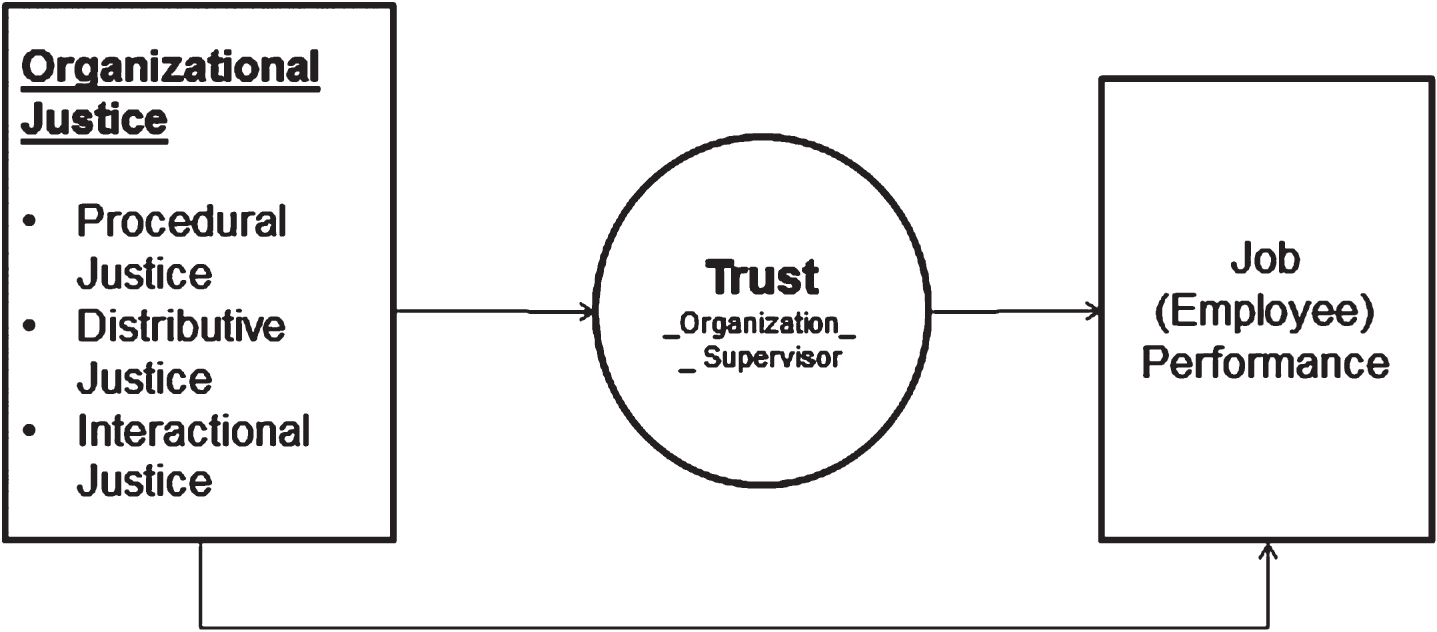
Conceptual Model.
The research methodology of this paper is designed and developed in accordance to determine the impact of organizational justice on performance through the element of trust. The main variables that are very helpful for the practical implementation of this research methodology in this paper are organizational justice, distributive justice, procedural justice, and interactional justice is considered as independent variables, trust is mediating variable and employee performance is dependent variable evaluated in private organizations of Pakistan. The nature of research is quantitative. The researcher has collected the research data through questionnaires and also processed the results according to determine the impact of organizational justice on performance through the element of the trust factor. The research findings of the previous researchers have been integrated. The research methodology goal of the phase is to develop an understanding and performing the analysis of the tools and techniques which have been utilized by the other researchers to address the issues.
Sampling procedure
The sampling procedure of this paper is composed of convenient sampling methods used for data collection. As, the actual population of the study is difficult to determine due to the lack of complete employee database availability, therefore non-probability (convenient sampling) method is more appropriate for this study. A sample of 433 employees working in different departments of six major commercial banks operate their branches in Pakistan has been collected. These banks were selected on the basis of their high number of branches all over Pakistan. The research data has been extracted from employees based on different designations like branch managers, operation managers, tellers, operational staff, marketing staff, information technology consultants and many other related executive staff or employees as well. These employees are directly linked with the strategies and policies employed by the top management.
Data collection tools
Data collection tools play a very important role in the completion of the research paper. The process of data collection tools is considered a critical part of this research study. Data analysis and research are extracted results are completely dependent upon the data collection techniques and provided for further analysis as well. The primary and secondary sources have been utilized for the data collection. A primary source is the utilization of the questionnaire, whereas secondary source is utilized in the section of literature review and formulation of theoretical framework model and hypotheses as well. The research data collected is done with the help of a questionnaire. Likert scale is used for processing of research data transform into a meaningful form. The questionnaire has been distributed within the specified commercial banks operates their operational functional activities in Pakistan. The research data is collected through employees working in different departments of commercial banks of Pakistan.
Measures
Organizational justice
This study used five-item scales designed by Niehoff and Moorman [40] to measure distributive justice. Respondents were asked to evaluate the fairness of work schedule, level of pay, workload, rewards received, and job responsibilities. Respondents were asked to evaluate the top management executive from regional and head office: is in an unbiased manner, employee concerns are heard before job decisions are made, collects accurate and complete information, clarifies decisions and provide additional information when requested by employees, job decisions are applied consistently across all affected employees, and employees are allowed to challenge or appeal job decisions made by the general manager. The study used a nine-item scale to measure Interactional justice by Niehoff and Moorman (1993). Respondents were asked to evaluate the decisions made about the job, for instance, the general manager treats me with kindness and consideration, respect and dignity, in a truthful manner, the general manager is sensitive to my personal needs, shows concern for my rights as an employee, discusses the implications of the decisions with me, offers adequate justification for decisions made about my job, offers explanations that make sense to me, and explains very clearly any decision made about my job. Variable was scored on a 7-point Likert scale, 1 = “strongly disagree”; 7 = “strongly agree”.
Trust
Following Karriker and Williams [41], we excluded a reverse response item specifically addressing fairness. Two reverse-coded items were reframed to the positive. For example, ‘My employer is not always honest and trustful’ was reworded to be ‘My employer is always honest and trustful’.
Employee performance
We measured employee task performance using 11 items from Tsui, Pearce [42]. Each supervisor provided ratings for their direct reports. The items cover a broad array of job performance indicators including quantity, quality, efficiency, overall ability, judgment, accuracy, job knowledge, and creativity in performing employees’ assigned roles. Sample items include, “This employee strives for higher quality work than required” and “This employee’s efficiency is much higher than average.”
Instrument reliability
Since this research has used certain scales i.e. continuous scales; results can only be used for the concrete outcomes if those are reliable and research should meet standards of reliability [43]. The persons engaged in research mostly rely on reliability measures [44]. The value of Cronbach’s alpha has been calculated and interpreted as per range given by Nunnally [45], which states that it should be greater than 0.70. Cronbach’s alpha for this scale has been calculated as 0.797 which is greater than threshold values of reliability. The results show that reliability statistic is based on the value of Cronbach’s alpha i-e 0.644 and the number of items used for conduction of the study i-e 21, which is considered as good for further proceeding of the study.
Data analysis and findings
Data analysis and findings of this paper are very important for the researcher for the actual determination of the current status of variables in this study. The main focus of the researcher is to determine the impact of organizational justice on performance through the element of trust. The data analysis and findings are based on two statistical tests. A first statistical test is about the correlational analysis used for testing suggested hypotheses derived with the support of the theoretical framework model and the other one is regression analysis used for measuring and estimating the relationship amongst variables. These data analyses and findings results are presented as followed:
Hypothesis testing
The above-mentioned hypotheses are tested using the correlation analysis and Baron and Kenny analysis. The results are presented in Table 2.
Reliability Statistics
Reliability Statistics
Correlation Matrix for testing of Multicollinearity
Table 2 shows the correlation between Employee Performance, Components of Organizational Justice, and Trust. The values in the table show a strong correlation among 2 components of Organization Justice i.e. Distributive Justice (0.650), Interactional Justice (0.579) with Trust. Similarly, the correlation of two components of Organizational Justice and Employee Performance is of mediocre values i.e. 0.156 and 0.209. Job performance and trust have a moderate correlation of value 0.274.
The middle section of Table 2 also shows that all correlations among variables under study are significant at 5% level of significance except that of Procedural justice with employee performance.
The results of the model summary are depicted in Table 3(A) and are derived with the support of multiple regression analyses. In accordance with this result, the predicators are interactional justice, procedural justice, and distributive justice, with the dependent variable of Trust having the value of correlation denoted by R i-e.698, R square 0.488, adjusted R square i-e 0.484 and standard error of estimation 2.41005. It also shows that variance in the trust is determined by Organizational Justice to the tune of 48%.
Model Summary
aPredictors: (Constant), interactional Justice, Procedural Justice, Distributive Justice.
ANOVA Model Summary
aPredictors: (Constant), Interactional Justice, Procedural Justice, Distributive Justice. bDependent Variable: Trust (Organization and Supervisor).
More importantly, a model summary from ANOVA as depicted in Table 3 (B), is reflected that the F value of 125.716 is significant at a 1% level of significance. This proves our Hypothesis No. 1 and we may conclude on the basis of results that Organizational Justice has a significant impact on Trust.
Table 4(A) shows that in accordance with this result, the trust with the dependent variable of Employee Performance, having the value of correlation denoted by R i-e 0.274, R square 0.075, adjusted R square i-e 0.073 and standard error of estimation 1.65913. It also shows that variance in Employee Performance is determined by Trust to the tune of 48%.
Model summary from ANOVA shows that the F value of 32.305 is significant at a 1% level of significance. This proves our Hypothesis No. 2 and we may conclude on the basis of results that Trust has a significant impact on Employee Performance. The results are shown in Table 4 (B).
Model Summary
aPredictors: (Constant), Trust (Organization and Supervisor).
ANOVA Model Summary
aPredictors: (Constant), Trust (Organization and Supervisor). bDependent Variable: Job (Employee Performance).
As elaborated above, the mediation of Trust between Organizational Justice and Performance is to be proved through Baron and Kenny’s tool. Barron and Kenny is a 4 step approach for proving mediation among variables. As per the stepwise approach of Barron and Kenny’s tool; first of all simple regression is conducted with Organizational Justice (Independent variable) predicting Employee Performance (Dependent variable). For the second step; simple regression is conducted with Organizational Justice (Independent variable) predicting Trust (Mediating variable). For the 3rd step; simple regression is conducted with Trust (Mediating variable) predicting Employee Performance (Dependent variable). For the 4th step; multiple regression is conducted with Organizational Justice (Independent variable) and Trust (mediation variable) predicting Employee Performance (Dependent variable).
Table 5(A) exhibits that the value of correlation denoted by R i-e 0.214, R square 0.0.046, adjusted R square i-e 0.0.039, and standard error of estimation 1.68926. It also shows that variance in Employee Performance is determined by Trust to the tune of 4.60%. Table 5 (B) presents the ANOVA results and shows the significant value of F (6.364). This proves step-1 of Barron and Kenny test and hence step-1 stands completed.
Model Summary
aPredictors: (Constant), Trust (Organization and Supervisor).
ANOVA Model Summary
aPredictors: (Constant), Trust (Organization and Supervisor). bDependent Variable: Job (Employee Performance).
Table 6(A) shows the model summary: the value of R is 0.698, R square 0.0.488, adjusted R square i-e 0.0.484, and standard error of estimation 2.14005. It also shows that variance in Employee Performance is determined by Trust to the tune of 48.40%. More importantly, a model summary from ANOVA as shown in Table 6 (B) depicts that the F value of 125.716 is significant at a 1% level of significance. This proves step-2 of Barron and Kenny test and hence step-2 stands completed.
Model Summary
aPredictors: (Constant), Interactional Justice, Procedural Justice, Distributive Justice.
ANOVA of Model Summary
aPredictors: (Constant), interactional Justice, Procedural Justice, Distributive Justice. bDependent Variable: Job (Employee Performance).
The result of the model summary is derived with the support of simple regression analysis. In accordance with this result, the Trust with the dependent variable of Employee Performance, having the value of correlation denoted by R i-e 0.0.274, R square 0.0.075, adjusted R square i-e 0.073 and standard error of estimation 1.65913. It also shows that variance in Employee Performance is determined by Trust to the tune of 7.30%.
More importantly Model summary from ANOVA Table shows that the F value of 32.305 is significant at a 1% level of significance. This proves step-3 of Barron and Kenny test and hence step-3 stands completed.
Multiple regression is conducted with Organizational Justice (Independent variable) and Trust (Mediating variable) predicting Employee Performance (Dependent variable).
Table 8(A) shows that multiple regression has been conducted with Organizational Justice (Independent variable) and Trust (Mediating variable) predicting Employee Performance (Dependent variable), having the value of correlation denoted by R i-e 0.286, R square 0.082, adjusted R square, i.e. 0.072 and standard error of estimation 1.6598. It also shows that variance in Employee Performance is determined by Trust to the tune of 7.20%. While Table 8(B) shows that the F value of 8.768 is significant at a 1% level of significance. This proves step-4 of Barron and Kenny test and hence step-4 stands completed. Based on the above discussed steps, the results show that Trust fully mediates the relationship between organizational justice and predicting employee performance.
Model Summary
aPredictors: (Constant), Interactional Justice, Procedural Justice, Distributive Justice.
ANOVA Model Summary
aPredictors: (Constant), Interactional Justice, Procedural Justice, Distributive Justice. bDependent Variable: Trust (Organization and Supervisor).
Model Summary
aPredictors: (Constant), Trust (Organization and Supervisor), Procedural Justice, Interactional Justice, Distributive Justice.
ANOVA Model Summary
aPredictors: (Constant), Trust (Organization and Supervisor), Procedural Justice, Interactional Justice, Distributive Justice. bDependent Variable: Job (Employee Performance).
It is concluded that organizational justice plays a very important role in increasing the employee’s performance especially in the banking sector of Pakistan. It is true the operational functional activities of commercial banks are very difficult as compared to other private and service organizations working in the same community. In this study the participation of top-level management is very important for distributing the compensation packages, benefits, promotions of employees, appreciate their hard-working employees and offer them the best competitive packages in accordance with the market. Now a day, commercial banks also meet with the task and objective of increasing and enhancing the outreach on a maintainable and sustainable foundation.
Commercial bank’s assets department is hiring the employees for the achievements of goals and objectives which they have set at the start of the year. The main duty and responsibility of the employees for which the commercial banks hire to achieve the goals of the banks divided into a specific time frame and shows their level of productivity towards the work such as disbursement of loans and deposits. It is analyzed that well known commercial banks are working under the concept of primary and secondary business of banking. Here, the involvement of the lower and middle level of employees are very important for the execution of its operational activates without having any doubtful cash transactions. In this regard, organizational justice helps to increase the trust among the lower and middle level employees of commercial banks, which in return enhance the performance of employees. Therefore, trust helps to explain the relationship between organizational justice and employee performance.
As with any other research, there are few limitations to the study. The study investigates the banking sector, thus generalizability to other sectors should be executed with caution. Moreover, the focal region of the investigation is an emerging economy, and the dynamics of developed economies might be different in this context. The primary business of commercial banks is considered as one of the collecting funds from the community and extended credit in the form of loans to people for their useful purpose, improve business conditions and creating more opportunities directly influences the economic growth. Well-reputed banking organizations are also involved in the nonbanking activities which described subsequent operational functions to well perform its operations in the community or society. And on the other side, due to these sensitive cash transaction issues the top management of commercial banks’ contribution crystal clear in terms of the distribution of benefits and special allowance for increasing the employee’s motivational level and directly impact on employee’s productivity as well. Managers need to pay particular attention to justice as an important motivating factor for employees in order to improve organizational productivity. In the future, more research studies should be carried on organizational justice as it has a great impact on the employee’s performance, retention and turnover rate, commitment, positive attitude, and many others.
Author contributions
CONCEPTION: Wasif Rasool
INTERPRETATION OR ANALYSIS OF DATA: Muhammad Fiaz and Amir Ikram
PREPARATION OF THE MANUSCRIPT: Wasif Rasool, Amir Ikram and Nabeel Rehman
REVISION FOR IMPORTANT INTELLECTUAL CONTENT: Nabeel Rehman
SUPERVISION: Muhammad Fiaz