




Abstract
BACKGROUND:
Based on the empirical consideration of small business apparel condition, theoretical consideration, suggestion, and limitations of previous research, this research is very essential to learn the influence of social entrepreneurship on organizational learning, partnerships, competitive advantage, and business performance in small scale businesses by raising the case of industry apparel oriented to the creative industry.
OBJECTIVE:
To analyze the The Influence Of Social Entrepreneurship On The Organizational Learning, Partnership, Competitive Advantages, And Business Performance.
METHODS:
The number of sample was 168 small businesses in DKI Jakarta. Data analysis using GSCA (generalized structured component analysis) to confirm the model that has been submitted into empirical data.
RESULTS:
Social entrepreneurship has a significant impact on organizational learning, business partnerships, competitive advantage, and business performance. However, the reciprocal relationship between those five variables is also very strong.
CONCLUSIONS:
Of the five variables, the overall model is dominated by the strength of business performance. The purpose of establishing business performance characteristics was to ensure that management runs well based on the principles of social entrepreneurship. business performance through good corporate governance is a necessity in the era of competition to increase the company value and prosper all employees and the community.




Introduction
Micro, Small and Medium Enterprises (MSMEs) are defined as business units, mostly characterized by labor intensive, and generally require relatively small capital (Marijan, 2005) [1]. Besides, MSMEs are also identified as a relatively simple or traditional type of business, both management, production processes, and marketing strategies (Idris & Primiana, 2015) [2]. MSMEs play an important role as the main support and driver of the economy (Mayer-Haug et al., 2013) [3]. MSMEs are proven to contribute to several functions: (i) capable of creating job vacancy, especially for local people; (ii) capable of providing capital; (iii) capable of contributing to exports; (iv) capable of reducing poverty; and (v) capable of reducing inequality between regions due to its flexible in determining business locations that cannot be touched by large scale industries.
The condition of MSMEs is in contrast to the growth in income per unit of largescale business actors, significantly increasing each year. The disparity between the actors of MSMEs and largescale business are also very high. It can be seen from the very noticeable per-unit income. The average revenue per-unit of MSMEs actors for five years is only Rp92.79 (US$ 6.50). It is very different when compared to that of largescale business actors reaching up to Rp804.33 million. This means that the income disparity reaches nine thousand times. The high risk of MSMEs affected its inconsistencies in carrying out business activities. These characteristics make MSMEs as very risky actors if they enter the competitive free market trade.
A large number of MSMEs entering and leaving the market indicates that MSMEs management in Indonesia is still not optimal. Various empirical studies found that the high risk of failure of MSMEs is still caused by a business model that is still independent and not formed by a collaboration model that should be carried out by smallscale businesses. Antoldi et al. (2011) [4] criticized the application of the MSMEs business model, still determined by business analysis which only focuses on the rational individual behavior based on the competitive environment. According to Visconti (2016) [5], the application of MSMEs businesses such as the competition model like a largescale business is not suitable. This is because the characteristics of MSME actors are those who are not yet independent and have not eligibility yet to compete.
Problems that often arise in MSMEs are categorized as difficulties in governance, especially the weak cooperation between MSME actors (Bharadwaj, 2012) [6]. The government has been neglecting the communal strategy that should be intertwined among MSMEs, both types of products, associations, and other similarities that can be mutually beneficial (Kraus et al., 2017) [7]. Cooperation is needed because MSMEs actors have a variety of limited resources; hence they need communal strength to cover their limitations. The low cooperation model between MSMEs causes those lacks the opportunity to improve economic efficiency so that they are aligned with the largescale business. The initiators of the MSMEs developer said that such a problem was caused by the limited use of institutional analysis, which had an impact on business inefficiency. As a result, MSMEs can be an effective strategy for involving local workers, being involved in community development, and supporting the public welfare system (Kazmi et al., 2016) [8].
Empirical evidence in several countries found that MSMEs can long run because it has strong relevance to several institutional implementations. Institutions represented through a collaborative mechanism can provide incentives and sanctions to regulate interactions among fellow MSMEs members (Frank, Ngozi & Nkem, 2012) [9]. Incentives and sanctions are needed so resources can complete each other, bearing in mind that MSMEs are faced with limited resources when dealing with market competition, such as capital resources, marketing, product innovation, and limited human resource skills. MSMEs successfully survive during crises are due to they can enhance cooperation between actors, increase the diversity of their organizations, and show business stability and reactivity, to create broad employment opportunities and build social capital in society (Majee & Hoyt, 2011 [10]; Sabatini, Modena & Tortia, 2011 [11]). As a result, MSMEs can be an effective strategy for involving local workers, being involved in community development, and supporting the public welfare system (Kazmi et al., 2016) [8].
Average MSMEs winning the market competition can implement several things: (i) the role of participation and agreement/institutional arrangements in controlling transaction costs; (ii) the role of social capital elements, also created based on price and authority as a differentiator with largescale companies; (iii) democratic governance structures and elements of commitment in the principle of self-help and organizational development that focuses on the process of community success (building community efficacy); and (iv) several variables such as trusts, networks, and norms as a maturer explanation in describing the economic activities of small-scale business actors. This is supported by several empirical studies conducted by Rahim & Mohtar (2015) [12] and Nuryanti & Nurjaman (2017) [13] showing that the practices of MSMEs carried out in a participatory manner based on community, networks, and social capital are proven to change the practice of MSMEs operationalization for the better.
Some of those characteristics indicate that MSMEs must be able to apply the aspects of forming strategic management, such as cooperation, trust, networks, norms, social capital, innovation, and excellence in controlling transaction costs. According to Bongo et al. (2016) [14], some aspects are categorized as forming aspects of social entrepreneurship entities. Social entrepreneurship is the ability to initiate, lead, and implement problem-solving strategies through collaboration with others in all types of social networks (Vasakaria, 2008) [15].
Wibhawa (2018) [16] stated that social entrepreneurship and social enterprise are two emerging concepts to address social problems, due to bad management of financial resources for social service delivery either run by the government or community. From the explanation above, can be summarized that the basic points of social entrepreneurship are: Entrepreneurship is a personal mental quality that full of creativity, innovations, and courage to realizing the ideas. Therefore, entrepreneurship is not similar with ‘companies’ (business). If those characters are owned by businessmen, it is because their work required them to be an entrepreneur. Entrepreneurship normally should be possessed by every person with any background of field and position. Social workers are encouraged to have entrepreneurship characteristics that can lead them to creativity, innovation, and the courage to apply the ideas to social services, particularly in social work practice as a primary profession within social service organizations. The nature of social work is closely related to the values of society, thus the solutions for the social problems must relate to these values and beliefs. The problem may be the same, but the perspective, psychological reactions, and attitudes of a person in handling the problem are strongly influenced by social and cultural values of the people.
In practicing the MSMEs (as explained earlier), social entrepreneurship is applied through a business model that promotes communal, cooperation, networking, social capital, norms, trust, and innovation, so that the orientation is very useful in solving social problems, especially in absorbing workforce and increasing the value of the local economy. Social entrepreneurship, which is the characteristics of an institution, has offered many solutions to social problems and is recognized as an effective mechanism for generating economic, social, and environmental value (Saparuddin & Bado, 2011) [17]. The level of social entrepreneurship at MSMEs is needed to influence business performance through upstream and downstream synergy strategies with mutually beneficial partnership networks (Haugh & Talwar, 2016) [18].
For MSMEs, the partnership will be very beneficial to survive the business. Therefore, the partnership can increase companies’ competitive advantage. According to Kotler and Armstrong (2014) [19], competitive advantage is an advantage over competitors obtained by offering consumers with more value. Analysis of competitive advantage shows the differences and uniqueness among competitors. The sources of competitive advantage are superior skills, resources, and control. Superior skills enable the company to carry out strategies in dealing with competitors. If the competitive advantage of MSMEs is high, business performance will automatically increase. Based on Wibowo (2008) [20], business performance is the work itself and its result.
Previous research (Franco & Haase, 2009 [21] and Urban & Gaffurini, 2017 [22]) used explorative and descriptive analysis whose results showed that it was not easy to propose a model or uniformity of actions. Ideally, the relationship between social entrepreneurship and organizational learning can be solved measurably, so a quantitative approach is needed to provide more optimal results. The second is regarding the object of research conducted by López et al (2005) [23] taking largescale companies in Spain with a more structured learning model. This research is very compatible when applied in the case of MSMEs. Third is regarding research variables conducted by Syafarudin (2013) [24] that use internal environment variables which generally provide a function to explain partnership and competitive strategies and their impact on competitive advantage and their implications for MSMEs business performance. Ideally, social entrepreneurship and organizational learning are required as a substitute for internal environment variables.
Alekam, et al (2018) [25] asserted that social capital emerges as the factor most closely controlling the business performance of SMEs. This component is followed by social innovation. The results also indicate that social capital and innovation have an important influence on SMEs’ business performance. Law and Breznik (2017) [26] stated that learning motivation is highly correlated with innovation.
Creative-oriented industry was selected because it is one of the priority programs for developing MSMEs in Indonesia. The development of creative industries in Indonesia contributed quite significantly to (i) the macroeconomy, (ii) employment, and (iii) the empowerment of creative human resources. Based on statistics from the Badan Ekonomi Kreatif (Creative Economy Body) (2017) [27], the contribution of the creative economy to Indonesia’s gross domestic product (GDP) in 2014 was Rp 784.82 trillion and was Rp 852 trillion in 2015; this indicated an increase of 8.6 percent. The culinary, craft and fashion sub-sectors contributed the most to other sectors (Bank Indonesia, 2015) [28]. One of the creative industry sectors included in the development priority due to its large contribution is from fashion, especially the apparel sub-sector.
Based on the empirical consideration of small business apparel condition, theoretical consideration, suggestion, and limitations of previous research, this research is very essential to learn the influence of social entrepreneurship on organizational learning, partnerships, competitive advantage, and business performance in small scale businesses by raising the case of industry apparel oriented to the creative industry.
Conceptual framework
From the previous studies, similarities, and differences in previous research variables are presented in Table 1.
The summary of similarities and differences in previous research variables
The summary of similarities and differences in previous research variables
Source: Data processed from Previous Research, 2019.
Based on the conceptual framework and the results of research in previous research, a conceptual framework can be prepared as a reference in this study, which is presented in Fig. 1.
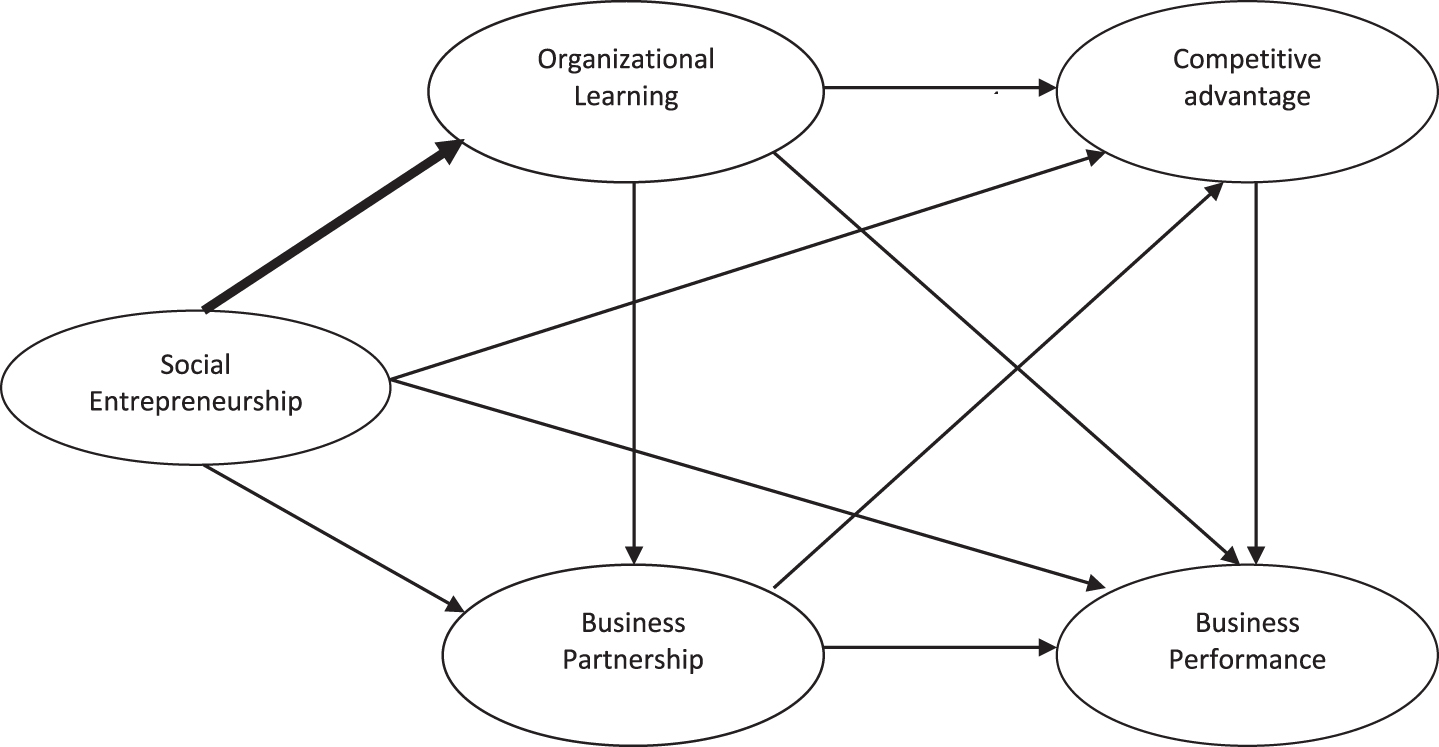
Conceptual framework.
The aforementioned conceptual framework connects the relationship between variables, in which social entrepreneurship affects organizational learning, business partnerships, competitive advantage, and business performance. While organizational learning affects business partnerships, competitive advantage, and business performance. Business partnerships affect competitive advantage and business performance. Competitive advantage affects business performance. The thick line presents the relationship between social entrepreneurship and organizational learning; it indicates that previous research has never investigated the issue.
Referring to the conceptual framework and hypotheses model that has been stated above, the theoretical influence between variables can be explained as follows.
Godói-de-Sousa and Júnior (2013) [31] conducted research on “Social Enterprises in Brazil: Socially Produced Knowledge Versus Social Innovation,” aiming to investigate whether socially generated knowledge in social enterprises in Brazil had promoted social innovation and regional development. This study was exploratory and descriptive research and developed in two stages. Initially, the sample group consisted of 378 projects selected from the Solidarity Economic Enterprises mapping, which was carried out by the National Secretary for Solidarity Economics. The sample was surveyed to verify the main characteristics of the company. After that, interviews were conducted with key managers in a sample of 32 projects.
The results showed it is not easy to propose a model or uniformity of actions to spread learning in the context of third sector organizations aimed at social innovation. It is necessary to recognize the individuals and their goals before carrying out analysis so that the organizational goals and the dynamics of learning can be understood. Based on the description above, the first hypothesis is as follows:
Yaumidin (2016) [34] conducted a research on the challenges of multi-sector and multi-dimensional synergy between social entrepreneurship and corporate social responsibility. The results showed the distribution of corporate social responsibility programs based on social entrepreneurship triggers a partnership between the company and the community. The partnership built with the program is expected to answer the challenges of multi-sector and multi-dimensional synergy between social entrepreneurship and corporate social responsibility.
Tani (2009) [36] tried to examine and analyze how social entrepreneurs are social assets as a source of competitive advantage. His research found that social enterprise tests the effectiveness of its evaluation and its ability to direct management actions in achieving sustainable competitive advantage without neglecting the organization’s social mission.
Żur (2014) [37] tried to examine how to build competitive advantage through social value creation with a comparative case study approach to social entrepreneurship. The results showed that social enterprise builds not only a competitive advantage but also a social mission. Social enterprises must have a social mission in their competitive advantage.
The results showed that social entrepreneurial behavior had a positive effect on organizational performance. Social entrepreneurship encourages entrepreneurs not only to focus on pursuing profits but also carrying out social missions. A social mission carried out well will be able to encourage an increase in business performance.
Muthalib et al. (2014) [40] tried to examine and analyze entrepreneurship and its impact on business performance and poverty alleviation. The results showed that entrepreneurship had a positive impact on business performance. This is emphasized that entrepreneurship had a positive impact on poverty alleviation. This is important to develop entrepreneurship in the community because entrepreneurship has proven to be able to improve business performance and alleviate poverty.
López et al. (2005) [23] tried to examine and analyze organizational learning into a factor that influences business competition. The results showed that organizational learning contributes positively to the achievement of competitive advantage. The greater the desire of an organization to continue learning, the better the competitive advantage it has.
Akhtar et al. (2013) [42], Hapsari et al. (2014) [43] and Mardiyono (2015) [44] also found the same results. Their results indicated that organizational learning had a positive and significant effect on competitive advantage. Organizations or companies need to learn continuously to have a competitive advantage so they can withstand the rigors of competition.
Cegarra-Navarro (2005) [46] tried to examine and analyze organizational learning on partnership strategies between MSMEs. The results showed that organizational learning is impossible to conduct on an organizational basis without being nurtured by the exploration and exploitation of knowledge among partners. Hence, it is important to note that the learning process must also encourage a better partnership.
Davey et al. (2001) [47] tried to conduct research related to how to generate opportunities for MSMEs to develop partnerships and improve performance. The results showed that practical assistance for getting business and financial rewards enable leaders to be busy devoting time to learning and developing strategies to improve company and industry performance. This indicates that it is necessary to have a learning process to build business partnerships and improve company and industry performance.
Meyskens (2010) [48] conducted research on a leading partner in a competitive advantage. His research revealed that diversity in partnership is positively associated with a competitive advantage. This showed the need for a good partnership strategy to increase competitive advantage.
Sanjaya et al. (2016) [49] tried to examine and analyze supply chain management practices towards competitive advantage. The results showed that strategic partnerships built between supply lines have a positive and significant effect on competitive advantage. A good partnership between supply lines will make the supply chain more effective and efficient so that it can increase competitive advantage.
Similar results were found by Borshalina (2015) [51] and Sirait et al., (2015) [52]. The results of their study showed that there was a significant effect of organizational learning on the performance of Micro and Small Enterprises (MSEs). A continuous learning process can increase the knowledge and skills of MSEs, affecting the changes in business performance too.
A study carried out by Kontoghiorghes et al. (2005) [53] in the relationship between organizational learning, adaptation to change, innovation, and organizational performance showed different results. The results revealed that organizational interventions focusing on the characteristics of the system, culture, and communication of the organization would produce higher level of performance, adaptation to change, and innovation than strictly focusing on learning and its application.
Kurniawan & Padmadisastra (2016) [55] conducted research on the effect of business partnerships and competitive strategies on business performance and found the same results too. The results showed that business partnerships affect business performance. As with the research results from Saparuddin and Bado (2011) [17] which revealed that business partnerships had a significant and positive effect on business performance.
Nugraha et al. (2015) [56] found slightly different results related to his research of the influence of competitive strategies and business partnerships on business performance in the textile industry found slightly different results. The results showed that business partnerships affected business performance, but competitive strategies had a greater influence on business performance. This shows that partnerships must pay attention to competitive strategies so that business performance continues to develop.
Eniola and Ektebang (2014) [58] tried to observe the performance of SMEs in Nigeria from the viewpoint of competitive advantage and the impact of competitive advantage. The results showed that RBV’s organizational competitive advantage is consequential and can be used as a conceptual measure for SMEs performance. This means competitive advantage can affect the SMEs performance in Nigeria.
Mohebi and Farzollahzade (2014) [59], through their study of increasing competitive advantage and business performance, found similar results. The results revealed that competitive advantage had a positive effect on the business performance of SMEs.
A different result was found by Setyawati (2013) [60] through her research on the Effect of Entrepreneurial Orientation and Market Orientation on Company Performance Through Competitive Advantage and Perceptions of Environmental Uncertainty as Predicted for Moderation Variable at Trade SMEs in Kebumen District. The results showed that the relationship between competitive advantage and performance is not significant.
This study was explanatory research. According to Moleong (2004) [61], this research explains the causal relationship between variables, meaning a study that views reality or action as the result of a real cause that precedes the effect temporarily or is likely to occur together. This research was conducted in DKI Jakarta Province because it is the Capital Region and is one of the provinces with the most number of apparel businesses in Indonesia, totaling 303 business players (Ministry of Cooperatives and SMEs, 2018).
The type of data used were primary and secondary data. The unit of analysis was small business players in DKI Jakarta. The total population was 303 small business players located in DKI Jakarta:289 small business players and 14 micro business players (Ministry of Cooperatives and SMEs Data, 2018). The sampling technique used was proportional random sampling. The number of sample was 168 small businesses in DKI Jakarta.
Based on the Slovin formula the sample is determined using the following formula:
n: number of samples
N: total Population
e: the degree of deviation from the expected population of 5%.
With a population of 289 Small Business Actors and a sampling error rate of 5%, the sample size is:
Number of samples = 289 / (1 + 289 (0.05) 2)=289 / 1.72
=168.02 (made to 168 Small Business Actors).
The sampling technique used was obtaining a representative sample, so that subjects are spread across different regions with different numbers. The requirements for this sampling are: the researcher knows the boundaries of the area and the subjects in each region are not the same (Arikunto, 2006) [62]. According to Singarimbun and Effendi (2006) [63], the area sampling method is used if the population is geographically dispersed. The boundary of this research area is the regency/city area in DKI Jakarta Province. Sampling in each region was balanced or comparable in each region (Martono, 2010) [64]. In this technique, the determination of the sample is done through the following stages:
1. In the first stage, the target population is grouped based on the region. Then, the number of samples is determined in each region. The number of samples allocation per region is proportional based on the number of populations in the region. The determination of the number of samples per region is done using the proportional allocation formula as follows:
N: population size
Ni: the size of sub-population i
M: sample size
Mi: the size of the sample that must be taken
Based on the formula, the number of samples per region is as follows:
West Jakarta:
112 : 289 x 168 = 65.10 UK (made to 65 UK)
East Jakarta:
73 : 289 x 168 = 42.43UK (made to 43 UK)
North Jakarta:
66 : 289 x 168 = 38,36UK (made to 38 UK)
South Jakarta:
38 : 289 x 168 = 22.08 UK (made to 22 UK)
2. In the second stage, each region sampling is done using the random sampling method: the sampling is done randomly in each region up to the number of samples determined. According to Arikunto (2006) [62], simple random sampling is done if the researcher takes a sample by describing all populations. All subjects included in the population have the same right to be sample members.
Operationalization of the research variables is as follows:
First, social entrepreneurship is a business activity that consistently allocates some of its operations to solving social problems. Business activities can bring an impact on better social change. In this study, social entrepreneurship was carried out by MSMEs on a review of its impact on changes in other MSMEs. For example, a smallscale business can increase into a microscale business. Borza et al. (2009) [38] explored two indicators of social entrepreneurship: (i) the success of MSMEs in empowering, especially to other MSMEs or the general public who want to get involved in the business world; and (ii) the ability of MSMEs to absorb local workforce.While Bengo et al. (2016) [65] suggested two indicators of social entrepreneurship at MSMEs: (i) the ability to develop training and guidance to the workforce; and (ii) the ability to innovate in production and service to increase the added value of the business.
Second, organizational learning is a continuous learning process in an organization to achieve better condition. Organizational learning is manifested through gathering knowledge and information from various sources and ensuring the organization’s activities will be applied in the future. Lopez et al (2005) [23] proposed four indicators of organizational learning: (i) commitment to continue learning, both for management and all employees; (ii) openness to various information and knowledge literacy; (iii) access to information, namely the willingness of the organization to continuously access beneficial information; and (iv) program dynamics, namely the potential for making dynamic programs tailored to environmental demands.
Third, the partnership is a strategic relationship that is intentionally designed or built between companies to achieve the goals. The partnership is a business strategy carried out by two or more parties within a certain period to achieve mutual benefits with the principle of mutual need and encouragement. Because it is a business strategy, the success of a partnership is largely determined by the compliance between those who partner in running business ethics. According to Syafaruddin (2004) [24], there are four indicators of partnership: (i) the number of networks as potential partners; (ii) creativity that is generated after or before partnering; (iii) the level of technology adoption after partner relations; and (iv) communication, that is post-partner communication skills, especially in the context of marketing communication.
Fourth, competitive advantage is the ability of a company to achieve economic benefits over the profits that can be achieved by competitors in the market within the same industry. The company is said to have a sustainable advantage only when consumers feel the difference between the company’s products and competitors. The difference arises because of the capability gap, and the gap can be maintained. According to Eniola & Ektebang (2014) [58] and Li et al., (2006) [66], competitiveness indicators include: (i) the price level that can be set by the company; (ii) the quality of product; (iii) delivery dependability, namely the ability of a company to deliver products on time, and with the type and volume that suits customer needs; and (iv) time to market, that is the extent to which the company is able to introduce new products faster than other competitors.
Fifth, business performance is the output of the management process ot an organization as a whole, assuming that the output must be demonstrated by concrete and measurable evidence (by comparing with established standards). Munizu (2010) [67] and Mohebi & Farzollahzade (2014) [59] suggested several indicators to determine business performance: (i) profit growth increases; (ii) growth in the number of customers; (iii) growth in total sales; and (iv) growth in total assets.
Data were analyzed descriptively (average or mean score and frequency distribution) and quantitative analysis using unconventional statistics that uses GSCA (generalized structured component analysis) to confirm the model that has been submitted into empirical data. Computer application software used was GeSCA (generalized structured component analysis).
Validity and reliability tests of research instruments
Validity test
A validity test is conducted to find out whether the instrument used can be precisely used for measurement; thereby, it can be said that the higher the validity of a test, the more accurate the test instrument. Validity value is the correlation value; the bivariate Pearson correlation test was used in this study. Thus, the total item correlation technique, which is the basis of the Pearson correlation, was used to test the validity. The Pearson correlation formula is:
r = correlation of the validity of the items to find
x = score obtained by the subject of all items
y = total score obtained by subjects of all items
Σx = number of scores in the x distribution
Σy = total score in the distribution y
[ [Σx] ] ∧2= sum of squares of scores in the x distribution
[ [Σy] ] ∧2= sum of squares of scores in the distribution y
N = number of respondents
A validity test is done to find the accuracy and reliability of the questionnaire; this means that the questionnaire can be properly used for measurement. A questionnaire is said to be valid if the questions can reveal something needed to be measured (Ghozali, 2011) [68]. Validity is tested with the AMOS program by examining the output estimate by comparing the p-value at the output estimate with an alpha of 5%; if the p-value is greater than 5%, the indicator is declared valid. Testing is very essential as one of the stages in research before exploring the results of hypothesis testing and descriptive analysis conducted.
Based on the results of the validity test, it appears that most of the questions in the Research Instrument had a value of Validity Coefficient > Critical Points (0.423), but there were some items declared invalid. Analysis can be continued in the next test if the research variables are declared reliable.
Reliability test
According to Azwar (2001) [69], reliability means trustworthiness, consistency, and so on. The measurement results can be trusted if the measurement on the same group of subjects obtain relatively the same results several times, provided that the aspects measured do not change. Instrument reliability is a reliable measurement result. It is needed to obtain data based on the measurement objectives. The Cronbach Alpha method was used as the reliability test in this study to determine the reliability of each instrument; the Cronbach Alpha (α) statistical test was used in this measurement uses. A constructor variable is said to be reliable if it gives a Cronbach Alpha value > 0.60 (Ghozali, 2011) [68].
Based on Table 3, it appears that the reliability coefficient for the Empowerment variable (X1.1) is 0.852, Local Workforce (X1.2) is 0.745, Training and Development (X1.3) is 0.824, Product and Service Innovation (X1.4) is 0.795, Learning Commitment (Y1.1) is 0.665, Openness (Y1.2) is 0.716, Access to Information (Y1.3) is 0.801, Program Dynamics (Y1.4) is 0.775, Network (Y2.1) is 0.828, Creativity (Y2.2) is 0.762, Technology Adoption (Y2.3) is 0.835, Communication (Y2.4) is 0.809, Price (Y3.1) is 0.757, Quality (Y3.2) is 0.714, Shipping Dependency (Y3.3) is 0.748, Market Access (Y3.4) is 0.643, Profit Growth (Y4.1) is 0.732, Customer Growth (Y4.2) is 0.75, Total Sales Growth (Y4.3) is 0.666, Growth in Asset Amount (Y4.4) is 0.78, and the value of the reliability coefficient was greater than the critical value (0.600); therefore, all research variables were reliable and the instrument can be used for further analysis.
The number of samples allocation per region
The number of samples allocation per region
Source: Ministry of Cooperatives and Small and Medium Enterprises, 2016.
Research instruments reliability test
Analysis result
Structural Equation Modeling (SEM) is an appropriate analysis tool to simultaneously test multiple exogenous and endogenous variables with many indicators. GSCA is an analysis of the 3rd generation of SEM developed by Heungsun Hwang, Hec Montreal and Yhoshio Takane in 2004. It aims to replace factors with linear combinations of indicators (manifest variables) in SEM analysis. This analysis approach uses the least square method in the parameter estimation process. The goodness of fit test is used to evaluate the degree of compatibility between data and models. The overall model fit test relates to the analysis of the GOF statistics generated by the GSCA program. By using GOF measurement guidelines and GOF statistical results, it can be analyzed the suitability of the whole model as in Table 2.
Table 2 shows that the model can be used to explain the phenomenon studied. In this study, the measurement model aims to describe how well the indicators can be used as an instrument for measuring latent variables. A variable is said to have good validity for its construct or latent variable if its factor t-value is greater than the critical value (≥1.96) and/or the standard factor load≥0.50. Reliability evaluation of the measurement models in the GSCA can use Constability Reliability (CR≥0.70) and Average Variance Extracted (AVE≥0.50).
In detail, it aims to find out the most dominant indicators in contributing to latent constructs. The best indicator in shaping the social entrepreneurship (X1) variable is the local workforce with a loading factor of 0.807, claimed as the biggest. Absorption of local labor is seen as a commitment of social entrepreneurial organizations or companies in developing the local economy.
The strongest indicator that forms organizational learning (Y1) is learning commitment with the loading factor of 0.844. Then, the best indicator that forms the partnership (Y2) variable is Technology Adoption which has the highest factor loading value. The best indicators that form the competitive advantage (Y3) variable are shipping dependencies that can be recommended to be prioritized. Last is the growth indicator for the number of customers who have the highest loading factor of 0.837.
Evaluate of coefficients or parameters that show a causal relationship or the effect of one latent variable on another latent variable. A causal relationship is declared insignificant if the value of the critical ratio (CR) is between the range –1.96 and 1.96 with a significance level of 0.05. Table 4 is the summary of the coefficient calculation results in the GSCA analysis.
The results of estimation and direct effect test
The results of estimation and direct effect test
The results showed that hypotheses 1, 2, 3, 4, 5, 6, 9, and 10 are accepted through the direct influence, indicating that social entrepreneurship influences organizational learning, organizational partnership, competitive advantage, and MSMEs performance. Organizational learning influences business partnerships and competitive advantage, but organizational learning does not directly influence the performance of MSMEs. Business partnerships had a direct effect on competitive advantage but did not directly affect the performance of MSMEs. On the other hands, competitive advantage directly affects the performance of MSMEs. The results of an indirect effect testing showed that organizational learning had an indirect effect on the performance of MSMEs through the intermediaries of competitive advantage, so did the partnership.
The overall model seeks to combine and mix the relationships between social entrepreneurship, organizational learning, business partnerships, competitive advantage, and business performance. If related to other variables, the first is social entrepreneurship. One of the most highlighted social entrepreneurship variables is empowerment activities, both empowerment to employees (internal empowerment) and empowerment external parties (external empowerment). This empowering activity affects not only organizational learning but also other variables such as business performance. This can be seen from the explanation that “social entrepreneurship is a sign of change and a new design to provide support and development for those not included in the opportunities of the new society.” The results of the study conducted by Borza et al. (2009) [38] played an important role to create social entrepreneurs, aiming to influence business performance, for example, through empowerment activities.
In addition to business performance, social entrepreneurial activities also have an impact on better organizational learning. For example, empowerment activities can increase production and non-production capacity, having implications for a company’s competitive advantage. The speed of empowerment can improve organizational learning so that it can be the only source of sustainable competitive advantage in the future. Thus, competitive advantage will also increase. Higher levels of organizational learning are positively associated with a competitive advantage. Basically, organizational learning deliberately designs and builds its structure, culture, and strategies to enhance and maximize the potential for competitiveness in a market arena. Organizational learning seems to adapt to an unpredictable environment faster than their competitors. Organizational learning efforts are not only choices but also a core requirement for organizations everywhere if they are demanded to compete optimally.
More specifically, organizational learning also has an impact on increasing the capacity of partnerships. Organizational learning and partnerships were delivered by Ghasemi et al. (2009) [70]. He also examined the relationship between organizational learning and employee performance-based partnerships. The results found that there was a positive and significant relationship between organizational learning and the needs for network partner expansion. The significant relationship between the two is due to the level of employee sensitivity of corporate governance that seeks to pay attention to the lives of employees through profitable network expansion. The company provides its best governance and applies company rules so that the company can divide the optimal time between internal interests and network partners. Some of the company’s efforts are realized by employees, and they return them in the form of time allocation to participate in organizational learning activities. Employees offer optimal performance and have a high commitment to the company. This result is reinforced by Oladele et al. (2016) [71] that employees will make their best efforts to achieve better output, and this way will contribute to the efficiency and effectiveness of the company.
Besides some of the connections above, a closed relationship is the impact of organizational learning on the improvement of social entrepreneurship and affects network formation. Social entrepreneurship practices that trigger motivations for network formation are based on personal relationships and informal work relationships. One of the characteristics of networks is the coexistence of various types of personal and professional relationships (Ceci & Lubatti, 2012) [72]. The aspects of personal relationships and informal work relationships are influenced by a sense of trust between MSMEs actors (Granovetter, 1985 [73]; Gulati, 1995 [74]; Lawson et al, 2009 [75). These arguments provide a view that the formation of effective and efficient networks comes from the awareness of MSME actorsalthough the social nature is full of weaknesses with various limitations. Hence, this limitation will not become a limiting factor if there is an awareness of the interaction between the SMEs; indeed, it can be said as a potential factor to drive the formation of the MSMEs network in a particular region.
Sabella (2016) 76] said that the correlation between social entrepreneurship and partnership was caused the company’s decision in allocating social costs, which is a reflection of the owner’s behavior and the culture of the organization. Hossain & Aktar (2012) [77] explained that companies, which have social cost allocations, such as mentoring for partners, are seen as potential work partners. This statement is reinforced by Nath, Islam & Saha (2015) [78], explaining that the social enterprise is often seen by partners as an ideal company representation because partners see social enterprise as a system to direct and Control Company for the better. Therefore, when a social enterprise can provide good direction, the network partners will see it as a very good corporate governance. If a social enterprise can provide positive social allocation support, it will foster a partner’s organizational positive attitude, so that it is willing to become a long0term member of a network partner.
From the description above, it can be concluded that social entrepreneurship has a significant impact on organizational learning, business partnerships, competitive advantage, and business performance. However, the reciprocal relationship between those five variables is also very strong. Business partnerships influence not only the level of strength of social entrepreneurship, but also organizational learning, competitive advantage, and business performance. Competitive advantage actually can be mediated by organizational learning in creating social entrepreneurial excellence. Meanwhile, in building strong social entrepreneurship, business performance can be influenced by business partnerships. It can be concluded that all variables are a unity that tends to increase business performance.
Of the five variables, the overall model is dominated by the strength of business performance. The purpose of establishing business performance characteristics was to ensure that management runs well based on the principles of social entrepreneurship. Through the implementation of business performance, the company is expected to have good performance to generate profits for the company owner and the community (social impact). These characteristics are the principles for controlling business activities to achieve stability between power and the authority of power in providing special accountability for stakeholders. The application of social entrepreneurship-based business performance, business partnerships increase, organizational learning, and competitive advantage are not only for the company’s interest but also for supporting stability and economic growth. The correlation between business performance characteristics and economic growth is related to securing investments and aims to guarantee a social impact. Therefore, business performance through good corporate governance is a necessity in the era of competition to increase the company value and prosper all employees and the community.
Contribution of the study
This research produced some important findings to further studies of social entrepreneurship, organizational learning, partnerships, competitive advantage, and business performance. Theoretically, this research will contribute to literature related to the relationship between complete variables. During this time, those ten relationships between variables complementing each other are rarely found. Previous empirical studies only emphasize that social entrepreneurship is difficult to realize if it is only oriented to meeting the needs of profit and social improvement without involving the determinants of the success of the company’s strategic management. This research produces a proposition that social entrepreneurship must pay attention to the concept of strategic management, divided into several concepts such as organizational learning, partnerships, competitive advantage, and business performance.
Specifically, this research contributes to two studies that had not been examined: (i) the relationship between social entrepreneurship and organizational learning; and (ii) the relationship between social entrepreneurship and business performance. Those two relationships are rarely reviewed deeply and still produce minimal propositions. The results of this study are at least able to strengthen some arguments about the relationships between those two variables. Besides, this study can explain some aspects strongly suspected as the influence of each variable. The social entrepreneurship variables are (i) empowerment; (ii) local labor; (iii) training and development; and (iv) product and service innovation. The organizational learning variables are (i) learning commitment; (ii) openness; (iii) access to information; and (iv) program dynamics. The partnership variables include (i) creativity; (ii) network; (iii) technology adoption; and (iv) communication.While the competitive advantage variable is (i) price; (ii) quality of production; (iii) shipping dependency; and (iv) market access. And the business performance variables include (i) profit growth; (ii) number of customers; (iii) sales amount; and (iv) asset growth. Some of these variables and indicators are important for further research.
In addition to contributing to further studies, this research is practically important to apply or test the theories. The specification of contributions is practically described as follows: The test results of this study are needed by business players, especially those running MSMEs. The results of this study can be used as a reference in managing corporate management and human resources oriented towards social entrepreneurship commitment so that the company will not lose some needs in winning the market competition. During this time, the implementation of the concept of social entrepreneurship is often difficult to implement because there is still confusion in managing profit-oriented companies. The confusion is in the form of difficulty to manage social entrepreneurial-oriented companies, especially for MSMEs. The results of the empirical study are expected to produce propositions, namely trying to provide a better understanding related to the relationship between variables. This understanding is expected to develop the construction of corporate management, especially MSMEs, which have been synonymous with the old style, which is the absence of the complete interconnectedness of variables, including social entrepreneurship, organizational learning, partnerships, competitive advantage, and business performance.Whereas theoretically, optimal management of social entrepreneurship is demanded to accommodate all variables to produce the right decision. The relationship between variables and indicators is expected to explain the way to apply social entrepreneurship practices carried out for organizational learning strategies, partnerships, competitive advantage realization, and governance implementation that can achieve business performance. Several features and the placement of modern social management governance require comprehensive research, so this research seeks to fill the void. The vacuum in question is the rarity of research which can explain the complex relationship between (i) social entrepreneurship and organizational learning; (ii) social entrepreneurship and partnerships; (iii) social entrepreneurship and competitive advantage; (iv) social entrepreneurship and business performance; (v) organizational learning and competitive advantage; (vi) organizational learning and partnerships; (vii) organizational learning and business performance; (viii) partnership and competitive advantage; (ix) partnerships and business performance; and (x) competitive advantage and business performance.
Research limitation
This research is based on quantitative analysis through the questionnaire distribution method without collecting field data after the questionnaire has been filled out. Even though it is already representative, it would be optimal if the field data were collected through a sample of respondents so that in-depth interviews can be conducted. This interview is necessary to review the discussion to be more exploratory to find a variety of perspectives. Hence, in the future, similar research can be even more exploratory if it is done through the method of deepening meaning, suggested by enriched quantitative studies through extracting field data with interview sampling techniques.
Recommendation
There are some suggestions for this research:
First, this study found that the application of the concept of social entrepreneurship on MSMEs proved to have implications for several variables of competition and strategic management, both for organizational learning, partnerships, competitiveness, and business performance. The relationship between endogenous and exogenous variables is also positive, indicating that all of these variables work in harmony and have mutual implications. Therefore, the strategy for developing MSMEs in the future must pay attention to the principles of social entrepreneurship, expected to have an impact on optimizing organizational learning, partnership strategies, competitive advantage, and business performance increase.
Second, this study found that social entrepreneurship has a significant effect on organizational learning. Therefore, in designing the MSMEs development strategy, it is very much needed a training and development program to increase the capacity of MSMEs in developing company organizations. The intended development and training includes efforts to apply the empowerment process, particularly to the workforce. Organizational development factors can be done through strengthening learning commitments, openness to all access to market information, and program dynamics. Organizational development is very important in determining competitiveness and business performance, especially for MSMEs.
Third, this study found that social entrepreneurship has a significant effect on partnerships. Therefore, in designing a MSMEs development strategy, it is necessary to have a network strengthening and partnership program among the MSMEs. Partnerships are very important for increasing knowledge stock, production efficiency, innovation, and improving marketing distribution chains. Therefore, the basis of strengthening partnerships is emphasized on programs to facilitate the accessibility of raw materials, the process of improving production quality, and increasing market accessibility. All of them aim to charge transaction costs which have been the most serious problem faced by MSMEs.
Fourth, this study found that social entrepreneurship had a significant effect on increasing competitiveness. Therefore, in designing the MSME development strategy, it is very much needed a program to increase the competitiveness of companies through price competence, product quality improvement, mastery of the marketing chain, and market accessibility. Every company must utilize partnership and the application of social entrepreneurial practices in mediating the achievement of competitive advantage.
Fifth, this study found that social entrepreneurship had a significant effect on business performance. Therefore, in designing the MSMEs development strategy, it is necessary to develop several programs related to this research variable: the need for social entrepreneurial practices, expansion of partnerships, and business competitiveness enhancement. All of which has implications for improving profit increase-oriented business performance.