



Abstract
BACKGROUND:
Non-public higher schools have developed dynamically since the transformative changes of 1989 and now play a remarkable role in the Polish educational market. However, the public schools are considered to be more prestigious. A study on the organizational culture of the two types of institutions should provide more insight into the nature of their effectiveness.
OBJECTIVE:
The purpose of this paper is to present differences between public and non-public higher education institutions in Poland with regard to their organizational culture.
METHODS:
A synthetic review of the literature on organizational culture was conducted and presented. Research in the form of a survey based on Cameron and Quinn’s model was conducted in eight universities in Poland. A sample of opinions of 186 workers was gathered and analyzed.
RESULTS:
In Poland public universities have a predominantly hierarchical culture while their non-public counterparts function in a less hierarchical market culture.
CONCLUSIONS:
The findings suggest that it may be necessary to use different management systems in the two types of institutions. A further, more comprehensive research into the subject will be worth conducting.
Keywords




Introduction
Polish higher education has undergone significant changes in the last 30 years. The changes are primarily related to the political transformation initiated in 1989. And, as with other spheres of the economy, the impact of strong market trends on its functioning could be seen in the academic world. The most important changes include the creation and dynamic development of fee-paying non-public universities, although it is worth noting here that public universities have also begun to offer part-time and weekend study courses for which there is a tuition fee; full-time studies at public universities remain free of charge for students and are financed by the state, which gives public universities a strong competitive advantage. An interesting research question would be to compare the specifics of the activities of these two types of schools. While the first studies on “hard” aspects, such as the economic efficiency of each of these types of schools, have already been conducted [45], not many attempts have yet been made to examine such an important “soft” element as the differences in the organizational cultures of public and non-public universities. It is worth noting here that, as in the case of commercial enterprises, each university also has its own separate “personality”. They usually have similar rituals in common, such as the solemn inauguration of the academic year. However, on a daily basis, there may be significant differences regarding the dress code, the degree of formalization of relationships between the staff and students, systems of remuneration and employee motivation, the assumed standards and ways of achieving the quality of teaching and research, or setting goals and pace of development. More in-depth knowledge about the differences in the organizational culture of public and non-public universities in Poland would lead to a better understanding of their business principles and results. The main research question concerns the differences in organizational culture between public and non-public higher education institutions in Poland. It should be emphasized that the analysis carried out in this area belongs to a wider stream of research on the comparison of the effectiveness of public and non-public entities, which does not concern only universities but also for example, healthcare units.
Objective and methodology
The aim of this study was to analyze the organizational culture at public and non-public universities in Poland, particularly because organizational culture is an important source of competitive advantage, not only for commercial enterprises but also for public organizations. One hypothesis was formulated based on the literature review and the objectives of the study: There is a significant difference in cultural profiles between public and non-public universities included in the study.
First, a selection of statistical data on public and non-public universities in Poland is discussed. Next, a synthetic review of the literature on the concept and models of organizational culture is presented. After that, results of a survey conducted on a sample of 186 university workers from eight public and non-public higher education institutions in Warsaw in Poland are presented and discussed. Finally, conclusions and a summary of the analysis are presented.
Results and findings
Public and non-public universities in Poland after the 1989 political transformation – characteristics
As of 20 September 2019, in the register of higher education institutions there were 387 universities with the status “operating”. In this group, 133 institutions are public ones [46]. While describing the institutions that fall into the two aforementioned categories, there are a few characteristics that should be taken into consideration as they may potentially influence the organisational cultures of those institutions. public universities are older; the first non-public university was founded in 1991; public universities rate higher in ranking lists – of the 80 top universities listed in the ranking list prepared by Perspektywy Education Foundation in 2018 [43], only nine were non-public. It can be assumed that both work and studies at public universities are deemed more prestigious; public universities are larger in size – according to the data obtained in 2018 from GUS (Statistics Poland) [19], the average number of students in a public university amounted to 6777. At the same time, the figure for a non-public university was 986. public universities employ significantly more teaching/research staff than non-public ones. The average numbers are, respectively, 722 and 51. public universities employ much larger administrative staff (346 on average) while non-public universities have – on average – 20 workers of that category. public universities enjoy a much better student/employee ratio. The ratio of students per one member of research/teaching staff amounts to 8.77 for public universities versus 17.21 in case of non-public universities.
As regards features that contribute to organisational culture, one should acknowledge the age of public universities, their size, their complex structure and the number of employees. One should also remember that public universities receive substantial subsidies from the state budget which allow them to offer free-of-charge, daytime studies. As a result, unlike their non-public counterparts, they are not entities operating on a commercial basis. Nevertheless, it is important to mention that the functioning of both – public and non-public – types of higher education institutions in Poland is regulated by the same public laws, such as the Law on Higher Education and Science and that all of them are controlled and supervised by the same regulators, the most important being the Polish Accreditation Committee and the Ministry of Higher Education and Science. Thus, such relevant elements of the organizational culture as the career-ladder, the degree of formalization of procedures and interpersonal contacts or career-path models and pace of promotion are not likely to differ to a significant extent at any higher education institution in Poland. Moreover, they seem to be quite conservative by nature, as, for example, the career path is quite long and based on meeting substantial formal criteria, such as the presentation and formal defence of the PhD thesis, followed by obtaining a post-doctoral degree and ending with a full professor title. According to a report conducted by NIK (Supreme Audit Office) [38], the average age of obtaining the PhD degree in Poland is 35, and 45 in case of a post-doctoral degree, which is the formal base to grant the academic employee the right to conduct his or her own research.
Organizational culture – literature review
The concept of organizational culture
In the literature on the subject one can find many definitions of organizational culture. For example, according to a foundational definition presented by Schein, it is “a pattern of shared basic assumptions that the group learned as it solved its problems of external adaptation and internal integration, that has worked well enough to be considered valid and, therefore, to be taught to new members as the correct way you perceive, think, and feel in relation to those problems” [50, p.18]. And other classics, Hofstede, Hofstede and Minkov define culture as “the collective programming of the mind that distinguishes the members of one group or category of people from others.” [24, p. 6].
Organizational culture has been the subject of many research projects. As Kezar and Eckel noticed “in the 1980 s, organizational researchers across various disciplines began examining the role of culture within organizational life [37, 53], and then connected it to effectiveness [56] and central processes (i.e., leadership, governance) of the organization [51]. Culture shifted from being used as a descriptive device to becoming linked with improvement and success” [30, p. 438]. Current studies on organizational culture examine a wide array of factors and relations, e.g. the impact of supportive organizational culture on the success of cutting-edge technology, such as cloud computing usage in a company [17], the interdependence of friendship among workers, transformational leadership and organizational culture [31], challenges related to merging different organizational cultures in virtual teams [5], the impact of different generational groups on the organizational behavior [2], the role which gender norms and expectations about parenting play in establishing the family-friendly versus the father-friendly university [49], the importance of mission statement in understanding and communicating the organizational culture [4], or the impact of employer branding on reinforcing and changing organizational culture [20].
A number of categorizations of organizational culture have been proposed. One of the classical divisions was presented by R. Harrison [22] and C. Handy [21]. As Sułkowski [55, p. 174] stresses, the concepts of both authors were created separately but cover very similar values. There are four main types of organizations which form specific cultures, oriented towards power, roles, tasks or people. And Ling-hsing Chang and Lin [33] discussed the following categorizations of organizational culture: results-versus process-oriented culture [1, 25], tightly controlled versus loosely controlled culture [1, 52], job-oriented versus employee-oriented culture [1, 59], closed system versus open system culture [1, 3], [7], [15], [25], [27], [29] or professional versus parochial culture [1], [25], [39].
Organizational culture in higher education
According to studies conducted by Kezar and Eckel [30], early research on organizational culture in higher education focused on student campus cultures and showed that campuses had cultures that differed uniquely from other types of institutions; they described the myths and rituals of colleges, and student and faculty subcultures [12], [35], [48]. Several later studies on higher education linked institutional culture with organizational success [11], [44]. And yet further studies showed the way in which different cultures shaped various institutional functions including governance [11], leadership [8], and planning [23], [32]. It is worth mentioning that as early as in 1988, a distinguished scholar, William Tierney noted the lack of cultural research on higher education and stressed the need to conduct studies on that matter. As he remarked, “Even the most seasoned college and university administrators often ask themselves, “What holds this place together? Is it mission, values, bureaucratic procedures, or strong personalities? How does this place run and what does it expect from its leaders?” These questions are usually asked in moments of frustration, when seemingly rational, well-laid plans have failed or have met with unexpected resistance. Similar questions are also asked frequently by members new to the organization, persons who want to know “how things are done around here.” [57, p. 3]. And, interestingly enough, another scientist, David Dill, commented “Ironically, the organizations in Western society which most approximate the essential characteristics of Japanese firms are academic institutions. They are characterized by lifetime employment, collective decision making, individual responsibility, infrequent promotion, anti-implicit, informal evaluation” [14, p. 307, quoted after 57, p. 7]. As far as more contemporary research on organizational culture in higher education is concerned, Ferreira and Hill [16] concentrated on differences between the non-public and the public sector. And Sułkowski [54] analyzed the multi-paradigm understanding of culture of higher education institutions. It should be also mentioned here that quite a number of case studies in higher education institutions have been analyzed with the use of the Cameron and Quinn’s model (to be discussed in the subsequent chapter) [18].
Models of organizational culture. Cameron and Quinn’s competing values framework model
A number of models describing organizational culture have been created. For example, in the classical model created by Edgar Schein, organizational culture is divided into three different levels: artifacts, espoused beliefs and values and basic underlying assumptions [50, p. 24]. Another model, presented by Daniel Denison focused on the link between organizational culture and bottom-line performance measures such as profitability, growth, quality, innovation, customer and employee satisfaction [13]. Another model, designed by Kim Cameron and Robert Quinn in 1988, called the Competing Values Framework, puts forward the assumption that the nature of organizational culture is based on two dimensions: internal/external focus, and stability/flexibility structure. Taken together, these two dimensions create four quadrants which represent four sets of values that guide organizational tasks of environmental management and internal integration. What should be stressed is that the underlying dimensions present contrasting values. For example, organizations need to be adaptable and flexible, but also stable and controlled. There needs to be growth, resource acquisition and external support, but also tight internal information management and formal communication. The framework suggests an emphasis on the value of human resources, but also emphasizes planning and goal setting. The Competing Values Framework, which will constitute the theoretical basis for research in this paper is presented in Figure 1. The model and the accompanying validated research method, The Organizational Culture Assessment Instrument (OCAI) developed by Cameron and Quinn to define the dominant type of the organizational culture in organizations were chosen as research tools for this study as they have been successfully used in examining organizational culture in many branches of the industry, e.g. logistics [34], or local governments [36].

Cultural profiles based on Competing Values Framework.
Four main types of company cultures were defined in the model. The first one, clan culture is held together by loyalty or tradition and attaches great importance to cohesion and morale. It should be noted here that in the case of the higher education sector in Poland, paying great attention to tradition concerns primarily public universities, given that the oldest non-public university is not even 30 years old. On the other hand, it should be emphasized that as far as the issue of loyalty is concerned, one might assume that it is the non-public universities that may be characterized by stronger loyalty to the founders – entrepreneurs. Value Drivers for this type of the culture are: commitment, communication and development and Quality Strategies are based on: empowerment, team building, employee involvement, Human Resource development and open communication. The second one, adhocracy culture, is focused on being at the cutting edge of the enterprise.
It is a dynamic, entrepreneurial, and creative workplace. Value Drivers cover innovative outputs, transformation and agility, whereas Quality Strategies focus on surprise and delight, creating new standards, anticipating needs, continuous improvement and finding creative solutions. One might assume that neither public, nor non-public universities in Poland could be strongly characterized by this type of culture, as educational institutions in Poland are quite conservative in general. The next one, market culture, is result-oriented and the glue that holds the organization together is the emphasis on winning. While Value Drivers comprise market share, goal achievement and profitability, Quality Strategies are directed at measuring customer preferences, improving productivity, creating external partnerships, enhancing competitiveness and involving customers and suppliers. It can be assumed that this model should be particularly well suited to non-public universities, which operate more strongly on market principles and must compete more strongly for clients who condition their development and survival. However, it should be taken into account that changes in the legal system in Poland also create a climate of more intense competition which was not previously encountered in public universities, especially in the field of scientific research. And lastly, hierarchy culture is based on formal rules, procedures and stability. Its Value Drivers are: efficiency, punctuality, consistency and uniformity while Quality Strategies are focused on: error detection, measurement, process control, systematic problem solving and quality tools [42, pp. 2– 8]. These features seem to be characteristic of all universities in Poland, especially big, old, prestigious, public ones, known for formal procedures, paying great attention to academic titles, rigid hierarchy and slow promotion processes.
As it has already been mentioned, the OCAI method has also been used to study the organizational culture in higher education units in various countries. The findings show that cultures vary in different countries and institutions [18]. For example, at Ohio State University the dominant (and preferred) culture was clan culture [6], whereas universities in Slovenia had a highly developed market culture [41]. Vasyakin et al. [58] found that although at the Plekhanov Russian University of Economics in Russia the prevailing culture was hierarchy culture, the majority of students wished to change it to either adhocracy or market. In a number of Christian higher education institutions in the United States and the District of Columbia the dominant culture was clan culture, though some of the institutions reported a dominant type of “adhocracy”, and it is worth mentioning that they adopted innovations more frequently [40].
In the research, the “Organizational Culture Assessment Instrument” (OCAI) developed by Kim Cameron and Robert Quinn was used. The research was carried out in 8 universities operating in Warsaw, Poland. 1 In terms of the university-type (or financial status), four were public and four – non-public. In total, 186 respondents filled in the questionnaire. Of this number, 113 were women (60.7%) and 74 men (39.3%). In terms of age structure, the majority of respondents (65) were between 41 and 50 years old. In terms of academic positions, 84 respondents (44.9%) were Professor Extraordinarius.
The participants were asked to distribute 100 points over four alternatives that correspond to the four culture types (i.e. clan, adhocracy, market, hierarchy). They judged six dimensions of their university: (1) dominant characteristics, (2) organizational leadership, (3) management of employees, (4) organizational glue, (5) strategic emphases and (6) criteria of success. They were supposed to assign a higher number of points to the alternative that is most typical of their organization.
The results of the questionnaire are presented in the following figures. The black solid lines represent the public universities and the black dotted lines represent the non-public universities. Figure 2 shows the values related to the current dominant features of the universities. The results allow us to conclude that the public universities are focused on internal support, stability and control (hierarchy culture) and non-public universities are focused on goals, targets and competition (market culture).

Dominant characteristics.
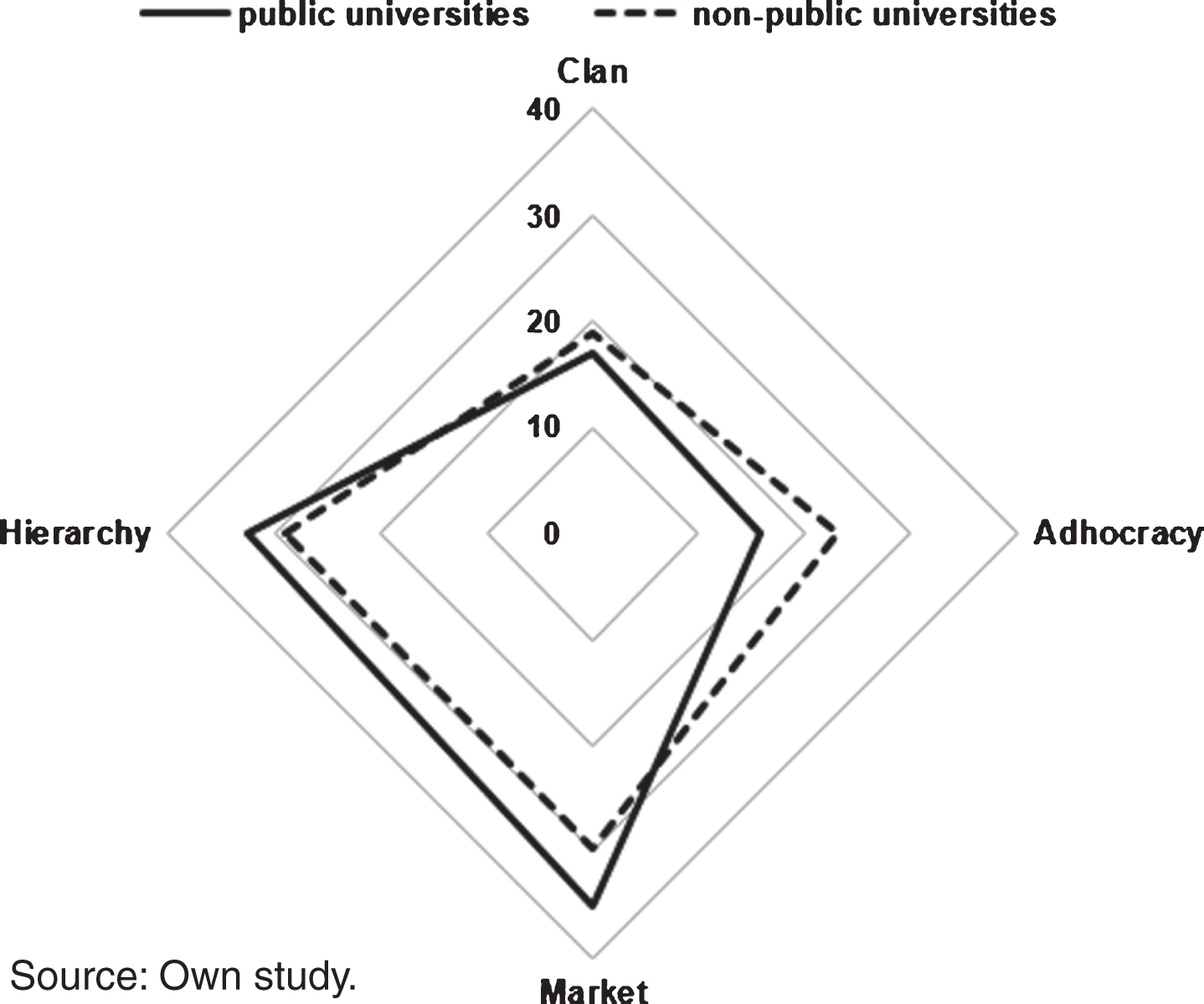
Organizational leadership was the second area of interest in the OCAI questionnaire. The results were recorded in Figure 3. Both at public and non-public universities, the leaders (rectors, deans, chancellors) are: hard drivers, producers and competitors (market culture: 34.99 points – public universities; 29.66 points – non-public universities). Leaders at public universities are least considered to be innovators and risk takers (adhocracy culture: 15.78 points), whereas leaders at non-public universities are least considered to be mentors and parent figures (clan culture: 18.82 points).
Organizational leadership.
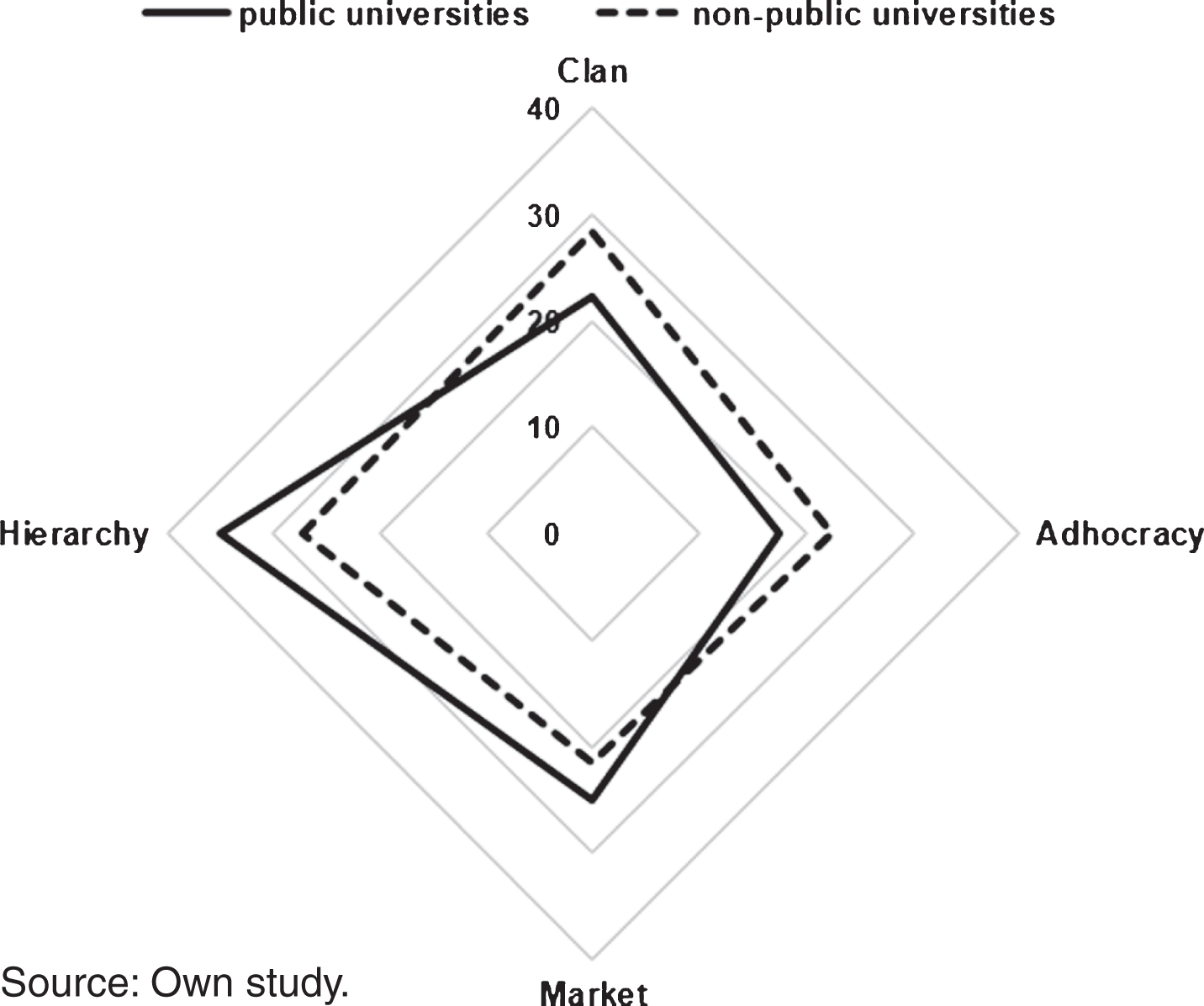
With regards to the third dimension and the management of employees, the majority of respondents at public universities chose hierarchy culture – Figure 4. This option focuses on security of employment, conformity, predictability and stability in relationships. The difference between clan culture and hierarchy culture at non-public universities does not exceed 2 points. This indicates that teamwork, consensus and participation are also used in the process of management of employees.
Management of employees.
Figure 5 illustrates the fourth examined area – organizational glue. It represents what consolidates an organization. At public universities, a hierarchical culture prevails where formal rules play a significant role. Adherence to the rules is important for the trouble-free operation of all activities at universities. But again at non-public universities the difference between two types of culture does not exceed 2 points (market culture: 27.02 points; hierarchy culture: 26.36 points).

Organizational glue.
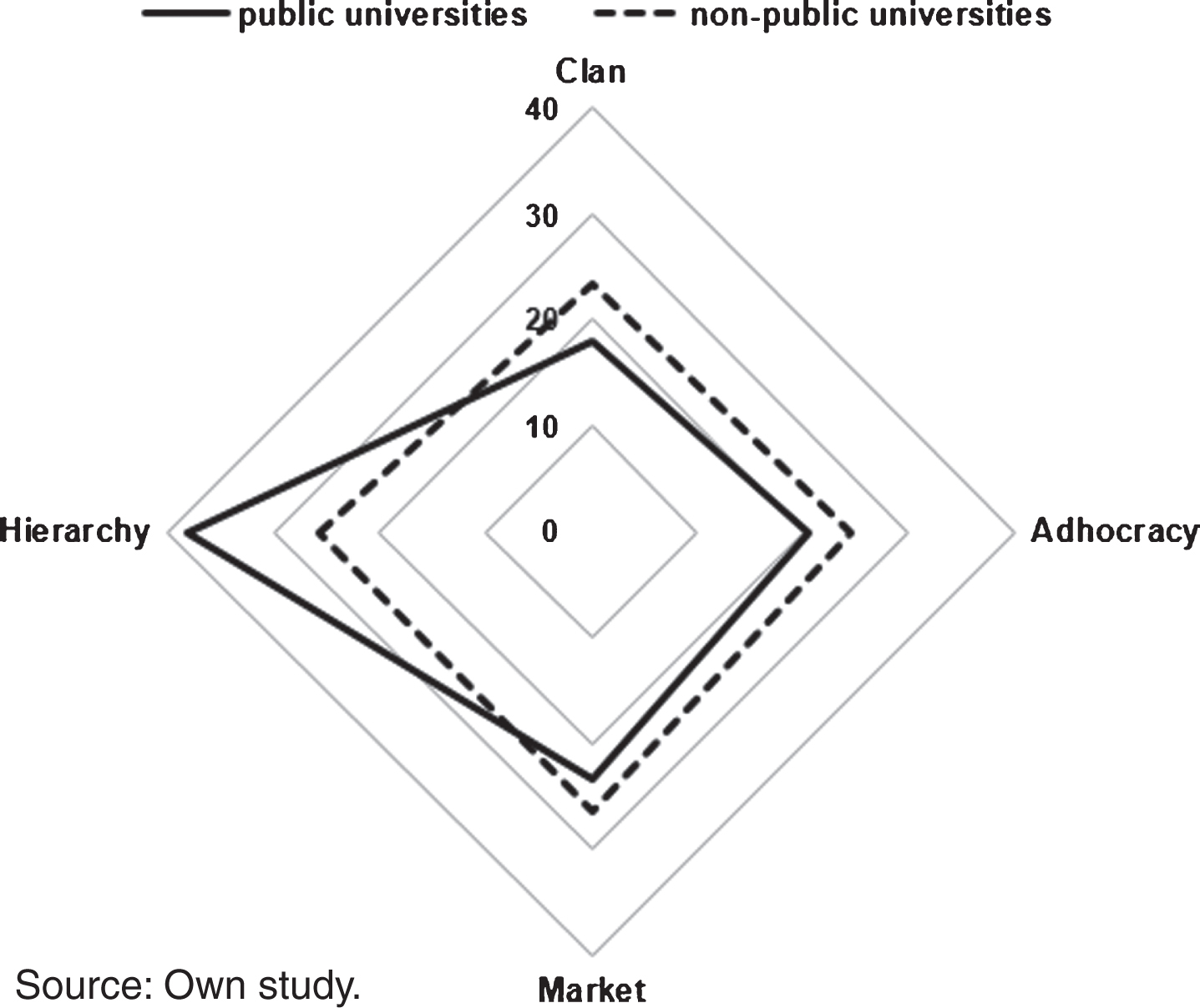
An analogous situation occurred in the fifth dimension (Figure 6) – strategic emphases. At public universities, hierarchical culture, which focus on stability and enterprise functioning, prevails. Performance, control and operating flexibility are the important factors for the achievement of the strategic goal. At non-public universities, market and hierarchy cultures scored a similar number of points.
Strategic emphases.
Success criteria were the last area of interest to be analyzed. The results are presented in Figure 7. For public universities again the dominant option is hierarchy culture (35.48 points). They define success on the basis of efficiency. A low-cost didactic process is crucial for them. Competitive market leadership is the prevailing criterium for judging success, at non-public universities.

Criteria of success.
As far as the analysis of statistical data available from the POL-on and GUS systems is concerned, from the point of view of the features contributing to organizational culture one should acknowledge the age of public universities, their size, their complex structure, the resulting number of employees and the sources of funding. It seems that in general, public universities are bigger, older, more prestigious, have more students, employ more staff and have stable sources of financing from the state budget. As a result, they do not have to operate on a commercial basis. It is different in the case of non-public universities, which are smaller in size and have to be more flexible. Their functioning depends on their competitiveness. One can assume, therefore, that these differences should have impact on the shaping of the “collective programming of the mind of the university”, i.e. its organizational culture. One should also bear in mind, though, that the career path model is similar in higher institutions in Poland as it is regulated by the same laws and that it is quite formal and conservative.
From the literature studies devoted to the concepts of organizational culture in general and, more specifically, in higher education one can draw the conclusion that a lot of factors should be taken into consideration while discussing the key elements of the organizational culture and its influence on the effectiveness of the functioning of the organization, e.g. the leadership style, governance or planning. Cultures of western universities seem to differ significantly from cultures in other organizations, rather resembling Japanese companies in this respect.
The results of surveys which used the “Organizational Culture Assessment” instrument, devised within Competing Values Framework proposed by Cameron and Quinn were conducted among 186 employees from 4 state-owned and 4 non-public universities from Warsaw. They showed that public universities function predominantly as hierarchy culture (Table 1) which is characterized by adherence to exact procedures and regulations. Emphasis is put on efficiency, and low costs. The culture is oriented towards internal support. Stability and control are important. The management of the employees is particularly focused on providing employment security. Non-public universities have a market culture with hierarchy following closely. It means that their leaders are hard drivers and competitors. The glue that holds the university together is an emphasis on winning. Therefore, the hypothesis: “there is a significant difference in cultural profiles between the public and non-public universities included in the study” was verified positively (Table 1).
Form of organizational culture in public and non-public universities in Poland – current state
Form of organizational culture in public and non-public universities in Poland – current state
Source: Own study.
It should be noted here that public and non-public universities in Poland operate in diverse conditions and have a strong specificity. To a large extent, it involves the financing of public universities by the state, which puts them in a privileged position. Despite some emerging problems and a number of limitations, they have been established and function on solid foundations. Non-public universities, by contrast, operate on principles similar to market ones. They must compete for students and related resources. The overall findings suggest, therefore, that it would be advisable to use different organizational solutions in the two types of schools. In public institutions the management system should be more formalized, and the top decision-makers should also have scientific authority, while at private universities the management system should be more flexible and goal-oriented.
The study led to interesting conclusions, but it should be remembered that it was preliminary and limited to 8 institutions.
The higher education sector in Poland has undergone a number of significant changes since the political transformation from a centrally planned economy to a market one. In addition to the public universities operating until then, subsidized from the state budget, non-public universities began to appear, offering studies which demanded a tuition fee and basing their activity on non-public sources of financing. Thus, higher education in Poland became subject to market forces. Therefore, defining the differences in such an important element of the functioning of each organization as the organizational culture was considered an interesting research question. One hypothesis was put forward. It stated that there is a significant difference in cultural profiles between public and non-public universities in Poland. This has been supported by assumptions formulated on the basis of statistical data, which showed that, on average, public universities in Poland are older, larger and more prestigious, both in terms of the number of students and employees, which total more than non-public universities. They also have more stable financial foundations. It could be concluded that non-public universities, whose existence depends on acquiring funds on their own, will be more dynamic and flexible. On the other hand, however, the activities of all universities in Poland are subject to the same laws and are supervised by the same regulators. This means that such an important element of the organizational culture as the career path and institutional hierarchy are similar, if not the same, in both types of schools. They can be described and compared to typical commercial enterprises – as being quite conservative, formalized and traditional. In order to examine the differences between the organizational cultures of public and non-public universities in Poland, the decision was made to use the Cameron and Quinn’s Competing Values Framework model. The research was carried out on a sample of 8 universities operating in Poland. The organizational cultures in these schools were analyzed by means of Cameron & Quinn’s methodology. i.e. the Organizational Culture Assessment Instrument (OCAI), used to define the dominant form of organizational culture in an institution. The research results show that a hierarchical organizational culture (hierarchy culture) based on adherence to exact rules, procedures or directives prevails at four public Polish universities as number one. Four non-public universities have a market culture with hierarchy culture following closely. Therefore, the research hypothesis stating that there are significant differences between these two types of universities was confirmed.
The results provide an interesting starting point for future research. Its limitations include the lack of research on a larger research sample that would cover a larger number of education institutions. An interesting area would be to look at the differences between the current and the preferred culture and include the opinions of students.
Footnotes
The authors of the study did not obtain permission to publish the names of the universities participating in the study.