



Abstract
BACKGROUND:
The proliferation of ICT has transformed customers’ buying patterns. The organic consumption patterns based on online consumers’ reviews were reviewed through moderated mediation model. This research paper examines the mediating role of consumer attitude in the relationship between online consumers’ reviews and organic consumption. It further examines, if perceived irritation moderates this effect.
METHODS:
Data were collected from 287 respondents who were experienced in online buying of organic products. Applied the PROCESS macros in IBM SPSS Statistics 23 to assess latent hypothesized relationships.
IMPLICATIONS:
These results have urged marketers to reconsider their strategies to treat modern consumers and scheming more artistic web pages braced with social feedback mechanism to stream organic consumption.
CONCLUSIONS:
The results supported that online consumers’ reviews positively influences organic consumption of Chinese. However, this effect is stronger when perceived irritation of webpages is low.


Introduction
Since 25 years, Information and communication technologies (ICT) have witnessed a firm growth in online buying through social commerce by instituting a platform for more flexible spatial and temporal buying [1]. A renowned phenomenon of online shopping has gained more market share than traditional stores. Since its inception, patronage of information and feedback has made people more efficient in online buying [2, 3]. This technological development established on systems, services and supporting infrastructure has grown more diverse. The intent of information systems has been changed from efficiency to human life facilitation in manifolds such as social interface and entertainment through social networking applications [4]. It has been observed that understanding of user benefits and feedback systems not only allow their users to include informational feedback [5] but also enable social interaction with others [6]. This phenomenon enables consumers to share opinions and experiences about the goods and services which can be used by others prospective consumers who are looking for more information of the same.
Social media interaction develops attitudes by others’ opinions while discussing products [7], but major gaps in the understanding of how online consumers’ reviews impact organic consumption. Online consumers’ reviews often stated as social recommendation or endorsement [8], are one of the easy-to-use communicating tools. For example, clicking like, love, thumps up/down aids in interpersonal relational management and skimming communal opinions and sentimentalities together. Most of the studies have investigated the social media engagements’ impact on users’ behavior [9–11], some have probed motivational aspects pertaining the practice of online consumer reviews in different cultural and platform contexts [12–15]. Therefore, reviews and recommendations are key to buying decision, generally perceived as valued and reliable [16, 17]. Research on how organic/sustainable consumption influenced by online reviews is still in the early stages [18]; the little notable exceptions contemplate the impact of online reviews on online impulsive buying of organic food [19, 20].
Nowadays, organic consumption is considered to be a topic of discussion at every level of society due to its social and ecological impression on individual’s consumption ranges [21]. Augmented sentience of consumption practices have been reported by consumers also. It has been witnessed that 87% of the respondents were anxious about social and environmental effect of what they devour [22]. The developing countries are reported to have organic consumption intent in their consumers, though to a lesser degree [23, 24]. Even after this better level of awareness, consumers are still not practicing organic consumption. Yet, there are quite a few aspects about consumers and sustainable consumption, which necessitate more consideration [25]. Consumer inspiration is the basic factor that should be promoted for widespread adoption of sustainable consumption [26, 27].
To stay competitive, companies are factually converging different strategies to plan and develop topical techniques to position their green brands in relation to sustainable consumption. A green brand is defined as “a brand, which offers a significant eco-advantage over its competitors and is able to attract consumers who set a high priority on making green purchases” [28]. Spending on green products impacts high on environmental awareness level of buyers, named as green buyers [29, 30]. Few businesses are actually promoting this notion of environmental perverseness. Like, Hybrid cars (partly electric vehicle) in automotive industry are good initiative of promoting green technology that sustain raw minerals and lessen greenhouse gases emissions. In 2008, Lifestyles of Health and Sustainability (LOHAS) Club members reportedly spent $300 billion on green products reckoning 8 members out of 10 on sustainable consumption [31].
This amplified awareness has still failed to arouse organic consumption patterns. There is expanded literature available pointing out this issue and indorsing theoretical and practical solutions to it [25]. Primarily, consumer attitude towards green brand is stimulus for organic consumption and its considerate fosters this perception to next level. Organic consumption is said to be more symbolic rather than economic value. Thus, benefiting more psychological in nature by having good feel for oneself that aids in self-enhancement, superior personal growth and upright social interaction [27]. However, the influence of perceived irritation in driving consumers’ attitudes towards green brand to consume sustainably is little known. Thus, this study contributes to the literature by recognizing consumer attitudes towards organic consumption and how it is driven by perceived irritation of online information. This study aims to present a theory-driven structural model, which enlightens the cognition process following the organic consumption. The proposed model integrates widely known Theory of reasoned action (TRA) and, empirically test the unique contributions of perceived irritation and consumer attitudes on organic consumption by applying hierarchical regression and a structural equation modeling. The outcomes of the study can not only provide managerial insights for Chinese organic industry, but also contribute theoretically in a novel perspective to comprehend the relationship of online consumers’ review and sustainable consumption.
Literature review
Theory of reasoned action (TRA)
According to Ajzen [32] “behavior is an individuals’ observable response in a given situation with respect to a given target”. Ajzen [32] said “behavior is a function of compatible intentions and perceptions of behavioral control”. Fishbein & Ajzen, [33] suggested The Theory of Reasoned Action (TRA), supporting the development of buying behavior. TRA explains the motivation stimuli of behavior that further offers the framework for consumer behavior [34]. The TRA was elaborated to deliver a parsimonious understanding of motivational and informational influences on individuals’ behavior. It is a causal model, which identifies the determinants of behavioral intention –and eventually overt behavior –and portrays how they are combined [35]. From a TRA perspective, behavioral intention is influenced by two independent factors: attitude toward the behavior, that is, “the degree to which a person has a favorable or unfavorable evaluation or appraisal of the behavior in question” [32], and subjective norm, that is, “the perceived social pressure to perform or not to perform the behavior” (p. 188). Past studies have generally analyzed the primary instincts that frame consumer buying behavior of organic products. Social networks ultimately become a permanent addition to TRA and through the application of Instagram this proves true [36]. In connection with environment and animal issues, several studies have presented the health issues are also prime motive for consumers to buy organic product, health attributes have become as significant as sensory one while making buying decisions [37–43]. To understand the consumer perception of organic food is prerequisite that helps to determine buying intention towards its consumption, which further explain the actual buying of behavior of these products [43]. In this study, attitude towards green brand along with online consumer reviews and perceived irritation is related to organic consumption i.e. to buy products that are not as much of detrimental to the society and environment at large. For example, hybrid car purchase intentions revealed that green intentions refer to buying environmentally friendly products as soon as one is aware of its green attributes [45]. Consumers’ intentions to buy green/organic product is significantly stimulated by green attitude and its perceived value [46, 47].
Online consumers’ reviews, organic consumption and mediating role of consumer attitude toward green brands
Daily life of Chinese consumers has been largely effected by the social media. Due to Facebook injunction in China, national social media platforms; Wechat, QQ and Weibo are playing a great role in Chinese consumerism at rigorous pace. In 2018, number of social network users has crossed the figure of 580 m users and WeChat is found to be most persuasive social media platform [48]. It has offered a diverse function to their users; the main feature is Wechat pay that is used to pay bills online [49, 50]. Internet has accelerated a radical revolution to promote healthy buying [51]. Network buying technologies increasingly replace traditional physical products, such as e-books, food, and appliances. For example, buying over the Internet lessens pollutions effects linked with buying physically as well as emissions from transportation [52]. Likewise, this platform is used for information sharing, in 2016, 31 percent users initiated buying from online official retailors and through social recommendations using links to other types [53]. Many famous brands have started their business operations online to capture maximum market share in China; luxury fashion brands are more prone to advertise their products virtually as compared to conventional tactics [51]. Such applications integrate features to fashion profiles and avatars connecting users with their friends and likeminded ones, allowing sharing information and providing feedback. This social feedback happens over social comparison, experience and praise or criticism. Online consumers’ review are influencing lives of many online users as it influences and build behaviors based on psychosomatic makeup, places them towards higher obligation and valuation of social cues [54].
Organic product buying is normally based on complex decision because of less knowledge and expertise to appraise the socio-ecological characteristics of the said product [55]. Multifaceted scientific information and language generally generates sustainable issues, comprising deforestation, climate change, global issues and its causes. These conditions restrict consumers to assess sustainable features of the product without assistance. It is highlighted in the credence dimension of theory of reasoned action. Online markets are characterized asymmetrically with imperfect information, where producers are more aware and consumers’ perceived higher levels of credible potentials. For example, while buying an organic apple, consumers readily ascertain the price and taste but unable to verify the farmer actually following the sustainable procedures. Similar challenges are faced by other organic food items either they are free of genetically modifies organisms or assertive to be an organic food or just a recycle waste [19]. Consumers are usually deficient of this knowledge that discriminate such contents and processes. Sustainable products notably claim superior environmental performance, no child labor and cruelty free manufacturing and these claims are quite challenging for buyers to evaluate [56]. Research is evident that environment and functional concerns of green products through the Internet can drive sustainable consumption [53]. Consumers admit their knowledge deficit for organic products which hinders its buying even those who buy these products claims to be ignorant [55]. Consumers are cautious about claim of sustainability of the products because of “greenwashing” risk as vendors pretend to be sustainable justifying the premium prices. Green consumption has, again, received a lot of recent attention, which shows that each consumer derives sustainable value from green products. To some extent, not all consumers take the health-related and environmental benefits of these green products into consideration [54]. This knowledge gap and skepticism is filled by the online reviews and recommendations through social media. Although this sector has been criticized for ling time creating ambiguity for consumers [57]. Social media has reported many transgressions and greenwashing scandals relating products’ sustainability and company claims [58]. This feedback from social media has reportedly ended up in many ways like disappointment, frustration, negativity that results in demotivation [59]. Therefore, it is important to determine the feedback type and its consequences. Such as, the core purpose of the social feedback is to expedite social communication [60].
Consumer attitude towards brand is allied with one’s preferences and general evaluation of brand that incarnates their likings and dislikings [61]. In agreement with previous studies, a consumer’s personal beliefs act as a driving factor for specific behavior. Certain attitudinal indicators can trigger the consumption of green products, that is, environmental sustainability and own health [62, 63]. Attitude has a significant effect on network buying. It is the positive or negative evolution toward a certain object by a person [64]. In a food safety knowledge study by Lim et al. [65], consumers’ food safety behavior is significantly influenced by food safety attitude. While buying sustainable seafood, consumer attitude was key in projecting the consumer’s motivation to purchase organic food besides the stimulus of social recommendations [66]. In Greek study based on organic consumers, similar conclusions have been witnessed [67]. Formerly, scholars substantiated that buying decisions were generally grounded on environmental attitude of consumers [68]. Positive image and feelings were found to be key ramifications that figure consumer’s attitude and stimuli their buying intentions towards green products [19]. Green marketing studies have significantly supported that eco-friendly consumer attitude influences the environmental knowledge and green product buying intention [69–71]. Similarly, Yadav and Pathak [72] have asserted that consumer attitude towards green products significantly impacts the green buying intention. Moreover, Indian consumer’s attitude predicts their green product intention [73]. Mostafa [74] found a significant association of consumer attitude towards green products and green brand by relying heavily on green brand positioning as these consumers have stronger buying intentions towards green brand. Thus, we hypothesize the following;
Moderating role of perceived irritation
A discomfort and feeling of displeasure by consumers is termed as consumer irritation that results in by provoking stimuli like messages, incidents or interactions which are against the expectation of consumers in a specific situation. Thus, perceived irritation while shopping online refers to messy shopping website and its contents appeared to be frustrating [75]. Few research studies have studied consumer irritation in connection with online shopping [76], most of them used it as determinant of others factors by focusing its consequences [77]. The results of such studies have shown a negative impact on consumer satisfaction, intentions to return, word of mouth and buying behavior of consumers [78]. Furthermore, perceived irritation have negative effect on vendor dynamics like competence, integrity and credibility [79]. Even with several studies of negative attributes of perceived irritation on shopping online, there has been little or no research work aimed at investigating indirect effect of perceived irritation of consumers’ reviews posted online on different social media platforms.
As hypothesized earlier, consumers felt irritation form disparaging interactions and experiences in online shopping. In comparison, irritation perception in online shopping ascend as of unpleasant interactions with the shopping website and its features. As websites aesthetics are the online storefront for online consumers that they used to interact with and shape their buying patterns virtually [80]. Like, websites are visually appealing, easy in navigation and informative in terms of others feedback, are considered to be less irritating which may result in ultimate buying decision [19]. In comparison, poorly administered webpages abstain users from completing their buying process that demands more cognition and effort and evokes negative insight [81, 82]. So theoretically supporting this argument, the current study hypothesized that
The first hypothesis suggests that consumer attitude towards green brand can enhance consumer approach based on online reviews by others, that results in augmented organic consumption. This study interrogates that if the strength of consumer attitude on organic consumption depends on the irritation consumers faced while shopping online. Based on the theoretical background, this study developed an overall conceptual model of online consumers’ reviews, perceived irritation, consumer attitude towards green brand, and organic consumption (Fig. 1). Specifically, the effect of online consumers’ reviews (X) on organic consumption (Y) via consumer attitude (M) is conditional on perceived irritation (W). Hence, the following hypothesis is advanced:
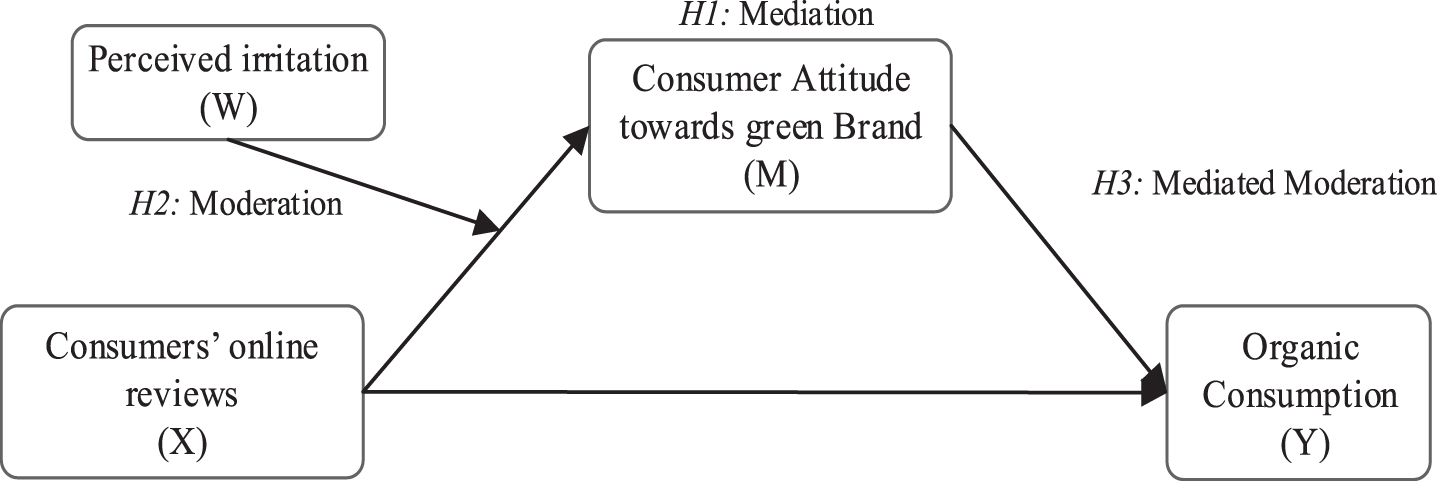
Hypothesized Model.
The proposed model and hypothesis were empirically tested by quantitative research method. To realize the structural association among latent constructs, cross sectional technique of data collection was used through online questionnaire; the best suitable technique in current setting [83], as it was geographically unlimited carrying lowermost survey cost with prompt response rate [84]. Survey questionnaire was designed in three sections targeting organic consumption. In first section, respondents were enlightened about the notion of organic consumption followed by a screening question with nominal scale (Yes/No), which helped to collect data from only those respondents who were experienced in organic consumption. Demographics were asked in second section of the questionnaire and last section was about assessing structural relationship among latent constructs. For effective understanding of the questionnaire, back translation services were hired by one the of Chinese Professor. To ensure accuracy, first it was translated into Chinese, then back translated into English. Both English versions were compared to recognize and amend the irregularities to certify the actual anticipated meaning of questions asked from the respondents.
Data were collected in third quarter of 2019. Applying convenience sampling technique, questionnaire was place on the most frequent Social media platform (WeChat) for data collection. Voluntary participation of all respondents were ensured and were informed that could stop at any time. In total, 350 questionnaires were received back, with 287 valid responses (response rate: 82%) with 120 males (42%) and167 females (58%). Among 287 respondents, 243 (85%) respondents were having minimum 16 years of education that represents highly qualified sample size. All respondents were found to be online buyers in terms of buying food items.
Measures
To assess the online consumer reviews, 27 items scale developed by Yayli, A., & Bayram, M. [78] was used for general understanding under following terms a) review’s characteristics; b) reviewer (writer of review); c) website that present the reviews; d) significance of reviews; e) type of advice and f) product related. Cronbach’s α was 0.89 for this scale above threshold of 0.7 recommended by Nunnally and Bernstein [86]. Perceived irritation was measured by three items-scale used in previous studies [75, 87]. Sample item was “I feel that most online shopping websites are irritating” (Cronbach’s α was 0.93). Seven-item scale was used to measure consumer attitude [87, 88] demonstrating good reliability (Cronbach’s α= 0.91). Example item includes “organic foods are more attractive to eat than conventional foods”. Organic consumption was measured on 19 items scale of organic food consumption scale developed by Eti İçli, G., Anıl, N. K., & Kılıç, B. [90]. Sample item includes “For me, consuming organic food would be valuable”. Cronbach’s α of the scale was 0.87.
Data analysis
The overall hypothesized model incorporates the mediation of consumer attitude (H1) and the moderation of perceived irritation (H2), suggesting the moderated mediation model [91]. To test latent relationships, step-by-step approach was employed using Process model 4 for the moderation hypotheses and model 1 for mediation hypotheses testing. In the end, Model 7 was employed to test the overall moderated mediation relating online consumer reviews (X), consumer attitude (M), organic consumption (Y) and perceived irritation (W). A 95 percent bias-corrected bootstrapping method using 5,000 resamples was applied to obtain confidence intervals (CIs) as in terms of the lack of power, Hayes [92] validated the statistical limitation in traditional mediation analysis by Baron and Kenny [93] in terms of the lack of power.
Results and discussion
Descriptive statistics and correlation matrix is presented in Table 1. A significant and positive correlation was found between online consumer reviews and other variables (p < 0.01). Consumer attitude was positively correlated with organic consumption. perceived irritation was negatively but insignificant statistically correlated with organic consumption.
Means, Standard deviations, and Correlations among constructs
Means, Standard deviations, and Correlations among constructs
Mediating role of consumer attitude, the first hypothesis, is confirmed by the significant mediating effect of consumer attitude on organic consumption through online consumers’ reviews. The results of PROCESS model 4 with 5000 bootstrapped sample represented the direct significant effect of online consumer reviews on consumer attitude (β= 0.491, CI = 0.371 to 0.631, p < 0.01). Consumer attitude also significantly influenced organic consumption (β= 0.219, CI = 0.075 0.231, p < 0.01).
The indirect effect of online consumer reviews on organic consumption via consumer attitude was significant as a 95% bias-corrected CI for the indirect effect estimate (β= 0.108, SE = 0.061, p < 0.05) ranged from 0.037 to 0.193, which did not overlap zero. Therefore, the indirect impact of online consumer reviews on organic consumption through consumer attitude was significant.
It was also hypothesized that the relationship between online consumer reviews (X) and consumer attitude (M) was moderated by the perceived irritation (W). Table 3 presents the results of PROCESS model 1 with 5,000 bootstrapped samples. The main effect of online consumer reviews on consumer attitude was significant (β= 0.463, CI = 0.382 –0.576, p < 0.01) while perceived irritation was insignificant (β= 0.002, CI = –0.047 to 0.067, p < 0.94). A significant interaction was qualified in main effects (β= –0.119, CI = –0.228 –0.041, p < 0.01). The interaction was significant when perceived irritation was equal to, lower than is mean (β= 0.602, SE = 0.068, CI = 0.341 –0.674). Figure 2 shows the interaction between consumer attitude and perceived irritation. As hypothesized, the impact of online consumer review on consumer attitude was stronger when consumers less irritated (vs high). It can demonstrate that high-perceived irritation could be a prodigious towards consumer attitude, which can negatively influence their attitude.
Summary of coefficients in PROCESS model 4(mediation analysis)
Notes: LLCI, lower level confidence interval; ULCI, upper level confidence interval. *p < 0.05;**p < 0.01.
Summary of coefficients in PROCESS model 1 (moderation analysis)
Notes: LLCI, lower level confidence interval; ULCI, upper level confidence interval. **p < 0.01.
Summary of coefficients in PROCESS model 7 (moderated mediation analysis)
Notes: LLCI, lower level confidence interval; ULCI, upper level confidence interval. *p < 0.05;**p < 0.01.
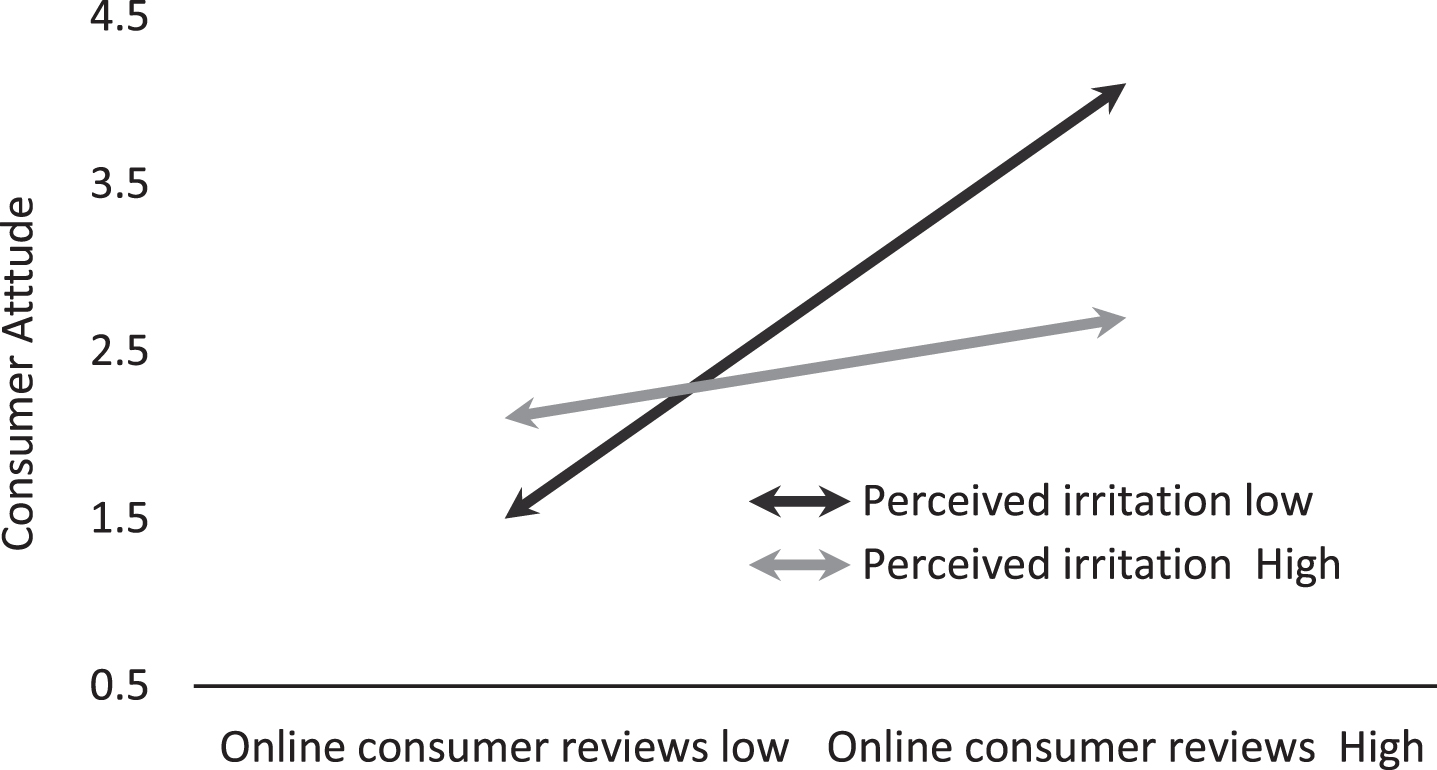
Plot of interaction between X, W and M.
Finally, the results of PROCESS model 7 with 5000 bootstrapped sample represented the direct significant effect of online consumer reviews on consumer attitude (β= 0.491, CI = 0.371–0.631, p < 0.01). Consumer attitude also significantly influenced organic consumption (β= 0.219, CI = 0.075–0.231, p < 0.01). The indirect effect of online consumer reviews on organic consumption via consumer attitude was significant as a 95% bias-corrected CI for the indirect effect estimate (β= 0.108, SE = 0.061, p < 0.05) ranged from 0.037 to 0.193, which did not overlap zero. Therefore, the indirect impact of online consumer reviews on organic consumption through consumer attitude was significant.
The conditional indirect effect of online consumer reviews on organic consumption via consumer attitude was significant at low (β= 0.141, 95% bias-corrected CI = 0.041 to 0.321, p < 0.01), moderate (0.00) (β=0.103, 95% bias-corrected CI = 0.031 to 0.194, p < 0.01), and high perceived irritation (β= 0.067, 95% bias-corrected CI = 0.027 to 0.128, p < 0.01). Largely, Model 4 (mediation) and Model 1(moderation) results were effectively replicated in the moderated mediation analysis. Explicitly, the results specified that online buyers experiencing least irritation while browsing positively effects their attitude that finally lead to organic consumption patterns.
In terms of organic consumption research, this research study has contributed to knowledge in manifolds. Firstly, it bids an ICT centered enriched model for online buying of organic items that develops consumer attitude with indirect effect of perceived irritation of webpages faced by online buyers. ICT has facilitated the creation of social commerce that altered buying behaviors, depending on social inspirations. But, how others have influenced has not been studied broadly. However, few research studies have studied the role of ICT and social commerce’ influence during shopping that regulates consumers’ buying decision. This research study offers an explicit insight about online consumers’ reviews and its framework for upcoming studies. Thus, various antecedents of attitude development should be investigated to have a deeper understanding of Chinese online buyers. Secondly, the portion of online consumers’ reviews as the theoretic base of the study reiterates the significant influence on organic consumption patterns. ICT has reformed consumer behavior; decisions are more relied on others’ posted contents. This model enlightens that how ICT powers customers’ attitude towards organic products. Consumers’ information, knowledge of science and technology and well understood organic processes could elevate organic consumption. Consumers’ decision quality of organic products is more relied on others’ referrals and reviews, learning from forums and communities and post experiences. Study results have projected several substantial factors that contribute in attitude development; dependable and précised review by other consumers along with supportive webpages in terms of information and ease of use, are critical in organic consumption. Third, this research study has enriched existing literature by identifying the perceived irritation created by technical features of websites in virtual shopping and revealed its significant impact on consumer attitudes and buying decisions of online consumers.
Managerial implications
From a managerial perspective; firstly, study results suggest that managers can safely establish relationship between consumer’s identities and products to reach initial market acceptance. Marketing managers should launch strategies that custom influential contents like “important others”, whose thoughts may prompt consumption choices. ICT can help to create health communities which serves to be a good communication mode to amend prospect organic consumers’ value proposition; an innovative way for realization of consumer value. These communities will strengthen consumers’ belief and incite them to inquire more which could be more advantageous in trust development, mutual benefit, and belongingness. This health community commands customer value proposition based on post purchase experience, social interaction, exchange of views, and others’ reviews. It advises consumers to institute an emotional bond with entrepreneurs along with modified consumers’ attitude ultimately rising their satisfaction and loyalty levels. Secondly, ICT has provided a platform for online consumers to interact and share their views publically. Experienced Internet users are found to be more receptive than less frequent users based on high attitude components. Therefore, social media with comprehensive information can easily and swiftly develop consumers’ attitude towards organic consumption. Consumers paying more attention on social media communications that positively affects their cognitive and purchase intentions. They are better able to absorb information instantly, but may also skirt relevance hastily if it does not incite engagement.
Lastly, for online venders, there is a strong competition in virtual market, maintaining a tempting and proficient webpage is precarious to attract and retain their customers. Monotonous and infective interface can be hastily rejected with a single mouse click. Henceforth, online retailers should be more observant in online store. Web pages should be friendly and easy to navigate with visually appealing elements of relevant products, like appetitive image for food. In organic products, more inclusive and streamlined web pages induce and intact browser that compels visitor to make buying decision. likewise, web pages with proper fonts, HD pictures, colors and graphics and, information of organic products (e.g. nutritional subjects, production and processing procedures, environmentally friendly, animal welfare) appeal more. Therefore, information asymmetry can be reduced by added media fertility eliminating consumers’ cynicism to a certain extent. Thud, this study provides empirical evidence of the inference and applicability of the ICT in development of organic consumption. Exclusively, results signify the impact of ICT on buying decisions is better understood through web page quality.
Future studies
Like all research studies, future studies form this study stem from limitations. This study is based on Chinese citizens to investigate their organic consumption with indirect effect of consumer attitude and online consumers’ reviews. Nevertheless, population of the study may limit generalization, which can be protected by replicating through samples from other countries. This study is centered on experienced online buyers, which was purposefully done as influence of ICT and its features on attitude was considered. It will be thought-provoking to investigate non-users’ perspective with regard to organic products. Future studies can ascertain more diverse components of ICT on behavioral patterns. One of the limitations of this study was the use of a convenience sampling, limiting the generalizability of findings. Thus, the results of this study can be replicated in other samples applying a random sampling technique. Future research studies should consider investigating the direct and indirect effects of demographic and psychographic variables in the relationship between online consumers’ reviews and organic consumption with ICT solicitation.
Conclusion
This is the first study to examine the relationships between online consumers’ reviews, consumer attitude and organic consumption. The results provide the support for indirect impact of online consumers’ reviews on organic consumption of Chinese consumers through their attitude towards green brand that is moderated by perceived irritation of websites. In line with the theory of reasoned action [33], consumer attitude plays a key role as an intervening variable in the relationship of online consumers’ reviews and organic consumption. In other words, consumers happily navigating the webpages without any interruption from website influences their attitude in a way that results in organic consumption decisions. Consistent with the theory of planned behavior [32], perceived irritation moderated indirect effect of online consumers’ reviews on organic consumption via consumer attitude towards green brands, suggesting that consumers who were less irritated exhibited a positive exposure of consumer attitude, which eventually led to the enhanced consumption patterns of organic items.
Author contributions
CONCEPTION: Anum Tariq
METHODOLOGY: Anum Tariq
DATA COLLECTION: Anum Tariq and Yasir Tanveer
INTERPRETATION OR ANALYSIS OF DATA: Yasir Tanveer
PREPARATION OF THE MANUSCRIPT: Anum Tariq
REVISION FOR IMPORTANT INTELLECTUAL CONTENT: Yasir Tanveer
SUPERVISION: Yasir Tanveer