



Abstract
BACKGROUND:
Considerable evidence suggests that social media usage has become an indispensible part of international expatriates’ daily lives. Studies have identified social media usage serves both as a positive and a negative channel to influence international expatriate’s personal development. Nevertheless, there is paucity of literature examining the effects and underlying mechanism through which social media usage impinges on international expatriates’ creativity, especially in cross-cultural settings.
OBJECTIVE:
To address the gaps, the current research is designed to investigate whether and how social media usage accounts for variance phenomena in international expatriates’ creativity with intervention role of cultural intelligence.
METHODS:
A questionnaire survey was conducted at three Chinese public universities with assistance of officials in charge of international education. 248 informative responses were used for testing hypothesis.
RESULTS:
Research findings suggest that social media usage contributes to international expatriates’ creativity partially through the conduit of peer relationship. Additionally cultural intelligence positively moderates the relationship between social media usage and peer relationship.
CONCLUSIONS:
As the elite group who make quick responses and efficacious solutions to manage the complexities in such an interconnected world, international expatriates deserve more scholarly attention for their creativity development. The current research examines the mediating role of peer relationship and the role of cultural intelligence moderating the relationship between social media usage and peer relationship. And this paper serves to arouse more scholarly attention to apply interdisciplinary analytics approaches to investigate how to develop international expatriate’s creativity in complicated cross-cultural settings.




Introduction
Identified as a significant life-span skill and key capability in the 21st century [1, 2], creativity is universally acknowledged to play a critical role in contributing to individual’s survival and success, organizational innovation and success, economic growth and competiveness [3–5]. Numerous studies have endeavored to explore the antecedents and mechanisms influencing individual creativity from the perspectives of personal attributes and contextual factors [6–8]. Accordingly, to keep up with the pace of economic globalization, developing expatriates’ creativity becomes a crucial topic for successful international business operations [9, 10]. However, the process wherein international expatriates’ creativity is fostered has been characterized with complexities due to the uncertainties and challenges existing in cross-cultural settings [10]. Although few studies have endeavored to uncover the factors influencing expatriate’s creativity developed from their international experiences [11–13], more efforts are merited to explore how international exposure facilitates expatriate’s creativity in cross-cultural environment.
From the interactionist perspective, creativity is a function of individual’s personal characteristics, environmental factors and interactions between these two [14]. Among environmental factors is information technology listed, which penetrates into every corner of expatriate’s international experiences [15, 16]. As an indispensible toolkit with registration of more than 4.2 billion users [17], social media has been identified to exert both positive and negative effects on individual’s psychological changes, performance and personal development [18, 19]. On the one hand, inconsistent research findings about social media usage need to be further examined, particularly in light of the complex cross-cultural environment. On the other hand, albeit few studies identified that social media usage indirectly influences individual capability [15, 16], there is large paucity of literature examining the direct relationships between social media usage and individual creativity, and relevant underlying mechanism through which expatriate’s creativity is influenced [9, 20].
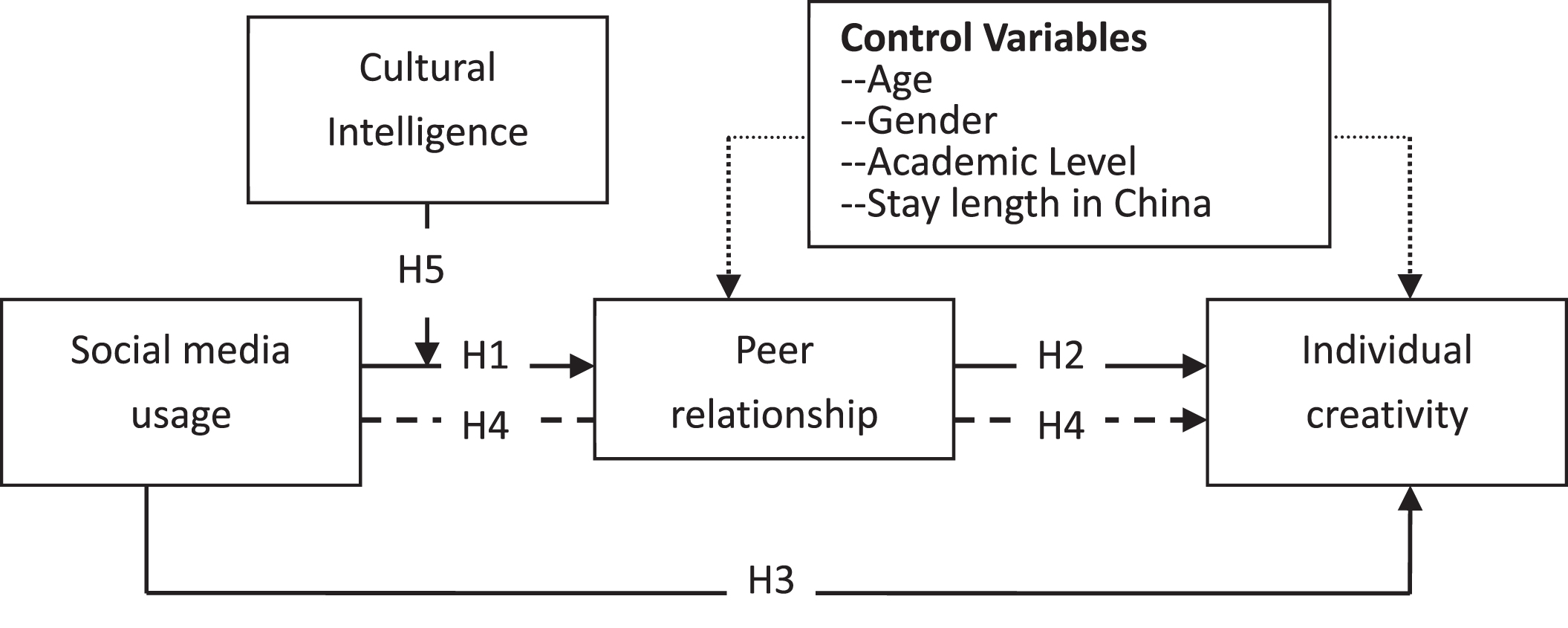
Proposed research model. Dotted lines indicate the mediation pathway.
Regarded as an individual’s malleable attribute, cultural intelligence represents one of the key expatriates’ capabilities to effectively manage cross-cultural related issues [21]. Evidence suggests that cultural intelligence contributes to expatriates’ cross-cultural adjustment, self-efficacy and creativity [15, 22]. In light of the two most influential factors from personal attributes and environmental elements in a foreign environment, cultural intelligence and social media usage are expected to exert profound effects on expatriates’ international assignments. However, it is under-investigated how cultural intelligence interacts with social media usage to influence expatriates’ creativity.
In order to fill in the above mentioned gaps, we employed the interactionist perspective as an overarching theoretical lens to develop a research model aiming to explicate the process through which individual creativity is developed [20, 23]. The theory argues that individual creativity is constellations of both individual differences and environmental factors [24]. For international expatriates, they are exposed to a complicated environment wherein social media and peer relationship are two most influential environmental factors, whilst their personal cognitive, motivational and behavioral capabilities comprise their personal attributes to tackle complicated cross-cultural issues. In this regard, we contend that interactionist perspective could match well the complexity of cross-cultural settings and illuminate the mechanism through which international students’ creativity is developed.
To be more specific, the current research is designed to explicate how social media usage impinges on international expatriate’ creativity through the conduit of peer relationship. Furthermore, we investigate how international expatriates’ personal attribute, namely cultural intelligence, moderates the relationship between social media usage and peer relationship, thereby influencing expatriates’ creativity.
The remainder of the research is organized as follows. The next section explicates literature review and hypothesis development, followed by research methodology. After data is analyzed, discussion part is included, and then implications are discussed. The last part is the conclusion part, which sums up the whole research paper. The proposed research model was shown in Fig. 1.
Social media usage and peer relationship
Defined as “a group of Internet-based applications that build on the ideological and technological foundations of Web 2.0, and allow the creation and exchange of user-generated content” [25], social media has attained its popularity among youngsters over the last two decades. For instance, registered users for Facebook reached 1.55 billion in September 2015 [26] and the monthly active users of Wechat in China have reached 500 million, which made the platform become the leading social networks [27].
In order to clarify the functions of social media usage, scholars explored users’ motivations by summarizing social media usage into two basic categories, informational and socializing [18]. Informational social media usage mainly refers to users’ behaviors of online information gathering and spreading for seeking solutions to specific problems [15]. Likewise, socializing social media usage illustrates users’ intention to establish and maintain interpersonal relationships with their peers, seniors, friends and families [28]. Behind the two categories of social media usage, scholars argued that informational social media usage is driven by users’ utilitarian value to improve users’ cognitive readiness while socializing social media usage is driven by users’ hedonic value to prepare for emotional and sensory enjoyment [15].
As a dominating peer relationship and key component for adolescents’ daily lives, peer relationship refers to the degree that peers care about, and support one another [29, 30]. Peer relationship seems to be more important for international expatriates because international expatriates travel far from their home countries and are separated themselves from their home cultures [19]. Such overseas experiences may exert negative effects on their psychology and behaviors because of unfamiliar environment and cultural conflicts [9, 15].
As evidence indicates, social media has become an indispensible part in international expatriates’ daily lives [15]. When they frequently use social media, they aim to search for relevant information for the purposes of interaction adjustment, general adjustment and work or learning adjustment [31]. Literature suggests that international expatriates have more difficulties to attain required information than locals [26]. Supported by social media, international expatriates feel much easier to seek for information they want from their peers. Likewise, the locals also get more acquainted with their international peers through information exchange behaviors. Further, driven by the key value of social media usage, establishing and maintaining interpersonal relationship with locals helps international expatriates better understand the cultural differences of the host country [15], which brings them more feasibility to integrate into the mainstream both psychologically and physically. Hence, socializing social media usage benefits the communication and interaction of expatriates’ community and contributes to positive peer relationship.
Based on the above reasoning, we hypothesize that: Social media usage is positively related to peer relationship.
As a diffuse construct, creativity was defined in various forms concerning the relevant research fields. Notable scholars have defined creativity as the process of generating new ideas [32, 9]. In the educational context, creativity refers to development of expatriates’ breakthrough of restrictive methods to diverse and novel ideas during their learning process [33]. In terms of conceptual model, four types of creativity have been expressed, Big-C, Little-C, Mini-C and Pro-C [34]. Big-C refers to unprecedented and influential creativity. Little C represents daily creativity. Mini-C is generated during the learning process and Pro-C refers to professional-level creativity [33, 34].
In the last 50 years, empirical study of creativity has been steadily burgeoning [35]. Considerable evidence suggests that creativity is the key solution to problems with critical thinking and enables individuals to adapt to a globalised, competitive and complex environment [36]. Even though few studies have identified the direct and indirect relationships between international experiences and creativity development [33, 9], there is lack of research investigating whether and how peer relationship, which is developed in cross-cultural context, contributes to international expatriates’ creativity [19].
In order to attain creative capability, international expatriates expose themselves to both virtual and real worlds. From the perspective of Four Ps (Person, Process, Press, and Product) for creativity [37], context and specific settings create space for creativity. During the process of interaction and communications with their peers, they learn from their peers in different ways. On one hand, when international expatriates have established sound peer relationship with locals and other international expatriates from different cultural backgrounds, they learn about cultural novelties which break through their original regimes of a single culture [9]. Those novel ideas and thinking styles from other cultures nourish international expatriates’ nomological framework of knowledge [15]. In this regard, learning methods and thinking stereotypes of international expatriates are enriched and broadened. As such, expanded knowledge reserve contributes to their creativity. On the other hand, according to social exchange theory, high-quality of peer relationship is characterized by mutual trust, close contact and successful collaborations. This indicates that good relationships with peers facilitate international expatriates to develop psychological and physical well-being [38, 39], and thus influence their engagement, commitment and extra-role performance [40]. It is likely that expatriates with intimate peer relationships enjoy more psychological comfort and have more reciprocity in exchanging ideas [41]. In this regard, their creativity will be enhanced.
Based on the above reasoning, we hypothesize that: Peer relationship is positively related to international expatriates’ creativity.
With the help of advanced social media platforms, international expatriates expose themselves to the virtual world, which offers more spaces for loads of information and timely communications. Previous research indicates that social media usage benefits users both psychologically and cognitively [15, 19].
As literature indicates, international expatriates are confronted with more challenges in many aspects than domestic people in cross-cultural contexts [31]. Driven by the value of utilitarian, international expatriates surf social media seeking for information with the purposes of cultural familiarity, social and academic adjustment [15]. Those loads of searched information add new knowledge into expatriates’ cognition framework and help to develop their thinking styles with new perspectives which are different from those rooted in their home cultures. Further, during the process of interaction with locals and other peers from different cultural backgrounds, social media usage benefits international expatriates with new ideas for solving specific problems. Those problems may relate to their international activities, daily routine or academic learning. New ideas generated by their peers develop international expatriates’ thinking ability for generation of novel ideas. Additionally, socializing purpose of social media usage also benefits expatriates to attain more social support and social capital [42]. Those resources are deemed to provide more conditions and prepare them with psychological readiness to generate new ideas for specific problems. Few studies have successfully identified that social media usage is a reliable channel to boost international expatriates’ self-efficacy [15, 19] and cultural intelligence, the capability to deal with cross-cultural related issues [9]. Relevant research has also identified the direct relationship between cultural intelligence and expatriates’ creativity [9]. In summary, social media usage is expected to positively influence expatriates’ creativity.
Based on the above statements, we hypothesize that: Social media usage is positively related to international expatriate’s creativity.
International expatriates traveling far from home cultures are inclined to rely more on social media to maintain personal relationships with families and friends, overcome cultural difficulties and establish new interpersonal contacts [19]. Social media usage is deemed to impact expatriates both psychologically and cognitively [15]. In this regard, the core value of social media usage for international expatriates is to build and maintain interpersonal connections with their peers and instructors in a foreign environment [16]. We propose that well-established peer relationships will be of great significance as the affective components leading to expatriates’ feelings of psychologically safe and comfortable environment [43]. In this context, expatriates’ willingness to take more risks has been increased to explore more creative ideas in daily activities [4].
Facilitated by social media usage to build and maintain good interpersonal relationships, international expatriates engage themselves more into a learning climate [35]. Benefited from such a learning climate, international expatriates exchange with their peers about new ideas and perspectives characterized by unique cultures [15, 44]. International expatriates’ original cognitive structures will be destabilized and new elements will be added into their holistic cognitive style [19, 44]. Those new inputs and shaped knowledge framework facilitate international expatriates to think, feel, perceive, and behave from different perspectives and combine valuable elements for creativity development [9]. In this regard, social media usage contributes to positive peer relationship and thereafter brings opportunities to resources growth for creative expansion.
Thus we hypothesize that: Peer relationship mediates the effects of social media usage on individual creativity.
Given the importance of global competition and cultural complexity, expatriates’ cultural competencies and cognitive capabilities to deal with cross-cultural issues are vital for both individuals and international companies [45]. In order to explicate such a cross-cultural capability and differentiate it from other capabilities, scholars have proposed a new concept, cultural intelligence to conceptualize the set of intelligences allowing people to deal with cross-cultural situations effectively [46].
Cultural intelligence (CQ) was conceptualized as a multidimensional construct with four dimensions which represent different foci of capabilities respectively, namely meta-cognitive CQ, cognitive CQ, motivational CQ and behavioral CQ [21]. To be more specific, meta-cognitive CQ refers to individual’s capability to control and manage cognition for acquirement and comprehension of cultural related knowledge, and thought process in novel cross-cultural settings [21]. It involves higher-level cognitive functioning to process adjustment to self-concept and flexibility to comprehend novelties in culturally diverse environment [45]. Cognitive CQ represents the capability characterized with expanded knowledge structures which are embedded with other cultural values, regulations, traditions, conventions, norms, taboos, and practices of a foreign country [47]. Motivational CQ refers to individuals’ capability to direct their attention and energy to learning activities and functioning in cross-cultural environment [48]. Finally behavioral CQ is characterized with individuals’ flexibility to demonstrate appropriate behaviors, verbal or non-verbal, to match specific culturally diverse situations [15].
As a key capability required for individuals’ flexibility in dealing with complex cross-cultural situations, CQ has demonstrated its sufficient power to explain effectiveness of individuals’ performance in overseas assignments and learning activities. For international expatriates, cultural intelligence has been identified as a crucial element to facilitate their cross-cultural adjustment, self-efficacy and creativity [9, 19].
Based on the previous research, we contend that CQ also facilitates international expatriates’ social media usage to improve peer relationship during their international experiences. First, expatriates with higher-level of meta-cognitive CQ can manage and control their cognition process when they use social media usage to exchange information and socialize with their peers from different cultural backgrounds. Likewise, they demonstrate more proactivity to use social media to establish and maintain relationship with their peers. Second, expatriates with higher-level of cognitive CQ know well about cultural differences and similarities between cultures. This helps them to select the most appropriate information and demonstrate good socializing manners when they use social media to interact with their peers. Their expanded knowledge structures help them to seek for cultural common sense and avoid potential cultural taboos, which surely improves their relationship with peers [48]. Thirdly, those with higher-level of motivational CQ demonstrate more interests, confidence and intrinsic motivation to use social media for information exchange or socializing purpose [19, 47]. Their psychological comfort and well-being contribute to frequent interaction and make them more acceptable with their peers. Accordingly, behavioral CQ facilitates international students to exhibit more appropriate verbal and nonverbal behaviors during the process of social media usage to exchange and socialize with their peers from other cultures. Individuals characterized with appropriate behaviors matching the mainstream culture meet with the tastes of the majority and get more access to integrate into the local community [15].
Based on the above reasoning, we hypothesize that: Cultural intelligence positively moderates the relationship between social media usage and peer relationship.
Means, Standard Deviations (SD), and Correlations
N = 248, variables were measured on five-point scales. The diagonal elements are the square roots of AVEs. *p < 0.05, **p < 0.01, ***p < 0.001.
Samples
Numerous studies researching international expatriates were conducted using international students as the samples. Like other groups of international expatriates, international students are confronted with the same problems of cultural shock, conflicts, cross-cultural adjustment in a foreign environment [15, 16]. As a special sub-group of international expatriates, international students are valuable contemporary resources for quick responses and efficacious solutions to manage the complexities in such an interconnected world [49, 50]. Regarded as the most important part of world talent reservoir and tomorrow’s business leaders, international students become highly valuable resources for international businesses and world’s continuous prosperity [9]. As such, developing international students’ creativity becomes a prioritized task for both educators and international businesses.
With the fast development of Chinese economy, China has become the third largest destination for international students in the world. According to the statistics, 492,185 international students from 196 countries chose to study at Chinese universities in 2018, which made China the largest destination for international learners in Asia [51]. Additionally, the majority of previous research about international students was conducted in western countries, while neglecting the group studying in non-western cultures.
A questionnaire survey was conducted at three Chinese public universities. With assistance of officials taking charge of international education at three universities, 399 questionnaires were delivered to the volunteer students. After that, we sent emails and called them as follow-up measures to increase the response rate. 327 questionnaires were collected back from those international students (82% response rate). After deleting the unqualified data, we used 248 questionnaires for the current research. Among 248 students, the average age is 21.99 among which 46% is between 12 and 20. 125 (50.4%) participants were boys and 123 (49.6%) were girls, who were from Asia (51.2%), Africa (31.5%), North America (15.7%) and other parts of the world (1.6%).
Measures
Relevant literature was first reviewed for the selection work of measure validation. Three international students were invited to finish the English-version questionnaires and gave their feedback for further revision in order to ensure the questionnaires to match the status quo of the current students studying in China. Four academic scholars were also invited to evaluate the questionnaire to ensure measures’ validity. All the variables were measured with five-point Likert scales, which ranged from “1 = strongly disagree” to “5 = strongly agree”.
To measure social media usage, we used six items proposed by Hughes et al. [52]. Three items were proposed to measure informational social media usage and other three were used to measure socializing social media usage. The sample items included “I use social networks to keep abreast of current events.” and “I use social networks to communicate with friends”.
A five-item scale was adapted to measure peer relationship, which was originally developed by Seers [53]. The sample items included “I often suggest better learning methods to others” and “Other members understand my problem”.
Creativity was tested with a six-item scale, which was adapted from Madjar et al. [54]. Sample items include “I am a good source of highly creative ideas” and “I demonstrate originality in my learning or research”.
A 20-item scale proposed by Ang et al. [55] was adopted to measure four dimensions of cultural intelligence, among which 4 items were used to measure meta-cognitive CQ, 6 items for measuring cognitive CQ, 5 items for measuring motivational CQ and 5 for assessing behavioral CQ. The sample items included “I am conscious of the cultural knowledge I apply to cross-cultural interactions”, “I know the cultural values and religious beliefs of other cultures”, “I am sure I can deal with the stresses of adjusting to a culture that is new to me” and “I vary the rate of my speaking when a cross-cultural situation requires it”.
Data analysis
Assessment of variables
We tested all the factors’ convergent validity with factor loadings, composite reliability (CR), Cronbach’s alpha, and average variance extracted (AVE) to test their convergent validity. Table 1 shows that the assessment results meet the benchmark value [56]. To be more specific, the loadings of all factors’ items were above 0.6. Convergent reliability of each construct ranged from 0.840 to 0.922 and was above required benchmark value 0.7. Cronbach’s alpha of each factor ranged from 0.729 to 0.897, which was over required 0.7, and AVE for each construct also ranged from 0.513 to 0.764, which was over required 0.5. These results presented that the measures have good convergent validity. We further examined the discriminant validity of each measurement. Table 2 shows that in comparison with the correlations between each construct and the other constructs, the square root of AVE for each construct was greater than the correlations between the construct and the others. This finding presented a good discriminant validity of the measures.
Measurement of constructs
Measurement of constructs
To assess the possible common method bias, we used Harman’s one factor, recommended by Podsakoff, Mackenzie, and Podsakoff (2012) [57]. Four principal components were generated (with an eigenvalue greater than 1). The first principal component only explained 39.405% of the variance, which indicates that the common method bias is not serious. Further, we used confirmatory factor analysis (CFA) to assess common method bias. The CFA results show that the four-factor model was considerably better (x2/df = 2.16, CFI = 0.97, IFI = 0.97, RFI = 0.94, SRMR = 0.057, RMSEA = 0.044) than that of the single-factor model (x2/df = 9.17, CFI = 0.86, IFI = 0.86, RFI = 0.83, SRMR = 0.12, RMSEA = 0.18). Based on the two tests, the common method bias for the current research is not a serious concern.
Results of hierarchical regression analyses for mediation
Results of hierarchical regression analyses for mediation
N = 248 . Standardized regression coefficients are shown. *p < 0.05, **p < 0.01, ***p < 0.001.
Results of hierarchical regression analyses for moderation
N = 248 . Standardized regression coefficients are shown. *p < 0.05, **p < 0.01, ***p < 0.001.
Regression analysis was conducted to examine each hypothesized statement. Tables 3 and 4 show the final regression results. Consistent with H1, the results indicated that social media usage is positively related to peer relationship (β= 0.316, p < 0.001). Thus H1 was supported. The results further showed that peer relationship is significantly related to individual creativity (β= 0.532, p < 0.001), thereby supporting H2. Further, consistent with H3, social media usage was also found to be positively related to individual creativity (β= 0.361, p < 0.001). Additionally, the role of peer relationship was found to partially mediate the relationship between social media usage and expatriate’s creativity, which supported H4 as well.
We further examined the moderating effect of cultural intelligence. H4 hypothesized that cultural intelligence positively moderates the relationship between social media usage and peer relationship. Consistent with the hypothesis H5, the results confirmed that cultural intelligence positively moderates the relationship between social media usage and peer relationship (β= 0.120, p < 0.01). The analysis of simple slope also confirmed the moderating role of cultural intelligence (Table 4 and Fig. 2).
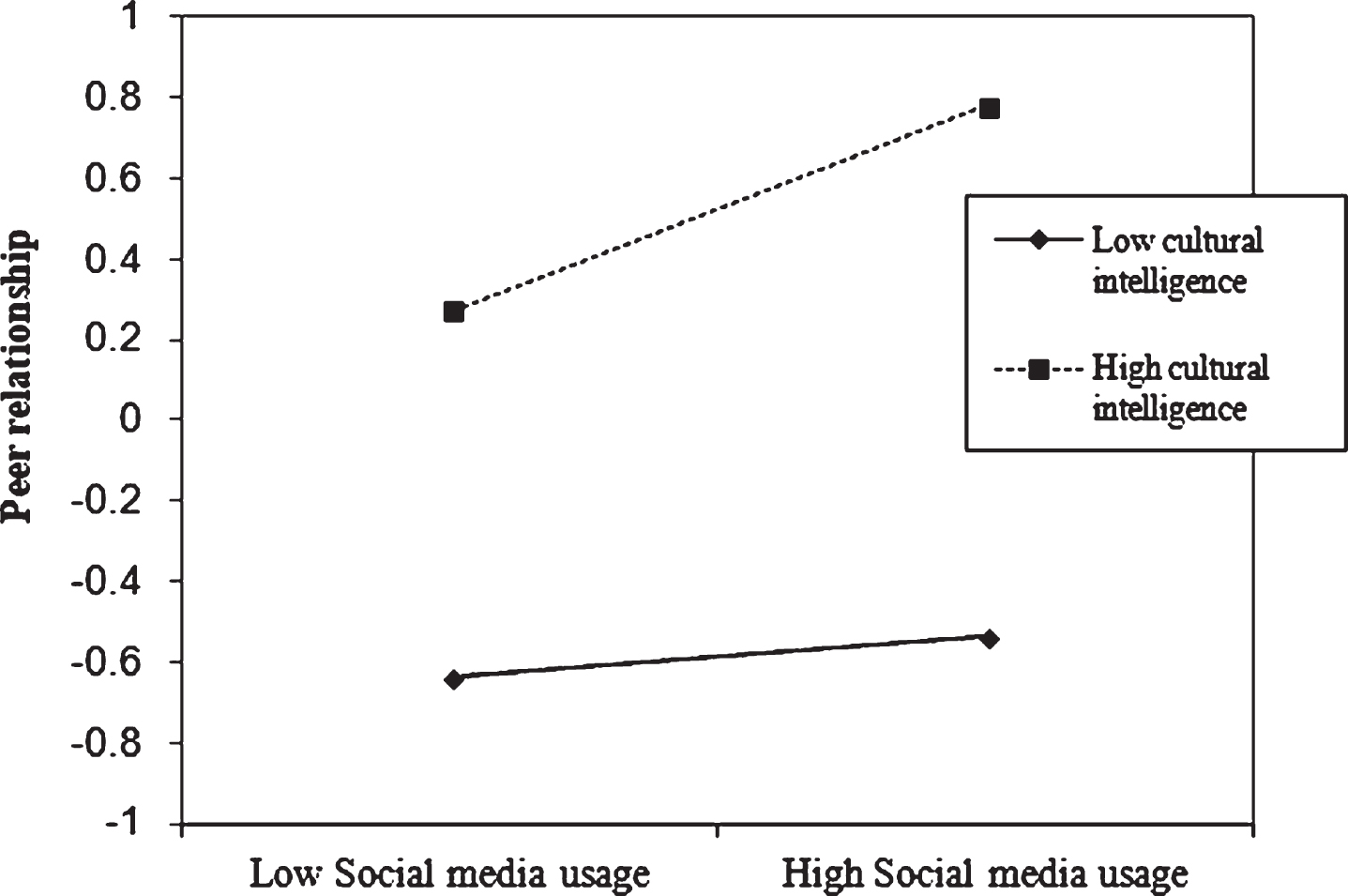
Moderating effect of cultural intelligence on the relationship between social media usage and peer relationship.
The current research developed a model analyzing how social media usage impacts expatriates’ creativity and the moderating effect of cultural intelligence on the relationship between social media usage and peer relationship in cross-cultural context.
The research findings support the proposed relationships among social media usage, peer relationship and expatriates’ creativity, which are consist with the prior research findings. For example, social media usage is confirmed to impact expatriates’ creativity and this is consistent with the prior research indicating that social media usage benefits individual cultural intelligence directly [15] and exerts indirect influence on expatriates’ creativity [9]. The research also identifies that peer relationship contributes to expatriates’ creativity, which keeps consistent with extant research suggesting that peer relationship is directly related to individual creativity [58]. Further, peer relationship partially mediates the relationship between social media usage and individual creativity, which in part keeps consistent with prior researching indicating that peer relationship is an efficacious conduit to enhance individual creativity [59].
Additionally, CQ moderates the relationship between social media usage and peer relationship. Prior evidence has confirmed that CQ is a key capability to facilitate overseas individuals to survive and succeed in cross-cultural environment by playing moderating and mediating roles [9, 59].
Theoretical and practical implications
The current research makes important theoretical contributions. First, the current study contributes to the literature of creativity by identifying that social media usage is a reliable resource to enhance expatriates’ creativity in cross-cultural environment. Even though previous research has identified the indirect relationships between social media usage and personal development [9, 60], this study addresses the gap of unveiling the direct relationship between social media usage and individual creativity, particularly in complex cross-cultural settings.
Further, the current research also contributes to the educational research about how peer relationship impacts on individual capability. Although previous research has touched that peer relationship is conducive to individual psychology and engagement [38, 40], the current research further identifies that peer relationship is an antecedent for individual creativity. Moreover, such a relationship has been uncovered as a bridge to mediate the relationship between social media usage and individual creativity. This enriches our understanding about new roles of peer relationship in cross-cultural contexts.
Third, based on our research findings, cultural intelligence has been identified to moderate the relationship between social media usage and peer relationship. Although previous research has already unveiled the different roles of cultural intelligence (moderating or mediating), this study is among the first trials to combine cultural intelligence research with information technology management [15, 16]. Accordingly, due to the fact that construct of cultural intelligence is attached to the cross-cultural study, the current research contributes to research about social media usage by considering cross-cultural construct, namely cultural intelligence. The research indicates that individuals with higher-level of cultural intelligence can better leverage on social media to develop interpersonal relationship, thereby influencing individual creativity.
Except for its theoretical contributions, the current research also has practical implications for international expatriates and educators.
First, the research findings suggest that creativity can be developed from social media usage in cross-cultural environment. This implies that social media usage, either for informational or socializing purpose, should be advocated. Educators should encourage international expatriates to search for relevant foreign cultural knowledge for better adjustment and preparation of engagement in learning activities. Accordingly, educational organizations should deliver more useful information on their designed social media platforms to help international students to enhance their cultural understandings and personal capability. Moreover, international expatriates should be encouraged to socialize through social media usage with their peers to learn from one another. Thus designing a public social media space for international and domestic students to communicate with each other would benefit their capability development, especially their creativity.
Second, good peer relationship has been found to be a bridge to link the functioning of social media and individual creativity. This is in particular important for international expatriates who travel far from their home countries. Any in-door or out-door activities which facilitate to develop good peer relationship should be organized. This not only helps international expatriates to overcome negative psychological changes, but to develop their capability in complex cross-cultural environment.
Third, cultural intelligence has been identified to increase the positive effects of social media usage on peer relationship. This indicates that expatriates with higher-level of cultural intelligence can better leverage on social media to serve improving peers relationship, thereby developing their creativity. Much evidence has illustrated the positive effects of cultural intelligence on expatriates [9, 21]. Based on the current research findings, training programs may be organized to improve expatriates’ cultural intelligence before and after their exposure to a foreign environment. Likewise, continuous efforts like cross-cultural activities and competitions could be made to improve expatriates’ cultural intelligence. Those measures will not only help with their cross-cultural adjustment, but also help to establish good interpersonal relationships for the benefits of developing their personal capability.
Limitations and future research directions
Except for its significant contributions, the current research also has limitations. First, the current research has only explored the mediating role of peer relationship and moderating role of cultural intelligence. More empirical research is required to further explore boundary conditions for social media usage in cross-cultural environment. Second, the current research adopts the cross-sectional design. All variables in the research model can only be inferred to be associative, not causal. Future longitudinal or experimental design could be alternatives to solve this problem. Third, the research samples for the current research are international students. And most of them came from Asian and African countries. Thus the researching findings should be cautiously generalized to other groups and to other continents.
Conclusions
The current research develops a model exploring the relationship between social media usage, peer relationship and individual creativity in cross-cultural context. Further, the moderating role of cultural intelligence is considered. The research findings suggest that social media usage contributes to peer relationship, thereby positively influencing individual creativity. Additionally, cultural intelligence positively increases the effects of social media usage on the peer relationship.
To the best of our knowledge, this study is among the first trials to combine cross-cultural studies with information management. Although the results have identified the underlying mechanism how social media usage impacts on individual creativity, there is much potential space for future research. And this paper serves to arouse more scholarly attention to apply interdisciplinary analytics approaches to investigate how to solve complicated cross-cultural issues.
Author contributions
Conception: Shangui Hu
Interpretation or analysis of data: Guoyin Wang
Preparation of the manuscript: Lingyu Hu
Revision for important intellectual content: Jinnan Wu
Supervision: Shangui Hu
Footnotes
Appendix:
I use social networks (e.g., Twitter, Facebook) to find and spread information. Social network is primarily for information. I use social networks to keep abreast of current events. I use social networks to communicate with friends. I use social networks because my friends do so. Social network is primarily for socializing.
Others let me know when I affect their study. Other members recognize my potential. I often volunteer my extra help. I am willing to finish task assigned to others. Others are willing to finish task assigned to me.
I use previously existing ideas or research in an appropriate new way. I am very good at adapting already existing ideas or research. I can easily modify previously existing work processes to suit current needs. I am a good source of highly creative ideas. I demonstrate originality in my learning or research. I suggest radically new ways for learning or research.
I am conscious of the cultural knowledge I use when interacting with people with different cultural backgrounds. I adjust my cultural knowledge when I interact with people from a culture that is unfamiliar to me. I am conscious of the cultural knowledge I apply to cross-cultural interactions. I check the accuracy of my cultural knowledge as I interact with people from different cultures. I know the legal and economic systems of other cultures. I know the rules (e.g., vocabulary, grammar) of other languages. I know the cultural values and religious beliefs of other cultures. I know the marriage systems of other cultures. I know the arts and crafts of other cultures. I know the rules for expressing nonverbal behaviors in other cultures. I enjoy interacting with people from different cultures. I am confident that I can socialize with locals in a culture that is unfamiliar to me. I am sure I can deal with the stresses of adjusting to a culture that is new to me. I enjoy living in cultures that are unfamiliar to me. I am confident that I can get accustomed to the shopping conditions in a different culture. I change my verbal behavior (e.g., accent, tone) when a cross-cultural interaction requires it. I use pause and silence differently to suit different cross-cultural situations. I vary the rate of my speaking when a cross-cultural situation requires it. I change my nonverbal behavior when a cross-cultural situation requires it. I alter my facial expressions when a cross-cultural interaction requires it.
Acknowledgments
The research was financially supported by Anhui Provincial Natural Science Foundation under Grant 1908085MG238, 2019’ National Education Sciences Planning Project of China under Grant BBA190019 and the Humanity and Social Science Major Foundation of Education Committee of Anhui Province under Grant SK2019ZD07.