




Abstract
BACKGROUND:
ICT based mobile working gives organizational flexibility, productivity and performance but at the same time it can lead to techno-stress and technostrain perceptions. A high level of technostrain amongst ICT-based mobile workers would impact their well-being, leading to lesser than expected gains from such organizational ICT investments. Given this paradox, we examine the actual transactional and relational stressor-strain coping response processes in this novel context.
OBJECTIVE:
The broad research aim of this paper is to explain the relative importance of the cognitive and affective processes used amongst ICT-based mobile workers when coping with technostressors.
METHODS:
Specifically, based on technology frames literature, we develop dual-path serial mediation models, showing the relationships between technostress-technostrain via two processes: (a) the primary cognitive appraisal process mobilization (threat/opportunity technology frame) and (b) the secondary affective resource process mobilization (affect towards ICT use) to account for technostrain perceptions. We use survey data from 165 ICT-based mobile managers from diverse work settings to empirically confirm the theorized models.
RESULTS/CONCLUSIONS:
A predominant cognitive ‘threat frames’ leads to increase in technostrain, which decreases if ‘affective resource’ is available for coping. This relationship is inverse in the case of ‘opportunity frames’ path, as technostrain perceptions decreases with and without affective resource mobilization. Implications to theory, practice and methods are also discussed.
Keywords
Introduction
Digital technologies offer organizational flexibility, operational efficiency and productivity enhancing perceptions and capabilities. The reliance on information communication technology (ICTs) for work has given rise to ‘new ways of working’ [13, 28] as well as shifted the preoccupations of organizations from employee satisfaction to employee experience [41, 72]. ICT-based mobile working is one of the new ways of working that has the potential to alter the cognitive, affective and behavioral aspects of organizational actors and their social fabric. A recent Microsoft survey of 20,000 European knowledge workers indicates that constant contact with technology at work causes stress which leads to reduced job satisfaction, organizational commitment and productivity [5].
ICT-based mobile workers are predominantly highly skilled full-time knowledge workers (often managers) not constrained by their place of work, who spend a large part of their time working with ICTs (computers, the Internet, e-mail and social networks) [51, 71]. Technostress is predicted to have serious psychological impact termed as technostrain on ICT-based mobile workers [71] apart from regular work exhaustion [3, 64]. As more organizations are mulling over how to address the new talent gap crisis and how to retain skilled employees in digital organizations [41, 78], addressing the issue of technostress and technostrain is clearly essential and timely as it extends the contextual elements to better understand and foster employee well-being [79].
The leading theory used in past technostress research that is used to explain the negative influence of technostress creators is the transactional model of stress and coping or TMSC [37, 67]. This theory is often leveraged only in two scenarios. Firstly, to explain the structural process (What) of stressor appraisal by human agencies but not to account for the appraisal mobilization process (How) by human agency. Secondly, to incorporate only the cognitive dimension of the human agency for the appraisal, while not accounting for the affective dimension of the human agency. Because technostress coping is in fact a transactional and relational stress-coping response process that is embedded within a sociotechnical context, it is important to theorize the social meaning-making process in a specific context. Technostressors are known to have both positive and negative impacts on technology users [64].
Thus far, in the context of ICT-based mobile workers, we do not know how this technosstress-coping response process occurs. The current study addresses these significant gaps, namely — knowledge void (absence of technostress coping process theorized; affective element; technology dependent outcomes not sufficiently studied in past literature), theory application void (coping mobilization process not theorized using TMSC thus far) and evaluation void (technostress-technostrain in the context of ICT-based mobile managers is a novel context) in the past technostress coping literature [93]. Thus there is a need for a more thorough examination of the transactional and relational process infused with the cognitive and affective dimension in the stressor appraisal process by ICT-based mobile managers in work settings [43] who face technostress creators on a daily basis.
Grounding our arguments in TMSC and technology frames concept [47], we argue that, in the first instance, technostrain response is an emotional response triggered by the technology frames of reference that are used to perceive technostressors in the ICT-based mobile working environment. These technology frames can be predominantly a threat frame or an opportunity frame, thus enabling us to account for both positive and negative effects of technostressors. This is followed by the affective coping resource mobilization process. We believe that the prior affect towards technology [70] possessed by ICT-based mobile managers is a crucial coping resource that is mobilized in this second stage of appraisal. We then, look at the serial impact of these two cognitive and affective processes to theorize the influence of technostrain perceptions experienced by the ICT-based mobile managers. In the light of the above, the three primary research questions that this paper addresses in the context of ICT-based mobile working are:
R1: What is the relationship between the technostressors and technostrain?
R2: How does the two dominant technology framing approaches amongst ICT-based mobile managers influence the primary appraisal process between technostressor interpretation and technostrain perceptions?
R3: What is the role of the technology-specific affective coping potential of the ICT-based mobile managers in stressor appraisal and response?
By answering these questions, we aim to make the following key contributions to theory and practice. Firstly, this paper provides empirical evidence that links two sociotechnical phenomenon generated due to the ‘new ways of working’ called ICT-based mobile working, i.e., technostress creators and technostrain perceptions. Knowing how technostress creators are linked to technostrain perceptions is crucial in understanding how the ICT-based manager’s appraisal process can inform organizations attempting to mitigate the negative impacts of such work forms so as to reap benefits from their ICT investments. Secondly, leveraging cognitive categorization theory and the concept of technology framing, for the first time, this paper theorizes the role of (threat and opportunity) technology framing as the cognitive process that mediates the techno stressor-strain relationship. It further expands on the notion of affect with regard to technology and its role in the transactional-relational process of technostress appraisal, thereby enriching the current technostress-coping literature in the context of ICT-based mobile workers. Thirdly, this study is also one of the view studies that uses a dual-path serial mediation model for theorization with the help of Smart PLS 3 software [56]. Thus, the paper can serve as a methodological guide on how to conduct and report on this type of mediation for other aspiring researchers testing complex structural models.
Background literature
Technostressor: The relational and transactional interpretative process
Organizational employees in general and ICT-based mobile workers in particular are increasingly dependent on ICTs for their work. The ubiquitous and pervasive nature of such technologies disrupts the natural balance or the homeostasis of such workers resulting in significant technostress perceptions of five kinds - techno-overload, techno-invasion, techno-complexity, techno-insecurity, and techno-uncertainty [69] - which demands a stressor appraisal followed by coping efforts, both of which require the utilization of the employee’s cognitive and affective resources [64]. Techno-overload describes situations where use of new technologies forces employees to work more and faster. Techno-invasion describes being “always exposed” and reachable anywhere, anytime. It also includes the perceptions of need to be constantly connected. Techno-complexity describes situations where the complex computer systems used at work drive employees to spend time and effort in learning and understanding new applications to update their skills. Techno-insecurity arises in situations where the employee feels threatened about losing his/her job to those who have better ICT skills. Techno-uncertainty relates to the sense of helplessness in the face of rapidly changing computer knowledge and skills that require constant adaptation.
The technostress phenomenon has been studied in various contexts including end user computing, amongst IT professionals, IT consultants working at client sites, teleworkers, and librarians, and often shown to negatively impact on job outcomes [64, 67]. Research has often linked technostress creators to other organizational outcomes that are technology neutral such as job strain, productivity, job satisfaction, burnout and job engagement [64, 67–69]. A small number of studies delve deeper into the question of how best to handle technostressors and strain caused due to technology, i.e. technostrain within organizations [3, 67]. Relatively few studies show that, depending on interpretation, technostressors can have both a positive and negative influence on organizational outcomes [64]. However, none of the studies that show positive or negative outcomes uses an exclusive sample of ICT-based mobile managers specifically.
We know that technostressors are filtered through various sense-making techniques by human agency. Humans use prior frames or categories to classify an equivocal stimulus, in order to make sense of it and enact appropriate coping behavior. However, little research looks into technology-specific outcomes, which are crucial in a technology-mediated work environment [67], and how this cognition and sense-making might be enacted to influence this outcome in the context of an ICT-based mobile manager’s technostress. This study bridges this research gap by studying how this specific workforce with unique characteristics (involved in knowledge incentive work, most often managers, full time contractual employment, high reliance on ICT, mobile workplace and higher degree of tenure in their jobs) affords meaning to technostressors (an equivocal work stimulus) that can cause technostrain (a technology-specific job outcome).
According to TMSC theory, a perceived imbalance in the demands made by the environment upon the individual and vice versa can lead to strain. The relationship between stressors and the generated strain is mediated by (1) the individual’s appraisal of the stressors, and (2) the action taken by the individual in view of the available resources at the individual’s disposal [2, 36]. The primary appraisal is a person’s judgment about the significance of the stimulus as stressful, positive, controllable, challenging or irrelevant. When appraising a technology-related stimulus, users view it as a threat or an opportunity [6]. In the secondary appraisal, those individuals evaluate their coping potential in order to enact different coping efforts [37]. However, we note that positive primary appraisals of technological stressors amenable to TMSC are often not theorized or investigated in past studies.
Moreover, the TMSC is also referred to as the emotional appraisal theory, but the affective dimension is almost always skipped in technostress-strain research. Past IS research has considered this aspect in the context of IT use. Any IT stimulus is firstly filtered through a cognitive process [6] which is then theorized to trigger emotional responses in the user, leading to the use of a specific coping strategy in the context of general IT use [65]. However, the appraisal of the affective potential of the human agency, such as measuring the expected affect toward IT use, has not been studied so far in technostress literature.
Since we were interested in studying the ICT-based mobile managers, we further looked at the managerial cognition literature to understand how issues and stimulus are dealt with by managers. We find that this literature also echoes a similar reasoning to that of the IT use literature. Studies posit that evaluating events, developments and trends in order to identify issues is a routine activity for managers [25]. Often such issues encountered by managers are ambiguous and require interpretations [11]. Thus, we see that there are two major streams of literature that tackle the phenomenon of issue and stimulus interpretations in sociotechnical work environments: one that relies upon organizational studies that uses prior cognitive psychology theories and another that relies on information system theories as a lens [90].
Thus integrating the knowledge from IS and from the management domain, we conclude that technostressors are unequivocal environmental stimuli that can trigger prior cognitive categorizations of frames (higher level issues) that are specific to the situation of ICT-based mobile managers during the appraisal process. The first-level cognitive appraisal mediated by technological frames can result in either positive or negative cognitive evaluation, which may then lead to emotional responses. Emotional responses depend upon affective coping potential that can be mobilized by the ICT-based mobile manager. Expected affect toward IT use as a resource is said to mediate the path between coping with the technostressor before it leads to technostrain perceptions. We will now explain the technostrain phenomenon in depth.
Technostrain: An emotional response to technostressors
It is the post-adoptive use (including diffusion, use and adoption of the technology) that is the key to unlocking economic and personal value from these technologies [3, 65]. Studies about the non-use of technology in the IS literature are limited [59]. Technology-related strain encompasses hidden responses or factors that can tip the balance between IT investments and their expected value outcomes [3]. Moreover, with new forms of work that rely on technology such as ICT-based mobile working, it becomes very important to understand the link between the use of ICTs and the expected (unintended) technostrain on the ICT-based mobile workforce [71]. Technostrain or work exhaustion caused due to technology are technology-specific responses that have not been measured adequately in the past literature (except in- [3]). More general concepts such as burn-out, lack of job engagement, and work exhaustion amongst IT professionals have been used to measure strain caused by technology [1, 40]. This study advances this stream of research [3], which measures strain caused due to ICT and does not equate it to strain caused due to a specific job function. In this study, we focus on technostrain and attempt to examine the relationship of cognitive and affect mobilization to explain how technostress creators and technostrain may be linked in a more nuanced manner. The study will therefore also address the inconsistencies cited by prior literature on technostress-job outcomes. Strain caused due to technology or technostrain has been identified as an important issue that has direct or indirect negative influence on several organizational outcomes [3]. It increases employees’ health concerns, lessens work commitment, increases work exhaustion and even decreases ICT-led productive and job engagement [1, 68]. It is also possible that it adversely affects the employee experience [41]. Thus, studying a technology-specific outcome such as technostrain is crucial to advancing our theoretical and practical understanding about new ways of working that are often mediated by technology and its impact on ICT post-adoptive behavior and IT-non-use behaviors amongst ICT-based mobile workers.
Theoretical background
Cognitive appraisal process mobilization stage
Expanding on the above literature review, and the several research gaps identified, we now elaborate the theoretical lens used by our study and enumerate how we leverage them to explain the transactional and the relationship process of stressor-coping response in the context of our study. The mobilization of the cognitive appraisal process is discussed firstly, followed by the affective resource mobilization process. For the first stage, we leverage cognitive categorization theory and organizational studies literature, and show how they have evolved within the IS domain. Cognitive categorization theory is a social cognition theory that acknowledges the power of cognitive heuristics to explain human behavior and decision-making [39]. Categorization acts as a tool to manage the cognitive load of having to remember all information stimulus/cues that arise from complex situations. According to this theory a general issue categorization precedes any specific stimulus interpretation in a given scenario [25]. Two characteristics of issues and interpretations that are widely acknowledged in general management literature are ‘threat’ and ‘opportunity’ [25, 50].
Orlikowski (1994) [47] expanded on this idea of long-lasting schemas or cognitive categories in the context of technology use in the organizations and introduced the concept of technology frames of reference. Technology frames are the assumptions, expectations, and knowledge people have about technology. These are the shared cognitive structures or frames of reference that determine the interaction between users and the technology within an organizational context [46]. Categorization involves environment-scanning activities or sense-making activity, including when technology related issues are involved. The literature on technological framing also supports the view that issue categorization pre-determines stimulus interpretations regarding technological outcomes. A few good review papers summarize the development of this concept and theory [See, 12, 45]. Other IS studies have used the two classifications of threat and opportunity as first level cognitive appraisals of stimulus when faced with a specific IT event. One of the initial studies was undertaken by [6] and a recent paper using this classification incorporates emotional aspects to the process of appraisal [74]. However, these studies do not tease out the distinction between an IT issue and stimulus. They measure the stimulus directly and do not explore how a general issue categorization may impact the appraisal of the IT stimulus.
Expanding on the concept of technology framing derived from cognitive categorization theory as a basis, this study attempts to unfold the cognitive process through which the broader issue categorization, i.e. the technology framing of general ICTs as either threat or opportunity amongst ICT-based mobile managers could influence how they eventually interpret and respond to a specific technological stimulus, technostressors at work.
Affective resource potential appraisal process mobilization stage
The primary tenet of appraisal theories including transaction model of stress and coping [37], already discussed in the literature review section, is that affective responses to the different events are based on the appraisal of the event. Past IS studies on IT events and their interpretation by a human agent were built on this notion [6, 65]. Affect is not theorized to be an antecedent to cognition. Appraisal theories hypothesize a causal link between specific appraisals and specific emotions [61]. Both the earlier and the latest IS studies quoted above have used affective response as a trigger to enacting coping effort after assessment of coping potential appraisal. Thus far, the perception of control has been used to understand the coping resource potential in the human agent [6]. An evaluation of the affective resource potential of the agent is however ignored. Affective resource potential may lead to positive or negative feelings about a specific situation. This potential is therefore a crucial coping resource that can be mobilized by an agent when faced with stressors [37]. The major role of coping potential appraisal is indeed to determine the appropriate response to an event by evaluating the resources at one’s disposal [61].
According to [77] TMSC, once the appraisal process is complete, i.e., when both the cognitive appraisal and affective coping resource appraisal are undertaken, the appraisal as a whole generates emotions to which coping strategies are engaged to change the person–environment relationship. The change is then effectuated by adopting strategies to regulate distressing emotions (emotion-focused coping) or by adopting strategies to change the problem causing the distress (problem-focused coping). In this study, we aim to evaluate the affective coping potential and its role in mediating the cognitive frames that are used at the primary cognitive appraisal process stage and the corresponding technostrain responses.
Theoretical model and hypotheses development
In this section, grounding our discussion in the logic of person-environment interaction or fit and TMSC [14, 94], we theorize the direct influence of technostress perceptions on the technostrain relationship. The mediating influence of the dominant technological frames of threat/opportunity and the affective coping resource potential in this relationship is explicated using cognitive categorization theory and TMSC. The research model is provided in Fig. 1. Based on the extant literature on technostress that views stressors and strain as a person-environmental interaction, it is clear that external demands that exceed an individual’s internal resources perceptions should negatively impact several organizational outcomes, both in general stress literature [7, 62] and specifically in technostress literature [3, 69].
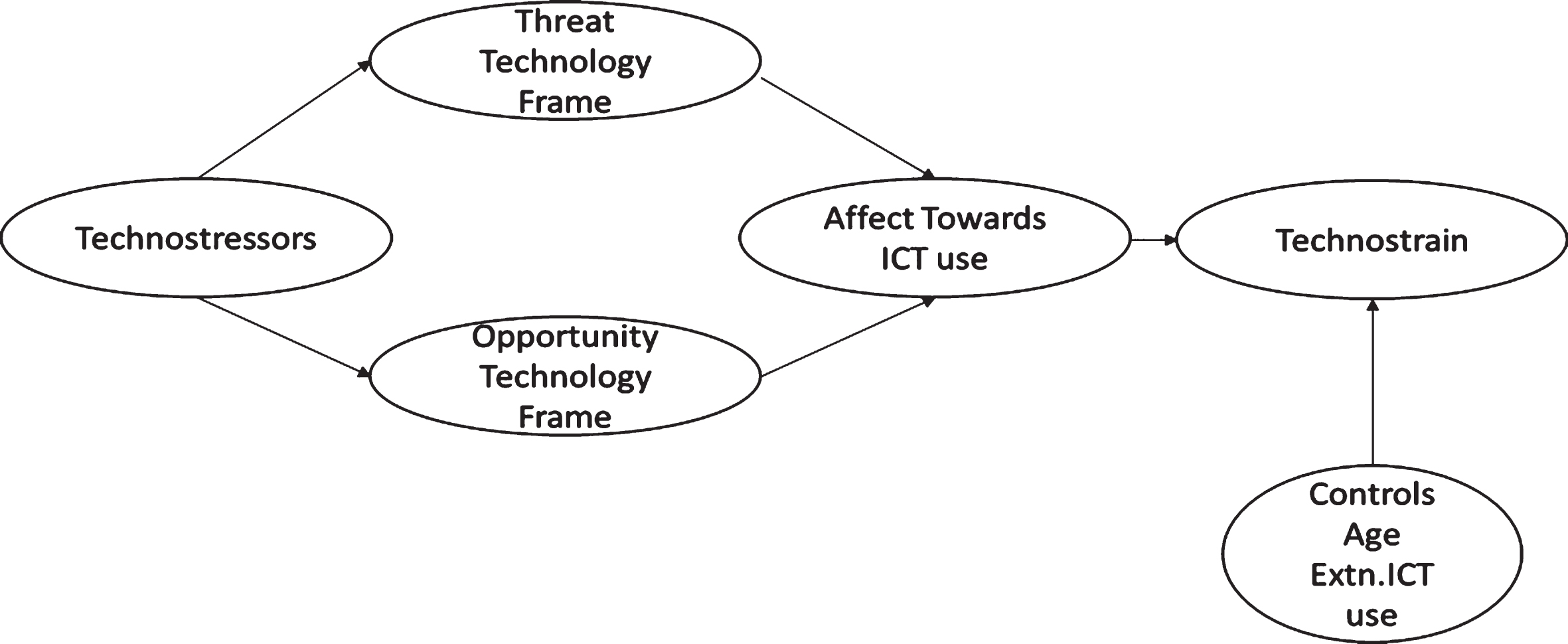
Theoretical Research Model.
[3] used the person-environment fit theory and showed that technostress can be related to technostrain. A recent paper from the psychology domain by [57] also establishes a relationship between technostressors and technostrain in particular. However, both the studies used varying measures for technostressor and technostrain perceptions. For the sake of parsimony, the current study uses an empirically validated construct of technostressors [53] and technostrain measure used in prior IS literature [3]. Therefore, the relationship between technostressors and technostrain is revisited for the context of ICT-based mobile workers.
This increased perception of cognitive and emotional strain caused due to technology induced misfit perceptions interferes with the manager’s stress-response coping process. It is proposed that strong perceptions of technostressors are a sign of misalignment between the external demands and the internal resource supplies. Emotional exhaustion due to technology also tends to lead to suboptimal utilization of ICTs for task accomplishment and socioemotional processes at work. Thus, the greater the perceptions of technostressors by the ICT-based managers the greater the person-environment misfit perception, leading to unmet demands and needs in the work environment which then leads to strain [10]. Thus, we hypothesize:
H1. Technostress is negatively related to technostrain amongst managers.
Leveraging the cognitive categorization theory discussed in the earlier section, we contend that ICT-based mobile managers might already have established cognitive ways in which they categorize issues pertaining to information communication technology (ICTs) in general. This general categorization is referred to as the technological frames in this study, i.e. Threat Technological Frames (TTF) or Opportunity Technological Frames (OTF) respectively [25, 47]. Such congruence in categorization of technology by different individuals is possible when the sample from a given population follows similar functions [47]. Therefore, we posit that ICT-based mobile managers, despite their diverse work settings, should choose to look at the specific technostress creators as an issue pertaining to information technology in general via the TTF or OTF [25]. The respective frames will then influence their perceptions and behavior relating to specific stimulus interpretation concerning a specific ICT-led phenomenon in their work context. Thus, the technology framing of general ICTs as either threat or opportunity amongst ICT-based mobile managers could influence how they eventually interpret and respond to a specific technological stimulus of technostressors. In other words, we contend that the primary appraisal of the stressors is mediated through cognitive frames (TTF/OTF) pertaining to ICTs at work. These broader categorizations or frames should automatically be used by the individuals to classify and interpret the pertinence of technostressor stimulus. The technological frames discussed above are the symbolic representation of how ICTs should be appropriated. The use and appropriation depend squarely on the general categorization of organizational ICTs.
Thus, the strength of the TTF should mediate the relationship between technostress creators and the technostrain relationship. Similarly, the strength of OTF amongst ICT-based mobile managers should act as a suppressor between technostressors and technostrain. The push and the pull effects of the dominant frames are tested in this study as dual paths of mediation that can explain how technostressors influence technostrain. This first stage is termed cognitive appraisal process mobilization.
It may be argued that an ICT-mobile worker could display both threat and opportunity frames at the same time. Therefore, it is the strength of the frames that would then determine the expected impact they might have on the cognitive and affective appraisal process mobilization stages. The TTF is a general frame that - if all ICTs at work are threatful - will lead to having a threatful appraisal about the specific technostressors present at work. Further, this will lead to increased technology-induced strain perceptions. Similarly, a dominant technology frame of OTF - that all ICTs provide an opportunity - would lead to interpreting technostressor as something challenging for work, thus paving the way to engaging in adaptive coping potential evaluation, so as to eventually come up with an adaptive coping strategy that can avoid or reduce the perceptions of technology-induced strain from ICT-based mobile working. Thus, we hypothesize both these theoretical possibilities:
H2: ICT-based mobile manager’s threat technology frames (TTF) mediate the relationship between techno stressors and technostrain perceptions
H3: ICT-based mobile manager’s opportunity technology frames (OTF) mediate the relationship between technostressors and technostrain
Based on the TMSC, we argue that OTF frames triggered due to the specific technostressor stimulus should activate the next process of appraisal, i.e. the coping resource potential of the ICT-based mobile managers. Expected affect, akin to anticipatory affect or affective forecasting, which predicts the emotional response towards ICT events are shown to be positively linked to perceptions of the current affect [31]. Consequently, it guides the congruent behavioral responses [34, 35]. In accordance with the reinterpretation hypothesis, people discount or reweigh memories of expectation-inconsistent events. This is known to correspondingly impact their current as well as future decision-making and behavioral options [31]. This concept is also similar to association affect towards an object or an event enumerated through the behavioral affective association model. This model predicts that positive/negative affective associations mediate cognitive beliefs and behavioral response and also directly influence behavioral decisions and outcomes [30]. Affect in general is also viewed as one of the dimensions of attitude [75] and recent research has highlighted the need to study cognitive as well as affective processes in IS behavioral studies to understand the phenomenon holistically [48].
The degrees of affective association or expected affect should provide insights into the speed and attention that will be devoted to attending to the appraisals made by the cognitive frames that get triggered. This affective resource can also be considered as a kind of affective frame. These frames are known to impact sense-making and decision-making in organizations [34]. In this study, we aim to understand the affective dimension involved in technostress-strain perceptions, therefore we choose to measure affect towards ICT use specifically as an anticipatory coping schema or personal resource in the stressor-coping process. Affect towards ICT use is specific to the context of technology use [70] and can be considered to be a prominent affective coping potential or resource that has the potential to alter the direction of one’s coping efforts either from emotional to problem-focused coping strategies or vice versa.
Thus, the activation of OTF at the (first) cognitive appraisal mobilization stage would lead to a positive or challenging cognitive evaluation of technostressors which will be carried forward to the next stage of coping resource potential appraisal mobilization stage. The activation of TTF, on the other hand, should lead the ICT-based mobile managers to categorize technostressors as a threat, even though the stimulus may be ambivalent in nature [25]. In all cases, based on TMSC, negative and threatful cognitive appraisal would be succeeded by next stage, that of coping resource potential appraisal mobilization.
If affective coping potential measured as expected affect towards ICTs use (AFFT) in the workplace is evaluated as weaker and unfavorable in valence, this should mean an insufficient or negative appraisal of one’s affective coping potential that can be mobilized to deal with technostressors stimulus. If the evaluation is stronger and favorable, it can mean a sufficient and positive evaluation of coping resource potential that can be mobilized for dealing with technostressors stimulus.
In light of the above two processes of mobilization of cognitive and affective resource appraisal, we posit that the individual will then enact coping efforts congruent to these appraisals [49], leading to an appropriate behavioral response [33, 75].
Therefore, the primary appraisal of technostressors as a threat by ICT-based mobile managers should elicit non-positive emotions towards ICT use, leading to the evaluation of low to medium degree of strength of expected affective coping potential that may be mobilized for coping with the techno stressors. Low perception of one’s affective coping potential should then lead to a congruent coping effort, resulting in technostrain perceptions [33, 61]. We do not measure coping efforts in this study as prior studies already provide the link between cognitive appraisal and coping efforts [6, 65]. Similarly, the primary appraisal of opportunity by ICT-based mobile managers should elicit positive emotions leading to the evaluation of medium to high affective coping potential strength available for coping with the technostressors. This then reduces perceptions of technostrain. Thus, we propose the following hypotheses:
H4: ICT-based mobile manager’s expected affect towards ICT use mediates the path between the threat technology frames and technostrain.
H5: ICT-based mobile manager’s expected affect towards ICT use mediates the path between opportunity technology frames and technostrain.
Data collection
We used survey method for collecting data and testing the proposed hypotheses. Validated scales from existing literature were adapted to the research context to formulate the questionnaire (Appendix 1). All the scales adapted for this studies were developed and validated using international samples with reasonable knowledge of their English language proficiency. To measure the items, we used a 7-point Likert scale. Data were collected through questionnaires distributed to senior-level organizational managers in fulltime employment who regularly use ICTs to accomplish their professional tasks. We sent online invitations to take part in the study survey to nearly 700 senior managers. The mailing list was prepared using alumni lists from two leading business schools that use English as the medium of studies, one in Europe and the other in Asia. An online link to the survey was attached to the email invitation, along with a letter which informed the participants of the voluntary nature of survey participation and assured them of confidentiality. A follow-up reminder was sent a week later, after which we finally received 164 usable responses that fit the profile of an ICT-based mobile worker.
Analysis of respondent demographics shows that nearly 77% of the respondents in our sample were male. The average respondent age was 37.96 years (S.D. = 6.73), and the respondents averaged 14.80 years (S.D. = 6.80) of total work experience and 7.33 years (S.D. = 5.71) of experience with the current employer. The average ICT use for professional work was 28.12 hours per week (S.D. = 18.53). The respondents from Europe made up 35.5% of the sample, while 64.5% of the respondents were from non-European countries. The standard deviations and correlations for the research variables in the study are set out in Appendix 1 and 2 respectively.
Because the dependent variables may be influenced by factors other than those in the hypothesized model, we incorporated suitable controls (age and extent of ICT usage) in our research model to better understand the variance explained by the research variables. To estimate structural equation models, we used the variance-based Partial Least Squares Structural Equation Modeling (PLS-SEM) approach (Hair et al., 2013). PLS-SEM approach is frequently applied as a multivariate analysis method in IS research [47]. The goal of this study is to explain the technostrain phenomenon, for which the variance-based (prediction-oriented) PLS-SEM approach is particularly suitable for exploration of different paths considered in this study [23]. CB-SEM is primarily used to confirm theories or compare of alternative theories. It does this by determining how well a proposed theoretical model can estimate covariance matrix for a sample data set. Moreover, structural models tested using CB-SEM can have circular relationships, which is not theorized in this study [84]. PLS-SEM is based on a series of ordinary least squares regressions and is not sensitive to small sample sizes; it is thus particularly well-suited for medium and complex model set-ups as in this study [73]. PLS-SEM has higher levels of statistical power than its covariance-based counterpart (CB-SEM) [54, 38]. Thus, the use of PLS-SEM seems warranted and suitable for examining our research model in this study. Several studies in diverse fields of management use PLS-SEM [80–82], its efficacy and benefits in comparison to CB-SEM has been proven by scholars [20, 86].
Model estimation
Following the recommended two-stage analytical procedure [18], the first stage of the data analysis evaluated the measurement properties of the instruments, while the second stage examined the structural relationships. To assess the measurement model, we tested for convergent validity and discriminant validity. Convergent validity detects whether the measures for a construct are more correlated with one another than with the measures of another construct. Factor loading values show a strong correlation between each of the indicators and their corresponding constructs.
We further tested convergent validity by examining the composite reliability (CR) and average variance extracted (AVE: the ratio of the construct variance to the total variance among indicators) for the indicators [18]. The suggested CR threshold for reliable measurement is 0.70 [8]. As can be seen in Appendix 2, the CR values ranged from 0.85 to 0.96. For the AVEs, 0.50 is the recommended threshold [16]. Appendix 2 shows that all AVEs were above the minimum threshold as they ranged from 0.559 to 0.82.
We verified the discriminant validity by examining the square root of the AVE, as recommended by [16]. The values of the square root of the AVE (shown on the diagonal in Appendix 2) are all greater than the inter-construct correlations (the off-diagonal entries in Appendix 2), thus exhibiting satisfactory discriminant validity. Further, the crossloadings of the items on other constructs are quite low, which again shows discriminant validity (Appendix 3). Since all aspects of the measurement model are satisfactory, we proceed to test any common method bias before going to the structural model.
Common method variance
Common method variance can either inflate or deflate observed relationships between the constructs. Variance occurring due to the measurement method may cause systematic measurement error and further bias the true relationship among the theoretical constructs [87]. In a critical review of common method bias in behavioral research [88] provide recommendations to alleviate common method bias by (1) using procedural remedies during study design, and (2) performing statistical checks. Similar to [64], the author used a mix of procedural and statistical checks to ensure that common method bias did not confound the results. During the research design stage, psychologically separation of the criterion and predictor variable measures was undertaken. This was achieved by providing distractive story between the criterion and predictor measurement phases, such as “Did you know that Bill Gate’s house was designed using a Macintosh computer?;“Did you know that the first computer mouse was invented by Doug Engelbart in 1964 and was made of wood?”. In addition, we assured anonymity for the respondents and indicated that there is no right or wrong answer. The design of the questionnaire also avoided the use of ambiguous or unfamiliar terms, vague concepts and ‘double-barreled’ questions.
Moreover, we employed two further tests to ensure that common method bias did not confound our results. First, to assess the severity of common method bias in the data we used Harman’s one factor test [89]. Exploratory factor analysis revealed that the maximum variance explained by a single factor was 26.923%, which was much lesser than the prescribed limit of 50%. Hence, we can conclude that common method bias was not a significant problem with the data in this study [87].
Second, for data analysis since partial least squares- structural equation modelling (PLS-SEM) is used for such a situation, [85] has recommended the use of a “full collinearity variance inflation test” for checking if common method bias is confounding the results. Per [85] for identifying common method bias using PLS, the inner VIF values for constructs - “the occurrence of a VIF greater than 3.3 is proposed as an indication of pathological collinearity, and also as an indication that a model may be contaminated by common method bias. Therefore, if all VIFs resulting from a full collinearity test are equal to or lower than 3.3, the model can be considered free of common method bias” [85, pp. 7]. There is no common method bias confounding the results as VIF values for the Technostrain path are all lower than 3.3. The Table 1 below provides the corresponding variables and their VIF values against the dependent variable of this study.
Technostrain (Inner VIF values)
Technostrain (Inner VIF values)
Notes: TTF-Threat Technology Frames; OTF-Opportunity Technology Frames; AFFT-Expected Affect towards ICT use.
Based on the design procedures and statistical checks described in this section, it can be concluded that common method bias does not confound the data and the results.
We engaged in a step-by-step analysis of the structural model to provide a detailed picture of our results and to test Hypotheses 1 to 3 comprehensively. To begin with, in step 1 of the analysis, we only focused on the relationships between the technostress and technostrain (Hypotheses 1). Subsequently, in step 2, we introduced each mediator separately for model 2 with TTF and model 3 with OTF (Hypotheses 2 and 3). Finally, in step 3, we assessed the full partial least squares or (PLS) path model as model 4 and 5 that assesses the influences of the joint effect of the two mediators for the threat frame path and opportunity paths including the affective dimensions respectively. The PLS-SEM mediator follows the general recommendations given, for instance, by [4, 50], and the PLS-SEM-specific suggestions given, for example, by [19, 60]. Such methods have been used by other studies in management [32].
Appendix 4 (Model 1, Fig. 2) illustrates the results of step 1 of the PLS-SEM analysis. It shows the results of the structural model estimation and evaluation of the relationships between technostress and the target construct, technostrain, without the presence of the three mediators, opportunity and threat frames and affect towards ICT use respectively. (Hypotheses 1). The central criterion for the structural model’s assessment [23], namely the coefficient of determination R2 or the variance explained, has a moderate value of 0.155 for technostrain construct. In IS research, such values of R2 are used to substantiate the model’s predictive validity [20]. However, the Q2 value [17, 66] which is also an element used to assess predictive relevance is reported in this study. After running the blindfolding procedure [8, 24], we have the Q2 value of technostrain (0.091), which is well above zero, showing the predictive relevance of the PLS path model. We used the bootstrapping procedure, with 164 cases and 1000 sub-samples with no sign changes option to assess the significance of the path coefficients [19].
When estimating the structural model without the mediator constructs, the direct effect of technostress on technostrain has a significant (p < 0.01) value of 0.379 (see Appendix 4, Fig. 2). Thus, Hypothesis 1 is empirically substantiated. Further, we note that both the control variables did not have a significant impact on technostrain. Next, in step 2 of the PLS-SEM analysis, we separately assessed the roles of TTF (Hypotheses 2 and 3) and Affect towards ICT use as mediators of technostressor’s direct effects on the focal construct, technostrain (Hypotheses 4 and 5). Appendix 4 (Model 2 and 3) shows the estimates for these two PLS path models, each of which includes one of the additional mediator constructs (i.e. TTF and OTF respectively).
After including the mediator construct TTF (Appendix 4, Model 2, Fig. 3), we found that technostress has high and significant effects on threat frames, which in turn have a strong and significant relationship with technostrain. The indirect effects of technostressor (i.e., 0.183, p < 0.01) via the mediator construct TTF, are significant (See Appendix 4, Model 3). At the same time, the relationship between technostressor and technostrain becomes less significant (Fig. 3; path coefficient of 0.208, p < 0.10) as compared to the (0.298, P < 0.001) in Model 1 in the absence of TTF as a mediator. When looking at the confidence interval range (see Appendix 4, Model 2) which includes zero, we can infer that TTF fully mediates the relationship between technostressors and technostrain perceptions. The coefficient of determination R² has a moderate value of 0.236 for technostrain construct. In IS research, such values of R2 are used to substantiate the model’s predictive validity [20]. However, the Q2 value [17, 66] which is also an element used to assess predictive relevance, is reported in this study. After running the blindfolding procedure [8, 24], we obtained the Q2 value of technostrain (0.091), which is well above zero, indicating the predictive relevance of the PLS path model. Thus, we see that TTF mediated the relationship between technostress and technostrain, empirically substantiating Hypothesis 2.
After including the mediator construct OTF (Appendix 4, Model 3, Fig. 4), we found that technostress has high and significant negative effects on opportunity technology frames, which in turn have a strong and significant negative relationship with technostrain. The indirect effects of technostress (i.e., 0.084, p < 0.01) via the mediator construct OTF are significant (Appendix 4, Model 3). At the same time, the relationship between technostress and technostrain remain significant (Appendix 4, Fig. 4; path coefficient of 0.208, p < 0.10) as compared to the (0.298, P < 0.001) in Model 1 in the absence of OTF as a mediator. Thus, we see that OTF partially mediated (competitive mediation) the relationship between technostressor and technostrain. Hypothesis 3 is thus empirically substantiated.
As step 3, we now include the second mediator variables to Model 2 and 3 (See Appendix 4) to test their relevance and significance. After including the mediator construct affect towards ICT use (Appendix 4, Model 4, Fig. 5) in the TTF path, we found that TTF have strong and significant negative effects on affect towards ICT use, which in turn has a strong and significant negative relationship with technostrain as hypothesized. The indirect effects of technostress (i.e., 0.352, p < 0.069*) are significant but reduced as compared to the (0.298, P < 0.001) in Model 1 direct effect as well as (i.e., 0.183, p < 0.01) Model 2 indirect effect of TTF; see (Appendix 4, Model 4) for more details. Thus, we see that affect towards ICT use partially mediates the relationship between technostress and technostrain along with the TTF mediation effect. Since there is a sign change in the path coefficient we can apply the term of competitive mediation [42, 78]. Moreover, we find that the R² and Q² values of Model 4 provide better explanatory power than the previous Model 2 with only one TTF mediator (See Appendix 4, Model 2). Thus, hypothesis 4 is empirically substantiated.
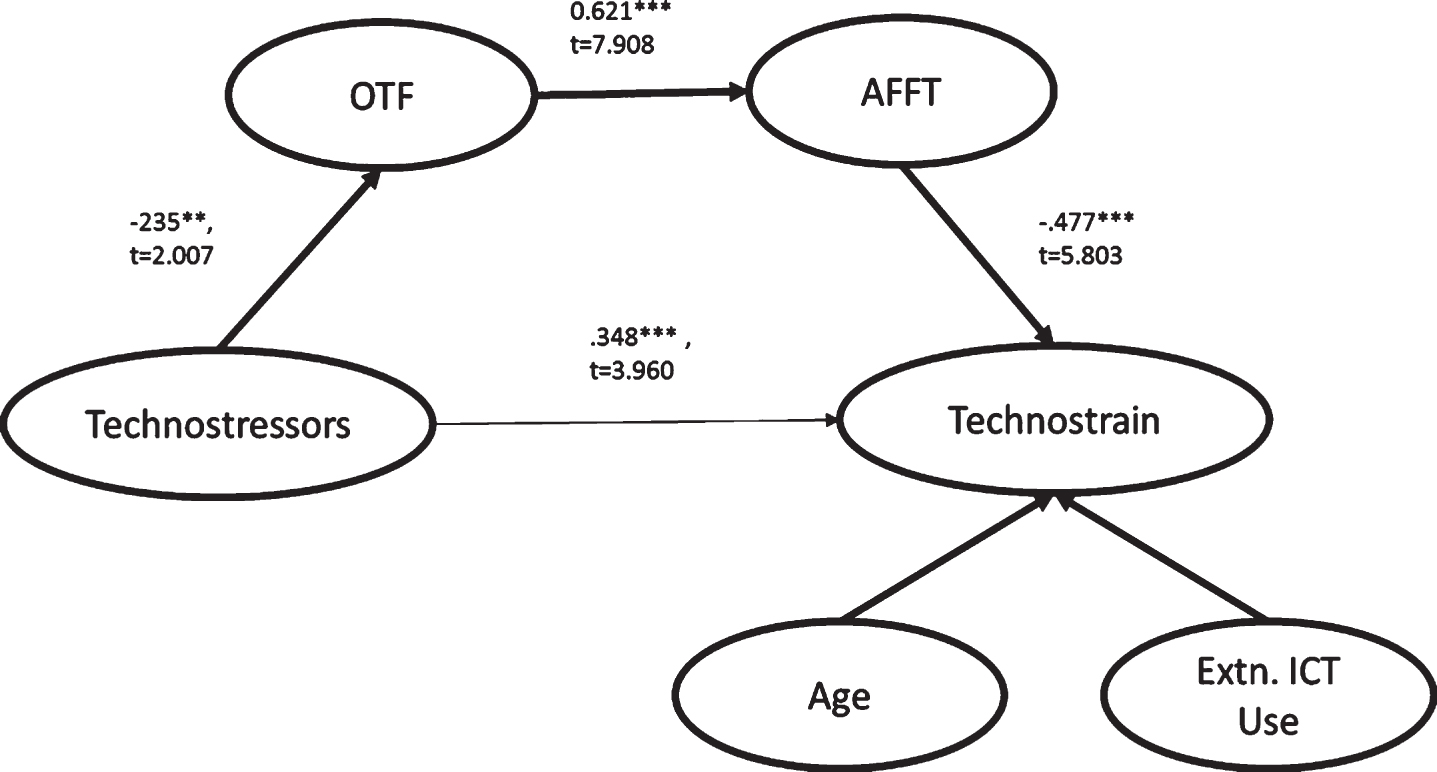
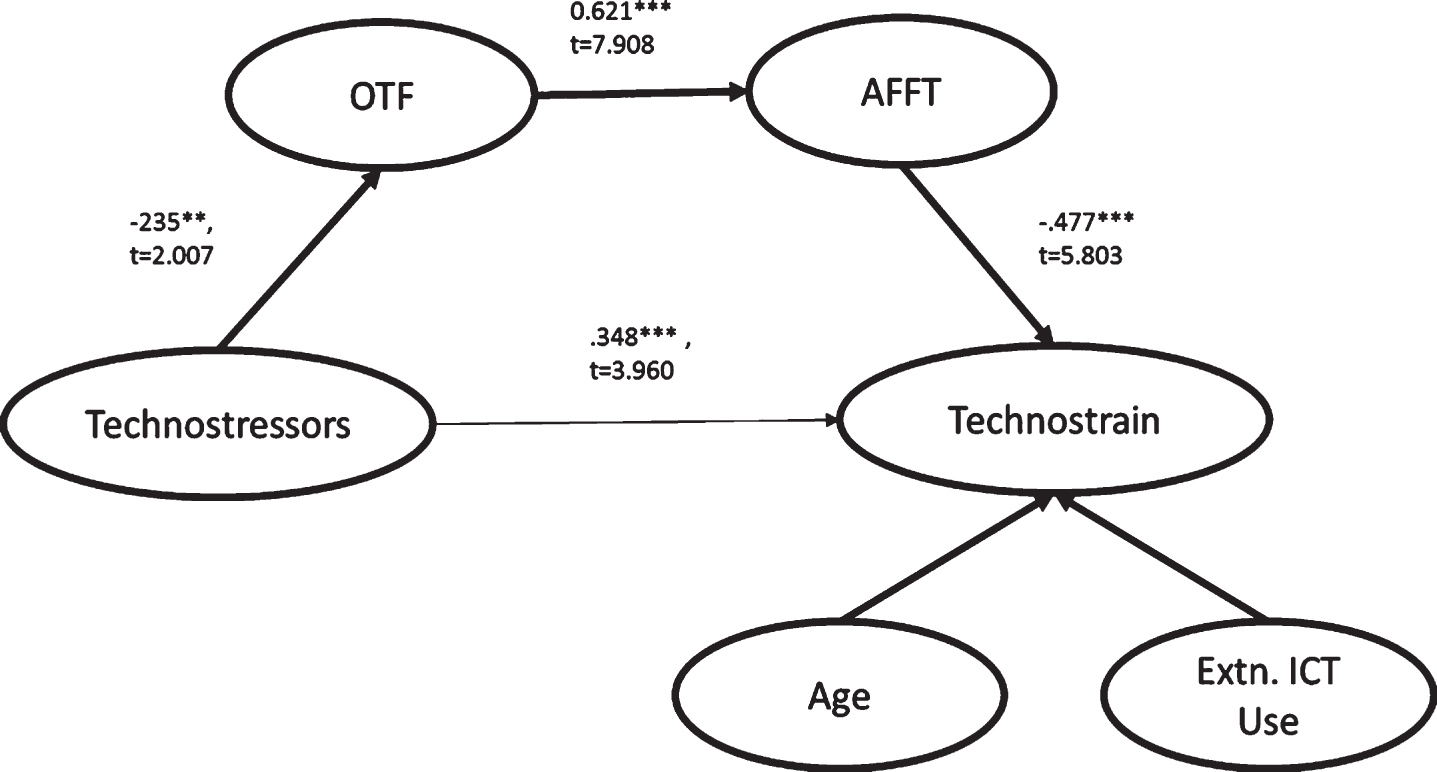
When the second mediator variable affect towards ICT use is introduced sequentially after OTF in (Appendix 4, Model 5, Fig. 6), we find that opportunity technology frames have strong and significant positive effects on affect towards ICT use, which in turn has a strong and significant negative relationship with technostrain. The indirect effects of technostress (i.e., 0.348, p < .070**.) are significant but reduced as compared to the (0.298, P < 0.001) Model 1 as well as the (0.308, p < 0.01**) Model 3. See Appendix 4 for more details. Thus, we see that affect towards ICT use partially mediates (competitive mediation) the relationship between technostress and technostrain along with the OTF mediation effect. Moreover, we find that the R² and Q² values of model 4 provide better explanatory power than the previous model 3 with only one OTF mediator (See Appendix 4). Thus hypothesis 5 is empirically substantiated.
Table 2 also provides a summary of all the direct and indirect effects of four mediation models (Model 2, 3, 4, 5 as shown in Appendix 4). We find that a combined reading of the results from the structural model and Table 2 that the indirect effects are all significant and that the predictive validity R² values of the endogenous construct technostrain are much higher for serial mediation models. For model 4, the R² value of the endogenous construct technostrain is 0.379 and for Model 5 the R² value is 0.357. These values are much higher than the single path mediation (models 2 and 3). The Q² values obtained through a blindfolding (bootstrapping) procedure for the endogenous constructs in the models are all well above zero, indicating predictive validity of the mediation models.
Direct, Indirect Effects and Total Effects
Direct, Indirect Effects and Total Effects
S.Construct: Source Construct, CPM-Complementary Mediation, NA-Not applicable.
We can also glean some inferences as to the type of mediation from the results in Table 2. Complementary mediation of TTF can be inferred from Model 2 results and all other mediations can be termed as competitive mediation as there is a sign change, as hypothesized in the path coefficients, between at least one of the mediating variables and dependent variables respectively. Thus, following other recent studies [42], the variance accounted for (VAF) [22] is normed between 0 to 100 percent. Higher value indicated stronger partial mediations. The VAF for Model 2 is reported as 63 percent as seen in the Table 2, whereas the value of VAF is not relevant for the remaining path models as they all represent a competitive mediation scenario [42].
The results of this study need to be considered in the light of the following limitations. Firstly, cross cultural validity of the scales used have not been particularly tested although all the scales used were developed for assessing ICT users who could understand English and were from an international context. This resembles the population sample used in this study and thus does not pose as specific issue. Further studies should use caution when using the scales in cross cultural context where the primary language of the sample is not English. Moreover, due to the complex connection between cognition and affect that is often difficult to perceive or measure within a social science research setting, this study cannot conclude with certainty that a causal connection exists between the cognitive frames and the affective component. Although mediation analysis does suggest the existence of such as relationship the study only takes into account expected affective strength towards use of ICT and does not measure in a longitudinal manner the current affective strength that may be elicited when a particular technostress event occurs. The measurement of elicited emotions along with the expected affective coping resource will provide a holistic picture of how cognitive appraisal and the coping potential appraisal act together. Future studies may attempt to use experimental design to assess the suggested theoretical model based on a more temporally apt measure of affect in conjunction with expected affect in explaining further the stress appraisal process. This study does not take into account other personal and situational factors that can moderate the relationship between cognitive frames and the affect infusion demonstrated in this study. Affect infusion may also depend upon certain personality factors and situational variables that are not taken into account in this research and are thus ripe for future investigation [15]. Although the theoretical foundation of this research does not advocate an interaction effect between the two mediators’ cognitive frames and expected affect towards ICT use, considering the current academic debate on the contested relationship between the two mediators in terms of their causal influence, it will be interesting to test such an effect in future studies in the context of the ICT-based mobile work context.
Theoretical implications
This study addresses the call for research to throw some light into the black box on the process of technostressor appraisal in general and specifically on its impact on ICT-based mobile workers (managers). Past research has described the appraisal stages, using the structural model, but has not explicated the process of how the individual appraisal of technostressors may be enacted in the specific context of ICT-based mobile workers. After all, the technostress phenomenon involves the understanding of the imbricated nature of technology, its use and its symbolic interpretation - both cognitive and affective - amongst various categories of users. In this case studying this aspect in the context of ICT-based mobile workers, who are knowledge workers/managers using mobile ICTs for work, has enabled us to link managerial cognition literature to the technostress-strain coping response process. The result of the study offers an explanation as to why the predominant past technostress literature only flags negative organizational impacts due to technostressor’s interpretation. The ICT-based mobile managerial population seems to have a dominant threat technology frame that influences negative behavioral outcomes as shown in most prior literature. We expect that this study will contribute to the literature on technostress in particular and provide managerial guidelines on how best to handle technostress-strain within organizations in the context of new ways of working such as ICT-based mobile working. Addressing the recent calls on context-specific theorization [67], this paper firstly expands on prior techno-stress literature that advocates both positive and negative interpretations of technostressors and investigates the combined role of technology frames of reference and the contextual affective response component in influencing technology-specific job outcome [64]. Answering this question is crucial in understanding why and how technostressors and technostrain need to be handled within organizations whose workforce consists of ICT-based mobile managers. It also allows human resource to appreciate the order and the degree between technostress specific management strategy/intervention versus changing general perceptions/frames of technology use in organizations through targeted organizational level strategy/interventions.
Secondly, leveraging cognitive categorization theory and the concept of technology framing, for the first time, this paper theorizes the role of “threat and opportunity” technology framing as the cognitive process that mediates the technostressor-strain relationship. It further expands on the notion of affect towards technology and its role in the transactional process of technostress appraisal.
Thirdly, this study is also one of the view studies in IS that uses the dual-path serial mediation model for theorization with the help of Smart PLS 3 software [56]. Thus, the paper can serve as a methodological guide on how to conduct and report on these types of mediation for other aspiring researchers testing complex structural mediation models such as the one in this study.
The paper adds to the technostress literature in particular, as well as recommending managerial implications such as the need to use positive re-framing amongst other techniques as a useful tool to alter the technology framing amongst managers in general and ICT-based mobile managers in particular. Such altered perceptions about the general use of technology should create a ripple effect on the cognitive appraisal of the technostress phenomenon when it is confronted by such new forms of workers. This technique should enable reversing/reducing the deficit-focused biased relationship between technostressor-technostrain as shown in the results of the study.
Further, borrowing from past work on sense-making and cognitive frames, we recommend that a concerted effort is made at the strategic level within organizations to reward ICT-based mobile managers who hold a positive technology framing and adopt successful coping strategies, as opposed to the current popular strategy of rewarding managers who perceive issues as a threat and then succeed with an effective coping strategy. This is proposed as a recommendation in other studies as well [25].
Practical implications
The final implication to be drawn is that the IS designer and managers must play close attention to how ICT-based mobile managers feel about technology use in their work setting. Accumulated unhappy employee digital experience within organizations can alter the expected affect towards technology use at work and thus have a negative impact on how they may cope with the technology related strain known to impact such professionals [71]. This result adds to other studies in IS that reveal the importance of playfulness, joy, cognitive absorption, and pleasure as important for IT adoption, and continuous and emergent usage [63, 75]. Since affect towards technology can influence the stress appraisal process in a sociotechnical work context, technology-related strain perceptions due to reduced affect towards ICT use at work can impact other organizational outcomes, thereby hampering productivity and collaboration efforts. A user-centric experience strategy that largely focuses on external clients should also extend to internal clients in order to reap benefits from digital transformation initiatives, IT investments and strategic digital measures. The sustainable use of digital technologies through new forms of work, such as ICT-based mobile working, needs efforts at the practical level to curb the challenges of the technostress-strain perceptions of this new workforce. The perceptions of employee from different generations may also display differences in how they react to technology at work place, this aspect should also not be ignored by human resource team in charge of technology implementations [91]. As more and more digital organizations are facing a huge talent gap, there is shifted from offering employee satisfaction to employee experience, this effort is said to rely on providing a good technological space, cultural space and physical space [41]. Addressing technostress and technostrain is not only an important step towards retaining talent and enhancing the employee experience but will also involve interventions that impact the socio-material and socio-technical aspects of technostress-strain management.
Footnotes
Appendix 1
Key Research Constructs and their Scales
| Technostress creators— | Mean | Standard Deviation |
|
|
4.5 | 1.3 |
| I am forced by ICTs to ... | ||
| ... work much faster. | ||
| ... do more work than I can handle. | ||
| ... work with very tight time schedules. | ||
| ... change my work habits to adapt to new technologies. | ||
| ... handle higher workload because of increased technological complexity. | ||
|
|
4.25 | 1.5 |
| Due to ICTs ... | ||
| ... I spend less time with my family. | ||
| ... I have to be in touch with my work even during my vacation. | ||
| ... I have to sacrifice my vacation and weekend time to keep current on new ICTs. | ||
| ... I feel my personal life is being invaded*. | ||
|
|
3.38 | 1.2 |
| I do not know enough about the new ICTs to handle my job satisfactorily. | ||
| I do not find enough time to study and upgrade my ICT skills. | ||
| I need a long time to understand and use new ICTs*. | ||
| I often find it too complex for me to understand and use new ICTs*. | ||
| I find new recruits to this organization know more about ICTs than I do. | ||
|
|
2.81 | 1.3 |
| Due to new ICTs, I feel constant ... | ||
| ... threat to my job security. | ||
| ... need to update my skills to avoid being replaced. | ||
| ... threat by coworkers with newer ICT skills. | ||
| For fear of being replaced ... | ||
| ... I do not share my knowledge with my coworkers* | ||
| ... I feel there is less sharing of knowledge among coworkers* | ||
|
|
4.5 | 1.3 |
| In our organization, there are always ... | ||
| ... new developments in the ICTs we use*. | ||
| ... constant changes in ICT software*. | ||
| ... constant changes in ICT hardware. | ||
| ... frequent upgrades in ICT networks. | ||
|
|
3.24 | 1.2 |
| I feel drained from activities that require me to use ICTs. | ||
| I feel tired from my ICT activities*. | ||
| Working all day with ICTs is a strain for me. | ||
| I feel burned out from my ICT activities. | ||
|
|
2.5 | 1.2 |
| I perceive ICTs to be a threat. | ||
| I may lose out by becoming technologically obsolete. | ||
| ICTs have negative implications for my future. | ||
| The threat of ICTs is not likely to go away. | ||
| There is little chance of removing the threat from new ICTs. | ||
|
|
5.5 | 0.90 |
| I perceive ICTs to be an opportunity. | ||
| I may gain from dealing with new ICT. | ||
| ICTs have positive implications for my future. | ||
| I know how to deal with ICTs. | ||
| There is a high chance of resolving the issue of dealing with new ICTs. | ||
|
|
5.05 | 1.20 |
| ICTs make work more interesting | ||
| Working with ICTs is fun | ||
| ICTs are okay for the kinds of jobs I do. |
Note: Items marked with a * were removed during the assessment of the measurement model due to insufficient factor loading.
Appendix 2
Fornell-Larcker Criterion and Construct Reliability and Validity
| Age | Extuse | TSCO | TSIS | TSIV | TSOV | TSTRN | TSUC | |
| Age | 1.000 | |||||||
| Extuse | 0.162 | 1.000 | ||||||
| TSCO | 0.261 | – 0.011 | 0.677 | |||||
| TSIS | – 0.100 | – 0.019 | 0.559 | 0.859 | ||||
| TSIV | 0.218 | 0.182 | 0.378 | 0.327 | 0.783 | |||
| TSOV | 0.054 | 0.229 | 0.306 | 0.401 | 0.576 | 0.803 | ||
| TSTRN | – 0.068 | 0.080 | 0.295 | 0.475 | 0.267 | 0.166 | 0.871 | |
| TSUC | – 0.041 | 0.179 | – 0.155 | 0.038 | 0.035 | 0.296 | – 0.140 | 0.838 |
| AVE |
|
|
|
|
|
|
|
|
| CR |
|
|
|
|
|
|
|
|
Appendix 3
Appendix 4. Structural Model Assessment (Model 1 through Model 5)
Below are tables 37 with Model 1 through Model 5 followed by each Figs. 26 with path diagrams for easy reference. Please note the legends for these tables and figures. Notes: TTF-Threat Technology Frames; OTF-Opportunity Technology Frames; AFFT-Affect Towards ICT use; CI-Confidence Interval; * p < 0.10, ** p < 0.05, *** p < 0.001.
Figures
Acknowledgments
I thank Dr. Shalini Chandra from SP Jain School of Global Management, Singapore, for providing her valuable inputs during the data collection stage of this study.