



Abstract
BACKGROUND:
Innovation is founded as a strong contributor to the formulation of competitive strategy and enhance organizational performance. Different organizations dropped drastically from the competition by not innovating their products and services.
PURPOSE:
To analyze the relationship of an organizational learning culture, workforce diversity and knowledge management with innovation and organizational performance, this topic is also has become an important topic in the field of management. With a few exceptions, however, the literature has focused on different business and small and medium-size enterprise, but this study intends to bridge this gap by testing the framework in educational institutes.
METHODS:
A quantitative research method is used to test the conceptual framework. The data was collected from Malaysian, and Thailand private sector universities; a closed-ended questionnaire was administrated to collect the data. Data is analyzed through statistical software SMART-PLS
RESULTS:
Findings of the study reveal that the exogenous variables knowledge management, organization learning culture, and workforce diversity has a significant and positive relationship with endogenous variable innovation and further innovation has a significant and positive association with organization performance.
CONCLUSION:
This study reveals that workforce diversity, knowledge management and organizational learning culture play a vital role to bring the innovation which further enhances the organization performance. Due to current pandemic COVID-19, educational institutes required more innovative process of teaching and operation, a learning culture, knowledge management systems and diverse workforce can play a vital role in the educational institute innovation process.
Keywords





Introduction
Workforce diversity is a key factor for innovation and effective organizational performance. The diverse workforce from different countries around the globe supplies pool of employees with a wide range of diverse skills, knowledge and abilities that consequently affect the innovation and organizational performance. They possess multiple knowledge, skills and abilities which give a competitive advantage to the organization. The workforce from different countries brings new ideas which help in the innovation process. Knowledge and skills vary from country to country, people from Asia might have different skills as compare to African countries, similarly knowledge and skills possessed by United States of America workforce might be different from European countries. If the organization combine workforce from different countries, having different knowledge skills and abilities, then this can add a competitive advantage to the organization.
The public sectors universities are mostly funded by the government, while private sectors universities bear all the expenses without the support of the government, but sometimes both sectors face similar challenges, including a decline in government funding, rapidly changing technology, new teaching methods, students drop out and online platforms for teaching. For government sectors, these challenges might not be so severe but for private sectors universities, these challenges could create like a nightmare situation as they may not compete in the educational industry and may not sustain further. To address these challenges, universities always focus on the quality of the academic environment and improve the world ranking of the university, and this can help them to attract local and international students. To improve the ranking, the most critical factors is research publication [1] for this, if universities build a learning culture, focus on workforce diversity, and implement a knowledge management system this will lead to innovation and will improve the institute’s performance. This process can also transform the organizational management system that can consequently improve the managerial services or services innovation to reduce the cost and attract more students. Limkokwing University of Creative Technology Malaysia (LUCT) and Stamford University, Thailand, both have a diverse workforce from Asia, the Middle East and African countries, European and the USA. The Malaysia government declares LUCT as the University of Innovation. This study aims to identify the critical success factors of innovation and its impact on organization performance, this study addresses the following research questions.
Research questions
Is there any relationship between Workforce diversity and innovation in educational institutes? Does the organizational learning culture effect the university innovation process? Does Knowledge Management system affect the Innovation process? Does innovation affect Organizational Performance?
The objective of the research
To identify the role of Workforce diversity in the innovation process. To find the relationship between Organizational learning culture and innovation process. To find the role of Knowledge Management in the Innovation Process. To find the effect of innovation on organizational performance.
This study focuses on the conceptualization of organizational learning culture, workforce diversity and knowledge management effects on innovation and organizational performance in educational institutes. The anticipation of the relevance of innovation for organization performance is because the implication has already been established in the existing firms. However, the past literature focused on the association between innovation and organization performance, but these studies have been conducted in different context and setting which cannot be generalized in Thailand and Malaysia. Important factors for innovation are also identified, as the current study identified, workforce diversity, knowledge management and organizational culture are positively associated with innovation. Furthermore, past studies focused on different manufacturing industries and service rendering companies, however current study focuses on higher educational institutes, as the conceptual model of the current study is not yet tested in higher education of Malaysia and Thailand. Hence, the results of the previous studies are to be confirmed in educational institutes, whether workforce diversity, knowledge management, and organizational culture influence innovation in educational institutes and enhance the performance or not. Therefore, the authors assert that searching for the effect of knowledge management, organizational learning culture and workforce diversity on innovation and organization performance, this study will offer new insights that could also utilize in forming various policies for the development high-performance system in educational institutes.
Literature review
Organizational learning culture
The process of innovation is an activity to perform or produce something new. Different factors can bring innovation, but mostly, the organization and surrounding environment play a vital role. Moreover, past literature reveals that two types of organizational factors play a vital role in the innovation process these are: Human resource practices and organizational culture [2, 26–28]. Continuous innovation is a requirement if a business wants to stay as competitive in the market. Different factors influence the innovation in a firm; among these factors, one is corporate culture which has been accepted as a more critical factor to bring innovation. Moreover, this article considered organizational culture as an essential variable which influences innovation.
Organization culture sets own norms and value, and employees are directed to follows these norm and value inside the organization, through these shared norms and values employees can perform their duty and solve business problems [29]. Researcher says that different organizations have innovation-oriented cultures, which reflects on bringing innovative ideas in a specific time framework [30]. AECA’s (1995) [31] proposal describes innovative organizational cultures is an approach which compels employees to think and behave in such a way, to create and develop ideas and attitude, which leads to innovation. Researchers Barratt-Pugh, L., Kennett, P., & Bahn, S. (2013) [32] stated the initial involvement and investment in staff learning and ownership areas principal as the investment in the system itself, thus building an organizational learning culture can open the door for the innovation process which can consequently improve the organization performance. Researchers Susanto, C., Al Habsy, T., Wilopo, & Abdillah, Y. (2020) [60] stated that organizational interventions focusing on the characteristics of organization culture produces a higher level of performance, innovation and adapt change. Therefore, this study postulates the following hypothesis. Organizational learning Culture has a positive impact on Innovation.
Workforce diversity
In today’s world, Workforce diversity is the primary concern with almost all type of businesses. Organizations have to know and manage workforce diversity in an effective manner. Nevertheless, for most of the organization, workforce diversity is a multifarious phenomenon to understand and manage in an organization. The importance of workforce diversity cannot be neglected in organizational success, because it is a tool to enhance the effectiveness of an organization and to compete in the world of competition. Organizations that worth diversity will achieve success, and they will have a bright future in this present era of globalization. One of the aspects to manage workforce diversity is promoting equal opportunity to all members of the organization. The equal opportunity philosophy ensures that everyone is treated fairly in the organization and organization never wants to lose their talent which can add innovation for the organization in future. The increase in interaction and mobility of people from diverse background compels the organization to embrace diversity at the workplace. Diversity brings heterogeneity which is a mean of organizational effectiveness that needs to be foster, cultivated and valued in the workplace.
The term diversity is not restricted to issues of race and gender. There is an old proverb that “if you looking at the world throughout the same window, you will see only what you have previously seen before”. If you only listen to the same person for all time you have listened, then there is less possibility for newness or revolutionary thinking or accomplishment. Today’s managers will be considered as successful managers if they reply quickly to customers’ demands, who belong to diverse, culture, ethnic group, race and society. The goal of the employer is to provide the best services to the customer or to accomplish a competitive edge over a competitor, now organization working in diverse culture has increasingly accepted and utilized diversity as an essential resource for the organization. Strategic alignment between diversity and organization mission, improve organization performance as it increases employee commitment and satisfaction, which lead to retain employees. It also gives competitiveness and productivity.
Different researchers have described diversity with categorical differences, such like: race [13, 14] the difference in an ethnical group like black-white etc. [15], in term of gender (male, female), [16–18], age difference among employees, the educational difference among employees [19], employees having different practical experience background in term of their skills knowledge and abilities [20], and physical [21], the difference among employees, these categorical differences have a significant impact on organization performance. Diversity leads to innovation because a diverse pool of employees brings different ideas, which produce a productive result, and hence innovation occur though these diverse ideas. Therefore, this study postulates the following hypothesis: Workforce diversity has a significant and positive association with the innovation process.
Knowledge management
Knowledge is an essential organizational resource. The organization which can acquire knowledge or use knowledge can add unique resources to an organization which would be not easy to produce or avail by competitors and thus it gives a competitive advantage [57–58]. Knowledge management is an impressive, versatile, and controversially discussed concept. The researchers have given awareness to acquire the knowledge for productive matters as its usage is increased now. Due to information technology revolution, an era of globalization and competition among rivals, implementation of the knowledge management system is essential now, because its time of innovation and business has to provide product and services of good quality. Through knowledge management, we can scan business and environment relation through which we can bridge the existing gap. Cavusgil et al. (2003) [7] declared knowledge management as innovation mechanism, firm which can create and use the knowledge, can bring innovation successfully and faster than others. According to Pyka (2002) [8], innovation can be formed by creation and well management of knowledge; further researches claim that organization performance is associated with the knowledge management system and human capital development [22, 23]. The results of Turulja and Bajgorić, (2018) [24] study show the indirect effect of knowledge acquisition and knowledge application on firm business performance through product and process innovation; a qualitative study conducted by Gloet and Samson, (2016) [25] also revealed the main contributions of KM to systematic and sustained forms of innovation; therefore this study aims to find the relationship between knowledge management and organizational performance with the indirect effect of innovation in higher educational institutes. Therefore, this study postulates the following hypothesis: Knowledge Management has a significant positive relation with Innovation in a higher educational institute.
Innovation
In today’s world, the importance of innovation has been acknowledged in small as well as in large businesses. The term globalization and information technology revolution have created the business environment very flexible and forceful for competitors, to compete with rivals, there is an urgent need of innovation because the customer wants changes rapidly [2]. Researchers have referred that there is need for competitive advantages and innovation creates and maintain competitive advantage [3]. For entrepreneurship, researcher, Drucker (1985) [4] stated innovation as an essential source to get success. Establishing the innovation process in an organization is considered an active contributor to acquire competitive advantage and consequently, this improves organization performance [5]. Peters and Waterman (1982) [6] stated that a successful organization believes that it should be a fast innovator.
Innovation is founded as an active contributor for the competitive advantage and also for improving the organizational performance [6]. The study of successful companies of Peters and Waterman (1982) [6] concluded that every organization has certain beliefs or values and successful companies have the belief that its member should be innovators. The organization can compete if it manages effectively and creates an innovative system for the future. For creating and sustaining competitive advantage, there is a need to ensure that business has innovative strategies because economic growth depends upon the speed of innovation. Innovation is the demand from the customer side also; however, it becomes a complex rapid change in the customers’ needs, technological change and competition [7]. Innovation also depends on knowledge, If the managers use the knowledge effectively and efficiently, then it ensures the organization success [8, 9]. The study conducted by Sawaean and Ali (2020) [10] in SME of Kuwait, revealed that innovation has a significant and positive impact on organization performance, similar other studies conducted in different businesses, while rare research is available on innovation relationship with educational institutional performance, therefore, this study aims to bridge this practical gap by testing the model in higher education institutes.
Every innovation has a comparatively strong impact on organization life in different ways. Hence, it is significant for business to have innovation as part of business core competencies. In this context, the real question is how to bring innovation in the organization and which factors can help to create innovative products or provide innovative services. Individual innovation also helps to establish organizational success [11, 12]. Innovation in the educational industry is the hottest topic, and educational institutes are trying to solve the issues of the world by high-quality conduction of research, the most prominent example is Harvard and Stamford University. For creating innovative culture inside the organization, this study focused on; knowledge management, organization learning culture and workforce diversity. These factors lead to innovation which can enhance the performance of any organization. The performance of the educational institute is measured by QS world ranking organization, and their focal point is the innovation which comes through a proper knowledge management system, learning culture and workforce diversity and research output. Therefore, this study postulates the following hypothesis: Innovation has a significant and positive impact on organizational performance.
Table 1 shows the theoretical justification the association among variable shown in Fig. 1.
Justification of construct relationship
Justification of construct relationship

Conceptual Framework.
Research approach
To test the proposed conceptual model, a quantitative research method is adopted in this study, as the conceptual model is developed based on past theories; therefore, a deductive approach is used to test the model.
Unit of analysis
This study targeted individuals who were working in two private universities; one from Limkokwing University of Creative Technology, Malaysia and other was Stamford University Thailand. The Ministry of education of Malaysia declared the Limkokwing University of Creative Technology as the most innovative university of Malaysia, in this university lecturers and staff are from more than 30 countries. Stamford University is offering international courses, and the teaching staffs are recruited from different countries. Therefore, this study aims to see whether for educational institutes workforce diversity is a key driver for innovation or not?
Instrument and data collection
To collect the data, a survey method was used, printed questionnaires were distributed. A questionnaire was adopted from past published research. To measure the construct organizational learning culture, five items were selected from the study of Leufv
Population and sampling
The 100 usable questionnaire forms represent a sufficient number as suggested by Hatcher (1994) [36], the researcher recommended that the number of respondents should be either 100 or five times the number of items, whichever is greater, as in this study the number of items was initially 25, later after factor analysis few items were deleted due to lower number of factor loading. The population of this study were all lecturers and academic staff, Non-probability sampling technique was used, and a purposive sampling approach was adopted, the reason for purposive sampling was to identify only those lecturers and staff who were a foreigner in these universities as the aim of the study was also to study workforce diversity impact on innovation. Two hundred forty questionnaires in hard copy were distributed, and 205 questionnaires returned from the respondents.
Research settings
The research setting was non-contrived, a field study approach was used, in a natural environment, data was collected.
Data analysis
PLS-SEM has become a widespread technique in human resource management and marketing literature and has been utilized by several previous studies [44–56]. As Hair et al., (2017) [37] stated that there are two approaches in SMART PLS to test the model; first, we have to test the outer model to assess the reliability and validity, in the second stage we have to test the inner model, known as a structural model to test the hypothesis. To assess the measurement model, outer loadings, composite reliability method for internal consistency and average variance extracted (AVE) for convergent validity incorporated. Initially, the measurement model confirms for convergent validity, by using factor loadings and for internal consistency, and composite reliability.
Results and findings
The common method variance issue was followed by Harman’s 1976 one-factor solution. Herman’s single factor test was conducted with the help of exploratory factor analysis (EFA) by SPSS software. The percentage variance obtained was 20.7%, that was below 50%, as suggested by Harman (1976). Hence, no issue of common method bias was detected in data. Measurement model assessment firstly assessed by reliability and validity. Initially, all variables were measured with 5 items, during the measurement model assessment, the factors loadings, reliability and validity of each variable were lower, therefore, researcher deleted 3 items from each variable to avail the reliability and validity. The results indicate that Cronbach’s alpha coefficients of all items ranging from “0.594 to 0.692”, that were higher than the proposed value of 0.7 [42]. Additionally, for testing construct reliability all the composite reliability (CR) values of all the items ranging from “0.646 to 0.724” were higher than the proposed value of 0.7, which satisfactorily specifies that construct reliability fulfilled as shown in Table 2. Factor loading method also used to assess indicator reliability, researcher’s hair et al., (2017) [37] suggests factor loading should above “0.50”, in this research factors loading for all the indicator were above 0.50 as mentioned in Figure 2 after deleting initially the items with lower factor loadings. Table 2 results display that all AVE values higher than the proposed value of “0.50” [37], ranging from “0.498 to 0.593”. Hence there was no problem with AVE of all constructs as its value stands above 0.50. For construct innovation, AVE is slightly less, but it is acceptable as past literature suggests that AVE should be above than 4. Figure 2 shows the factor loadings of items; it has been observed that factor loadings for all items are above 0.650.
Construct Reliability and Validity
Construct Reliability and Validity
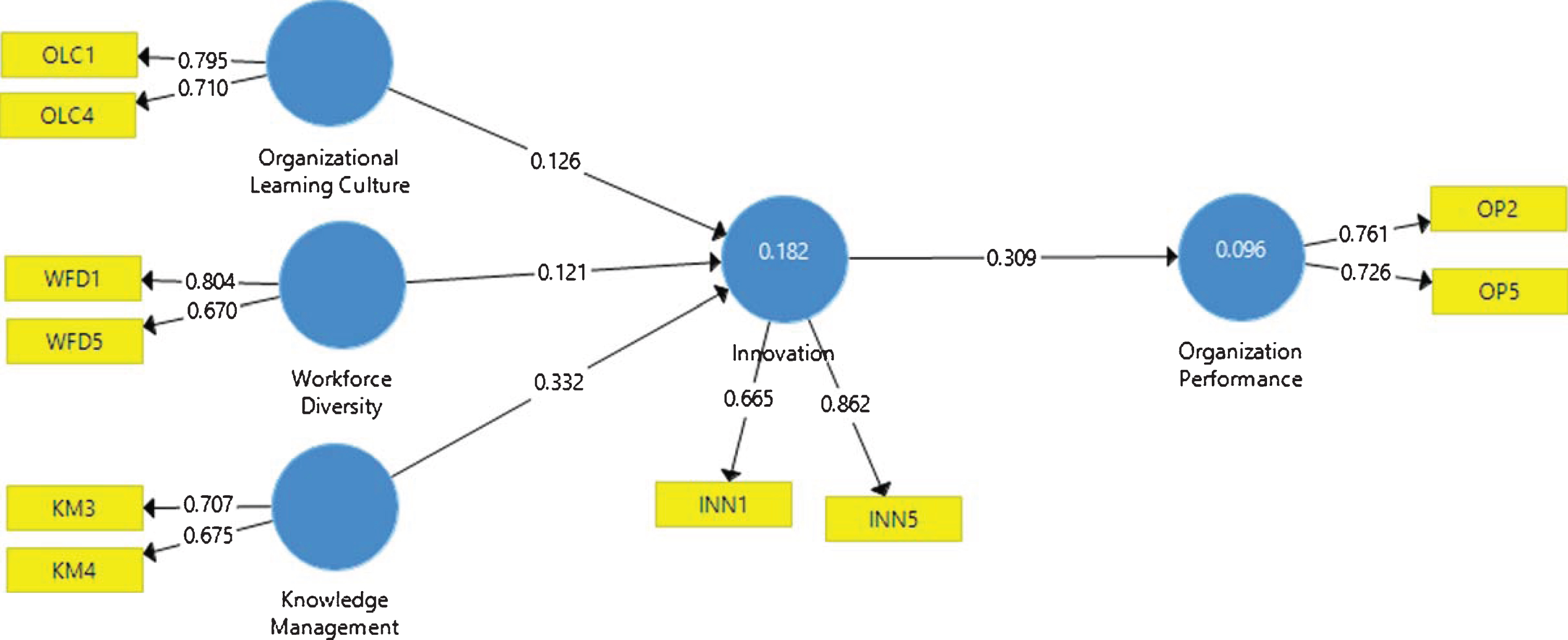
Outer model measurement.
To assess the discriminant validity of the measurement model Fornell-Larcker method used in this study Table 2 shows the square root of the AVEs on the diagonals, as represented by the bolded values, and the values are higher than the correlations between constructs. Table 3 indicates that the constructs are strongly related to their respective indicators compared to other constructs of the model [38, 39] hence results show a good discriminant validity. Therefore, discriminant validity successfully obtained. Figure 3 shows the inner model assessment.
Discriminant Validity (Fornell-Larcker Criterion)

Inner Model assessment.
Structure Equation Modeling assessment, researchers Hair, Hult, Ringle & Sarstedt (2017) [37] stated only p-value is not enough to accept the hypothesis, R² and t values should also incorporate, they also suggested to report the effect sizes (f²), and the predictive relevance (Q²) further researchers Hair et al (2017) [37] stated that simply the p-value might not explain the effect size. In this study, all hypothesizes are accepted as p < 0.005 obtained. H1: Organizational Learning Culture has a positive impact on Innovation, Table 4 results shows (β= 0.124, t = 2.212, p < 0.000), therefore, H1 is accepted. H2: Workforce diversity has a significant and positive association with innovation., Table 4 results shows (β= 0.119, t = 5.861, p < 0.05), therefore, H2 is accepted. H3. Knowledge Management has a significant and positive relation with Innovation, Table 4 results shows (β= 0.334, t = 2.209, p < 0.000), therefore, H3 is accepted. H4: Innovation has significant and positive impact on organizational performance, Table 4 results shows (β= 0.312, t = 5.826, p < 0.000), therefore, H4 is accepted. Figure 4 shows 17 % variance is observed in endogenous variable innovation from constructs; learning culture, knowledge management, and workforce diversity, while 9% variance is observed in endogenous variable organization performance from exogenous variable innovation.
Hypothesis Testing

Adjusted R-square.
To measure the inner model, the only p-value is not enough; therefore, in this study, the effect size is also assessed, Table 5 shows the most substantial effect size is observed from knowledge management on endogenous variable innovation, while the effect size of innovation on organization performance is also considered as a strong effect (f2 = 0.306).
Effect Size (f2)
As revealed in Fig. 5 and Table 6, this study “plotted the total effects scores and index values” in a priority map, and it suggests that innovation is an essential factor in determining organization performance due to its relatively higher importance values compared to other constructs in the model. Knowledge Management is the second important factor in determining organizational performance. Similarly, the organizational culture and workforce diversity are on third and fourth respectively as an essential factor in determining organizational performance.
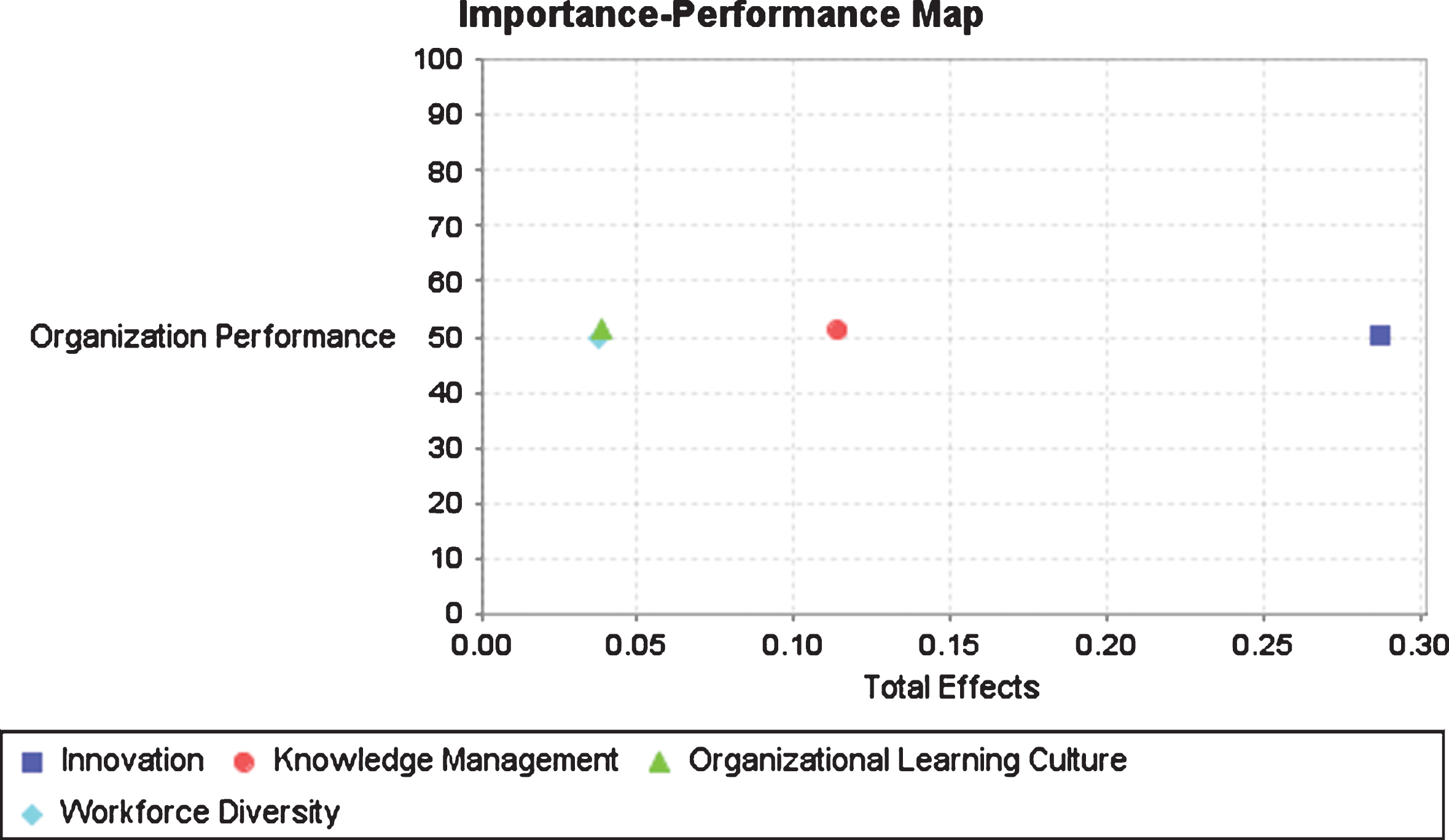
Importance-Performance Map.
Constructs Performance
Organizations are facing tough competition due to the Information Technology revolution and globalization. The customer always prefers change, to satisfy customer needs, business to provide an innovative product to capture the market. The purpose of this study was to examine the relationship between innovation and organization performances in the higher educational institute of Thailand and Malaysia, as past studies tested the relationship between innovation and organizational performance in manufacturing organizations while the current study focused on service render organization. The variables which are discussed in this study have a strong literature background, and researchers have proven that these variables have a significant relation with innovation and organizational performance. Therefore, to enhance organization performance, a leader needs to create a learning culture, bring diversity and to apply knowledge management strategy. Such kind of tools brings distinctive capabilities to the organization which add value to organization core competitive strength.
The first hypothesis of this study was: organizational learning culture has a positive impact on Innovation, results of Table 4 shows (β= 0.124, t = 2.212, p < 0.000), hence organization learning culture has a significant and positive association with innovation, findings of this study are consistent to the study of Maroofi & Kahrarian (2016) [40] they suggested: “that value innovation capacity is strengthened when managers deliberately install specific learning mechanisms inside the organization”. The second hypothesis of this study was: Workforce diversity has a significant and positive association with innovation., Table 4 results show (β= 0.119, t = 5.861, p < 0.05), this hypothesis is also accepted, and findings are consistent with the study of Sung & Choi, (2019) [41] as they found a positive association between diversity and innovation. The third hypothesis of the study was: Knowledge Management has a significant and positive relation with Innovation, Table 4 results show (β= 0.334, t = 2.209, p < 0.000), hence the third hypothesis is also accepted, findings of this study are consistent with the study of Gomes (2014) [42] as he stated that knowledge management represents an important resource to improve innovation. The last hypothesis of the study was: Innovation has a significant and positive impact on organizational performance, Table 4 results show (β= 0.312, t = 5.826, p < 0.000), therefore, H4 is accepted. Figure 4 shows 17 % variance is observed in endogenous variable innovation from constructs; learning culture, knowledge management, and workforce diversity, while 9 % variance is observed in endogenous variable organization performance from exogenous variable innovation. Therefore, all hypothesize of the study are supported, hence this study concludes that organizational learning culture, knowledge management, and workforce diversity are key drivers for the innovation process, further innovation has a significant and positive association with organization performance.
Implication of research
Theoretical contribution
This research contributes theoretically to the existing literature of organizational learning culture, workforce diversity, knowledge management, innovation and organizational performance. This study tests a conceptual model which add a theoretical contribution to the existing body of knowledge of the variables. Past literature identified some factors that contribute to innovation and organizational performance, but this study collectively analyzed the impact of an organizational learning culture, workforce diversity and knowledge management, and findings of this study show positive and significant relationship among all exogenous and endogenous variables. This study contributes to the understanding of innovation and organization performance through organizational learning culture, workforce diversity and knowledge management. Further, this kind of understanding helps to improve innovation and performance of higher education institute of Thailand and Malaysia. Collectively the relationship of endogenous variable and exogenous variable of this study is rarely discussed in past literature.
Practical contribution
The practical implication of this research is for not only for higher educational institutes but for all those organizations which consider innovation as a significant factor for a competitive edge. A proper database for acquiring new knowledge, storing the knowledge and sharing the knowledge within an organization can lead towards the innovation process. Bringing a diverse workforce from around the world can add value to the innovative process of the educational institute. Promoting a learning culture in an educational institute is also a major factor of innovation, and further innovation is strongly related to organization performance, the performance of the educational institute truly relies on innovation. Similarly, the current study found that workforce diversity has a significant and positive impact on innovation, hence more international staff can bring innovation in an educational institute, as they can share diverse ideas which lead towards innovation. This study gives direction to the educational institute to design an innovative model which will lead towards higher performance. By introducing a learning culture, knowledge management system and give importance to workforce diversity will lead to organization performance. Due to current pandemic COVID-19, educational institutes required more innovative process, a learning culture, knowledge management systems and diverse workforce can play a vital role in the educational institute innovation process. Continues learning culture can enhance faculty members and staff innovative capabilities which will consequently enhance organization performance. A knowledge management system inside educational institutes will enable academic and other staff to acquire new knowledge which can improve their skills and further, this will improve the innovation process, similarly, globally diverse workforce will also contribute to innovation which will further boost organization performance. This study also contributes to the methodological literature, as this study tested the model with the help of Smart-PLS approach.
Limitations and future research direction
The current research design has several strengths, such as adequate sample most effective and worldwide useable software of smart PLS. However, the present findings should be interpreted with caution considering several limitations, which also indicate recommended directions for further studies. First, a mono-method is adopted in this study, future researchers can use mixed-method to validate the findings of the currents study. Secondly, During the reliability and validity process, we have dropped several items and model is tested with few items for each construct, thirdly, the future researcher can test the model in a different region of the world and different organization. Further, the current study did not discuss the difference between the educational institute of Malaysia and Thailand, in future researcher can compare different countries, to see whether, learning culture, knowledge management and workforce diversity leads to innovation or not, and which construct is more important for innovation. Future theoretical and empirical endeavours are needed to achieve a comprehensive understanding of the intermediate processes between innovation and organization performance. Future research should consider additional industry or macro-level environmental contingencies in explaining the firm-level diversity, knowledge management, learning culture with innovation and performance.