




Abstract
PURPOSE:
Trust is vital to all positive relationships. This empirical study explores the effect of three facets of organisational trust (trust in supervisors, in co-workers and in the organisation) on employee commitment in Salalah Mills Co. in the food industry in the Sultanate of Oman.
METHODOLOGY:
Data were collected via an online survey sent to all employees working in Salalah Mills Co., Oman. The final sample consisting of 102 responses with a response rate of 54 percent were analysed using multiple regression analysis.
RESULTS:
The findings revealed that two facets of organisational trust (trust in co-workers and trust in supervisors) were found to have a significant positive effect on employee commitment, while trust in the organisation was found to have no significant effect.
PRACTICAL IMPLICATIONS:
Trust in supervisors and trust in co-workers directly affect employee commitment. Therefore, managers should consider promoting both of these forms of trust to enhance employee commitment.
VALUE:
Although previous studies have examined the link between organisational trust and employee commitment, a focus on Oman and the food sector has been particularly rare, so this study offers new insights. The findings will help decision-makers on design strategies and policies to improve employee commitment through trust.




Introduction
There are many ways in which trust impacts overall organisational functioning [1]. Trust in the workplace has been recognised as a critical antecedent for positive employee performance [2, 3], job satisfaction [4], entrepreneurship and learning orientation [5].
Organisational trust is considered one of the fundamental pillars that help organisations to develop their effectiveness and accomplish their objectives [6]. Many positive job-related attitudes have been recognised as outcomes of trust at work [7], including increased independence, improved collaboration, transparency in sharing information and success in achieving managerial efficiency and organisational goals [8, 9]. Empirical studies on trust among individuals show that trust leads to improved performance, job satisfaction and greater employee commitment [10], and an increase in citizenship behaviours such as sportsmanship, altruism and courtesy.
Consequently, trust serves as an organisational tool that facilitates relationships among co-workers as well as between each worker and the organisation. Employee attitudes related to organisational trust and employee commitment have been important factors for organisational behaviour research [11, 12]. Employee commitment is a well-established concept in the literature and refers to an employee’s attachment to their organisation. In other words, it represents the bond and relationship between an employee and an organisation. Employee commitment is considered one of the most important factors for success in organisations; it has been found to play a significant role in motivating employees to achieve job satisfaction and performance excellence [13].
Social exchange theory emphasises the link between trust in work and job outcomes. Following previous research [4, 14–16], the current study contends that trust in work is a manifestation of social exchange. In view of social exchange theory, if a trustee (co-worker, supervisor or organisation) is not perceived as trustworthy by the trustor (employee), the trustor will not participate in the social exchange process [17].
An examination of previous literature reveals that there has been limited investigation of how trust may affect commitment in different occupations, industries and cultural contexts, and highlights the need to conduct further empirical research about this relationship since trust may vary considerably between different countries [18]. Although many studies [4, 20] have shown trust as an important factor of organisational commitment, few studies have examined the link between trust in work as a multi-dimensional factor with employee commitment, specifically in the food industry in Oman. Hence, to address this gap, the present study attempts to examine the effect of three facets of organisational trust (trust in co-workers, trust in supervisors and trust in the organisation) on employee commitment in Salalah Mills Co. (SMC) in the food industry in Oman.
Context
Salalah Mills Co. is the largest flour mill company in the Sultanate of Oman and one of the largest flour mills in the Gulf Cooperation Council (GCC) countries. It was established in 1995 as a joint-stock venture with an investment of around US$18 million, and it commenced commercial operation in 1998. With 189 employees, SMC now has a wheat-milling capacity of 450 thousand metric tons annually (SMC, 2020). The company fulfils the requirements of the following certifications: 1) ISO 9001:2008 Quality management system, 2) ISO 22000:2005 Food safety management system, and 3) ISO 14001:2004 Environmental management system (SMC, 2020). Its main products include flour, bran and feed, and its headquarters are located at the Raysut Industrial Area in Dhofar Governorate in the south of Oman. SMC markets its products (e.g. bread/baking flour, mix/wheat bran and feed flour) mainly in Oman and exports to GCC and Africa [21, 22].
Literature review
Organisational trust
Since the mid-1990s, trust has been presented as a pillar for quality interpersonal relationships [1]. Different aspects of organisational trust have received exceptional attention from those interested in regulating the relationship between employees and the companies in which they work. Previous literature has revealed that organisational trust is a requirement for the appropriate operation of an organisation [23] and a crucial element in a positive social process [24]. Organisational trust between individuals has been emphasised as a vital component for achieving and maintaining long-term organisational stability and employee welfare [25, 26].
Organisational trust has been defined as referring to employees’ matching status with their organisation and their willingness to build long-standing relationships with the organisation [27], to the positive expectations an individual has from an organisation and its members [28], and to an individual’s (or a group’s) belief that the organisation will make every effort, whether implied or explicit, to work according to its commitments [29].
Organisational trust is not unidimensional; rather, it is a multi-faceted phenomenon [8, 30]. It can be divided primarily into interpersonal [8, 31] and impersonal [32] dimensions. Interpersonal trust refers to the trust of employees in their co-workers and immediate supervisors [23]. Overall, the three key facets of trust within the workplace are trust in co-workers, trust in supervisors and trust in the organisation [33, 34].
Employee commitment
Organisational commitment is the bond that links employees to the organisation [42, 43] and helps the organisation to succeed [44]. It can be considered as the desire or intention of employees to be a part of the organisation [45] or the degree to which an employee feels linked to their company and has some level of loyalty towards it [46, 47] (i.e. their psychological and moral attachment to their organisation [48, 49] and the relative strength of their identification with a specific organisation [50]).
There are three major types of organisational commitment: affective, continuance, and normative commitments [51]. Affective commitment refers to employees who tend to stay with their organisation because its values and goals fit well with their views. Continuance commitment refers to employees who tend to hold their membership with the organisation as the economic and social costs of leaving would be too high and there is no better option available to them. Normative commitment refers to employees’ feelings of obligation to maintain their membership with the organisation [51].
Commitment has been found to determine the work behaviour of employees [52] and affect many organisational outcomes [53]. It has been shown to have a significant positive influence on job performance [54], employee satisfaction [55], entrepreneurship and learning orientation [5], organisational identification [56], service performance [57] and reducing employee turnover [58, 59],
In the literature, different personal and organisational factors have been found to determine the commitment of employees. Previous researchers have indicated that the antecedents of organisational commitment include both intrinsic and extrinsic factors [60], including job characteristics, personal characteristics, group–leader relations and organisational characteristics [61]. Examples of factors that influence organisational commitment include individual differences, demographic variables and work experiences [62], organisational trust [60, 63], job satisfaction [64] (as impacted by clarity of purpose, feedback and recognition, equity and fairness, empowerment and autonomy, and interesting work [44]), leadership behaviours and styles [65–67], employees’ competence and workload [57], organisational cynicism, psychological empowerment and emotional intelligence [68].
Organisational trust and employee commitment
Previous researchers have revealed a significant positive correlation between organisational trust and commitment [69, 70] and found that organisational trust is an antecedent of organisational commitment [e.g. 18, 19, 33, 63, 71–75]. This is likely because organisational trust supports the most substantial factors that affect organisational commitment [76].
Trust in co-workers and in supervisors and commitment
Trust in co-workers and supervisors (interpersonal trust) has been shown to have a positive correlation with affective organisational commitment [77]. Trust in individuals and creating a trusting climate leads to a high level of commitment and performance improvement [78] and has a significant influence on other job-related attitudes of employees.
According to the leader–member exchange theory [79], trust is the most important element of building a high-quality interpersonal relationship between leaders and members. Trust between a team leader and a team member will lead to several positive outcomes, including improving overall commitment [80]. A study investigating how leader–member exchange influences work-related attitudes and behaviours in different cultures found that there is a cultural difference between Western and Asian organisations, with leader–member exchange and leader trust being stronger in Western culture than in Asian culture [81]. However, there is no cultural difference in the relationship between leader–member exchange and organisational commitment, specifically affective and normative commitments. Trust in leaders has shown significant positive effect on organisational commitment (82). Trust in supervisors has been shown to positively affect emotional and normative commitment, while trust in co-workers and organisation positively influences normative commitment [83]. Trust in co-workers has also been positively linked to the affective commitment of employees [84].
Trust in organisation and commitment
Previous studies have shown that impersonal trust is positively related to organisational commitment [4, 34]. Organisational trust enables a positive emotional exchange between and organisation and its employees [33]; thus, trust in the organisation varies directly in line with organisational commitment [85].
Previous studies have tended to focus on just one aspect of trust or commitment at a time. Few studies have examined the influence of both interpersonal trust (in supervisors and co-workers) and impersonal trust (in the organisation) on organisational commitment [e.g. 18, 33, 34]. Accordingly, the following hypothesis is proposed based on the literature review (Fig. 1):
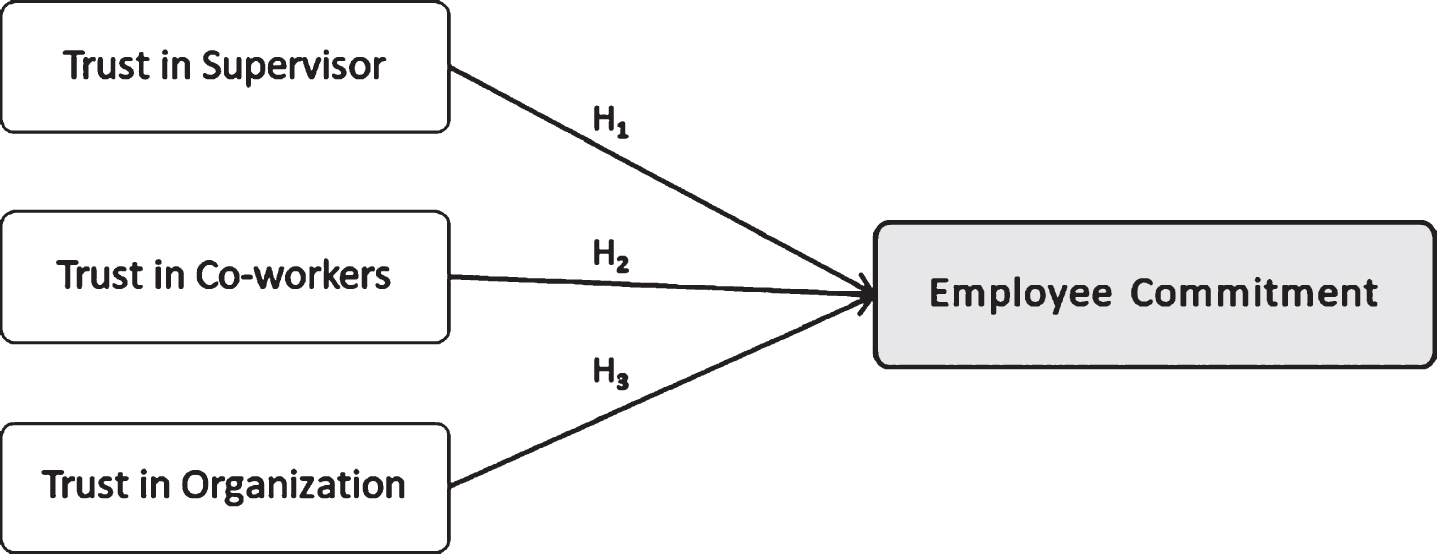
Proposed theoretical model.
The present study seeks to investigate the impact of three facets of organisational trust on employee commitment in the food industry in the Sultanate of Oman, specifically in SMC, which is one of the largest firms in this industry. In this study, a single case study approach was utilised. Salalah Mills Co was selected and viewed as a valid representation of the food industry in Oman for the exploratory survey in this study for one main reason: Salalah Mills Co. is the largest flour mill company in the Sultanate of Oman and one of the largest flour mills in the Gulf Cooperation Council (GCC) countries [21, 22]. Following the quantitative approach, data were collected via an online survey. To test the hypothesis, the data were examined by multiple regression analysis using the SPSS statistical analysis program.
Respondents
The population of the present study comprised all employees working in Salalah Mills Co. (n = 189). After giving consent, employees within various sections from different job levels and functions (administration, finance, marketing, human resource, IT, safety, warehousing and logistic, purchasing, quality, mechanical, and production sections) were invited to participate in the online survey via a link that was emailed to them.
A final sample of 102 employees (54% of the population) responded to the email with the survey link was analyzed. Table 1 shows the demographic characteristics (gender, age, education level and years of experience in the industry) of the respondents. More than three-quarters of the sample respondents (76.5%) were male, and 42% of the sample were in the under-35 age group, 42% were in the 35–50 age group, and 20% were above 50 age group. The majority of the respondents (around 59%) had bachelor and postgraduate degrees, and 60.8% of them had more than five years’ experience.
Demographic Characteristics of Respondents
Demographic Characteristics of Respondents
Organisational trust was assessed by a scale of 12 items, based on Sanders et al. [86], using four-item sub-scales to measure trust in supervisors, in co-workers and in the employer. Employee commitment was measured by a nine-item scale based on Commeiras and Fournier [87]. Responses to these items were made on a five-point Likert format ranging from (1) strongly disagree to (5) strongly agree. As the respondents spoke Arabic as their native language, the original English-language version of the questionnaire was translated into Arabic using a back-translation method. To ensure face validity, the questionnaire was assessed and moderated by three professors specialising in management and organisational behaviour fields.
Descriptive statistics
The descriptive statistics: means, standard deviations, reliability, correlation and are presented in Table 2. Means of organizational trust dimensions are at average levels, the highest one was trust in supervisors (
Items No., Means, St. D., Cronbach’s α, and Correlation
Items No., Means, St. D., Cronbach’s α, and Correlation
**p < 0.01
Cronbach’s Alpha (α) for variables of the study are shown in Table 2. The results showed that the scale utilized in the current study is reliable because the values were within the acceptable range, which is above (0.60) according to Hair et al. [88], as trust in supervisors has α= 0.851%, trust in co-workers has α= 0.874%, trust in organization has α= 0.791%, and employees’ commitment has α= 0.886%.
Correlations between study variables, the findings in Table 2 indicate there is a positive and significant relationship between each of the two variables at a significance level (0.01) in the present study except the trust in organization and employee commitment.
Multi-collinearity between independent variables (Table 3) showed that the condition has been achieved, where the values of tolerance more than 0.05 and the values of variance inflation factors less than 10 for each variable [89].
Multi-Collinearity Test of Independent Variables
Multiple regression analysis examined the impact of three facets of organizational trust (i.e. trust in supervisors, trust in co-workers, and trust in organization) and employees’ commitment. The results (Table 4) show that only two facets of organizational Trust (Trust in supervisors and trust in co-workers) appear to have a significant effect on employees’ commitment (ß1 = 0.328; T1 = 4.02, P < 0.001, ß2 = 0.233; T2 = 2.99, P < 0.05), respectively; therefore, the first and second hypotheses were accepted. However, trust in organization was found to have no effect on employees’ commitment (ß= –0.078; T3 = –1.119, P > 0.05); therefore, the third hypothesis was not supported. The model is significantly valid at level (0.001) as F = 12.89 and it has an explanatory power up to 31.7%.
Multiple Regression Analysis of Organizational Trust with Employee Commitment
Multiple Regression Analysis of Organizational Trust with Employee Commitment
*p < 0.05, **p < 0.01, ***p < 0.001, n = 102.
Table 5 and Fig. 2 show the results of hypotheses testing, where H1 and H2 were accepted, while H3 was rejected.
Hypotheses Testing Results

Tested Model.
The present study aimed to investigate the effect of three facets of organisational trust –trust in co-workers, trust in supervisors and trust in the organisation –on employee commitment. The findings revealed that the effect of trust on employee commitment varied by the type of trust. Trust in co-workers and in supervisors (interpersonal trusts) were found to have a significant positive effect on an employee’s commitment, whereas there was no significant effect of the employee’s trust in the organisation (impersonal trust) on employee commitment.
The results related to the first hypothesis showed that trust in supervisors has positive effects on employee commitment. These results are in accordance with previous studies [e.g. 33, 50, 71, 75, 85]. This finding is also in accordance with the social exchange theory perspective: when employees feel more trust in supervisors, they will be more likely to be engaged in commitment. In addition, trust in supervisors was found to have a larger influence on employee commitment than trust in co-workers. Therefore, to enhance employee commitment, the organisation needs to move in a direction which leads to an increase in trust in supervisors. This adds further significance to the responsibilities of supervisors in terms of achieving higher levels of employee commitment.
Regarding the results related to the second hypothesis, trust in co-workers has positive effects on employee commitment. These results are in accordance with previous studies [e.g. 33, 50, 71, 75] and with the social exchange theory perspective: when employees feel more trust in co-workers, they will be more likely to engage in commitment. When employees are trusted and feel trust, they will be more likely to engage in more positive behaviours and be more beneficial to their organisation [4, 91]. Therefore, high levels of trust among co-workers encourage employees to demonstrate highercommitment.
Finally, the results related to the third hypothesis showed that trust in the organisation does not have a significant effect on employee commitment. This finding is contrary to results reported by previous studies [e.g. 18, 33, 34, 85, 92, 93]. This could be explained from two perspectives. One explanation is the methodological approach; in the correlation analysis, trust in organisation was revealed to have the lowest correlation coefficient with commitment compared to other variables. Another explanation could be the theoretical approach. The first factor here is the context of the organisation. The link between trust in the organisation and employee commitment can vary based on the type, location and system of the facility [9], which are likely to determine which type of trust has a significant influence on employee commitment. The second factor is the work environment; it has been shown that a negative work environment can reduce employee commitment [94, 95]. Perceptions of organisational injustice can also affect both trust in the organisation [3, 96] and commitment[73, 97].
Our findings indicate that the level of organisational trust is strengthened by positive human interpersonal relationships rather than through impersonal relationships with the institutional system.
Theoretical implications
This study has examined the impact of three facets of organisational trust on employee commitment to SMC. Trust in both co-workers and supervisors was found to positively affect employee commitment. This work has many theoretical implications: it contributes to the literature of organisational behaviours in general, and to the fields of organisational trust and employee commitment, specifically. It also extends prior studies that have examined the link between organisational trust and employee commitment [e.g. 9, 18, 73, 91] by investigating the food industry sector in Oman.
This study contributes further by differentiating between co-worker trust, supervisor trust and organisational trust. It highlights that interpersonal trust can strengthen employee commitment, and thus, from a theoretical viewpoint, interpersonal trust should be taken into account when examining and looking to increase employee commitment.
This research suggests that trust in the organisation does not affect employee commitment, which, in turn, indicates that trust should be explored in two dimensions (interpersonal and organisational).
This study also adds to the current literature by providing a thorough understanding of workers employed in the food sector in Oman.
Practical implications
This study is important for practitioners and mana-gers who are seeking to strengthen employee commitment. The findings show that workers who trust their co-workers and supervisors may have a stronger bond with their entire organisation than workers who distrust their co-workers and supervisors.
To create and enhance trust in supervisors, super-visors need to provide sufficient work-related assis-tance [14, 74] and to engage in quality communication with their subordinates by sharing information in a timely and accurate manner through formal and informal means [74]. Supervisor trust can also be supported by enhancing supervisory interpersonal and informational justice [14], which can be strengthened by providing subordinates with adequate explanations of various work-related decisions [98]. Supervisors also need to avoid being abusive and displaying hostile behaviour [74]. The organisation’s management must provide a friendly atmosphere that is characterised by openness, clarity and transparency between supervisors and subordinates as well as an appropriate psychological climate for work in the company.
To support trust among co-workers, organisations need to enhance communication quality by sharing organisation-relevant information in an accurate and timely manner and allowing for sharing concerns and solving problems through formal and informal means [74, 99]. Co-worker trust can also be supported by avoiding ignoring or excluding others in the workplace or engaging in Conflict during social interaction at work [74]. Hence, it is important to develop strategic and managerial practices (e.g. justice and communication) to create and maintain a work environment that motivates co-workers to support each other. Such measures could boost employee trust and, in turn, employee commitment.
Thus, to enhance employee commitment, managers need to emphasise the dimensions of trust among co-workers and trust between subordinates and supervisors in their organisational policies and strategies.
Limitations and directions for future research
Despite the important results of this work, some limitations of the current study could present opportunities for other aspects to be addressed in future research. First, the study is limited to two variables –organisational trust and employee commitment–so future studies may examine the relationship or impact of organisational trust on employee morale, performance, loyalty and job satisfaction. Second, this study addresses a behavioural phenomenon using only a quantitative approach. Future researchers may try to follow a triangulation strategy by applying both quantitative and qualitative approaches (such as ethnographic methods) to shed more light on the relationship involving trust and commitment. Third, this study is restricted to the food industry, so researchers could study other sectors such as banking, education and hospitality. Fourth, this study has examined organisational commitment as a single factor, and future studies could also expand the scope by analysing it as a multi-dimensional concept. Finally, the sample was selected from only one company in Oman. Future studies may cover several organisations in the GCC countries. However, despite those limitations, the findings of the current study contribute significantly to the literature on the relationship between employee commitment and organisational trust.
Conclusion
The main purpose of this study was to investigate the effect of organisational trust on employee commitment in the context of the Sultanate of Oman –specifically, Salalah Mills Co. To test the proposed hypotheses, multiple regression analysis was applied. The results of the study indicate that trust in supervisors and trust in co-workers have a significant direct positive influence on employee commitment. However, they do not support the effect of trust in the organisation on employee commitment. The current study extends the literature regarding employee commitment by providing evidence from Oman that interpersonal trust (trust in supervisors and in co-workers) and impersonal/system trust (trust in the organisation) are related but distinct and have different outcomes, specifically in terms of commitment.
Footnotes
Acknowledgments
Researchers would like to express gratitude to Salalah Mills Co. and the journal editor and anonymous reviewers for their constructive comments.
Author contributions
CONCEPTION: Moaz Gharib and Kamaal Allil
METHODOLOGY: Omar Durrah, Moaz Gharib and Kamaal Allil
DATA COLLECTION: Moaz Gharib
INTERPRETATION OR ANALYSIS OF DATA: Omar Durrah
PREPARATION OF THE MANUSCRIPT: Moaz Gharib, Kamaal Allil, Omar Durah and Mohammed Alsatouf
REVISION FOR IMPORTANT INTELLECTUAL CONTENT: Kamaal Allil and Mohammed Alsatouf
SUPERVISION: Moaz Gharib