




Abstract
BACKGROUND:
Finding solutions to increase the efficiency of school organizations is needed in Romanian national education system. In this context, a previous general theoretical approach on school as learning organization (SLO) has been developed based on the literature review. Most, the article debates the case of the sport schools (whether they are school sports clubs or schools with integrated sports program) in the context of the pre-university education system. Due to the proximity to performances in competitions and the pressures they exert, this type of schools should be much more willing to collaborate and keen to learn and adapt. Therefore, it is more likely to develop elements specific to the concept of learning organization.
OBJECTIVE:
The research aims to establish to what extent certain key-characteristics specific to the integrated model of school as learning organization are identifiable at the level of the sport schools’ organization.
METHODS:
The research is based on data collected in a diachronic way, from two consecutive school years and from two samples with a total of 471 urban and rural schools, out of which 34 are school sports organizations. The data were collected from 471 external quality audit reports of the schools. Statistical checks using z parameter tests (two-tail) were developed to determine whether the results of each sample are reliable and whether the two samples could be concatenated.
RESULTS:
At the samples’ level, the minimum levels of incidence of several key-characteristics of SLO’s can be identified, these varying between 55.88% and 85.29% for school sports organizations and between 50.74% and 71.76% for school organizations without a sports program. These results were only for three action-oriented dimensions of the proposed SLO integrated model: “creating and supporting continuous learning opportunities for all staff”, “embedding systems for collecting and exchanging knowledge and learning” and “learning with and from the external environment and larger learning system”.
CONCLUSIONS:
The research results are related to two management practices regarding “cooperation and collaboration inside and outside school boundaries” and “support that is provided to continuous learning opportunities for all staff”. Thus, the results will be used to provide evidence to support the implementation of the SLO model at Romanian national level and, in the long run, to help increase the schools’ efficiency.
Keywords




Introduction
Against the background of the postmodern society dominated by globalization (with plentiful ideas and information, people and money moving across national boundaries), by the huge expansion of media technology (especially the internet) and by dynamism and fluidity (with companies moving from one country to another if they find a cheaper labour market and with people changing jobs several times during their life time), there has been a restructuring of economic hierarchies and a need to rapidly adapt a business in order to survive.
The pressures were felt both in the business and in the non-profit field, like education, confronted with: high accountability in achieving greater levels of academic outcomes (tests and exams results) and in preparing an effective workforce (faster integrated into the labour market); high societal expectations to prepare students for an unpredictable future (developing them a broad set of key competences for situations and jobs that do not yet exist at the time of their schooling) and for a continue retrain throughout their entire lives.
The challenges of postmodern society lead first, to conceptual changes in management, in the early 80’s being introduced Total Quality Management, then in the early 90’s being introduced Reengineering and Benchmarking and then in the late 90’s being introduced Knowledge Management. They also lead, in the early 90’s, to new organizational models developed by the academic and business environment, in attempting to provide solutions to the need for companies to adapt and survive, among which the “learning organization”. Since the moment of widespread recognition, the evolution of the concept and model undergoes developments, including for organizations in non-profit areas such as education, public administration, health and social care. The most recent approach on schools’ direction proposes a model for re-conceptualizing them as learning organization focusing on seven action-oriented dimensions, seen as elements that together shape this profile and must be considered as action imperatives in order to change.
Regarding Romania, as it was shown by [2], in last decade the pressure on educational system was high, schools from the pre-university segment being subjected to financial constraints (a constant decrease of public expenditure in education, from 5.76% of total expenditures in 2009, to 3.76% of total expenditures in 2017), as well as the decline of the school population (the total number of pupils decreased by 17%, their number decreased by 20% in pre-school education and by 13% in schools - pre-university education). In addition, a research carried out by [3] on a representative sample of 2,956 schools (out of a total of 6,413 schools with legal personality forming the national school network of 2017-2018), highlighted among other things, a massive decrease in school efficiency for the 2014-2017 period –64.7% of them registered negative evolutions of the efficiency index, 15.6% had a steady evolution and only 19.7% had positive evolutions of the efficiency index. Taking in consideration that the sample was a representative one, using the inductive process of generating information regarding the characteristics of the entire school network for the year 2017-2018 (statistical inference), could be concluded that 4149 school units (out of a total of 6413) were in the same situation, recording a decrease in efficiency.
In terms of PISA assessments, starting form 2015 Romania has taken few steps backward compared to 2012, being on a downward trend in all three fields (mathematics, science and reading) and reversing some of the gains observed between 2006 and 2012; currently, results in last PISA assessment are similar with those in 2009 evaluation, Romania being in the same situation as ten years ago and far from the current Organisation for Economic Co-operation and Development (OECD) average in reading (487), mathematics (489) and science (489). Therefore, finding solutions to increase the efficiency of school organizations is needed at Romanian national level, whether they are general, technical, or vocational schools.
In this context, a general theoretical approach on SLO at the Romanian educational system level has been developed by [2], aiming to provide a starting point on implementing it, following the integrated model and assessment instrument proposed in 2017 by Kools and Stoll [1]. The present paper presents a sequel of the theoretical approach developed by [2]. It describes an experimental research developed on two samples with a total of 471 rural and urban schools (out of which 34 are school sports organizations), in order to establish to what extent, without explicitly and intentionally introducing the SLO model, certain key-characteristics specific to it are identifiable at sport schools level. Due to the proximity to performances in competitions and the pressures they exert, the sport schools should be much more willing to collaborate and keen to learn and adapt, and therefore it is more likely to develop elements specific to the concept of learning organization. Therefore, our focus has been on this type of organization, instead of targeting school organizations that are at the base of the educational system - kindergartens or primary schools. The results will be used to provide evidence to support the implementation of the SLO model at Romanian national level and, in the long run, to help increase the schools efficiency.
Literature review
The learning organization concept and model gained wide recognition with the publication of the paperwork “The Fifth Discipline: The Art and Practice of the Learning Organization” [4] but has had over the years numerous descriptions and extensions. Since the moment of widespread recognition, the evolution of the concept and model over the course of almost three decades undergoes developments, either in the direction of learning at all levels (individual, team, organizational) or in the direction of management practices and organizational policies in order to define the learning strategy. In addition, the literature review on the concepts of “learning organization” and “innovative organization” has underlined that an innovative organization can be developed from the foundation of the learning organization [5] and that, the structure of a “learning organization” could be acquire through knowledge, by giving importance to education and development, and maintained, by adopting learning as a manner of life [6].
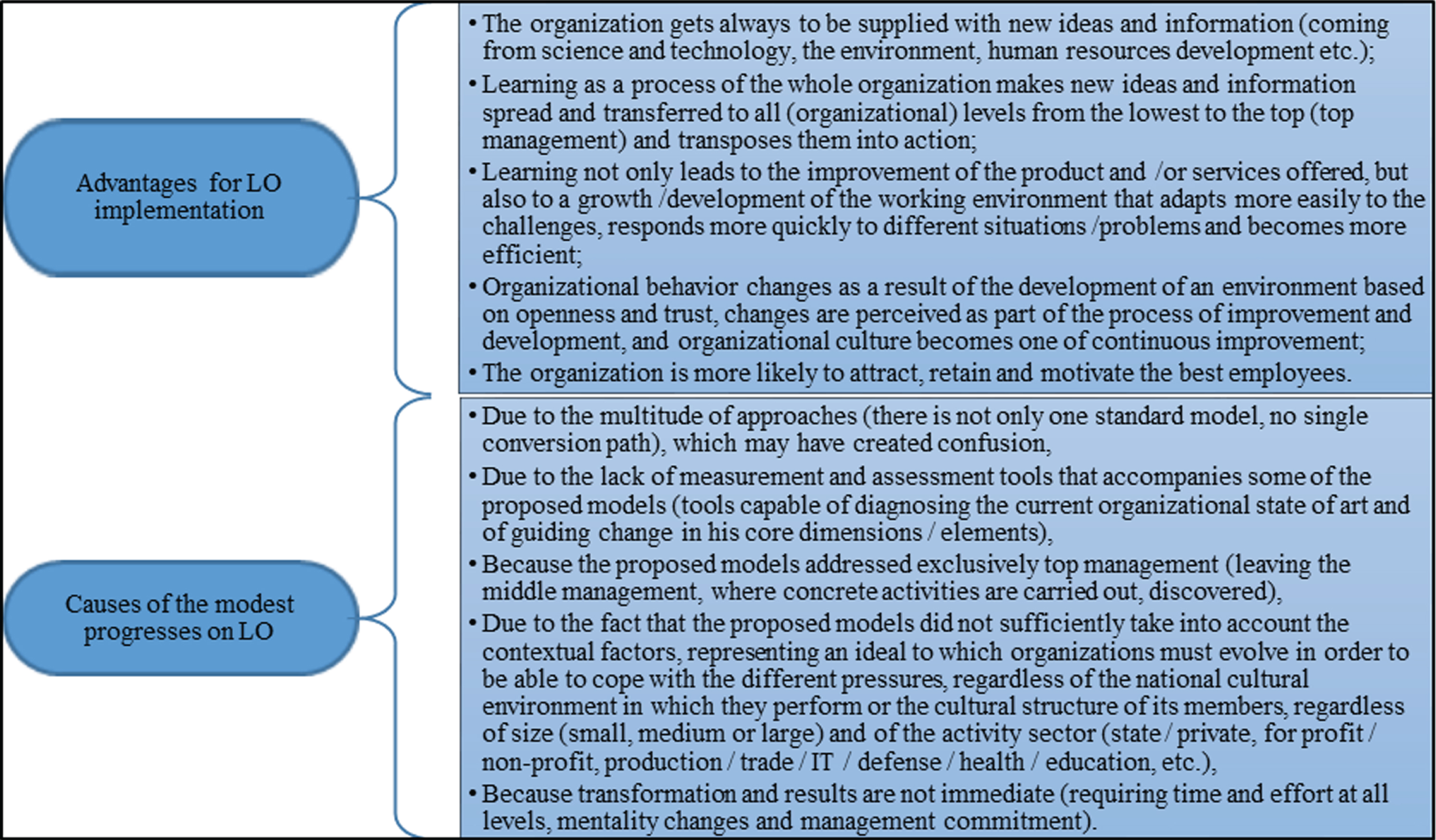
Nevertheless, almost three decades after initiation, a modest progress has been made in the implementation of the “learning organization” model. In Fig. 1 there are presented the advantages for the implementation of learning organization concept and/or model, according to [7], together with relevant conclusions on causes of the modest progresses on implementation, considering both the theoretical and practical perspective.
Internet usage and e-government access.
However, in a society quite different from the one in which the initial concept was generated, is it still relevant and has a possible future? The current relevance of the concept, the level of interest and the need for its implementation are discussed in [8]. Analysing the views on the usefulness of the concept today, from critics’ side and supporters’ side, it is concluded that both categories recognize its relevance for improving organizational performance, organizational culture and innovation capacity, but enlargements/developments/improvements are necessary. The current level of interest identified remains strong in Europe, Asia and the Middle East, but is declining in North America, with a focus on medical and educational organizations (focus explained as being generated by the specific nature of these organizations, which requires individuals and groups to work together in a complex ecosystem, with a large number of stakeholders and for which profit is not the only indicator of success).
Consistent with this focus highlighted by the research presented in [8], learning organization concept becomes more actual and powerful in the last three years, not from the theoretical perspective, but mostly from the practical perspective, due to the strong relation with: organizational learning [9, 10]; learning communities [11]; knowledge management [12]. Furthermore, according to [8], research and debates in the field of education on “schools as a learning organization“ (SLO) have had a high intensity in the last five years and especially due to general concerns about increasing the efficiency and effectiveness of the learning process. The approaches have been related to educational organizations to generate continuous improvements of the teaching staff and to perform better schools’ leadership [13–16] or the approaches focused on educational effectiveness and improvement [17].
That is way, models originally proposed for SLO, centred on mutual learning and peer collaboration within the same school, have been expanded, including networking and collaboration beyond school boundaries as well as strategic leadership (as a condition to create an organizational culture of learning and to encourage organizational learning). Kools and Stoll have provided in 2017, the most recent approach on schools’ direction [1], proposing a model for re-conceptualizing them as learning organization focusing on seven action-oriented “dimensions”: “developing and sharing a vision centred on the learning of all students”; “creating and supporting continuous learning opportunities for all staff”; “promoting team learning and collaboration among all staff”; “establishing a culture of inquiry, innovation and exploration”; “embedding systems for collecting and exchanging knowledge and learning”; “learning with and from the external environment and larger learning system”; “modelling and growing learning leadership”.
Kools and Stoll approach [1] is based on the organizational business model but was extended with inputs from other fields of sciences like organizational behaviour, knowledge management, learning sciences and professional learning literatures [18]. Moreover, operational guidance was provided [19] and it has introduced key –characteristics (key features) for each of the seven directions of action. Therefore, the model has the following advantages: It is generated from the business field, but it is customized to the educational field; It is complemented with an implementation support, a practical guide that could be used to measure and establish equally the starting level and the degree of transformation after a certain period; The guide does not have a unique addressability - school leaders; it can be used also by both teachers and decision makers, supporting and guiding them on how they can develop joint efforts in order to reach the change, the transformation, the re-conceptualization.
The general theoretical approach on SLO at the Romanian educational system level concluded that the starting baseline implementation could be given by the national performance indicators and descriptors identified as being correlated with dimensions and key-characteristics of the proposed SLO model [2]. Figure 2 presents the list of the theoretical correlations established, which are going to be the basis of the present experimental research.
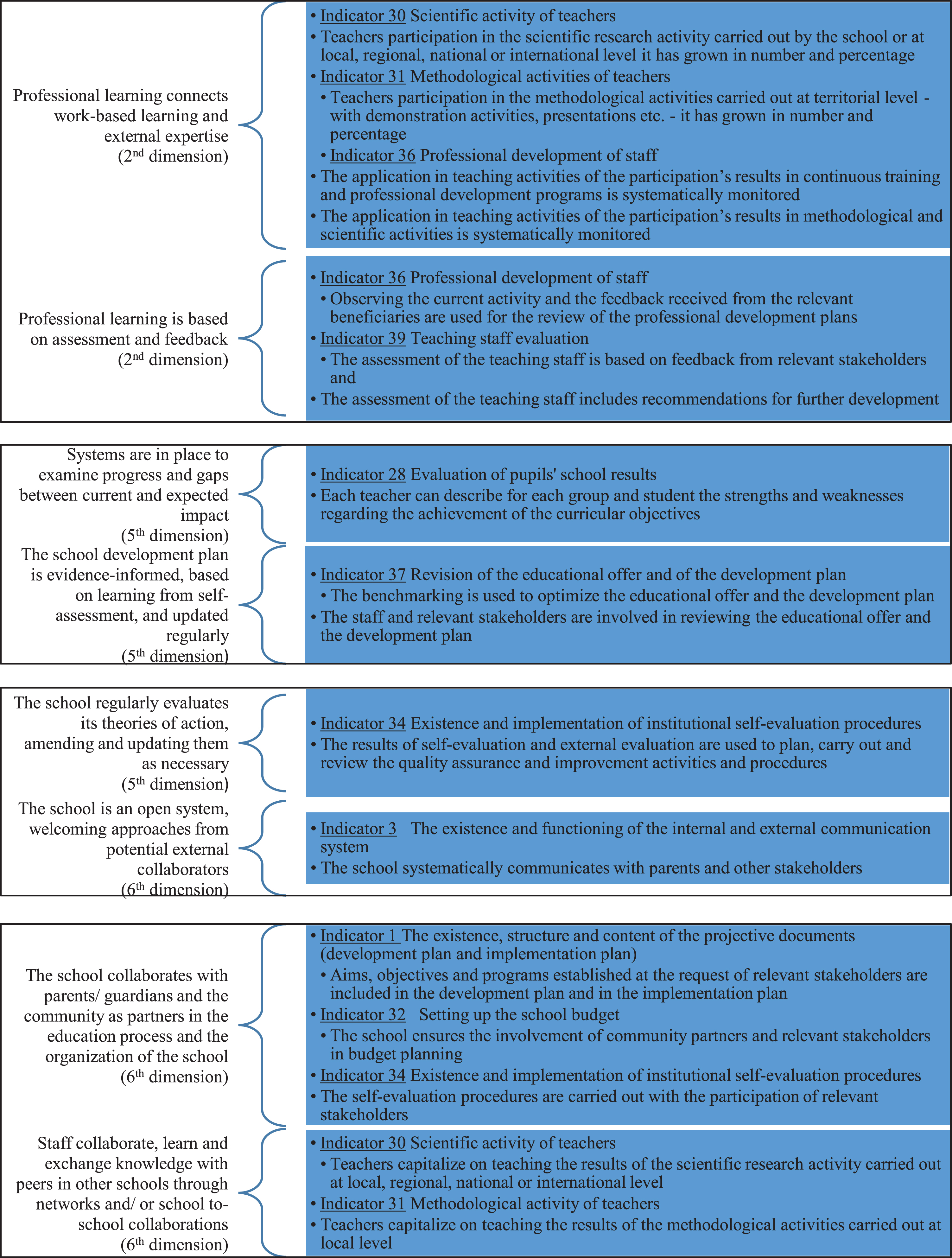
List of theoretical correlations between underlying characteristics and performance indicators (including descriptors) at Romanian national level [2].
Data collection and sample
The data collection process for this research relies on 238 public reports from the first semester of the 2018-2019 school year and on 233 public reports from the first semester of the 2019-2020 school year; these reports present the level of educational services provided by schools and each of them include a section devoted to self-evaluation.
The first research sample consist of 238 schools, from which 124 organizations from the urban area, 114 organizations from rural area, and 6 school sport organizations (3 school sport clubs and 3 high schools with sports program). The second research sample consist of 233 schools, from which 170 organizations from the urban area, 63 organizations from rural area and 28 school sport organizations (15 school sport clubs and 13 high schools with sports program). Both data groups (related to the samples) consist of values obtained in external and internal audit processes related to 43 performance indicators which means that, for the first sample of 238 schools, there was considered two sub-samples values, one for external audit results and one for internal audit results. For the second sample of 233 schools, there was considered also two sub-samples values, one for external and one for internal audit results.
To understand the approach, it should be pointed out three specificities of the Romanian system: The schools’ performance is assessed through 43 national performance indicators (including descriptors) for quality audit (assessment) and quality assurance in pre-university education (set by the Romanian Government Decision no. 1534/2008 regarding the approval of reference standards and performance indicators for quality assurance and audit in pre-university education); The same 43 indicators (and descriptors) are used for both audit processes: external and internal (self-evaluation); For each indicator, it is used a 5-level quantitative scale with points: 0 for “Unsatisfactory” (when the minimum/basic requirements are not met), 1 for “Satisfactory” (when the minimum/basic requirements are met), 2 for “Good” (when at least one performance descriptor is reached), 3 for “Very Good” (when all performance descriptors are reached) and 4 for “Excellent” (when all performance descriptors are reached and, in addition, an organization proves that had set out and reached its own performance descriptors).
Due to the fact that these 471 schools never went through a regular external evaluation, they were nominated the County Schools Inspectorates for this process. Therefore, their distribution by type of services provided and by residence area do not reflect the situation at national level. There was no selection made, by any criteria, all schools nominated by the school inspectorates to be evaluated externally, in the two consecutive school years 2018-2019 and 2019-2020, being included in this research.
Measurements
For both samples, the first level of analysis is developed identically - they were determined for ten performance indicators listed in Fig. 2 (I1, I3, I28, I30, I31, I32, I34, I36, I37, I39) the following: (1) the average external assessment scores (as a simple arithmetic mean of the results obtained by the 238 schools, respectively by the 233 schools, in the external evaluation), (2) the average internal assessment scores (as a simple arithmetic mean of the results provided by the 238 schools, respectively by the 233 schools, in self-evaluation) and (3) the average score’s differences between internal and external prospects, to see to what extent these two are close for the ten targeted performance indicators; positive values mean that the result of self-evaluation is higher than the external evaluation, and negative values mean that the result of self-evaluation is lower than that of external evaluation.
The second level of analysis is devoted to the reconciliation between the two evaluation processes (internal and external) and to establish which of the results of the previous level of analysis can be further used (to the third and final level of the analysis). For both samples, the second level of the analysis is developed also identically –they were introduced, for the ten performance indicators listed in Fig. 2, the following: (1) the dispersion for each set of values (self-evaluation and external evaluation), as a synthetic indicator of variance (considering the average central trend); and (2) the z parameter test (two-tail) for comparing the averages of each sub-sample values (self-evaluation and external evaluation) per indicator. Therefore, they were performed 20 parametric bilateral tests, in order to compare the means of the sub-sample values, having as background: the H0 hypothesis (the null hypothesis) - the compared values do not differ between them (the difference in the mean of the two sub-sample values, internal and external evaluation, is not significantly different from zero); the H1 hypothesis (the alternative hypothesis) - the compared values differ between them (the difference in the mean of the two sub-sample values, internal and external evaluation, is significantly different from zero). They were used the significance threshold α= 0.05 and the critical region for the test (–∞; –1.96] ∪ [1.96; ∞).
The third level of analysis, developed only for those indicators that do not have significant differences between external and internal evaluation, leads to the identification of the percentage of school sports organizations which demonstrate key-characteristics of SLO model.
Results and debates
Considering the previous 5-level quantitative scale points there were obtained average scores per indicator for both types of audits (external and internal). Table 1 presents the results of the first level of the analysis; a general over-valuation tendency on the part of school organizations could be observed, more accentuated in the 2018-2019 school year; each year, for a single descriptor the two perspectives - external and internal - are identical.
The results of the first level of the analysis
The results of the first level of the analysis
The results of the 20 bilateral parametric tests are outlined in Table 2. They led to the identification of two indicators in the first sample - I01 and I28 and of three indicators in the second sample - I01, I30 and I37 for which the values of the z test belong to the critical region; therefore, in their case, the null hypothesis is rejected, considering that there are significant differences between the internal audit results and the external audit results.
The results of the second level of the analysis (Authors development using the significance threshold α= 0.05 and the critical region for the test (–∞; –1.96] ∪ [1.96; ∞))
Given that no significant changes have occurred in the context of operation (in terms of conditions and resources) in the two consecutive school years 2018-2019 and 2019-2020, it turns out that the two samples can be concatenated with some limitations. So: (a) the results that would be obtained by concatenation are considered irrelevant, in case the differences are statistically significant in both samples; (b) the results that would be obtained by concatenation are considered uncertain, in case the differences are statistically significant in only one sample; (c) the results that would be obtained by concatenation are considered consistent and reliable, only if the differences are statistically insignificant in both samples. Therefore, due to the significant differences identified, 4 performance indicators –I01, I28, I30 and I37 –and their tracked descriptors were further excluded from the third level of analysis.
It must be taken into account that in national standards each performance indicator has several subsequent descriptors and only some of them were find, at a theoretical level, as being correlated with key- characteristics of SLO’s organizations - 1, out of 2 for I03; 2, out of 2 for I30; 1, out of 2 for I32; 2, out of 8 for I34; 3, out of 4 for I36; 2, out of 4 for I39 (their list and correlations established during the theoretical research is presented in Fig. 2).
Therefore, at this point (with this kind of data and this type of analysis), only the minimum level of incidence of the tracked issues can be determined, by calculating the percentage of schools that have met all the requirements (all descriptors), including those that are correlated with key- characteristics of SLO’s organizations. Table 3 presents for each performance indicator: (1) the number of schools that have fulfilled all of the descriptors in national standards at the concatenated sample level (out of a total of 471 school organizations); (2) the number of sport schools that have fulfilled all of the descriptors in national standards at the concatenated sample level (out of a total of 34 sport school organizations); (3) the number schools without a sports program that have fulfilled all of the descriptors in national standards at the concatenated sample level (out of a total of 437 school organizations).
Number of schools that have fulfilled all of the descriptors in national standards
In this way, the minimum levels of incidence of several key-characteristics of SLO’s at sample level, at sub-sample sport schools’ level and at sub-sample general education schools’ level were determined. As can be seen in Table 4, these varying between 54.78% and 77.49% for the whole sample, between 55.88% and 85.29% for sport schools and between 50.74% and 71.76% for schools without a sports program.
Correlations between several key-characteristics of SLO model and the minimum levels of incidence at Romanian national level
From an experimental point of view, resulted that the minimum levels of incidence of several key-characteristics of SLO’s could be identified, but only for three action-oriented dimensions: “creating and supporting continuous learning opportunities for all staff”, “embedding systems for collecting and exchanging knowledge and learning” and “learning with and from the external environment and larger learning system”. At this point, it cannot be determined whether these schools act fully or not as learning organizations, but the research results show that, in some respects, they already develop key features of SLO.
As regards the school sports organizations, the hypothesis that they are more likely to develop elements specific to the concept of learning organization is confirmed, for all the tracked issues, except one, the minimum levels of incidence being above of those obtained in schools without a sports program and above the general values at sample’s level. Taking into account the fact that these school sports organizations are spread throughout Romania (namely operating in local communities with different socio-economic and cultural contexts), and the fact that staff includes both coaches and teachers of general education disciplines (therefore, although they belong to the same professional culture, different targets are set in relation to students and different educational practices are developed), these results can only be related with management practices. The management of these organizations developed an optimal climate for: (1) cooperation and collaboration inside and outside their own boundaries, in order to learn from the external environment, but also to monitor and respond to external challenges and opportunities; (2) supporting continuous learning opportunities for all staff, investing in career-long opportunities for professional development and growth, and ensuring ongoing professional learning, by all means and in all contexts. Which, in its absolute value, can be more than just good practice examples among schools on two management issues; exceeding the theoretical threshold, it can be one of the starting points in the implementation of the SLO’s model in Romania.
The presented study has provided a preliminary overview on the situation at the Romanian educational system level in relation to the SLO’s model. Some final discussions related to these aspects are useful to underline the implications of the research: It proves that the implementation of the SLO model at Romanian national level would not start from scratch, which should remove panic, mistrust and opposition that usually accompany any novelty and/or change; conceptual novelty should be counterbalanced by the aspects identified as already developed by the schools, to a greater or lesser extent, and change must be attached to the three directions of action analysed, following that later to be extended to the other four. The results do not provide a guide for the model’s implementation in Romania, but substantiate a strategic decision from where exactly the change should start (around those organizations which demonstrate to a greater extent that they already developing key features of SLO) around the school sports organizations and their management teams. It is necessary a future deeper analysis of the sport schools’ management, in order to identify nuanced insights of their strategy and practice, and to map those that could be valuable prescriptions for the organizational learning process and for the re-conceptualization of schools as learning organizations, whether they are kindergartens, primary, lower secondary or high schools (general, technical, or vocational).
In addition, future research approach must consider the process of creation and defining strategies for the Romanian school sports organizations that will support their transformation into innovative organization, by considering their foundation as learning organizations (as suggested by [5] which establishes links between organizational learning and the process-oriented innovations [20]. Moreover, using Geert Hofstede’s cultural dimensions theory, future directions of research can be set, to analyse the correlation between the national culture (defined through six dimensions –“power distance”, “individualism/collectivism”, “masculinity”, “uncertainty avoidance”, “long-term versus short-term orientation” and “indulgence versus restraint”) and the learning organization culture of school sports organizations.
Limitations
A first limitation of this paper is given by the fact that data were collected from 471 reports developed in the process of external audit of schools (in order to determine the level of educational services provided); means that they were not specifically devoted on identifying the characteristics of SLO’s. However, given the sample size and the fact that the data were collected diachronically (in two consecutive school years), we consider that this indirect approach can provide valuable information.
A second limitation is given by the fact that all data were collected before the COVID-19 pandemic, in a time when school management was confronted only with diminishing resources and with high accountability in achieving greater levels of academic outcomes (tests and exams results), and/or faster integration of graduates into the labour market, and/or greater levels of performances in national and international sport competitions. Given the fact that for the pandemic crisis period schools and teachers have had to find solutions for a vast array of issues –the lack of physical resources (computers and/or high-speed internet) to support student’s distance learning, poor/limited training and teaching practices in distance education, the students’ demotivation and the decrease of their engagement level - it is clear that new pressures have been added (on schools, as well as on the educational staff - teachers and school managers). As a consequence, the existing need for increasing the Romanian school organizations’ ability to learn and adapt has become even more acute in the new turbulent environment; thus, we consider as valuables the idea that has debated the learning organization development in turbulent environment (as is the case with the current health and social crisis) [21]. However, this last period is one that brought the educational community closer and determined it to cooperate and work together for the unplanned move from traditional offline learning to exclusively online learning; and some of the experiences should be further used, learning and adapting quickly to different contexts and situations being in fact the central aspects.
Author contributions
CONCEPTION: Constanta-Valentina Mihaila and Vasilica Grigore
METHODOLOGY: Constanta-Valentina Mihaila and Alina Paraschiva
DATA COLLECTION: Constanta-Valentina Mihaila, Alina Paraschiva and Laurentiu Mihaila
PREPARATION OF THE MANUSCRIPT: Constanta-Valentina Mihaila, Alina Paraschiva, Vasilica Grigore and Laurentiu Mihaila
REVISION FOR IMPORTANT INTELLECTUAL CONTENT: Constanta-Valentina Mihaila and Alina Paraschiva
SUPERVISION: Constanta-Valentina Mihaila