



Abstract
BACKGROUND:
Customer retention and management of customer churn are deemed as among the most significant issues for businesses. Given the fact that customer churn is not typically predictable easily, identifying and analyzing customer churn is necessary for businesses.
OBJECTIVE:
Therefore, the current research was conducted to employ a complementary approach to identify the reasons influencing customer churn.
METHODS:
To do so, initially, customers’ data were clustered by recruiting the K-means method. Each cluster represented customers who held similar values and the probability of churn behavior. In the next step, stakeholder groups are identified based on the K-means algorithm. Then, Soft Systems Methodology (SSM) was employed to encapsulate each of the identified interested groups’ world-view to better understand logical reasons for churned customers. Purposeful activity modeling (human activity system) was adopted for each interested group utilizing SSM techniques.
RESULTS:
Using SSM techniques, purposeful activity modeling (human activity system) for each interested group adopted. Utilizing human activity systems for structuring debate sessions about change actions, short-term and long-term plans have been proposed to maintain and improve customer retention programs.
CONCLUSIONS:
SSM can be considered as an overarching approach that can afford a better understanding of the processes derived from data mining.


Introduction
Customer relationship management (CRM) is one of the strategies concerning customer revolution. CRM uses customers’ information to enhance customer satisfaction, ultimately leading to a surge in the competitive advantage of an organization [1]. CRM aims to reduce the sales cycle and marketing costs, create new customers’ needs, and boost revenue, customer value, profitability, and loyalty [2, 3]. Customer relationship management also intends to improve customer loyalty and reduce churn. In one view of CRM, customer classification is one of the key critical components of CRM. In this view, the classification of an organization’s customers is carried out in groups where the members of each group are similar in terms of a variety of characteristics, such as purchasing behavior, value creation for the organization, and subjective characteristics, etc. Such a classification is done to provide services and products customized for each section [4]. One of the applications of customer classification is customer retention. The primary purpose of managing customer relationships is to boost the customers’ overall value—as customer retention is crucial to business prosperity [5]. Customer classification is usually done according to a large volume of customers’ data [6]. That is why customer classification is linked to data mining. Therefore, data mining deployment to elicit customers’ knowledge plays a vital role in marketing and sales operations using demographic data and customer transactions [7].
It is noteworthy that data mining in decision-making theories is considered a hard approach [8]. A hard approach considers problems as tamed, hard,or structured ones. Similarly, hard problems refer toentirely structured problems for which there is a def-initive optimal solution. Hence, there are common and consistent interpretations for solutions related to this set of problems, and the application of mathematical and statistical methods in solving these problems is commonplace [9]. Contrary to hard app-roaches, there are soft approaches in which problems are considered as a construct of people’s intellectual perceptions, which are labeled soft problems. Soft approaches maintain that any solution to soft problems requires simultaneous consideration of exp-eriences, actions, and appreciation [10]. As such, one can infer that data from a transaction or demographic data obtained from databases do not in any way reflect intellectual factors influencing customers’ purchasing decisions.
Accordingly, this study attempts to establish arelationship between the two approaches mentionedabove in solving customer retention problems. This aim is achieved by identifying different groups/classes of customers through the mining of custom-ers’ transaction data. Then, Soft Systems Methodology (SSM) is recruited to encapsulate the world-view of each identified class. As one of the practical and most used decision-making approaches, this methodology is perceived as an appropriate methodology for identifying the world-views of diverse customer groups [11]. For this reason, although various studies have endeavored to employ a blend of soft and hard approaches as a mixed research method in solving organizational problems [12, 13], there is still a dearth of research on the use of such approaches in solving problems of customer relationship and customer retention. Therefore, the objectives of this research are as follows: 1) Customer classification based on transactional data elicited by data mining with the aim of customer retention; 2) Identifying the factors influencing customers’ post-purchase decisions and their world-views in the identified classes using SSM, and 3) Providing suggestions to improve customer retention in light of the results obtained from the previous steps.
This study is organized into 7 sections. Section 2 reviews the research background. Section 3 describes the research methodology. In Section 4, each research step’s results are presented separately. Section 5 seeks to evaluate the proposed methodology to better explain the chosen methodology’s advantage over employing data mining and SSM solely. Section 6 concludes the research outcomes. Section 7 also points out the limitations of the research and makes suggestions for future research.
Research background
Customer management
Companies continuously seek to diversify their brands, products, and services; meanwhile, creating a superior customer experience along the entire value chain is one of the main challenges encountered by businesses nowadays [14–17]. Customer management is one of the solutions that contribute to the business’s profitability and, at the same time, can reduce costs. Proper customer management enables companies to ensure that their provided services are aligned with the customers’ needs. Importantly, it can also identify further opportunities for growth.
When designing data-driven strategies to create a unique customer experience using customer management plans, companies are interested in employing CRM [18]. To them, CRM refers to the utilization of “technology as an enabler to capture, analyze, and disseminate current and prospective customers’ data in order to identify customers’ needs more precisely and to develop perceptive relationships” [19]. This implies integrating strategic goals into business processes and information and communication technology (ICT) [20, 21]. Any business requires CRM to sustain its entity and survive in the long-term. CRM amalgamates the potential of relationship marketing and IT strategies to gain a better understanding of customers and create value with them while considering the development of profitable and lasting relationships [22]. CRM’s challenge is to identify and track profitable customers, satisfy and retain them, and develop valuable relationships [23]. It also addresses customer retention and loyalty.
Customer retention and loyalty are important goals for successful companies. Customer retention management is perceived as one of the pillars of CRM, which intends to realize customers’ perceptions of satisfaction. Elements of this dimension embrace one-to-one marketing, loyalty, bonus programs, and complaints management [15, 24–26].
Customer classification using data mining
customers’ database is at the core of customer management. customers’ data is a precious asset of any business. A business that has clean, correctly formatted and accurate customers’ data will be able to provide an adequate level of service and save time and money. Along these lines, the emergence of Web 2.0 has been based on collaborative platforms like Wikis, blogs, and social media aimed at facilitating creativity, collaboration, and sharing among users for tasks other than just e-mailing and retrieving information [27]. In addition to facilitating customer communication through Web 2.0 technologies, these platforms also provide a huge amount of business data. Data mining is one way to discover customers’ knowledge in such bulky data. Chagas, Viana [15] revealed that customer identification and retention are among the most discussed CRM dimensions in the literature for data mining applications.
It is noteworthy here that research findings have demonstrated that K-means algorithms are one of the most widely used methods in customer classification [15, 29]. K-means clustering groups a set of data into clusters through an iterative procedure [30]. Let X = {x
i
} =1, 2 ... , n be the set of n-dimensional points to be clustered into a set of K clusters, C = {c
k
, k = 1, 2, …, K}. K-means algorithm finds a partition such that the squared error between the empirical mean of a cluster and points in the cluster is minimized. Let μ
k
be the mean of the cluster c
k
. The squared error between μk and points in a cluster c
k
are defined as [31]:
The K-means algorithm aims to minimize the sum of the squared error over all the K clusters.
K-means algorithm starts with an initial partition with K clusters and assigns patterns to clusters to reduce the squared error. Since the squared error tends to decline with a rise in the number of K clusters (with J(C) = 0 where K = n), it can be minimized only for a fixed number of clusters.
Developed by Hughes [32], RFM analytical model is a model that identifies important customers from the massive volume of data about customers. The goal of RFM is to provide a simple framework for determining customers’ behavior. When a customer is rated through the RFM model, it can be grouped into categories and analyzed for organization profitability. Such a profitability analysis furnishes the ground for deciding how to deal with a customer in the future. This model is constructed by scoring three features, namely R, F, and M. Details of these features are presented in the following:
(
RFM model is used to categorize customers and serves as a proper model for measuring customer value. That is why many studies in various industries have recruited this model [33–35]. Despite numerous applications of this model, its applications in customer-related research have come under attack by some scholars. Based on the findings in the study by McCarty and Hastak [36], in the RFM model, only retrospective aspects of customers’ behavior are taken into account, and there are no indications that reveal awareness of the future customers’ behavior. Actually, such static indicators alone cannot reflect the dynamism of future customers’ behavior. Thus, it is essential to add an index to the RFM model so that it demonstrates the dynamics of customers’ behavior and analyzes the future behavior of customers as well.
Soft systems methodology
In recent years, a wide variety of studies have applied SSM to tackle social situations’ complexities. SSM stresses that social problems are complex ones. That is why SSM seeks to explain the world-views of different groups in the problem situation and use it to make accommodations to improve the problem situation [13]. SSM is not regarded as a tool or technique, but rather an action-oriented methodology to tackle complex social situations with a multiplicity of perspectives and interests in defining a problem. This methodology emphasizes that structuring the thought about “how to think” can improve the problem situation and provoke learning about social situations. It is of prime importance to employ this methodology in dealing with social and human issues, as many studies have recruited this methodology [13].
As mentioned earlier, SSM capitalizes on action research. Therefore, it relies on a researcher who intervenes in a problem situation and intends to think about the problem in accordance with SSM guidelines and improve it using a series of actions [37, 38]. In this case, the researcher strives to ascertain the world-view of the interested groups about the problem situation and sort out modeling of these world-views [38–40]. Intervention in problematical situations develops a better understanding of the pro-blem situation. Then, researchers utilize ideal models as intellectual devices to raise questions about the problem situation and adopt actions that are both logically appropriate and culturally feasible. Therefore, it can be argued that solving soft problems requires an inquiry into the problem situations, identification of mindsets (interested-groups) and their world-views, creation of debate and discussion, and finally, improvement of the perceived problem situation. Inquiry into the problem situations familiarizes the researcher with all the mindsets. Such an event allows all the mindsets to participate in the problem-solving process as frequently as possible. Research studies reported the use of SSM to resolve problems related to customer management. Some researchers have used SSM in order to share and manage customer knowledge [41–43]. In addition to customer knowledge management, some researchers have also taken into account product/process/service innovation [37, 44–46]. In addition, some researchers have used SSM in customer requirement elicitation [47–49]. Other researchers focused on SSM’s capabilities in its participatory nature for solving customer problems [50, 51].
According to Checkland and Poulter [52] view, SSM consists of four different activities. Finding-out: The purpose of this activity is to understand the problematical situation. Modeling: This activity aims at constructing some purposeful activity models pertinent to the problem situation. These models are drawn on pure world-views. Debate and discussion: In this activity, models are used to arouse debate and discussion with the aim of improving the problem situation. Such debate and discussion will empower different groups to change the problem situation. Definition and improvement actions: In this activity, actions are defined. Actions are also taken to improve the problem situation.
Research methodology
The current research was conducted to employ a complementary approach to identify the reasonsinfluencing customer churn. According to Mingers [53], using a combination of research methods/met-hodologies has several advantages. Different paradi-gms and approaches lead to multiple views on theresearch problem. Furthermore, the validation of theobtained data is more robust, resulting in rigorousanalysis and broadening of the research problemthrough providing new insights. Moreover, the mix-ed-method approach eliminates the weaknesses ofthe single research method and simultaneously enhances its strengths. In this study, recruiting a com-plementary approach built upon mixing soft (enca-psulating intellectual factors influencing customers’purchase behavior) and hard (mining customers’ tra-nsactional data) approaches in decision making, anattempt was made to identify factors effective incustomers’ purchase behavior. The research framework in the current study is composed of five main steps (Fig. 1).

Research design.
RFMC indices
For identifying intellectual factors, it is necessary to identify the interested groups (stakeholder groups). Stakeholder groups consist of at least one of the customer classes identified in the previous step. Each class will belong to only one stakeholder group.
Step 1: Data preparation
At this stage, two basic steps were adopted with the aim of preparing the data. customers’ transactional data were extracted. The time interval between 2016-2019 was considered to extract the data. The accumulated data were cleaned. At this stage, the data were assessed and audited in terms of quality, validity
2
, accuracy
3
, completeness
4
, and uniformity
5
. Table 2 shows the related information about the extracted variables. After extracting and cleaning the data, R, F, M, and C indicators were calculated for 471 customers of a company active in the production and sales of electronic organizational equipment (B2B sector) whose transaction information was available in the company’s database over a four-year period.
Extracted variables and their role in RFMC calculation
Extracted variables and their role in RFMC calculation
Then, the values of R, F, M, and C indicators were selected as an input of the K-means clustering algorithm, and customers were clustered in fivecategories based on the obtained results. Table 3 shows the related results.
Clusters obtained using K-means algorithm
Clusters obtained using K-means algorithm
According to Table 3, Cluster-1 involves people whose purchasing intervals have been so broad that they have bought five times on average over four years. This customer group has a very low turnover for the organization, and their churn rate is high. Although members of Cluster-2 differ from those of Cluster-1, they still hold high R values. Members of this cluster have little loyalty to the organization and are easily susceptible to competitors’promotions/advertising campaigns. On the other hand, Cluster-3 represents customers who are capable of turning into loyal customers of the organization. The values of R, F, M, and C of the members in this cluster are very distinct from those of Cluster-2, and the value of C in this cluster indicates that customers in Cluster-3 can be brought closer to the fourth and fifth clusters by providing appropriate promotional services. The fourth and fifth clusters, which account for approximately 25 % of customers and generate approximately 73 % of the company’s turnover, have an outstanding relationship with the company and have not declined but increased their purchase from the company over the four years. All the entities indicate that these groups of customers are considered as loyal. It is worth mentioning here that although both of these clusters are equally loyal to the organization, the fifth cluster of customers embraces those who are grouped as almost weekly customers of the company and bring in a large amount of the organization’s financial turnover. Such customers are dedicated and faithful to the company and have developed strong feelings of care toward and bond with the company. Such customers exclusively purchase the company’s products or services, and they are reluctant to turn to a rival firm to satisfy their needs. This group of customers has shown a great desire to buy from the company.
The goal of this phase is to develop an understa-nding of customer groups/clusters. Such an understanding can embrace various aspects. At this phase, documents and information related to customers were obtained to get a better idea of identified clusters in the previous step. The reviewed information included the type of business, type of industry, the number of the received complaints, and the number of the received after-sales services. Table 4 presents this information. According to Table 4, the company deals with two major groups of customers. The first group of customers constitutes service companies that use services, such as consultation on the setup of telecommunication towers and radio masts, flexible manufacturing systems, and improvement of field service management. The second group of customers consists of manufacturing companies that use both services and products manufactured by the company, such as telecommunication and mast towers. It is noteworthy that the rate of loyalty in the first group of customers was much lower than that of the second group. The number of complaints received by the first group was much higher than the second group, and at the same time, they used less after-sales services. Therefore, the results of the finding-out phase can be summarized as follows. The company’s customers can be grouped into two main interested groups (mindsets). These two mindsets hold different expectations of the received services, and it is essential to define services separately for them.
The information gained for each cluster of customers in the finding-out phase
The information gained for each cluster of customers in the finding-out phase
Numbers indicate the number of complaints. For example, out of 123 very low loyal companies, 14 companies had complaints.
The purpose of this phase is to encapsulate intellectual factors. SSM techniques, such as root definitions, PQR formula, CATWOE analysis, and formal systems, can be recruited at this phase [10, 56]. Therefore, the purpose of this phase is to encapsulate the ideal models of the identified classes about customer retention services. This phase is composed of two key activities. Initially, Root Definitions are created, and then, they are modeled in the form of purposeful activity models.
Data resources for identifying intellectual factors are the information derived from focus group sessions. Using convenience sampling [57], interviewees were invited for focus group sessions that were separately held with the selected customers from each cluster to collect qualitative data. Selected apart from meetings with customers of Cluster-5 (very high loyal customers), including 4 customers and 1 moderator, the other meetings consisted of 8 customers and 1 moderator. Overall, 5 focus group sessions were held, yielding adequate qualitative data, analyzed using ATLAS. ti 7 software. It is worth mentioning here that before holding interview sessions, interview protocols (Appendix 1) were shared with the customers. Then, as the scheduled time approached, the time and place of focus group sessions were confirmed with the interviews once more. At the outset of the interview, the moderator shared with the attendees the meeting aims. Then, interviews were recorded with customers’ consent, and along with each customer’s demographic information, audio tracks were transcribed and returned to participants to check for accuracy and resonance with their experiences (member checking for exploring credibility of results). Subsequent focus group sessions were also held as a follow-up for coding of the first session’s recorded data.
During the analysis of qualitative data collected through interviews, an attempt has been made to investigate differences between diverse clusters of customers (See Appendix 2 for a selected discussion and related codes and Appendix 3 for information on open-coding). These differences revealed two distinct mindsets. Accordingly, a root definition was offered for each of the identified mindsets. Table 5 characterizes root definitions.
Root definitions for two interested groups
Root definitions for two interested groups
According to Table 5, the most crucial factor intransforming the first group of customers into loyal customers is improving service quality by speeding up the provided support and responding through multiple communication channels, such as customer service center, website, and by defining dedicated support. For this interested group, the essential as-pect of a decent customer relationship system is to have their complaints immediately and intelligently resolved. For the second group of customers, due to the manufacturing nature of their work, the steady presence of supporters in the form of providing support and maintenance services has been expressed as the most significant element of maintaining and providing services to them. For this interested group, an appropriate customer relationship system can be established by defining and designing multiple maintenance/support models as a periodic and occasional case, prompt monitor of services and support processes, initiating different levels of access tothe software, and receiving various reports by creating executive insights through smart managerial dashboards. Purposeful activity systems (conceptual models) were gleaned from the analysis of interview protocols conducted with representatives of each mindset in the model-building phase. Conceptual models were designed as follows: First, interviews were thoroughly assessed by researchers and two experts of X company. Following an in-depth review of contents in the interviews, open-coding was conducted on the basis of consensus reached among researchers and the two experts about labeling codes. This step was taken to achieve higher consistency between the encoded and interpreted texts. (See Appendix 3 for information on open-coding). During the coding phase, the relationship between codes in interview protocols was investigated. For example, when interviewees characterized “design multiple maintenance/support models” as a requirement for “define multi-channel customer support policy “then,” design multiple maintenance/support models” was considered as a prerequisite for “define multi-channel customer support policy.” Conceptual models were designed to address concerns of every single representative of mindsets. Figures 2 and 3 illustrates the purposeful activity model (human activity system) advocated by proponents of the first and second mindsets, respectively.
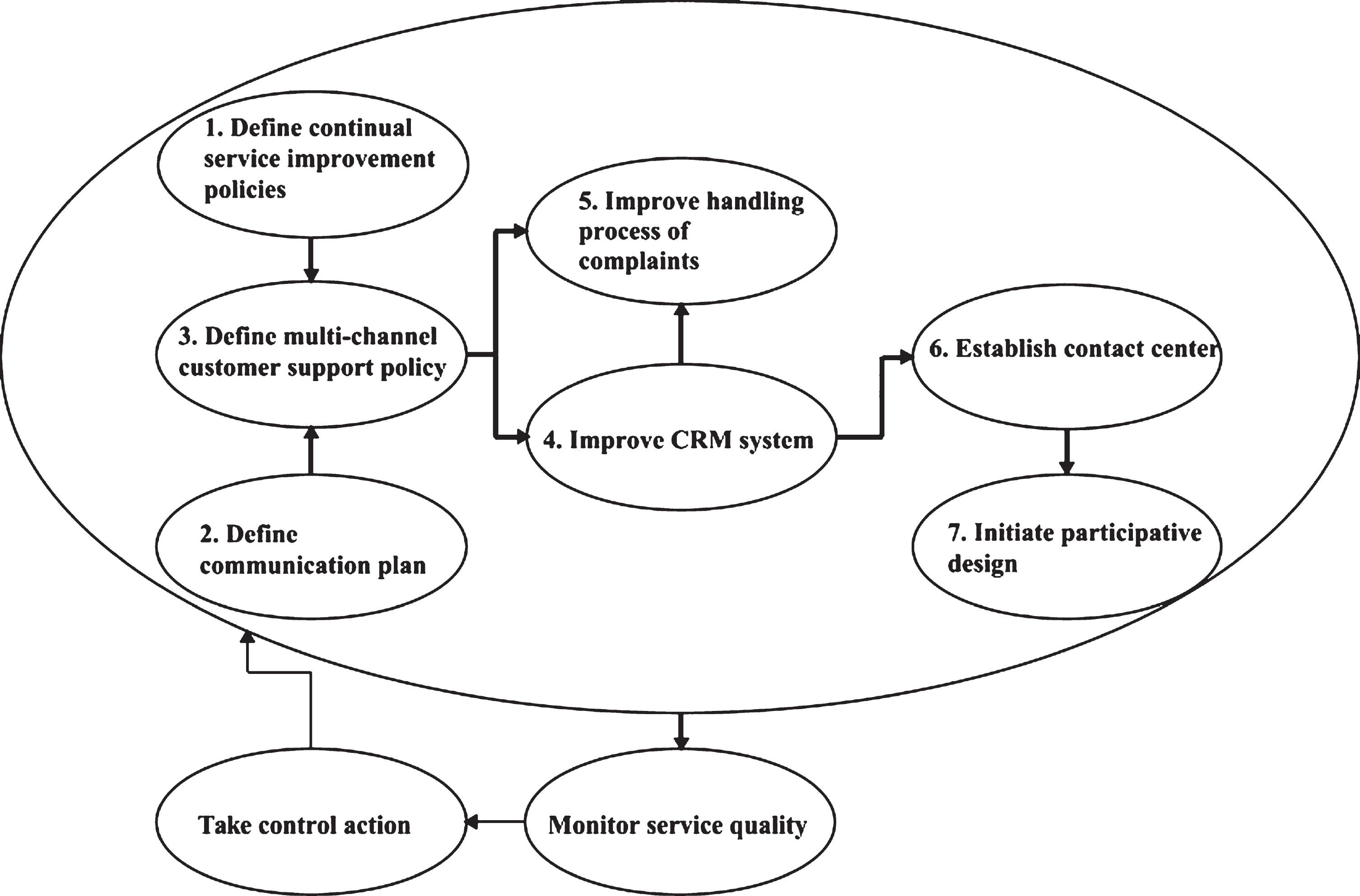
The conceptual model for the first world-view (service companies).
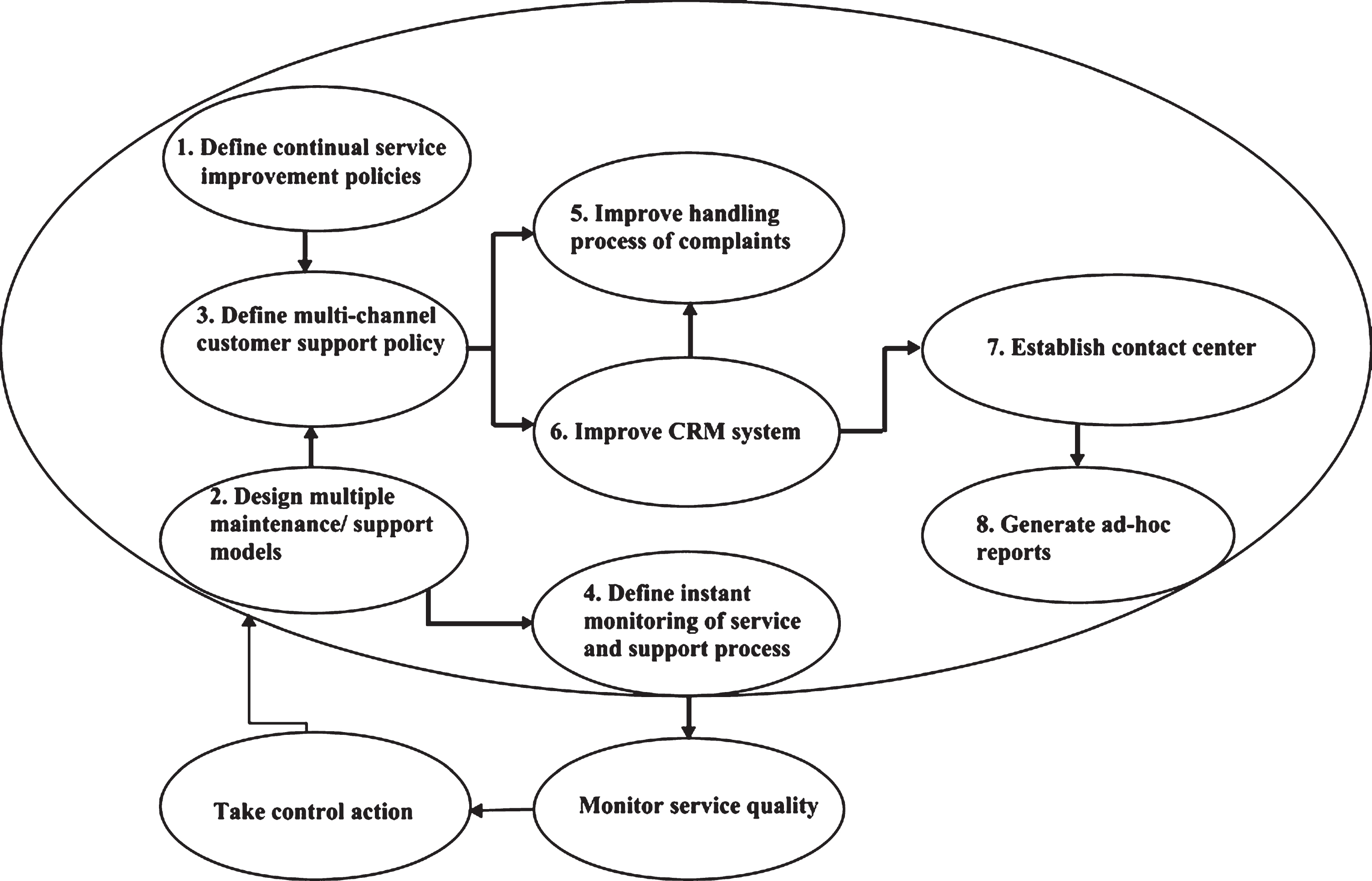
The conceptual model for the second world-view (manufacturing companies).
According to Fig. 2, the main concern of the first world-view, which involved service organizations, was enhancing the quality of services by speeding up the rate at which complaints are handled. Also, the collaborative design of joint services was one of the ideals of this group of customers. For the second world-view (Fig. 3), manufacturing organizations, promotion of equipment support and maintenance services, and continuous monitoring of equipment and devices purchased by them through sensors and IoT (Internet of Things) network were among their deepest concerns.
This phase requires using ideal models garnered in the previous step during debate and discussion sessions. It should be mentioned here that such a procedure does not allow discussion sessions to be random and makes debate and discussion sessions more structured and energetic. Furthermore, the involvement of multiple stakeholders in discussion sessions yields vigorous debates. It is also worth mentioning here that it is necessary to discuss and debate performance measures defined in terms of efficacy, effectiveness, and efficiency at this phase. Debate and discussion also facilitate control and monitor the implementation of the desired actions. During debate/discussion sessions, accommodation is achieved for two different types of activities, including operational and strategic activities. Most of the operational activities were fast-paced and aimed at reducing customers’ turnover and consequently, boosting revenue. These activities were separately defined for each of the five customer groups (See Table 6). For example, strategic activities require structural, attitudinal, and procedural changes indispensable to Company X and are appropriate for long-term periods. Strategic activities were determined for the two identified mindsets. The discussion and debate sessions also pointed out that all the activities outlined by conceptual models are systematically desirable and culturally feasible.
Defined change actions
Defined change actions
The current research methodology uses a hybrid research method for customer behavior analysis. Accordingly, this study attempts to establish a relationship between the two approaches mentioned above in solving customer retention problems. This aim was achieved by identifying different groups/classes of customers through the mining of customers’ transactional data. Then, SSM was recruited to summarize the world-views of each identified class. The results of the previous studies have revealed research flaws in each of these methods/methodologies. That is why a hybrid approach was selected in this study. Table 7 presents the drawbacks of each of these methods/methodologies as well as the methodological approach proposed in this paper to address each of the flaws.
Evaluation of the proposed framework for customer behavior analysis
Evaluation of the proposed framework for customer behavior analysis
According to Table 7, it can be claimed that the use of the proposed methodology could partially overcome the weaknesses in addition to taking advantage of data mining and SSM strengths. Although data mining approaches can uncover decent knowledge hidden in data, their results rest on retrospective data. The use of interpretive and qualitative approaches identifies cognitive, cultural, and contextual aspects that influence the formulation of problems and acts as an overarching approach that can afford a better understanding of the processes derived from data mining. Moreover, the use of data mining can minimize some of the weaknesses and limitations of SSM, including extreme subjectivism, difficulty in generalizability, and the possibility of personal judgments shaping outcomes and solutions.
Research conducted in various decision-making areas has either focused on objectives or intellectual factors to justify human behaviors. In this study, recruiting a novel approach built upon mixing soft (encapsulating intellectual factors influencing customers’ purchase behavior) and hard (mining customers’ transactional data) approaches in decision making, an attempt was made to identify factors effective in customers’ purchase behavior. To do so, first, customers were clustered by employing RFMC, which combines traditional RFM indicators with C-index to show customer churn. To measure intellectual factors that impact customer purchase behavior, an inquiry into problem situations was recruited to develop an understanding of customer churn behavior and define improvement actions based on results. Given that company X is a B2B company, customer churn gives rise to a considerable income reduction.
For clustering customers, the K-means clustering method was employed, and five distinct clusters of customers were identified. In the next step, an inquiry into the problem situation revealed that the five identified classes of customers determined by the clustering method could be divided into two main distinct interested groups. The first interested group’s main concern was that service organizations were escalating service quality by accelerating complaints management; whereas, for the second world-view, manufacturing organizations’ promotion of equipment support and maintenance services, as well as continuous monitoring of equipment and devices purchased by them through sensors and IoT networks, were among the most profound concerns. Some debate and discussion sessions were held to obtain operational and strategic actions using conceptual models as an intellectual device for encapsulating different mindsets. Most of the operational activities were fast-paced, aimed at reducing customers’ turnover and thus, increasing revenue. These activities were defined separately for each of the five customer groups. Strategic activities refer to those that demand structural, attitudinal, and procedural adaptations that are indispensable to company X and are suitable for long-term periods.
In addition to identifying customer behavior, the current study attempted to provide effective marketing and sales services tailored to the class in which they are assigned to ultimately increase their revenue for the organization. For customers with very low loyalty, awareness strategy was selected whereby it is necessary to increase the organization’s interaction, especially the sales manager, with this group of customers and inform them of organizational constraints. Besides information dissemination, for customers with low loyalty, it is recommended to reduce the costs incurred by customers as for this group of customers, cash discounts can inspire their loyalty and raise their awareness of services. As for customers with moderate and high loyalty, it is advisable to provide incentive and promotional services, and finally, for customers with very high loyalty, a differentiation strategy needs to be specified. Cash discounts on sales, marketing, personalized advertising services, and direct interaction with senior executives and receiving feedback are among the operational plans for this group of customers.
Limitations and new avenues for further research
The probability of prolonging the decision-making process in improving customer retention management systems is one of the limitations of the proposed methodology. The framework’s reliance on involving multiple stakeholders, group meetings, focus group discussions, and in-depth interviews may require plenty of time. Therefore, it is necessary to formulate appropriate plans for time management and scheduling of the decision-making process. The proposed methodology was implemented in only one single-shot case study. On top of that, the size of companies is not considered in clustering and analyzing the results. Some research findings may be open to different interpretations given some researchers’ viewpoints; for this reason, attempts were made to reconcile authors’ views with primary sources to the greatest possible extent by studying various sources and referring to them. The results of the current study were only discussed with one example in mind. That is why findings may vary, considering many other respects. This research was confined to applying SSM, while other researchers have devised several soft operations research methodologies.
With these limitations, the following are suggestions for future work: 1) Other approaches, such as Critical Systems Heuristics, can be used along with data mining; 2) Other techniques, such as Zaltman metaphor elicitation technique (ZMET), can be used together with focus group meetings. 3) It is possible to conduct research for a more extended period of time and compare the results of customer behavior before and after proposing change actions.
Footnotes
Acknowledgments
The authors have no acknowledgments.
Author contributions
CONCEPTION: Mohammad Mehrabioun Moh-ammadi
METHODOLOGY: Mohammad Mehrabioun Mohammadi and Bibi Malihe Mahdizadeh
DATA COLLECTION: Mohammad Mehrabioun Mohammadi and Bibi Malihe Mahdizadeh
INTERPRETATION OR ANALYSIS OF DATA: Mohammad Mehrabioun Mohammadi and Bibi Malihe Mahdizadeh
PREPARATION OF THE MANUSCRIPT: Mo-hammad Mehrabioun Mohammadi and Bibi Malihe Mahdizadeh
REVISION FOR IMPORTANT INTELLECTU-AL CONTENT: Mohammad Mehrabioun Mohammadi and Bibi Malihe Mahdizadeh
SUPERVISION: Mohammad Mehrabioun Moh-ammadi
Appendix 1. The protocol of focus group discussion
What is the purpose of holding a focus group meeting? What is the scope of conversations?
Discovering
Finding
Choosing
Evaluating
•Incorrect information
•Problems that all the
•Customer retention
•Different communicational
received from company
customers are involved in
services
channels with customers
•Previous problems
•The most appropiate options
•Customer retention
•Current customer
with company
available in improving relationship
requirements
support policy
with the company
•Unpleasant experiences
•Options that facilitate
•Customer retention
in using company’s
communication with the company
requirements
products/services
What
What have been the most significant challenges you have had with our company?
What is the most important feature of our company that you would recommend to others?
What could be better about your relationship with our company?
How
How can we help you to better connect with company X?
How can we inform you about services and products faster?
Why
Why did you choose us to work with?
Why do not you increase your cooperation with us?
When
When do you feel that our company has been able to create a pleasant experience for you?
When do you recommend us to others?
Appendix 2. Selected discussion and attributed codes
One of the reasons I recommend your company to others was how quickly you respond to our requests or complaints. However, recently there has been a slowdown the last time I complained, it took almost 72 hours for experts and specialists of your company to respond to my complaint and repair my device.
I also agree. Years ago, the specialist who had come from your company to repair our devices did the work quickly while knowing about his job and behaving very well.
I will add this as well. The attitude of the person in the call center was much better. While your call center experts are acting as if they want to do it on their own.
Thank you for the tips you said. How do you think we can recreate this pleasant experience for you now?
In my opinion, increase the speed of your response. We are a service company, and if our device is not ready soon or repairs are not done quickly, a largequeue of customers will be created that we cannot be responsible for them, which is very stressful for us.
In the beginning, you did an outstanding job, and one of your company’s support experts periodically visited our company and gave a basic check of the devices once a month. This distance has increased drastically, and I think the last time someone came from your company and checked our device was almost three months ago.
Well, why not render an application for us to install and let you know right away if something goes wrong. It should be a line of contact so that we can talk to this expert directly. Presently, as we call, the call center expert will tell us that specialist will contact you later. The expert may not call at all
The codes included improving handling processes of complaints, receiving customer problems and requests from various communication channels (phone, e-mail, in person, etc.), specifying the standard time for the organization’s services, and effective complaint management.
Appendix 3. Focus group details
No
Class details
Codes
Concepts
1
R: Very high
Instantaneous monitoring of service and support process,
Define multi-channel customer support policy,
F: Very low
improving handling processes of complaints, receiving
define communication plan, improving CRM system,
M: Very low
various reports by creating executive insights through
initiate participative design, and improve
C: Very low
smart managerial dashboards, extracting knowledge
handling process of complaints
about services and merchants using big data analytics,
reducing service delivery costs especially overhead costs,
receiving customer problems and requests from various
communication channels (phone, e-mail, in person, etc.),
prioritizing customer requests, service scheduling,
changing customers’ after-sales service contracts,
specifying the standard time for services provided
by the organization, ability to view the status of
service items, integration of communication channels,
case management, effective complaint management,
information on the status of complaints,
and participative design
2
R: High
Improving information processes, ability to view the status
Define multi-channel customer support policy,
F: Low
of service items, integration of communication channels,
define communication plan, improve CRM system,
M: Low
improving the process of handling support requests,
initiate participative design, improve handling process
C: Low
taking immediate action to resolve dissatisfaction
of complaints, establish contact center,
about services, accelerating support process, presence
and define continual service improvement policies
of the qualified experts for customer organization,
considering customers’ feedback in improving CRM,
and improving handling processes of complaints
3
R: Medium
Following up complaints immediately and intelligently,
Improve handling process of complaints,
F: Medium
continuous monitoring of clearance and delivery
define multiple maintenance/support models,
M: Medium
of maintenance, repair, and operations (MRO) goods,
and define instant monitoring
C: Medium
taking immediate action to resolve dissatisfaction
of service and support process
about services, receiving customer problems and
requests from various communication channels,
integration of communication channels,
and improving handling processes of complaints
4
R: Low
Managing communication with service requesting
Define multiple maintenance/support models,
F: High
organizations, reviewing complaints, following
define instant monitoring of service and
M: High
up complaints immediately and intelligently,
support process, establish contact center,
C: High
notifying instantaneous notifications in the form
and define multi-channel customer support policy
of online notifications about services,
the possibility of instantaneous monitoring
of maintenance performance, checking the
history of MRO goods, checking history
of raw materials, continuous monitoring
of clearance and delivery of MRO goods,
improving information processes,
integration of communication channels,
and taking immediate action to
resolve dissatisfaction about services
5
R: Very low
Defining and designing multiple maintenance/
Generating ad-hoc reports, define multiple
F: Very high
support models as a periodic and emergency case,
maintenance/support models, improve CRM system,
M: Very high
reducing costs and increasing revenue by reducing
and improve handling process of complaints
C: Very high
waste of time to reach the location of service,
improving support cycles/periods,
faster installation of equipment,
and real-time and reliable maintenance/
support services for their payment infrastructure

Invalid data, such as incorrect contract amounts were altered
Accurate company data, such as correctness of the industry in which companies have been active
Fixing incomplete data, such as empty/incomplete contract purchase volume/ product amount
Exchanging different currencies into one agreed unit