




Abstract
BACKGROUND:
Most leadership theories, such as transformational, ethical, and servant leadership, emphasize the notion that leaders influence their followers’ in-role and extra-role work performance by treating them collectively and similarly. On the other hand, leader-member exchange (LMX) theory challenges this idea and argues that leaders treat followers differently and have high-quality exchange relationships with some followers and low-quality ones with others. However, few studies have examined LMX differentiated relationships in social contexts.
OBJECTIVE:
This study aims to investigate the role of employee leader-based self-esteem (LBSE) (i.e., employees’ self-evaluation of their worth derived from the quality of the relationship with their supervisor) in the relationship between LMX and two types of performance: task performance and organizational citizenship behaviour at individual level (OCB-I). Using an integrated theoretical framework of social comparison and self-consistency theories, we develop a moderated mediation model in which the mediating role of LBSE in the LMX-task performance and OCB-I relationships is conditional on the values of LMX social comparison (LMXSC).
METHODS:
Using a research sample of 298 manager-employee matching dyads working in 43 branches of a leading bank in Pakistan, results of hierarchical multiple regression analyses provided support for our developed model.
RESULTS:
We found that LMX positively led to LBSE which, in turn, served as a mediator between LMX and both performance types, with a stronger effect on OCB-I. We also found that by moderating the relationship between LMX and LBSE, LMXSC moderated the mediating role of LBSE, which had stronger effect on performance at high values of LMXSC than at low values.
CONCLUSIONS:
Following these findings, we discuss the contributions that this study offers to LMX and self-esteem literature and its managerial implications.
Keywords




Introduction
Most leadership theories, such as transformational, ethical, and servant leadership, emphasize the notion that leaders influence their followers’ in-role and extra-role work performance by treating them collectively and similarly [1]. However, leader-member exchange (LMX) theory challenges this idea and argues that leaders treat followers differently and have high-quality exchange relationships with some followers and low-quality ones with others [2, 3]. Based on this core tenet of LMX theory, prior studies have found that employees who perceived high-quality LMX exhibited higher in-role and extra-role work performance than those who perceived low-quality LMX [4, 5].
In prior literature, social exchange theory [6] has been used extensively to explain the positive relationship between LMX and performance. According to this literature, performance is a form of employees’ payback to leaders for their high-quality LMX [5, 7–9]. Although the social exchange-based view on the LMX-performance relationship produced consistent research findings, it has two limitations. First, the scope of this relationship is generally restricted to the two parties only, i.e., the leader and the follower. It does not offer any direct explanation for the role of employees’ social comparison processes in the LMX-performance relationship [10]. Understanding employees’ social comparison, particularly on the quality of the relationship with their immediate superior, is highly relevant to LMX theory, considering the centrality it gives to differing quality levels of leader-follower relationships [2]. In this vein, Vidyarthi et al. [10] complemented the social exchange framework with social comparison theory [11]. Vidyarthi & colleagues (p. 850) introduced the concept of LMX social comparison (LMXSC) and defined it as “the comparison between one’s own LMX and that of coworkers” [10]. They argued that the integrated theoretical framework of social exchange and social comparison theories was useful in explaining additional variance in both task and OCB performance as they examined the mediating role of LMXSC between relative LMX and both performance types. Second, prior leadership research suggests that the leader-performance relationship is a complex phenomenon and cannot be fully uncovered by any single universal theoretical framework [1, 12]. Accordingly, we argue that the positive LMX-performance relationship is not grounded only in employees’ feelings of social exchange-based reciprocal obligation; there may be other underlying motivational mechanisms supporting this relationship. For instance, Tse et al. [13] found the social identity theory [14] framework quite useful in explaining the significant mediating effect of social identification between relative LMX and performance.
Thus, following the above discussion, this study aims to contribute to the existing literature on the LMX-performance relationship in three ways.
First, by addressing the gap revealed in a meta-analytic review of the LMX-performance relationship by Martin et al. [4]. These authors noted that “there are surprisingly few empirical studies that have directly tested mediational models of LMX, despite the frequent calls in the literature” (p. 98) and “little is known of the potential mediators between LMX and performance” (p. 68). To address this research gap, we incorporate self-consistency theory [15] to explain how LMX leads to task and OCB performance through the mediating role of leader-based self-esteem (LBSE). Building upon self-consistency theory, we argue that employees’ perception of high-quality LMX leads them to develop high LBSE, which then motivates them to perform in accordance with their self-esteem level.
Second, we integrate social comparison theory [11] with self-consistency theory [15] to investigate LMXSC as the moderator of the direct positive relationship between LMX and LBSE. We argue that employees’ perception of high-quality LMX leads them to develop high self-esteem (LBSE) when LMXSC is also high (i.e., when they judge the quality of their own relationship with their supervisor to be higher than that of coworkers). In so doing, LMXSC serves as a boundary condition for the mediating role of LBSE between LMX and both performance types and explains when this mediating effect is stronger or weaker, depending on the values of LMXSC.
Third, in comparison with organization-based self-esteem, i.e., employees’ self-belief in their overall worth for the organization [16], LBSE is more focused and pertinent to the supervisor-subordinate relationship [17]. However, only two studies have investigated this construct in the supervisor-subordinate relationship context so far [17, 18]. For instance, Sguera et al. [18] reported the significant mediating role of LBSE between perceived supervisor support and OCB. Our study is different from Sguera et al. [18]’s in two ways. First, Sguera and colleagues have examined LBSE derived from employees’ perceptual support from the supervisor. However, we aim to investigate the quality of the relationship in the form of LMX and its role in the development of LBSE. Although perceived supervisor support and LMX look conceptually similar, and may be linked to similar outcomes such as psychological contract breach [19], they differ in their theoretical background and measurement [20, 21]. Wayne and colleagues evidenced the distinction between perceived organizational support and LMX and found that both constructs differ in their effects on employee attitudes and behaviors. Like perceived organizational support, perceived supervisor support is formed when employee contributions are valued and appreciated [22], while LMX develops from the interaction and quality of the relationship between leader and member (2). Our study is also different from Sguera et al. [18]’s considering the context in which it was conducted. We have conducted this study in a developing country that is characterized by a highly collectivist cultural orientation (3), while Sguera and colleagues examined the findings in the American context, which is a highly individualistic society.
Thus, by investigating the mediating role of LBSE in the LMX-performance relationship for the first time, this study contributes to the initial body of literature on antecedents and consequences of LBSE and establishes LBSE’s discriminant validity through its confirmatory factor analysis with other leadership-related constructs, i.e., LMX and LMXSC.
Research context
This research takes place in the banking sector in Pakistan. Pakistan is a developing country from South Asia with an estimated population of 215.25 million (the world’s sixth most populated country) and a growth rate of 1.80%. According to the Economic Survey of Pakistan 2017-18 [23], the country has 35%(55.75 million) working population (prior to COVID-19). The number of unemployed people in Pakistan is 3.58 million (6%of the total labor force). The literacy rate is approximately 54.4%, with 69.3%for males and 44.7%for females. According to Hofstede [24] country-level analysis of the individualism/collectivism cultural orientation, Pakistan is a highly collectivistic country with a meager score (14) on individualism, which is much less than most Western countries, e.g., the United States of America (91) and the United Kingdom (89). Pakistan has social and economic indicators quite different from those found in American and European contexts.
The meta-analytic studies on the LMX-performance relationship [4, 25] and the construct of self-esteem [26], which highlighted prior findings on these constructs, were extensively drawn from research samples taken from Western countries. South Asia, which represents one-fourth of the world’s population and a zone of emerging economies, has been mostly ignored in prior studies. With its sample drawn from a highly collectivistic South Asian country, our study departs from most prior research. Given that some studies have reported significant positive associations between collectivism and social comparison, self-esteem, and OCB [27], it appears important to examine whether or not the findings of this study are consistent with those carried out in individualistic societies, such as the USA and the UK. Therefore, we believe that our study is unique and contextually offer a significant contribution to leader-follower relationship research.
Literature review and hypotheses establishment
Leader-member exchange (LMX) and employee performance
Organizational research has often classified employee performance into in-role, i.e., task performance, and extra-role performance, i.e., organizational citizenship behaviour (OCB) [28]. Task performance refers to work behaviours covering an employee’s job description; whereas, OCB refers to discretionally performed work behaviours that are not directly recognized by the formal reward system of the organization, yet contribute to its effective functioning [29, 30]. Some OCB are directed toward the organization (OCB-O), such as taking care of the organizational property, while others are directed toward individuals (OCB-I), such as helping coworkers to do their work effectively [5, 29]. In the current study, we focus on OCB-I (hereafter, OCB) as well as task performance.
Many studies have investigated the relationship between various leadership styles (transformational, ethical, servant, and authentic leadership) and performance [31–33]. According to these leadership theories, leaders influence followers’ performance through the collective and similar treatment of all followers, motivating them to perform better [1, 34]. Contrary to this assumption, LMX theory [35] focuses on individual, dyadic leader-follower relationships in which the leaders form relationships of differing quality levels with the followers. Consequently, the followers have different perceptions regarding the quality of their LMX with the leader, i.e., some may perceive high-quality LMX, while others may perceive low-quality LMX [2, 36].
According to Graen and Uhl-Bien [2], high-quality LMX between leader and follower is a “partnership” in which both parties perceive increased levels of role expectations, trust, support, two-way influence, and informal interaction. On the other hand, in low-quality LMX both parties treat each other as “strangers” and have low or no expectations beyond their organizational hierarchy-based relationship. Previous meta-analytic reviews on the LMX-performance relationship [4, 25] have found a positive association between high-quality LMX and employee performance. Using social exchange theory [6] as a dominant theoretical framework, most of these studies explained the positive relationship between LMX quality and performance as a form of employees’ reciprocation to their leader for forming high-quality LMX with them [4]. However, social exchange-based explanations for the positive relationship between LMX and performance may be incomplete, because: (1) it does not explain the role of social comparison processes as it relates to LMX, and (2) a feeling of reciprocal obligation is not the only motivational mechanism through which high-quality LMX leads to high performance [13]. Thus, to address these limitations, we incorporate the integrated theoretical framework of social comparison theory [11, 37] and self-consistency theory [15] to understand how and when high-quality LMX leads to high performance.
Self-consistency theory and social comparison theory
Korman [15] set the theoretical foundation of self-consistency theory around his argument that when employees construe a high positive self-image, they “engage in and find satisfying those behavioural roles which maximize their sense of cognitive balance or consistency” (p. 32). Building upon this notion, the proponents of self-consistency theory [15, 39] suggest that employees’ motivation for positive work attitude and behaviour depends on their perception of self-worth. Moreover, the quest for self-worth fulfills by collecting objective information (e.g., supervisory feedback, reward, and appreciation) and subjective information through social comparison with similar others [40].
Social comparison theory [11, 37] emphasizes individuals’ inherent need to evaluate their current standing by comparing themselves to others. According to Festinger [11], an individual’s desire for self-evaluation serves as a motivation to establish that his/her opinions are correct and estimate what he/she can do. Social comparison theory suggests that information collected by employees about their competence and worth in the workplace through social comparison with their coworkers contribute to the development of their self-image [41, 42]. Moreover, the self-consistency literature suggests that once employees have developed their self-image or self-esteem, they strive to be consistent with it, and adjust their work attitude and behaviour accordingly [26, 38].
This brief overview of self-consistency and social comparison theories suggests that they complement each other. Thus, in the next part of the paper, we integrate these two theories and argue that this integrated view is useful in answering how and when LMX leads to performance through the mediation of LBSE and the moderation of LMXSC.
Leader-based self-esteem (LBSE)
In its general form, self-esteem refers to an individual’s self-evaluation of his/her worth and competence [43]. Prior research suggests that self-esteem is a hierarchical and multifaceted phenomenon that may be built around any social, physical, and moral self, both at the individual and group level [26, 44]. In contextualizing self-esteem in an organizational context, Pierce et al. [16] introduced the construct of organization-based self-esteem to refer to “the degree to which an individual believes him/herself to be capable, significant, and worthy as an organizational member” (p. 625). In a meta-analytic study on the predictors and consequences of organization-based self-esteem, Bowling et al. [26] found that this specific form of self-esteem explained more variance in work attitudes and behaviours, including performance, than general self-esteem.
Organization-based self-esteem is a specific form of self-esteem within the overall organizational context. Its focus is broad as it covers all aspects of organizational work-life [17]. Within an organizational context, some more specific forms of self-esteem may also exist. For instance, given supervisors’ status and power within their work unit, it is very likely that employees evaluate their self-worth based on their relationship with their immediate superior [45, 46]. Thus, in parallel to the conceptualization of organization-based self-esteem, Landry and Vandenberghe [17] introduced the concept of LBSE and defined it as “a self-evaluation of one’s worthiness resulting from the relationship with one’s supervisor” (p. 11). Compared with organization-based self-esteem, LBSE is more focused on the supervisor-subordinate relationship’s aspects of organizational work-life [17]. Following this line of reasoning, we argue that LBSE is highly relevant to understanding the positive LMX-performance relationship.
LMX and LBSE
Self-esteem literature suggests three factors as determinants of general self-esteem: (1) the social environment structure to which an individual is exposed, (2) messages received from significant others, and (3) self-efficacy and competence [38]. When studied in an organizational context, these factors constitute determinants of organization-based self-esteem [26, 38]. Following the same pattern, we take a step further and consider these factors in light of LMX and argue that they are determinants of LBSE. We contend that all three factors prevail in the LMX relationship; for instance, the first factor represents the dyadic relationship between the supervisor and the subordinate which provides clues to the subordinate about his/her worth to their supervisor (i.e., LBSE).
Given that leaders’ relationships with followers can influence followers’ perception of themselves [46], if an individual perceives a high-quality LMX, he or she will likely see him or herself in a positive light (i.e., high LBSE). Similarly, given supervisors’ status and power derived from the organizational hierarchy, they are the most salient and significant organizational actor for most employees. Through formal and informal communication, supervisors relay messages to employees about their importance to them. Thus, regarding the second factor above, we argue that two-way formal and informal supervisor-subordinate communication in high-quality LMX is very likely to give the employee a feeling of high self-worth. Regarding the third factor, we argue that in high-quality LMX relationships, supervisors and subordinates enjoy a high degree of mutual trust, respect, and self-confidence. Thus, employees’ perceptions of high-quality LMX are likely to result in high self-efficacy and confidence in their competence, engendering high LBSE.
Taken together, all three determinants of self-esteem prevail in the specific LMX relationship context and provide support for positioning LMX as an antecedent of LBSE. This argument is also in alignment with the leadership literature, which suggests that leaders’ behaviors toward their followers profoundly affect followers’ self-concept and self-esteem [45, 46]. Employees’ interpersonal relationships –with their supervisor and coworkers –enable them to gauge their worth in the organization [26, 38]. Research shows that when relationships are positive, it enhances the employee’s perception of organization-based self-esteem [47]: effect on LBSE should be even greater when focusing specifically on the quality of the leader-member relationship. Furthermore, the findings of Sguera and colleagues [18] regarding the significant positive relationship between perceived supervisor support and LBSE also supports our argument for a positive relationship between LMX and LBSE.
Thus, based upon the above LBSE conceptualization and the cited empirical evidence, we hypothesize the following relationship.
Hypothesis 1: LMX has a positive association with LBSE.
LBSE and performance
In line with self-consistency theory, given that performance, such as doing the assigned work effectively and efficiently (task performance) and helping coworkers in their work (OCB), have direct and visible implications for both employees and supervisors, employees with high LBSE are likely to act in accordance with their self-esteem level and thus engage in these performance behaviours. Prior studies on both general and specific forms of self-esteem, e.g., on organization-based self-esteem [26] and LBSE [18], have also found significant positive relationships between self-esteem and both task performance and OCB. Similarly, employees with high organization-based self-esteem are less likely to quit the organization [48] and more likely to experience positive spillovers in work and non-work domains [49]. In sum, high self-esteem tend to engender positive attitudes and behaviours.
Thus, we hypothesize the following relationship based on self-consistency theory and prior empirical findings on the positive relationship between self-esteem and performance.
Hypothesis 2: LBSE has positive associations with both task performance and OCB.
The mediating role of LBSE between LMX and performance
Building upon self-consistency theory [15], we argue that employees with high LMX quality feel valued and worthy in their supervisor’s eyes –corresponding to high LBSE–, which motivates them to engage in positive work attitudes and behaviours consistent with their self-image.
LBSE has major implications for employees. Perception of LBSE gives them the impression that their perception of the quality of the relationship with the leader is consistent and aligned with the leader’s perception of the relationship. Consequently, employee’s attitudes and behaviours would be affected by the extent to which they feel such alignment in the relationship [50]. If employees are not feeling worthy (i.e., low LBSE), organizations face negative consequences. For example, when organizations are unsupportive, employees experience low levels of organization-based self-esteem which in turn leads them to engage in organizational deviance [51], whereas perception of injustice lowers employees’ organization-based self-esteem, which results in decreasing work efforts [52].
Following these arguments, we argue that LBSE serves as an underlying mechanism through which employees’ perceptions of high-quality LMX with their leader transmute into their improved task and OCB performance. Thus, we hypothesize the following relationship.
Hypothesis 3: LBSE mediates the relationship between LMX and both task performance and OCB.
The moderating effect of LMXSC on the LMX-LBSE relationship
A core tenet of LMX theory lies in the idea that leaders tend to have relationships of different levels of quality with their followers, who then adjust their work attitudes and behaviours according to their self-perceived quality of LMX. According to Liden and Graen [36], leaders’ differing quality relationships with followers, i.e., low-quality or high-quality, motivate followers to engage in social comparison to understand their own standing on LMX relative to that of their coworkers.
However, despite early findings on the potentially important role of social comparison in shaping employees’ perception of LMX differentiation, most prior studies on the consequences of LMX have ignored social comparison [10]. Only recently have LMX researchers started incorporating social comparison theory to understand LMX outcomes. In this regard, a pioneering study by Henderson et al. [53] reported that relative LMX, referring to the difference between an individual’s own LMX and the average LMX quality within a work group, was positively related to psychological contract fulfillment and subsequent OCB. Progressing further in this strand of research, Vidyarthi et al. [10] introduced the concept of LMXSC (in which “SC” stands for “social comparison”), referring to the perceptual comparison between an individual’s own LMX and that of their coworkers, and reported that LMXSC mediated the relationship between relative LMX and both task performance and OCB.
Both relative LMX and LMXSC are LMX differentiation indicators. The former is an objective measure of LMX differentiation (an individual’s LMX minus the workgroup mean for LMX). In contrast, the latter is a subjective measure of LMX differentiation (an individual’s perception of one’s own standing on LMX as compared to the perceived LMX of workgroup members as reference points) [10]. Many recent studies have focused on relative LMX to explain how it influences followers’ performance both directly [54] and indirectly through the mediation of social identification [13] and task efficacy [55]. In contrast, research on LMX differentiation has largely ignored LMXSC. More research on LMXSC is needed for two reasons: (1) prior research suggests that employees’ subjective experience of the work environment (i.e., perceptions) influence their work outcomes more so than objective characteristics of the environment [56, 57]; (2) the results of Vidyarthi et al. [10] showed that LMXS explained unique variance in employee task performance and OCB.
Accordingly, we argue that employees’ perceptions of LBSE depend on their LMX and their LMXSC. When an individual perceives that the quality of his/her own LMX is better than that of coworkers, it should strengthen the positive relationship between LMX and LBSE. On the contrary, when LMXSC results in a negative self-evaluation, i.e., an individual’s perception that the quality of his/her own LMX is worse than that of coworkers, it weakens the positive relationship between LMX and LBSE. In other words, an individual’s LBSE depends on the interactive effect of his/her own LMX and LMXSC such that high-quality LMX results in higher LBSE when LMXSC is also high.
Accordingly, we hypothesize the following relationship.
Hypothesis 4: LMXSC moderates the positive relationship between LMX and LBSE such that the positive relationship between the two is stronger at high values of LMXSC than at low values.
Some authors have called for a finer-grained examination of potential moderators of the LMX-performance relationship [58]. Following this call and the arguments presented for the development of hypotheses 3 and 4, we argue that LMXSC acts as a boundary condition of the mediating role of LBSE between LMX and both task performance and OCB. In other words, we propose that the strength of the mediating effects of LBSE between LMX and both types of performance is conditional on the values of LMXSC (see Fig. 1).
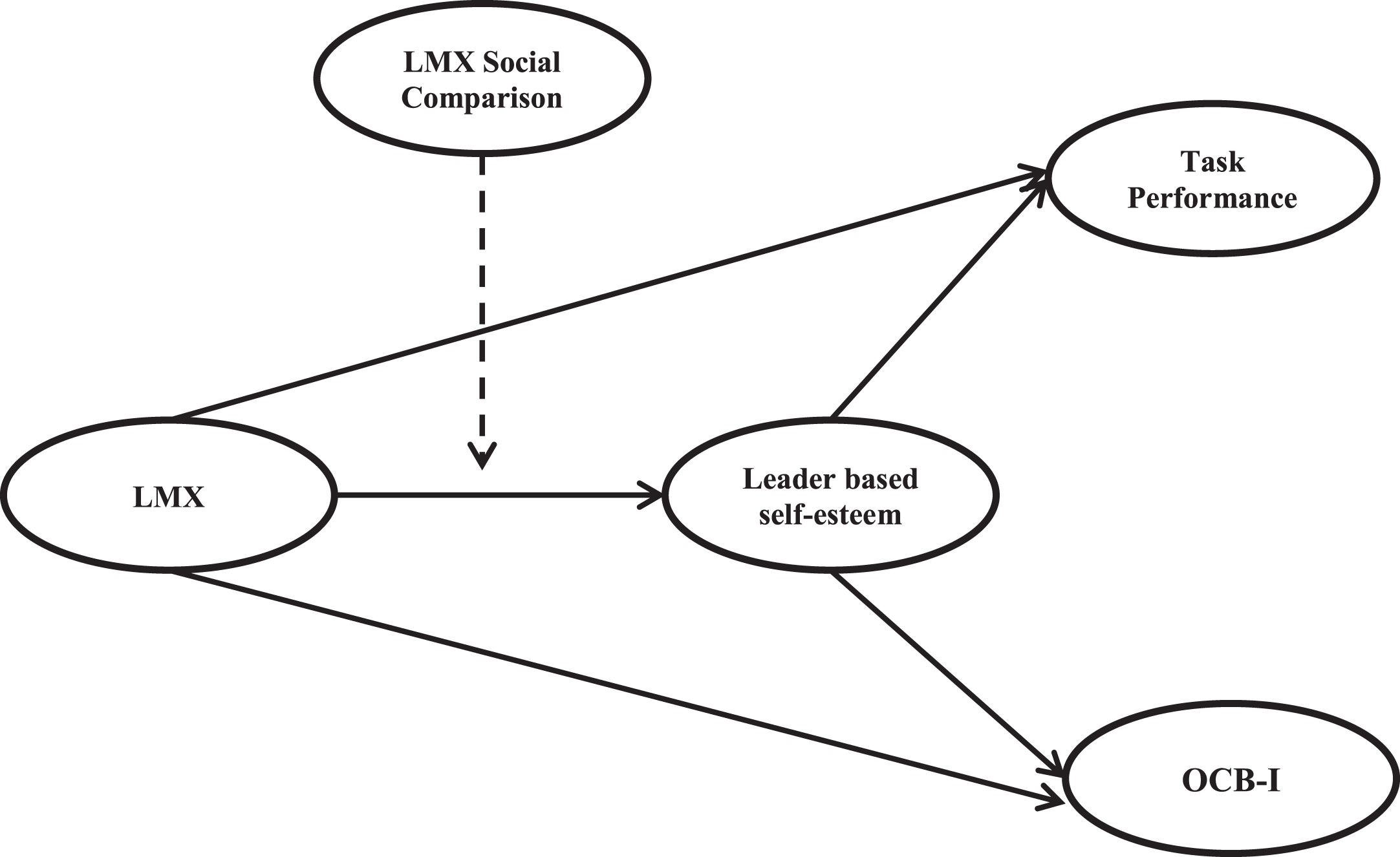
The hypothesized research model.
Accordingly, we hypothesize the following relationship.
Hypothesis 5: The mediating effects of LBSE between LMX and both task performance and OCB are conditional on the values of LMXSC such that the mediating effects of LBSE are stronger at high values of LMXSC than at low values.
Sample and data collection procedure
The researchers collected data from employees of a leading government-owned bank working in Sindh, the second most populated province of Pakistan. In collectivistic societies, supervisor-subordinate relationships –captured by LMX –play an important role in the performance of frontline service sector employees [59]. In order to foster high-quality relationships and improve service quality in commercial banks, the State Bank of Pakistan (the monitoring regulatory authority) has devised various policies over time. However, despite the crucial steps taken by regulatory and commercial banks to create positive work environments, banking employees have been found to be affected by negative supervisory behaviors [60, 61] and tend to engage in social comparison processes [59]. This research context is thus particularly pertinent to our investigation in which we aim to examine the quality of supervisory relationships, social comparisons employees engage in, and their performance.
Prior research suggests that employees’ self-serving bias and the social-desirability motive may influence self-reported data on task and OCB performance [30, 63]. Consequently, we collected employees’ task and OCB performance data from their immediate supervisor (i.e., their branch manager). The remaining data (LMX, LBSE and LMXSC) were collected from employees. Data collected from supervisors and employees were then matched to form dyads. We used a convenience sampling method and visited several bank branches to distribute the survey questionnaires (written in English).
Data were collected from 43 branches where the managers worked for more than one year and the employees for more than six months under the same branch manager. Two hundred ninety-eight sets (298) were collected back out of the 317 manager-employee distributed questionnaires. All the branch managers participated, but 19 employees did not return their questionnaire. Therefore, the response rate was 94%for the employee-focused questionnaire and 100%for the manager-focused one. These high response rates can be explained by the fact that questionnaires were distributed on days when public dealing activity was low or nil due to regulations even though the branches remained open. Consequently, branch managers fully cooperated with the data collection activity. Moreover, one of the authors worked in the bank, therefore, proximity, as well as prior knowledge of the work context, was already acquired.
Each branch manager rated between five and eight employees directly reporting to him/her. The names of the respondents were erased during the data entry process to ensure confidentiality. Of the managers, 92%were male, and 8%were female; 3%had from one to two years’ experience, 96%had more than two years’ and up to three years’ experience, and the remaining 1%had more than three years’ experience. Of the employees, 95%were male, and 5%were female; 98%were aged 34–41, and the remaining 2%were over 41; 97%had an experience of three years or less in the same bank, while the remaining 3%had more than three years of experience; 94%had between one- and three years’ work experience with the same branch manager. These experience statistics can be explained by the fact that the State Bank of Pakistan has imposed a condition on the banks to rotate their staff every three years to limit frauds. Further, Pakistan banking industry is going through transformation wherein young and recent graduates are taking over positions from older employees. So, newly transferred employees or employees with less than 3 years’ experience in that branch participated in the survey.
Measures
The employee-focused questionnaire consisted of scales measuring LMX, LMXSC, and LBSE. The manager-focused questionnaire consisted of measurements of task and OCB performance of their employees. Participants responded on a scale ranging from one (not at all) to five (to a great extent). The sources of the scales and sample items are given in Table 1.
Description of measures
Description of measures
Control Variables. We controlled for gender, age, organizational tenure, and supervisor-subordinate relationship tenure, as these contextual variables may influence the LMX-performance relationship [10, 13].
We conducted confirmatory factor analysis (CFA) using AMOS version 22 to confirm the factorial discriminant validity of the measures. Following the recommendations of Byrne [64] and Schreiber et al. [65], the fit indices used to assess model adequacy included the following: CMIN/df, Tucker–Lewis Index (TLI), Comparative Fit Index (CFI), and Root-Mean-Square Error of Approximation (RMSEA). CFI and TLI values above 0.90 and RMSEA values below 0.08 represent a good model fit [66]. The baseline five-factor model, i.e., LMX, LMXSC, LBSE, task performance, and OCB, showed excellent fit with the data (CMIN/df = 1.54, CFI = 0.95; TLI = 0.94, RMSEA = 0.04).
Furthermore, three alternative measurement models [67] were tested and compared with the baseline five-factor model (see Table 2). All the study measurements loaded on a single latent factor in the first alternative model. For the second alternative model, LMX, LMXSC, and LBSE merged on a single latent factor. For the third alternative model, LMX and LMXSC merged on a single factor. However, these alternative models indicated a poor fit with the data. Therefore, the baseline five-factor model was used in further analyses because of its superior fit indices over the three alternative models.
CFA model fit indices
CFA model fit indices
Note. N = 298, CMIN/df = Normed Chi-Square, CFI = Comparative Fit Index, TLI = Tucker–Lewis Index, RMSEA = Root-Mean-Square Error Approximation.
Descriptive statistics and correlations are presented in Table 3 along with the scales’ reliability values.
Descriptive statistics, inter-correlations and alphas
Note N = 298, and Cronbach’s (α) values for each scale (on the diagonal, highlighted in italics). Sex of employees was coded: Male 1, Female 2. Age of employees was coded: 1 = 18–25 yrs, 2 = 26–33 yrs, 3 = 34–41 yrs, 4 = 42–49 yrs, 5 =≥50 yrs. Tenure of employees in the same bank was coded: 1 = < 1 yr, 2 = 1– < 2 yrs, 3 = 2– < 3 yrs, 4 = 3– < 4 yrs, 5 =≥4 yrs. Tenure of employees with the same branch manager was coded: 1 = < 1 yr, 2 = 1– < 2 yrs, 3 = 2– < 3 yrs, 4 = 3– < 4 yrs, 5 =≥4 yrs. **p < 0.01 level, *p < 0.05 level.
Given that each branch manager reported data for multiple employees’ task performance and OCB (between 5 and 8 employees), we nested 298 employees in 43 branch groups and used Hierarchical Linear Modeling (HLM) to test for proportions of within- and between-branch variance for the dependent variables by computing intraclass correlation (ICC) indices before hypothesis testing [68]. However, the results (see Table 4) showed that no significant difference existed (p > 0.50) between branches. Thus, we proceeded to test the hypothesized model at the individual level of analysis through hierarchical multiple regressions. For hypothesis 5 of the moderated mediation analysis, we used the PROCESS macro for SPSS [69].
Nested branch group analysis
Of the four control variables, employee gender showed significant negative correlations with LBSE (–0.12*) and LMXSC (–0.24**); whereas, employee age showed a significant positive correlation with LMXSC (0.13*). To ensure that our hypothesized direct and indirect effects are not diluted by the inclusion of these significant contextual variables, we controlled for their effects when testing the hypothesized relationships.
Hypothesis 1 regarding the direct relationship between LMX and LBSE was tested using hierarchical multiple regression analyses. As reported in Table 5, LMX had a significant positive relationship with LBSE (β= 0.64; p < 0.001). This result supported hypothesis 1. Similarly, hypothesis 2, regarding the positive relationships between LBSE and both task performance and OCB, was supported (β= 0.43; p < 0.001, and β= 0.57; p < 0.001, respectively).
Direct, moderating and indirect effects
**p < 0.01 level, *p < 0.05 level.
Data also supported hypothesis 3 concerning the mediating effect of LBSE between LMX and both task and OCB performance. The indirect effects of LMX, via LBSE, were significant for both task performance (β= 0.12; p < 0.001) and OCB (β= 0.23; p < 0.001). Hypothesis 4 regarding the moderating effect of LMXSC on the direct relationship between LMX and LBSE was also supported, as the interaction term (LMX*LMXSC) showed a significant positive effect on LBSE (β= 0.12; p < 0.05). To establish the direction of the supported moderating effect of LMXSC, we plotted the interaction on a graph (see Fig. 2). The graph depicts that the positive relationship between LMX and LBSE is stronger at high values of the moderator (i.e., LMXSC) than at the low values.

Interaction between LMX and LMXSC.
Finally, hypothesis 5 concerned the conditional indirect effects of LMX, via LBSE, on both task and OCB due to the moderating effect of LMXSC. It was tested using a moderated mediation analysis with the PROCESS macro for SPSS [70]. The bootstrapped results (see Table 6), determined by the three selected levels of LMXSC (–1SD, mean, and +1SD), showed that the indirect effects of LMX, via LBSE as a mediator, on both task performance and OCB were increased along with higher values of LMXSC as a moderator. Thus, the data supported hypothesis 5.
Conditional Indirect Effect of LMX on Performance via LBSE on the selected values of LMX Social Comparison (LMXSC)
Note: 5000 Bootstrapping resamples, SE = Standard Error, LLCI = Lower Level Confidence Interval, ULCI = Upper Level Confidence Interval.
The aim of this study was two-fold. First, to examine the LMX-performance relationship beyond the extensively used social exchange framework; second, to extend the limited literature on the mediators of this relationship. Accordingly, we used the integrated theoretical framework of self-consistency theory and social comparison theory to explain how and when high-quality LMX, through the mediation of LBSE and the moderation of LMXSC, leads to high task performance and OCB. Our results provided support for the above integrated theoretical framework and the hypothesized moderated mediational model.
More specifically, confirmation of hypothesis 1 regarding the positive relationship between LMX and LBSE supported our argument that employees’ perception of high-quality LMX leads them to feel esteemed and valued by their supervisor (i.e., high LBSE). As our study is the first to investigate this relationship, we do not have any prior empirical study to compare this finding directly. However, similar results were obtained in prior leadership and self-esteem research. For instance, the leadership literature suggests that leaders, through their interpersonal behaviour toward followers, play an important role in developing followers’ self-concept, i.e., how they see and value themselves [45, 46].
Our study also reveals that employees who feel valued and esteemed by their supervisor (i.e., high LBSE) perform better and engage in more OCB; LBSE is in fact a mediating mechanism between LMX and both performance indicators, as suggested in hypotheses 2 and 3. This is aligned with prior leadership and self-esteem literatures. For instance, Bowling et al. [26] found that organization-based self-esteem had a significant positive relationship with task performance and OCB. Similarly, studies have shown a positive association between employee’s self-esteem and OCB [70, 71]. Recently, Bantha and Sahni [72] proposed a conceptual framework in which organization-based self-esteem mediated the effect of leadership on employees’ citizenship behaviours. Moreover, Wen et al. [73] found that organization-based self-esteem played a mediating role in the relationship between leadership and employees’ innovative behaviours. Taken together, the findings of the cited studies provide corroboration for our hypotheses 2 and 3.
However, it is worth noting that the above cited studies reported that both organization-based self-esteem [26] and LBSE [18] had a stronger positive effect on in-role (task) performance than on OCB; whereas our findings revealed the opposite, i.e., a stronger effect on OCB than on task performance. This might be due to the different research context of this study compared to past ones. For instance, the cited findings of prior studies were mostly drawn from research samples taken from Western individualistic countries (i.e., the USA and UK), whereas the findings of this study were drawn from a research sample of a relatively unexplored, highly collectivistic South Asian country, Pakistan. Considering that we focused on citizenship behaviours directed at individuals, this collectivist orientation seems to offer a reasonable explanation for the stronger relationship observed for OCB as compared to task performance. This is in line with an empirical study by Arain et al. [27] which used a sample of business students from Pakistan and found that their collectivistic culture orientation was positively associated with their academic citizenship behaviour, i.e., OCB. Thus, the recorded higher effects of LBSE and LMX on OCB than on task performance might be attributed to the collectivistic nature of this study’s sample.
Lastly, concerning the construct of LMXSC, our results are in line with the few studies published on the topic. For example, Lee et al. [74] demonstrated that LMXSC contributed to predict organizational commitment and job performance, over and above LMX quality. Confirming our hypotheses 4 and 5, our results indicate that when employees feel better off than their coworkers in terms of LMX (i.e., high LMXSC), the positive relationship between LMX and LBSE is stronger. Moreover, this positive social comparison strengthens the conditional indirect effect of LMX on task performance and OCB. This confirms that supervisor-subordinate relationship quality does not operate in a vacuum; employees engage in social comparisons with regard to LMX and this has tangible effects on their self-esteem (i.e., LBSE) and ultimately on their behaviours (i.e., task performance and OCB).
Contributions
Our findings extend the prior literature on LMX, self-esteem, and performance in several ways. First, the integrated theoretical framework of self-consistency and social comparison theories offers a useful explanation of how LMX leads to performance. In so doing, this is one of the few studies on the LMX-performance relationship and the first of its kind to explain this relationship beyond social exchange theory. We do not mean to imply that our explanatory framework is superior to the social exchange framework used in most prior studies. Rather, in parallel to the social exchange perspective, this explanatory framework broadens the spectrum of ways through which LMX may lead to performance.
Second, this study contributes to the limited literature on the mediators of LMX, a research gap mentioned in Martin et al. [4]’s meta-analysis on LMX-performance relationship. The findings of our study explain how LBSE significantly mediates the indirect effects of LMX on task performance and OCB. Furthermore, our findings also illuminate the boundary condition of this mediating relationship by showing that these indirect effects of LMX are conditional to the values of LMXSC.
Third, unlike general self-esteem and organization-based self-esteem that have received considerable research attention, LBSE is a fairly new construct that has been researched in two studies only, i.e., Landry and Vandenberghe [17] and Sguera et al. [18]. LBSE’s conceptualization is in parallel to organization-based self-esteem, but the former is more focused on leader-follower relationships and their outcomes than the latter. Although studies have mentioned that the relationship that an employee has with his/her supervisor is one of the crucial determinants of organization-based self-esteem [75], they have not considered the self-esteem deriving specifically from such a relationship (i.e., LBSE). Thus, by investigating LBSE in the LMX-performance relationship for the first time, we underlined the pertinence of LBSE in explaining this relationship. Moreover, by testing various measurement models, the CFA performed confirmed the factorial discriminant validity of LBSE from other leadership constructs (i.e., LMX and LMXSC).
Fourth, this is one of the few studies which used a research sample from a South Asian country, i.e., Pakistan. Given that most of our findings are similar to those reported in prior comparable studies, this study extends the generalizability of those results to this new research context. Furthermore, our discovery that the direct and indirect positive effects of LMX, via LBSE, were stronger for OCB than for task performance, highlights the likely influence of the research context on the findings of this study. These context-specific results are useful in broadening our understanding of the LMX-performance relationship in a variety of research contexts.
Managerial implications
Our study offers some useful, practical implications for managers to improve LMX with their employees and, in turn, improve their employees’ performance. We suggest that employees’ LBSE depends not only on their perception of LMX quality but also on their LMXSC within the workgroup. An employee’s initial positive LBSE, resulting from his/her perception of high-quality LMX with his/her manager, is likely to be decreased when his/her social comparison with coworkers (i.e., LMXSC) results in a negative self-evaluation. For instance, awarding performance-based rewards –which implies that some employees will get more than others –may result in negative LMXSC and subsequent decreased performance and OCB. To reduce the likelihood of employees’ negative LMXSC, managers should provide clear and realistic one-to-one feedback to employees working in their team and explain why some received performance-based rewards while others did not. This communication strategy in the form of one-to-one feedback might be more useful for employees who did not receive a performance-based reward. It may help restore their LBSE if they perceive this feedback as a sign that their manager still values them.
Furthermore, as this study highlighted, employees’ perception of high-quality LMX transmutes in high task performance and OCB through LBSE. Therefore, managers need to focus on this aspect of the manager-employee relationship. It can be achieved by having more informal and frequent communication with employees, which may provide them with a social cue that their manager values them. In this way, employees may develop high LBSE and, subsequently, high performance. Organizations should take this mechanism into account to keep employees motivated.
Limitations and future research directions
Despite our contributions to the research in this field (using two-source dyadic data, collecting data from the relatively unexplored research context of Pakistan, receiving support for the integrated theoretical framework of self-consistency and social comparison theories, and establishing the factorial validity of LBSE through a rigorous CFA analysis), this study has limitations. Although most of our findings are consistent with previous longitudinal and meta-analytic reviews, the use of cross-sectional data allowed us to make inferences about the causal order of the hypothesized relationships. Thus, future studies may replicate the proposed research model using a longitudinal research design, measuring LMX and LMXSC at time 1, LBSE at time 2, and performance at time 3. Such a longitudinal research design would be more precise in establishing the causal order of the relationships than the inferences made in this study. A longitudinal study would also enable us to see how the leader-member exchange relationship may change over time based on its dynamic nature [4].
We used a quantitative approach to investigate the LMX phenomenom in the banking sector in Pakistan. The aim of this study was to examine the effect of leadership and social comparison on employee performance through self-esteem, and thus an explanatory research design was employed. To explore in more details why and how such behavioral factors (leadership, self-esteem) affect performance, future researchers could adopt a qualitative approach, using ethnographic methodologies to interpret the emerging patterns from the quantitative data.
Moreover, we attributed the stronger effects of LMX and LBSE on OCB than on task performance to the highly collectivistic nature of our research sample. It would be interesting to replicate this study using a cross-cultural research sample from collectivistic and individualistic countries to examine the influence of cultural differences on these relationships. Another avenue worth exploring is the relationship between the leadership variables explored in the current study (i.e., LMX, LBSE and LMXSC) and employees’ psychological well-being. Recently, Gardner [76] suggested that organization-based self-esteem is an essential tool to enhance employees’ happiness and health. Considering the crucial role played by their immediate supervisor, it is likely that LBSE contributes to employees’ psychological adjustment. Similarly, knowing that high LMX promotes followers’ engagement in the creative process [77], it would be interesting to investigate self-esteem and social comparison processes with regard to broader performance indicators (e.g., innovative and adaptive behaviours). Finally, it would be interesting to see how individual characteristics of leaders and members [4] (i.e., personality) may affect the relationships explored in the current study.
Conclusion
This study demonstrated that employees’ social standing with their manager compared to that of their coworkers plays a vital role in affecting their self-esteem, which potentially influences their performance. Empirical investigation was undertaken on the contribution of LMX in the formation of leader-based self-esteem and the moderating effect of differentiation in LMX (LMX social comparison) on employee performance. The study, conducted on employees and managers of the banking sector in Pakistan, enabled us to contribute to the research stream in highly collectivistic societies with widely different social and economic factors than Western countries. In light of the findings, managers should be aware that the relationship they establish with their employees may enhance employees’ self-esteem and, consequently, their performance.
Footnotes
Acknowledgments
We acknowledge Dr. Ghulam Ali Arain, Associate Professor of Leadership & OB at the College of Business & Economics, United Arab Emirates University for his guidance in the revision of this manuscript.
The authors have received no financial support for this research.
Author contributions
CONCEPTION: Gul Afshan
METHODOLOGY: Gul Afshan and Carolina Serrano-Archimi
DATA COLLECTION: Gul Afshan
INTERPRETATION OR ANALYSIS OF DATA: Gul Afshan and Uzma Javed
PREPARATION OF THE MANUSCRIPT: Gul Afshan
REVISION FOR IMPORTANT INTELLECTUAL CONTENT: Guylaine Landry
SUPERVISION: Carolina Serrano-Archimi and Guylaine Landry