




Abstract
BACKGROUND:
Employee’s expression of voice needs cognitive and emotional resources to express the constructive challenge. Leader humility, with the characteristics of openness to new ideas and feedback, may provide employees with psychological resources to express their voice. This study considers work engagement and cognitive emotion regulation strategies as psychological resources and examines their mediating effects.
OBJECTIVE:
Referring to the conservation of resources theory and affective events theory, this study aims to examine the mediating effects of work engagement and cognitive emotion regulation strategies on the relationships between leader humility and employees voice behaviors.
METHODS:
This study conducted a questionnaire survey on managers and employees at travel enterprises in China. Based on a survey of 837 valid questionnaires, participants provided their perception for the proposed research model.
RESULTS:
The results show that enhancing work engagement and controlled emotion regulation strategies and reducing automatic emotion regulation strategies partially mediate the relationships between leader humility and employee’s prohibitive voice.
CONCLUSIONS:
Enhancing work engagement and reducing automatic emotion regulation strategies have the mediating effects. However, controlled emotion regulation strategies and promotive voice need much psychological resources, employee adopting controlled emotion regulation doesn’t affect promotive voice and have mediating effects significantly.
Keywords


Introduction
In today’s highly competitive business environment, the topic of how leaders promote employees’ expressing constructive voice for improving and benefiting their organization has received increasing attention. Among them, leader humility, with the characteristic of openness to new ideas and feedback, may create the social contexts that employees are willing to express their voice [1]. The growing research focused on the mediating process to explain that leader humility promotes follower voice behavior, and their results showed that the mediating effects of employees’ personal sense of power [2], organizational identification [3], follower’ perceived relational energy [4], follower’s sense of security [5], and trust in leadership and positive affect [6]. However, few studies have paid attention to the mediating effects of employee’s psychological resources (e.g., work engagement, cognitive emotion regulation strategies) on the relationship between leader humility and employee voice behavior. Therefore, to fill this research gap, the present study focuses on this relatively understudied issue.
According to the work of Hobfoll et al. [7], the core of conservation of resources (COR) theory was a motivational theory which could explain that, based on the evolutionary need, plenty of human behavior obtained and conserved resources for survival. Furthermore, in organizations, by obtaining and retaining resources, employees may perceive that they were capable of meeting stressful challenges [7]. The present study argues that leader humility, as an interpersonal characteristic emerging in social contexts [1], may promote employee voice behavior through the mediating process that employees obtained and retained emotional and psychological resources [8]. Therefore, referring to the COR theory, the present study expects that the effects of leader humility on follower voice behavior are mediated by follower’s obtaining and retaining psychological resources, such as work engagement and cognitive emotion regulation strategies.
Work engagement was defined as a positive, fulfilling work-related and affective-cognitive state of mind [9]. Kahn argued that, given appropriate conditions (such as meaningfulness, safety, availability), employees may prefer to express their engagement and personal voice [10]. As employees obtained physical, emotional, and psychological resources, connected to their work, from their ethical leaders, they may engage in proactive voice behavior [11]. Referring to COR theory, the present study considers work engagement as a psychological resource and indicates that leadership behaviors may increase employees’ work engagement, and then promote them to express voice behavior.
Emotional regulation was defined as the processes for monitoring, evaluating, and modifying emotional reactions, and was indicated that the capacity of emotional regulation may affect constructive functioning [8]. Referring to Weiss and Cropanzano’s Affective Events Theory (AET) [12], workplace events stimulated affective responses which may influence worker’s attitudes and behaviors. Workers, as interacting with their leaders and coworkers, were exposed to situations that produced emotions [12]. Furthermore, emotions can potentially influence worker’s feelings, attitudes and behaviors [13]. The present study indicates that employee’s capacity of emotion regulation may influence employee’s attitudes and behavior, and can be considered as emotional and psychological resources [8] to meet stressful challenges (such as employee voice behavior). Therefore, this study expects that employee’s use of different emotional regulation strategies may promote or undermine their constructive functioning, such as expression of constructive voice.
The COR theory explained that employees obtai-ned and conserved resources to be capable of meeting stressful challenges [7], and the AET indicated that workplace events stimulated affective responses which may influence worker’s attitudes and behaviors [12]. This present study considers that, in organizations, employee’s attitudes and behaviors were affected by emotional and psychological resources (COR) and their affective responses to workplace events (AET). According to the above-mentioned studies which considering work engagement and emotional regulation strategies as emotional and psychological resources, this study expects that, for expression of voice, employees may need psychological resources of managing their engagement and cognitive emotion regulation process. Previous research showed that work engagement mediated the relationship between ethical leadership and voice behavior [11]. Meanwhile, in the context of leader-follower interaction, employee’s emotion regulation may mediate the effects of leadership behavior on follower’s performance attitudes, and behavior [13–15]. Furthermore, the present study expects to examine that the effects of leader humility on follower voice behavior were mediated by follower’s psychological resources, e.g., work engagement and cognitive emotion regulation strategies.
The present research is intended to contribute to fill the research gap concerning the mediating process to explain that leader humility promotes follower voice behavior. The present study adopts the COR and AET theory to consider employee’s work engagement and cognitive emotion regulation strategies as psychological resources to mediate the effects of leader humility on employee voice behavior. This study adopts the purposive and snowball sampling technique to collect data from managers and employees at travel enterprises in China, who may need more psychological resources for interacting with customers or leaders and expressing constructive voice. By examining the multiple mediation model, the present study expects to further our understanding of the underlying mechanisms of the effects of leader humility on follower voice behavior.
The findings show that leader humility may di-rectly promote employee’s voice behavior, and partially through providing employees with psychological resources. Meanwhile, this study finds that to promote employees to express voices of “suggestions of changing the status quo of their organization”, leader humility need to provide employees with more psychological resources of enhancing work engagement and adjusting emotion regulation strategies. The findings could enhance the knowledge of mediating process of leader humility affecting employee voice.
Literature review
Leader humility and employee voice behavior
Employee voice was defined as promotive behavior that expressed constructive challenge which was intended to improve rather than merely criticize [16]. Leader humility, with the characteristics of acknowledging the strengths and contributions of followers and being teachable [1], may promote employee’s willingness of expressing their voice. The topic of leader humility affecting employees’ expressing constructive voice has received increasing attention in the leadership field. Liu found that leader humility was positively related to employee voice behavior [6]. Bharanitharan et al. examined that leader humility can directly affect follower’s defensive voice (i.e., showing the persistence toward changes), but not affect follower’s challenging voice (i.e., promoting the flexibility toward changes) [5]. Li et al. indicated that leader humility positively affects employees’ constructive voice behaviors toward supervisor (speaking up) and coworkers (speaking out) [3].
Moreover, Liang, Farh, and Farh proposed two types of voice—prohibitive and promotive [17]. Employee’s expression of prohibitive voice concerned about the events, processes and behaviors in the workplace which may damage their organization. As to expression of promotive voice, concerning about improving their own organization, employees needed more cognitive efforts and resources for generating ideas and suggestions [18]. The present study adopted the work of Liang et al. [17] and examined the effects of leader humility on employees’ prohibitive voice and promotive voice. Considering the abovementioned rationale, the following hypotheses are proposed:
H1: Leader humility positively affects employee prohibitive voice behavior.
H2: Leader humility positively affects employee promotive voice behavior.
COR theory and AET
The core of COR theory was a motivational theory, in organizational context, which could explain that, by obtaining and retaining resources, employees may perceive that they were capable of meeting stressful challenges [7]. The present study argues that leader humility, as an interpersonal characteristic emerging in social contexts [1], may promote employee voice behavior through the mediating process by employee’s obtaining and retaining emotional and psychological resources [8]. Therefore, in the context of leader-follower interaction, leader humility may promote employee voice behavior through the mediating process that employees obtained and retained emotional and psychological resources, such as work engagement and cognitive emotion regulation strategies.
Work engagement was defined as a positive, fulfilling work-related and affective-cognitive state of mind [9]. Wu and Lee considered work engagement as the personal resources and showed that engaged employees had more resources to obtain and accumulate further resources for engaging in knowledge sharing [19]. Moreover, some research indicated that, as experiencing engaged in motivated activities, employees would be able to easily identify, activate or create resources [20, 21]. Therefore, referring to the COR theory, this study argues that work engagement, as a positive state of mind, could be considered as a psychological resource and leader humility may enhance employees’ work engagement, and create more resources for engaging in expression of voice.
In the present study, another important emotional and psychological resource is cognitive emotion regulation strategies. Weiss and Cropanzano’s AET indicated that workplace events stimulated affective responses (e.g., emotional reactions) which may influence worker’s attitudes and behaviors [12]. Buruck, Dörfel, Kugler and Brom defined emotion regulation as a process of identifying, evaluating, and changing emotional reactions, and considered emotion regulation strategies as personal resources of dealing with high job demands [22]. In the workplace, when interacting with others, individuals experienced the cognitive processes of emotional regulation [23, 24]. Therefore, in organizational context, employees as interacting with their leaders and colleagues, were exposed to situations that produced emotions. Moreover, the performance of emotional reactions (i.e., behaviors driven by emotions or the resources used by emotion regulation process) depended on the match between emotional reactions and job demands [12], and the capacity of emotional regulation may affect constructive functioning [8]. This study expects that employee’s use of different emotional regulation strategies, as a psychological resource, may promote or undermine their constructive functioning, such as expression of constructive voice.
Leader humility and work engagement
Work engagement was defined as a positive, fulfilling work-related and affective-cognitive state of mind, which characterized by vigor, dedication, and absorption [9, 25]. Owens and Hekman argued that leader humility behaviors led to follower engagement, due to employees may perform their strengths, participate in decision making, or grow and learn in the workplace [26]. Owens et al. indicated that leader humility may shape the state of mind for employee engagement, such as “dignity, self-appreciation, and a sense of value [10]”, and found that leader humility had positive effects on employee’s work engagement [1]. Furthermore, following the above research stream, some research found that leader humility positively affected employee engagement [27, 28]. Therefore, referring to COR theory, in organizational context, employees would obtain and retain psychological resources for dealing with high job demands. The present study argues that leader humility may provide psychological resources for employees to shape the state of mind for work engagement. Considering the abovementioned rationale, the following hypotheses are proposed:
H3: Leader humility positively affects employee work engagement.
Leader humility and cognitive emotion regulation strategies
Previous research proposed different cognitive emotion regulation strategies and assessing their outcome. Gross and John proposed a process mo-del of emotion regulation and two different emotion regulation strategies, i.e., response-focused (e.g., suppression) and antecedent-focused (e.g., reap-praisal) [29]. Naragon-Gainey, McMahon, and Chacko indicated that the most often used emotion regulation strategies, including distraction, behavioral and experiential avoidance, rumination, acceptance, mindfulness, problem solving, worry, reappraisal, and expressive suppression [30]. Moreover, they tested the strategy groupings implied by emotion regulation strategy models. For studying on whether and to what extent different cognitive emotion regulation strategies regulate emotions, Garnefski, Kraaij, and Spinhoven constructed the Cognitive Emotion Regulation Questionnaire (CERQ) and nine cognitive emotion regulation strategies were distinguished, including self-blame, rumination, catastrophizing, blaming others, acceptance, positive refocusing, positive reappraisal, refocus on planning, and putting into perspective [31]. Furthermore, they found that the more adaptive strategies (such as positive reappraisal) were applied more often than the less adaptive strategies (such as catastrophizing).
The abovementioned cognitive emotion regulation strategies can be grouped into “less adaptive (negative-focused)” and “more adaptive (positive-focused)” [31], “automatic” and “controlled” [32], or “automatic” and “elaborative” [23]. In general, the cognitive emotion regulation strategies described as less adaptive (negative-focused) or automatic (i.e., self-blame, rumination, catastrophizing, and blaming others), were characterized by being fast, preconscious and difficult to control; whereas more adaptive (positive-focused), controlled, or elaborative strategies (i.e., acceptance, positive refocusing, positive reappraisal, refocus on planning, and putting into perspective) were characterized by being voluntary, conscious, and slow [23]. Castellano et al. adopted the perspective of evolutionary psychology and explained that, with the evolution of human cognitive system, human learned more complex, rational and controlled capabilities of cognitive emotion regulation processes and manner [23].
Some researchers studied on the influence of leadership behaviors on subordinates’ emotions (e.g., emotional labor) [32, 33]. McColl-Kennedy and Anderson found that perceived transformational leadership positively affected the employee’s frustration emotions and negatively on optimism emotions [13]. Rowold and Rohmann indicated that perceived transformational leadership positively affected follower’s positive emotions and negatively affected their negative emotions [34]. Tsai, Chen, and Cheng demonstrated that the transformational leadership behavior may improve employees’ positive moods [35]. Berkovich and Eyal showed that school transformational leadership was positively related to emotional reframing (i.e., emotional regulation) [14]. Referring to the abovementioned leadership literature, this study expects to examine the effects of perceived leader humanity on employee’s cognitive emotion regulation strategies.
Humble leaders, expressed openness and sincerity, may influence followers to improve their cognitive emotion regulation strategies. The research findings of Owens et al. contributed to the leadership literature by emphasizing the importance of leading by example, and may explain that leader insincerity produced negative follower emotions [1, 36]. Moreover, Oc, Daniels, Diefendorff, Bashshur, and Greguras indicated that authentic leader humility, as an interpersonal factor, may provide emotional and cognitive resources to followers (e.g., vitality, positive affect), and help followers to manage emotional and cognitive processes [37, 38]. Furthermore, authentic leader humility, leading by example, may influence followers to reduce their negative feelings which caused by having a sense of being inauthentic [39], and to reappraise the situation and regulate their emotions [29]. Therefore, referring to COR theory, in organizational context, employees would obtain and retain psychological resources for dealing with high job demands. The present study argues that leader humility may provide psychological resources for employees to regulate their emotional reactions. Considering the abovementioned rationale, the following hypotheses are proposed:
H4: Leader humility negatively affects employee adopting automatic emotion regulation strategies.
H5: Leader humility positively affects employee adopting controlled emotion regulation strategies.
The mediating effects of work engagement and cognitive emotion regulation strategies
Some research studied on the mediating process to explain that leader humility promotes follower voice behavior. Lin et al. found that employees’ personal sense of power mediates the relationship between leader humility and employee voice [2]. From an identification-based perspective, Li et al. indicated that organizational identification mediates the effects of leader humility on employees’ constructive voice behaviors [3]. Ma et al. argued that follower’ perceived relational energy (i.e., receiving psychological resources from their interactions with the leader) mediates the effects of leader humility on followers’ constructive voice behavior [4]. Bharanitharan et al. demonstrated that follower’s sense of security can mediate the effects of leader humility on follower’s both challenging and defensive voice at the same time [5]. Liu found that trust in leadership and positive affect mediated the relationships between humble leadership behavior and employee voice behavior [6]. Furthermore, referring to the COR theory, in organizational context, employees would obtain and retain psychological resources for dealing with high job demands. The present study argues that leader humility, as an interpersonal characteristic emerging in social contexts, may promote employee voice behavior through the mediating process that employees obtain and retain emotional and psychological resources.
The mediating effects of work engagement
The present study argued that leader humility may increase employees’ work engagement, which make them express voice behavior. Some research found that leader humility had positive effects on employee’s work engagement [1, 26–28]. Cheng et al. found that work engagement, due to the increase of meaningfulness or safety, mediated the relationship between ethical leadership and voice behavior [11]. Furthermore, according to the work of Liang et al. [17], the present study adopts two types of voice (i.e., prohibitive and promotive). The results of Liang et al. showed that employee’s felt obligation was related to promotive voice, psychological safety was related to prohibitive voice, and organization-based self-esteem was interrelated to promotive voice [17]. Therefore, referring to the COR theory, in organizational context, employees would obtain and retain psychological resources for dealing with high job demands. The present study expects to explore more detailed about the mediating process, which considered work engagement as a psychological resource and indicated that leader humility may enhance employees’ work engagement, and create more resources for engaging in expression of voice. Considering the abovementioned rationale, the following hypotheses are proposed:
H6: Employee work engagement mediates the relationships between leader humility and em-ployee prohibitive voice behavior.
H7: Employee work engagement mediates the relationships between leader humility and em-ployee promotive voice behavior.
The mediating effects of cognitive emotion regulation strategies
Employee’s capacity of emotion regulation may influence employee’s attitudes and behavior, and can be considered as emotional and psychological resources to meet stressful challenges (such as employee voice behavior). Buruck et al. considered emotion regulation strategies as personal resources of dealing with high job demands [22]. Kafetsios, Nezlek, and Vassilakou found that employee’s use of emotion reappraisal was positively related to positive work outcomes (e.g., higher job satisfaction), whereas employee’s use of suppression was negatively related to job satisfaction and positively related to negative affect [40].
In the context of leader-follower interaction, em-ployee’s emotion regulation may mediate the effects of leadership behavior on follower’s performance, attitudes, and behavior. Rowold and Rohmann found that emotions partially mediated the relationship between different leadership styles and follower’s performance [34]. McColl-Kennedy and Anderson argued that followers’ emotional regulation might mediate the relationship between transformational leadership behavior and followers’ performance [13]. Berkovich and Eyal found that the effects of transformational leadership on teachers’ organizational commitment were partially mediated by emotional reframing [14]. Zheng et al. examined that, in the context of school management, principal could adopt paternalistic leadership behavior to promote teacher commitment, which was mediated by teachers’ emotional regulation strategies (i.e., deep acting and surface acting) [15].
Owens et al. argued that leader humility, expressed the characteristics of openness and sincerity, positively affected follower’s positive attitudes, traits, and adaptive behaviors (e.g., emotional stability) [1, 41]. Oc et al. theorized that leader humility may influence follower’s feeling authenticity at work environment, which mediated by enhancing follower’s emotional and cognitive resources (e.g., decreasing follower vulnerability) [38]. Therefore, referring to the COR theory and Weiss and Cropanzano’s AET, this study expects that, in the context of leader-follower interaction, workplace events stimulated employee’s emotional reactions which may influence their attitudes and behaviors (AET). Moreover, employee’s emotional regulation strategies, as a psychological resource (COR), may mediate the effects of leadership behavior on follower’s performance attitudes, and behavior. Therefore, follower’s cognitive emotion regulation strategies may mediate the effects of leader humility on follower’s voice behavior. Considering the abovementioned rationale, the following hypotheses are proposed:
H8: Employee adopting automatic emotion regulation strategies mediates the relationships be-tween leader humility and employee prohibitive voice behavior.
H9: Employee adopting automatic emotion regulation strategies mediates the relationships be-tween leader humility and employee promotive voice behavior.
H10: Employee adopting controlled emotion regulation strategies mediates the relationships be-tween leader humility and employee prohibitive voice behavior.
H11: Employee adopting controlled emotion regulation strategies mediates the relationships between leader humility and employee promotive voice behavior.
Research methodology
Research model
This research studies on the effects of leader humility on employee voice behavior, and particularly examined the effects mediated by work engagement, automatic emotion regulation and controlled emotion regulation. The proposed research model is tested by using a survey instrument based on validated scales. The research model is shown in Fig. 1.
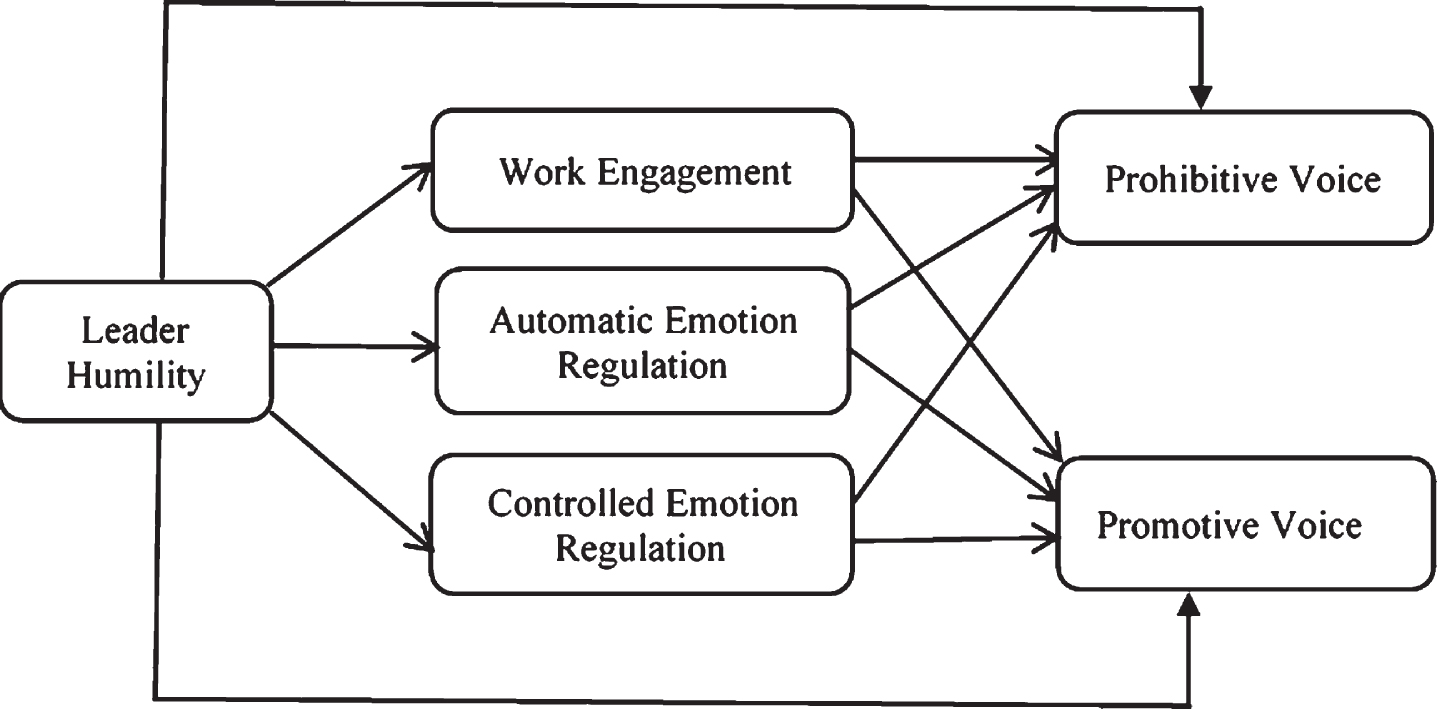
Research model.
This study conducted an online survey of managers and employees at travel enterprises in China. Participants were employed by 16 travel enterprises in Yunnan Province and Guangxi Zhuang Autonomous Region. As the domestic tourism market in China continues to grow rapidly [42], the sustained increasing rate of tourists in Yunnan and Guangxi provided travel enterprises with high revenue growth. Meanwhile, employees of travel enterprises sustain much more challenges of employee-customer and leader-follower interactions and may need more psychological resources for providing excellent customer service and expressing constructive voice. Therefore, this study selected employees of travel enterprises as target population and expected that the effects of leader humanity on employee voice behavior may mediate by employee’s psychological resources, such as work engagement and cognitive emotion regulation strategies.
This study adopted the purposive and snowball sampling technique to collect data from participants. A total of 16 travel enterprises participated in this study. One of the authors contacted managers and employees of travel enterprises through personal networks. In purposive and snowball sampling, the employees who didn’t have enough interactions with their present supervisor (i.e., job tenure was less than 1 year, or length of time with supervisor was less than 3 months) would not be included in this study.
The online questionnaire was edited online and posted on “Wenjuanxing”, a professional questionnaire platform in China. The link to the online questionnaire was posted on social media platforms (i.e., WeChat and QQ, known as two of the most-used social media in China). Participants were invited to answer the questionnaire and asked to share the link with other potential respondents. This approach has been effective in prior studies [43, 44].
Following Podsakoff, MacKenzie, and Lee, to control method variance, this study adopted some procedural remedies [45]. The questionnaire survey was self-administered and anonymous. Respondents were ensured that their supervisors and colleagues would not be able to get their answers, and they were informed that there were no right or wrong answers.
Data was collected from 837 managers and employees in 2017. The demographic profile of the sample for this study was reported in Table 1. Among the 837 participants, 441 (52.7%) were male. Regarding job tenure, 306 participants were 1 year to less than 3 years (36.6%) and 5 years and or above (36.6%) respectively, and 225 were 3 years to less than 5 years (26.8%). Fifty-eight participants’ educational level were middle or high school graduate or the equivalent (6.9%), 233 were associate degree (27.8%), 509 were bachelor degree (60.8%), and 37 were master degree or higher (4.5%). Regarding length of time with supervisor, 248 participants were 3 months to less than 6 months (29.6%), 227 were 6 months to less than 1 year (27.1%), 139 were 1 year to less than 2 years (16.6%), and 223 were 2 years to less than 4 years (26.7%). As to job position, 540 participants were employee (64.5%), 168 were first-line manager (20.1%), and 129 were middle-level manager (15.4%).
Demographic characteristics of the sample
Demographic characteristics of the sample
The survey was conducted in Chinese, and back translation was employed. The conversion of the questionnaire’s language (i.e., translating the scales from English into Chinese; and then again back to English) was conducted by two different bilingual experts to check the translation of all the items and the conversion quality [46].
Based on the existing literature, the scales of estimating leader humility, work engagement, emotion regulation strategies and employee voice behavior were used to measure the variables. All the items were measured on a 5-point Likert scale ranging from 1 (strongly disagree) to 5 (strongly agree). To examine the reliability and validity of the scales, Cronbach’s α coefficient and confirmatory factor analysis (CFA) were used.
The nine-item leader humility scale was adapted from the study of Owens et al. [1] and comprised three major components of the construct, i.e., willingness to view oneself accurately, appreciation of others’ strengths, and teachability. The Cronbach’s α value of this scale was 0.871 (as Appendix 1). The work engagement scale was adapted from the study of Schaufeli et al. [25], contained three constructs: vigor (6 items), dedication (5 items), absorption (6 items). The Cronbach’s α of this scale was 0.917. The ten-item employee voice behavior scale, contained five-item per subscale (i.e., prohibitive voice and promotive voice), was adapted from Liang et al. [17]. The Cronbach’s α values were 0.870 and 0.848 (as Appendix 1).
For measuring the cognitive emotion regulation strategies, this study adopted the Cognitive Emotion Regulation Questionnaire (CERQ), which was developed by Garnefski et al. [31]. Nine cognitive emotion regulation strategies (each consisting of four items) were distinguished within the CERQ. By referring to the works of Flores-Kanter et al. [32] and Castellano et al. [23], the CERQ was grouped into two constructs, termed automatic cognitive emotion regulation strategies (i.e., self-blame, rumination, catastrophizing, and blaming others) and controlled cognitive emotion regulation strategies (i.e., acceptance, positive refocusing, positive reappraisal, refocus on planning, and putting into perspective). Participants were invited to answer “after the experience of facing negative events (threatening or stressful life events), how they tend to cope with?”. The Cronbach’s α values were 0.889 and 0.919 (as Appendix 1).
Data analysis and results
Preliminary analyses
As illustrated in Table 2, the correlation matrix, means and standard deviations are reported. As expected, leader humility is significantly correlated to work engagement, automatic emotion regulation, and controlled emotion regulation. Moreover, leader humility, work engagement, and cognitive emotion regulation strategies are significantly correlated to prohibitive voice and promotive voice behavior.
Correlation matrix, means and standard deviations, and discriminant validity
Correlation matrix, means and standard deviations, and discriminant validity
Notes. 1. *p-value < 0.05, **p-value < 0.01. 2. The discriminant validity (square root of the AVE) for the overall constructs is given in bold-italic font on the diagonal. 3. LH = leader humility; WE = work engagement; AER = automatic emotion regulation; CER = controlled emotion regulation; Proh-V = prohibitive voice; Prom-V = promotive voice; Tenure = job tenure; Edu = education level; LTWS = length of time with supervisor; Position = job position.
This study conducted a series of confirmatory factor analyses (CFA) with AMOS 21.0 to measure the goodness of fit for the measurement model. The results show that the fit of the proposed six-factor model (i.e., leader humility, work engagement, automatic emotion regulation, controlled emotion regulation, prohibitive voice, promotive voice) with the data was achieved (χ2/df = 1.219, GFI = 0.911, SRMR =0.032, RMSEA = 0.016, NFI = 0.904, IFI = 0.981, CFI = 0.981, PGFI = 0.852, and PNFI = 0.869).
This study has tested several nested models through combining constructs and compared the fit of the proposed six-factor model with seven alternative models. The results indicated that the proposed six-factor model achieved better fitness than other alternative models. The fit (χ2/df = 1.651, GFI =0.863, SRMR = 0.036, RMSEA = 0.028 NFI = 0.870, IFI = 0.944, CFI = 0.944, PGFI = 0.807, and PNFI =0.837) of a five-factor model-1 (prohibitive voice and promotive voice were combined) and the fit (χ2/df =1.464, GFI = 0.890, SRMR = 0.054, RMSEA =0.024, NFI = 0.884, IFI = 0.960, CFI = 0.960, PGFI =0.833, and PNFI = 0.851) of a five-factor model-2 (automatic emotion regulation and controlled emotion regulation were combined) were not better than the six-factor model. The fit (χ2/df = 1.894, GFI =0.844, SRMR = 0.057, RMSEA = 0.033, NFI =0.850, IFI = 0.923, CFI = 0.923, PGFI = 0.791, and PNFI = 0.819) of a four-factor model-1 (automatic emotion regulation and controlled emotion regulation were combined, prohibitive voice and promotive voice were combined) and the fit (χ2/df =1.845, GFI = 0.857, SRMR = 0.097, RMSEA =0.032, NFI = 0.854, IFI = 0.927, CFI = 0.927, PGFI =0.804, and PNFI = 0.823) of a four-factor model-2 (work engagement and cognitive emotion regulation strategies were combined) were not better than the five-factor and six-factor models. The fit (χ2/df =2.276, GFI = 0.815, SRMR = 0.098, RMSEA =0.039, NFI = 0.820, IFI = 0.890, CFI = 0.890, PGFI =0.764, and PNFI = 0.791) of a three-factor model-1 (which combined work engagement and cognitive emotion regulation strategies, and combined prohibitive voice and promotive voice) and the fit (χ2/df = 1.956, GFI = 0.840, SRMR = 0.087, RMSEA =0.034, NFI = 0.845, IFI = 0.918, CFI = 0.918, PGFI = 0.788, and PNFI = 0.815) of a three-factor model-2 (which combined leader humility, work engagement and cognitive emotion regulation strategies) were not better than the four-factor, five-factor and six-factor models. The fit (χ2/df = 1.959, GFI = 0.840, SRMR = 0.087, RMSEA = 0.034, NFI = 0.845, IFI = 0.917, CFI = 0.917, PGFI = 0.788, and PNFI = 0.815) of a one-factor model (which combined all variables) was not better than the four-factor, five-factor and six-factor models.
In addition, the results indicated that the scales in this study achieved convergent validity [47]. According to Appendix 1, the standardized factor loadings ranged from 0.630 to 0.862, the composite reliability (CR) ranged from 0.853 to 0.962, and the average variance extracted (AVE) ranged from 0.540 to 0.618. In Table 2, the square root of the AVE values (in bold-italic font on the diagonal) exceeded the zero-order correlations among the constructs, offering evidence of sufficient discriminant validity [48]. Due to the correlation coefficient between prohibitive voice and promotive voice was 0.46 (p < .01), this study adopted the recommendation of Anderson and Gerbing [49] and conducted a complementary assessment of discriminant validity. The results showed that the confidence interval (±two standard errors) around the correlation estimate between prohibitive voice and promotive voice was (0.404, 0.513), not including 1.0. Therefore, the discriminant validity between prohibitive voice and promotive voice was sufficient.
As the data were self-reported and collected from the same source, this study conducted statistical analyses to assess the severity of common method bias. First, Harman’s one-factor test indicated that the fixed single factor explains 20.14% of the covariance of the variables, which was less than 50%. The results show that common method bias was not a serious problem in the data [50]. Second, following Podsakoff et al. [45] and Liang, Saraf, Hu, and Xue [51], we performed the common method bias analysis by including in the SEM model a common method variance factor and conducted confirmatory factor analysis. The results showed that the average substantively explained variance of the indicators was 0.536 and the average method-based variance was 0.028. The ratio of substantive variance to method variance was about 19:1. Therefore, we indicated that common method bias was not a serious concern for this study.
The proposed model hypothesized that leader humility had direct or indirect effects on prohibitive voice behavior and promotive voice behavior, which were mediated by work engagement, automatic emotion regulation and controlled emotion regulation. The overall fit of the model was good. The goodness-of-fit statistics indicated that the model fit the data well. The indices for all the participants were χ2/df =1.233, GFI = 0.910, SRMR = 0.039, RMSEA =0.017, NFI = 0.903, IFI = 0.980, CFI = 0.980, PGFI = 0.851, and PNFI = 0.868; all were reasonably good.
The standardized path coefficients for all the participants are presented in Fig. 2. Leader humility positively affects prohibitive voice behavior (β= 0.253, p < 0.001) and promotive voice behavior (β= 0.332, p < 0.001), and H1 and H2 are supported. Leader humility positively affects employee’s work engagement (β= 0.616, p < 0.001), negatively affects employee adopting automatic emotion regulation (β= –0.307, p < 0.001), and positively affects employee adopting controlled emotion regulation (β= 0.503, p < 0.001). The results show that H3, H4, H5 are supported. Employee’s automatic emotion regulation negatively affects employee’s prohibitive voice behavior (β= –0.082, p = 0.027) and promotive voice behavior (β= –0.111, p = 0.004). Employee adopting controlled emotion regulation positively affects employee’s prohibitive voice behavior (β= 0.108, p = 0.009), but has non-significant effects on promotive voice behavior (β= 0.023, p = 0.585).
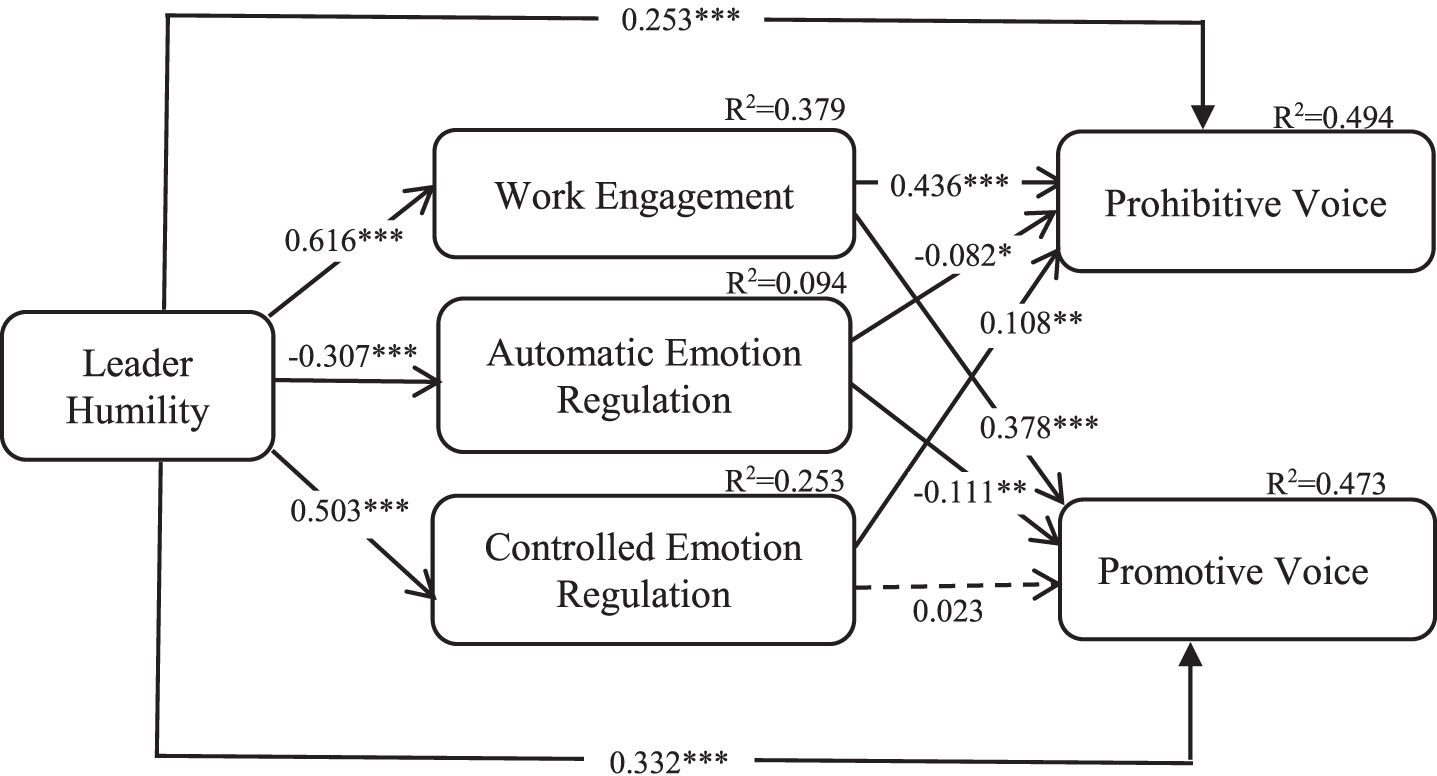
The Results for the hypothesized model. Notes. 1. * p-value < 0.05, ** p-value < 0.01, and *** p-value < 0.001.
The mediating effects were tested with the bias-corrected bootstrapping procedure [52], the results are presented in Table 3. Based on 2,000 bootstrapped samples, the indirect effects of leader humility and employee prohibitive voice via work engagement, automatic emotion regulation and controlled emotion regulation are significant (b = 0.268, SE = 0.037, 95 percent bias-corrected CI = 0.203, 0.352; b = 0.025, SE = 0.012, 95 percent bias-corrected CI = 0.003, 0.050; b = 0.054, SE = 0.021, 95 percent bias-corrected CI = 0.170, 0.306), providing support for H6, H8 and H10 (see Table 3). The indirect effects of leader humility and employee promotive voice via work engagement and automatic emotion regulation are significant (b = 0.233, SE = 0.034, 95 percent bias-corrected CI = 0.170, 0.306; b = 0.034, SE = 0.012, 95 percent bias-corrected CI = 0.013, 0.061) providing support for H7 and H9 (see Table 3). Then, the indirect effect of leader humility and employee promotive voice via controlled emotion regulation is not significant (b = 0.012, SE = 0.021, 95 percent bias-corrected CI = –0.030, 0.051) (see Table 3). However, H11 was rejected.
Bootstrapping results for indirect effects and direct effects
Notes. 1. *p-value < 0.05, **p-value < 0.01, and ***p-value < 0.001; 2. SE standard error, CI confidence interval, 2000 bootstrap samples.
Moreover, in Table 3, the direct effects of leader humility on employee prohibitive voice and leader humility on employee promotive voice are significant (b = 0.253, SE = 0.06, 95 percent bias-corrected CI = 0.131, 0.365; b = 0.332, SE = 0.061, 95 percent bias-corrected CI = 0.216, 0.458). According to the study of Cheung and Lau [52], the results of Table 3 showed that work engagement, automatic emotion regulation and controlled emotion regulation were partially mediated the relationship between leader humility and employee prohibitive voice. Meanwhile, work engagement and automatic emotion regulation were partially mediated the relationship between leader humility and employee promotive voice.
Theoretical and practical implications
This study explores the mediating mechanisms to explain that leader humility promotes follower’s voice behavior. By referring to the COR theory, the present study considers employee’s work engagement and emotion regulation strategies as the psycho-logical resources, which affected by leader humility, to meet stressful challenges (such as employee voice behavior). Therefore, this study hypothesizes that work engagement and emotion regulation strategies mediated the effects of leader humility on employee voice behavior.
First, the results support the hypotheses that: (1) leader humility positively affects prohibitive voice behavior and promotive voice behavior (H1 and H2); (2) leader humility positively affects employee’s work engagement, negatively affects employee adopting automatic emotion regulation, and positively affects employee adopting controlled emotion regulation (H3, H4, and H5).
Although, some earlier studies have verified the same results that leader humility positively affects employee voice behavior [1, 6], the present study shows that leader humility positively affects prohibitive voice behavior and promotive voice behavior. Moreover, leader humility, with the characteristic of openness and sincerity, may encourage employees to express their voice, not only express their ideas or suggestions for improving their own organization, but also express their concerns about the organizational process and behavior which may damage their organization
The results show that leader humility positively affects employee’s work engagement, which is consistent with the earlier studies [1, 26–28]. The present study argues that leader humility, with the characteristics of acknowledging the strengths and contributions of followers and being teachable [1], may enhance employee’s work engagement. Meanwhile, the present study shows that leader humility negatively affects employee adopting automatic emotion regulation and positively affects employee adopting controlled emotion regulation. Earlier study has argued that leader humility may provide followers with emotional and cognitive resources and help followers to manage emotional and cognitive processes [38]. The present study indicates that leader humility, expressing sincerity and leading by example, may influence followers to improve their cognitive emotion regulation strategies. Furthermore, according to the perspective of evolutionary psychology in the work of Castellano et al. [23], the results of this study shows that leader humility may help followers to manage emotional processes by adopting more controlled emotion regulation strategies (e.g., acceptance) and less automatic emotion regulation strategies (e.g., self-blame).
Second, leader humility could promote employee’s prohibitive voice by enhancing their work engagement (H6) and adopting more controlled emotion regulation strategies (H10) and less automatic emotion regulation strategies (H8). The present study argues that leader humility may encourage employees to express their prohibitive voice, by enhancing work engagement and managing their emotion regulation strategies. Therefore, referring to the COR theory, the present study argues that leader humility may provide employees with psychological resources (e.g., work engagement and emotion regulation strategies) for expressing prohibitive voice.
Third, leader humility could encourage employee’s promotive voice by enhancing their work engagement (H7) and reducing automatic emotion regulation strategies (H9). According to the work of Liang et al. [17], promotive voice needed employees’ extra efforts to generate suggestions and solutions and was related to felt obligation. Based on COR theory, the present study argues that leader humility may encourage employees to express their promotive voice through providing employees with psychological resources (i.e., enhancing work engagement and reducing automatic emotion regulation strategies).
Forth, the mediating effect of employee adopting controlled emotion regulation strategies on the relationships between leader humility and promotive voice are not supported (H11). Meanwhile, employee adopting controlled emotion regulation positively affects employee’s prohibitive voice behavior, but doesn’t affect promotive voice behavior significantly. The results show that employee adopting controlled emotion regulation strategies could enhance prohibitive voice, but couldn’t enhance promotive voice significantly. According to the work of Castellano et al. [23], controlled emotion regulation strategies were characterized by being voluntary, conscious, and slow. Therefore, employees may need more psychological resources and time for such cognitive emotion regulation. Meanwhile, according to the work of Liang et al. [17], promotive voice needed more employees’ cognitive efforts and resources to generate ideas and suggestions for changing the organizational status quo [18]. Therefore, the results of present study indicates that both controlled emotion regulation strategies and promotive voice need a lot of psychological resources and efforts, so employee adopting controlled emotion regulation doesn’t affect promotive voice behavior significantly and couldn’t mediate the relationship between leader humility and promotive voice.
The research findings have several implications for organizational managers. The results show that enhancing work engagement and controlled emotion regulation strategies and reducing automatic emotion regulation strategies partially mediated the relationships between leader humility and employee’s prohibitive voice. Therefore, to encourage employees to express voices of stopping or preventing harm for their organization, managers expressed humility (such as showing openness to new ideas and feedback) may provide employees with psychological resources, which enhancing employee’s work engagement, adopting controlled emotion regulation strategies and reducing automatic emotion regulation strategies. Meanwhile, the results show that enhancing work engagement and reducing automatic emotion regulation strategies partially mediated the relationships between leader humility and employee’s promotive voice. Therefore, to promote employees to express voices of proposing ways of changing the status quo of their organization, managers expressed humility may provide employees with psychological resources of enhancing employee’s work engagement and reducing automatic emotion regulation strategies.
Limitations and recommendations
There are some limitations in this study, which could be further improved in future research. First, this study adopted the purposive and snowball sampling to survey the managers and employees at travel enterprises in China. The researchers contacted and received supports from the managers and employees of 16 travel enterprises to collect the questionnaires. Therefore, the application and generalization of the research findings should be approached cautiously. Future studies could test the proposed model with probability sampling techniques and collect data from multiple resources.
Second, this study collected all the data from the same source and adopted some procedural remedies to control method variance. Although, to test the severity of common method bias, the results of statistical analyses were not a serious problem, it would be better to refine this and collect data from different sources (e.g., leaders, coworkers) in future research.
Finally, because the data were collected from mainland China, it is not certain that the findings can be generalized to other cultural settings. In Chinese culture context, interpersonal relationships emphasis on maintaining harmonious relationships and reciprocation, and employee voice behavior may be considered as a risky behavior [17]. Even though this study argues that employee’s psychological resources (e.g., work engagement, emotion regulation strategies) partially mediate the relationships between leader humility and employee voice behavior, there are some differences between Chinese and western culture. Therefore, the researchers recommend that future research could test this research model across cultural contexts.
Footnotes
Acknowledgments
The authors have no acknowledgments.
Author contributions
CONCEPTION: Chiang-Kuo Tu and Shan Huang
METHODOLOGY: Chiang-Kuo Tu and Shan Huang
DATA COLLECTION: Shan Huang and Chiang-Kuo Tu
INTERPRETATION OR ANALYSIS OF DATA: Chiang-Kuo Tu and Shan Huang
PREPARATION OF THE MANUSCRIPT: Chiang-Kuo Tu and Shan Huang
Appendix 1
“Item’s Factor Loadings” and “Construct’s CR and AVE”
Construct (&Items)
Factor Loadings
Composite Reliability (CR)
Average Variance Extracted (AVE)
Leader Humility (Cronbach’s α= 0.871)
1. This person actively seeks feedback even if it is critical.
0.751
0.936
0.618
2. This person admits it when they don’t know how to do something.
0.862
3. This person acknowledges when others have more knowledge and skills than him- or herself.
0.776
4. This person takes notice of others’ strengths.
0.752
5. This person often compliments others on their strengths.
0.754
6. This person shows appreciation for the unique contributions of others.
0.764
7. This person is willing to learn from others.
0.727
8. This person is open to the ideas of others.
0.851
9. This person is open to the advice of others.
0.826
Work Engagement (Cronbach’s α= 0.917)
1. At my job, I feel strong and vigorous.
0.749
0.953
0.545
2. When I get up in the morning, I feel like going to work.
0.839
3. At my job, I am very resilient, mentally.
0.662
4. At my work, I always persevere, even when things do not go well.
0.652
5. At my work, I feel bursting with energy.
0.682
6. I can continue working for very long periods at a time.
0.739
7. I find the work that I do full of meaning and purpose.
0.755
8. I am proud of the work that I do.
0.808
9. My job inspires me.
0.762
10. I am enthusiastic about my job.
0.652
11. To me, my job is challenging.
0.768
12. When I am working, I forget everything else around me.
0.753
13. Time flies when I am working.
0.840
14. I get carried away when I am working.
0.730
15. It is difficult to detach myself from my job.
0.693
16. I am immersed in my work.
0.697
17. I feel happy when I am working intensely.
0.731
Automatic Emotion Regulation (Cronbach’s α= 0.889)
1. I feel that I am the one to blame for it.
0.666
0.951
0.547
2. I feel that I am the one who is responsible for what has happened.
0.757
3. I think about the mistakes I have made in this matter.
0.740
4. I think that basically the cause must lie within myself.
0.759
5. I often think about how I feel about what I have experienced.
0.730
6. I am preoccupied with what I think and feel about what I have experienced.
0.792
7. I want to understand why I feel the way I do about what I have experienced.
0.744
8. I dwell upon the feelings the situation has evoked in me.
0.718
9. I often think that what I have experienced is much worse than what others have experienced.
0.655
10. I keep thinking about how terrible it is what I have experienced.
0.763
11. I often think that what I have experienced is the worst that can happen to a person.
0.778
12. I continually think how horrible the situation has been.
0.792
13. I feel that others are to blame for it.
0.636
14. I feel that others are responsible for what has happened.
0.753
15. I think about the mistakes others have made in this matter.
0.741
16. I feel that basically the cause lies with others.
0.782
Controlled Emotion Regulation (Cronbach’s α= 0.919)
1. I think that I have to accept that this has happened.
0.712
0.962
0.560
2. I think that I have to accept the situation.
0.856
3. I think that I cannot change anything about it.
0.689
4. I think that I must learn to live with it.
0.759
5. I think of nicer things than what I have experienced.
0.739
6. I think of pleasant things that have nothing to do with it.
0.734
7. I think of something nice instead of what has happened.
0.764
8. I think about pleasant experiences.
0.757
9. I think I can learn something from the situation.
0.723
10. I think that I can become a stronger person as a result of what has happened.
0.630
11. I think that the situation also has its positive sides.
0.745
12. I look for the positive sides to the matter.
0.759
13. I think of what I can do best.
0.837
14. I think about how I can best cope with the situation.
0.751
15. I think about how to change the situation.
0.705
16. I think about a plan of what I can do best.
0.779
17. I think that it all could have been much worse.
0.730
18. I think that other people go through much worse experiences.
0.827
19. I think that it hasn’t been too bad compared to other things.
0.752
20. I tell myself that there are worse things in life.
0.686
Prohibitive Voice (Cronbach’s α= 0.870)
1. Dare to point out problems when they appear in the unit, even if that would hamper relationships with other colleagues.
0.768
0.872
0.579
2. Dare to voice out opinions on things that might affect efficiency in the work unit, even if that would embarrass others.
0.805
3. Advise other colleagues against undesirable behaviors that would hamper job performance.
0.728
4. Speak up honestly with problems that might cause serious loss to the work unit, even when/though dissenting opinions exist.
0.824
5. Proactively report coordination problems in the workplace to the management.
0.668
Promotive Voice (Cronbach’s α= 0.848)
1. Proactively voice out constructive suggestions that help the unit reach its goals.
0.864
0.853
0.540
2. Proactively develop and make suggestions for issues that may influence the unit.
0.739
3. Proactively suggest new projects which are beneficial to the work unit.
0.631
4. Raise suggestions to improve the unit’s working procedure.
0.725
5. Make constructive suggestions to improve the unit’s operation.
0.694