



Abstract
BACKGROUND:
Supervisory support enhances employee retention and also improves the psychological empowerment of employees and generates organizational citizenship behavior. Employees feel more optimistic as they get the necessary support and adequate resources to perform their duties efficiently. Hence, empowered employees are more likely to stay in the organization for a more extended period. Similarly, employees receiving high supervisory support may exhibit a higher level of OCB that will ultimately lower the turnover rate and elevate employee retention.
OBJECTIVE:
This study aims to analyze the mechanism to enhance employee retention (ER) through supervisory support (SS). The study also examines the indirect influence through the serial mediation of psychological empowerment (PE) and organizational citizenship behaviour (OCB).
METHODS:
The serial mediation approach was used to test the proposed model of the study. The data was collected through a self-administered structured questionnaire filled by 428 banking employees of North India. The model hypotheses of serial mediation were tested by applying Hayes PROCESS Model 6.
RESULTS/CONCLUSION:
The relationship between SS and ER of banking employees through serial mediation of PE and OCB was unprecedented. The results reveal that supervisory support positively contributes to enhance employee retention among private sector banking employees. Additionally, the study has outlined that PE and OCB play noticeable mediation roles for employees to stay in the organization. Implications are also discussed.
Keywords


Introduction
Employees are the physical assets of the organization. Many research scholars and supervisors/managers in the organization may ask a question “why should retention of employees be important?” and [1, 2] suggested the answer to this question that low retention rates increase the expenses of recruitment, selection, and training of new persons to be employed. The money spent on these activities could have been used on career development or improvement in the skills and abilities of employees. Almost every organization is witnessing several challenges because of the dynamic work environment. One of those challenges is employee retention; it is easy to hire new employees but challenging to retain them. Several studies found that dealing with employee turnover is one of the major challenges for organizations, and all organizations have their own methods for employee retention [3]. Employee retention is a way to keep the employees encouraged and motivated to stay in the organization. In addition to this, an organization with a low retention rate may face a fall in efficiency, and performance [3, 4]. Therefore, employee retention has always been vital aspect for organizations because every organisation invests in the grooming of their new employees and experienced employees play significant role for the success of an organization. If an organization fails to retain its employees, it would be unable to grow human capital and productivity and may meet devastating economic results [5]. Hence, it is evident to retain the key employees for increasing productivity and performance. It is cogitated as an all-around aspect of human resource plans and strategies. The top authorities should do their best to retain those employees who are key contributors and really important for the system.
Former empirical studies [6–10] investigated the prominence of various human resource practices such as training and development, perceived organizational support, rewards and recognition, career growth opportunities, motivation for performing well and job security, etc. to retain the employees, dropping absenteeism and turnover intentions and enhancing the productivity of employees. However, very few studies [3, 11–15] explored the role of supervisory support in enhancing employee retention. [16] found the critical role of supervisors in the growth of employees and the organization. Considering the worth of supervisory support, [7] argued that the aid of a supervisor is a critical source of organizational success, and promotes the positive behavior of employees. Moreover, supervisors play a great role when an organization moves ahead for the development of employees and managers. Additionally, supervisory support also enhances the psychological empowerment of employees [17–19] and generates organizational citizenship behaviour [20–22]. Employees feel more optimistic as they get the necessary support and adequate resources to perform their duties efficiently. Hence, empowered employees are more likely to stay in the organization for a more extended period. Similarly, employees receiving high supervisory support may exhibit a higher level of OCB that will ultimately lower the turnover rate and elevate employee retention [20–23]. Therefore, the present study explores the mediating role of psychological empowerment and organizational citizenship behavior between the association of supervisory support and employee retention in the private banking sector. Banking sector plays a vital role in the growth of an economy [24]. Employee turnover is a key concern for all sectors, specifically for the banks, because of cutthroat completion and it is challenging to retain vivid and brilliant staff [25]. Indian banking sector turns into a highly growing and dedicated innovation-based sector which becomes strength in the market. Banks treat their employees as the spine of their administration and human capital for their organizations. Moreover, this sector contributes significantly to the economy and provides job avenues. However, in the past years the turnover rate is increasing in private sector banks [26]. Since, employee retention is a significant unavoidable rehearse to beat the competition and enhance productivity in the ongoing timeframe in the banking sector. Thus an efficient and supportive supervisor is required to run all the activities because a positive association between supervisors and subordinates is essential. This research’s use of psychological empowerment and organizational citizenship behavior as a mediator is consistent with previous studies [27–29]. Besides individual mediation, more specifically the study will analyze serial mediation of psychological empowerment and organizational citizenship behavior, and it will be a key contribution of this study. These two mediating variables play a significant role in enhancing employee retention [30–35]. So the question arises, “How supervisory support enhances employee retention through psychological empowerment and organizational citizenship behavior?” To answer this question, a conceptual framework of serial mediation has been formed and analyzed.
The present study is worth doing for several objects. The novelty of the study is that this study used objectives and models that were not covered by former studies. Previous studies were mainly conducted in the telecom sector, manufacturing sector, and hotels and educational organizations. This study is concerned with the private banks of Punjab, Chandigarh, Haryana and Delhi NCR. Existing studies have not investigated the association of the variables as mentioned earlier, specifically in the banking sector of north India, where the respondents may have diverse characteristics and work environments from existing studies. Therefore, the present study will fill gaps in the existing literature.
Theoretical framework and hypotheses formation
Social exchange theory
The present study’s conceptual framework is rooted in the social exchange theory as it has become a widespread theoretical base for organizational studies [23, 37]. The relationship between the study variables can be recognized more clearly with the use of social exchange theory. The theory mainly states that “A” person’s attitude and behavior supports or strengthens person “B’s” behaviour, and the other way round results in building the association between them. Or it can be said that one entities’ behaviour impacts the behaviour of other entity, which will generate some kind of relationship between them. and In support, [38] stated that supervisor and subordinate could be considered as two “entities” in social exchange association as suggested by a gamut of management literature. In the present study, supervisory support is regarded as a social exchange construct. Supporting this, research by [8] stated that employees stay in the organization if their superiors value their contribution and they are treated well, communicated properly, and provided required respect and recognition along with their support. Therefore, the theory is considered as a suitable theoretical base for studying the relationship between supervisory support and employee retention. Similarly, the theory is also used to understand the relationship between other constructs of the study, such as, that when employees get support from supervisors and evaluate their actions, they wish to pay back with OCB. In return for social obligations, they reward their supervisors through a positive work attitude and increased performance [37, 40].
Supervisory support
The supervisor plays a vital role in the organization because the supervisor acts as regulator for the staff behavior, work process, and become a link between all the working parties of organisation. Considering the vital role of supervisors in the organization [16], supervisor support is considered as the acute source of support at the workplace, which enhances the optimistic attitude and lowers the pessimistic behavior and stress [7]. The positive and strong relationship between supervisor and subordinate also helps to generate employees’ skills and abilities. Because of this mentoring and grooming, employees build their strong intentions to stay in the organization [3, 42].
Employee retention
Employee retention means doing the actions to retain the employees in the organization. It involves various strategic actions to keep the employees focused and dedicated towards the work so they tend to stay in the organization and perform more productively for the organization [5]. [43] stated that the cost of turnover of an employee is considerably higher than retaining them through monetary and non-monetary benefits. Thorough plans and policies about employee retention programs can play an influential role in retaining the existing key employees and attracting potential ones. It will reduce the turnover cost. As it is economical to keep the key employee than to recruit the new one of the same quality and train those from starting point [44]. This will result in the enhancement of productivity and performance of the organization.
Psychological empowerment (PE)
The empowerment of employees is essential for the success of the organization. Empowerment is defined as “a process of improving feelings of self-efficacy among organizational members through identifying conditions that foster powerlessness and through their removal by both formal organizational practices and informal techniques of providing efficacy information.” Whereas psychological empowerment (PE) is defined as a motivational construct formed by the workplace and revealing a persons’ active orientation towards their work role [45].
Organizational citizenship behavior (OCB)
Organizational citizenship behavior (OCB) is defined as “individual behavior that is discretionary, not directly or explicitly recognized by the reward system and that in the aggregate promotes the effective functioning of the organization” [46]. It is a voluntary individual behavior that enhances the ability of employees by providing them resources and time. Employees work voluntarily with their will without seeking any formal reward. Therefore the absence of these acts is not punishable. However, it is considered as being caring, helpful, and concerned towards others. OCB has been examined in prior studies since it was found to be favorable for several organizational outcomes.
Supervisory support (SS) and Employee retention (ER)
Support is significant for development and performance. Many researchers have widely studied supervisory support to influence organizational outcomes [14]. When the supervisor and subordinates have a positive relationship in the organization, it will enhance the loyalty and attachment towards the firm and improves productivity, and these kinds of organizations enjoy the loyalty of their employees [3, 42], as their perception about the support received from supervisor greatly impact their relationship with their workplace [47]. Therefore, to improve employees’ retention rate, it’s prominent to build a strong and supportive association between supervisor and employees [15, 48]. Likewise, earlier researches also revealed the great role played by supervisory support to increase employee retention. They found that employees receiving higher support from supervisors demonstrate high concern towards the organization and are more likely to stay in the organization [11, 50]. Additionally, recent research of [12, 15] also strengthen the positive relationship between SS and ER. Thus, the support received from the supervisor demonstrates the strongest influence in building and enhancing satisfaction among employees and their intention to stay in the organization resulting in framing the following hypothesis:
H1: Supervisory support has a significant positive effect on employee retention in private banks
Mediation of psychological empowerment (PE)
Some prior studies [17–19, 51] found a positive association between SS and PE and explained that employees receiving support at the workplace generally feel psychologically empowered. Furthermore, supervisory support influences organizational commitment, optimistic attitude, work engagement, job satisfaction, empowering the employees by meeting their needs [13]. As higher PE will lower the turnover intention, and employees tend to stay in the organization, thus enhances employee retention [52]. Previous research found a significant influence of PE on employees’ commitment towards their organization and their intention to stay [30, 53]. After studying the relationship of PE with SS and ER, existing literature recommends that PE can and may mediate the relationship between SS and PE. Moreover, after detailed literature, the present study found hardly any previous research to support this claim in the Indian context. Therefore it’s worth examining the mediating role of PE between SS and ER. Thus the following hypothesis has been framed:
H2: Psychological empowerment significantly mediates the relationship between supervisory support and employee retention in private banks.
Mediation of organisational citizenship behavior (OCB)
It is vital to understand the association of supervisory support and OCB in the realm of today’s corporate world. The social exchange theory has been used to understand the role of supervisory support to foster OCB in employees. Existing literature established the positive association between SS and OCB [20–23, 37]. If employees receive spatial treatment by supervisors, they will perform better and support the organization’s goals. Moreover, they will provide voluntary assistance if they are treated fairly. The success of an organization is critical without OCB [54]. Further, [55, 56] found that Higher OCB can develop a positive and loyal attitude among employees to stay in the organization. The previous studies by [33, 34] established a positive association between OCB and ER in the organization. In addition, [32] also found a positive influence of OCB on employee retention in the banking sector. In a similar way, OCB lowers the employee turnover and generates the feeling among employees to stay in the organization. In one study OCB was examined as a mediator between perceived organizational support and ER [29]. Similarly, [28] also explored the role of OCB as a mediator between transformational leadership and ER. The focus of the present study is to examine the mediating role of OCB between SS and ER. Moreover, after detailed literature, the present study found that there is hardly any previous study to support this claim in the Indian context. Therefore based on the findings of existing literature, OCB can and may mediate the relationship between SS and ER. Hence, the following hypothesis has been proposed:
H3: Organizational citizenship behavior significantly mediates the relationship between supervisory support and employee retention in private banks.
Serial/sequential mediation
The current study examines the serial mediation effect. Taking all hypotheses proposed above, the present study foresees that the relationship between supervisory support and employee retention can be mediated by PE and OCB (a serial mediation). Former studies provides empirical evidence to confirm the positive association between SS and PE [17–19, 51]. Support from the supervisor empowers the employees working in the organization, and employees feel more optimistic as they get the required support and adequate resources to perform their duties efficiently. It is evident that psychologically empowered employees generally have high motivation to perform effectively, which leads to OCB [57–59]. Then, Higher OCB generates a positive attitude and sense of belongingness among employees to stay in the organization [32–34, 56]. On the other hand, Islam et al.(2016) found a negative association between OCB and turnover intentions, which means employees having OCB have no or significantly lower turnover intentions. Hence, a significant positive association between OCB and ER can be forecasted. Therefore, from the existing literature, it can be seen that psychological empowerment generated by supervisory support [30, 53] will positively influence OCB [57–59] and it will ultimately lead to significantly influencing ER [33, 34]. Therefore, it’s possible that PE and OCB not only play an independent mediating role in the relationship between SS and ER but also relate with each other and perform a role of serial mediation in this relationship simultaneously. Taken together, the following hypothesis has been proposed:
H4: Psychological empowerment and Organizational citizenship behavior significantly serially mediate the relationship between supervisory support and employee retention in private banks.
Conceptual framework
Based on the above literature related to Supervisory Support, Psychological empowerment and Organizational citizenship behaviour and employee retention and hypotheses, the following conceptual framework has been framed:
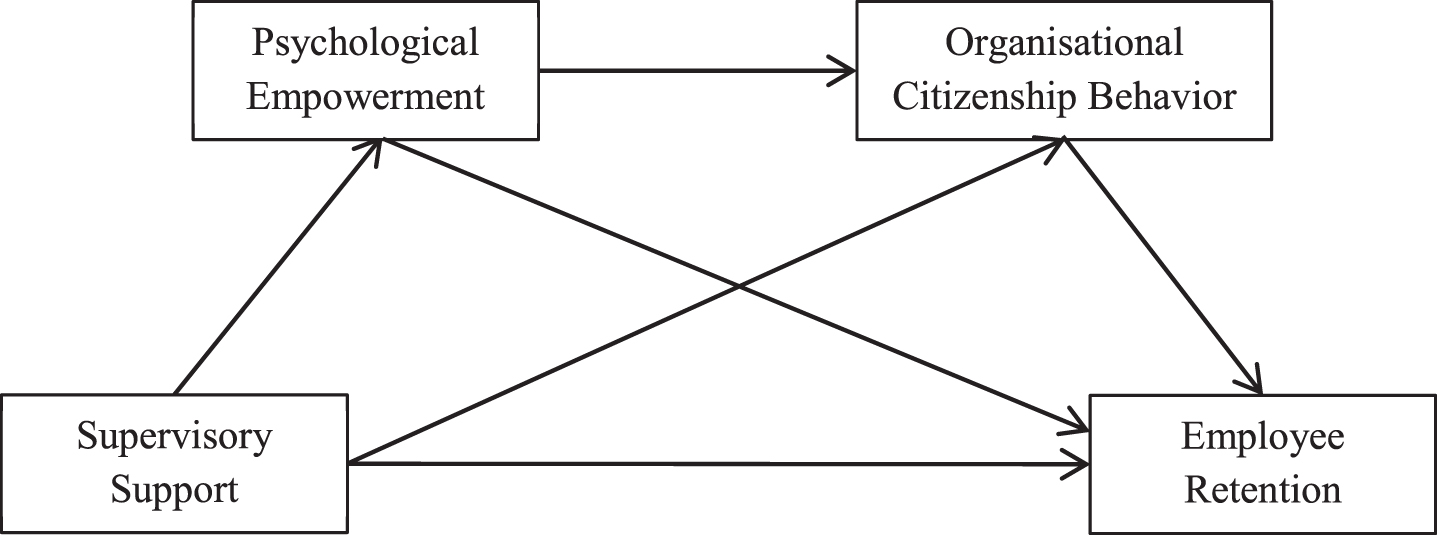
Conceptual Framework.
Sampling and data collection
For the present cross-sectional study, primary data was collected from employees of banking sector of Punjab, Chandigar h, Haryana, and Delhi NCR through an online survey using a structured questionnaire in April-June, 2021. Private Banks were taken for the study because this sector plays a significant role in the economy and provides job avenues. The study covers the top private sector banks based on market capitalization. The close-ended questions were used because it would be easy for respondents to fill the questionnaire and it consume less time and cost of the study. To reduce the common method biases, data for the study were gathered at two points in time with an interval of 3 weeks. In the first phase, respondents were asked to fill data about demographic profile, supervisory support and psychological empowerment, then after 3 weeks, respondents were asked to fill data about OCB and employee retention. A close-ended questionnaire was distributed to 500 employees and out of which 458 responses were submitted, resulting in an 89 percent response rate. Out of the submitted questionnaire, 30 were discarded because of incomplete and invalid responses. Finally, 428 valid questionnaires were used analysis. Before moving to analysis, the primary condition of sample size and correctness of data is met. As a rule of thumb, 100–150 sample size is considered to be an adequate minimum sample size for analyzing a model [61, 62]. Thus, the effective sample size of 428 for the present study is suitable to analyze the proposed model.
Measurement development
The variables in the present study were measured using existing scales extracted from previous literature. The supervisory support was measured by five items adapted from [63] The sample item is “My supervisor treats people well and is easy to get close to”. A Five item scale of employee retention was extracted from [64]. The sample item is “I see a future for myself within this company”. While five items to measure Organisational citizenship behavior were extracted from the study [65]. The sample item is “I willingly give my time to help others who have work-related problems”. Psychological empowerment was measured through a 12 items scale adapted from [45]. The sample item is “The work I do is very important to me”. All the scale items used five-point Likert scales ranging from 1 (strongly disagree) to 5 (strongly agree).
All the scales were standardized and validated. However, factor analysis with varimax rotation was conducted to re-check the suitability of the scales for the present study. Factor loading of all the items was greater than the minimum threshold of 0.5 except for three items of psychological empowerment. Those were discarded for further analysis. Along with this, the internal reliability of the constructs was measured by Cronbach’s alpha with a minimum threshold of 0.6 [66]. Table 1 shows the Measure of Sampling Adequacy KMO and Bartlett’s Test of Sphericity. KMO value greater than 0.8 shows the adequacy of the sample for the study. As per Barlett’s test, p-value < 0.001 reveal that factors forming the constructs are significantly satisfactory. Results of factor loadings and Cronbach’s alpha are depicted in Table 2.
KMO and Bartlett’s Test
KMO and Bartlett’s Test
Source: (Author’s calculations).
Rotated Component Matrix
Source: (Author’s calculations).
Although the current study uses self-reported data collected through a survey questionnaire at two points in time to control common method bias. Even though there can be a potential problem of common method bias as each participant responds to a survey. To measure biasness, the study used Harman’s Single factor test as it is the most widely used test to assess CMB. In the study, variance explained was 35.58%, i.e. less than the 50% criterion suggested by [67]. Hence, statistical results show that common method bias is not a threat to the interpretation of our results in the current study.
Data analysis
The data was put through various steps through which the proposed model was examined. SPSS 23 with Process macro version 3.4 and AMOS version 21.0 [68] were used to analyze the collected data. SPSS was used to analyze the reliability, correlation, and factor analysis of the constructs. The validity of the scale was examined through AMOS 21.0 by conducting CFA [69, 70]. Further, serial mediation was analyzed using SPSS with Model 6 of PROCESS Macro using the 5000 bootstrapping with a 95% confidence level [71]. PROCESS Macro Serial Mediation model 6 developed by Professor Hayes (2017) was used because it clearly depicts the results for specific indirect effects of variables which is very difficult to analyse in AMOS. And the mediation test is found to be significant when it does not contain zero under 95% confidence level.
Results
Demographic characteristics
The demographic profile of respondents is depicted in Table 3 following gender, age, qualification, and job level. The respondent’s profiles comprise (57.3 percent) male and (42.7 percent) female respondents. The majority of respondents belong to the age group of 20–30 (40.2 percent) and between 30–40 years (36 percent). In terms of educational level, the numbers of graduates were (64 percent), whereas (36 percent) were postgraduates. Furthermore, the majority of the respondents belong to the middle level (54.3 percent), junior level (36.6 percent), and only (9.1 percent) were at the senior level.
Demographic Characteristics of Respondents
Demographic Characteristics of Respondents
Source: (Author’s calculations).
Descriptive statistics and correlation among variables were computed and the results are shown in Table 4. Data Normality was tested by using skewness and kurtosis. The values of skewness and kurtosis were found to be within prescribed limits i.e. between –2 and +2 [72]. All the variables were found to be statistically significant and correlated to each other as expected providing the fundamental base to hypotheses.
Descriptive statistics and Inter-correlations among Variables
N = 328, **p < 0.01 *p < 0.05. Source: (Author’s calculations).
Firstly, the research model was analyzed using confirmatory factor analysis by using AMOS 21 [68] to examine the overall model fit. Model value, GFI, PGFI, CFI, and TLI were examined for the goodness of fit measurement indices [70]. All these values were found to be within acceptable limits, and RMSEA (0.07) was also within the specified range, thus acceptable. The results are depicted in Table 5.
Fit statistics of the model
Fit statistics of the model
Source: (Author’s calculations).
The convergent and discriminant validity of scale constructs was examined. All the values were found to be within the acceptable limits i.e. CR > 0.6, AVE > 0.5 [72, 73]. This demonstrates internal consistency and convergent validity. Moreover, the results in Table 6 depict a satisfactory level of discriminant validity. As recommended by [74], the square root of AVEs for each construct exceeded its correlation coefficients with other constructs. Validity master was used to analyzing the validity which was fully established.
Convergent and Discriminant Validity Statistic of Variables
Source: (Author’s calculations).
Table 7 depicts the direct effect of all four constructs. The total effect of SS on ER was significant (β= 0.687, p < 0.001). Supervisory support has a positive direct effect on employee retention (β= 0.549, p < 0.001), psychological empowerment (β= 0.459, p < 0.001), and organizational citizenship behavior (β= 0.515, p < 0.001). Similarly, a positive significant impact of psychological empowerment on employee retention (β= 0.114, p < 0.001), and organizational citizenship behavior (β= 0.247, p < 0.001) can be observed. Further, organizational citizenship behavior was also found to be positively impacting employee retention (β= 0.126, p < 0.001).
Results of Direct Effect
Results of Direct Effect
Source: (Author’s calculations). Notes: 1. *** p-value < 0.01; ** p-value < 0.05. 2. SS = Supervisory Support, ER = Employee Retention, PE = Psychological Empowerment, OCB = Organisational Citizenship Behavior.
Specific Indirect Effects
Source: (Author’s calculations). Notes: 1. SS = Supervisory Support, ER = Employee Retention, PE = Psychological Empowerment OCB = Organisational Citizenship Behavior. 2. Number of bootstrap samples for bias-corrected bootstrap confidence intervals: 5000. Level of confidence for all confidence intervals: 95%. 3. Model 1 = SS –> PE –> ER, Model 2 = SS –> OCB –> ER, Model 3 = SS –> PE –> OCB –> ER.
The direct and indirect effects of psychological empowerment and organizational citizenship behavior were examined. It was observed that after mediation analysis, the direct effect of supervisory support on employee retention is positively significant (β= 0.5499, 95% CL:0.4261,0.6738), leads to acceptance of hypothesis H1. The total size of the indirect effect is (β= 0.1317, 95% CL:0.0584, 0.2137), and was found to be statistically significant as there are no zeroes between LLCI and ULCI in the confidence interval. Mediation effect of psychological empowerment H2 (β= 0.0524, 95% CL:0.0054, 0.1028) and organizational citizenship behavior H3 (β= 0.0650, 95% CL:0.0108, 0.1279) were also found to be statistically significant. Simple mediation analyses predicted in hypotheses 2 and 3 are supported by the results. Further, examining the serial mediating effect H4 (β= 0.0144, 95% CL:0.0021, 0.0331), is also found to be statistically significant. Through this, the serial mediation effect of PE and OCB is confirmed in the relationship between supervisory support and employee retention. As forecasted all the results were found to be significantly significant, leading to acceptance of all hypotheses. Furthermore, the direct effect of SS on ER was statistically significant (β= 0.5499, p < 0.05), indicating partial mediation.
Pairwise comparisons between the three indirect effects on the supervisory support and employee retention relationship were examined to compare the strengths of these relationships. Overall findings suggest that the indirect effect of SS on ER through OCB was significantly greater than the serial mediating effect, b = 0.05, SE = 0.02, 95% CI = [.0066, 0.1043], and the indirect effect through psychological empowerment, b–= –0.01, SE = 0.04, 95% CI = [–0.0975, 0.0709]. The pairwise comparison between the serial mediating effect and the indirect effect through psychological empowerment was not statistically significant.
The present article was an attempt to understand the elevation in employee retention with supervisory support in Indian private banking sector. To articulate the relationship, the study proposed and examined a serial mediation model of supervisory support influencing employee retention through psychological empowerment and organizational citizenship behavior. The evidence is found in favor of the three hypothesized indirect effects: (1) Supervisory support → psychological empowerment → employee retention, (2) Supervisory support → organizational citizenship behavior → employee retention, and (3) Supervisory support → psychological empowerment → organizational citizenship behaviour → employee retention. The empirical results of this study reveal some important findings.
Firstly, the study examined the direct and indirect effects of supervisory support (SS) on employee retention (ER). The study found that SS is an essential element influencing ER. From hypothesis one, results exhibit positive significant association between SS and ER, which explain that employees receiving higher support from supervisor demonstrate high concern towards the organization and are more likely to stay in the organization. These findings are consistent with previous studies [11–15, 50], which also found that supervisory support can significantly raise the level of commitment and satisfaction from job and they tend to become loyal and stay in the organisation. Both direct and indirect effects were found to be statistically significant. It explains that support received from the supervisor plays a significant role in retaining the employees. From the perspective of social exchange theory, when employees get support and care from supervisors for their well-being, they are likely to get more attached and connected to the organization; they would like to return the favor by performing well and staying in the organization.
Further, the study examined the mediating role of PE and OCB. As forecasted, the results were found to be positively significant. The study adds pieces of evidence to the existing literature [30–35] that examined the association of PE and OCB with SS and ER. The study forecasted the mediation effect of PE and found significant empirical results. The result exhibits similar findings with previous research [27] that examined the mediating role of PE between SS and ER. It explains that supervisory support is an important element to enhance psychological empowerment for raising employee retention. Thus, supervisors have to understand the significance of empowerment for employees to motivate and retain them in the organization. Then, this study analysed OCB as a mediator between SS and ER. The results revealed the positive mediating role of OCB between the relationship of SS and ER, similar to existing studies [28, 29]. It describes that employees receiving support from supervisors incline to be more attached towards the organization and have a positive and voluntary helping attitude for others. Therefore, support by supervisors results in developing OCB in employees, which generates a positive attitude and loyalty among employees, hence, improving employee retention. Finally, the article analyzed the proposed serial mediation of PE and OCB. The results revealed that both variables were statistically significant in influencing SS on ER. This is a key finding as this is the first study to analyze serial mediation in this relationship. Serial mediation effect describes that the higher the supervisory support, the higher will be the level of psychological empowerment [30, 53], which will generate OCB [57, 59], it will ultimately strengthen the intentions of employees to stay in the organization [33, 34]. However, after comparing all the indirect effects, it was found that OCB impacts more significantly on the relationship of SS and ER. Findings illuminate that psychological empowerment and organizational citizenship behavior are significant factors to strengthen the positive association between supervisory support and employee retention.
Implications
Theoretical implications
The present study contributes to the literature by adding the pieces of evidence in various ways. Firstly this study examined the important aspect of HR practices, i.e. supervisory support to influence employee retention in the private banking sector of India. Another emphasis of the research was to examine employee retention through PE and OCB. The present study is the first to investigate the relationship between SS, PE, OCB, and ER and it offers a vital contribution by validating the serial mediation. Indeed previous literature has investigated these variables in isolation but not simultaneously in the Indian private banking sector. Moreover, to the best of our knowledge, no previous study examined the underlying process mechanisms of influence of SS from the perspective of PE and OCB. In addition, the research model tested in this study expands the existing knowledge that SS [11, 50], PE [30, 53] and OCB [32–34, 56] are building blocks for employee retention in the banking sector. Thus the study shed light on the new HR research arena for scholars that supervisory support plays a significant role in employee retention.
Practical implications
Besides the theoretical contribution, the present study also provides practical and managerial implications. Previous research has not been taken into account the potential to illuminate the impact of SS on ER through PE and OCB in the private banking sector. From a practical perspective, the study results can play a notable role for employers/supervisors to address the necessity to upsurge employee retention. Likewise, the results suggest that instead of putting all efforts into a single variable, top authorities of organizations should use a more holistic approach to grow and enhance employees’ performance and productivity. Supervisors should offer full support to employees to empower them, reminding them about their importance, and encourage them to participate. Moreover, supervisory support should be considered as an essential part of the organizational policies and strategies for employee retention. It will develop empowerment among employees and develops OCB. Additionally, the present study has outlined that PE and OCB play noticeable mediation roles for employees to stay in the organization. The study has made a notable stride that PE and OCB can be healthy mediators when it comes to the association of supervisory support and employee retention.
Potential limitations and future research scope
Though findings of the study illuminated the importance of supervisory support, psychological empowerment, organizational citizenship behavior on employee retention, there are some drawbacks.
At first, though the present research used a two-wave survey parted by a three-week interval data collection, the study cannot mark robust causal implication about the association between supervisory-support, psychological empowerment, organizational citizenship behavior, and employee retention due to the interval of the short time period to collect data. Subsequent research is recommended to conduct a longitudinal or quasi-experiment research design. Second, the study used a data set of India’s northern region, which generates the concern of the generalizability of the study. In future research, the same model can be replicated in other regions and countries to check for cultural impact on the association under research. Third, the study examined only supervisory support as an influencing variable on other variables. Scholars are recommended to explore other variables in future research. Finally, this study used mediators only and did not examine any moderating variable; future studies can consider this issue.
Footnotes
Acknowledgments
The authors have no acknowledgments.
Author contributions
CONCEPTION: Ella Mittal
METHODOLOGY: Navneet Kaur
DATA COLLECTION: Navneet Kaur
INTERPRETATION OR ANALYSIS OF DATA: Navneet Kaur
PREPARATION OF THE MANUSCRIPT: Navneet Kaur
REVISION FOR IMPORTANT INTELLECTUAL CONTENT: Ella Mittal
SUPERVISION: Ella Mittal