



Abstract
BACKGROUND:
Performance management is pivotal in determining employee outcomes. Firms may face undesired consequences in the absence of an impartial and fair performance appraisal system. Organizational justice theory predicts the negative outcomes of performance appraisal politics that the study examines in the form of mediating and outcome variables.
OBJECTIVES:
There is a paucity of research regarding the impact of justice/fairness perceptions on employee outcomes in the performance appraisal context. Therefore, the study examines the effect of performance appraisal politics on deviant work behavior with the mediating role of job satisfaction.
METHODS:
Survey data were collected from 309 employees of banks through a likert type scale questionnaire. Structural equation modeling was used to test the model.
RESULTS:
The results show that performance appraisal politics is positively related to deviant work behaviors. The mediating role of job satisfaction in the relationship is also substantiated.
CONCLUSIONS:
The findings confirm the view of organizational justice theory regarding the negative impact of performance appraisal politics. The findings also highlight the need to design effective interventions to mitigate the negative effects of such politics. The study provides fresh insight into the dynamics of the interplay between performance appraisal politics, job satisfaction and deviant work behaviors.
Keywords




Introduction
The human resource management of firms can become more efficient, disciplined and effective if there exists a strong, accurate and valid performance appraisal system (PAS) [1]. Performance appraisal systems have been studied and given considerable attention by researchers in the field of HRM during the last three decades. According to Hennessey Jr & Bernardin [2], it is unfortunate that only a handful of organizations are using an effective, efficient and accurate PAS. As a system, PAS has an immense effect on the justice perceptions of the employees, which further affects their attitudes and behaviors, ultimately affecting the overall organizational performance [3]. Workers’ political views in an organization are relatively immature if their perceptions regarding justice are high. Whereas, according to Byrne [4], fairness perceptions of employees about performance appraisal mitigates any negative impact of politics in an organization and vice versa. Moreover, it is also well established that the raters often manipulate the ratings according to their own judgments and concerns [5].
Past research has shown that the process of performance appraisal often gets affected by the politics involved in it, and the same affects important employee outcomes, like job satisfaction (JS), motivation, intentions to quit the job. Referring to Ram & Prabhakar [6] regarding the effects of performance appraisal politics (PAP), these perceptions result in reduced job satisfaction, and behavioral intentions to quit the job. According to Shen [7] the most important and considerable issue faced by the organization in the process of PAS is the fairness attached to it, and many employees perceive that their appraisals were neither fair nor accurate. According to Poon [8], when employees perceive that their performance rating, pay increases, promotions are being affected by the influence and considerations of politics rather than their performance, they experience reduced job satisfaction or dissatisfaction. This implies that much work has been done to study the impact of PAP on job satisfaction, turnover intentions, performance ratings and subsequent employee performance. However, the research examining the impact of PAP on deviant work behaviors (DWB) is almost nonexistent. Deviant work behaviors represent the violation of the organization’s norms, values, customs and regulations by any group or individual that may hurt the wellbeing of the organization. These may include sexual harassment, rumors spreading, not following the instructions of the manager, long absenteeism, harming the property of the organization, unpunctuality or putting slight strength into work, etc. [9, 10].
According to Sharkie [11], the sensitivity of PAS has not been given much importance in debate, which needs to be considered as the PAS is influenced by political means and affects the satisfaction and perception of the employees. Previous studies were more focused on studying the effects of the PAS on different factors like job retention, satisfaction, motivation, etc. whereas, now the researchers are moving towards the political factors involved in the procedure of assessing and rating employee performance. Therefore, there is a need to study the role of PAP in bringing DWB. This is critical in understanding whether or not PAP stirs up undesired work behaviors alongside its frequently studied outcomes.
Numerous studies highlight that organizational politics lead to deviant work behaviors. For example, Khattak & Zolin [12] recently reported a positive relationship between politics and DWB. Similarly, Meisler & Drory [13] demonstrated a positive relationship between organizational politics and counterproductive work behaviors. Although perceived politics has been found to influence workplace deviance, the negative consequences are not limited to deviance only. For example, perceived politics have been found to affect employee silence motives, performance levels, employee commitment and negligent behaviors [14–16]. This highlights the need to verify the relationship between organizational politics and DWB in the context of performance appraisal.
Researchers have demonstrated that job satisfaction reduces workplace deviance. Studies show that there is a negative relationship between JS and DWB [17, 18]. Yet job satisfaction has been reported to bring other desired attitudes and behaviors as well. For example, studies demonstrate that job satisfaction leads to improved employee performance, employee engagement and employee wellbeing [19–21]. Therefore, the relationship between JS and DWB needs to be confirmed in the context of performance appraisal politics.
Given the fact that previous studies have examined the performance appraisal system’s impact on certain work-related outcomes, this study attempts to test the effect of PAP upon employee deviance. Studies show that overall fairness in performance appraisal determines its effectiveness and further outcomes, yet there is a need to verify specifically the impact of PAP on such outcomes. For example, researchers have demonstrated a need to test the impact of PAP on employee-level outcomes [22, 23]. Moreover, there is a need to ascertain the role of PAP in bringing employee deviance since much of the literature only focuses on organizational politics and human resource practices while ignoring the very context of performance appraisal [12, 24]. Due to the study being explanatory in nature, the authors attempt to provide comprehensive grounds by linking the outcome with the mediating role of job satisfaction. Hence, the study is intended to expand the body of knowledge regarding performance appraisal and employee deviance by testing performance appraisal politics as one of the antecedents of deviant work behavior.
Performance appraisal in the context of organizational justice theory
Various studies have shown that employees’ perception of organizational justice dimensions has a definite influence on individual and organizational outcomes. For example, Fernandes & Awamleh [25], reported that the employee’s perception of distributive justice influences their concern about the distribution of resources and outcomes. These concerns affect their satisfaction levels which influence the effectiveness of the organization. According to Thurston & McNall [26], the wide literature on organizational justice has revealed that organizational justice also predicts employees’ work-related behaviors. Performance appraisal is a special case concerning organization justice theory (OJT). According to OJ theory, the usefulness of the performance evaluation system also depends on the perception of its impartiality. This implies that PAP being a manipulating factor has the potential to negatively affect employee behaviors as per OJT. Concerning the construct of justice theorized in OJT, the perceptions of employees about rewards received and the efforts put by them in comparison to the efforts of their coworkers can be distorted in the presence of PAP. Distributive justice (fair distribution of the resources among the employees/individuals) perceptions are prone to be negative in the case of PAP. Secondly, procedural Justice (whether the benefits are distributed by adopting a fair and transparent procedure and the decisions made about the performance appraisal, rewards and pay are procedurally fair) perceptions are also likely to be negatively affected in the environment of PAP. According to Ahmed & Ramayah [27], procedural justice has an impact on the behavior, loyalty and employee reactions in an organization. Thirdly, interactional justice (how an individual is treated when decisions are made) perceptions are also subject to doubts and distrust when PAP in an organization is high.
Theoretical framework and hypotheses
Performance appraisal politics (PAP) and deviant work behavior (DWB)
Performance appraisal politics is defined as the deliberate effort to influence employee ratings to benefit /protect self or organization’s interest [28]. Appraisers are goal-directed and they manipulate the ratings to achieve those goals while considering them legitimate [29]. According to Dhiman & Singh [30], appraisal politics is higher when there is ambiguity in the system of PA, appraisers are not accountable to a neutral authority, appraisers are untrained, the instrumentality of PA is low. As per Poon [8], political behavior is a behavior that is not formally, professionally and ethically sanctioned. There are very few who will deny the involvement of politics in the performance appraisal process [22]. According to Longenecker & Sims Jr [31], “Politics” influence the process of performance appraisal and the executives who appraise their subordinates. Executives are the political actors in an organization and they gain influence and control their motives by internal politics. This implies that there is a likelihood of injustice being done on part of the raters as per the justice theory. Employees’ work attitudes are altered when they observe that their performance has not been evaluated impartially and this leads to behavioral consequences [32]. When employees identify PAP as an impediment, withdrawal from the workplace by representing behavioral changes is apparent. According to Omotayo & Olubusayo [33], deviant work behavior (DWB) takes place when the employees perceive injustice or inequitable treatment in the organization. According to them, such injustice can be among anything like procedures, outcomes, or interpersonal interactions of the employees as per the justice theory.
In line with the existing literature of DWB, the moment employees sense that the environment of the workplace is unfair, they may develop negative attitudes leading to deviant work behavior. The behavior is called deviant when the organization’s norms, values, customs and regulations are violated by any group or individual that may hurt the wellbeing of the organization. Bennett & Robinson [34], has explained the topology of the Deviant Behavior which has taken a wide interest of the researchers in this field. According to him the typology of Deviant Behavior has two dimensions: Minor VS Serious and Organizational vs. Interpersonal. “Organizational Deviance” is the grouping of behaviors between organization and employees, it included: stealing, sabotage, inefficiency, ineffectiveness, lateness, etc. Whereas, “Interpersonal Deviance” includes the behaviors between the individuals/employees within the organization and it involves the behaviors like making fun of others, belittling others, rude behavior, harassment, etc [34].
The PAS and the associated justice theory literature have shown that the involvement of politics in the performance appraisal process influences the attitudes and behaviors of employees in the workplace. When employees contend that their performance evaluations are often influenced due to political means/actions in the organization, they change their attitudes and behaviors [8]. Researchers have proposed that additional studies need to be carried out on the repercussions of organizational politics on the behavioral changes of employees [35]. Therefore, under the condition of PAP in the workplace as an unavoidable scenario, there is a necessity to examine and analyze its effects to some further extent [22, 36]. When PAP is prevalent and perceived as a threat to employees, the same may lead to employee deviance. It means that, when the workers see politics as a threat to them rather than an opportunity, they respond with defensive behaviors. Defensive behavior is the behavior linked to negative behaviors in the work environment, like deviant work behaviors.
In light of the literature, the H1 (Hypothesis 1) is proposed as under:
H1: Performance Appraisal Politics is positively related to Deviant Work Behavior
Job satisfaction as a mediator in the relationship between performance appraisal politics and deviant work behaviors
Performance appraisal politics is strongly connected with compensation, and reward systems in the workplace and the same reward system is connected to the job satisfaction of employees. As per the research of Arshad & Masood [37], if there is a distortion in the reward and compensation system due to any reason, the same affects employees’ job satisfaction. Similarly, in line with the justice theory, workplace politics affects organizational justice and the same affects job satisfaction, which is explained by Kim [38] as a positive feeling and attitude of employees in their job based on the conditions of the workplace, environment, rewards and their relations to fellow subordinates. According to Aziri [39], the feeling/attitude the employees have about their work is called job satisfaction. Employees’ negative reactions towards the PAS can damage the whole PA system even if it was created or built accurately. Many researchers have noted that out of the reactions to performance appraisal, job satisfaction has been the most important. As explained by Palaiologos & Papazekos [40], job satisfaction with the aspects of the appraisal system has been declared as one of the most important reactions. Fairness in the process of performance appraisal predicts the employees’ satisfaction with the supervisor and the process of appraisal and leads to increased job satisfaction levels. Moreover, performance appraisal feedback plays an essential role in many employee outcomes including job satisfaction, [41]. This suggests that factors in the PA process determine its effectiveness and affects further attitudinal outcomes.
Concerning the above discussion and from the existing literature, it appears that there is a strong association between performance evaluation systems and job satisfaction. It is plausible that the employees who perceive that their performance evaluation is determined by political attention experience lower levels of job satisfaction. According to Hochwarter & Rosen [35], politics is inherent in the structure of an organization. In general, perceived politics in an organization has a negative relationship with JS [37], We argue that a high quality of the PA has an enormous constructive influence on the JS of the employees, whereas, low quality of the performance appraisal negatively affects the PAS. By the negative quality of the PA, it is presumed in case that external factors like politics affect the PA process then the same will likely affect the satisfaction level of the employees. Perceived politics in the organization would have a negative relationship with Job Satisfaction. According to Jeet & Sayeeduzzafar [42], HRM practices like performance appraisal has a significant impact on Job Satisfaction, and if performance appraisal is not as per the standards, then employees face job dissatisfaction. Being a manipulative factor in the performance appraisal process, appraisal politics is anticipated to decrease job satisfaction of the ratees.
Hence hypothesis 2 can be stated as:
H2: Performance Appraisal Politics (PAP) is negatively related to Job Satisfaction (JS)
The theoretical lens of justice theory predicts that organizational policies and procedures have an immense effect on the behaviors of the employees and the same has an influence on their work-related satisfaction. According to [33], when the employees are dissatisfied with their jobs then the unproductivity of such employees is apparent and if the same employees remain in the workplace, they may engage in negative work behaviors. It has been explained by Cohen & Golan [43] further that, if an employee is dissatisfied then he/she spends less time on the job and further moves towards withdrawal behaviors. The findings of the study of Chirasha & Mahapa [44] have shown that the DWB consists of various factors because of which the employees in an organization indulge in such behaviors. These factors include low JS among others. This implies that when the levels of job satisfaction are low, then the employees are likely to indulge in DWB. According to the research carried out by Wiesenfeld & Swann Jr [45], organizations with more satisfied employees experience positive work culture in the form of positive work behaviors. Conversely speaking, the organizations with decreasing job satisfaction levels among employees will presumably experience negative employee behaviors in the form of DWBs. As per the past literature on organizational politics, when the relationship between perceptions of organizational politics and other variables are studied, job satisfaction can play the role of a mediator Vigoda-Gadot [32]. Moreover, many prior studies took job satisfaction as a mediator in the relationship between various variables. This shows that job satisfaction is a predictor of many work-related behaviors and attitudes and has been tested as a mediator with those behaviors and attitudes.
Hence, the following hypotheses are stated:
H3: Job Satisfaction is negatively related to Deviant Work Behavior.
H4: Job Satisfaction mediates the relation be-tween Performance Appraisal Politics and Dev-iant Work Behavior.
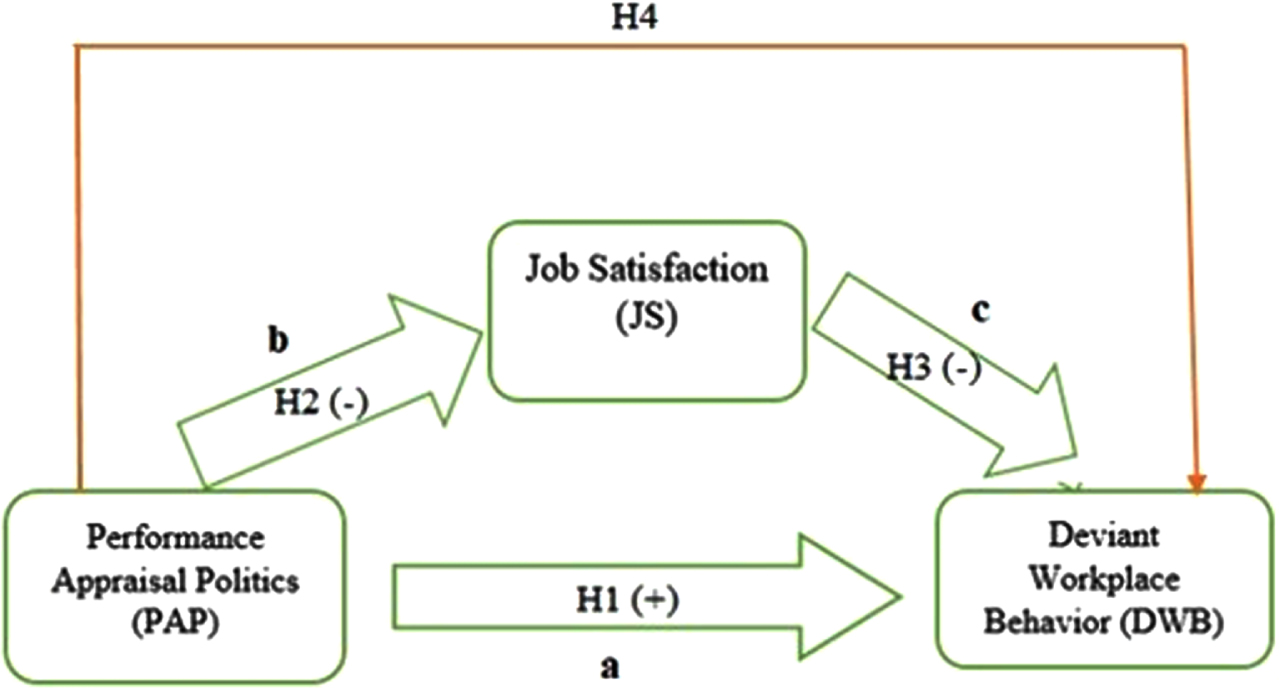
Research Model.
Data and sample
The primary data were collected from the employees working in public and private Banks of Quetta- Capital City of Balochistan, Pakistan, through adopted questionnaires. The Administrative and HR heads of the banks were contacted and requested to allow for data collection. After taking the approval, the data was collected from the banks. HR departments of the banks were then requested to provide the lists of the employees, but they just provided the total strengths of the employees because of confidentiality issues. Due to this limitation and constraint, the complete sample frame of the employees could not be developed. Hence, the sampling technique used in the study was the non-probability convenience sampling technique.
Out of the taken banks, the total employees in public sector banks were 424 and in private Banks were 598. Thus, the total population was calculated as 424 + 598 = 1022. Krejcie & Morgan [46] table was used to determine the sample size. According to the Krejcie & Morgan [46] table, an appropriate sample size for the population of 1022 is equal to ∼ 285. The total number of respondents was 309. The demographic profile of the respondent (Table 1) shows that out of the total respondents of 309, the gender-wise frequency analysis reported that 74.1% of the sample comprises males and 25.9% were females. According to the frequency results, 164 respondents (53%) belonged to the age group 21–30 Years, whereas 107 respondents (34.6%) belonged to the age group 31–40 years. In the age bracket of 41 Years and above the number of respondents was 26 which is 8.4%, and 12 respondents belonged to the age group 20 years and less, which is 3.9% of the total sample. Regarding the job experiences of the respondents 46.3% which is 143 respondents of the total sample size had an experience of 1 to 5 years, 97 respondents had a total experience of 6 to 10 years i.e. 31.4%. However, in other experience categories, 50 respondents had 11 to 15 years of experience i.e. 16.2% and 19 persons had an experience of 16 years and above i.e. 6.1%. According to the report, out of the total 309 respondents, 138 belonged to public sector Banks i.e. 44.7% and 171 belonged to private sector Banks i.e. 55.3%. Hence, the majority of the respondents belonged to the Private Banking sector. This survey had also collected data regarding the nature of the jobs of the employees. The majority of the respondents were white-collar (Administrative/officers/technical) 91.9% of the total sample size and Blue collar (Technical) was 8.1% of the total sample size.
Demographic Characteristics of Respondents
Demographic Characteristics of Respondents
Questionnaire of Political Considerations in Performance Appraisal (QPCPA) by Tziner & Latham [47] was the main source of the items selected to measure our predictor variable (PAP). A fourteen items scale was used to measure PAP with five-point Likert scale ranging from strongly agree to strongly disagree. These fourteen items were adopted by Moayeri [48] in their study (Table 2). The responses on DWB were collected based on the DWB categorization of Bennett & Robinson [34]. There are a total number of 28 items in the original scale, however shorter scales of DWB are generally used. For example, to measure DWB, Qu & Jo [49] adopted 05 main items out of the total items of Bennett & Robinson [34] using Likert scale (1 Not Much to 5 very much). We used the same scale (Table 3). To assess Job Satisfaction (JS) the scale of Brayfield & Rothe [50] was adopted which is also used by Moayeri [48]. The scale consists of 05 items using a Likert scale (Table 4).
Performance Appraisal Politics Scale (PAP)
Performance Appraisal Politics Scale (PAP)
Deviant Work Behavior (DWB)
Assessment of Job Satisfaction (JS)
To test the internal validity of the scales, CFA (confirmatory factor analysis) was run. The CFA was conducted using IBM AMOS 24. The CFA was run and was tested both individually and collectively. As the scales were adopted from different sources, it was essential to test the internal consistency and validity of the items. The results of CFA are summarised and are given in Table 5. The acceptable criteria to analyze the CFA results in light of the available references are as follows. The CFA test for each scale was tested and found satisfactory. Relative/Normal Chi-Square (χ2 / Df) ≤3 was acceptable as per Barrett [51]. The (χ2 / Df) also acceptable within the range of 2.0 to 5.0 in line with Tabachnick & Fidell [52]. Comparative fit index (CFI) ≥0.95, whereas ≥0.90 is also acceptable [53]. Tucker Levis Index, TLI≥0.90 is also considered acceptable [54]. Standardized root square mean residual (SRMR) ≤0.08 and it is also acceptable at the level of≤0.05 [55]. Root mean square error of approximation (RMSEA) < 0.05, is also acceptable at the level of < 0.07 [56]. The P of the “close fit” (PCLOSE) > 0.05 is acceptable as per Tabachnick & Fidell [52].
Confirmatory Factor Analysis
Confirmatory Factor Analysis
According to the results, the values of tests show an acceptable model fit. After testing the construct validity of the items individually, it was also essential to test the same in the context of the whole model (3-Factor Model). The whole model fitness was tested because the possibility of the errors cannot be neglected. For this, the CFA test was run on a single model as a whole where all the items were tested on a single factor model, as shown in Table 6.
CFA (3-Factor Model) –Model Run
According to the thresholds levels of different CFA tests, the CFA (3-factor Model) results in all the indices meeting the required criteria and hence indicates that the model has an acceptable fit. After the test of construct validity, the discriminant and convergent validities were also tested to have an outstanding level of construct validity. Convergent validity was tested through the results of CR, AVE and MSV [57, 58]. According to Hair & Sarstedt [57] once the reliability of the constructs is tested the second step should be to examine the validity (both convergent and discriminant). The convergent validity must have the outer loadings (CR) above 0.70 and Average Variance Extracted (AVE) 0.50 or higher and must be less than (CR). As per our test shown in Table 7. CR and AVE both are meeting the criteria as CR≥0.70 and AVE≥0.50 and MSV (Maximum Shared Variance) should be less than AVE (MSV < AVE). According to Nunan & Malhotra [59], the AVE is a more traditional measure than CR, while both account for convergent validity.
Convergent Validity
Average Squared Shared Variance (ASV) scores of each scale were calculated to determine the Discriminant Validity of the scales. The ASV scores were calculated manually by using the formula given by [57], the formula is shown below:-
ASV =Σ r2 / n [(Σ r2 = sum of squared correlations of variables to other constructs, n = total No. of constructs)
Fornell & Larcker [60] said that, the ASV score of a scale should be less than its AVE scores (ASV < AVE). In order to Larcker calculate the ASV test, the correlation analysis was performed and is shown in Table 8. The results of the ASV is shown in the Table 4; whereas, the example calculation of the ASV is shown below:-
Discriminant Validity (ASV)
As per the threshold criteria: AVE≥0.50. [58], whereas, AVE > ASV [60]. The results shown above, have established the convergent validity and discriminant validity of all the constructs. The composite reliability (CR) coefficient for all the scales was also acceptable i.e. α≥0.70 [57] (shown in Table 3 above).
Following Hauke & Kossowski [61], the correlation analysis was performed to evaluate the extent and nature of the relationship or association between the variables (shown in Table 9). All the values of correlations turned out to be significant and predicted the direction in which the relationships were hypothesized. The correlation analysis above shows that PAP and DWB are positively related and a coefficient of 0.125 also suggests a significant and positive relationship between the two variables. This means that as the PAP increases at a workplace, the DWB also tends to increase. Additionally, the PAP has a correlation coefficient of –0.224 against Job Satisfaction (JS) depicting a negative relationship between the two variables, which means that the more there is PAP the weaker the JS. Lastly, it can be noted that DWB and JS are negatively correlated as implied by a coefficient of –0.144 meaning that there is a lower chance that a satisfied employee will trigger DWB.
Correlation Analysis
Correlation Analysis
*Correlation is Significant at 0.05 level (2-tailed). **Correlation is significant at 0.01 level (2-tailed). Cronbach alpha reliability values are reported in parentheses.
Following Cohen & West [62], the regression analysis tests if there is a significant impact of the IV on the DVs. The regression analysis can test the mediating as well as the moderating impact of variables. As the research was aimed at examining the impact of PAP on DWB with mediating role of JS, the bootstrapping method proposed by Hayes [63] was utilized. The results of regression analysis using the process macros are illustrated in Table 10. In this study, the analysis of Model 4 (simple mediation) was used by 10,000 bootstrap samples with 95% confidence intervals. The resulting Table 6 shows the mediation analysis including the direct, indirect and total effects.
Mediation Analysis
Mediation Analysis
The total effect is the effect of IV to DV without considering the mediator. In this case, the total effect explains the relationship between PAP and DWB and is denoted by (path c) in Fig. 2. The total effect turned out to be 0.27 (27%) with no zero value in between LLCI (0.07) and ULCI (0.47). The Direct effect shows the effect of IV and Mediator collectively on DV. In this case, the direct effect shows the impact of PAP and JS collectively on DWB. The direct effect is path (c’) in the figure. The direct effect turned out to be 0.38 (38%) with no zero value lying in between them, LLCI (0.18) and ULCI (0.59). The indirect effect (ab) is the effect of IV on DV in the presence of the mediator. According to this assumption, the mediator is supposed to nullify the effect of IV and DV. According to Kane & Ashbaugh [64], when the indirect effect is significant then the mediation is established, when this happens the direct effect may disappear. In this case, the indirect effect is the impact of PAP on DWB in the presence of JS as a mediator. The indirect effect turned out to be –0.11 (11%) with no zero value lying in between LLCI and ULCI (–0.20 and –0.03). According to Hayes [65], the presence of non-zero values in upper (ULCI) and lower (LLCI) boot limits shows a significant relationship. According to the results, it can be concluded that the PAP and DWB are positively related to each other, whereas the JS mediated the said relationship. Consequently, all the study hypotheses have been supported by the results.
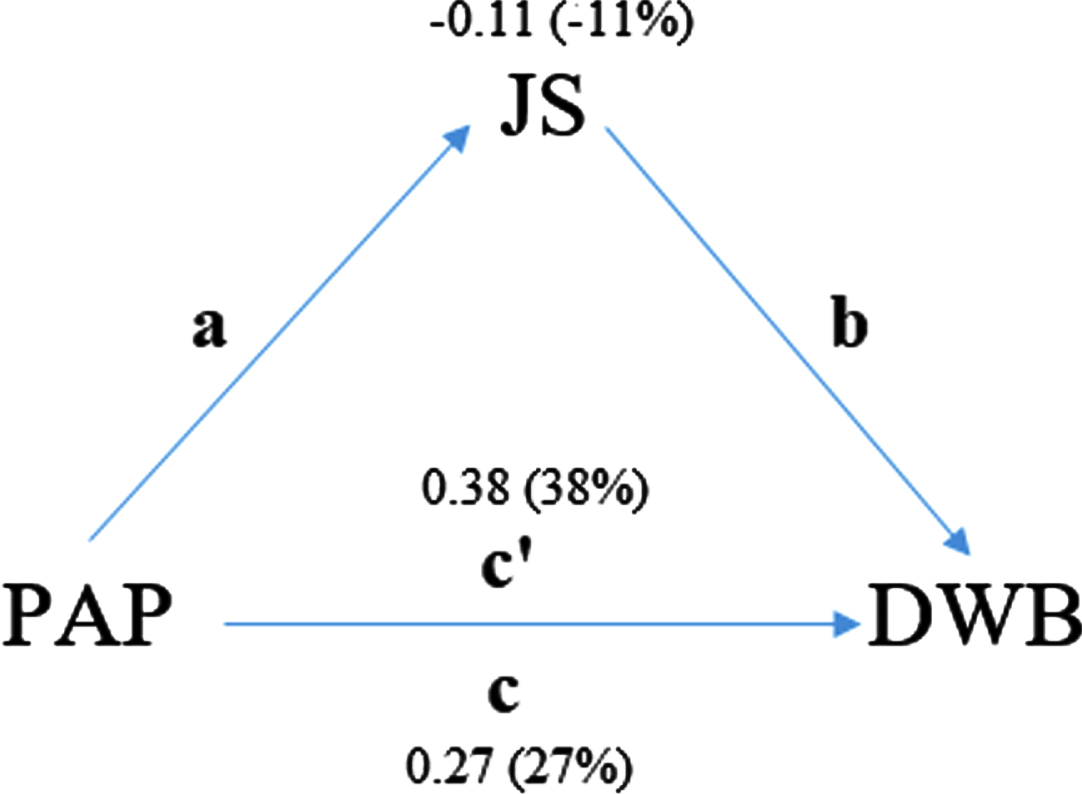
Mediation Analysis.
The objective of this research study was to examine the effect of Performance Appraisal Politics on Deviant Work Behavior with the mediating role of Job Satisfaction. The regression analysis suggests a negative relationship of PAP with JS and a positive relationship of PAP with DWB, while the relationship between JS and DWB is also found to be negative and significant. The results also confirm the mediating role of JS in the relationship between PAP and DWB.
In the first hypothesis (H1) it was postulated that the PAP has a positive impact on DWB. The results show that it has been confirmed since the relationship between PAP and DWB has been found significant and positive. According to Vigoda-Gadot [32] when the employee perceives unfair, political and unsanctioned means in an organization, the change in their behavior and attitude is evident. Employees in an organization plan to change their behavior and job attitudes when they feel they are not being treated fairly and this results in behavioral consequences. The study results support the hypothesis holding a positive relationship between PAP and DWB. This implies that the study results are supportive of the notion that PAP has the potential to alter and change employee behaviors [22, 28]. This also supports that view of the justice theory that suggests the occurrence of negative behavioral outcomes in a work environment where justice (distributive, procedural and interactional) and fairness are lacking [66, 67].
The study results also supported the second hypothesis (H2), which anticipated a negative relationship between PAP and JS. The result of this hypothesis is consistent with the literature focusing on the negative effects of PAP generally and the relationship between PAP and JS specifically. For example, Poon [8], also reported a negative relationship between PAP and JS. According to Arshad & Masood [37], the more the performance appraisal is unfair the more the employees perceive it to be negative. This implies that PAP has the potential to affect employees’ job attitudes, which the study results confirmed. Performance appraisal politics gives an impression to the employees that there is a lack of justice in the process, hence they start perceiving unfairness. Literature also highlights that a lack of fairness has a negative impact on employee attitudes like job satisfaction and psychological ownership [68–70]. Thus, in line with justice theory, job satisfaction (an attitudinal variable) has been identified as an outcome of PAP which represents a scenario with distorted perceptions of employees regarding justice and fairness.
In the third hypothesis of the study, it was conjectured that JS is negatively related to DWB. After regression analysis, it was found that the results are in line with what we hypothesized. This implies that satisfied employees are less likely to involve in deviant work behaviors. This confirms the findings of other studies testing the employee attitude-behavior relationship [71–73]. The findings of the study of Chirasha & Mahapa [44] have shown that the DWBs get affected by various factors which cause employees to indulge in such behaviors. The study identified one such factor in the form of job satisfaction. Moreover, there exists vast literature that discusses the role of individual attitudes in causing certain behaviors. Our findings are broadly consistent with the stream of research that advocates and confirms the attitude-behavior relationship. Hence, a favorable attitude towards an object or person is likely to bring positive behaviors and vice versa [74, 75]. Here, the decreasing levels of job satisfaction (attitude) are found to be linked with deviant work behaviors.
The fourth hypothesis was postulated to test the mediating role of JS in the relationship between PAP and DWB. The findings confirmed the role of JS in the said relationship. There is little known as to how the politics in the performance appraisal process affects employee behaviors [22, 28]. The study results identify the mediating mechanism that explains the relationship between PAP and DWBs. After establishing a significant relationship between the study variables i.e. PAP, JS and DWB, it is needed to find out whether JS emerges as a significant mediator in the model. The mediation result is also significant which shows that job satisfaction has emerged as a significant factor in explaining the said relationship. We can infer that PAP negatively affects employee attitudes (in the form of reduced job satisfaction) which in turn brings workplace deviance. This is in congruence with the view that a negative work environment forms unfavorable employee attitudes which leads to negative work behaviors [74, 75]. Therefore, the study findings are holistic in a way that it not only describes the interrelationships between the variables of interest but also explain the mechanism by which the predictor and outcome variables are linked.
Theoretical and practical implications
The study model was supported by the justice theory, which holds that the perceptions of justice and fairness are critical in determining employee outcomes in the form of attitudes and behaviors [76, 77]. As per the justice theory, performance appraisal politics represents a scenario, where the ratees’ perceptions are likely to be distorted when they feel a lack of fairness in the system [78, 79]. The results obtained support and extend the view of the justice theory by demonstrating the negative impact of PAP on work behaviors. In this way, deviant work behavior exhibits a behavioral outcome of PAP. Moreover, the mediation results not only explain the link between the independent and dependent variables but also confirms another attitudinal outcome of PAP in the form of JS. This implies that under the current study settings, the findings confirm the theoretical foundations on which the study model was laid. Consequently, the study findings extend the body of knowledge regarding justice theory by establishing the interrelationships between the study variables and the associated mediating mechanism.
The outcomes of this research study also have some practical implications. Results have shown that the employees being affected by PAP are more likely to face a reduction in JS and subsequently involve in deviant work behaviors. The banking organizations (public and private) need to adopt such practices through which politics in the performance appraisal process could be restricted and their harmful effects could be mitigated. The study findings are essential for the management of the banks for the betterment and understanding of the work environment. They can control the politics within the organization and by adopting different methods. For example, supervisors’ coaching leadership styles reduce the perception of politics among the employees and such leaders are considered as less manipulative [80]. Therefore, the management needs to design training programs to develop the coaching leadership style across the organization. Additionally, it is worthwhile to arrange executive coaching sessions to train supervisors to undertake the role of a coach toward their subordinates. The next step that can be taken by policymakers pertains to the engagement of employees in the process of PAS. The middle and lower management teams can include the workers in the procedure of taking decisions to increase the understanding between the peers and reduce the perception of politics. Moreover, the top management of the banks can reduce the politics by regulating and ensuring a merit-based performance appraisal process in the organization.
Limitations and future directions
The study has certain limitations. Firstly, in this study, PAP was taken as a predictor of JS and DWB in the form of mediator and outcome variables. This represents the omission of other employee attitudes and behavior that may form/arise when the employees perceive PAP. Other attitudinal and behavioral changes can also be considered in future studies. For example, the outcome variables of work motivation, organizational citizenship behavior, and workplace ostracism can be tested with other variables as mediators like fairness perception, trust in raters, etc. Similarly, the mediation model that was tested in this research was the “simple mediation model”. Future research can test the mediation by taking into account a “parallel mediation model”. The study can also be considered by taking different dispositional and contextual variables as moderators like conscientiousness, self-monitoring and leadership style, etc. Next, the study employed a nonprobability sampling technique, which may have limit the study’s generalizability. Finally, the study is not a comparative study of public and private commercial banks. Future studies can be carried out by comparing the results in the context of public and private banks.
Footnotes
Acknowledgments
The authors have no acknowledgments
Author contributions
CONCEPTION: Arsalan Haider Nagi
METHODOLOGY: Arsalan Haider Nagi and Zeeshan Khalid
DATA COLLECTION: Arsalan Haider Nagi, Zeeshan Khalid and Asia Bibi
ANALYSIS OR INTERPRETATION OF DATA: Arsalan Haider Nagi and Asia Bibi
PREPARATION OF THE MANUSCRIPT: Muhammad Asad
REVISION FOR IMPORTANT INTELLECTUAL CONTENT: Muhammad Asad
SUPERVISION: Muhammad Asad and Zeeshan Khalid