




Abstract
BACKGROUND:
Systemic Constellations Work (SCW) is a non-conventional method of dealing with organizational development and change that has been gaining popularity since the 1990s.
OBJECTIVE:
The goal of this study was to understand how kinesthetic and spatial sensations gained through SCW translate into knowledge with a particular focus on the longer-term organizational effects.
METHODS:
We performed semi-structured interviews and used triangulation of sources (constellator and clients) and methods (inductive, deductive coding and ethnographic approach).
RESULTS:
The study identified a phase model of SCW process revolving around organizational trauma enmeshed in the context of personal, organizational and social systemic fields.
CONCLUSIONS:
The results imply that SCW is a valid method of trauma healing and prevention.
Keywords

Introduction
Systemic Constellation Work (SCW) is a novel, creative and useful method of exploring group dynamics [1, 2] that has been gaining popularity in professional organizations since the 1990s. It was devised by a German psychotherapist Bert Hellinger from many established practices, such as family, group and contextual therapies, transactional analysis, systems approach, psychomotor training, psychodrama and Gestalt psychology, and, although it keeps some common aspects with the mentioned disciplines, it is in itself a self-standing method [3, p. 27; 4, p. 33; 5, p. 17]. In the past decades, it became part of organizational learning, development and change as a method of examination, decision-making and transformation [6, 7].
As such, SCW brings numerous benefits and is used in various contexts and layers by including managers, workers, customers, suppliers, etc. to improve organizational performance [8, p. 206]. The application of SCW allows new concepts, perceptions, techniques, actions, behavior and leadership to emerge [3, p. 1]. It helps to discover tacit knowledge, hidden relationships, opaque structures, unknown influences, obfuscated communication dynamics and unrecognized systemic elements thus supporting decision-making processes in various complex systems [9]. SCW can focus a seemingly unstructured mass of data, elements or ideas by revealing logical hidden frameworks. It can help to transform data into information and information into knowledge [10, 11]. As similar insights, strategic choices, opportunities and outcomes are not obtainable through surveying, interviewing or document studying, SCW can complement other more conventional methods. However, because it cannot replace them, it can become a practical bridge between conscious and unconscious knowledge [3]. The applicability of the method extends across the borders of any particular professional background, orientation and context thus helping organizations to move beyond the fixed mindsets and reluctance to change [12, p. 2].
Current research gap
In order to corroborate the usefulness of this promising method in the context of organizational learning, development and change, additional research must be done. Although SCW is recognized as a useful method to understand, picture and internalize the settings of an examined system in its totality as well as possible solutions [13, p. 13; 5, p. 32] there are still lingering dilemmas regarding the applicability of the method, suitability of approaches and credibility of constellators [14–16, pp. 224–243]. This is related to the fact that, since SCW relies on patterns of communication that are not sufficiently understood, “objective” assessment of SCW processes currently does not exist and knowledge of this method still remains phenomenological and experiential. This is also related to the lingering challenge in organizational learning of explaining how unconscious or tacit knowledge can be transferred to conscious or explicit knowledge [17].
Research goal
All things considered, it would be useful to understand how the SCW-specific processes (intuitive, kinesthetic, spatial, sensational, etc.) transform into knowledge and, consequently, organizational benefits, because the long-term outcomes have also not been properly researched [18] and can be seen from multiple angles in their specific contexts [19].
The goal of this research is to shed more light into (i) how the non-cognitive, e.g. kinesthetic and spatial sensations, gained through the practice translate into knowledge with a particular focus on (ii) the effects of organizational constellations in the specific contexts of the participants and their organizations.
In the first part of the paper, we cover the theoretical background of SCW which includes its explanation and reasons why organizations or individuals reach out for its mediation, and we also briefly review the scientific research conducted to date. The second part is aimed at explaining our research method that combines semi-structured interviews, Grounded Theory, deductive coding and ethnographic approach. The third part of the paper covers the results and discussion, while the fourth brings the conclusion including the research limitations and recommendations for further research.
Theoretical background
What is organizational constellation
Organizational (systemic) constellation or simply constellation is an entirely phenomenological activity [5, p. 38] during which insights are made from apparent clues, feelings, sensations, impulses, movements, dynamics, words and formations represented by persons or paraphernalia reproducing a specific group context [3, p. 27]. Constellations are in effect workshops that provide structural or spatial visualization of the examined organizational system by placing all its important elements (various stakeholders, i.e. managers, clients, employees, partners and/or abstract concepts, i.e. purpose, product, finances, goals, etc.) to be represented by people or objects, which are laid out in space according to an intuitive model of how they relate to each other. After the initial set up has been readied, constellation develops by bringing conscious or concealed insights painting a vivid picture of the organizational structure, relations and dynamics [20, p. 8]. As such, constellation is a useful method to visualize and clarify the settings of a system in its entirety [5, p. 32].
Constellations are based on the phenomenon of the so-called systemic field. When people work, play, live or learn together, a system is created, composed of connected elements in a specific dynamic [21]. This systemic structure in human organizations which regulates and balances individual and collective behavioural patterns is, in the SCW jargon, called systemic field or the knowing field [12, p. 138].
Organizational constellations can be set up with organizational members, but also with people who have no previous connection or knowledge of the organization in question. Different constellation techniques should, at least in theory, have similar outcomes. In a typical constellation, the client briefly describes the problem they would like to fix to the constellator (practitioner) who at that point lets the client choose representatives from the present attendees who will represent the core elements of the observed system which normally includes the client. Alternatively, the constellator can also select representatives who are, in either case, intuitively set in a specific layout which is the starting point from which the constellation develops. At some point in the session, the client is also brought in to directly and kinesthetically experience the systemic situation. Alternatively, the client in some set-ups can participate from the beginning. At the end of the constellation, there is no processing conducted by the constellator [18, 22].
During constellation, constellator forms impressions (“reads the field”) and collects information directly (by asking) or indirectly (by feeling or observing) from representatives who, in practically 100% of cases, successfully represent people or abstract concepts from the organizational system in question. It was phenomenologically observed that representation in systemic constellations is a universal human phenomenon, which means that every person with the right attitude can partake in the sessions [3, p. 26; 23].
Constellators, representatives and clients thus experience phenomena of representative perception by somehow resonating with the implicit or hidden knowledge present in the system [24] and becoming aware of various information by “decoding” layouts, impressions, clues, patterns and relations whereby unknown links, opaque influences, hidden patterns, unrecognized relationships, concealed interactions, under-surface dynamics, unspoken conventions or implicit/hidden knowledge rise to surface [20, p. 8]. The observed phenomena often include kinesthetic sensations (headache, stomach ache, lightness, heaviness, embarrassment, tension in the shoulders, sympathy, goose bumps, etc.) which are interpreted by representatives as information, insights, understanding, awareness or implicit/hidden knowledge [20, p. 29]. Participants thus take systemic constellation as an unusual yet realistic representation of actual organizational system and its structure [25], in which the client can, through a combination of the embodied representative phenomena, observations, feedback from the representatives and constellator, come up with fresh insights for enduring resolution [5, pp. 38-41].
A constellation lasts until a solution or picture emerges favorable to the client [3]. When such solution is found, “instant release” can be felt by all participants in the constellation as a kinesthetic representative phenomenon of resolution [5, p. 49], and thus a new picture and/or course for action is embodied –kinesthetically internalized by the client lasting as a memorable change-catalyst [12]. In this way, improved efficacy and effectiveness of individuals, work environments and organizations can be attainted [27].
Although it is not known how representative phenomena function, literature confirms that such representation is not subjective, incidental or orchestrated, but navigated by the hidden systemic forces, i.e. the characters, layout and dynamics of the represented system [3, p. 32]. Thus, SCW cultivates a reliable phenomenological mindset where mental baggage is dropped, and kinesthetic and topological sensations are used by connecting naturally to the systemic field to observe “what is” without interference of one’s mind [5, p. 117; 18].
This method can be hard to understand and accept by individuals who have never had such a direct phenomenological experience. However, it is often said that, once constellation is experienced, it becomes self-evident and familiar. Nietzsche’s quote seems fitting here: “And those who were seen dancing were thought to be insane by those who could not hear the music.” In other words, those who have never experienced a constellation may view constellations as quite bizarre ritualistic behavior, but those who have, take it as a realistic and impressive representation of the system in question [19].
Motivational factors promoting the use of SCW
To-date research of motivational factors for the use of organizational constellations indicates that organizational members resort to SCW when they feel that traditional approaches to organizational problems do not work, when they sense blockage and/or repeating patterns that do not support flow [12, p. 99], when they need to deal with cultural clashes, irrational behavior and incompatible needs [21], clarity on recruitment processes, choose business options and decide about implementation [22], when there is unloyalty, insecurity and anger towards the management [28], in solving revenue and profit issues [29], dealing with intra-team conflicts [30], when there is arrested innovation and loss of customers [31], need to overcome organizational defensiveness, establish/improve relationships and uncover hidden truths/facts [7], when they want to identify and pre-test potential solutions for “unexplainable” problems and crises [32], when they need help with strategic planning, exploring market potential or strategic alternatives, product and service evaluations, project assessments, mergers and acquisitions, structuring negotiation outcomes, evaluations and leadership/organizational development and challenges, and, on the individual level, deciding on issues of promotion or moving to another company or division, when they need to clarify larger career objectives or conflicts with one’s supervisor or direct reports, find life-work balance, improve health and general life satisfaction, etc. [33].
A notable strength of SCW is that it can be used as a testing ground to experiment with various decisions that can be examined in a safe-environment and result in outcomes useful for decision-making [5, p. 69; 22].
SCW as a subject of scientific research to date
In spite of the mentioned epistemological dilemmas, SCW has been accepted as a useful and practical method for the exploration of organizational group dynamics [1, 2]. As such, the method caught attention of numerous scientific researchers who studied it in the paradigm of management as an aid to business consulting [23, 35], theory-based program evaluations [2] and scientific method of managing organizational complexity [36]. Other researchers approached it from the point of view of learning and delved into the topics of individual and team coaching [37], learning organizational sustainability [38, 39], learning in rapidly changing and crisis situations [40], university teaching and learning [41] and learning corporate social responsibility [42]. SCW was also explored from the “more practical” business angles for identifying branding opportunities [15], human-machine interfaces as regards to decision-making in production processes [9] and helping spatial planning processes [14]. Notable research contributions were also made in intra-team conflict resolution [30], healing organizational trauma [20], cultural exploration [43], etc.
Outside of the business realm, SCW was also researched as a method of dealing with violence-induced trauma taking place in large group dynamics in political conflict resolution [44, 45], helping prison populations [26], children’s trauma symptomization [46], overcoming violence-induced trauma [47], healing multi-generational trauma [48], etc., etc.
The above research load is signaling that SCW can be a fresh and welcome tool in improving organizational life and development. This is because, in the rapidly changing world, organizations must show tremendous agility in accepting the new and letting of the old [49]. More than ever, organizations must be able to perform fast experimentation and prototyping, deal with crises and complexities, overcome conflict and traumatic situations, and thus learn how to become sustainable. On this account, SCW seems like a tool that can help combine analytics with experiential knowledge, thus fostering informed human intuition to achieve success, which was unacceptable and unexplainable until recently, but now is looked at not only as a fresh and innovative, but also indispensable method in organizational problem-solving [50, p. 3].
Method
Due to the phenomenological, heuristic and contextual nature of SCW, which does not allow explanatory or predictive approach, qualitative research, such as semi-structured interviews, was deemed the most appropriate method [51–53], which involves asking non-specific and descriptive questions designed to explore experiences [54–56] and surpasses the researcher’s knowledge, penetrates deeper into the matter and allows new ideas to emerge [57]. Although this approach contains an unavoidable degree of subjectivity, this weakness seems relatively minor, because SCW involves individual perspectives immersed in specific social contexts and therefore a degree of unpredictability, which is an integral part of the SCW experience and therefore of any honest effort to make sense of this phenomenon [57]. In this regard, qualitative tools are appropriate whenever such social realities must be explored and understood [58, p. 45; 59, p. 110; 60].
Simultaneously with this research, the first author attended an educational course for systemic constellators comprising of twelve weekend modules. In this process, he gained access to a ramified network of practitioners and clients in Slovenia, Serbia and Croatia, etc., and experienced SCW from a multitude of angles, i.e. from a multiple point of view of observer, representative, client, constellator, student and researcher. Additionally, he became member of a vibrant SCW metacommunity that communicates, works and moves between the groups [61]. The decision to attend the course was made solely for this research, namely to assess the method from a 360° perspective, because he had no substantial prior knowledge of SCW.
Therefore, this study went beyond “objectivity” and “neutrality” by researching SCW in its natural environment and partaking in its activities and communities. Thus, it has strong ethnographic and community-ecological validity, because researchers accepted in the studied group can obtain better information through their status position and can perform stronger analysis that includes the process of self-reflection [62].
Since the respondent’s answers during interviews could not be predicted, the researcher strived to stayed detached yet focused in order to anticipate unexpected observations that he additionally explored with follow up questions or requests for elucidations [63, 64]. This approach was aimed at developing trust and affinity with the interviewees, so that they would be willing to share their authentic “lived” SCW experiences [65, p. 64]. The fact that both sides belonged to the community certainly helped in this process.
This study had an additional ambition of making sense of relatively ambiguous phenomenon of SCW. Therefore, it was necessary to increase its validity, which was addressed through data sources triangulation (one constellator and three clients) and method triangulation combining inductive and deductive coding with ethnographic approach.
The semi-structured interview questions were founded on research objectives and literature review. However, flexibility was necessary in the preparatory phase of this research, because of the ambiguity of the SCW phenomena and limited previous research in this field. It was decided to conduct a test interview with a constellator in the summer of 2019, because constellators are trained in the specific SCW awareness whereby their bodies “act as an antenna”, they observe systemic energy and share kinesthetic/intuitive reactions with participants [5, p. 83], as they use their body/mind differently, more kinesthetically and less mentally [5, p. 120]. This was done in order to check data quality and relevance, and evaluate the research tool [66]. The pilot study confirmed the quality of interview questions that were subsequently used in clients’ interviews with only minor adjustments in order to make comparison of data less complicated, which helped the subsequent analysis [67].
Interviewee sample
Sampling was targeted to persons with confirmed experience in SCW, which was ensured by the first author who became member of the SCW community. He got to know the interviewees in Zagreb, Croatia and Belgrade, Serbia where they jointly attended seminars. As literature review never indicated that age, gender or profession played any role in SCW [3, p. 31; 5, p. 161], no special considerations were made to that end. The rather uncomplicated sample homogeneity problem allowed for a relatively narrower sample size. For example, according to Boyd [68], a well-chosen sample between 2–10 participants leads to saturation. Since the point in this research was quality, not quantity, there was no reason to focus on large numbers, but rather on the quality of the sampled participants and research purpose [65, p. 48]. Therefore, this study greatly benefited from a small number of homogenous participants [65, p. 51] and focus on their specific contexts and experiences, and the contrast of similarities and differences during data analysis [65, p. 3]. This approach was also in line with Guest et al. [68] who also established that, the more homogenous the group, the less interviews will be needed.
The relative homogeneous sample (all female, educated, employed, extensive experience and education in SCW, no linguistical differences, all from the same geographical region, etc.) allowed the researchers to obtain ‘rich’ and ‘thick descriptions’ and good understanding of the “lived experiences” of the participants [63] who all have had similar experience of SCW [70, p. 155]. Two out of four interviewees, although interviewed from the point of view of the client, were formally educated to become SCW practitioners (but are not formally practicing, just currently use it as a help in their work), one is active constellator, while the fourth has an extensive experience as client, active community member, avid reader of SCW publications and frequent attendee of SCW events.
Instrument
Questions for our semi-structured interviews (Table 1 2) were formulated based on existing literature on SCW practice in work organizations [3, 71] and in line of the standard qualitative methodology in social sciences [72].
Structured interview question guide for the constellator
Structured interview question guide for the constellator
Structured interview question guide for clients
Prior to interviews, the interviewees were informed of the purpose, how the research data is going to be handled, anonymized, presented and publicized, and were asked for a written consent, while making sure that their narratives are kept unidentifiable to the public [73]. Thus, interviewees were acquainted with the good ethical motives of the study and ensured that there were no concerns related to their obligations or access to its findings thereafter [74]. Only after the written consent (including participation, recording, processing, use and access to research data) was obtained, the interviews were scheduled to be conducted by Skype. The interviews lasted approximately 50±5 minutes.
Skype is nowadays accepted valid tool in qualitative research, which particularly made sense during the concurrent COVID-19 pandemic, because it ensures social distancing and reduces complications of travel and affordability. Our experience confirms that the tool is reliable while allowing rapport, sensitivity and high levels of collegiality and familiarity [75–77].
Procedure for conducting data analysis
After the Skype interviews were recorded, the audio files were extracted and transcribed manually with the help of an online service oTranscribe which allows a relatively painless transcription without switching from one application to another. The manual transcription allowed the researcher to be immersed in the data and thus scrutinize details and consider various possible concepts from the literature. This was deemed a crucial research activity and was conducted in entirety by the first author of the article who additionally became a close and careful listener and analyst [78].
The basic methodological approach to data analysis of using both inductive and deductive analysis processes was done based on Elo & Kyngäs [79] in order to build a model which conceptually describes the SCW phenomenon. At the initial stage of the study, the Grounded Theory approach was applied, unbound from any particular theoretical commitment. Content was analyzed with open coding which led to categorization of data [72]. This approach was chosen for two main reasons. Firstly, there was no previous knowledge in sufficient quality/quantity to derive codes from the existing literature. Secondly, the nature of topic which, being highly heuristic and contextual, calls for a method that allows “preconscious connections and insights” to pop up [80] and leaves enough room for serendipitous findings allowing the data categories to emerge during content analysis while allowing fresh contextualization [5, p. 98].
For organizing the data in inductive coding stage, a three-stepped process was used: open coding, creating categories and abstraction. By analyzing the categories, the authors looked at the possible key reasons why clients seek the mediation of SCW, what kinesthetic effects they feel, what insights are gained, what happens at the moment of the when the solution is found what subsequent conclusions were made, what their post-facto performance was, what role in organizational development SCW can play, etc. Since we eventually focused on creating a phase model, these categories were effectively sorted in a time trajectory where some categories precede or follow others. In the final step of inductive coding, these conceptual building blocks were abstracted into a visual of the phased SCW process typical for a client (Fig. 1). Two examples of interview data coding are shown in Table 3 to present two passages from the interviews.
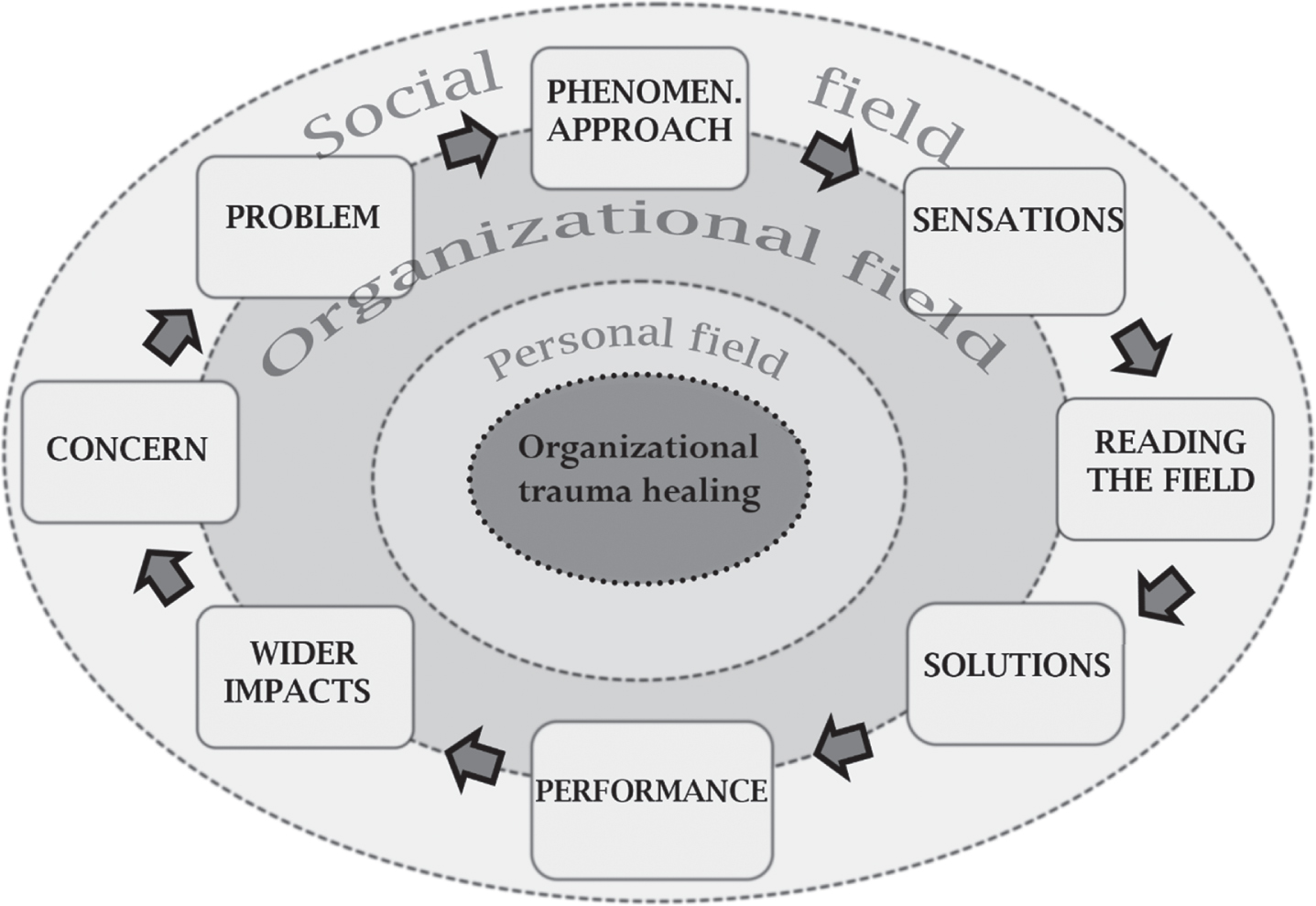
Emergent model of the client’s phase process through SCW fostering trauma healing.
Example of interview passages, coding and abstraction
Since no data can be analyzed without dilemmas and contradictions [81], and these challenges are particularly present in inductive coding. they were dealt with the help of the literature review. At the end of this stage for which we initially thought would be the final one, we gained a more general conceptual perspective of the matter visualized in the phase model (Fig. 1). However, after a careful examination of the subcategories, it became apparent they were consistent with organizational trauma as postulated by deKlerk [82] and Hormann & Vivian [83]. Based on their theoretical framework, we set off to deductive coding in order to formally establish a connection of our model with the theme of organizational trauma (Fig. 1). In this regard, based on the model used by Mewborn [84] and Richie et al. [85], we quantified how many times deductive codes appear congruently with our inductive ones (Table 7). This type of methodological mixing of quantitative tools in qualitative research typically appears in the data interpretation stage [86].
Deductive coding results connecting Main Categories with Organizational Trauma
Our combined approach established additional theoretical evidence to support the categorization and interpretation. It also allowed multiple perspectives and meanings thus strengthening the complex reasoning and reflexivity of the research [58]. Thus, in the later phase of the study, we identified a prevalent theme of organizational trauma tying the SCW process together, which is deemed the fundamental analysis strategy in phenomenology aiming to find meaning or the substance of the experience, in this case, of the SCW clients and their organizations [87].
As with any method that aspires to replicate reality, it is always a good idea to constantly question the SCW approach [88]. Here we must understand that there we may never reach a definite answer on the extent of usefulness of SCW due to the phenomenological and systemic nature of the matter which dictates that it will never be possible to predict what a favorable outcome for a particular client may be, nor it would be possible to evaluate the effects of the constellation based on the client’s behavior. This is because SCW affects the system as a whole rather than just the individual who sets up the constellation [19]. In effect, organizations behave as non-living autopoietic systems “presupposing other levels of reality” and are guided by general organizational principles and are organized as life [89]. This means that organizations constantly change and, therefore, it will never be possible to replicate a constellation, because an organization and its context are never the same. This also means that organizations act differently from its members, do not follow their notions of morality or expectations, and do not behave in accordance to their cultural perspective, such as the economics. Therefore, SCW focuses on “what is” or what is possible rather than on what should be. In this way, we talk about organizational heuristics rather than of laws or certainties [19].
Arnold [3, 39] established the connection of SCW and systems theory that offers a useful paradigm of how the processes of learning and development take place in social systems. Systems theory, being focused on objects and processes in dynamically changing complex situations, is very congruent with SCW. Systemic elements are by definition all interconnected and influence one another. Discerning systemic relationships is key in understanding the functioning of systems, because the systemic phenomena of self-organization, self-referencing and self-dynamic take place in non-linear and non-causal ways. In other words, interaction processes are often cyclical or they backtrack, inhibit or complicate the simple cause-effect relationships. Systemic thinking includes the superposition of multiple contexts and levels of description applied to a situation. Thus, various levels jointly influence the specific context, problems and solutions, which completely reflects in our final model (Fig. 1).
Results and discussion
Inductive coding categorization and presentation of the results
We identified 8 main categories with 22 categories and 69 subcategories in the constellator’s and SCW clients’ experiences and present them in this section. Main categories and categories are presented in Table 4 with the belonging frequencies, while additional subcategories provided the necessary structure and granularity to the subsequent text. For example, in the main category of Problem, we had category General with subcategories Work environment and Productivity. We also had another category Specific with subcategories Financial, Career, Relationships, Productivity and Action. In the main category Approach, we had category Mindset with subcategories Phenomenological, Holistic and Supportive. An additional category was Technique with subcategories Tactic and Focus, etc.).
Main categories and categories with frequencies
Main categories and categories with frequencies
The present variance in frequencies (Table 4) is owed to the context of the described constellations and personal attributes/experiences of actors. Since SCW is by definition highly contextual and phenomenological, each constellation reproduces a particular context and evokes specific dynamics [3, p. 27]. Hence, constellators, for example, will have a different, more impersonal and more patterned view of constellations compared to clients, because of the sheer number constellations they conducted. On the other hand, clients are more focused on their own particular experiences, the quality of which depends on the specific nature and complexity of problems that were addressed with constellations, which are highly specific and hard to compare. Thus, in our analysis we focused more on the overlapping aspects of constellations rather than on nuancing and contrasting differences between participants’ experiences. In the end, we established that the concepts arising from the data appeared consistent across the board regardless of separate contexts (Fig. 1).
Two-mode network in Fig. 2 shows how the participants shared their experiences according to the main categories and reveals a high level of coherence respondent’s answers in in both themes (lines) and frequencies (numbers on a line).
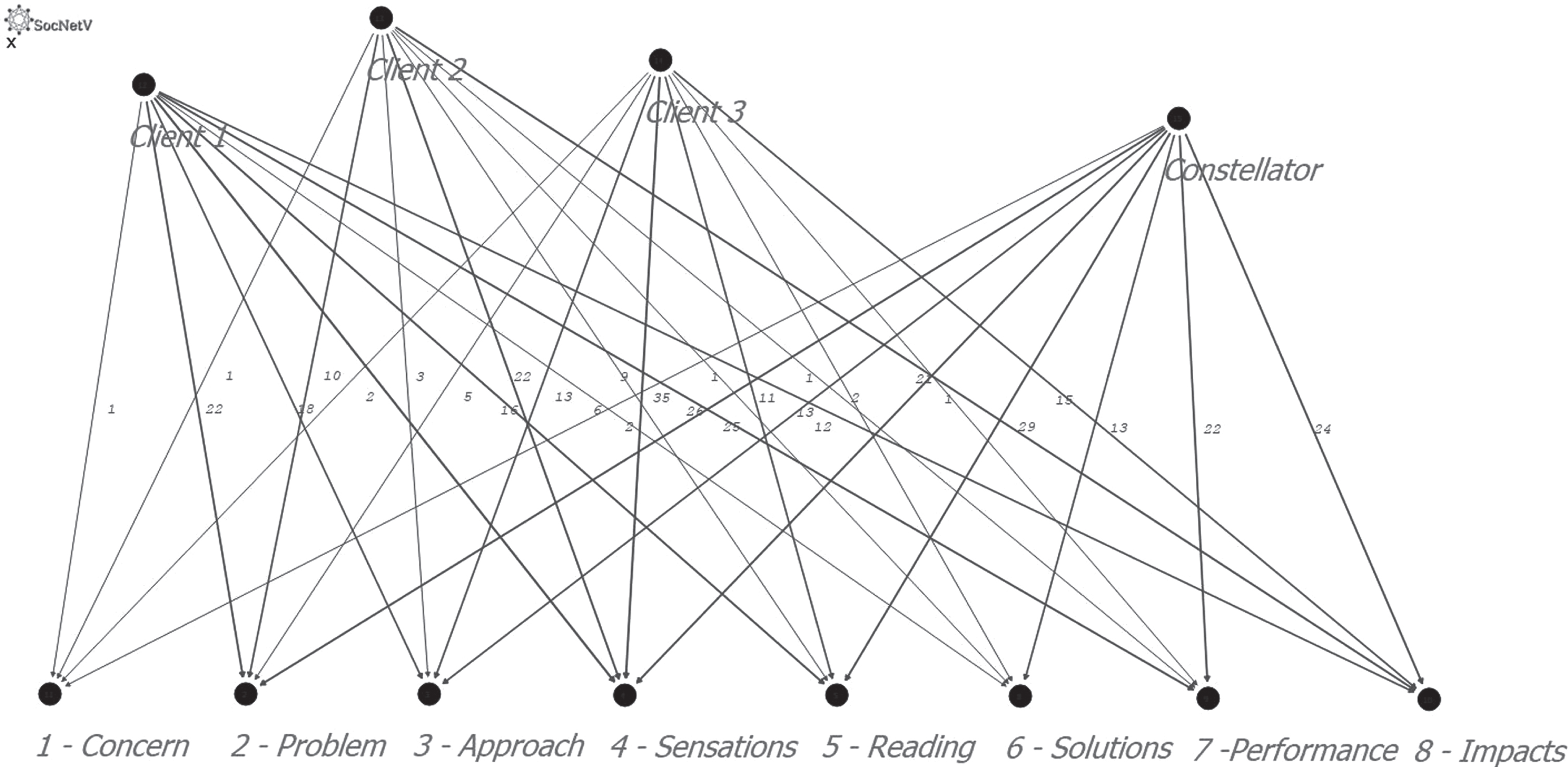
Two-mode network presentation.
Clients are people who want to build better work and life environment, proactive individuals willing to try organizational constellations regardless of what anyone else is doing to fix the contending issues. Client’s decision to set up a systemic organizational constellation is often triggered by worrying, confusing and protracted concern that something is wrong which they do not know how to approach. Such concerns can cause anxiety or even depression. Sometimes, concerns can be relatively simple and related to practical operational problems. In all cases, clients believed that SCW would help.
Problem
Organizational constellations only can be set if the client’s concern has been derived in a “workable” problem expressed as a specific question that constellation can possibly address. These problems or questions are sometimes defined with the help of the constellator. They can be connected to wider organizational issues, such as bad atmosphere and business climate, lack of acceptance, tensions, complaining and blaming culture, various conflicts and blockages, aggression, dysfunctional and collapsing teams, bad organizational performance, diminishing value and productivity, etc.
Problems can also be more specific, such as explicit financial problems, career issues, specific communication or team difficulties. They can relate to poor focus, procrastinations, neglecting clients, obligations and/or project goals, falling business indicators, etc. Respondents also mentioned practical issues, such as dilemmas about signing documents, starting a new project, hiring and firing dilemmas, solving specific business problems, and even answering the specific question of whether to use SCW at work.
Approach
Kinesthetic sensations are the focus of SCW, are constantly felt during constellations and become a way of life for constellators. Information during constellation is “received on the body level” and “intelligence of the whole body is used, because the body acts as one huge brain receiving and processing information”. In this way, clients gain insights because constellations “inform us which way to proceed”, because “brains cannot imagine or process all dynamics that a constellation can reveal.”
Therefore, SCW mindset is not connected to any particular narrative, thinking or rational analysis, but is purely phenomenological. Every constellation is different. Participants should not worry in advance what will happen in a constellation, but assume that they will feel what should be said or done when it starts. Once there, it is important to monitor body movements and whether it feels right to change the physical position in the layout. The focus is kept on emotions and other non-mental elements rather than on rational analysis and discussion. In their work, constellators must consider the whole life context of a client. They are not supposed to give advice, but help clients obtain and expand their own insights, and help them become fully engaged in SCW.
Clients are sometimes advised to keep a written log of the constellation so that it can be reviewed in a timed perspective. Constellator can conceal persons’ names and roles in order to protect the constellation from mental interference of representatives. They can, before setting up an organizational constellation, conduct individual constellations with team members in order to identify the common issues. Constellators sometimes use objects, such peg as dolls and yoga mats to represent the structure, and combine SCW with coaching.
Sensations
Representatives during constellations feel a whole range of kinesthetic sensations. Some reflect anxiety, such as headache, pressure in the chest, chills and pressure on shoulders, lump in throat, blocked mind, nausea, choking, tension, worry, questioning, uneasiness, hardness and difficulty. Sensations also connect to helplessness, such as lameness, heaviness, tiredness, immobility and not wanting to be touched. Various types of sadness were observed, i.e. disappointment, unhappiness, need for comforting, and child-like sadness. Representatives also feel mentally or physically confused, and they can be unsure where to turn or move. They can also have intense sensations of rejection, such as urge to step back, to move away and hesitancy to get closer to someone or something.
Emotionally neutral sensations can also be felt, such as when representatives feel taller and bigger relative to another representative or feel so big that it is impossible to move. They can also feel they are in the right spot, important, surprised and curious, while they can be changing positions to feel out different energies in different places. Positive sensations include love, closeness, nice emotions, calm, ease and urge to join others.
Sensations are intensely felt during the so-called epiphany, which is invariably collectively felt as the peak moment of the systemic constellation when tensions are released, when everything gets light and empty “like dust in the air settling down”. This moment is sensed as instant release bringing relaxation, calmness and relief. It feels a breakthrough bringing change that can be kinesthetically felt.
Reading the field
The interviewed constellator said that reading the field is a special skill which is hard to explain because it requires 10 years of education to be fully grasped. Every constellator has a different and unique approach and they learn from experience how to “read” participants’ movements and sensations. Sensations reflect the systemic phenomena, are inseparable from insights and are means of communication with the systemic field. It is therefore necessary to focus on sensations, because they reflexively connect to insights. For example, body pain sometimes identifies blockage; headache may indicate that someone is “too much in the head”, while various uneasy feelings are normally connected to negative insights.
Constellators sometimes asks participants to verbalize their kinesthetic sensations and impressions, what limbs they want to move and/or whether they want to change position. They also monitor their own kinesthetic sensations to check on the participants, because kinesthetic sensations are commonly shared. Participants are required to differentiate sensations related to the constellation from those that are not. Generally, if a sensation persists, it belongs to the constellation. Therefore, patience is advised, because inauthentic sensations will wither away.
Sensations reflexively activate mental processes leading to insights in the form of simple and true answers. They also regulate behavior during constellation. For example, a client felt attraction and love, which urged them to move closer to the person who represented a particular job and at that point they knew that the business relationship would be fulfilling. Insights are also formed from the positions of the representatives, layout, distances, directions in which they are turned or looking, from body language, non-verbal interaction, moves, spontaneous verbal sharing and other related clues. In all cases, insights are specific to the problem addressed in the constellation.
Reading the field is in essence a combination of reflexively connected sensations and insights, and interpreting them in a rational way. Still, interpretation should not slip into forced rationalizations. Interpretation of sensations and insights depends on the specific context, situation and question. The sensation of epiphany can be triggered by changing the layout, when something is said or realized and, when it happens, it a signal from a “deeper knowing place” that feels true.
Solutions
Various possible solutions can be experimented with in a constellation through different layouts, positions and postures in order to find the arrangement where calmness is felt by the participants as well as epiphany –sensation that something moved or changed in the system.
In some constellations, the solution picture gradually emerges while producing new awareness and inciting new possibilities. New perspectives include different points of view that inform the client how others participate in or see the situation.
Constellations create momentums, situations or energy supporting clients’ readiness to see the solution, because they visualize disposition and interaction of systemic elements and thus point to possible breakthroughs. Systemic structure and systemic order are important in this regard, namely that all members of the system are included and that they have their appropriate place. Thus, constellations make possible the necessary interventions in the systemic structure and relations between systemic elements. In fact, solutions are often found in structural adjustments of systemic elements.
Improved performance
In a particular example, team members who jointly set up a constellation immediately after felt peace and had better relationships. Although they had to discuss sensitive issues, such as budget reallocations, the atmosphere was calm, processes gained flow and team members did not feel isolated anymore. Productivity and communication were improved, while the focus shifted on the project goals and clients.
Clients also reported positive changes in perspective, personal attitudes, self-confidence levels, organizational support, ability to work, acceptance in teams and even support in private life. There was less ego and more inclusion involved. More empathy was felt including improved understanding and respect, and acknowledging the appropriate role and contribution of every person. A particular client received useful guidance whether to use SCW at work. Constellations also helped to choose the right job and achieve subsequent career progress. Clients also reported improved business indicators, focus and adaptability.
Some clients got into uncomfortable situations or conflicts in the periods after constellations. Some stepped out of their comfort zone, some realized that their profession, job or position was not fitting, some even got fired. However, later developments showed that these conflicts were only temporary and served to find better opportunities.
Wider impacts
Respondents shared lots of positive feedback unanimously stating that organizational constellations bring successful, positive, amazing and fascinating experiences. SCW supports awareness of new social, cultural and business paradigms, and allows truth to be revealed and responsibility to be learned. Constellations are very successful in letting go of prejudice and showing the true systemic picture and correct places of systemic elements. They improve systemic balance and hierarchy, and remove systemic obstacles preventing individuals from reaching their true potentials. While SCW is different from other methods, its success depends on openness of participants.
SCW helps when employees have baffling problems with management, with complaining cultures, and when it is not clear whether the employees or leadership cause problems. Organizational constellations can reveal that sometimes good people are not good together, which is hard to make sense of, let alone to explain or accept in organizational life. They help with ambiguous problems, mixed feelings and cultural differences by offering different and wider perspectives. Constellations can be used to discover unknown elements by diving deep into the unknown realm and thus releasing unused potentials. SCW is not connected to clairvoyance, but to seeing fully the present and identifying solutions to reach the set goals. The best results are gained when a combination of SCW, professional experience and traditional business methods is used.
SCW is also helpful when personal problems are transferred to business and when cultural or social issues impede organizational processes. Thus, SCW can be successful in finding balance for individuals, teams and markets.
Applying SCW to organizational trauma is very intriguing, inspirational and not often worked with. In spite of its importance, organizational trauma is frequently ignored. Whenever there is a crisis or abrupt change in management, organizational trauma can occur at which point systemic order is disrupted, everything freezes and productivity diminishes. Organizational conflicts and scapegoating are often fig leaves for these situations. To heal organizational trauma, organizations must learn how to let go of the blame culture. Organizations are like humans and therefore can act like children. In this sense, they must mature, learn to accept responsibility, and act responsibly and gratefully.
Discussion of the results
The initial goal of the study was to use the Grounded Theory method to examine the experiences of SCW clients. In this section, the results of this method are discussed related to the research questions and conjoined with the previously available research in order to further confirm the validity of the SCW method.
How sensations gained through SCW translate into knowledge
Various sensations (kinesthetic, spatial, intuitive, emotional, etc.) are felt constantly during SCW and are inseparable from insights [20, p. 29]. They are a means of communication with systemic field that intuitively and reflexively lead to insights which give simple and true answers to problems [3, p. 32; 25].
Insights are gained from emotions, kinesthetic reactions, positions, layout, distances, body language, non-verbal interactions, moves and other related clues [3, p. 22; 5, pp. 38–41]. Verbal communication is only secondary in SCW and used mainly to express simple messages or clarify the context [3, p. 24]. Such clarifications are necessary sometimes, as constellations can be confusing, contradicting or ambiguous until a solution is reached. In the process of “reading the field”, rational interpretation also plays a certain role, although constellations adhere to the phenomenological mindset and stay away from rationalizations.
Constellators require clients to formulate their problem as a specific question. In some cases, they hide the constellation theme and roles in order to protect privacy and/or ensure that representatives do not mentally influence the set [3, p. 64; 5, p. 47]. They sometimes encourage clients to log the constellation so that it can be analyzed in a timed perspective. They can use various objects, such as peg dolls or yoga mats instead of representatives to visualize the systemic structure [5, p. 83]. In certain cases of team SCW, individual constellations may precede the collective one in order to identify the common issues. Reading the field requires experience and is always unique to the person doing it, but is always intuitive and reflexive, although it includes elements of rational analysis, professional experience and traditional business methods. In this approach, bodies are used as reliable resonators of information and hidden knowledge [6], and, based on kinesthetic inputs, decisions can be made and collectively reverified on the level of shared kinesthetic sensations of the whole group [5, 2008, p. 83].
Kinesthetic sensations may be negative, such as pain, anxiety, helplessness, withdrawal, sadness, disorientation, rejection, etc., which point to negative dynamics. Positive sensations, such as love, closeness, warmth, etc., point to positive dynamics. Neutral sensations also provide valuable information leading to important insights. At the moment when solution is identified, powerful “instant release” is kinesthetically felt by all participants, which gives consensual credibility to the established insights supporting change [5, 2008, p. 49; 12, p. 169]. All sensations are specific to the role that participants perform in the constellation and every insight or interpretation, such as information, understanding, judgement or implicit or hidden knowledge is taken from the aspect of the person or object they represent [20, p. 29].
Phenomenological mindset is an essential component of SCW, because it allows participants to be guided by systemic field dynamics rather than their own mental processes or constructs [3, p. 64]. Since every constellation is different, participants must let go of prejudices, expectations and preconceptions [5, p. 53]. It is additionally important to keep a holistic approach by considering the whole context of the person and organization, which encompasses complex relationships and multilevel problems entangling, private lives and business and social contexts [3, 69]. Constellators also maintain a supportive stance by abstaining from giving advice, but help clients to develop their own insights which are intensely taken as credible because they are embodied.
Effects of organizational constellations
Organizational constellations can be used by clients from diverse professions and hierarchical positions, by individuals and teams alike [12, p. 5]. In the period after SCW, clients report improvements in team work, energy flow, focus, atmosphere, communication, relationships and productivity [3, p. 33]. Clients also report improvement in individual performance: perspective, higher numbers (sales, clients, finances, etc.), self-confidence level, connectedness, communication, understanding, productivity, support and acceptance. Clients feel that they receive useful and operative answers to their specific questions and take SCW was a legitimate and useful discourse in organizational change [21].
In some cases, clients can encounter problems after SCW, but these issues, although intense, are only short term and lead to long term improvements. The feedback on SCW is generally very positive. Organizational constellations bring increased organizational openness by widening the set of social, cultural and business paradigms.
SCW addresses questions of balance and systemic hierarchy. It is useful in removing obstacles and allowing clients to become more productive. SCW can show how personal, social and organizational issues interfere in a specific milieu and help solve those entanglements [3, p. 39; 5, p. 28]. Therefore, SCW can help individuals, teams and organizations to find peace and balance. SCW can explore hidden knowledge and thus identify unknown options and release untapped potentials. Its approach is also phenomenological, context based and there are no ready-to-use prescriptions.
SCW is not a form of clairvoyance, but an action-oriented method of supporting decision-making and problem-solving [23, 91]. SCW is different from other models focusing on analytics, narratives and discussions and works the best when combined with other traditional methods.
Emergent phase model of the SCW process
The above results not only additionally confirmed the credibility of the SCW method, but also allowed us to contemplate a phase model connecting all pieces of the SCW puzzle to explain the clients’ experience in every stage of the SCW process. The emergent model (Fig. 1) postulates that clients, although acting in different contexts, go through a similar SCW process: developing a concern, identifying the problem, adopting SCW-specific phenomenological approach, gaining sensations and insights, reading the field, identifying the solution, reaping the benefits of the improved performance in the post-SCW stage that are also felt in the wider organizational context (Table 5).
Clients’ phase process through SCW
Clients’ phase process through SCW
From the results, we also noticed that clients regularly use SCW as an aid to decision-making. Since there is no permanent solution to organizational problems, every solution will eventually give way to another problem (albeit possibly at another level). This signals that clients often use SCW as a reliable method of organizational “maintenance” and that it is reasonable to present the method as circular (Fig. 1).
Additional analysis revealed that SCW may be consistent with organizational trauma healing which was specifically mentioned by the interviewed constellator and appeared in the literature review presented in section 1.3. These indications encouraged us to establish a formal connection between SCW and organizational trauma healing with the help of deductive coding with codes that were subsequently developed from the available theoretical frameworks.
Namely, deKlerk [82] postulated that organizational trauma healing consists of the following steps that we developed into deductive codes: (1) Acknowledge the existence of trauma, (2) Providing a safe space, (3) Symbolizing the trauma, (4) Putting it into perspective, and (5) Allowing and dealing with emotions. An additional code (6) we identified in Hormann & Vivian [83] who established that actions arising from prematurely processed trauma can lead to conflicts, as these individuals may still be dealing with lingering anger, pain and resentment.
Following the format used by Mewborn [84] and Richie et al. [85] adjusted to this purpose, the results of inductive coding, which helped to create a phase SCW model, were checked against the above new deductive codes related to the phase organizational trauma framework using particular categories to indicate the frequency of appearance and thus the congruence of these two models (Table 6). In Table 7, numbered columns indicate new deductive codes of organizational trauma categories related to the main categories of inductive codes from the SCW phase model presented in rows.
Example of interview passages with GT Main Categories and deductive codes
Example of interview passages with GT Main Categories and deductive codes
The percentages indicate a high level of congruity, between the inductive codes and the theme of Organizational Trauma (97%). This would imply that the phase processes of SCW and organizational trauma healing are highly consistent and therefore organizational trauma can be helped with the mediation of SCW (Fig. 1).
The further scrutiny of our research findings indicated that organizational dynamics cannot be separated from personal and wider social dynamics mentioned by the interviewees (“we must include more and new social and cultural paradigms”, “people have transferred personal issues into business”, “you cannot separate individual and cultural issues from an organization”, “personal relationships affect the whole system”, “business is a place where we can solve a lot issues that are present in society and individuals”, “SCW is successful in finding balance for individuals, teams and markets”, and also for solving “cultural differences”, etc.).
These phenomena are also known in the literature. For example, Roevens [5, pp. 98, 121, 125] speaks about personal problems and work/life balance that can be a source of organizational problems. Tener [13] mentions that sensemaking in SCW also depends on social and identity characteristics, while Green [1] astutely observes systemic interdependences of family and personal issues with organizational dynamics. Therefore, we propose an emergent model of understanding the client’s SCW process revolving around (and resolving) organizational trauma that is also enmeshed in systemically connected personal, organizational and social fields (Fig. 1). In effect, organizational systemic field cannot be easily separated from personal and wider societal systemic dynamics, which, to paraphrase Hellinger [92], are all just waves in a vast interconnected ocean.
Hence our emerging model points to the possibility that issues blocking organizational development and change can have a root cause in some kind of organizational, personal or even social trauma that creates dysfunctional behavior that disseminates in organizational culture (“field”) and prevents members from seeing, accepting and dealing with organizational realities [93, p. 122] and that these blockages can be potentially solved by SCW. However, from our codes, we also saw that SCW can have other applications, such as in prototyping, decision-making and innovating (“sign something”, “start a new project”, “hire or fire someone”, “look for a solution”) that should be considered in further research.
Conclusion
In this study, we established that SCW-related sensations automatically translate into insights in a phenomenological mindset where mental baggage is dropped. This process also allows delving deeply into hidden knowledge. We also found that SCW have numerous benefits and applications in solving organizational problems, which depend on the context in which they are used. The context notwithstanding, clients always go through a phase process of developing a concern, identifying the problem, adopting the phenomenological mindset, gaining sensations and insights, which, through the proper “reading of the field” aided by the constellator, develop into specific solutions resulting in improved organizational performance and wider organizational benefits. This process can be seen as circular, since there is no permanent problem-free state in organizational life.
Since crisis and concerns are often and indication of (or can result in) organizational trauma, SCW can be seen as a method of trauma healing and prevention. The identified circular process serves to remove those problems and concerns, ideally before they escalate into a crisis which can cause trauma. Our research also indicates that organizational dynamics must be seen in the context of wider personal and social dynamics, and that every organizational issue must be viewed and dealt with in its specific personal, organizational and social, i.e. systemic context.
While we used a combined inductive-deductive qualitative research, additionally combined with quantitative analysis and ethnographic approach, this research also has limitations. First is the approach, since, as identified by Roevens [5, p. 123], longitudinal studies will be necessary to assert that the SCW techniques, heuristics and mindset are effective. We did not answer to this call. Second, we had a limited number of interviewees, which is something that should be addressed with subsequent studies. Third, although the inductive coding was combined with appropriate theoretical SCW premises [94, 95], it could be argued that different authors would have had different interpretations of specific terms and passages and possibly come up with different conclusions [96], which is certainly possible in a subject as vast and convoluted as SCW. We thus believe that we covered one, albeit important aspect, but certainly not all encompassing and universal to all possible applications of SCW.
For further research, we recommend further exploration of steps of our emergent phased model and focusing on other applications of SCW in organizational learning, development and change, i.e. as an aid to innovation, prototyping and decision-making, as indicated in the literature review. On this account, it is worth mentioning an experiment conducted by Otto Scharmer and Jan Jacob Stam at MIT Boston which demonstrated that SCW can quickly identify solutions even to very complex problems, such as social, ecological, prosperity and spiritual conflicts and show way to the future [97, pp. 47–49].
Footnotes
Acknowledgments
The authors have no acknowledgments.
Author contributions
CONCEPTION: Domagoj Nikolić
METHODOLOGY: Domagoj Nikolić
DATA COLLECTION: Domagoj Nikolić
INTERPRETATION OR ANALYSIS OF DATA: Domagoj Nikolić
PREPARATION OF THE MANUSCRIPT: Domagoj Nikolić
REVISION FOR IMPORTANT INTELLECTUAL CONTENT: Valerij Dermol
SUPERVISION: Valerij Dermol