




Abstract
BACKGROUND:
Designing the future workplace as flexible and location independent is one of the actions every leader can take for better performance at individual or organizational levels.
OBJECTIVE:
The study aims to provide a deep understanding of the concept of a digital workplace, identifies its key components/digital tools from selected IT companies, create a digital workplace as a conceptual model and analyze how it (DWP) impacts the performance of the organization and its employees in the IT industry.
METHODS:
The survey was conducted through a structured questionnaire from 500 IT employees of the top 15 IT software service companies in Bengaluru. The percentage method was adopted to analyze the data to create a proposed conceptual model.
RESULTS:
The digital workplace, a conceptual model, was created based on the literature reviewed and the data collected from respondents of IT companies. The conceptual model included Digital workplace, Employees Efficiency, Engagement, Digital Competency, Employee, and organizational performance. The results showed that the digital workplace has a strong relationship with major digital components, which positively impact the organization’s performance in the IT industry.
CONCLUSIONS:
The proposed conceptual model showed how the digital workplace and other factors impact the organisation’s performance in the IT industry.



Introduction
Designing a conceptual model for better performance of the organisation and its employees in the IT industry is a need of the hour. Building the future workplace as flexible and location independent is one of the actions every business leader can take for the organisation’s performance [1]. Better performance can be at the individual as well as organisational levels. Digital tools and technologies are integrated with many aspects of our future workplace. Any organisation should use innovative, advanced digital tools, technologies and strategies to sustain itself in the competitive business. In order to have benefits from digital technologies, a business organisation must be innovative and creative for new working places around digital developments in the workplace to avoid losing employees and their efficiency, engagement, and digital competency in the workplace. The key to the success of the business organisation depends on the effective use of digital tools and technologies in the workplace [2].
The study aimed to develop a conceptual model to support better performance in IT software service companies. It was an effort to identify the digital tools provided to employees by employers and create a conceptual model. Business organisations benefit from such a digital workplace, i.e., through increased flexibility, a more mobile and agile workforce, and increased cost savings in the workplace. Employees collaborate, communicate, and connect by using digital tools and technologies that allow them to work anywhere, anytime, to achieve organisations’ goals. A digital workplace allows flexibility in work styles which would change employees’ efficiency, engagement, and competency leading to an influence on individual and organisational performance [3].
Origin of the concept ‘digital workplace’
In 1993, Charles Grantham and Larry Nichols published the book “The Digital Workplace: Designing Groupware Platforms,” in which he mentioned the term digital workplace. That is when digital connectivity becomes the essential factor, uniting all inside & outside digital operations into a single collaborative strategy. The digital workplace helps to intercommunicate with one common platform and connect organisational activities using tools and technologies. It brings people and digital tools together proficiently, uniting them under the company ethos for great success [4].
In a blog post published in 2009, McConnell [5] drove a meeting to generate new ideas with more than 300 members from an intranet group she managed on LinkedIn to replace ‘intranet’ with a new term. The meeting brought about a few terms ranging from ‘web office’, ‘online office’, and ‘web workplace’ to the more current news and company information, collaboration portal’ and ‘collective and personal workplace’ [4].
A glance at Google trends shows the increasing interest in digital workplace solutions in recent years. The term has begun to go mainstream thanks to publications and books by industry specialists like Paul Miller (CEO of Digital Workplace Group) and Jane McConnell (a digital expert and researcher) [6]. Mill popularised the term through his book “digital workplace: How technology is liberating work”, published in 2012. This book is based on the premise that the physical office will slowly be less central to technological innovations such as mobile devices, telecommunication services, social media, and more [7].
Definitions of digital workplace
The digital workplace is an alternative model of working which improves employees’ performance, agility, productivity, collaboration and engagement, as well as work-life balance [8–10].
“The digital workplace is the virtual, digital equivalent of the physical workplace.” –Paul Miller [11]
“The digital workplace is the experience of work delivered through the collective use of connected devices, software, and interfaces.” –DWG (Digital Workplace Group) [4]
“The digital workplace is the collection of all the digital tools provided by an organisation to allow its employees to do their jobs.” –Chris Tubb [12].
Review of literature
This paper aimed to provide a fresh theoretical understanding of the digital workplace and related factors contributing to individual and organisational performance [13]. Conceptualised by reviewing literature across multiple disciplines and examining the digital workplace and factors that are employees’ efficiency, engagement, and digital competency [14].
Digital workplace components (digital tool)
The digital workplace is a business strategy comprising four components used to collaborate, communicate, and connect to carry out day-to-day better services. Digital workplace tools are broadly defined into eight categories in most organisations: messaging, productivity, collaboration, communication, business applications, crowdsourcing, connectivity, mobility [2]. In the report “The digital workplace encompasses more than tools or virtual offices and presents a framework that includes a set of digital tools; the key is embracing the right tools for employees to perform their assigned tasks efficiently” [15]. “The digital workplace brings specific challenges and; it can fragment work, but it also enables employees to enjoy technological contribution to collaboration and cooperation among employees, sometimes distant and in different time zones” [16].
Since the digital workplace is not the same in all sectors and the company’s different departments, like marketing, finance, transportation, manufacturing, services, IT, and non-IT companies, may use various and suitable digital tools [17]. Hence the present study has considered appropriate digital tools, which are classified into five categories in the IT software service companies after studying several case studies and discussions with IT experts [18]. The present conceptual model is classified into five categories: Communication Tools, Collaboration Tools, Mobility Tools, Software Technologies/applications Tools, and Software Programming Languages Tools. Each type of digital tool contains specific valuable tools according to their characteristics [19].
Communication Tools: Communication tools are Intranet/ Portals/ Email, Skype/ Go to Meeting/ Teams/Lync/Hangout, LinkedIn, Facebook, Blogs/Vlogs, YouTube, or another video-sharing tool, Google+, Salesforce, Twitter, Podcast/Vodcast, Chatbots/Autobots, Instagram, SharePoint/ OneDrive/ OneNote [2].
Collaboration Tools: Employees must work in a team to perform their day-to-day work by collaborating with colleagues. They use collaboration tools like; Team rooms, Conference rooms, Communities (Lync Meetings) (SKYPE, LYNC, VC, etc.) Web Conferencing, Wikis, Videos in real-time Communication, Social Media, Group Support Systems, etc. [2]
Mobility Tools: Mobility refers to the state of being mobile or movable. Employees can work anywhere, anytime, using digital tools like; Netbooks, Desktop, laptops, and Tablet devices. Bring Your Own Technology (BYOT), Bring Your Own Device (BYOD), and Bring Your Own Apps (BYOA), technological tools, are considered mobility tools. [2]
Software Technologies /Applications (Tools): Technological innovation is taking place very rapidly because of global competition in the IT sector. The present new software technologies and applications are Artificial Intelligence (AI), Machine Learning (ML), Virtual Reality (VR), 4 G/5 G Technology (VPN with broadband), IT Robotic, Enterprise Software (Various ERP), Big Data, Cloud Computing, Internet of Things (IoT), etc. [20]
Software Programming Languages (Tools): Software Programming Languages like C, C++, Java, J2E, Informatics, SQL,.NET, Tableau, MATLAB, VB, Python, PERL, Visual Studio, UNIX, LINUX, etc. are significant digital tools that will support employees to perform easier, faster, and perfect [21].
Employee efficiency
‘Employee efficiency’ is characteristic of a worker or an employee; it is about the speed and accuracy of an employee towards the job at the workplace. Peter Drucker stated, “Efficiency is doing things right; effectiveness is doing the right things.” Efficiency measures employee performance. It is an ability to perform well with minimum expenditure, waste, or unnecessary effort. Efficient working conditions also make employees happier and more productive [22].
Efficiency is the outcome in the eyes of employers, administrators, clients, and co-workers, according to Campion [23]. How to input is productively converted into output is ‘efficiency’, which expresses the relationship between input and output. Efficient use of technology increases the efficiency of the employees & makes them work faster and easier. Routine tasks should be automated to help save the workforce and time, which can also be used to tackle complex tasks in the business organisation.
Employee engagement
Employee engagement is a term used by William A.Khan for the first time in his article published in 1990 [24] in an academy of management journal. The term “employee engagement” became more popular in the corporate world after the book was published in 1999’ it first broke all the rules [25]. “Employee engagement is based on two-way communication and commitment, honesty, and belief between an organisation and its workforce. It is a method that raises the chances of business success, contributing to organisational and individual performance, efficiency, and well-being” [26].
Engagement can be understood as being engaged, and employee engagement is a state of mind where one feels empowered, satisfied, and committed to work. It is well-defined by Khan as “the harnessing of organisation members, selves to their work roles; in engagement, people employ and express themselves physically, cognitively and emotionally during job performances” [27].
Digital competence
Competence is an ability of an individual who may not have the same level. Each job demands a different type of competence. There is no specific rule about which jobs will require excel and which will not. Workforces must be able to use digital tools to do their job proficiently and effectively. “A combination of knowledge, skills, and attitudes appropriate to the context.” [28].
“A combination of communication skills, content creation skills, information skills, problem-solving skills, and safety skills is considered as digital competency” [29] well-defined “four broad skill categories are technical, social, critical, and creative skills”.
Employees may use many digital competencies for their day-to-day services at the workplace. However, the present study considered the following digital competencies and how directly digital competence relates to the performance of the employees. The digital competencies considered for the investigation to know the relationship with the performance of employees are Information, Creative, Problem-solving, Communication, and Content creation [30].
Employee performance
The performance in business organizations can be classified as organizational performance & employee performance [31]. Employee performance is an individual who efficiently performs their job-related tasks & achieves the specific job; it is also called ‘job performance. Individual efficiency is decided by the level of output gained with regard to the resources used. Efficiency is the level of accomplishment of the set goals of an organization [32]. The level of employee performance is significant for any organization, as the success of the company is determined by the creativity & commitment of employees [33].
Vroom [34] defined that “employee performance is influenced by certain factors like skills, personality, knowledge, and experience. The attention towards committed work performance determines Employee Performance, the degree of direct involvement in job-related activities & the effort made for achieving the fixed goals”. Performance of employees is the behaviour of an employee displayed in their job-related activities related to the aims and objectives of the business organization [35]. Employee performance is determined by characteristics, an employee’s effort, and the organization’s support. Employee performance is the outcome of [36] individual characteristics (Individual & Psychological factors) that decide the capacity to perform something. Work effort that helps to accomplish something desired supports the business organization, which creates an opportunity for better performance of an employee.
Employee performance can vary when there is a change in an organizational setup. When the working environment adopts advanced technology, individual efficiency level, digital competency, employee engagement, and level of interest in work may change and these factors directly or indirectly impact performance. The ability of an individual to perform the assigned job is measured through performance appraisal. The performance of employees has a significant share in the digital workplace, which is connected to employee performance [37].
Statement of problem
Digital Technology plays a significant role in a business organization’s Human Resource strategy, confirming greater employee satisfaction. Providing digital tools to employees may undoubtedly increase or decrease their engagement and productivity at the workplace. Effective implementation and use of advanced technologies, applications, and approaches are called the digital workplace. The digital workplace determines the level of individual & organizational performance, engagement, efficiency, and competency. The digital workplace and employees’ performance have a strong relationship. The digital workplace impact individual performance; individual performance decides organizational performance or success. Apart from that, rarely does any research discuss assessing the impact of all factors on employee performance in the IT software service companies in Bengaluru city. Current research studies light on how ‘the digital workplace impacts employees’ performance in the IT industry.
Objectives
To identify the digital tools provided by employers to employees to perform their
work effectively. To analyse the digital workplace as a conceptual model impact on performance in the
IT industry.
Methods
The present study-used qualitative and quantitative methods to find the answers to the research questions. What digital tools are employers providing employees to perform their work effectively? How do the digital workplace and other factors impact the performance of organisations and their employees in the IT industry? The structured questionnaire was validated by conducting a pilot survey from 30 samples. The survey considered 500 IT employees from different levels, designations, gender, age, and experience. The data was collected from respondents distributing a structured questionnaire offline and online from the top 15 IT software services companies in Bengaluru city in India, operating for more than 15 years. The present survey is considered a specific location and type of IT Company. We may not find the same digital workplace in all companies. There will be different digital tools and technologies. The study expects at least 90% similarities. IT companies are classified as IT software service-based, product-based, and IT-enabled service (ITes) companies. Only IT service-based companies were considered for the study. The findings could not be generalised. It applies to IT software service companies operating for more than 15 years.
Conceptual model: [38] “The actual ideas and beliefs you hold about the phenomena studied, whether these have been written down or not; this may also be called the ‘theoretical framework’ or’ idea context’ for the study.” [39].
Based on the review literature, the present study tried to create a Digital workplace as a conceptual model for better performance in the IT industry. There are quite a few studies done on the digital workplace conceptual model.
The percentage method has been adopted to analyse the data. The percentage was calculated by dividing the value by the total value and multiplying the result by 100. The percentage formula is: (value/total value)×100%.
The study created a conceptual model to understand how this model helps in individual and organisational performance with other factors like employees’ efficiency, engagement, and digital competency by related literature reviewed rigorously. Figure 1 explains how the digital workplace and other elements contribute to better performance.
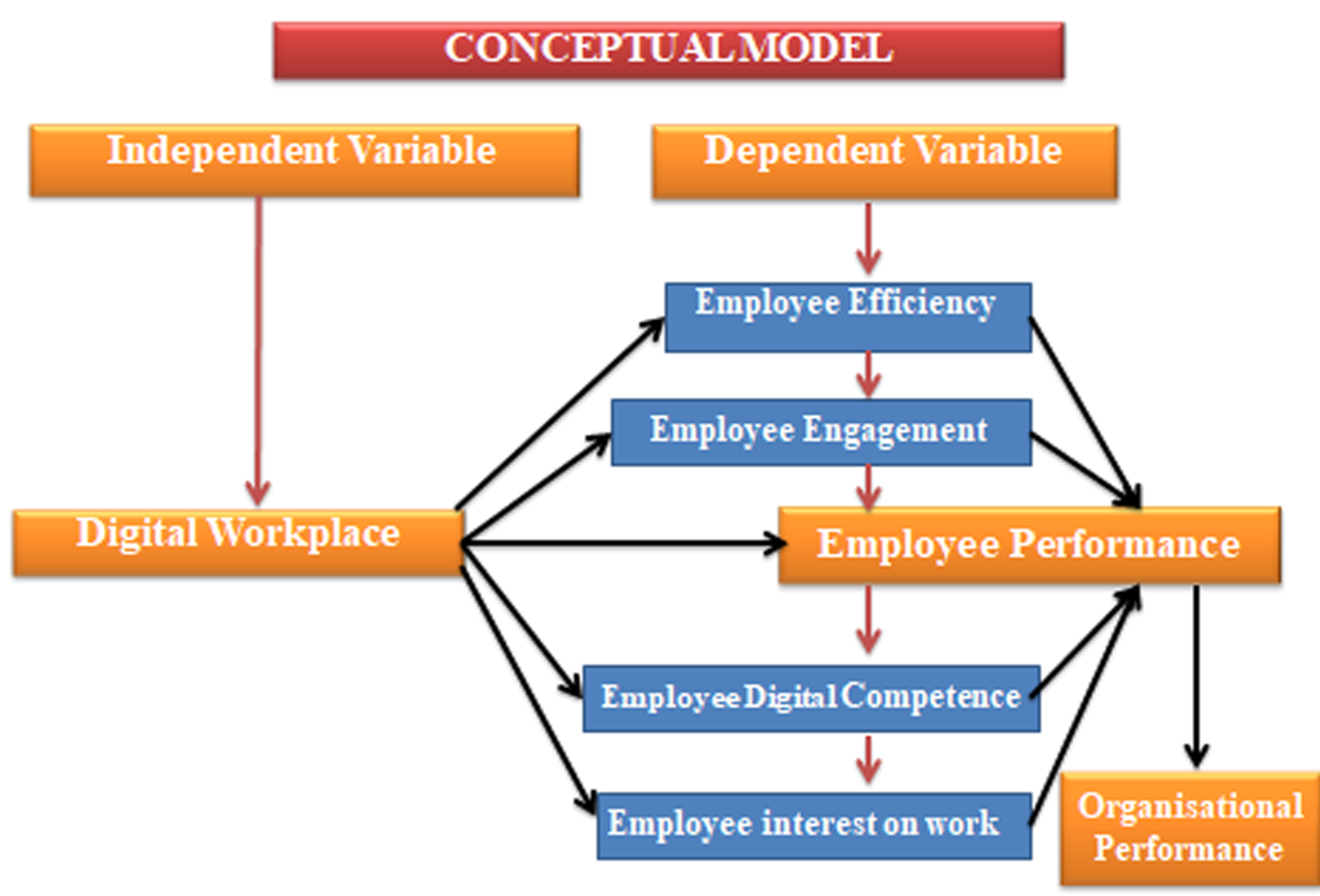
Digital workplace-a conceptual model for better performance in it industry.
Objective 1: To identify the digital tools provided by employers to employees to perform their work effectively.
To know the provision of digital tools of the 15 top selected IT software companies, we received opinions from 500 IT employees to achieve the objective.
Provision of communication tools
In the digital workplace, various communication tools are provided to the working executives to perform their work effectively. Table 1 provides the provision of such tools among the surveyed respondents. It explains that almost all have intranet and email facilities. Skype/Teams/Lync/Hangout/Goto Meeting are provided to around 96.6% of executives. About 92% of executives have SharePoint, while around 90% have Chabot’s/Autobots. Video-sharing tools are provided to about 80% of executives. Podcasts/Vodcasts are provided only to 62.6% of executives, while only 61.2% have Blogs/Vlogs.
Provision of communication tools (Base = 500, in %)
Provision of communication tools (Base = 500, in %)
Table 2 shows, it can be interpreted that more than 95% of IT executives have opined that they have collaboration tools which are Skype/Lync/VC meeting too, web conferencing facilities, and team rooms/conference rooms to perform their job effectively.
Provision of collaboration tools (Base = 500, Table in %)
Provision of collaboration tools (Base = 500, Table in %)
Table 3 shows that employers were provided mobility tools to perform their job. About 80% to 82% of employees opined that they have mobility tools such as laptops, desktops, Netbooks, and Tablet devices (iPod, Galaxy Tab, Nexus, Surface, etc.).
Provision of mobility tools (Base = 500, Table in %)
Provision of mobility tools (Base = 500, Table in %)
Table 4 shows the provision of Software Technology Tools to IT executives. Enterprises Resources Planning (ERP) software and 4 G/5 G/VPN tools stood on top, with 73.4% of respondents mentioning that they are provided with these. Big Data platform is provided to 71.6% of executives, while cloud computing and machine learning tools are given to 67% of executives. Artificial Intelligence and Virtual Reality are only provided to a lesser portion of executives (57.5%).
Provision of software technology tools (Base = 500, Table in %)
Provision of software technology tools (Base = 500, Table in %)
Table 5 shows that about 92% of IT executives are provided with VB, Visual Studio, Unix/Linux and SQL, Python, Perl, Matlab, etc. The languages C, C++, Java, J2E, DotNet, Tableau, and Informatica are provided to about 90.2% of executives. Closer to 87% of surveyed respondents are with the provision of HTML, PHP, Angular JS, React JS, etc. Jira, Oracle, VSTS (Team Foundation Service), GIT version control system, Eclipse, spring boot, Box, SalesForce, etc., are other software programming language tools reported by a few respondents.
Provisions of software programming language tools (Base = 500, Table in %)
Provisions of software programming language tools (Base = 500, Table in %)
Objective 2: To analyse the digital workplace as a conceptual model impact on performance in the IT industry.
A proposed Digital Workplace conceptual model has been created to achieve the set objective by considering relevant variables.
Figure 1, a conceptual model, shows how the digital workplace and other variables, like employees’ efficiency, engagement, and digital competence, have influenced individual and organisational performance. The identified digital tools and technologies are classified into five groups: communication, Collaboration, Mobility, Software Technology, and Software Language Programming Tools. Then classified digital tools have considered a digital workplace and surveyed employees’ perceptions about the influence of the digital workplace and other variables on performance. Increased digital tools and technologies will directly influence the employees’ efficiency, engagement, and digital competence of the employees. The influence of the digital workplace on these variables leads to individual and organisational performance in the IT industry. Standardised tools have checked the overall relationship and coordination between dependent and independent variables. The result concluded on the opinion of selected respondents.
In this study, we have created a conceptual model based on literature and the perceptions of the respondents working as IT employees at different levels, ages, gender, experience etc. We identified and analysed the digital tools and technologies from selected IT software service companies operating for more than 15 years to consider a digital workplace. Then analysed how the digital workplace and other variables impact the organisation’s performance in the IT industry.
The research study identified the digital tools provided by employers to employees to
perform their work effectively. The identified digital tools were categorised into five
groups and considered a digital workplace. The following digital tools have been provided to
employees for better performance in the IT industry. Provision of Communication Tools: The provision of such
tools among the surveyed respondents. Skype/Teams/Lync/Hangout/Goto Meeting are
provided to around 96.6% of executives. About 92% of executives have SharePoint, while
about 90% have Chabot’s/Autobots. Video-sharing tools are provided to about 80% of
executives. Podcasts/Vodcasts are offered to 62.6% of executives, while only 61.2%
have Blogs/Vlogs. Provision of
Collaboration Tools: More than 95% of IT executives have opined that they have
collaboration tools such as Skype/Lync/VC meetings, web conferencing facilities, and
team rooms/conference rooms. As mobility tools, laptops are given to 80.8% of
respondents, Desktop is provided to 82.6% of respondents, Netbook is given to 82.8%,
and Tablet device (iPod, Galaxy Tab, Nexus, Surface, etc.) are given to 83.8% of
respondents. Provision of Mobility
Tools: There are about 80% to 82% of employees opined that they have mobility tools
which are laptops, desktops, Netbook, and Tablet devices (iPod, Galaxy Tab, Nexus,
Surface, etc.) Employers have provided mobility tools to their employees to perform
their job. Provision of Software
Technology Tools: The provision of Software Technology Tools to the IT executives.
Enterprises Resources Planning (ERP) software and 4 G/5 G/VPN tools stood on top, with
73.4% of respondents mentioning that they are provided with these. Big Data platform
is provided to 71.6% of executives, while cloud computing and machine learning tools
are given to 67% of executives. Artificial Intelligence and Virtual Reality are only
provided to a lesser portion of executives (57.5%). Provision of Software Language Programming Tools: The data
indicates that about 92% of IT executives are provided with VB, Visual Studio,
Unix/Linux and SQL, Python, Perl, Matlab, etc. The languages C, C++,
Java, J2E, DotNet, Tableau, and Informatica are provided to about 90.2% of executives.
Closer to 87% of surveyed respondents are with the provision of HTML, PHP, Angular JS,
React JS, etc. Jira, Oracle, VSTS (Team Foundation Service), GIT version control
system, Eclipse, Spring boot, Box, SalesForce, etc., are other software programming
language tools reported by a few respondents.
The research found that 500 employees in selected 15 IT software service companies confirmed that all listed digital tools had provided more than 85% of employees. It assumes that the Digital workplace will be tested to know the relationship between the digital workplace and other factors with the performance in the IT industry.
The study of a conceptual model revealed how the digital workplace, other variables and performance related to each other in the IT industry. The conceptual model showed how the digital workplace is interconnected with individual and organisational performance and other factors like employees’ efficiency, engagement, digital competence, and interest in work. Increased use of digital tools and technologies will directly or indirectly influence the employees’ efficiency, engagement, digital competence, and interest in work. The digital workplace influences these variables, leading to individual and organisational performance in the IT industry.
The digital workplace is a business strategy ensuring the organisation’s success. The proposed conceptual model analysed the digital tools and technologies provided to the employees of selected IT software service companies and tried to understand how the digital workplace and other variables are connected with performance in the IT industry. The conceptual model showed how the digital workplace influenced individual and organisational performance and other factors like employees’ efficiency, engagement, digital competence, and interest in work. Increased use of digital tools and technology will directly influence the employees’ efficiency, engagement, digital competence, and interest in work. The digital workplace influenced by these variables leads to individual and organisational performance in the IT industry.
The present research was to provide a deep understanding of the digital workplace concept, specifying its key elements/components/digital tools, and develop a conceptual model to support better performance for the IT industry. An analysis of the textual information was performed, applying definitions of ‘digital workplace’ and related terms proposed by organisations and exponents. A qualitative study was conducted with a content analysis approach.
Findings
The analysis of the text segments of the investigated conceptual model included five elements in the IT industry; Employees Efficiency, Employee Engagement, Digital Competency, Employee (individual) performance, and organisational performance. Based on the research results, the conceptual model was created. The IT sector has been classified as IT service-based, product-based company, and IT-enabled service (ITes). The present survey is considered only software service companies, and the digital workplace will differ from the different segments of the company. This conceptual model applies to IT software service companies operating for more than 15 years. This model does not apply to start-ups since they use different digital tools and technologies at their workplace. The present conceptual model is a business strategy which can be implemented in any software service company for better performance.
Management implications
Previous research suggests that the future focus of theory and practice of digital
workplace transformation should be on identifying the enabling and limiting effects of
digital tools and exploring empirical evidence of the success of digital workplace
implementation in various organizations. The study proposed a workplace conceptual model which can be
utilized in the IT sector for a more efficient and effective analysis of employees
and organization. The current
research provides a platform for further empirical investigation of the impact of
the digital workplace on employees’ performance and organizational performance in
the IT industry [40, 41]. The
digital workplace is a strategy adaptable to various types of companies. The present
study selected fifteen IT software services companies operating for more than
fifteen years. The IT companies
should study and know each other’s strategies and digital tools for organizational
and individual performance [42]. The digital workplace
impacts individual and organizational performance, and related factors like
employees’ engagement, efficiency, digital competency, usage of digital skillset,
and so employees’ psychological and physical factors should lead to the impact of
the digital workplace. The IT
companies not focusing much on empowering their employees can enhance their employee
empowerment policies, as it aids in improved employee productivity. When employees
are trusted and given autonomy to find solutions, it speeds up the process, and
results are achieved faster. Empowerment offers employees a sense of authority,
boosts morale, develops self-confidence, increases organizational commitment, and
thus enhances organizational performance [43, 44]. Organizations should
emphasize encouraging the commitment and integrity of employees. Employees are more
dedicated to their job and the organizations perform better with increased
efficiency, leading to high employee performance and organizational growth [45, 46]. The association
between the digital workplace, employee performance, and other aspects related to
organizational performance should be intertwined so that they have an interlinked
connection towards the organization and the well-being of employees [47, 48]. Developing a digital
workplace would be beneficial for both well-established reputed organizations as
well as for upcoming organizations. Nurturing digital workplaces that are well
accepted and obeyed by their employees aims towards achieving company goals. As a
digital workplace makes, an organization investing in its digital tools is investing
in its employees and strives to achieve common organizational goals [49].
Footnotes
Acknowledgments
We have collected data from fifteen IT Software companies. I take this opportunity to thank all HR managers, respondents for their support to my research work.
Author contributions
CONCEPTION: Udayakumar HM.
METHODOLOGY: Udayakumar HM.
DATA COLLECTION: Udayakumar HM and Santhosha HM.
INTERPRETATION OR ANALYSIS OF DATA: Udayakumar HM.
PREPARATION OF THE MANUSCRIPT: Udayakumar HM Irshad Nazeer and Santhosha HM.
REVISION FOR IMPORTANT INTELLECTUAL CONTENT: Udayakumar HM.