



Abstract
BACKGROUND:
While the intensive work-related use of information and communication technologies after working hours have led to increased techno-invasion, much less is known regarding whether and for whom techno-invasion influences job satisfaction.
OBJECTIVE:
Drawing on the conservation of resources theory and person-environment fit theory, this study examined the relationship between techno-invasion and decreased job satisfaction. Specific attention was paid to the moderating effect of boundary preference for segmentation and its joint influence with marital status on this relationship.
METHODS:
Questionnaire data were collected by an online survey of a nationwide and diverse sample of 472 employees from China. Data were analyzed using descriptive statistics, confirmatory factor analysis and hierarchical regression analysis.
RESULTS:
We found that techno-invasion negatively correlated with job satisfaction, which was strengthened by boundary preference for segmentation. Furthermore, the results of a three-way interaction effect suggested that the moderating role of boundary preference for segmentation on the relationship between techno-invasion and job satisfaction is stronger for unmarried employees than it is for married ones.
CONCLUSIONS:
The findings expand the understanding of the mechanisms underlying the relationship between techno-invasion and employee satisfaction in the Chinese context. Moreover, the findings have important implications for employers and employees that the interaction and matching of work environment, family environment, and individual preferences need to be considered to reduce the negative impact of techno-invasion on job satisfaction.
Keywords





Introduction
Information and communication technologies (ICTs), such as social media, social software, and instant messaging technologies, have strengthened the connections between employers, employees, and other stakeholders outside of organizations [1]. ICTs allow employees to work flexibly without being limited by time and space, which improves individual and organizational performance [2–4]. However, work-related use of ICTs after working hours (WU_IWH) also has side effects from creating an overlap between work and family environments [5]. More specifically, WU_IWH creates situations where employees can potentially be reached anytime, perceive the need to be constantly connected with the demands of their job, and blur the boundaries between their work and family lives, which is a phenomenon known as techno-invasion [6].
Techno-invasion is a problem that has garnered worldwide attention [7, 8], especially in China, where difficulties with establishing a balance between work and family pose a challenge to the country’s family-oriented culture [9], which may affect various job outcomes, such as role stress [6], job anxiety [10], job burnout [7], job satisfaction [11, 12], individual productivity [6, 13] and IT-enabled innovation [14]. Among these job consequences, job satisfaction can reflect the extent to which employees perceive and recognize their working conditions and status and is related to job outcomes such as job performance [15], turnover intentions [16], and workplace well-being [17]. Job satisfaction has been extensively examined in technostress research [18, 19], however, to date, the influence of techno-invasion on job satisfaction has remained unclear. Although a few studies have examined the direct or indirect effect of techno-stressors (including techno-invasion [11, 12] or not [20]) on job satisfaction, there is no consensus on this relationship in different cultural contexts, which may indicate that this relationship is influenced by contextual factors, and more research is needed to examine this relationship in different cultural contexts and to find the contextual factors that may influence the relationship. The lack of research focusing on techno-invasion, especially in China as well as similar cultural context where it is common for employees to remain attached to their job demands after hours (a phenomenon known as “the new night shift”) [21], limiting our understanding of the “net” effect of techno-invasion on job satisfaction in the context of widespread WU_IWH. Moreover, previous studies mainly draw on stress process theory [11, 20] and socio-technical theory [22] to understand the mechanisms of techno-stressors on individual work and non-work outcomes, more theory-driven are needed to explain how and why technology creates side effects [23]. Conservation of resources theory (COR) [24, 25] provide the perspective of competition of resources available between work and non-work domains, which could produce work-family conflict and ultimately results in decreased job satisfaction [26, 27]. The present study therefore aims to address these research gaps by focusing on techno-invasion and examining the relationship between techno-invasion and job satisfaction from the perspective of COR.
For the mechanism of techno-invasion and job satisfaction, previous research has examined the individual (e.g., agreeableness and extraversion [7]; proactivity [28]) or organizational factors (e.g., competitive climates and leadership climates [29]) from a stress process perspective, lacking from an individual-organizational interaction perspective. Therefore, the other purpose of this study is to fill this gap by assuming an approach that is grounded in person-environment fit theory (P-E fit) [30, 31]. P-E Fit theory claims that when individual needs are matched with an environment (e.g., an organization or family setting), this dynamic produces a win-win effect and positive emotions, but adverse effects and negative emotions are produced if this relationship does not exist [30, 32]. In the interaction among employees, organizations and family environments, we focused on two situational moderators based on cultural context: subjective boundary preference for segmentation referring to an individual’s preferred degree of separation between work and family domains [33–35] and objective marital status referring to whether an individual is married or not [36]. Given that techno-invasion derives from the work environment, we then select the marital status as affecting the family environment [37]. Especially in traditional Chinese Confucian culture, family is emphasized as a priority [38, 39] and competes with the work demands over resource allocation, boundary preference for segmentation and marital status may jointly moderate the relationship between techno-invasion and job satisfaction as important contextual factors that may be the important mechanism leading to different job satisfaction outcomes.
In order to broaden critical conversations about technostress, this study aims to make three contributions. First, our study examines the link between techno-stressors and job satisfaction by focusing on techno-invasion and examining its effect on job satisfaction in China from the perspective of COR [11, 22]. Investigating how this dynamic unfolds in China is especially useful because it has the largest population of employees experiencing WU_IWH [40] which makes it an ideal area of focus for studies that seek to understand how techno-invasion affects job satisfaction. Second, examining boundary preference for segmentation as moderator from the perspective of person-environment fit allows us to take a step towards identifying who may experience lower job satisfaction from techno-invasion by focusing on their willingness to engage in “interdomain transitions” [41]. The third contribution of our study is that it sheds light on the relationship between techno-invasion and job satisfaction by examining the joint moderating effect of boundary preference for segmentation and marital status. Though limited studies have examined the moderating role of boundary preference for segmentation on the impact of role transitions (e.g., techno-invasion is a type of role transition driven by WU_IWH [42, 43]), they did not always demonstrate expected effects, perhaps because they ignored the marital difference. Thus, we test whether the moderating effect of boundary preference for segmentation differs between married and unmarried employees. Overall, the results of the current study can inform organizations about whether and for whom techno-invasion facilitates or complicates job satisfaction.
Literature review and hypotheses
Techno-invasion
Techno-invasion refers to “the invasive effect of ICTs in terms of creating situations where employees can potentially be reached anytime, perceive the need to be constantly connected with job demands, and feel their work and family domains being blurred” [6], this may causes work-family conflict [26, 44].Techno-invasion also depletes resources that could have been devoted to family and reduces recovery from off-job activities, which has adverse effects on job satisfaction, organizational commitment, innovation behaviors [11, 22], and employee productivity and long-term well-being [45].
Although many of the negative outcomes of techno-invasion are associated with the interference of work in the family domain [8], previous research has focused more on the conditional effects of environmental factors, such as technostress inhibitors and individual factors (e.g., the negative effects of techno-invasion can be buffered by organizational support [22] while neurotic (extroverted) individuals are more likely to perceive techno-invasion as a threatening (protecting) factor and suffer stronger (weaker) negative effects [7]. In a narrative synthesis of empirical research, Schlachter et al. [27] also proposed (but did not examine) other individual characteristics, such as individual preference and motives and perception of control over ICT use, that may mitigate the well-being effect of voluntary ICT use after working hours (i.e., techno-invasion in the present study).
Based on relevant research in the technostress field [8, 20], stress can be classified as positive (challenge stressors) or negative (hindrance stressors) depending on its own characteristics and the impact it brings to the individual. Since techno-invasion reflects the spillover of work demands to the family domain and is certain involuntary for the employees, which may lead to resource constraints and role conflicts [8], this study considers techno-invasion as a hindrance stressors. That is, techno-invasion can cause employees to feel that their non-work time is occupied by endless work demands and force them to grapple with and respond instantly to expectations from the work domain. To seek ways to mitigate the adverse effects of techno-invasion, it is important to focus on detecting boundary conditions in the relationship between techno-invasion and job satisfaction.
Techno-invasion and job satisfaction
Job satisfaction is defined as a positive emotional state generated after an evaluation of work [15] and reflects how much employees like their jobs [17]. Because techno-invasion is becoming a widespread phenomenon due to an increase in WU_IWH [4, 5], future studies would likely benefit from research that examines the effect of techno-invasion on job satisfaction among modern employees. Regarding the relationship between techno-invasion and job satisfaction, previous studies have demonstrated that techno-stressors significantly reduce employees’ job satisfaction [11, 46]. For example, techno-invasion as a technology-induced stressor can lead to greater strain, which in turn could reduce teleworkers’ job satisfaction [14]. Also, techno-invasion could increase social overload [47], create more work-family conflicts [48] and job burnout [49], and impede job recovery [5], resulting in the decreased perception of job satisfaction [50, 51].
COR theory [24, 25] states that the number of individual resources used to cope with work demands is relatively limited. When individual resources are consumed too quickly or people fail to allocate and coordinate resources properly, negative outcomes such as stress and burnout occur. Therefore, individuals need to coordinate the allocation of resources between their family and work spheres. When employees are subjected to techno-invasion, the spillover from work-related demands into the family domain can consume resources that employees should have allocated to their families, which creates employee resource allocation dilemmas [52] that are not conducive to job satisfaction. Therefore, we propose the following hypothesis:
Hypothesis 1: Techno-invasion is negatively related to job satisfaction.
The moderating effect of boundary preference for segmentation
According to COR [25], individuals, work environment, and family environment are constantly interacting with each other, and individuals need to allocate limited resources to two competing environments according to their expectations. From the perspective of P-E Fit theory [30, 31], when an individual’s expectations of resource allocation for work and family environments match their actual consumption of resources, they will be satisfied; otherwise, they will experience conflict and be unsatisfied [53]. Despite the well documented negative relationship between techno-invasion and job satisfaction, some other studies also found that WU_IWH provides employees with greater flexibility and control with respect to when and where they conduct their work, which helps them balance their work and personal lives and may therefore benefit job satisfaction [47, 54]. Thus, this study considers the moderating role of individual preferences for resource allocation (i.e., boundary preference for segmentation).
Studies on boundary management suggest that work and family environments span a continuum from complete separation (the separation of work and non-work roles) to complete integration (the allowance of overlap between work and non-work roles) [55], with work and family domains overlapping in most cases [56, 57]. No one can completely separate or integrate work and family, but individuals can apply various boundary strategies to better manage these two domains [34, 35]. The degree of preference for separation between work and family environments is called “boundary preference for segmentation” [33].
According to the P-E Fit theory [30, 31], when individual preferences are matched with job demands, they will have a positive impact on job satisfaction; otherwise, they will produce negative effects [44, 53]. Specifically, boundary preferences for segmentation can moderate the relationship between individual differences and work-family conflict [33], work-family conflict and work-family guilt [9], and workplace ostracism and family satisfaction [58]. However, we have not found any studies that examine the moderating role of boundary preference for segmentation on the relationship between techno-invasion and job satisfaction.
Thus, we expect that different boundary preferences for segmentation among employees will lead to different levels of fit when techno-invasion exists in an organization. More specifically, we assume that techno-invasion will blur the boundary between work and family, and create a low level of separation between work and family. If employees have low boundary preference for segmentation, their preference of accepting the invasion of work into the family domain will fit the organization, which, in turn, will decrease work-family conflict, stress, and emotional exhaustion [40] and lead to attenuating the adverse effect of techno-invasion on job satisfaction. However, if an employee has a high boundary preference for segmentation but has to sacrifice family/personal time and reallocate resources from the family domain to work, they will have lower job satisfaction because of this dilemma [59]. We thus present the following hypothesis:
Hypothesis 2: Boundary preference for segmentation moderates the negative relationship between techno-invasion and job satisfaction; that is, for employees with a high boundary preference for segmentation, the negative effect of techno-invasion on job satisfaction is greater than it is for those with a low boundary preference for segmentation.
The joint effect of boundary preference for segmentation and marital status
Marriage requires people to focus their attention on family dynamics and lowers their tolerance for work-family conflict, which can affect their level of job satisfaction [60, 61]. Compared with the resource demands of the work domain (i.e. techno-invasion), marital status, to some extent, reflects the resource demands of the family domain. People who are married have different priorities than those who are single. In particular, marriage makes individuals prioritize their personal life over their work more [62], which means more responsibilities [63] and demands from family domain, resulting in more dilemmas of reconciling work and family roles [61] for married employees than unmarried employees.
Compared with married employees, unmarried employees have fewer family responsibilities [63], meaning that they have more resources to allocate between family and work, which makes them more capable of achieving to conserve (i.e., high boundary preference for segmentation) or deplete (i.e., low boundary preference for segmentation) family resources according to their preferences. Thus, based on COR [25] and P-E Fit theory [30, 31], we argue that the moderating role of boundary preference for segmentation on the relationship between techno-invasion and job satisfaction is stronger for unmarried employees than it is for married ones. When the work demands (i.e., techno-invasion) match employees’ preferences (i.e., low boundary preference for segmentation), unmarried employees may feel less job dissatisfaction due to the strength of techno-invasion, while married employees may still have conflicts due to competition for resources between family and work domains. And when the work demands mismatch employees’ preferences (i.e., high boundary preference for segmentation), unlike married employees’ persistent work-family conflict, the mismatch between expectations and reality could be greater for unmarried employees, leading to more job dissatisfaction. Therefore, we propose the following hypothesis:
Hypothesis 3: Boundary preference for segmentation and marital status jointly moderate the relationship between techno-invasion and job satisfaction; that is, for those employees with high (low) boundary preference for segmentation, the negative effect of techno-invasion on job satisfaction is stronger (weaker) for unmarried employees than married ones.
Figure 1 depicts our research hypotheses.
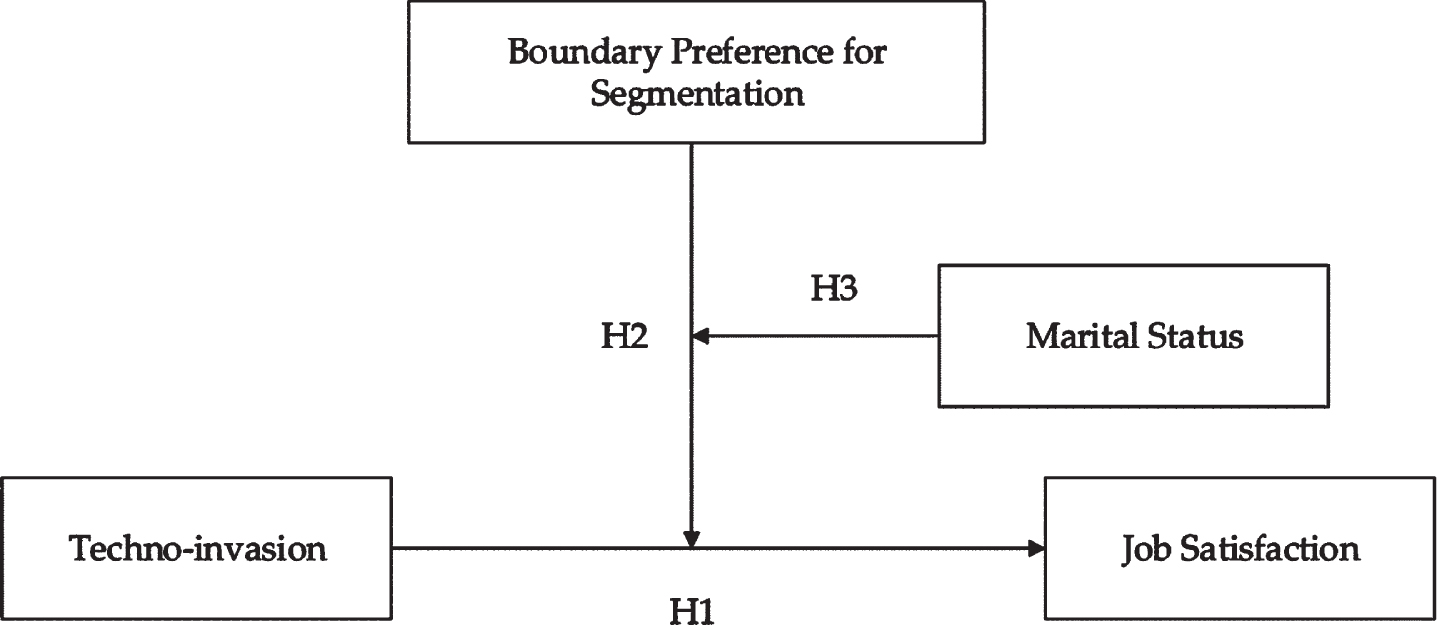
Conceptual framework.
Participants and sampling procedures
To decrease the impact of sensitive information on the validity of the questionnaire, our questionnaire was distributed to participants on an online survey platform called Wenjuanxing (http://www.wjx.cn), which has provided survey services for more than 90% of Chinese universities and scientific research institutes, issued more than 136 million questionnaires, and collected 10.973 billion responses since its launch in 2006. This approach allowed us to maintain a high level of anonymity and reliability while collecting sensitive information [46, 64]. To ensure a representative sample, we targeted full-time enterprise employees from 26 provinces or municipalities in central and eastern China. The online survey results were collected over a period of four weeks, and participants could access the web-based questionnaire from computers and mobile devices during off-duty hours (i.e., 18:00 –23:00). Before filling out the web-based questionnaires, participants were asked to take a minute to understand the purpose and instructions of the survey. Then, it took them about three minutes to complete the web-based questionnaire. Each participant received a reward (e.g., member points in the survey platform) worth about 2 RMB (approximately 30 US cents) after completing the web-based questionnaire. To ensure the validity of the responses, two reverse-coded questions were included to assess whether participants took the task of filling in the questionnaire seriously.
Initially, our questionnaire was distributed to 900 employees, and 512 employees answered and returned the questionnaires. After eliminating responses because of missing values and contradictory answers to reverse-coded questions, a total of 472 valid responses were obtained, with an effective response rate of 52.4%. Table 1 reports detailed demographic information.
Demographic information (N = 472)
Demographic information (N = 472)
The theoretical model used in the present research involved four research variables (i.e., techno-invasion, boundary preference for segmentation, marital status, and job satisfaction). All of the measures used in the present study were adapted from existing scales and adjusted to fit the research context when necessary. All of the items were measured on a 7-point Likert scale, ranging from 1 (strongly disagree) to 7 (strongly agree).
Techno-invasion
The measurements for techno-invasion were based on the four items used in the research of Tarafdar et al. [6]. All of the items were designed to ask participants to what extent their life domain was invaded by WU_IWH. For example, one of the items that we used was “I have to be in touch with my work even during my vacation due to work-related use of ICTs”. The Cronbach’s alpha coefficient of this scale in the present sample was 0.883.
Boundary preference for segmentation
The measurements for boundary preference for segmentation were based on the four items used in the research of Kreiner [44]. All of the items were designed to determine the extent to which participants agreed or disagreed with them. For example, one of the items that we used was “I don’t like to have to think about work while I’m at home”. The Cronbach’s alpha coefficient of this scale in the present sample was 0.800.
Job satisfaction
The measurements for job satisfaction were based on the five items used in the research of Judge et al. [65]. All of the items were designed to determine the extent to which participants agreed or disagreed with them. For example, one of the items that we used was “I feel fairly well satisfied with my present job”. The Cronbach’s alpha coefficient of this scale in the present sample was 0.920.
Marital status
Marital status was determined by a background variable that was estimated through a single question: “Are you married?” [36]. If a participant’s answer was “yes”, the variable was assigned 1; otherwise, it was assigned 0.
Control variables
In line with previous research [18, 66], to control for other aspects that may affect job satisfaction and might not have been identified in this study, we included several control variables in all of our models, including gender, age, education, tenure, income, and position.
Results
Common method bias
Because we collected data from questionnaires at the same time and from the same source, common method bias (CMB) needed to be tested in the responses. We used two approaches to gauge CMB. Harman’s single-factor test was conducted to assess the three conceptual variables in the model. The results showed that three constructs had eigenvalue greater than 1, and the first factor accounted for 33.128% of the variance, which was lower than the standard of 40%. The common latent factor method was also conducted to determine the presence of CMB. First, Mplus 7.0 was conducted to examine the measurement model that did not include a common latent factor (Baseline model). Second, we examined the measurement model that included a common latent factor (model with the common latent factor). The results displayed in Table 2 reveal that the difference in CFIs between the Baseline model and the model with the common latent factor was 0.003, which is significantly lower than the threshold of 0.05 [66]. Therefore, the threat of CMB influencing the results was not serious.
Model fit and comparison for baseline model with the common latent factor
Model fit and comparison for baseline model with the common latent factor
We used confirmatory factor analysis to test the reliability and validity of the model. The results indicated that the data fit the measurement model well [67]: χ2/df = 3.731, CFI = 0.952, TLI = 0.939, RMSEA = 0.076, SRMR = 0.065.
Table 3 reports the results of the confirmatory factor analysis. All of the values, including Cronbach’s α and the composite reliability (CR), were above the recommended value of 0.70, which showed that our scales had good reliability [68]. Moreover, the loadings of all items were above the recommended level of 0.50 [67]. The values of AVE were higher than the recommended threshold of 0.50 [68]. These results suggested that all of the scales had sufficient convergent validity.
Results of confirmatory factor analysis
Results of confirmatory factor analysis
Notes: TI, techno-invasion; JS, job satisfaction; BP, boundary preference for segmentation; CR, composite reliability; AVE, average variance extracted.
To assess discriminant validity, comparisons were made between the square root of AVE of each construct and the correlations among constructs [68]. If the square root of the AVE value is above the correlation coefficients of each construct, then the scale has good discriminant validity. Table 3 shows that all of the square roots of the AVE were greater than the corresponding interconstruct correlations and therefore supported the discriminant validity.
The mean, standard deviations and correlations are shown in Table 4. None of the correlation coefficients between the independent and moderating variables exceeded the usual threshold of 0.30, indicating that multicollinearity is not serious in our data.The mean values (on the 7-point scales) for self-reported techno-invasion and job satisfaction are 4.308 and 4.762, respectively. These results indicated that the respondents experienced a moderate level of being invaded by WU_IWH and that their perceived job satisfaction was at a slightly high level. Also, the results suggested that techno-invasion was negatively related to job satisfaction (r = –0.220, p < 0.001) and that marital status was positively related to job satisfaction (r = 0.164, p < 0.001), which provided primary evidence for our hypotheses.
Mean, standard deviations, and correlations
Mean, standard deviations, and correlations
Notes: TI, techno-invasion; JS, job satisfaction; BP, boundary preference for segmentation; MS, marital status. NA: not applicable. The square roots of AVE are the numbers in the diagonal row. *p < 0.05, **p < 0.01, ***p < 0.001.
Main effect testing
We used SPSS 26.0 to test the hypotheses using hierarchical regression analysis in accordance with the moderating effect testing procedure [69]. Techno-invasion and boundary preference for segmentation were centered before performing regression analysis. The category variable of marital status was coded as 0 for unmarried and 1 for married, and it was regarded as a continuous variable for the moderating effect test. We included control variables in Model 1 and then introduced independent variable in Model 2. Boundary preference for segmentation and two-way interaction (TI*BP) were added in Model 3. Finally, we included marital status, two-way interaction (TI*MS), the interaction term of boundary preference for segmentation and marital status, and three-way interaction (TI*BP*MS) in Model 4. The results of the hierarchical regression analysis are reported in Table 5. The results of Model 2 indicated that techno-invasion has a negative relationship with job satisfaction (β= –0.178, p < 0.001). Thus, H1 was supported.
Results of hierarchical regression analysis
Results of hierarchical regression analysis
Notes: TI, techno-invasion; BP, boundary preference for segmentation; MS, marital status. *p < 0.05, **p < 0.01, ***p < 0.001.
Model 3 showed that the two-way interaction (TI*BP) was significantly associated with employee job satisfaction (β= –0.169, p < 0.001), indicating that boundary preference for segmentation moderated the relationship between techno-invasion and job satisfaction. Following the study of Aiken and West [69], the two-way interactions were plotted to explain this moderating effect by applying one standard deviation above (+1SD) and below (-1SD) the mean on the predictor variables. As shown in Fig. 2, the relationship between techno-invasion and job satisfaction was stronger when boundary preference for segmentation was high (β= –0.342, p < 0.001) than when it was low (β= –0.002, p > 0.05). Thus, H2 was supported.
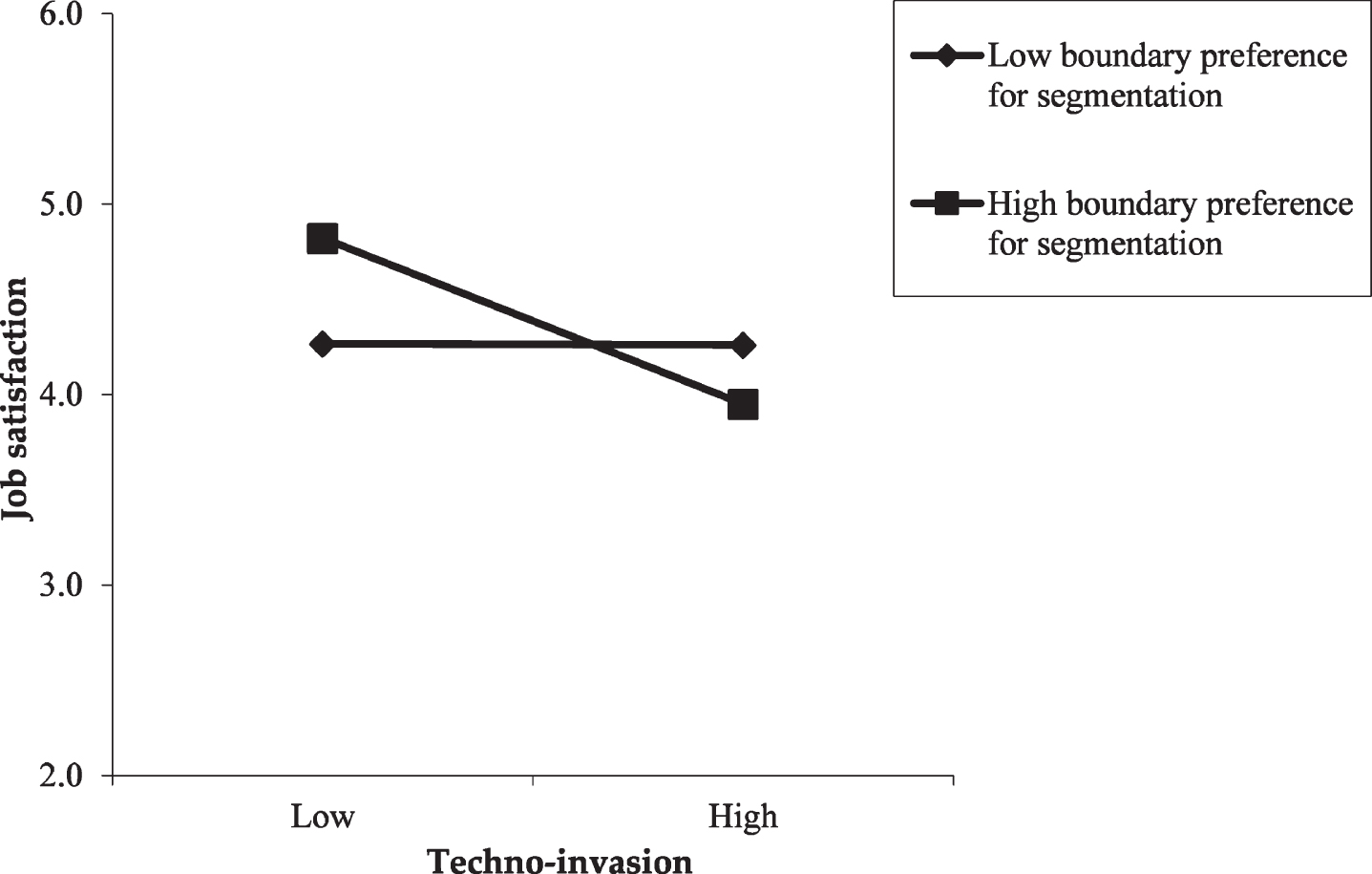
The moderating role of boundary preference for segmentation.
The results in Table 5 indicate that the explanatory power of Model 4 was significantly greater than it was for Model 3 (ΔR2 = 0.032, ΔF = 9.067, p < 0.01) and that the three-way interaction was significantly associated with job satisfaction (β= 0.252, p < 0.001), which suggests that the joint moderating effect is significant. Following Aiken and West [69], the three-way interaction was plotted to explain this result. As shown in Fig. 3, for married employees, whether or not they had a low boundary preference for segmentation (β= –0.182, p < 0.05) or a high boundary preference for segmentation (β= –0.274, p < 0.001), techno-invasion was negatively correlated with job satisfaction. For unmarried employees with a low boundary preference for segmentation, techno-invasion was positively correlated with job satisfaction (β= 0.237, p < 0.01). For unmarried employees with a high boundary preference for segmentation, techno-invasion was negatively correlated with job satisfaction, and the slope was steepest among the four lines (β= –0.361, p < 0.001). Thus, H3 was supported.

Three-way interaction among techno-invasion, boundary preference for segmentation, and marital status.
Techno-invasion has become a common phenomenon in the workplace and has received extensive academic attention [52]. The present study explored the impact of techno-invasion on job satisfaction, and analyzed the moderating role of boundary preference for segmentation as well as its joint moderating role with marital status on this effect, from the perspective of COR [25] and P-E Fit Theory [30, 31]. The main finding of our study is that techno-invasion is negatively related to employees’ job satisfaction, which further supports previous findings [12, 20]. This result supports our claim that techno-invasion increases workload and work-to-family conflict, and reduces job recovery opportunities, which leads to a decrease in job satisfaction. As we expected, our results also suggested that employees with high boundary preferences for segmentation experience greater negative impacts of techno-invasion on job satisfaction than those with low boundary preferences for segmentation, which could be because of the mismatch between their expectation and actual environments. In terms of joint moderating effect, the moderating role of boundary preference for segmentation on the relationship between techno-invasion and job satisfaction is stronger for unmarried employees than it is for married ones. Our findings mostly support the research hypothesis, except for the positive effect of techno-invasion on job satisfaction for unmarried employees. This positive effect may stem from the match between expectation and actual work-family resource allocation for unmarried employees. Specifically, techno-invasion requires employees to utilize their family time to continue working, and unmarried employees with low boundary preference for segmentation are well matched with job demands in terms of expected resources allocation, and are capable of allocating resources to the work domain aligning with their expectations in terms of actual resources allocation, which may be difficult for married employees with high family demands [70]. Therefore, boundary preference for segmentation influences an unmarried employee’s fit with an organization more than it does for a married employee and thus plays a stronger role in moderating the relationship between techno-invasion and job satisfaction.
Theoretical implications
The present study enriches research in ICT fields by contributing to the insufficient but growing number of studies that examine whether techno-invasion reduces job satisfaction from the perspective of COR theory [25], thereby enriching the limited theoretical insights on techno-invasion, such as stress process theory [11, 20] and socio-technical theory [22], and offering new evidence from China. Although, resource allocation and motivation to conserve resources have already been adequately explored from theoretical and empirical perspectives [71], resource-based allocation and coordination difficulties resulting in negative psychological states have received little academic attention in the context of ICT, which calls for additional research that explores how techno-invasion affects employees’ work and family lives [45]. We responded to this gap in scholarship by shedding light on the impact of techno-invasion on job satisfaction based on COR [25]. This study therefore provides a new perspective for understanding the adverse outcomes of techno-invasion by highlighting the fact that techno-invasion leads to decreased job satisfaction due to difficulties that arise when they reallocate personal resources that should be consumed by family demands to extended work demands. And our findings also update and support previous similar evidence from the United States [11, 20] and India [22] by providing new evidence from China, where a large percentage of employees engage with techno-invasion [40]. Together with the results from similar studies across different countries, our findings help provide compelling evidence that employees’ job satisfaction is negatively affected by techno-invasion activities.
We also theorized and confirmed the influence of employees’ boundary preference for segmentation on their response to techno-invasion. Although some scholars proposed that personal preference and organizational segmentation culture are technostress inhibitors [27, 72], direct empirical evidence is lacking. Drawing from the P-E Fit theory [30, 31], we considered and tested a contingency model of the relationship between techno-invasion, boundary preference for segmentation, and job satisfaction, suggesting that employees’ boundary preference for segmentation strengthened the negative influence of techno-invasion on job satisfaction. In doing so, we answered the recent call of [27] and [72] and revealed the compatibility or incompatibility that exists between a person (i.e., boundary preference for segmentation) and the environment (i.e., techno-invasion) in the context of technostress and WU_IWH.
Moreover, by considering marriage as a culture-specific factor, this study provides theoretical development for broadening our understanding of the impact that techno-invasion has on job satisfaction in the Chinese context. Previous studies on technostress neglected marital status and the role it plays in predicting individual differences in the stress-strain process within specific cultural contexts, which means that they revealed little about whether marital status moderates the influence of employees’ techno-invasion on job satisfaction.
The final contribution of this study lies in our decision to focus on employees’ family demands interaction with organizational demands from the perspective of P-E Fit theory [30, 31]. We argued that an individual’s marital status determines how they allocate limited personal resources to work and family activities and to what extent they can tolerate work-family conflict during the hours they are away from work [60, 73], especially in the traditional Chinese culture of prioritizing family networks and interests [39], and thus marital status may interact with boundary preference for segmentation and affect the degree to which techno-invasion impacts job satisfaction. Our findings indicate a different moderating effect of boundary preference for segmentation between married and unmarried employees and thus reveal a complex three-way interaction process, being the first to consider both person-specific situational factors while testing the relationship between techno-invasion and job satisfaction. This result is not only able to broaden the existing studies related to the use of boundary preference for segmentation as a boundary condition [74], but more importantly, to provide some explanations for the divergence of studies in which techno-invasion produces different job satisfaction outcomes [75].
Managerial implications
Our findings have implications for employers and employees. First, our results indicated that employees who suffered from techno-invasion had lower job satisfaction than those who did not. We thus recommend that employers reduce the degree of techno-invasion by decreasing unnecessary job demands and expectations related to WU_IWH [5]. They can work towards this goal by establishing rules about communication channels and subjects that should or should not be discussed through ICTs [76] and heightening their focus on compensation measures to cultivate boundary preferences as a means of promoting healthy forms of work-home integration [40]. van Zoonen, Sivunen and Rice [1] recommend reducing the possible detrimental effects of techno-invasion by discussing family and work expectations with employee leaders, which can help orient and coordinate these different demands.
Second, it is difficult for organizations and employees to stop WU_IWH because of widespread ICT use and continuous job demands that can emerge at any time. Hence, we recommend that organizations could reduce the negative impact of techno-invasion on job satisfaction from the aspects of employees’ demands and expectation for family. They can provide employees with economic compensation for their loss of family resources [76]. Also, employers can respect individual differences in boundary preferences for segmentation or integration, providing software for employees to schedule uninterrupted work time [3] or providing employees with organizational interventions and family-friendly policies to alleviate technostress and reduce perceptions of work-family conflict [33]. Moreover, given the fact that employees’ boundary preferences are subject to change and can be influenced by external factors [44], an important approach is to incorporate organizational boundary-biased expectations of employees into organizational work-family norms so that employees embrace overarching expectations (i.e., work-family integration) when they adapt to their surroundings.
Third, as our findings indicated, the moderating effects of boundary preference for segmentation varied between married and unmarried employees. Thus, it may be beneficial for employers to consider matching job demands according to individual preferences and family demands. This could support employees with different traits that need to combine work and family roles, and as a means of improving their health and work outcomes over time [77]. More specifically, for employees who are more susceptible to the negative effects of techno-invasion (i.e., married employees and unmarried work-family segmenters), they should reduce these negative effects by setting physical, time, and psychological micro boundaries [78]. Also, organizations and employers should pay more attention to these groups and provide organizational support, such as prioritization techniques, transition routines, and mindfulness training, to avoid instances of person-organization mismatch [79] as well as help these two groups of employees cope with work and family role-transitions. To our surprise, for unmarried work-family integraters, techno-invasion was positively related to job satisfaction. This finding indicates that employers should empower unmarried work-family integraters and help them develop job autonomy in order to help organizations and employees benefit from WU_IWH. Finally, our findings offer practical insights for how to improve the lives of a large number of Chinese employees who are suffering from techno-invasion and can thus be useful to organizations in countries with similar characteristics (e.g. Korea, Singapore).
Limitations and future directions
Though findings of this study are significant, our results should be approached with caution for following reasons. First, the design and methodology of the cross-sectional survey limited the inference of causal relationships between techno-invasion and job satisfaction, so longitudinal or experimental designs should be incorporated in the future [28, 81]. Second, the representativeness of the present samples was also limited. Though we collected a diverse sample of 472 employees from 26 provinces or municipalities in central and eastern China, previous studies showed that the effects of techno-invasion on employees may be cross-culturally consistent [7]. Especially marriage, which has a culturally specific meaning in the Chinese context, may lead to the joint effect of boundary preference for segmentation and marital status being reinforced. So more studies are required to replicate the present findings across countries and cultures [82] and account for cultural difference variables [83], which may bolster the relevance and robustness of our findings. Third, although the present study expands our knowledge of the individual-level situational variables that affect the link between techno-invasion and job satisfaction, various other conditions may strengthen or weaken this effect, such as technical support provision, technology self-efficacy, job characteristics, and coping behaviors [13, 27], which would be valuable if taken into account in future research.
Conclusion
In focusing on the interaction between individual and organizational environments, this study analyzed two person-specific situational factors (i.e., marital status and boundary preference for segmentation) to understand how they interact with organizational (job) demands through the lenses of P-E Fit theory and COR theory. Our findings indicate that techno-invasion is negatively related to job satisfaction and that high boundary preference for segmentation can strengthen this negative effect. Additionally, the moderating role of boundary preference for segmentation in the relationship between techno-invasion and job satisfaction for unmarried employees is stronger than it is for married employees. The results provide new evidence from China on the negative effect of techno-invasion on job satisfaction, complementing evidence from countries such as the United States and India. It also provides empirical evidence on the role of personal preference and organizational segmentation culture in reducing the negative effects of techno-stress. Furthermore, we combine family and work domain factors in contrast to previous studies that have examined them independently to reveal a complex three-way interaction process of individual, family, and work dimensions. We hope that our study will motivate researchers to pay attention to the fact that techno-invasion can have different effects depending on whether individual requirements align with organizational demands and encourage employers to manage the impact of techno-invasion activities scientifically and on an individual basis.
Measurement items
Footnotes
Acknowledgments
This research was supported by the National Natural Science Foundation of China [Grant No. 72172002], the Humanity and Social Science Major Foundation of Education Committee of Anhui province [Grant No. SK2019ZD07], the Philosophical and Social Science Key Foundation of Anhui Province [Grant No. AHSKZ2020D19], the Humanity and Social Science Foundation of Education Committee of Anhui province [Grant No. SK2020A0163], and the Natural Science Foundation of Anhui province [Grant No. 2108085QG293].
Author contributions
CONCEPTION: Jinnan Wu and Shanshan Guo
METHODOLOGY: Shanshan Guo and Jinnan Wu
DATA COLLECTION: Mengmeng Song
INTERPRETATION OR ANALYSIS OF DATA: Jinnan Wu, Shanshan Guo and Wenpei Zhang
PREPARATION OF THE MANUSCRIPT: Wenpei Zhang and Jinnan Wu
REVISION FOR IMPORTANT INTELLECTUAL CONTENT: Jinnan Wu and Donghee Shin
SUPERVISION: Wenpei Zhang and Jinnan Wu