



Abstract
BACKGROUND:
The increase of technological complexity at the workplace has encouraged researchers to pay more attention to the stress employees experience while constantly learning and adapting to new technologies. This study considers employee silence as a passive coping strategy in response to technological complexity.
OBJECTIVE:
This study examines whether self-efficacy mediates the effect of technological complexity on employee silence (i.e., quiescence and acquiescence) and whether social support interacts with technological complexity to influence self-efficacy and thereby employee silence.
METHODS:
Using a web-based survey, the data were collected from 206 full-time employees working in different sectors in France.
RESULTS:
Results indicate that technological complexity is positively associated with employee silence (i.e., quiescence and acquiescence silence) and that self-efficacy mediates the effect of technological complexity on employee silence. However, the effects of technological complexity are less pronounced when individuals have access to a large pool of social support.
CONCLUSION:
Managers are encouraged to introduce HR policies that motivate employees to speak up about the use of complex technology at the workplace by leveraging different social support programs.
Introduction
New technological developments and the COVID-19 pandemic have encouraged employees to use technological tools to maintain high-performance levels [1]. In parallel with the increasing importance of technology at the workplace, researchers have started to pay more attention to the stress employees experience while constantly learning and adapting to new technologies (i.e., technological complexity). For example, previous work on technological complexity showed detrimental effects on employee productivity [2], employee satisfaction [3], and employee engagement [4]. These studies have been essential to understand the consequences of technological complexity, yet they are still limited because they overlook passive coping behaviors, such as employee silence. Indeed, employee silence, defined as the “conscious withholding of information, suggestions, ideas, questions, or concerns about potentially important work- or organizational-related issues from persons who might be able to take action to address those issues” (Morrison, p. 377) [5], is a recently introduced passive coping behavior employees might ‘display’ while facing occupational stressors, such as technological complexity. Although frequently unnoticeable within an organization, employee silence can have a strong impact on performance because it inhibits creativity and learning among colleagues [6, 7]. As such, the objective of this study is to examine how technological complexity influences employee silence.
We use the conservation of resources theory [8, 9] as a starting point to propose that technological complexity triggers a process of resource loss, and employees are likely to remain silent to protect and regulate one’s remaining resources. Technological complexity is proposed to yield adverse outcomes at least partly because of their (potential) loss of resources due to excessive cognitive work demands [10, 11]. In this study, we propose that technological complexity might reduce personal resources, in the form of self-efficacy. Self-efficacy is a personal resource referring to an individuals’ belief regarding their capability to fulfill various tasks successfully [12]. While previous studies have reported that working conditions influence personal resources [12–14], very few studies have investigated if technological stressors, such as technological complexity, influence self-efficacy. Finally, according to the conservation of resources theory [8, 9], we propose that the effect of technological complexity on employee silence depends on social support. Social support is defined as: “social interactions or relationships that provide individuals with actual assistance or with a feeling of attachment to a person or group that is perceived as caring or loving” (Hobfoll, p. 467) [15]. We theorize that social support attenuates the negative consequences of technological complexity and propose that the association between technological complexity and employee silence, through self-efficacy, will be weaker at higher levels of social support. Figure 1 provides the conceptual framework of this study.

Proposed conceptual framework.
This study makes two major contributions to the literature. First, this research contributes to the conservation of resources theory [8, 9] by exploring how individuals engage in passive behavior to cope with technological complexity to enhance our understanding of the effects of technology on workplace behavior. Our empirical findings show that technological complexity triggers a passive coping strategy in the form of silence that enables employees to protect their remaining resources. By verifying the mediating effect of self-efficacy between technological complexity and employee silence, we also validate self-efficacy as a personal resource under strain by technological complexity. Furthermore, our research contributes to a better understanding of social support within the conservation of resources theory [8, 9] to actively cope with technological complexity. Previous research has acknowledged the importance of technological inhibitors, such as training to increase technological literacy [3, 16–18], while downplaying the relevance of social support. However, our empirical findings point out that social support appears to be a critical aspect of mitigating the impact of technological complexity at the workplace. As such, our study also provides valuable practical insights on how managers can help their employees to cope with technological complexity actively. Indeed, managers could create a socially supportive environment that ensures employees build and maintain strong relationships with peers. These peers might provide valuable advice or reassurance to each other when confronted with new complex technologies.
Our theorizing draws from the conservation of resources theory suggesting that individuals attempt to obtain, foster, and protect valued resources [8, 9]. This motivation theory posits that individuals perceive an increased level of motivation when they accumulate and acquire valued resources [8]. Valued resources are those resources that help in attaining personal goals [8]. One of the central tenets of the conservation of resources theory is the primacy of loss principle, which is based on the idea that it is more harmful to lose resources than to gain resources that have been lost [8, 9]. Stress is most likely to occur when valued resources are threatened, actually lost, or when there is a lack of resource gain following significant resources investment [19]. As a result, individuals strive to conserve their resources and protect themselves from further resource loss and depletion when confronted with a (potential) resource loss [8, 9].
Technological complexity and employee silence
This study suggests employee silence as a passive but crucial response strategy for employees facing technological complexity to conserve their remaining resources. Technological complexity refers to the stress employees experience while constantly learning and adapting to complex technologies [3, 11]. Introducing complex technologies requires employees to invest additional time and effort to cope with their work [10, 20]. Due to the rapid pace of technological developments [1], this demanding process drains valuable resources as employees continuously try to cope with new technologies. Indeed, it is likely that technological complexity threatens and depletes valued resources because an employee might need to invest additional resources to learn and understand new technologies [10, 21]. For example, Zhao, et al. [2], in a study among 513 full-time employees, showed that technological complexity was positively associated with perceived work overload. When employees have insufficient resources to cope with complex technologies, they eventually become cognitively overextended and become passive towards their work to protect and retain their resources. Indeed, employees might adopt a passive coping strategy by remaining silent about increased technological complexity. Employee silence captures the “conscious withholding of information, suggestions, ideas, questions, or concerns about potentially important work- or organizational-related issues from persons who might be able to take action to address those issues” (Morrison, p. 377) [5]. As such, employee silence is a deliberate decision by the employee not to report problems and to withhold suggestions or ideas. Traditionally, employee silence has been conceptualized as passive behavior ensuing from a sense of resignation [22, 23]. Yet, more recent research argues that employee silence can be considered a multi-dimensional construct based on the underlying motivation or reason to remain silent [24]. The two reasons that motivate employees to become silent are quiescence and acquiescence [22]. Whereas acquiescence silence is passive behavior fostered by a sense of resignation [22, 23], quiescence silence refers to the deliberate withholding of ideas to protect oneself from the possible negative consequences of speaking up [22–24].
The association between technological complexity and quiescence silence
Drawing from the conservation of resources theory [8, 9], we argue that employees who experience technological complexity are motivated to engage in a passive coping behavior, in part, through quiescence silence. It is likely that employees are unwilling to express their opinions even though they are aware of alternative technologies or technological solutions [22, 23]. More specifically, employees who face complex technologies are more likely to remain silent at work to protect themselves from the possible negative consequences of speaking up [22–24]. For example, Milliken et al. [25], in a qualitative study among 40 employees, found that 30 percent of the employees were not willing to express their opinions because they were afraid to be perceived as a troublemaker. Similarly, Morrison [26] also mentions that employees remain silent because they are afraid of negative performance reviews. As such, employees are afraid to speak up about the difficulties they experience with complex technologies at the workplace because they fear the consequences of making suggestions or providing alternative ideas [23]. Indeed, employees remain silent about technological complexity to avoid being held responsible for the ‘problem’ [27]. Employees are afraid to be held responsible, which is most likely to create additional personal discomfort depleting the already low resource reserves. It might also be possible that suggesting new ideas require extra time and energy because employees need to convince their colleagues and managers of a new idea or solution [24, 26]. In sum, building on the conservation of resources theory [8, 9], we argue that technological complexity is positively associated with quiescence silence because employees deliberately withhold ideas to protect themselves from personal discomfort or negative personal consequences. Therefore, we hypothesize the following:
Hypothesis 1a: Technological complexity is positively associated with quiescence silence.
The association between technological complexity and acquiescence silence
Employees might also withhold relevant ideas, information, or opinions due to a resignation from work (i.e., acquiescence silence) [22–24]. Drawing from the conservation of resources theory [8, 9], we argue that employees who experience technological complexity also engage in acquiescence silence because they believe that meaningful changes are beyond their capabilities [22–24]. Indeed, employees who believe that they cannot make a difference are less likely to contribute ideas or suggestions [23]. For example, Milliken et al. [25], in a qualitative study among 40 employees, found that 25 percent of the employees were not willing to express their opinions because employees were not convinced that it would make any difference or that the recipient would be responsive. Relatedly, Detert et al. [28], in a qualitative study among 89 employees within a high technological multinational corporation, show that individuals are more likely to remain silent when they believe it is futile to speak up. As such, employees are not willing to offer suggestions or ideas to cope with technological complexity because they lack the belief that their efforts will lead to positive changes. For example, Salanova et al. [29], in a study among 1072 participants, experience more skepticism and lower levels of self-efficacy while experiencing technostress, including technological complexity. In sum, building on the conservation of resources theory [8, 9], we argue that technological complexity is positively associated with acquiescence silence because employees believe that meaningful changes in technology usage are beyond their capabilities. Therefore, we hypothesize the following:
Hypothesis 1b: Technological complexity is positively associated with acquiescence silence.
The association between technological complexity, self-efficacy, and employee silence
As the conservation of resources theory underscores, individuals experience increased stress levels when perceiving a threat or actual loss of valued resources [8, 9]. With regard to the link between technological complexity and self-efficacy, we expect that when technological complexity increases, it will deplete personal resources by triggering negative cognitions about the self and its capabilities. Self-efficacy is a personal resource referring to an individuals’ belief regarding their capability to fulfill various tasks successfully [12]. More specifically, technological complexity is associated with self-efficacy because employees experience decreased personal accomplishment while facing or dealing with technological complexity. For example, previous research has shown that technological complexity increases demands on (a) required knowledge [30], (b) cognitive ability [31], (c) information processing [32], (d) effort [21], and (e) persistence [11]. This increase in work demands might be perceived as a sign of personal inadequacy or a reduced sense of self-efficacy because individuals perceive that they do not have the capabilities or skills necessary to use complex technologies [9, 34]. Hence, we argue that a decrease in individuals’ beliefs regarding their capabilities to complete tasks successfully is triggered by technological complexity.
Self-efficacy as a personal resource is an individuals’ belief regarding their capability to successfully fulfill various tasks [12–14], which helps explain why it relates strongly to employee silence. Previous studies have reported a negative relationship between self-efficacy and silence because of a perceived threat to ones’ ability to cope with work demands [22, 35]. As mentioned earlier, Pinder and Harlos [22] distinguished between quiescence and acquiescence silence. Because disengaged or resigned employees experience low connectivity with their work tasks, they strive to protect their remaining resources, leading to higher levels of acquiescence silence. More specifically, employees who are less convinced about their capabilities to complete a task successfully are less likely to offer suggestions, ideas, or concerns about work- or organizational- related issues because they lack the self-confidence to speak up [22–24]. In fact, a meta-analysis of employee silence conducted by Sherf et al. [36] has established a positive relationship between withdrawal and silence. They reported a mean corrected correlation of 0.44 (95% CI 0.37, 0.50) between resignation and employee silence.
Employees are also more likely to remain silent because they are afraid of the additional resource depletion when offering alternative solutions or suggestions. Indeed, it is likely that employees who voice their opinion need to defend their position, subsequently requiring additional resources to which the employees do not have access [24, 37]. In the meta-analysis cited earlier, Sherf et al. [36] reported a mean corrected correlation of 0.23 (95% CI 0.19, 0.27) between depletion and employee silence.
Taken together, we expect that self-efficacy mediates the association between technological complexity and (a) quiescence and (b) acquiescence silence. Building on the conservation of resources theory [8, 9], we argue for an energy depletion process in which individuals experience lower levels of self-efficacy when technological complexity is high, subsequently increasing the level of employee silence (i.e., quiescence and acquiescence). Therefore, we submit:
Hypothesis 2: Self-efficacy mediates the positive association between technological complexity and (a) quiescence and (b) acquiescence silence.
The moderating role of social support in the association between technological complexity and self-efficacy
Social support is defined as: “social interactions or relationships that provide individuals with actual assistance or with a feeling of attachment to a person or group that is perceived as caring or loving” (Hobfoll, p. 467) [15]. From a psychological point of view, social support is a social resource that might alleviate the detrimental effect of workplace stressors [12, 15]. For example, in a meta-analytical review, Halbesleben, et al. [34] showed that social support attenuated the positive impact of workplace stressors on burnout. Relatedly, Bakker and Demerouti [38] showed that social support attenuated the health impairment process experienced by chronic stressors. As such, the core idea guiding research on social support is the buffering hypothesis in which social support can replenish or compensate depleted resources [15, 39–41].
Drawing from the conservation of resources theory [8, 9], we argue that the effects of technological complexity on self-efficacy is contingent upon the perceived amount of social support available to the individual. Indeed, individuals who have a large reserve of social support are more likely to receive emotional (i.e., empathy or compassion) and instrumental support (i.e., advice or reassurance) from colleagues [40–42]. The provision of social support while dealing with technological complexity is effective because it reinforces the positive self-image of the individual [34]. Indeed, receiving social support contributes to a positive self-image stimulating the perception that one can cope with the demanding circumstance and encouraging personal accomplishment during periods of adversity [34, 39]. In contrast, individuals who receive less social support are more susceptible to the adverse consequences of technological complexity because they might not receive encouragement or assistance from peers. This lack of social support reduces the likelihood of maintaining a positive self-image while learning new complex technologies.
In sum, we expect individuals to cope better with technological complexity when they have a large reserve of social support because these individuals are more likely to maintain a positive view of themselves while learning new complex technologies. Indeed, individuals who maintain a positive self-image are more likely to maintain confidence in their ability to cope with demanding workplace stressors, such as technological complexity. Therefore, we hypothesize the following:
Hypothesis 3: Social support moderates the negative association of technological complexity with self-efficacy such that the strength of the negative association between technological complexity and self-efficacy decreases when social support increases.
Integrated model
Integrating these ideas, we propose a moderated mediation model in which social support moderates the indirect association between technological complexity and employee silence, through self-efficacy. That is, when social support is high, technological complexity will have a weaker influence on self-efficacy and indirectly on employee silence. When social support is low, technological complexity will have a stronger influence on self-efficacy and, subsequently, on employee silence. Thus, we submit:
Hypothesis 4: Social support will moderate the indirect effect of technological complexity on (a) quiescence and (b) acquiescence silence through self-efficacy. Specifically, the indirect association between technological complexity and (a) quiescence and (b) acquiescence silence (through self-efficacy) will be weaker for higher levels of social support than for lower levels of social support.
Method
Sample and procedure
We conducted a web-based survey by collecting responses from full-time employees in France. Participants were recruited by advertising the study on social media sites (e.g., LinkedIn and Facebook) and sending follow-up e-mails with further instructions to individuals who showed interest in the study. In total, 325 questionnaires were sent out to the interested individuals yielding a response rate of 68.92%. This study followed the recommendations by Podsakoff, et al. [43] for questionnaire design. More specifically, the web-based survey was accompanied by a participation information sheet explaining the purpose of the research, assuring confidentiality, emphasizing anonymity, and underscoring the voluntary nature of the research. A reminder e-mail was sent to all potential respondents two weeks after the web-based survey was made available.
Listwise deletion of respondents with one or more missing values on the study variables resulted in a final sample of 206 full-time employees. Based on previous studies and given theory, a small effect size of f2= 0.05 was expected in this study. Assuming an alpha level of 0.05, using a two-tailed test for a multiple regression model, six predictors, and a desired power of 0.80, a power analysis using G*Power 3.1.9 [44] indicated a minimum sample size of 159 participants. Hence, our final sample was well above the recommended sample size. The demographic characteristics of the sample are reported in Table 1. Participants have an average age of 39.09 years (SD = 11.64). Thirty-eight percent of the participants are female and have been working, on average, for 10.34 years with their current organization (SD = 9.30) and 5.07 years with their current manager (SD = 4.62). The majority of participants have a Bachelor degree (54.85%), followed by a High school degree (24.75%), a Master degree (16.5%), a Professional degree (2.9%), and a Doctoral degree (1%). The sectors were heterogeneous, and the most represented sectors are information technology (28.64%), retail (20.39%), education (9.71%), manufacturing (6.31%), finance (10.68%), healthcare (7.28%), and government (5.34%).
Demographic characteristics of the sample
Demographic characteristics of the sample
The questionnaire was distributed in English and the participant’s language (i.e., French). The conventional translation and back-translation method [45] was used to translate the measures from English to French. The translated versions were pretested by two bilingual-speaking individuals who did not indicate the necessity for major changes in wording.
Technological complexity was measured using the four-item scale developed by Tarafdar, et al. [11]. A sample item reads, “I often find it too complex to understand and use new technologies.” All items were measured on a five-point Likert scale (1 = Strongly disagree; 5 = Strongly agree). Cronbach’s alpha was α= 0.91.
Self-efficacy was measured using the six-item scale developed by Maslach, et al. [46]. A sample item reads, “I can effectively solve the problems that arise at my work.” All items were measured on a seven-point Likert scale (1 = Never, 7 = Every day). Cronbach’s alpha was α= 0.85.
Employee Silence was measured with eleven items representing quiescence (i.e., defensive) and acquiescence (i.e., diffident) silence from Brinsfield [24]. All items were measured on a five-point Likert scale (1 = Strongly disagree; 5 = Strongly agree). Quiescence silence was measured with six items, and a sample item reads, “I feel it is dangerous to speak up.” Cronbach’s alpha was α= 0.95. Acquiescence silence was measured with five items, and a sample item reads, “I do not believe that my concerns would be addressed.” Cronbach’s alpha was α= 0.91.
Social support was measured using the four items scale developed by Peeters, et al. [47]. The items used were: “My colleagues show that they like me,” “My colleagues show that they appreciate the way I do my work,” “My colleagues give me advice on how to handle things,” and “My colleagues help me with my tasks.” These items reflect the different types of support (i.e., emotional, informational, instrumental, and appraisal support) and were grouped into one factor (see for a similar approach Schreurs, et al. [48]. All items were measured on a five-point Likert scale (1 = Strongly disagree; 5 = Strongly agree). Cronbach’s alpha was α= 0.76.
Control variables. We controlled for gender, organizational tenure, and management tenure because of their potential impact on employee silence behavior. Indeed, employees who have a longer tenure at an organization might be more willing to speak up [49]; employees who have worked longer with their current manager might also feel more comfortable to speak up [50], and gender might also play a role in silence behavior [51].
Measurement models
We conducted a series of confirmatory factor analyses to examine the distinctiveness of our study variables. The proposed five-factor model (i.e., technological complexity, self-efficacy, quiescence silence, acquiescence silence, and social support) showed a good model fit (χ2= 480.73 (df = 289), p < 0.00, RMSEA = 0.06, CFI = 0.95, TLI = 0.94, SRMR = 0.06). As shown in Table 2, the five-factor model fit our data better than the alternative models, suggesting that our respondents could distinguish the core constructs clearly.
Results of confirmatory factor analysis of measurement models
Results of confirmatory factor analysis of measurement models
Note. Root Mean Square Error of Approximation (RMSEA), Comparative Fit index (CFI), Tucker-Lewis index (TLI), and Standardized Root Mean Square Residual (SRMR) to test for model fit. aThis model combines all items into one factor; bThis model separates the items of social support and combines the items of technological complexity, self-efficacy, quiescence silence, and acquiescence silence into two different factors; cthis model separates the items social support and technological complexity and combines the items of self-efficacy, quiescence silence, and acquiescence silence into three different factors; dthis model separates the items social support, technological complexity, and self-efficacy combines the items of quiescence silence and acquiescence silence into four different factors; ethis model separates the items social support, technological complexity, self-efficacy, quiescence silence, and acquiescence silence into five different factors.
The SPSS macro PROCESS (available at www.processmacro.org) was used to test the conditional indirect models [52]. PROCESS is a tool to test mediation, moderation, and conditional indirect research models with observed variables based on ordinary least squares (OLS) regression [52, 53]. The PROCESS tool includes a set of preprogrammed conceptual and statistical diagrams defined by a model number from which the researcher can choose [52]. After identifying the variables in the model, we followed the necessary steps to test the research model. First, the mediation hypotheses were tested using model 4 within the PROCESS tool Hayes’ [52] developed. Second, the moderation effects were tested using model 1 within the PROCESS tool to determine the first-stage moderation. Third, the conditional indirect effects were tested using model 7 within the PROCESS tool to determine the role of social support. Following Aiken, et al. [54] guidelines, we grand-mean centered the independent, mediator, and moderator variables to facilitate the interpretation of the results. We also applied Hayes’ [52] bootstrapping procedure and reported 95% confidence intervals of the bootstrapping results. Bootstrapping is a robust procedure with high statistical power and free of data-distributional assumptions [53].
Results
Table 3 provides an overview of the means, standard deviations, and correlations for the study variables. The results show that technological complexity was negatively correlated with self-efficacy (r = –0.26, p < 0.01) and positively correlated with quiescence (r = 0.50, p < 0.01) and acquiescence (r = 0.46, p < 0.01) silence. Relatedly, self-efficacy was negatively correlated with quiescence (r = –0.31, p < 0.01), and acquiescence (r = –0.30, p < 0.01) silence. Finally, social support positively correlated with self-efficacy (r = 0.33, p < 0.01).
Means. standard deviations. and correlations among the study variables
Means. standard deviations. and correlations among the study variables
Note. Sample (N = 206). Gender (1 = female; male = 0). Reliabilities are on the diagonal. *p < 0.05 and **p < 0.01.
Hypothesis 1 predicted that technological complexity was positively associated with (a) quiescence and (b) acquiescence silence. The results are presented in Table 4 and reveal that technological complexity was positively associated with quiescence (b = 0.54, SE = 0.07, p < 0.001) and acquiescence (b = 0.47, SE = 0.07, p < 0.001) silence; Hence, Hypotheses 1 was supported.
Regression results for mediation
Regression results for mediation
Note. Sample (N = 206). The control variables gender, organizational tenure, and tenure manager are included in the analysis but not reported. Unstandardized regression coefficients are reported. *p < 0.05, and **p < 0.01. ***p < 0.001. Bootstrap sample size = 10,000, CI = confidence interval.
Hypothesis 2 predicted a mediation effect of self-efficacy between technological complexity and (a) quiescence and (b) acquiescence silence. Results revealed that technological complexity was negatively associated with self-efficacy (b = –0.23, SE = 0.06, p < 0.001) and self-efficacy was negatively associated with quiescence (b = –0.20, SE = 0.07, p < 0.01) and acquiescence (b = –0.21, SE = 0.07, p < 0.01) silence. The bootstrapping results from the mediation analysis showed that both indirect effects were significant: quiescence (b = 0.04, Boot SE = 0.02, Boot CI = [0.01;0.10]), and acquiescence (b = 0.05, Boot SE = 0.02, Boot CI = [0.01;0.10]) silence. Hence, Hypothesis 2 was supported.
Hypothesis 3 predicted that the negative association between technological complexity and self-efficacy would be attenuated by social support. The results in Table 5 revealed that the interaction between technological complexity and social support was significant (b = 0.18, SE = 0.09, p < 0.05). Figure 2 shows the moderating effect of social support on the association between technological complexity and self-efficacy at two levels of social support (i.e., mean plus and minus one standard deviation). Simple slope analysis [54], showed that the association between technological complexity and social support was significant at low levels of social support (b = –0.40, SE = 0.09, p < 0.00), but was weaker at high levels of social support (b = –0.16, SE = 0.07, p < 0.05). As predicted, the level of social support attenuated the negative association between technological complexity and self-efficacy. Hence, Hypothesis 3 was supported.
Moderating role of social support in the association between technological complexity and self-efficacy
Note. Sample (N = 206). Gender (1 = female; male = 0). aStep 1 degrees of freedom = 3, 202; Step 2 degrees of freedom = 5, 200; Step 3 degrees of freedom = 6, 199). *p < 0.05, and **p < 0.01. ***p < 0.001.
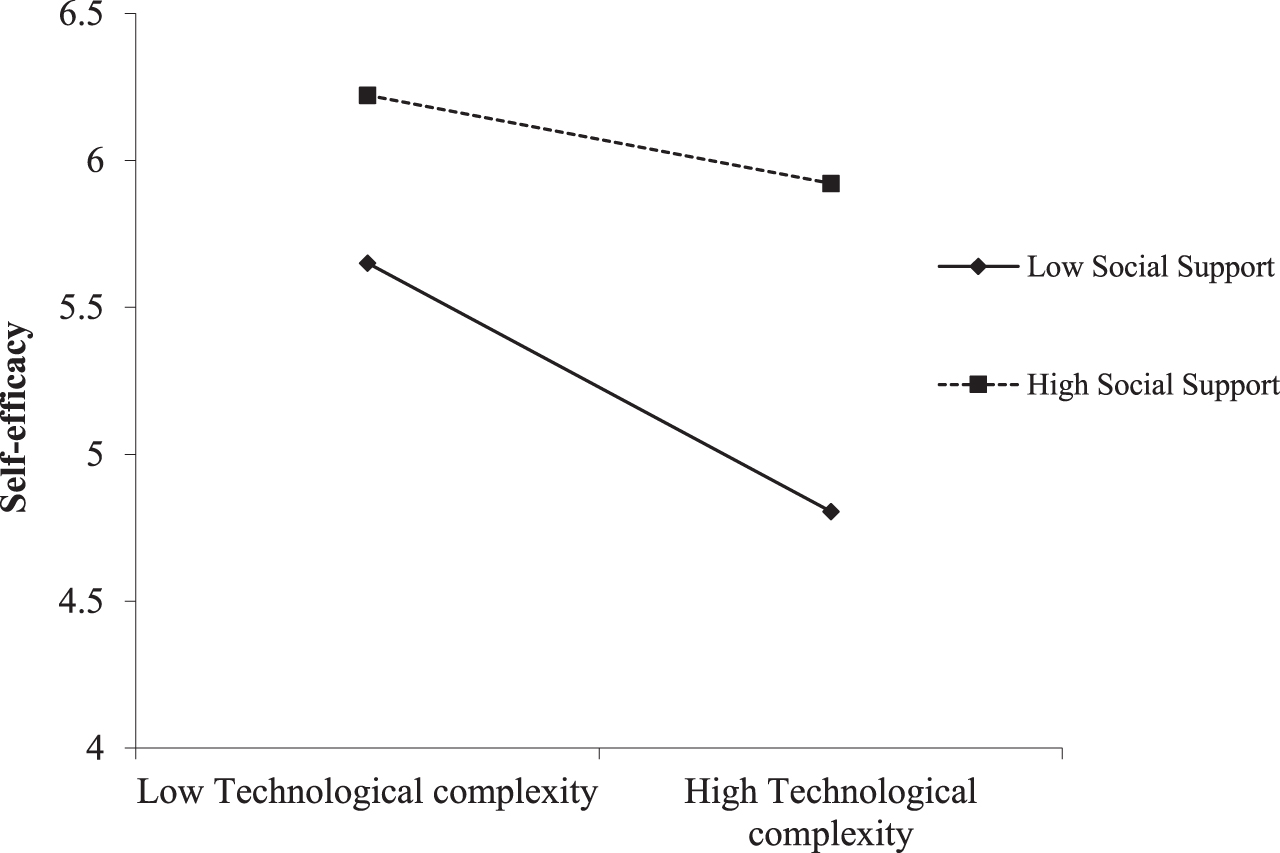
Self-efficacy predicted by technological complexity moderated by social support.
Hypothesis 4 predicted that the indirect effect of technological complexity on employee silence, through self-efficacy, was contingent on social support. In Table 6, the results show that the indirect effect of technological complexity on employee silence through self-efficacy became progressively weaker as social support increased. For quiescence silence, the results showed that the indirect effect of technological complexity on quiescence silence through self-efficacy was significant for a value of social support equal to one standard deviation below the mean (b = 0.08, Boot SE = 0.05, Boot CI = [0.01;0.20]), and was still significant, but weaker, for social support at one standard deviation above the mean (b = 0.03, Boot SE = 0.02, Boot CI = [0.00;0.07]). For acquiescence silence, the results showed that the indirect effect of technological complexity on acquiescence silence through self-efficacy was significant for a value of social support equal to one standard deviation below the mean (b = 0.09, Boot SE = 0.05, Boot CI = [0.01;0.19]), and was still significant, but weaker, for social support at one standard deviation above the mean (b = 0.03, Boot SE = 0.02, Boot CI = [0.00;0.07]). Hence, Hypothesis 4 was also supported.
Moderated mediation results for technological complexity across different levels of social support
Note. Sample (N = 206). The control variables gender, manager tenure, and organizational tenure are included in the analysis but not reported. Unstandardized regression coefficients are reported. Bootstrap sample size = 10,000. Level of confidence = 95 %. LLCI, lower level of confidence interval, ULCI, upper level of confidence interval, SE: standard error.
Three primary findings emerge from this study. First, we found that technological complexity is positively associated with employee silence (i.e., acquiescence and quiescence silence). This result supports the idea that employees engage in passive coping strategies while responding to technological-induced stressors. Second, we also found that self-efficacy mediates the positive association between technological complexity and employee silence. This result supports the idea that the introduction of new technologies depletes personal resources in the form of self-efficacy, subsequently increasing employee silence. Third, we found evidence that perceived social support impacts the association between technological complexity and employee silence, through self-efficacy. This finding supports the idea that social support might buffer against the negative consequences of technological complexity.
Theoretical implications
Our primary theoretical contribution rests in exploring a passive coping strategy as part of the conservation of resources theory [8, 9]. This approach posits that individuals engage in passive behavior to protect against resource loss [9]. Prior research that used the conservation of resources theory is based on the idea that individuals actively cope with resources loss by acquiring additional valuable resources [8, 9]. Yet, we found that employees also engage in passive behavior in the form of employee silence to protect against resource loss. As such, our study offers a novel and important insight that employees are likely to remain silent when faced with excessive work demands, such as technological complexity. We argued that employees who perceive increased levels of technological complexity are more likely to adopt a passive coping strategy in the form of employee silence. Our results showed that individuals who continuously need to learn, understand, and adapt to complex technologies are motivated to remain silent at work due to two underlying motives. More specifically, we showed that technological complexity increases quiescence silence because employees are afraid of the additional resource depletion when offering alternative solutions or suggestions. We also showed that employees engage in acquiescence silence when technological complexity is high because they are less convinced about their capabilities to make meaningful changes. These findings highlight a continued need to examine different coping behavior as part of the conservation of resources theory.
Our findings also extend and complement the primacy of loss principle of the conservation of resources theory [8, 9] to explain the consequences of technological complexity. Our results suggest that personal and social resources play an important role in explaining the consequences of technological complexity. On the one hand, this study adds to the limited literature that has examined self-efficacy as a mediator in the association between technological complexity and employee silence. Whereas previous research has investigated the moderating role of self-efficacy in attenuating the negative consequences of techno-stress [17], this study finds that technological complexity associates negatively with self-efficacy. This finding suggests that technological complexity reduces personal resources due to the continuous need for employees to learn, adapt, and understand new technologies. On the other hand, we also found support for the important role of social support while offsetting the positive association between technological complexity on employee silence, through self-efficacy. As such, this study finds evidence for the primacy of loss principle, suggesting that social support offers a wide pool of resources that can buffer against various strains at work [15].
Practical implications
Our findings have several practical implications for human resources and managers. This study showed that self-efficacy explained the positive association between technological complexity and employee silence. This finding might explain how managers can deal with the continuous introduction of new technologies and prevent employee silence within an organization. Rather than implementing expensive training programs focused on technology literacy, as often suggested in the literature [16–18], managers could create a socially supportive environment that ensures that employees build and maintain a high degree of self-confidence when faced with technological stressors [17]. For example, managers could promote the development of strong interpersonal and informal friendships among employees to cope with increasing work demands. Relatedly, managers could also develop professional development programs to increase employee self-efficacy. These development programs might help boost employees’ self-reliance within an organization.
Limitations and future research
As with all empirical research, certain limitations need to be mentioned. One limitation has to do with the cross-sectional research design, which limits the possibility to test causal relationships. In this study, self-efficacy acts as an antecedent of employee silence. Although this theorizing is consistent with the conservation of resources theory [8, 9], it is possible that the opposite also holds, e.g., higher levels of employee silence decrease self-efficacy to learn to use new complex technologies. Future research is needed to test the causal relationships between the constructs. A second limitation arises from the fact that all constructs rested on the respondents’ perceptions. Although the concepts used are highly subjective, it does suggest a potential source of common method bias. However, this paper followed the recommendations of Podsakoff et al. [43] to diminish the possibility of common method variance. Future research is needed to test our conceptual framework with multi-source data to improve generalizability; for example, technological complexity and self-efficacy might be evaluated by colleagues or a direct supervisor. A third limitation relates to the conceptualization of social support. Although our conceptualization of social support is consistent with previous research investing the moderating role of social support [15, 47], it is possible to look at other conceptualizations of social support. Indeed, next to the perception of social support, it is also possible to look at different characteristics of social support, such as quality, utilization, source, content, format, and consistency [41]. Therefore, it might be possible that the impact of social support might be a buffer and a catalyst or enhancer of the negative consequences associated with technological complexity.
Conclusion
The insights from our research are the results of bringing together two previously disconnected research perspectives of information systems and psychology to explore the impact of technological complexity on employee silence and the moderating role of social support. The result is a richer understanding of how technological complexity triggers employee silence and how social support can mitigate this passive behavior. In future research, scholars should refine and extend our work and shed further light on the role of technostress on passive and active coping strategies employees adopt.