



Abstract
BACKGROUND:
There is a growing number of reasons that encourage worldwide universities to implement integrated systems and further introduce major technology-enabled change in the organization. Successfully implementing and sustaining such change demands an effective post-implementation strategy on the part of top management.
OBJECTIVE:
The purpose of this research work is to review the post-implementation strategical aspects of integrated information systems projects of academic organizations.
METHOD:
For this purpose, an exploratory case study is conducted in one of the leading universities in Pakistan. This institution implemented enterprise information systems recently in 2021. The interviews of the officers involved in the process of implementation and management of such systems were conducted and transcribed.
CONCLUSION:
The findings of this research will help the top management to proactively develop effective strategies for the successful implementation and maintenance of enterprise information system projects in the organization.




Introduction
Information and Communication Technology (ICT) is a broader technological tool that has covered several integrated software applications, including Enterprise Resource Planning (ERP) and Information Systems (IS). These integrated IS projects are the best way to gain a competitive advantage in the business market. If these integrated IS projects are correctly implemented, they can provide the right information to the right person at the right time that enables the individual to make effective decisions. According to Aloini et al. [1], Implementation of the integrated system is a strategic activity; and it is recognized as a complex phenomenon of technology innovation that affects the whole organization. Till the 1990 s, companies implemented integrated IS systems to reduce cost, improve efficiency and gain seamless integration of data flow across the organizations [2, 3]. Hence in the literature, the advantages of the implementation of integrated IS are well documented, but the failure rate of implementing an information system is very high due to various impediments and challenges [4]. Implementation of integrated IS projects required to be handled as a project which goes through various stages and has a definite starting and end date [5].
The research argued that most research studies are focused on the first two stages of an integrated information system (design and implementation), where the post-implementation phase attracts less consideration from the researchers [6–9]. In recent year various research works have been carried out on the post-implementation stage of IS projects [4, 10] because it is the longest phase of IS projects [11] and have a backbone role in the success of the whole project. But firms are still facing various challenges and issues in the post-implementation phase [4, 12]. Emerging markets forced firms to implement integrated IS to encounter various challenges more often than in developed countries [13]. According to Malik and Khan, [9] in the Pakistani context, research is still prevailing to review the implementation strategies of organizations for integrated IS. Further, they argued that integrated IS research studies are mostly conducted in developed countries, where only 10–15 % of research is conducted on integrated IS in developing countries [9]. Moreover, the literature review shows that there is a need for further exploration of IS post-implementation strategical aspects, challenges and issues [9, 15].
Higher Education Institutions (HEIs) across the world have implemented or are investigating integrated IS [16, 17]. There is a growing number of reasons that encourage worldwide universities to implement these integrated systems [18, 19]. For example, changes in the nature of academic work create high competition among academic institutions and reduce the operation cost [17, 20]. These continuing and substantial changes in the education industry required a more efficient management system [21, 22] and enhanced administrative processes [22]. Hence research on integrated IS in the education sector is increasing [e.g. Cornford and Pollock, 2001; 21, 23]. however, there has been less consideration for implementation strategies of integrated IS that leads to success or failure of the IS in the HEI sector [17].
Based on the above evidence, this study aimed to conduct exploratory case study to address the following research questions.
RQ1: What sort of strategies are adopted/developed by the management for the post-implementation phase of enterprise information systems in the organization?
RQ2: Which strategic aspects were found effective in maintaining the integrated systems in the organization successfully?
The paper is organized in such a way that the first part covers the introduction, whereas the residue of the research paper is organized into five parts. Literature Review is conducted in section 2. The methodology used for the current study is presented in section 3. The results of the two case studies are presented in section 4, while discussion, conclusion and future research directions are encompassed in section 5.
Literature review
An IS project lifecycle usually contains three stages: IS including designing, implementation and post-implementation [4]. Post-implementation usually starts after the operationalization of the IS and remains until the previous legacy systems are shifted into the new system [24]. Usually, the success of the entire integrated IS depends on the post-implementation success of IS [4]. Therefore, the early implementation achievement is not the last objective; IS should evolve and change after go-live [25].
Hence integrated IS has not been recommended as they are unable to achieve the return on investments promised [8]. It is evident that 70% of integrated IS implementations fails. So extensively implementation of enterprise systems through firms is important [27–29], which indicates the concept of integrated IS post-implementation adaptation. The analysis of prior research study noted various challenges and issues which are recognized as a crucial part of the post-implementation phase, and these were linked with various locations across the world and how the variation of culture can create misunderstanding and challenges in the integrated or enterprise IS post-stage [30]. Sometimes user expectations and perceptions of the system are unrealistic, and challenges are associated with backing the user’s in adjusting the fresh system and offering appropriate and effective exercises and training approaches [30]. The importance of maintenance and good executive support is specifically addressed as being important [8, 32]. In addition, a good and effective implementation strategy throughout the organization is crucial [33]. Findings of previous research noted that system integration and continuous process upgrading are important for business process performance, collaboration/communication within interdepartmental, competency of internal IS team, top management support, and user training are key factors of continuous process improvement [31].
Several studies found that change management is the key driver of most the IS projects; if the process of change management during the integrated system is not managed effectively, integrated systems are ready to fail because integrated IS projects fail due to people-related issues [8, 34]. Further, they argued that process, people, and technology are three key antecedents of change management during enterprise integrated IS projects [8, 35].
Most recent research highlights two important challenges that have been faced by organizations during the post-implementation phase of IS projects. The first is Initial IS post-implementation benchmarking, which includes benchmarking and setting milestones parameters and measuring expected against actual. Second, at the post-implementation stage, embedded additional or new features in the system that are value-earned features, such as introducing attractive templates and user interface, is also the key issue for integrated IS adoption organizations [8]. Data security is always a hot topic for researchers, and security issues are considered the most crucial issues faced by project managers [31]. Research emphasizes that top managers need an evaluation of the achievement and success of the resulting integrated IS; these evaluations should consider other factors that affect the benefits of the integrated IS. [36]. Recent studies [30, 33] also highlighted the governance of projects and making them aligned with the priorities of the stakeholders as a key antecedent for the successful implementation of such kinds of projects. The importance of feedback from the user and periodic evaluation of the implemented system also plays a crucial role in the successful implementation and maintenance of enterprise information system projects [36].
Implementing successful enterprise information systems in universities required effective project planning and methodology [2]. However, universities are still facing various issues in the implementation of these projects [17], such as a lack of effective implantation strategies [33]. In nutshell, the literature highlighted that most universities underestimate the post-implementation strategies of enterprise information systems which contributed to the high failure of these projects. In the next section, we will describe the overall research methodology of this research study.
Research methodology
Enterprise IS project is a complex system that affects all stakeholders of the organizations, and complete installation is required for two to three years. In the selected organization during secondary data review from documents such as project performance reports, it was evident that the process of implementation of the enterprise information system took two years. The implementation of the information system was made in two phases as per the classification of their internal and external stakeholders (Multiple departments i.e. Examination, Admission, Fee, Accounts, etc. Faculty, Students, Parents, Alumni, Employers, Research and regulatory organizations).
To improve descriptive and conceptual understandings of such phenomena, prior researchers recommended that the case study approach is the best way to understand this phenomenon [37–40]. Therefore, this research study used a case study approach to identify the post-implementation strategies of one academic institution. The research design of the current study is shown in Fig. 1.

Research Methodology.
The data collection process for the current case study-based research comprises a review of documents of the case organization, observation, and in-depth interviews. The organization provided relevant documents including manuals, tutorials, SOPs, and initial feasibility reports for the review of our team. The record of observation was also maintained by one of our team members. In the third stage, semi-structured interviews of the senior management and middle management involved in the process of implementation and staff of such systems were conducted and transcribed. The role and responsibilities of each author were defined for the process of the interview. In total seven participants were selected for a semi-structured interview through the purposive sampling technique. The interviewees were the project leader, project officer, and team members. The demographic information of the interviewees is shown in table.
The transcribed interviews were reviewed by the relevant interviewees, and further, their important points were incorporated. In addition to formal interviews, this research also conducted informal discussions with the team members. The relevant information about the implementation of such systems also helped us in understanding this complex phenomenon. The next section will discuss the results of the case study.
The management was facing various issues and challenges due to its legacy systems. These issues and challenges were related to tracking official records and storing the official records, which resulted in increased operational costs. One of the interviewers argued that:
“it is very difficult for university management to handle and control the official correspondence manually, and due to non-integration of processes and systems, we were facing serious problems regarding availability of updated information at different locations. . .since we are operating in different cities. . ..”
Similarly, another manager said:
Our operational cost was very high due to the non-integration of different systems. . ..
The top management realized the need for enterprise information systems in the organization and decided to implement such a system on a priority basis. The management was interested in developing a paperless environment in the organization. Further, they want to ensure the availability of the right information in the right place.
This research explored the strategy of the management through interviews and informal discussions with the team members. The available documentation also helped us to understand the efforts of the senior management regarding the implementation of such systems in the organization. The following main aspects of strategy were explored: Strategy regarding the change in existing processes and their integration Discouraged IT outsourcing and preferred in-house development of such systems Team formation and collaboration The hiring of experts from the Industry Top Management support and active involvement/engagement
The management of this organization decided to develop such systems through their own experts. They developed such systems through their IT department. They also hired a few professionals from the market on a contract basis. The management developed a plan to introduce change in processes by involving relevant experts from different departments. The development team was comprised of representatives from different departments along with IT experts of the university. One of the senior managers said:
. . .We were interested in introducing change in existing processes by eliminating redundancies; we don’t want to implement technology on existing processes. . ..
After reengineering of processes, the IT experts of this organization were able to implement such a system successfully the organization. Top management consistent engagement and support resulted in the successful implementation of this system. One of the comments of the middle management was:
Our top management was actively involved in different phases of implementation and provided full support at different times. . ..
The successful implementation of enterprise systems in the organization was a challenging task. The management was able to implement such systems successfully due to their consistent engagement and support. The next part of this case study will discuss the post-implementation strategy of this organization.
Post-implementation strategies
This research documented the post-implementation strategy of enterprise systems of this organization. It identified the following key aspects of the Post-implementation strategy: Maintenance and Support Information security Training and skills development aspect Feedback from different stakeholders Top management consistent involvement/engagement even after implementation
a. Maintenance and Support
The management has developed an effective strategy for the maintenance and support of such systems. They clearly developed a plan for testing and maintenance of such systems in the organization. One of the team members said:
Our IT team provided us with the regular support, and they were never frustrated, even in rectifying our mistakes repeatedly. . ..
Experts in the IT directorate provided regular support to all concerned stakeholders through emails and telephone calls, and they also developed a proper manual guide to support the concerned stakeholders.
b. Information Security
The main aspect of the post-implementation strategy was the concern of senior management regarding the security of data and systems in the organization. The management gave clear instructions to the IT team to ensure security for avoidable and unavoidable factors. One of the IT experts said:
We know our top management is conscious of information security, and we have to ensure the right information accessible to the right persons. . .
Similarly
We have to ensure the security and availability of data even for unavoidable factors like abrupt electricity breakdowns /earthquakes/floods etc......... . ..
They have developed proper data backup and management systems for this purpose. The remote backups helped them to access data from different locations in case of any unavoidable circumstances.
c. Training and skills development aspect
One of the important aspects of the post-implementation strategy of this organization is the importance given to job training and development. Several training was conducted to improve before the implementation of enterprise systems. Top management also planned training even after the implementation of such systems. It helped them to address critical issues and challenges in the post-implementation stage. As one of the IT experts was of the view:
On-job training helped us to sort out the problems and issues of individuals at the post-implementation stage successfully. . ..
d. Feedback from different stakeholders
The mechanism developed by the management to get feedback from different stakeholders was found to be an important aspect of their post-implementation strategy. One of the team members said:
The continuous feedback system developed by the management helped us to proactively manage critical issues and further develop the trust of individuals and groups in the organization
e. Top management consistent involvement even after implementation
One of the important aspects of the post-implementation strategy of this organization is the consistent engagement of top management. The top management did not lose interest after its successful implementation. They were aware of the importance of the post-implementation stage of such systems. As one of the senior managers said:
We know the implementation of enterprise systems is a journey, and it does not stop after implementation; rather, more conscious efforts are required at the post-implementation stage. . .
The management was able to successfully implement and sustain such a system due to the post-implementation strategies of the top management. In the next section, we will discuss the conclusion and discussion part of our research.
Conclusion
The study concluded with a framework of post-implementation strategies as shown in Fig. 1. A complete framework of the discovered post-implementation strategies is developed from the results of the study and displayed in Fig. 2. These eight strategies are covering the needs and requirements of the stakeholders for addressing the post-implementation issues of enterprise information system. The developed framework would be significant for organizations in the education sector seeking to handle the issue arising after the implementation of the enterprise information system.
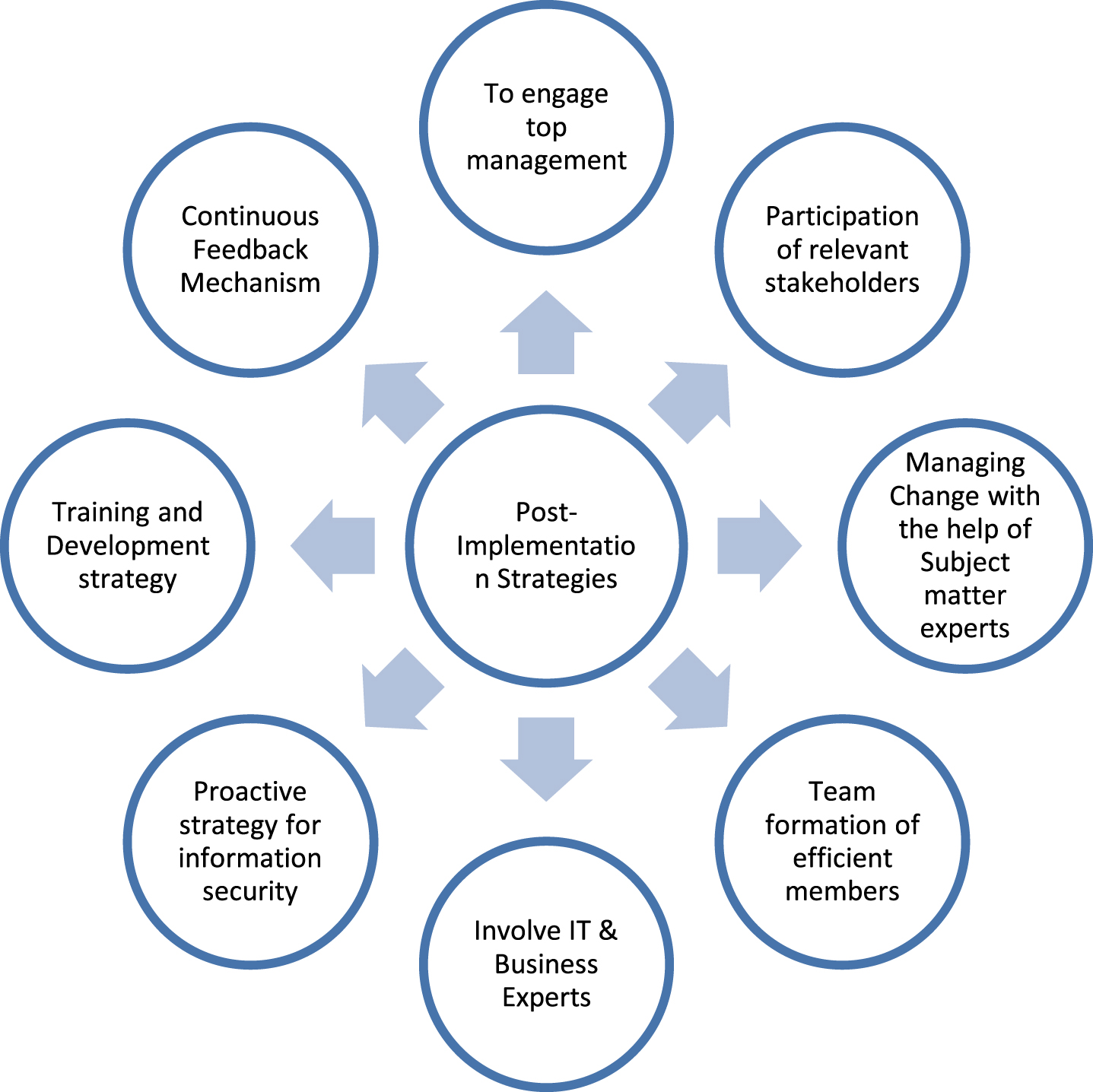
Framework of Post-implementation strategies.
An effective strategy for enterprise systems in the pre and post-implementation phases is important for the successful implementation of such systems. The strategy developed by the management of this organization was found effective, and it clearly understands the importance of different phases and especially the post-implementation phase of enterprise systems [9].
Demographic data of interview participants
A critical aspect interrogates that “who will be responsible for the maintenance and support of the newly implemented IS”? This is a very crucial question, and researchers emphasize that this question should be properly addressed in the designing stage for a sustainable journey of information systems, and most organizations underestimate this question [31]. The post-implementation strategies of this university were maintained, and the support strategy was well defined during the planning stage, and they helped the management in the successful implementation of such systems [48, 49].
The security issue has been considered the most important issue by the management of this organization. Previous research allots and considered high rank to the security issue, but most organizations pay less attention to security [50] and 57 % of the management of organization underestimate the security issues [51]. Many organizations lost a huge amount of money (US$ 5.5 million per incident) due to security breaches and lost 17–30% of their brand image and reputation [31, 52]. The information security strategy of this organization was found effective in managing critical issues of such systems.
Organizing training frequently and developing users’ skills play a significant role in the sustainable journey of enterprise IS projects that are recognized by researchers and practitioners [31, 54]. However, most organizations do not focus on the training and skills development of the users after the implementation of such systems [9]. In the case of this university, this study finds proper training and skill development strategy even after implementation that helped the successful management implementation of enterprise information systems in the organization.
Most recent research highlighted protection of data has been least discussed in the integrated IS literature [44]. However, a plethora of research studies have discussed that system of laws, including their codifications, ethical architecture, accountabilities, and responsibilities related to the sense of ethics, prescribe effective approaches to control the stakeholders and participants of a society. [44, 55]. The proper strategy developed by the management regarding the security of data has helped the management to develop the trust of individuals and groups in such systems.
Top management commitment and support are usually decreased during the post-implementation stage as they perceive only the successful implementation as a success of overall enterprise IS [47, 56–58]. The top management’s consistent involvement and engagement at different phases of implementation has helped them successfully maintain and sustain such systems in the organization.
Previous research highlighted that post-implementation evaluation and feedback are the important and critical success factors of integrated information system projects [45, 59]. But most organizations underestimate the post-implementation evaluation and feedback as they recognize the overall success of integrated IS when they achieve their short-term objectives [31, 60]. Therefore, organizations need to get feedback from different stakeholders after the implementation of such systems. The feedback strategy developed by the management in the post-implementation phase helped the senior management proactively manage the resistance at different levels. A comprehensive framework of post-implementation strategies is shown in Fig. 2.
This research underlined the implications and rendered the following recommendations for the successful implementation of enterprise systems, also depicted in the below figure. Top Management’s consistent engagement and involvement are the keys to the successful implementation of technology-enabled change in the organization. Participation of relevant stakeholders at different stages must be ensured Efforts must be made regarding the change in existing processes. Importance must be given to the subject matter experts of different departments. Team formation is very critical for initiating technology-enabled change in the organization. The involvement of IT and business experts will help the management to effectively develop the strategy in the organization. A proactive strategy for information security. Planning for avoidable and unavoidable factors. Training strategy for the pre/post-implementation phase is important Continuous feedback mechanism at different stages of project implementation is important and especially in the post-implementation phase.
Future directions
The current research study mainly focused on Information system post-implementation strategies and does not review the analytics strategical aspects such as business intelligence and artificial intelligence. So, further research needs to conduct on these aspects because business intelligence and artificial intelligence are the best tools that make information systems more beneficial for an organization and provide a more competitive advantage. Further, this research only included one organization; future research may use a similar research method and include multiple organizations to generalize the findings. In addition to this, this research only focused on the academic sector future research may be expanded to other sectors.
Footnotes
Acknowledgments
The research project did not receive any funding. The authors acknowledge the cooperation received from the selected case organization and acknowledge the individual participants for interview and discussion process.
Author contributions
CONCEPTION: Abdul Zahid Khan
METHODOLOGY: Muhammad Anwar Khan and Faisal Mehmood
DATA COLLECTION: Muhammad Anwar Khan and Faisal Mehmood
INTERPRETATION OR ANALYSIS OF DATA: Muhammad Iftikhar Ali
PREPARATION OF THE MANUSCRIPT: Muhammad Iftikhar Ali
REVISION FOR IMPORTANT INTELLECTUAL CONTENT: Abdul Zahid Khan and Faisal Mehmood
SUPERVISION: Abdul Zahid Khan