



Abstract
BACKGROUND:
The service sector is facing challenges due to its competitive environment. Thus it needs a transformation of the traditional sector into the learning sector. In this competitive atmosphere, organizations and institutions are putting several efforts into making itself learning organizations to upgrade their effectiveness and efficiency.
OBJECTIVE:
The current study aimed to examine the impact of learning organization from errors on organizational effectiveness under the mediating role of organizational commitment and job satisfaction.
METHODS:
The study has adopted a descriptive and quantitative approach. The data has been collected from the healthcare sector employees by applying a convenience sampling technique. Statistical Package for the Social Sciences (SPSS) and SmartPLS-SEM was used for data and regression analysis.
RESULTS:
Findings revealed that organizational learning from errors has a significant and positive effect on organizational effectiveness. Results also divulged that organizational commitment and job satisfaction significantly mediate the relationship between organizational learning from errors and organizational effectiveness.
CONCLUSIONS:
Organizations are changing by moving towards a more informative and knowledge-gaining organizational culture, and organizational learning from errors positively and significantly affects organizational effectiveness.
Keywords




Introduction
In recent years, the knowledge economy, characterized by the establishment of advanced innovations has allowed novel learning to accelerate business functions [1]. Inevitably, increasing globalization and competitiveness have caused companies to face distributive changes in organizational learning. This growing dynamism has compelled rising complexities to influence learning drastically. Today, the business landscape is enduring numerous changes and has embraced new learning to accelerate the firms’ operations. Organizational learning from errors has gained considerable attention in an organization’s life. Errors are part of an organization’s daily routines that lead to either positive or negative outcomes. Errors may unintentionally or potentially help an organization to achieve its standards and goals (i.e., effectiveness).
Organizational learning from errors alludes to a firm’s ability to discover and correct errors. It redefines the organization’s knowledge base and values by enhancing individuals’ problem-solving skills [2]. In recent years, organizational learning from errors has become a profound construct in business learning [3]. It is a unique phenomenon that forces an organization’s members to alter their actions and behavior as per the situation. As a consequence of errors, the individual learns from the results. Employees recognizing mistakes is conducive to coping with and combatting unforeseen events. Organizational learning enables employees to detect and fix errors, ultimately increasing organizational effectiveness. This error detection process improves the firms’ knowledge by inspiring the employees to learn from their mistakes. As such, mistakes are an efficient way of learning [4]. In recent years, mistakes and errors have become the focal point of business adaptability and change. As a result, today’s organizations have accepted this phenomenon as a strategic component influencing organizational functioning.
In particular, given the increasing organizational effectiveness, learning from errors in recent years has gained tremendous importance in the healthcare sector [5]. Notably, today, individuals have developed high organizational effectiveness, thereby inspiring them to connect deeply with their firms’ offerings. Accordingly, organizational commitment is an effective catalyst that guides organizations to foster their practices toward achieving their business goal. Study shows that organizational commitment plays a pivotal role in ensuring the prolonged stay of employees within the organization, thereby strongly contributing to achieving the organizational goals [6].
According to all these factors, learning is considered a necessary device that helps organizations compete in today’s competitive business environment. This learning must be congruent with organizational effectiveness and commitment that help an organization succeed [7]. Enterprises frequently believe that knowledge creation and learning continuously occur, promoting learning in groups and teams. Learning in an organization plays a crucial role in making employees committed to it, which helps achieve effectiveness [8]. Learning in an organization is critical in encouraging employee commitment to an organization and helping it attain efficiency [8].
The modern health sector, however, faces problems in an increasingly competitive environment. Healthcare centers are complex organizations that demand workers to work collectively, thus emphasizing learning from errors and constraints. A prior study states that specialized healthcare effectiveness increases employees’ job satisfaction and work commitment [9]. Therefore, in this regard, organizational learning capability has become an important aspect influencing employees’ experiences and satisfaction. Today, learning from errors has become the prime priority of firms. However, despite the increasing significance of organizational learning from errors, the previous literature is limited to specific regions or industries only [10]. Hence, this prevailing research gap calls for the need for empirical literature on this research topic, especially in the healthcare sector of Pakistan, as is the focus of the current study.
Significantly, the present study provides a detailed view of organizational learning from errors and organizational commitment among the employees working in Pakistan’s various healthcare centers [11]. The selection of the current topic is due to the lack of learning opportunities among healthcare employees in Pakistan, which faces many difficulties in the healthcare system. It is not developed according to international standards, and the infrastructure of healthcare centers is weak. The employees are not educated according to the required level of education, and they are less aware of the importance of training and learning than health workers in other nations. They do not participate in different training programs. This means that the individuals working in the health sector of Pakistan have fewer opportunities to learn [12]. It is said that employee learning is considered organizational learning, so healthcare centers in Pakistan are not learning organizations. Every organization, including healthcare centers, needs to provide a learning environment to its workforce in the modern age. Hence, these problems create ambiguity about the effectiveness of the overall sector. For example, there are challenges in adopting a performance-based pay approach [13]. The health sector of Pakistan is also facing problems such as low financial resources, non-availability of staff, i.e., doctors and nurses, low salaries of doctors and nurses, an inadequate number of doctors, and a brain drain. Due to these factors, the health sector is not growing according to international standards and recommendations. Hence, attaining a competitive edge by ensuring the effectiveness of healthcare centers has become a key topic under discussion.
It is evident from the studies above that there is very scant literature on the mediating role of organizational commitment in the relationship between organizational learning from errors and organizational effectiveness among health sector employees, especially in Pakistan [14]. Indeed, to overcome this research gap, this study presents a novel theoretical framework that sheds light on organizational learning. The study discusses the link between organizational learning from errors, organizational effectiveness, and commitment. Furthermore, the paper incorporates the mediating role of organizational commitment and job satisfaction nexus to organizational learning from errors and organizational effectiveness.
The present research identifies and measures the effectiveness of the health system [15]. In assessing health systems, policymakers have very little guidance regarding what they should and can strengthen [16]. Researchers have identified that learning organizations attempt to learn through learning individuals. Today’s healthcare systems are complicated, occasionally chaotic, and busy. There is a persistent demand from healthcare analysts, funders, and policymakers regarding the need to provide and convey the best possible healthcare services, which are cost-efficient and operative [17]. It is challenging to fulfill the increasing demands of a changeable and challenging environment, even in high-income countries. It can be an insuperable task in middle and low-income countries where policymakers and health professionals have to detail financial and human resources [18].
This paper consists of six different sections. Section 2 sheds light on the previous theoretical background, while Section 3 presents the data collection procedures and designs. Section 4 illustrates the characteristics of the research outcomes, and Section 5 verifies the study assumptions in light of the current research findings. Lastly, Section 6 summarizes the study by providing the research implications, limitations, and future research directions.
Literature review
Organizational learning from errors and organizational effectiveness and commitment
In recent years, the considerable changes brought by globalization and technological advancement have evolved global intricacies, thus creating a need for superior organizational effectiveness. As a result, learning in organizations has embraced a new paradigm to compete in the fast-growing environment. However, the increasing global demand has forced learning organizations to adopt novel firm practices to enhance their organizational learning capabilities. A learning organization empowers individuals to obtain, transform, and share knowledge by developing an effective model of firms’ capabilities and effectiveness. As such, academics state that the organizational effectiveness model exploits the significance of the organization’s deliverables, thus reflecting this approach to fostering organizational performance [19].
Organizations face numerous challenges that impede development and learning. Hence, concerning the increasing market uncertainties, organizational learning from errors plays a significant role in boosting business efficiency. One study shows that an organization’s learning capability supports its development process (i.e., efficiency and effectiveness) [5]. An organization’s learning from errors develops a strong relationship with organizational effectiveness. It fosters the firm’s functions, thereby enhancing its performance. The errors trigger learning in individuals and provide the organization with informative feedback about the non-replaced business process. Errors-related learning also increases the organization’s readiness to try new things.
Errors-related learning fosters employees’ willingness to learn new things, thus increasing the organization’s tendency to adapt and adjust. However, learning is closely related to risk. Organizational learning actions reduce the effect of errors, thereby compelling the organization to adapt to the changing situation. In particular, in operationalizing organizational learning from errors, knowledge guarantees the organization’s effectiveness [20]. However, in contrast, if the employees do not learn from their mistakes, it adversely affects the organizational effectiveness. A prior study states that organizations usually fall behind if they do not learn from their mistakes [21].
In particular, organizational learning from errors guarantees and promotes an organization’s effectiveness. Errors-related learning develops novel skills and thinking in individuals, thus making them confront future events by adopting improved procedures. This novel learning makes the organization respond quickly to unforeseen circumstances in the future, allowing them to stay ahead of its competitors. Overall, error-related learning provides a deeper understanding of rich adaptation, challenges, and competition [22], ultimately increasing organizational effectiveness. Indeed, today, the progressing significance of knowledge has revolutionized the global health sector by opening new avenues for organizations to adopt effective learning practices for governing their learning systems. However, in healthcare, this novel learning opportunity has meant individuals need to acquire skills and knowledge to support the changing requirements of the educational stakeholders [23]. Consequently, based on the prior literature, the current study proposes the following hypothesis:
Commitment is a psychological mindset that stimulates individuals to achieve specific goals and objectives [24]. The workplace’s commitment construct has fundamental importance, focus, and interest in creating a linkage between the organization and its employees [25]. Creating a committed workforce is one of the crucial goals of human resource practice and policies. The literature has shown that commitment is linked positively with turnover, productivity, and employees’ willingness to assist in co-workers’ work [26]. In particular, organizational commitment is an essential component, in promoting employees’ active learning behavior, performance, and competence.
High learning performance creates an environment that promotes team learning and collaboration. It empowers employees to work toward a collective vision [27]. When organizational members learn and grow with the firms, they develop a strong bond with the organization. Employees with high commitment work rigorously to achieve business goals— error-related learning influences organizational processes, procedures, and structures. As a concept, errors are a constructive contribution to the organization. They support and enhance the employees’ learning and development, substantially elevating individuals’ organizational commitment. Errors-centered learning engages the organization to understand the impact of unforeseen situations on organizational elements, thereby profoundly influencing the employees to show high organizational commitment [28].
Indeed, the most fundamental feature of organizational learning is learning from errors. It is an ability that ensures the firm’s continuous learning and systematic thinking [29]. The employees learning from errors show positive commitment toward the organization. It motivates the employees to portray a strong loyalty toward the organization. The employees learning from the mistakes make dedicated efforts toward improving the organizational activities. Further, learning from mistakes is viewed as a positive experience that boosts individual commitment to the organization. Organizational adaptability to the fast pace, and changing climate motivates employees to pursue their learning experience [30], thus influencing the individuals’ level of commitment. In particular, the learning experience powerfully encourages employees’ loyalty. It increases their attachment to the brand and makes them aware that continuous learning contributes to their self-development and growth, thus elevating long-term commitment. Hence, in line with these previous arguments, the current study proposes the following hypothesis:
Organizational learning from errors and job satisfaction
Over the years, work dynamics have constantly changed, and to effectively capture the business market, organizations are continually updating their knowledge base, thereby satisfying the needs of their employees [9]. Today, in maintaining high work demands, employees have realized the need to acquire and adapt to the changing organizational demands with new learning. Errors-related learning has brought beneficial results for today’s organizations. In most organizations, this increasing phenomenon has assisted employees in learning from failure. In recent years, error-related learning has widely influenced employee job satisfaction.
In the business world, organizations are constantly adapting to changing situations. The organizational learning capabilities help employees to detect opportunities and trends, thus influencing business performance and employee satisfaction [31]. Employee job satisfaction is the product of individuals’ learning experiences. Once employees realize that the learning organization fulfills its learning need, they feel satisfied and highly committed to the organization. Indeed, employee learning from mistakes is key to effective employee functioning. However, employee satisfaction depends on various aspects. Among these, the characteristics of the learning organization mainly influence the employees’ satisfaction level. Errors-related learning develops a learning climate that accelerates team productivity, job satisfaction, employee participation, and cooperation. Learning from errors allows employees to acquire knowledge that improves their performance, ultimately individuals’ job satisfaction. One prior study shows that errors-related learning significantly boosts employee job satisfaction and performance [32]. Hence, based on the previous literature, the current study proposes the following hypothesis:
The mediating role of organizational commitment
Attracting and recruiting the best talent is the goal of every organization. Unsatisfied employees quickly leave the organization, reflecting low organizational commitment [33]. Hence, organizational commitment plays a crucial role in an organization’s life. In recent years, organizational commitment has emerged as the most prominent factor in accelerating an organization’s effectiveness. Organizational commitment has a long history as it plays a major part in accelerating organizational effectiveness, which largely depends on human resources, processes, and procedures. Organizational effectiveness allows firms to optimize their business process. The firm’s resources, competencies, and capabilities inspire its employees to exhibit positive organizational commitment [34]. Therefore, given the importance of organizational effectiveness, organizational commitment brings favorable outcomes for organizations and individuals. Individuals’ commitment is the organization’s core component that empowers employees to perform business functions. It encourages employees to work toward the common goal, sustainably increasing organizational effectiveness [35]. Hence, the literature shows that organizational commitment is a powerful concept that enhances organizational continuity and effectiveness. Accordingly, in line with the presented studies, the current study proposes the following hypothesis:
Significantly, the healthcare industry demands its employees to adapt to the fast-growing clinical advances, thus facilitating the organizational model of increasing commitment and efficiency. This changing need has encouraged learning organizations to create and consolidate new knowledge to transform the firms’ processes, capabilities, and activities. Learning organizations expand to enhance their cultivated learning pattern, inspiring knowledge members to adopt novel programs as an essential aspect of improving their commitment. In explaining this notion, one study indicates that organizational learning forms a positive relationship with organizational commitment and enhancement [36]. It is the realization of commitment that supports the firm’s objective. It is a vital component that leads a firm to acquire measurable goals (e.g., employee commitment and firm efficiency) [37]. Accordingly, one study states that organizational learning and effectiveness foster employees’ productivity and organizational performance [38]. Hence, an organization’s efficiency based on performance inspires employees to work for the business goal.
In today’s world, the new learning realities have caused the workforce to be more adaptive and capable. Particularly, in the healthcare sector, one study states that promoting organizational commitment is a way to counter the nursing shortage [39]. One of the other features of a learning organization is that it adopts organizational elements that affect organizational performance [40]. Indeed, achieving a high organizational outcome promotes team adaptability and commitment, empowering the organization’s vision [27]. Significantly, learning cannot happen without mistakes. The literature is full of evidence that firms learn from their mistakes. Errors-related learning enables managers and employees to fight uncertainties. Therefore, to succeed in today’s world, modern organizations have focused on learning from the growing challenges they face (e.g., failures, errors). Organizational learning from errors is a critical element that enables organizations to restructure their business processes and procedures (e.g., effectiveness). Errors-related learning enables employees to accept the failure and view the situation as an opportunity for positive career prospects (e.g., commitment). The prior research shows that high commitment enables employees to resolve problems by developing innovative approaches to new learning, procedures, and process (i.e., effectiveness) [41]. Hence, the following hypothesis is developed based on the studies discussed above:
The mediating role of job satisfaction
Lopez [42] specified that a learning organization improves learning, knowledge management, organizational and individual performance, and maintains a competitive edge in turbulent markets [43, 44]. Employees are the most valuable asset for any organization. As a result, today’s organizations have recognized the need for satisfied employees. Job satisfaction is a highly researched phenomenon that plays a critical role in accelerating organizational effectiveness. Organizational effectiveness enables employees to seek novel opportunities, thus increasing their job satisfaction level [45]. Today, companies are investing in boosting employees’ job performance to accelerate organizational effectiveness. When employees feel happy and satisfied, the organization outperforms in the market, thus staying ahead of their competition. Satisfied employees play a vital role in enhancing organizational effectiveness and performance. Organizations strive hard to make employees satisfied, stable and contented. Happy employees tend to perform well, thus increasing organizational effectiveness. In particular, every organization seeks to attain a high level of efficacy, productivity, and performance in its daily routine. Organizations try to set goals and objectives to achieve this business goal that keep the workforce motivated. Thus, prior research indicates that a satisfied pool of employees enables an organization to achieve its business goals and objectives, thus influencing organizational effectiveness [46]. Therefore, in accordance with the previous argument, the current study proposes the following hypothesis:
Organizational learning from errors is a powerful construct that makes employee accept their mistakes. Errors is persuasive in a firm’s life. Errors are prevalent in a firm’s everyday functions ranging from product development to service provision. The errors-related approaches are a constructive way of fostering positive organizational outcomes. The prior research shows that errors-related learning significantly influences employee job satisfaction [32, 48]. In particular, mistakes are not constant; they are a vital part of individual learning. The most effective learning is to adapt to an unforeseen situation. As a part of learning, errors-related learning fosters the organizational process, procedures, and activities, thus stimulating organizational effectiveness. The organization’s learning capability enhances organizational effectiveness, thereby increasing job satisfaction.
Undoubtedly, employees continually learn to be productive. This increasing effectiveness makes them feel satisfied and motivated, thus contributing to business welfare. Usually, contended employees are more innovative and skilful [49, 50]. In this regard, organizational learning from errors increases organizational effectiveness, thereby strengthening job satisfaction. Self-learning by seeking feedback helps employees to achieve their development goals, thereby actively contributing to their job satisfaction. Therefore, in today’s turbulent market, organizational learning is useful for detecting market opportunities and increasing organizational efficiency. The research shows that competitive organizations focus on maintaining a satisfied workforce to achieve business competitiveness and effectiveness [31, 51]. Therefore, job satisfaction plays a critical part in increasing organizational effectiveness. In particular, drawing on this statement, the current study proposes the following hypothesis:
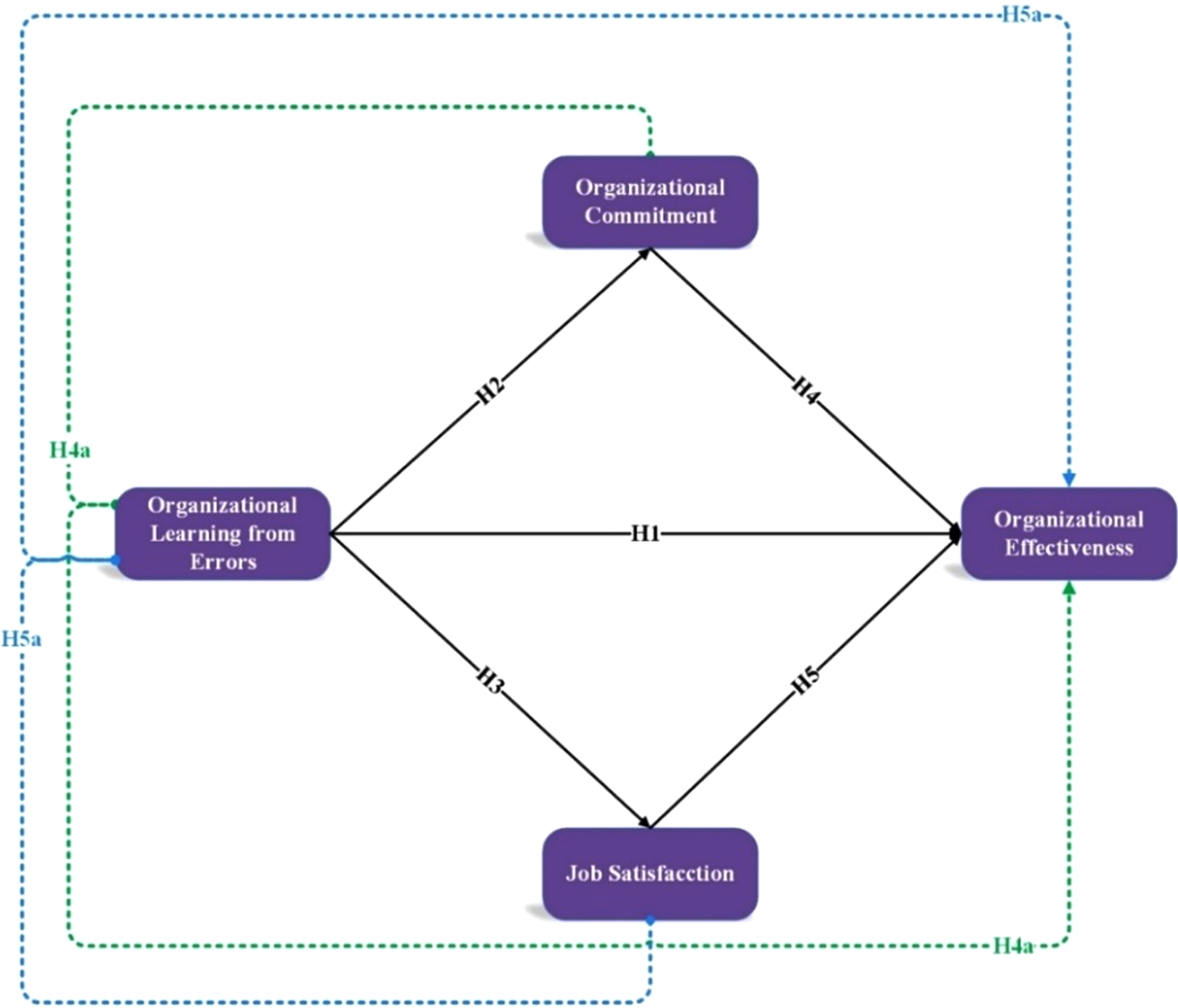
Study Theoretical Framework.
The present study is based on a hypothesis derived from existing theory; therefore, the deductive approach was adopted in this study. In the deductive approach, hypotheses are developed and derived from existing theory, and then the research strategy is designed according to the hypothesis. A quantitative research approach has been adopted in the current study. Statistical tests have been applied to analyze the data. A structured questionnaire with a 5-point Likert scale was used in the current study. This study’s target population comprises registered healthcare workers (Medical and Managerial positions) working in Pakistan’s public and private healthcare centers. Public and private healthcare centers have been selected to explore how organizational learning from errors influences organizational effectiveness under the mediating role of job satisfaction and organizational commitments. Sampling is a systematic process of selecting a portion of cases to depict the conclusion about the entire population. The convenience technique is appropriate when collecting information from the whole population is impossible. We have selected three major cities, i.e., Lahore, Islamabad and Karachi, for data collection due to their large healthcare center’s locations. In this study, 450 healthcare workers were selected by adopting a convenience sampling technique. The valid questionnaires received for data analysis were 409. Organizational learning from errors scale was adopted from the study of Putz [52]. Organizational commitment and job performance scales were adopted from the study of Goetz [53]. The organizational effectiveness scale was adopted from the study of Naveed [54].
This study used SPSS and SmartPLS-SEM for data analysis and hypothesis testing. Harman’s single-factor approach was adopted to test the common method bias. This study has no common bias because the variance extracted by one single factor is 16.292%, less than 50% [55].
Results
Table 1 represents the study participants’ demographics, including gender and education frequency distribution. In this study, 409 participants participated from the healthcare sector, of which 223 were male and 186 female.
Participants’ Demographic
Participants’ Demographic
Table 2 indicates the reliability analysis using composite reliability (CR), average variance extracted (AVE) and Cronbach’s alpha coefficients. The reliability values show that all scales are correctly calculated. This study’s reliability analysis results show that the current study instruments are reliable. All the constructs and alpha values fulfilled the minimum acceptable level of the alpha score, which was 0.70. Organizational Learning from errors has the highest Cronbach’s alpha value of 0.954, while organizational commitment has the lowest Cronbach’s alpha value of 0.838. Figure 2 is a graphical representation of measurement model results.
Reliability & Validity Analysis

Measurement Model Results.
Table 3 shows the result of the discriminant validity analysis. We applied Fornel Larcker & HTMT method for the discriminant validity analysis. All the values are within the range, as suggested by the researchers.
HTMT & Fornel Larcker Analysis
Table 4 shows the result of direct hypothesis results. H1 states that organizational learning from errors significantly and positively affects organizational effectiveness. At the 0.001 level, H1 is positively significant, and its standardized path coefficient is 0.332. Hence, H1 was supported. According to H2, organizational commitment is positively and significantly impacted by the ability to learn from errors. At the 0.001 level, H2 is positively significant, and its standardized path coefficient is 0. 611. Thus, H2 was accepted in this study. H3 states that organizational learning from errors has a positive and significant effect on job satisfaction. The H3 was accepted at the β= 0.599, p < 0.001. H4 states organizational commitment has a positive and significant effect on organizational effectiveness, which was accepted at the β= 0.289, p < 0.001. According to H5, organizational effectiveness is positively and significantly impacted by work satisfaction., which was accepted at β= 0.228, p < 0.001. A visual illustration of the structural equation model is shown in Fig. 3.
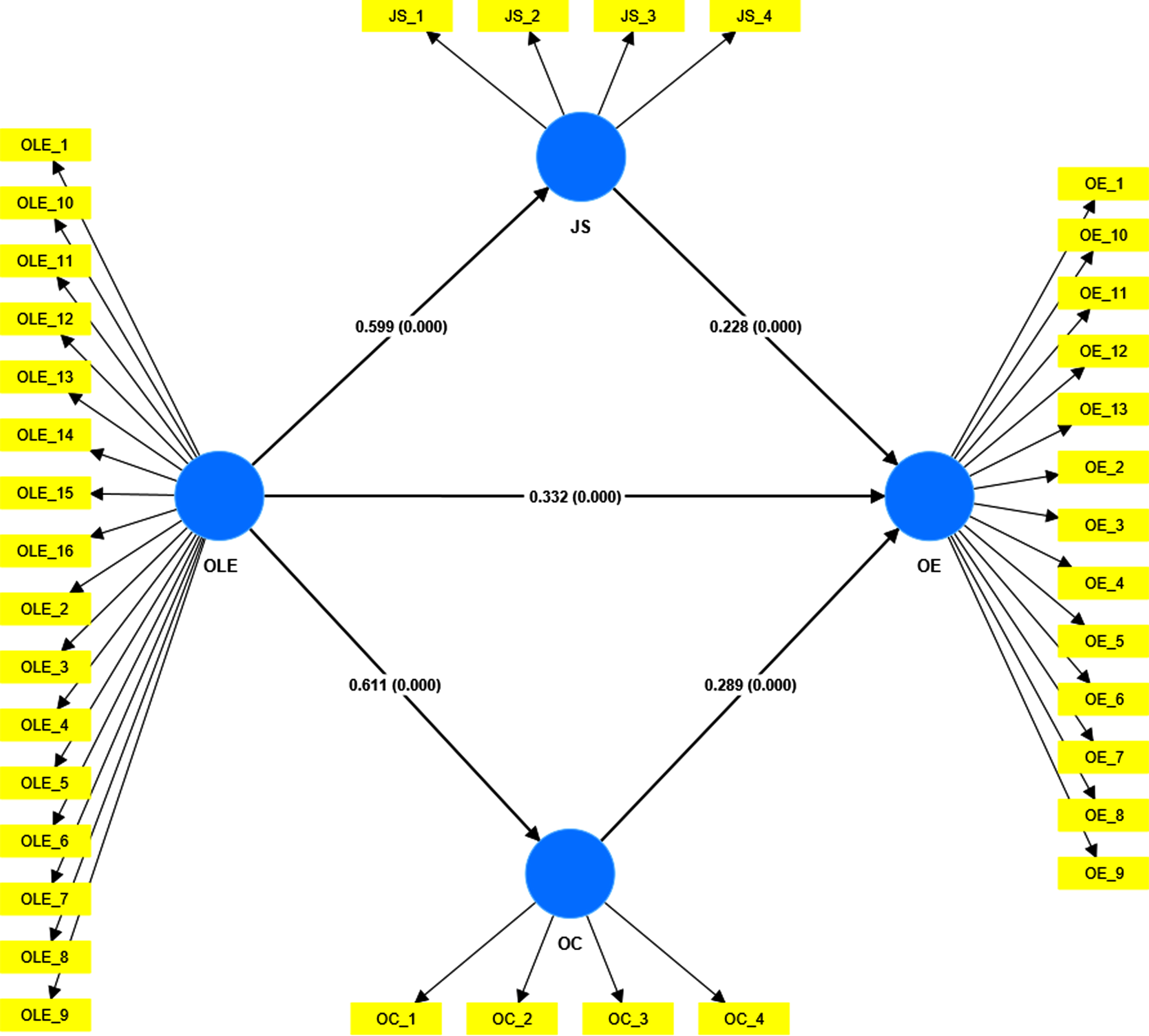
Structural Model.
Direct Hypotheses Results
OLE = Organizational learning from errors; OC = Organizational Commitment; OE = Organizational Effectiveness; JS = Job Satisfaction; ***p < 0.001.
Table 5 depicts the mediating effect of organizational commitment on the association between organizational learning from errors and organizational effectiveness (β= 0.176, p < 0.05). Job satisfaction mediates the relationship between organizational learning from errors and organizational effectiveness. So, the H5(a) was accepted in this study (β= 0.136, p < 0.05). These results indicate that the relationship between organizational learning from errors and organizational effectiveness strengthens in the presence of job satisfaction and organizational commitment.
Mediation Analysis
SE = Standard Error; OLE = Organizational learning from errors; OC = Organizational Commitment; OE = Organizational Effectiveness; JS = Job Satisfaction; ***p < 0.001; **p < 0.01.
Table 6 illustrates the R2, adjusted R2, Q2 and F2 values. Organizational effectiveness has the highest R2 value of 0.527. The adjusted R2 values of job satisfaction, organizational commitment and effectiveness are 0.357, 0.372 and 0.524, respectively.
Quality Criteria
OLE = Organizational learning from errors; OC = Organizational Commitment; OE = Organizational Effectiveness; JS = Job Satisfaction.
Organizational learning is vital to organizational effectiveness, job satisfaction and commitment. The current study examines how organizational learning from errors influences an organization’s effectiveness by considering the mediating role of organizational commitment and job satisfaction in the healthcare sector. In particular, the ability to learn is vital for the health sector since skills and knowledge can speedily become outdated just because of the continuous improvement of medicine and science. The transformation process of organizations and enterprises into learning organizations has pointed out that learning organization is an imperative tool to improve efficiency and effectiveness. Umpteen studies have demonstrated that organizational learning has been widely explored in the corporate atmosphere; hence, it is a new concept for healthcare systems. The current study provides directions to the health sector on how this sector can enhance its effectiveness by introducing learning from errors within hospitals for administrative and medical staff. Organizations with learning mechanisms have a great influence on enhancing organizational effectiveness. As learning organizations use strategic tools and plan to polish the employees’ learning skills, it ultimately positively affects employees’ commitment and overall organizational performance. Employees with learning aptitude are considered keystones to improving organizational performance. The learning organizations become more effective by boosting employee performance and learning how to survive in the changing culture and global competitiveness. They focus on the factors that are changing day-by-day businesses. These factors might be the innovation in products and services and a flexible work environment for the employees. Moreover, organizations focus on retaining and developing their employees and building them as one team to achieve organizational goals. Learning organizations also assist their newly hired employees and provide them with complete training and e-trainings so that employees get training worldwide wherever the organization and its branches exist.
The study findings concluded that learning from errors positively and significantly affected organizational effectiveness. Tseng [56] also stated that different learning practices substantially improve organizations’ effectiveness. Ahmad and Bakar [57] stated that the path coefficient between organizational learning and effectiveness is substantial.
Furthermore, current results are also supported by some previous studies [58]. The present study revealed that organizational commitment significantly mediates the relationship between organizational learning from errors and effectiveness. There is scant literature on the mediating role of organizational commitment and job satisfaction in the relationship between organizational learning from errors and organizational effectiveness among health sector employees, especially in Pakistan. The current study outcomes also described that employees collaborate and promote team building in the organization’s department when organizational learning continues. Organizations strengthen employees by giving them authority and providing a completely flexible working culture in which employees learn techniques and strategies from each other, circulate information throughout the organization with transparency and develop proper channels and systems through which strategies are being made and communicated to employees at all levels.
However, the committed employees demonstrate a higher interest in organizational activities such as learning programs and training, which augments organizational performance.
The current study also presents some study limitations. Firstly, the study was conducted in the healthcare center of Pakistan. Secondly, the data was collected from only the healthcare centres in Pakistan. So, future studies might consider other service industries, such as banking and telecommunications, and data can be collected from countries such as India and Bangladesh. The current study didn’t explore the influence of demographic characteristics on organizational learning from errors. In the future, the researcher can further explore how demographics play a role in enhancing organizational effectiveness.
It is suggested that future studies consider large sample sizes to analyze the vast range of data collected by different individuals and organizations. Different cultures should be considered as cultural changes influence organizational efficiency. In multiple cultures, individuals have different mindsets and respond differently to any change. Studies in dynamic cultures can help in proper strategies to achieve organizational commitment. Longitudinal studies should gather data from the same individuals in different work and learning environments. Future researchers should use multiple moderation variables to explain the relationship between organizational learning from errors and organizational effectiveness and the impact of organizational commitment on theirrelation.
Study implication
Employees working in Pakistan’s health sector have immense value in meeting the diverse goals of hospitals/healthcare centers. Providing a learning environment to employees has become a challenging issue recently. The government is endeavoring to accomplish this goal by conducting different training programs. Hence, the present research study provides an important understanding to the government and policymakers that organizational learning has an essential effect on the effectiveness of an organization, so it would be appreciable to provide an atmosphere of learning to the medical and managerial staff of the health sector in Pakistan.
The present research outcomes can enhance the government’s understanding of how to improve the performance and efficiency of the individuals working in the health sector by providing them with an environment where they can learn and apply what has been learned. Organizational commitment plays a crucial role in the performance and effectiveness of the organization. It plays a vital role in the organizational competitive advantage. As the employees of any organization are the most important asset, their empowerment and commitment play a critical role in the organization’s success.
Conclusion
Organizational learning from errors and innovations plays a pivotal role in organizational effectiveness and commitment globally. Competition among organizations is increasing with high intensity, and it requires multiple ways to gain a competitive advantage among the competitors to succeed in the competition. Organizations are changing their culture by moving towards a more informative and knowledge-gaining organizational culture. These changing cultures are essential because information rotation and increased knowledge are the only keys to matching changing and innovative technology. Employees need to improve their skills and knowledge to become a source of development for the organizations. These distinguishing characteristics of any organization lead them to achieve a competitive advantage in both the competitive environment and the changing technology. Organizational learning includes informal and formal learning, which helps achieve organizational and individual goals. The current study examines how organizational learning from errors influences an organization’s effectiveness by concentrating on the mediating role of organizational commitment and job satisfaction in the health sector. This research uses the healthcare workers as respondents, thus assisting the top management of healthcare centers in how the effectiveness of healthcare centers can augment by providing an atmosphere of learning to the employees, who play an integral role in treating patients in the healthcare centers. This research also provided a learning paradigm for healthcare workers. The present research can enhance the government’s understanding of improving the individuals working in the health sector by providing them with a learning environment. The study findings are useful to the policymakers and managers for achieving organizational performance in the healthcare sector.
Footnotes
Acknowledgments
The authors have no acknowledgments.
Author contributions
CONCEPTION: Muddassar Sarfraz and Muhammad Ibrahim Abdullah
METHODOLOGY: Larisa Ivascu and Umair Ahmad
DATA COLLECTION: Umair Ahmad, Muddassar Sarfraz and Muhammad Ibrahim Abdullah
PREPARATION OF THE MANUSCRIPT: Muddassar Sarfraz and Larisa Ivascu
REVISION FOR IMPORTANT INTELLECTUAL
CONTENT: Larisa Ivascu, Umair Ahmad and Muddassar Sarfraz
SUPERVISION: Muddassar Sarfraz