




Abstract
BACKGROUND:
In recent years, social media has surged in popularity and affected every facet of people’s lives from the office environment to leisure time by transforming their lifestyles and influencing well-being.
OBJECTIVE:
The purpose of this study is to investigate the impact of social networking usage on the subjective well-being of users by first determining the key gratifications that motivate them to use social networking sites by applying the uses and gratification theory, and then focusing on psychological outcomes such as social capital that affect their subjective well-being.
METHOD:
The data were collected from 400 students of reputed universities in North India by adopting a judgemental sampling technique.
RESULTS:
Results indicated that key gratifications such as entertainment, tension release, personal integration, information seeking, emotional connection and socialization played a significant role in social networking usage. Moreover, social networking usage had a significant impact on bonding social capital, bridging social capital and subjective wellbeing. Furthermore, results showed that bonding social capital, and bridging social capital could significantly mediate the relationship between social networking usage and subjective well-being.
CONCLUSIONS:
Social networking usage has the potential to promote social capital and subjective well-being by addressing the fundamental needs of users in life.
Introduction
Everyone wants to keep linked throughout the world, but owing to hectic and busy schedules, face-to-face engagement with friends, relatives, and other acquaintances has decreased dramatically. But people have found an alternate means of communicating and socialising outside the limits of time and place to meet this main desire for belongingness and love: “the Internet” [1]. This type of communication media has shown to be a blessing to those who feel compelled to engage, preserve existing bonds, and develop new ones. The Internet has also opened a slew of new communication channels, including instant chats, e-mails, blogs, social network sites (SNS), and so on, all of which are heavily used by users to facilitate effective communication. According to statista.com, the use of social networking sites in India is increasing in tandem with the use of the Internet. Growing digitalization and internet accessibility enable over 560 million people in India to utilise the internet actively. India is the second-largest user base (560 million) after China (854 million) [2]. Moreover, social networking sites (SNS) allow users to create a profile that is visible to others and displays the list of their connections/friends [3]. In addition to this, it enables the users to post photos, update status/videos, write articles, create web pages etc. They can also give and take feedback from others on their updates by using like and comment buttons [4]. In this way, the users can create their social networks virtually. Hence, the way individuals communicate with one another has changed dramatically with the advent of social media, and this advent has the potential to change how people evaluate their lives by altering attitudes and judgemental processes.
Moreover, literature has demonstrated that these social networking sites help to develop social capital by making new and maintaining existing relations with friends, family, and acquaintances [3, 5]. Previous studies have also examined the relevance of these mobile communications on the subjective well-being of users [6–8]. Subjective well-being refers to a person’s general views, consciousness, and assessments of his or her life situations or specific life domains.
As social networks become more geographically fragmented, SNS are also a good tool to stay in touch and seek social contact with friends. Users encounter a variety of content on social media and not all of it can be blamed for harming human life [9, 10]. The intent of using social media and looking for useful information could aid users in improving their quality of life and personal well-being. Considering the positive outcome of social media usage, Nabi and Prestin [11] claimed that usage of social media positively influences the life satisfaction of individuals. Moreover, of all the perceived advantages of using social media, perceived social support is one of the most important elements that drive social media use and, ultimately results in improving an individual’s well-being. However, some researchers claimed the association between social media use and life satisfaction was detrimental [12]. Therefore, previous research findings appeared to be insufficient in understanding the psychological effects of social networking site use and despite the widespread use of social networking sites, only a small amount of study has been published on the motives of SNS usage and its psychological effects.
Therefore, the study investigated the following research questions to examine the impact of social networking sites on users’ subjective well-being: (a) Do social networking usage influence the subjective well-being of SNS users? (b) Do social capital (bridging social capital and bonding social capital) mediates the social networking usage and subjective well-being relationship?
SNS has emerged in recent years in the Indian context and has gained enormous popularity among the masses and classes. Yet only a few empirical studies have been undertaken utilising variable social networking usage. This research would be the first of its kind in India. Moreover, past research mainly focused on the antecedents of social media use such as gender, age, personality traits and social skills etc and negative outcomes such as lowers academic performance [13], loneliness, depression, narcissism [14] and reduce face to face interactions etc related to social media addiction and problematic use. Furthermore, the majority of studies use self-reported time-specific predictors (the amount of time spent on social networking sites, and the frequency of checking social networking sites) and the size of networks to measure social media use [15–18]. These social media predictors, however, may be too general to result in significant relationships with well-being components. Such predictors might be beneficial for outcomes like distraction or procrastination, which could be caused by time spent on social media. As a result, there is more of a need to concentrate on content-based predictors of social networking usage. To understand the dynamic relationship between SNS use and psychological determinants, special consideration must be given to the underlying motivations for social networking site use. This study makes an important contribution by determining how various dimensions of social networking usage (motives) are related to social capital and subjective well-being. Moreover, a different perspective is required when it comes to student social media use as their level of social media participation may have an impact on their lives. Therefore, the purpose of this research is to answer these questions and explore their implications.
Theoretical framework and hypotheses development
Uses and Gratification Theory (U&G)
Uses and gratification theory is used to develop the hypotheses in the study as this theory is a widespread theoretical base for media and communication studies [19, 20]. This theory is proposed by Elihu Katz and his colleagues (Jay Blumler & Michael Gurevitch) in 1973, helping to understand the relationship between the variables more concisely. This theory aids in understanding the socio-psychological needs of people to engage in social media meaning their reason to use that particular media and the selection of content they want to consume on that media [21]. This theory postulates that users consume such media in a goal-directed way to gratify their needs. While this theory was originally developed to investigate the gratifications gained from watching television and listening to the radio, it has since been adapted for the study of social media and its various components, including gratifications from Facebook use, social media apps [22], social capital [23], and motivations for social media use [24, 25]. Furthermore, many scholars have applied this theory to various social media platforms such as Facebook [26, 27], Instagram [28], Twitter uses [27, 29], YouTube [30], and Pinterest [31], all of which contribute to the credibility of using this theory for the current study [32]. Different people have different reasons to engage in a particular media to gratify different needs. As a result, the uses and gratification theory was used as the foundation for developing an instrument that will tap motivations for social networking use in the current study. Some explorations have demonstrated that hedonic, cognitive, social, personal, and habitual uses are motivations to use social media but not all uses are consistently gratified. Because people’s engagement in media affects their behaviour and attitude [12, 33]. So, these gratifications of using social media have either positive or negative impacts on users’ behaviour. Therefore, it is expected that this usage of social networking sites or online behaviours will have an impact on the subjective well-being of users. Therefore, the theory is considered a suitable theoretical base for studying the relationship between social networking usage and subjective well-being.
Subjective Well-being (SWB)
Subjective well-being is the subjective assessment of one’s life i.e., evaluation of one’s own life and how satisfied, and happy we are in our life. It includes people’s emotional responses (more positive or less negative emotions), and global judgements of life satisfaction [34]. It is a state of positive mental health and wellness. It refers to a person’s general views, consciousness, and assessments of his or her life situations or specific life domains [35, 36]. It is a multi-faceted construct that primarily comprises cognitive assessments of overall life satisfaction, as well as affective assessments of moods and feelings [6, 37] and these different assessments (life satisfaction, positive affect, and negative affect), represent one’s subjective perception of the life experience.
Social capital (SC)
Social capital can be categorized into two aspects- Bonding social capital and bridging social capital which is differentiated on two basis- relationship strength and type of resources provided [38]. Bonding social capital is defined as resources derived from close relationships, such as family members and close friends, with a high degree of trust and closeness. They are well-defined homogenous groupings that engage on a small scale. As a result, bonding capital is more likely to provide emotional support and spontaneous assistance [3, 16]. However, bridging capital reflects the resources from weak ties or heterogeneous groups, such as casual acquaintances with little intimacy and fewer social connections. Weak ties serve as a bridge between relationships in various clusters, allowing for the closure of structural gaps between previously unconnected groups. They can also provide access to new information and allow for the mobility and spread of heterogeneous data [39].
Social networking usage (SNU)
Social networking sites (SNS) are defined as “virtual social networks” which are online platforms that enable users (i) to create a bounded system for public or semi-public profiles, (ii) a comprehensive list of users of social networking sites with whom they are connected, (iii) to view and navigate their contact list as well as contacts made by others within systems [3]. Some examples of enlisted social networks include Facebook, Twitter, Snapchat, Whatsapp, Friendster, Myspace, Telegram etc. The popularity of social networking as a communication medium is rapidly increasing owing to the rapid growth of mobile devices. Students use social networking sites to connect, communicate, share, build, and maintain connections with others for socialization, entertainment, information, and academic purposes. Young adults are becoming accustomed to sharing their daily lives and experiences online, as well as keeping in touch with friends, family, and teachers, and discussing their life experiences [40]. Moreover, following a review of the prior literature on social networking usage, it was discovered that information, enjoyment, social, mood regulation, pass time, and conformity are the specific needs for utilising social networking sites [41]. However, Eid and Al-Jabri [42] identified enjoyment and entertainment, file sharing, content creation, online discussion, and chatting are the key motivators to use social networking sites. In the same vein, Pornsakulvanich and Dumrongsiri [43] explored friendship, passing time, relationship maintenance, trend, entertainment, and relaxation are the particular needs of the users to use social networking sites. Moreover, Jenkins-Guarnieri, Wright and Johnson [44] analyse the daily routines of users, as well as the combination of social behaviour and emotional connection, and the relevance of this use. So, based on the literature review and theoretical framework, this study used six dimensions entertainment, tension release, personal integration, information seeking, emotional connection and socialization to measure social networking usage. Hence the following hypothesis has been proposed.
Social networking usage and subjective well-being
Information and communications technologies such as mobile devices, the internet, and social networking platforms have become ubiquitous, and it is difficult to imagine life without them [45–47]. While the primary goal of technological advancement is to improve the quality of life and provide support to society, it is widely believed that social networking sites (SNS) facilitate communication and induce happiness in human life [48–50]. But since technologies are abstract objects while individuals are the primary drivers and users, the use or misuse of technologies and their potential effects depend on the users [51, 52]. People use social networking sites to seek information about the people around them, gain knowledge, and form social connections by making new relationships and maintaining existing relationships with family and friends [53]. These sites enable the users to express their feelings, enjoy their time, having fun with the content on social media and with their friends [54, 55] and all these gratifications from social media influence the behaviour, attitude, and feelings of the users [56, 57] and this impact may be positive or negative for users’ well-being. Earlier research found that high usage of social networking sites has a negative impact on subjective well-being [58] but, Lai, Hsieh, and Zhang [59] observed a positive relationship between social media usage and subjective well-being. However, these inconsistencies can be explained by how the users use social media and it will determine whether the outcome is positive or negative [9, 51, 60]. The positive impact of SNS on well-being could be attributed to the accumulation of diverse information, improving users’ emotions [22, 61]. Earlier research discovered that active usage of social networks (commenting on other accounts’ stories, messages, or images) is associated with a higher level of subjective well-being. In contrast, passive participation (seeing other user profiles or seeking information about other accounts) is associated with a lower level of self-worth and subjective well-being [59, 62, 63]. Moreover, active social media usage (posting, commenting) predicted positive outcomes (perceived social support) while passive social media usage (only browsing other’s profiles) predicted negative outcomes (upward social comparisons). However, few of them investigated the causes of these effects and provide policy guidelines to intervene in the use and benefits of these unavoidable technologies. While users experience an abundance of information on SNS, not all of it can be blamed for having a negative impact on human life [9, 10]. The intention of SNS use and the search for good information may assist users in improving their quality of life and personal well-being. Further, as per the uses and gratification theory, people use social media to seek specific information, which gives them satisfaction once they find it. As a result, the more and more diversified information users find on social media, the better they will feel about their interaction with the platform. This could lead to an increase in subjective well-being [64]. However, previous studies mainly focused on the duration of using such sites and the intensity of social media usage (emotionally connected to social media) which is a narrow view to measure the well-being of users. So, the present study will remove this limitation and consider individuals’ roles in interacting with SNS in daily life [65, 66], and the previous literature review, the following hypothesis has been proposed.
Social networking usage and social capital
Social networking sites have become key platforms for the creation and maintenance of social capital since the age of Web 2.0-enabled technology-mediated interaction, where individuals can engage with their virtual relationships at any time and from any location via their networked mobile devices [67, 68]. SNSs connect individuals with existing offline relationships with loved ones while simultaneously growing their online networks through connections with people from all over the world who have similar interests [69]. SNSs have recently been identified as an effective way to allow people to build up and promote their online bridging and bonding social capital. According to Ellison et al. [70] relationship maintenance actions on Facebook, such as wishing and sympathising with other people, result in enhanced bridging social capital. Therefore, social networking usage is a new form of interaction among people [71] and the affordance of this media able the users to maintain their weak ties to facilitate bridging social capital [70]. Moreover, their ease of accessibility not only helps the users in bridging weak ties but also helps the users to expand their social network. Also, social networking usage helps to maintain close relationships through emotional support, spontaneous help, communicative use, friending, and self-disclosure to facilitate bonding social capital [72]. Similarly, Gil de Zuniga et al. [73] discovered that political discussion and information-seeking using SNSs anticipated social capital. Moreover, Phua and Jin [69] discovered that SNS use had a beneficial effect on bridging social capital and bonding social capital in the higher education environment. As a result, SNSs can play an important role in influencing users’ online social capital. Similarly, Tong and Walther [74] concluded that social networking helps users to maintain their strong and week ties. Accordingly, the authors proposed that social media usage (information seeking, socialization, emotional connection) would be positively associated with both bonding and bridging capital. However, no literature found regarding the relation of social capital with social media usage in the context of entertainment usage, personal identity, and tension release. So, the present study will remove this limitation and include these motives in social media usage. Hence the following hypothesis has been proposed.
Social capital and subjective well-being
Previous studies have identified significant shreds of evidence that social capital could impact the subjective well-being of people [3, 37, 75, 76]. The connection between social capital and well-being was found to be positive due to community support and sharing. A sense of belongingness was developed when people feel a social connection online which reduces loneliness and depression [72] and these quantity and quality relationships lead to psychological satisfaction and enhance their subjective well-being [77]. Helliwell and Huang [78] proposed that differences in well-being can be explained by differences in social capital. For example, studies by authors [79, 80] demonstrated that perceived social capital directly influenced the quality of living of journal bloggers. Similarly, Nabi and Prestin [11] revealed that emotional and instrumental social support is related to the overall well-being of Facebook users because it decreases stress and improves physical health. Additionally, a researcher showed that computer-mediated communications with strong ties (close friends and family) or bonding social capital influence the subjective well-being of users in Japan [81]. Moreover, Ghamari [82] also revealed a positive relationship between social capital and happiness among high school students of Karaj city. Similarly, Woo and Kim [83] anticipated considering health, social status, and belief, revealed that social capital has a positive impact on life satisfaction in Taiwan. In the same vein, researchers [84, 85] claimed that WeChat (SNS) aids students in enhancing their relations with close friends, making new friends, and providing social support which leads to improve their subjective well-being because people feel secure and cherished and they have more opportunities to receive meaningful resources [72]. So, based on these studies, this study is assuming that developing strong ties with close friends/family and making new friends expand the social network and leads to bonding and bridging social capital which enhances the subjective well-being of individuals because it develops a sense of trust and intimacy among them. Hence, the following hypothesis is proposed.
The mediating role of social capital
In addition to the direct effect of social media usage on subjective well-being, the authors attempted to explore the underlying mechanism and suggested a mediation effect of bridging and bonding social capital between social media usage and subjective well-being. Nabi and Prestin [11] examined that usage of social media enhances subjective well-being (life satisfaction) and perceived social support is a major factor that influenced social media usage behaviour and results in high well-being of users [86]. Similarly, Ang et al. [87] concluded making friends online through computer-mediated communication helps in meeting the psychological needs of individuals which leads to high life satisfaction of them. Moreover, a study by Valkenburg and Peter [88] predicted that the relation between social media usage and well-being is indirectly influenced by closeness to a friend online. Furthermore, having many friends on social networking sites helps to improve both bridging and bonding social capital, as well as reduce loneliness and improve life satisfaction [89]. As a result, social media usage aids in the maintenance of strong ties with friends and family, facilitating bonding social capital and improving weak ties with acquittances, which in turn makes people feel cared for or valued, and that they have more access to resources and opportunities, enhancing their well-being. Moreover, researchers [86, 87] conducted a study on computer-mediated communication and life satisfaction and argued that online friendships aid in the fulfilment of an individual’s psychological needs which improves life satisfaction. Therefore, social networking usage enhances the social capital of users and improves subjective well-being. Users feel more optimistic when they get the necessary support from their friends which helps in improving their subjective well-being. Oh, Ozkaya and LaRose [90] also reported that interaction with people through social networking sites leads to a sense of community and social support, which positively impacts life satisfaction. Therefore, in this study, we proposed that bridging and bonding social capital could mediate the relationship between social media usage and subjective well-being.
Conceptual model
Based on the above literature and hypotheses, the following conceptual framework has been framed as shown in Fig. 1.
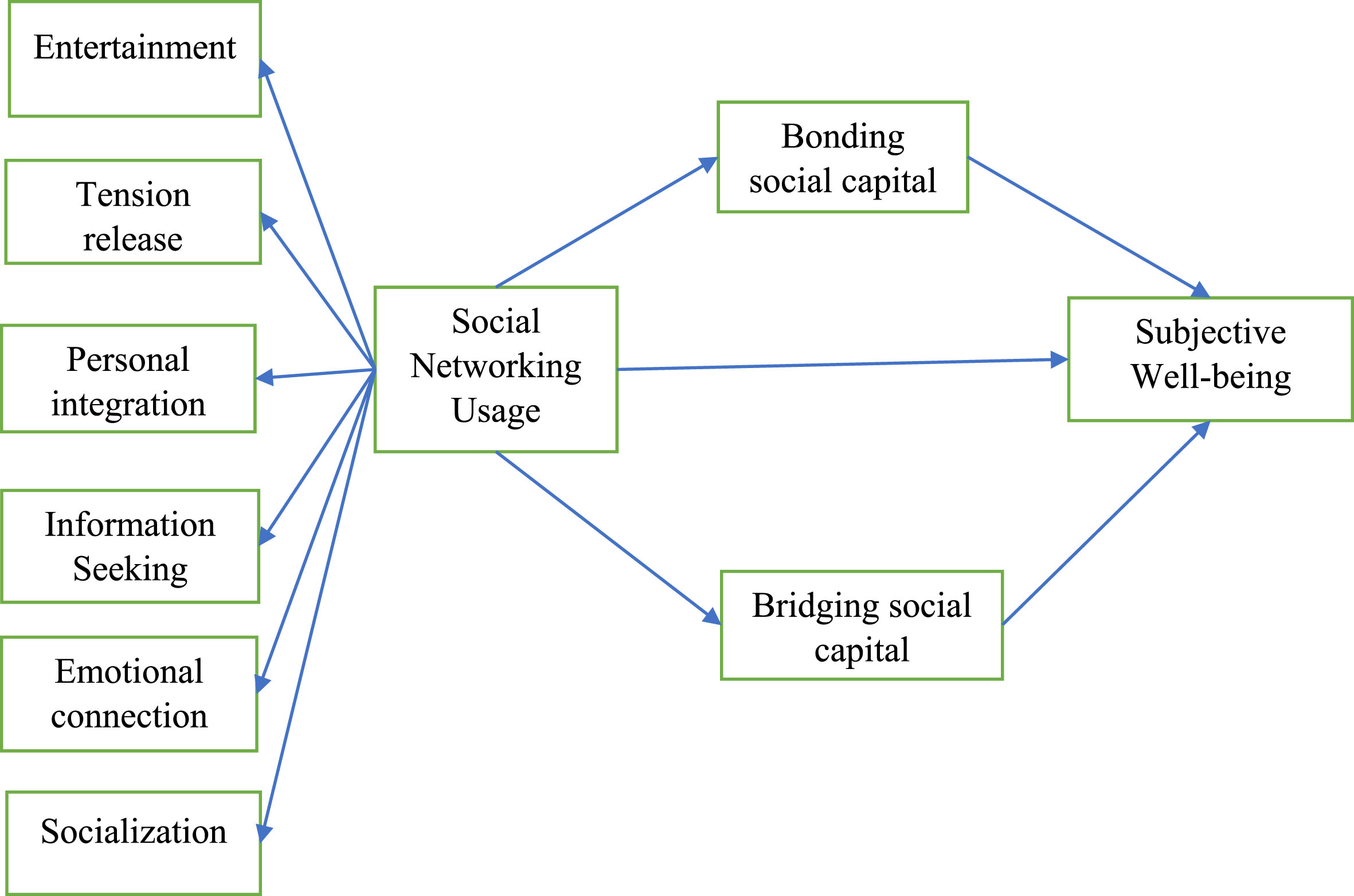
Conceptual model.
Sample and procedure
This study aims to investigate the relationship between social media usage and the subjective well-being of university students in north India. A total of 450 questionnaires were distributed to students who use at least one social networking site, with 27 students declining and 423 students accepting. The study used a large sample size: First and foremost, a large sample size accurately represents the population. Second, it reduces the impact of outliers or extreme observations. Finally, enough samples are required to produce results among variables that differ significantly. After removing outliers and unqualified responses, 400 remained, resulting in an 89 per cent response rate for the analysis, which is relatively high when compared with previous research in the social sciences [62]. The higher response can be explained by ensuring respondents’ anonymity and privacy. According to Tomaskovic-Devey et al. [49], for homogeneous data, any response rate between 30% and 35% is adequate to limit non-response bias. Data was collected through the online survey utilizing google forms as well as personally from students of some reputed universities like Panjab University, Chandigarh, Punjabi University, Patiala, Thapar University, Patiala etc. of north India. Judgmental sampling was employed to collect data from students of different age groups and courses. To make the sample more representative, it included students from urban, rural, and semi-urban areas, as well as from various economic groups.
Instruments
Social media usage
A total of 31 items were included in the social media usage scale (appendix). The measurement scale is based on the uses and gratifications needs (entertainment, tension release, personal integration, information seeking, emotional connection and socialization) adapted from [3, 40, 91, 92]. The scale comprised 3 items of entertainment, 4 items of tension release, 5 items of personal integration, 8 items of information seeking, 4 items of emotional connection, and 7 items of socialization. The participants expressed their degree of (dis) agreement (1-strongly disagree; 5-strongly agree) on a 5-point Likert scale.
Social capital
A scale developed by Williams [93] was used with modifications to assess the individuals’ social capital online (appendix). This internet social capital scale is a bi-dimensional construct that determines the bonding social capital and bridging social capital. The participants expressed their degree of (dis) agreement (1-strongly disagree; 5-strongly agree) on a 5-point Likert scale of 10 statements with higher scores suggesting high bonding/bridging social capital. The scores of five items were averaged to form a scale of bonding social capital. and the scores of the other five items averaged to form bridging social capital.
Subjective well-being
A total of 15 items were included in the subjective well-being scale comprised of 5 life-satisfaction items, 5 items of positive affect and 5 items of negative affect (appendix). The measurement scale of Diener et al. was used to measure global cognitive judgments of one’s life satisfaction [34]. The answers to these questions were reported on a 5-point Likert scale (1-strongly disagree; 5-strongly agree). Then items of positive affect and negative affect were adapted from the SPANE scale (Scale of Positive and Negative Experience) [94]. The answers to these questions were reported on a 5-point Likert scale (1-very rarely/never; 5-very often/always). The items of negative affect were reversely coded.
Data analysis
The data was collected and coded in SPSS version 23. So, the reliability of the instrument was determined using Cronbach’s alpha in SPSS and validity was examined using Confirmatory Factor Analysis (CFA) in AMOS Version 21.0. Moreover, hypotheses testing of direct effects was conducted through structural equation modelling in AMOS 21.0 and indirect effects were conducted through Model 4 of Hayes ‘PROCESS macro with bootstrapping 5000 at a 95% confidence level [97]. Bootstrapping is recommended by previous researchers because it accurately assesses the significance of indirect effects [98, 99]. A minimum sample size of 200 people has been recommended in previous studies to conduct structural equation modelling (SEM) [95, 96]. This study was conducted on 400 respondents. As a result, the fundamental need for using SEM analysis has been fulfilled.
Results
Demographic characteristics of the respondents
The demographic profile of the respondents has been shown below in Table 1.
Demographic characteristics of respondents
Demographic characteristics of respondents
(Source: Primary Data).
As one respondent answered every question on the questionnaire, there is a risk of common method bias. Thus, this study employs two methods to exclude the CMB dilemma and ensure respondents’ privacy and secrecy [100]: Harman’s single factor test and the common factor analysis test. Using “Harman’s single-factor test,” this paper investigates the percentage of variance caused by a “single factor” [101]. The results show that the single factor with the greatest eigenvalue explains only 25.40 per cent of the variance which is less than Harman’s stated criteria of fifty per cent [101, 102], implying that the instrument was free of the problem of common method variance. As a result, statistical data suggest that common technique bias does not pose a threat to the interpretation of the current study’s findings.
Factor analysis and measurement model
Before the factor analysis, recommended aspects, such as appropriate sample size and the Kaiser-Meyer-Olkin (KMO) Measure of Sampling Adequacy and Bartlett’s Test of Sphericity were reviewed and examined [103]. As a result, the current study’s effective sample size of 400 is adequate for analyzing the proposed model. Table 2 shows the Kaiser-Meyer-Olkin Measure of Sampling Adequacy and Bartlett’s Test of Sphericity. KMO value greater than 0.8 shows that the sample for the study is adequate and Barlett’s test shows a p-value<0.01 supporting the factorability of the correlation matrix.
KMO and Bartlett’s test
KMO and Bartlett’s test
(Source: primary data).
After that, Exploratory Factor Analysis (EFA) with varimax rotation was used to evaluate the scales’ applicability for the current study as shown in Table 3. Moreover, Confirmatory Factor Analysis (CFA) is a statistical method for confirming the factor structure and determining the relationship between observed variables. Then, the proposed model was analyzed to reveal the values of model fit i.e., CMIN/DF=2.62≤3 [64], PGFI = 0.63 > 0.5 [65], CFI = 0.92 > 0.9, TLI = 0.91 > 0.90 and RMSEA = 0.07 < 0.08 [66]. All the values are within the threshold limits representing the goodness of model-fit [104].
Rotated component matrix
The reliability of the scales was tested by using Cronbach’s alpha coefficient. Cronbach’s alpha above 0.7 is considered good for the scales’ reliability [105]. Table 4 depicts Cronbach’s alpha of the scale items.
Reliability
Reliability
The study continues with an examination of the confirmatory factor analysis (CFA). After identifying the factors from the EFA, the CFA is used to validate scales in terms of convergent and discriminant validity [106]. A validity master in the stats tools package was used to calculate the values of convergent and discriminant validity. To achieve convergent validity, factor loadings should be greater than.50 (95), AVE > .5 [107], and composite reliability (CR) should be greater than 0.7 [108] as shown in Table 5. The Fornell and Larker criterion is used to achieve discriminant validity, in which the correlation coefficient should be less than.85, (off-diagonal elements are correlation between constructs) and AVE square root scores or diagonal values of all variables (bold) should be greater than correlation values in the corresponding row and column showing the variables exhibit discriminant validity [109, 110]. Following that, the model was used for the final analysis of hypotheses testing.
Convergent and discriminant validity statistic of variables
Convergent and discriminant validity statistic of variables
Source: Primary Data. Note: 1. CR = Composite reliability, AVE = Average variance extracted MSV = maximum shared variance. 2. SNU-Social networking usage, SWB-Subjective well-being, BOSC-Bonding social capital, BRSC-Bridging social capital.
Social networking usage dimensions
Exploratory Factor Analysis (EFA) and Confirmatory Factor analysis (CFA) ensures the significant role of entertainment, tension release, personal integration, information seeking, emotional connection and socialization in social networking usage supporting hypothesis 1. The fitness of the model shows that the dimensions used in this study are comprehensive enough to measure social networking usage.
Structural equation modelling (results of direct effects)
The structural Equation Model in Amos version 21 was applied to test the direct hypotheses. Table 6 depicts the significant positive relationship between social media usage and subjective well-being (CR = 2.365, p < 0.05) (H2), and the significant positive relationship of social networking usage with bonding social capital (CR = 3.717, p < 0.01) (H3a) and bridging social capital (CR = 3.944, p < 0.01) (H3b). Similarly, a significant positive association was found between bonding social capital and subjective well-being (CR = 2.470, p < 0.05) (H4a) and bridging social capital and subjective well-being (CR = 2.780, p < 0.01) (H4b). It leads to the acceptance of hypotheses H2, H3a, H3b, H4a and H4b as shown in Fig. 2.
Direct effects
Direct effects
Notes: 1. *** p-value < 0.01; ** p-value < 0.05 and * p-value < 0.10. 2. SNU- Social networking usage, SWB- Subjective well-being, BOSC- Bonding social capital, BRSC- Bridging social capital.

Structured equation model: Source: AMOS output. Notes: SNU- Social networking usage, SWB- Subjective well-being, BOSC- Bonding social capital, BRSC- Bridging social capital.
The impact of social networking usage on subjective well-being was also examined indirectly through bonding social capital and bridging social capital. It was observed that the effect of bonding social capital (β=.0843, p < .05) in the relationship between social networking usage and subjective well-being was statistically significant. Moreover, the relation between social networking usage and subjective well-being is also significantly mediated by bridging social capital as (β=.1007, p < .05) leading to the acceptance of H5a and H5b respectively. The results supported H5a and H5b depicting that there exists partial mediation in the relation between social networking usage and subjective well-being through bonding and bridging social capital because the direct relationship between social networking usage and subjective well-being is also significant through bonding and bridging social capital as shown in Table 7 [97].
Indirect effects
Indirect effects
Notes: 1. *** p-value < 0.01; ** p-value < 0.05 and * p-value < 0.10. 2. SNU- Social networking usage, SWB- Subjective well-being, BOSC- Bonding social capital, BRSC- Bridging social capital. 3. Number of bootstrap samples for bias-corrected bootstrap confidence intervals: 5000. Level of confidence for all confidence intervals: 95%.
This study is an attempt to investigate the impact of social networking usage on the subjective well-being of students in universities of north India by first determining what are the key gratifications that motivate them to use social networking sites applying uses and gratifying theory, and then focusing on psychological outcomes such as bonding social capital and bridging social capital from using social networking sites that affect their subjective well-being. So, the data evaluate using confirmatory factor analysis ensures the role of different factors (entertainment, tension release, personal integration, information seeking, emotional connection and socialization) in the social networking usage supporting hypothesis 1. It means these factors play a significant role in social networking usage. The results support the usage and gratification theory which explains that there are socio-psychological needs for people to engage in social media and users consume such media in a goal-directed way to gratify their needs [28]. Moreover, the relationship between social networking usage and subjective well-being was found positive and significant, which leads to the acceptance of H2. The results are consistent with the results of past studies [59, 111]. Results imply that social networking usage in terms of entertainment, tension release, personal integration, information seeking, emotional connection and socialization predicts subjective well-being. The students seeking information from social media, developing social circles, maintaining a relationship with friends, and family, expressing their feelings, enjoying their time, and having fun on sites lead to an increase in their subjective well-being. Furthermore, the results of this study showed a significant linkage between social networking usage and bonding social capital, supporting previous studies [72, 112] and social networking usage and bridging social capital supporting previous studies [74]. Thus, hypotheses 3a and 3b have been accepted. The results imply that maintaining interpersonal relationships with homogenous and heterogeneous groups through socialization is the basic gratification that users seek while using social networking sites which is consistent with the results of studies [113].
A significant association of bonding social capital, bridging social capital with subjective well-being was found supporting previous studies [79–81] leading to the acceptance of H4a and H4b. Bonding social capital refers to close relationships, such as family members and close friends, with a high degree of trust and closeness. As a result, bonding capital is more likely to provide emotional support and spontaneous assistance [3, 16] promoting high well-being. Bridging weak ties such as casual acquaintances with little intimacy and fewer social connections allowing for the closure of structural gaps between previously unconnected groups helps to increase well-being. Another purpose of the study was to examine the mediating role of bridging social capital and bonding social capital. The indirect effect of social networking usage and subjective well-being through bonding social capital and bridging social capital is positively significant leading to acceptance of H5a and H5b which is consistent with the studies [52, 112] and the direct relationship between social networking usage and subjective well-being in the presence of bonding social capital and bridging social capital is also significant. So, using the approach of authors [97, 114], the results show partial mediation in the relationship between social networking usage and subjective well-being as both direct and indirect relationships between social networking usage and subjective well-being are significant through bonding and bridging social capital.
Implications
Theoretical implications
The current study adds to the literature by incorporating numerous forms of evidence. To begin, the researchers focused on an important part of the well-being of students, meaning how social networking usage affects the subjective well-being of students in the northern cities of India. However, previous studies majorly focus on time spent on social networking, intensity, and frequency of using these sites influenced subjective well-being but this study focuses on the socio-psychological needs of people to engage in social media meaning their reason to use that particular media and the selection of content they want to consume on that media [51]. Because according to the uses and gratification theory users consume such media in a goal-directed way to gratify their hedonic, cognitive, social, personal, and habitual needs. This theory takes an audience-centred approach, emphasising what people can do with media rather than what media can do to them. The U&G theory focuses on psychological and social factors that influence user motivations [68, 115]. Existing U&G research has primarily focused on gratification seeking [115, 116], while understanding of gratification obtained remains inadequate. This paper anticipates that the findings not only generalise the U&G theory in the social media context but also support the understanding of the gratification-based change in the behaviour of social media users. The current paper demonstrates that the gratification obtained has a direct impact on the users’ well-being. So, based on this theory, the following variables are employed in the study-information seeking, entertainment, socialization, emotional connection, personal identity, and tension release are found to be major influencing factors of student’s well-being. Hence, this is the first study to look at the relationship between social networking usage dimensions and subjective well-being and it makes a significant contribution by validating the mediation of bonding social capital and bridging social capital. Furthermore, no previous study, to our knowledge, has looked at the underlying process mechanisms of social networking usage’s influence from the perspective of bridging social capital. Moreover, the research model used in this study adds to the existing literature that focuses on the association of social networking usage with subjective well-being and social capital [51, 70, 111, 117]. This paper provides both theoretical and empirical support that using and gratifying social networking sites has a positive effect on subjective well-being, bonding, and bridging social capital. Thus, social media users who participate in social networking at a high level are expected to strengthen their bonding and bridging social capital, which will positively impact their subjective well-being. As a result, this study illuminated a new HR research field for researchers, demonstrating that social networking usage is critical to subjective well-being.
Practical implications
The current study has practical implications in addition to its theoretical contribution to managing social networking usage. From a practical viewpoint, the study findings can help in understanding the importance of social networking use to enhance their subjective well-being.
Moreover, the current study asserts that providing distinct gratifications to students is a significant driver for utilizing social networking sites. The results revealed that the major needs of students for using social networking sites are seeking information, establishing, and maintaining their interpersonal connections, developing an emotional connection, entertainment, portrays self-image. So, more interactive features, and customized profile options that filter content should be added to social networking sites to ensure privacy. This would allow users to customize their connections and preferences as desired. Furthermore, the use of SNS can be perceived as counterproductive. Many colleges and universities forbid students from using social networking sites. However, the current findings indicate a positive relationship between social networking usage and subjective well-being. Rather than prohibiting SNS, academicians and the management should reconsider the appropriate utilization of SNS to improve students’ well-being and happiness. Based on the result of the findings, the study recommends that academicians develop features to boost students’ academic involvement by promoting various events such as job fairs, conferences, and the launch of new educational programmes on social networking sites [118]. Students utilize social networking sites to gain social capital, more friendships, and an online social circle, thus academic institutions can provide social benefits to students in the form of discussion portals, active educational groups, and individualized career advice. All these advantages may enable students in achieving academic success, and an overall positive assessment of their life, boosting their subjective well-being.
Limitations and future research scope
While the findings of the study highlighted the relevance of social networking usage, bonding social capital and bridging social capital on subjective well-being. However, there are significant limitations. Firstly, a longitudinal or quasi-experimental study approach is encouraged for future research to better represent variances in the relationship of variables across time. Secondly, the study used a small data set from northern cities of India only, raising concerns about the study’s generalizability. In future studies, the same model can be repeated with a larger sample size in other areas and countries in the future to see if there is a cultural impact on the association under study. Third, the study mainly investigated social networking usage as a factor impacting other factors. In future studies, scholars should also investigate other variables. At last, this study just focused on mediators and did not look at any moderating variables (gender, age, culture), future studies might explore this. Furthermore, investigating various social networking uses and their relationship with student well-being in a developing country such as India has advantages because many cultural and societal norms in this country prevent the expression of personality traits that may lead people to seek pathways such as social networking sites (SNS) to cope with their emotional and interpersonal struggles. Because India is still a conservative society with different societal and gender role expectations, females who are unable to socialise in public may turn to social networking sites (SNS) to meet new people and socialise with them. Overall, this study will point other researchers in the right direction if they want to study this topic in a developing country like India and gain new insights.
Conclusion
This research adds to the body of knowledge by proposing a framework that includes social networking usage promotes social capital and, as a result, enhances the subjective well-being of users. Data collected from students in north India provides strong external validity for social networking usage as a predictor of social capital and subjective well-being. In conclusion, students use social networking sites to seek information about the people around them, gain knowledge, and form social connections by making new relationships and maintaining existing relationships with family and friends. These sites enable the users to express their feelings, enjoy their time, having fun with the content on social media and with their friends and all these gratifications from social media influence the behaviour, attitude, and feelings of the users. In this view, social networking usage has the potential to promote social capital and subjective well-being by addressing the fundamental needs of users in life. Hence, the findings of this study provide new insight into the aforesaid relationships in a variety of fields, including positive psychology and social psychology.
Footnotes
Acknowledgments
The authors have no acknowledgements.
Author contributions
CONCEPTION: Ella Mittal.
METHODOLOGY: Tamanna Rani.
DATA COLLECTION: Tamanna Rani.
INTERPRETATION OR ANALYSIS OF DATA: Tamanna Rani.
PREPARATION OF THE MANUSCRIPT: Tamanna Rani.
REVISIONS FOR IMPORTANT INTELLECTUAL CONTEXT: Ella Mittal.
SUPERVISION: Ella Mittal.
Appendix
Appendix
| Social networking usage | |
| Entertainment | I use social networking sites for sharing pictures. |
| I use social networking sites to look at funny sharing. | |
| I use social networking sites for watching movies. | |
| Tension release | When I am unhappy, I share my feelings on social networking sites. |
| I use social networking sites to get relief from academic purposes. | |
| Social networking sites help me to feel less lonely. | |
| Social networking sites let me escape my feelings. | |
| Personal integration | Social networking sites are part of my self-image. |
| Social networking sites portray an image of me to others. | |
| Social networking sites make me cool among my peers. | |
| I use social networking sites to gain favourable approval among friends. | |
| When I got a significant number of likes/comments on shared pictures/videos, it boosts my confidence. | |
| Information seeking | I use social networking sites to gain knowledge. |
| Social networking sites gave me information about others. | |
| I use social networking sites for getting job-related information. | |
| I use social networking sites to solve my academic problem. | |
| I use social networking sites for online academic group discussions. | |
| I communicate with my friends via social networking sites for preparation for exams. | |
| I use social networking sites for collaborative learning. | |
| I use social networking sites to seek help from my teachers. | |
| Emotional connection | I use social networking sites to express my emotions to others easily. |
| I use social networking sites to develop romantic relationships. | |
| I use social networking sites to talk about my problems and get advice. | |
| Social networking sites friends are an important source of emotional support to me | |
| Socialization | I use social networking sites to communicate with my friends. |
| I use social networking sites to make new friends. | |
| Social networking sites enable me to get through to someone hard to reach | |
| I use social networking sites to become more sociable. | |
| I use social networking sites to create my social identity. | |
| I use social networking sites for strengthening interpersonal relationships. | |
| I use social networking sites to keep in touch with my relatives. | |
| Subjective well-being | |
| Life-satisfaction | I am satisfied with my life. |
| The conditions of my life are excellent. | |
| So far, I have gotten the important things I want in my life. | |
| In most ways, my life is close to my ideal. | |
| If I could change anything in my past, I would change almost nothing. | |
| Positive affect | I often feel joyful. |
| I often have a feeling of contentment within me. | |
| I often feel a sense of pride within me. | |
| Sometimes I experience a feeling of ecstasy. | |
| I feel affection towards other fellow beings. | |
| Negative affect | I get angry too often. (R) |
| I often have a feeling of sadness. (R) | |
| I often get stressed due to small things. (R) | |
| I worry too often. (R) | |
| I feel too depressed sometimes in my life. (R) | |
| Social capital | |
| Bonding social capital | There are several people online I trust to help solve my problems. |
| There is someone online I can turn to for advice about making very important decisions. | |
| When I feel lonely, there are several people online I can talk to. | |
| The people I interact with online would put their reputations on the line for me | |
| The people I interact with online would help me fight injustice. | |
| Bridging social capital | Interacting with people online makes me want to try new things. |
| Talking with people online makes me curious about other places in the world. | |
| Interacting with people online makes me feel like part of a larger community. | |
| Interacting with people online reminds me that everyone in the world is connected | |
| Interacting with people online gives me new people to talk to. |