




Abstract
BACKGROUND:
Strategic planning is very important in achieving sustainable organizational performance. Therefore, leaders need to pay attention to their planning by considering the conditions they face.
OBJECTIVE:
This study aims to investigate the relationship between strategic planning and performance with organizational trust as a mediator and pandemic planning as a moderator.
METHODS:
A survey technique was used to obtain cross-sectional data on 227 food business leaders (restaurants and cafes). Furthermore, the data were analyzed using Hayes Process Macro models 4 and 8 to answer the research hypothesis.
RESULTS:
The results showed that strategic planning had a positive effect on organizational trust and performance. Moreover, the relationship between strategic planning and performance was mediated by organizational trust and moderated by pandemic planning. However, pandemic planning was not proven as the moderator on the relationship between strategic planning and organizational trust.
CONCLUSIONS:
This study contributes to the performance of the food business by relating strategic planning, pandemic planning, and trust as the drivers of organizational sustainability. Moreover, the findings have implications for leaders that the interaction of pandemic planning needs to be considered in efforts to improve organizational performance during the COVID-19 period.
Keywords


Introduction
The COVID-19 pandemic affected all areas of life [1], including the Small and medium-sized enterprises (SMEs) [2]. Small and medium-sized enterprises that allegedly survived the 1998 crisis [3]. However, their development experienced a decline during the pandemic, hence, the businesses were stopped. The food sector, including restaurants and cafes, were also affected. The COVID-19 pandemic situation requires companies to reorganize their strategies by carrying out human resource restructuring and changes to organizational systems [4]. The data in Fig. 1 shows a decline in the number of businesses in the food sector between 2019-2020. This is as a result of the COVID-19 outbreak, which suddenly affected business aspects. The pandemic is an external factor that is difficult for company leaders to predict. Therefore, companies need proper planning to be able to face it and survive during the COVID-19 pandemic.
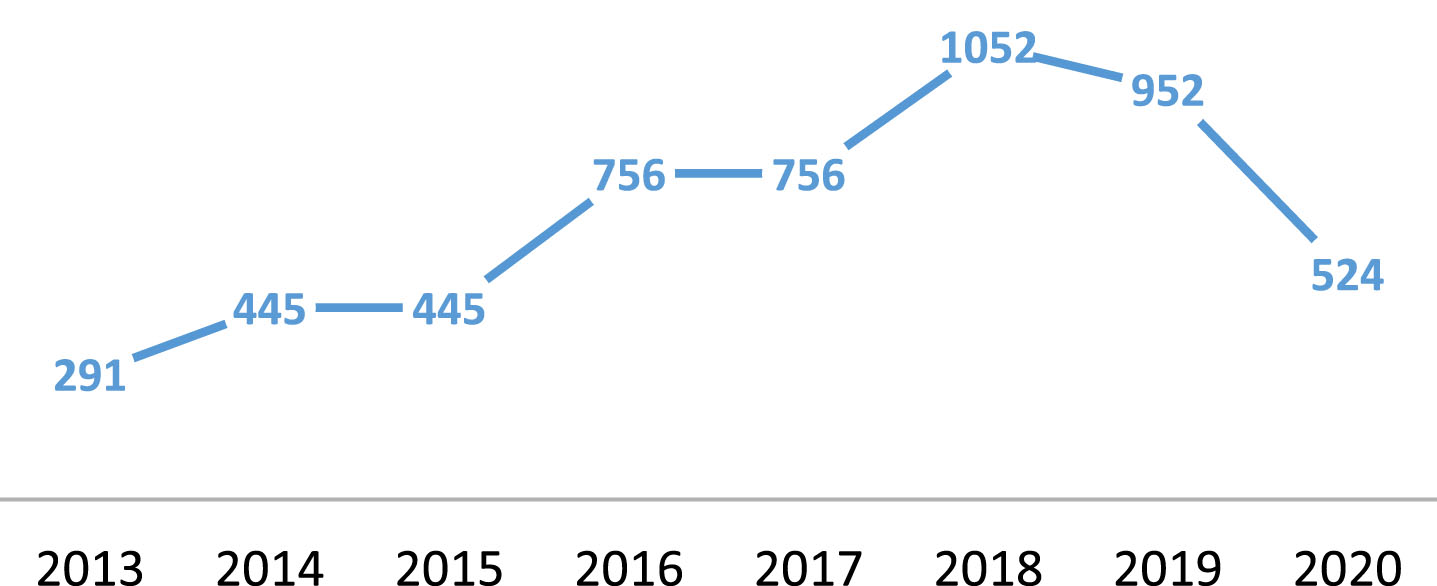
Number of food business. Sources: opendata.jabarprov.go.id.

Conceptual model.
Strategic planning is very important since the impact of the pandemic can change the company’s goals and performance strategies [4–6]. Several studies have observed the relationship between strategic planning and organizational performance [7]. It was found that strategic planning could improve organizational performance [8], organizational efficiency [9], and company performance [10–12]. However, this is contrary to another study which showed that strategic planning had a negative effect on performance [13]. Likewise, it was reported that strategic planning did not affect performance [14]. Therefore, in an attempt to resolve the inconsistencies in previous studies regarding the relationship between strategic planning and organizational performance, several studies offered interventions [13, 15]. More specifically, organizational trust was considered to be able to mediate this relationship, by examining several previous reports [16, 17]. It is able to maintain the confidence of members of the organization to trust each other, therefore, the employees have high emotionality [18, 19]. This condition of trust makes the plans carried out by the organization to be easily accepted and implemented by employees.
In addition, companies should also have a pandemic planning in order to survive amidst the vicious policies implemented by the government [20]. The government policies—during the pandemic—prioritize public safety, which are sometimes not profitable for companies, such as restrictions on social interactions that prohibit people from engaging in activities in crowds, eating at restaurants and shopping at malls [21]. This is a challenge for companies to carry out strategies and planning in order to run their business. Therefore, strategic and pandemic planning are considered important factors for companies [6, 22]. Planning allows individuals to have a sense of trust that the organization is able to deal with all existing problems. In other word, organizational trust has an important role in the success of employee relationships with superiors to improve performance [23].
The current study has a number of objectives that can complement the strategic planning literature. First, it examines the relationship between strategic planning, organizational trust, and performance. It is very important to study this relationship since the organizational goal has high performance. Second, in relation to the inconsistencies regarding the relationship between strategic planning and performance, organizational trust should be placed as a mediation between the two variables [16, 17]. Third, a moderating effect of pandemic planning is offered as a factor that can influence the relationship between strategic planning, organizational trust, and performance. Pandemic planning is very important, especially in dealing with unexpected external threats [20]. Additionally, the context related to the place (food business) and time (pandemic event) becomes an interesting novelty study to complete a small part of the knowledge related to strategy and organizational performance.
Social exchange theory
The main principle of this study is to relate strategic planning and performance mediated by organizational trust and moderated by pandemic planning. A number of previous reports may largely stem from a lack of attention to these variables and their potential impact on strategic planning practice and performance [14, 24]. The relationship between the research variables was explained using social exchange theory, where individuals really need to repay their superiors with positive attitudes and behavior towards the company as a result of reciprocal exchanges between the superiors and the subordinates [25]. Furthermore, this theory explains that when individuals perceive their work environment as supportive while managing the work, they are more likely to feel cared for [26]. Therefore, this study aims to explain the relationship between organizational performance improvement and organizational trust, as well as strategic and pandemic planning.
Direct effect of strategic planning on organizational trust and organizational performance
Planning can improve organizational capabilities by integrating, combining, and reconfiguring company resources [27]. Furthermore, it relates to regular actions and leads to the achievement of stated goals or objectives [28]. Planning is developed before the implementation of organizational activities and it contains the determination of goals or strategies within the organization. In other words, planning orientation can encounter a large amount of uncertainty in the future [28]. Strategic planning is a systemic and logical approach to developing and implementing strategic objectives in organizations [29, 30]. Therefore, since it focuses on better business performance, unit missions, long and short-term goals, as well as implementation plans should be clearly defined [31]. Furthermore, it is oriented towards increasing customer satisfaction and improving the company’s operating performance. This indicates that customer satisfaction and operating performance are an integral part of overall business planning [32].
The role of strategic planning in organizations significantly impacts employee trust. This trust should be adequately planned because advanced organizations have solid employees and trust among each other [33]. Organizations can increase employee confidence through a planned system. Organizational trust is supported by individuals’ positive expectations of the company’s role and actions [34]. Strategic planning reflects leaders’ role in planning strategies and tactics for the development and sustainability of the organization both in the short and long term. A previous report found strategic planning as the driving force in transforming employee trust within the organization [35]. Meanwhile, another study stated that planning and trust have a reciprocal relationship that reinforces each other and has an impact on the integrity and operational performance of the organization [36]. Therefore, trust is a social capital influenced by the company’s strategy consisting of tasks, goals, and rewards [37].
Hypothesis 1: strategic planning is positively related to organizational trust
Organizations that plan resources can improve performance [38–40], especially in decision-making mechanisms and budgetary oversight in order to facilitate communication or participation of the employees. Additionally, planning allows the organization to perform flexibility and adaptation to the environment at hand [41, 42]. It is carried out to create a conducive environment in increasing work flexibility and competitive advantage [43]. Therefore, the organization has the opportunity to develop and improve performance both at the individual and organizational levels [13]. Errors to carry out planning have fatal consequences in the process of organizational performance. Therefore, leaders are required to carry out their planning strategies by examining the performance needs of the organization. In simple terms, organizational performance is related to the aggregate output of the total activities carried out. Moreover, its classification is determined by the ability to develop innovation, profits and success that are higher than other organizations [44]. It is also influenced by organizational strategies or activities, and has different dimensional effects on employees. The superiority of the performance depends on the quality match between the strategic orientation of the organization and the resources prepared by the leaders, therefore, it is important to plan the organizational activities strategically [44, 45].
The explanation of the relationship between strategic planning and organizational performance is explained by goal setting theory [39]. This theory explains how goals—as the basis for shaping motivation—affect individual and organizational performance [46]. Organizational performance is a general goal that should be achieved by the company in order to survive and thrive in every situation. Goal setting theory emphasizes how organizations achieve their goals by setting and implementing organizational plans [47, 48].
A previous study found that planning strategies could strengthen cognitive diversity by increasing organizational unity [30]. Likewise, it was reported that strategic planning had an effect on performance [14]. In organizational activities, planning is a very important factor to ensure that the procedures carried out by the organization run in the planned manner and methods in order to improve performance [24]. When an organization ignores planning, its performance could decrease since it may not understand what to do in the future [49]. In other words, organizational performance can run effectively and efficiently when strategic planning is properly carried out at the right time [39]. Especially during the COVID-19 pandemic, strategic planning is required to survive and develop in order to achieve organizational performance.
Hypothesis 2: strategic planning is positively related to organizational performance
Mediating effect of organizational trust
The concept of trust relates to individual or group beliefs about the inherent system and culture in order to encourage a group of people to trust each other. Trust can be seen from action because it is cognitively and emotionally driven [50]. Individuals who believe in organizations have the integrity to advance their organizations, this is formed by the exchange of interests between both of them [51]. Meanwhile, organizational trust is related to individuals’ positive expectations about the intentions and behavior of the members based on the roles and relationships within the organization [34]. It is also considered a basic fact of human life, which without, decisions and actions will never exist [52]. Therefore, it is a crutch in the search for certainty, while distrust is based on the selection of negative expectations about the attitudes and behavior of others, resulting in a decision not to participate [28].
Trust is very important for organizations since it improves cooperation, maximizes flexibility, and reduces coordination costs [53]. Additionally, organizations that adhere to beliefs tend to have solid members and a work climate that goes beyond the basic requirements of their work. This is because each team member has a belief that they are responsible for completing the assigned task [23]. Therefore, organizational trust is a determining factor in performance improvement [18]. Employees who trust each other will produce creative ideas for the improvement of the organization. Meanwhile, the lack of trust is the reason employees share knowledge and work with the members of other organizations [54].
A previous study found that organizational trust was a mediating factor in the relationship between knowledge and performance. In other words, trust can facilitate an organization’s ability to improve relationships, gather market information, carry out technology development, and encourage the desire to share knowledge [19]. This is an evidence that organizational trust is able to build trust to improve performance. In other words, trust requires planning in improving organizational performance. Strategic planning functions as a driver of individual trust, therefore, it creates confidence among the members to work together in improving performance.
Hypothesis 3: The positive relationship between strategic planning and organizational performance will be mediated by organizational trust
Moderating effect of pandemic planning
Advanced companies have strategic goals, directions, and priorities even in a crisis [55]. Additionally, they can also formulate plans to reveal their character, culture, and values [56–58]. Pandemic planning is made by organizations to deal with the problems of disease outbreaks that afflict humans and surely have an impact on the business sector [4, 59]. Furthermore, it is the practice of setting overall company goals and operational targets during a pandemic to promote better coordination of organizational resources and productive results [20]. In other word, it relates to the organization’s efforts in planning the prevention, response, or maintenance to survive and be productive during an outbreak. Pandemic planning emphasizes business, social, and policy plannings [20].
Planning in the business sector requires the consideration of internal and external factors [55, 60]. This consideration is closely related to the company’s resilience and ability to respond to challenges from within and outside the organization [60]. Strong resilience implies that a company is able to move proactively to deal with organizational problems [61, 62]. Pandemic planning is a construct developed by policy stakeholders to deal with pandemic problems that come from outside the organization. In the context of the relationship between strategic planning and organizational trust, pandemic planning is able to strengthen strategic planning. Employee trust is the key in carrying out activities for the improvement of the organization [33]. Pandemic planning is a factor that can affect trust because trust arises as a result of the organization’s role in protecting and maintaining the members [63]. One way to maintain organizational stability is by making pandemic planning in order to survive and thrive during disease outbreak [64]. Therefore, such plan is very important in strengthening the relationship between strategic planning and organizational trust.
Hypothesis 4a: Pandemic planning moderates the relationship between strategic planning and organizational trust, such that the positive relationship between them is stronger or weaker.
Pandemic planning can strengthen the effect of strategic planning on organizational performance. Furthermore, its position can clarify company’s goals and overall operational targets, thereby promoting better coordination of organizational resources for productive results [20]. Coordination of resources may exist due to the right planning process [10] and trust between the employees [23, 65]. Therefore, pandemic planning is very supportive in organizational performance improvement, especially in the food business sector.
Moreover, it is one form of environmental regulation that can affect how businesses implement changes and alter their activities during a crisis. Organizations can survive and improve their performance by implementing changes [1]. Social exchange theory explains that organizational performance is based on mutual trust between superiors and subordinates, or trust that arises between the members as a result of the planning prepared by the organization [25]. Perceptions of security and prosperity that arise among members can be a reflection of planning prepared by the company. Therefore, it is important for organizations to have a plan in dealing with a pandemic, which of course has an impact on organizational performance. They are also required to carry out pandemic planning in improving strategic planning carried out by leaders to improve performance in conditions of a work climate of mutual trust among employees [66]. The push for pandemic planning can make employees have a high level of trust for easy application of strategic planning. Therefore, pandemic planning can strengthen the relationship between strategic planning, organizational trust and performance during the COVID-19 pandemic.
Hypothesis 4b: Pandemic planning moderates the relationship between strategic planning and organizational performance, such that the positive relationship between them is stronger or weaker.
It is very interesting to have a more in-depth study on the relationship between strategic planning and organizational performance, considering that there are research inconsistencies regarding this [13, 14]. Therefore, the mediating role of organizational trust and the moderating role of pandemic planning are important in developing this hypothesis. The interaction of pandemic planning plays a role in strengthening the relationship between strategic planning and organizational performance mediated by trust. Pandemic planning is a form of planning that focuses on operational factors in dealing with pandemic issues [20], while strategic planning focuses on strategic concepts to improve company performance. The right form of planning can increase organizational trust because trust is built by employees’ confidence in the policies implemented for the benefit of company performance.
Hypothesis 4c: Pandemic planning can moderate the mediating effect of organizational trust on the relationship between strategic planning and organizational performance.
Methodology
Data collection and sample
To test the study hypotheses, food business category covering restaurants and cafes located in Bandung City, West Java were selected and analyzed using a quantitative approach. This study involved cross-sectional data derived with a survey technique using questionnaires that were filled out by the leaders [67].
In 2020, Bandung City had 524 food businesses, therefore, studies used the purposive sampling technique in selecting respondents to fit the specified criteria. The characteristics of the respondents in this study were [1] leaders with at least one year leadership experience, [2] carrying out business activities during the pandemic, and [3] implementing pandemic planning during the COVID-19 period. Furthermore, the sample size was determined using a margin of 0.05 through a traditional statistical approach [68], and 227 respondents were selected. Before the respondents filled out the questionnaire, a cover letter was given to provide an understanding that their identity was kept confidential. Therefore, they all agreed to fill out the questionnaire delivered by the research assistants. Ethical considerations mandated by the Research Ethics Committee of the University of Indonesian Education were complied, and the necessary approval was obtained.
The survey process was carried out for three months, starting from March to May 2022, and involved five research assistants. At the end of May, 227 respondents had filled out the questionnaire. Most of the respondents consisted of 132 men with 58% and 180 or 79% were married. Regarding educational level, 51 graduated from junior high school, 138 had Diploma 1-Bachelor, and 38 graduated with a Master-Doctoral degree, marking up 22% 61% and 17% respectively. Meanwhile, based on the duration of business, 25 had run it for 1-2 years, 73 for 3–5 years, and 129 for 6–10 years, representing 11% 32% and 57%.
Measurement
To assess the study variables of strategic planning, pandemic planning, organizational trust, and performance, a five-point Likert scale ranging from 1 = strongly disagree to 5 = strongly agree was used to measure the extent to which the respondents agree or disagree to each of the statement. The use of a five-point Likert scale is comparatively easier to understand, ideal scale for big surveys, and facilitates better data distribution [69].
Strategic planning was assessed by a 3-item statement modified from [30]. An example is the item “In our department, employees understand and put a lot of emphasis on the mission statement”. Organizational trust was assessed by 4-item statements modified from [16]. An example is “Trust play an important role in our organization”. Organizational performance was assessed by 5-item statements modified from [44]. An example is “Compared to key competitors, our company has a greater market share”. Pandemic planning was assessed by 8-item statements modified from [20]. An example is “Our organization uses policies for flexible worksite and work hours”.
Data analysis
The analysis procedure in this study began with instrument assessment to determine whether the instrument used was appropriate to represent the assessment of the studied variables [68, 70–72]. After this test, descriptive analysis was conducted to determine the percentage level of each variable. The last step of the analytical procedure was the assessment of the study hypotheses using SPSS 26 statistical tool along with the Hayes process macro analysis method model 4 to test the mediation hypothesis. The mediation model is classified as full, partial, and no mediation [73]. Furthermore, the Hayes model was used to test the moderating and moderated mediation hypotheses [74]. This type of analytical method is useful for analyzing the moderator as well as the mediator variables regarding their effects on the relationship between the independent and the dependent variables. The category of moderator variables can be classified as pure, quasi, and no moderation.
Results
Validity and reliability test
The data collection was carried out in 1 time period, giving rise to common method bias (CMB). Furthermore, Harman’s one-factor test was conducted to overcome the threat of the CMB [75, 76]. Based on the test results, the data variance value was 47.4% which is smaller than 50%. Therefore, it can be concluded that the common method bias in this study did not affect the data obtained. To prevent multicollinearity in the regression model, all variables used in this study were standardized. The highest value of variance inflation factor (VIF) was 2.246 which showed multicollinearity was not a problem [70].
The validity and reliability tests were applied to the measures used towards the study variables [70–72]. The validity test of strategic and pandemic planning, as well as organizational trust, and performance, had a loading factor value of >0.5 [77]. This value ranged from 0.810 to 0.877, which showed satisfactory convergent validity, while the composite reliability value was >0.7 [78]. Furthermore, the variables obtained values of >0.60 for the reliability test. Therefore, the research instrument was declared valid and reliable in assessing the variables. The results of the validity and reliability tests are presented in Table 1.
Construct validity and reliability measures
Construct validity and reliability measures
Descriptive analysis was conducted for each variable to test the level of strategic planning and organizational performance in a food business company context. Table 2 shows that on average, food business companies were in the category of having good strategic planning (Mean = 4.132, SD = 0.845), pandemic planning (Mean = 4.051, SD = 0.876), organizational trust (Mean = 4.210, SD = 0.709), and organizational performance (Mean = 4.048, SD = 0.822). Furthermore, the results of the correlation analysis in Table 2 showed that strategic planning was positively related to organizational performance (Coef = 0.838, Sig = 0.000), strategic planning was positively related to organizational trust (Coef = 0.695, Sig = 0.000), and organizational trust was positively related to performance (Coef = 0.622, Sig = 0.000). This indicates a relationship between the dependent variable of organizational performance, the independent variable of strategic planning, the mediating variable of organizational trust, and the moderating variable of pandemic planning. Furthermore, the discriminant validity test showed that the AVE square root value is greater than the correlation value between variables, this indicates that the research variable had a high level of validity [78].
Descriptive statistics, correlations matrix, discriminant validity
Descriptive statistics, correlations matrix, discriminant validity
Direct effect testing
Hypothesis 1 states that strategic planning is positively related to organizational trust. As shown in Table 3 and Fig. 4, the direct link between both was positive and significant (β= 0.347, p < 0.001). Additionally, it was found that the 95% confidence interval for the direct effect of strategic planning on organizational trust did not include zero (0.219 to 0.476). This suggests a significant direct effect, therefore Hypothesis 1 was supported.
Mediation regression analysis results
Mediation regression analysis results
N = 227; Bootstrap sample size = 5000 LL lower limit, UL upper limit.
Hypothesis 2 states that strategic planning is positively related to organizational performance. As shown in Table 3 and Fig. 4, the direct link between both was positive and significant (β= 0.768, p < 0.001). It was also found that the 95% confidence interval for the direct effect of strategic planning on organizational trust did not include zero (0.696 to 0.839). This indicates a significant direct effect, therefore, Hypothesis 2 was supported.
In support of Hypothesis 3, four conditions of the mediation effect of organizational trust were met. Table 3 and Fig. 4 show that the transformational leadership (β= 0.347, p < 0.001) had a partial effects after organizational trust was accounted for, with a significant value (β= 0.768, p < 0.001). This result indicates that organizational trust positively mediated the relationship between strategic planning and organizational performance (β= 0.136, p < 0.001). It was also found that the 95% confidence interval for the indirect effect of strategic planning on organizational performance through organizational trust (β= 0.047, p < 0.001) did not include zero (0.008 to 0.109). This suggests a significant indirect effect, hence, hypothesis 3 was supported.
Moderating effect testing
The test for the moderating effect of pandemic planning on the positive relationship between strategic planning and organizational trust (hypothesis 4a), the positive relationship between strategic planning and organizational performance (hypothesis 4b), and pandemic planning can moderate the mediating effect of organizational trust on the relationship between strategic planning and organizational performance (hypothesis 4c). The hypotheses were subsequently tested using the Hayes process macro model 8 [74]. For hypothesis 4a, the results of the analysis presented in Table 4, revealed that the interaction (strategic planning×pandemic planning) on organizational trust had no significant effect (B = 0.0233, p > 0.05). In addition, the 95% confidence interval for the interaction effect of pandemic planning on the relationship between strategic planning and organizational trust included zero (–0.120 to 0.166). This suggests an insignificant interaction effect, therefore, hypothesis 4a was not supported.
Moderated mediation regression analysis results
Moderated mediation regression analysis results
N = 227; Bootstrap sample size = 5000 LL lower limit, UL upper limit.
For hypothesis 4b, the results of the interaction analysis (strategic planning×pandemic planning) on organizational performance showed a significant positive effect (B = 0.088, p < 0.05). It was also found that the 95% confidence interval for the interaction effect of pandemic planning on the relationship between strategic planning and organizational performance did not include zero (0.008 to 0.169). This suggests a significant interaction effect, therefore, hypothesis 4b was supported. Additionally, the interaction effect of pandemic planning on the relationship was pure moderation. This is because the data in Table 4 showed that the relationship between pandemic planning and organizational performance was not significant (B = –0.328, p > 000.0). However, when the relationship between strategic planning and organizational performance was interacted with pandemic planning, it became significant (B = 0.088, p < 0.05). The interaction of pandemic planning can be seen in Fig. 3.

The moderating effect of pandemic planning on the relationship between strategic planning and organizational performance.

Model with coefficients.
Finally, for hypothesis 4c, the results of the moderated mediation analysis revealed that the pandemic planning did not moderate the indirect relationship (via organizational trust) between strategic planning and organizational performance [bootstrap estimate = 0.005, bias-corrected confidence interval was (–0.0187, 0.0399)]. Therefore, hypothesis 4c was not supported. This indicates that pandemic planning had no impact on strengthening or weakening the positive relationship between strategic planning and organizational performance mediated by organizational trust.
The discussion on the positive relationship between strategic planning and organizational performance has at least two main objectives. First, to explore the mediating role of organizational trust on the relationship between strategic planning and performance. Second, to explain pandemic planning as a moderator in the relationship between strategic planning, organizational trust, and performance. Most of the hypotheses were accepted, and only two were rejected.
This study showed that strategic planning was positively related to the organizational trust. This proved that the trust of the members was developed by the right strategic planning of the company. Strategic planning shows the level of organizational maturity to interpret and implement the missions that have been set. Therefore, it is very important in encouraging employee trust. This result enhances the understanding of the relationship between strategic planning and organizational trust, and also confirms the conclusions of the previous studies. Strategic planning is a process of transforming the trust of employees [51]. In addition, corporate strategy can form social capital, namely trust in the organization [9, 37].
Strategic planning was also proven to have a positive effect on performance. In organizational performance, it is very important that the company has a strategic plan that can map its activities [79, 80]. Therefore, it is an initial process that the company needs to carry out before going any further into the program [38, 49]. When strategic planning is not carried out, organizational activities can be hampered because of the company’s unpreparedness in carrying out the activities. According to goal setting theory, organizational performance is the goal and the basis for working. In other words, this theory is a form of strategic planning that can affect organizational performance in order to survive and thrive in every situation [46–48].
In the context of a restaurant and cafe business, it is very important to implement strategic planning. Besides, the implementation should also be understood by employees in order to carry out their duties and responsibilities appropriately and improve organizational performance. Restaurant and cafe businesses in Indonesia have a plan in their business, because for them, planning is the first step to develop a business and generate the expected profits. This result is supported by previous studies regarding strategic planning and organizational performance [14, 81], wherein the performance could be increased when the company implements strategic planning.
Furthermore, this study also confirmed organizational trust as a mediating variable on the relationship between strategic planning and performance. Trust is the belief that the employees have in the company. The organization’s performance will increase when the employees have a high level of trust [82]. Conversely, the performance will decrease with low trust. Organizational trust is very important such that the companies need a plan to increase it [83]. In Indonesia, cafe and restaurant leaders plan to improve employee trust in the organization by providing compensation, such as family gatherings, traveling, and maintaining communication between employees and superiors. These activities are organized on a strategic plan made by the leaders every year and updated according to the company’s conditions. Therefore, strategic planning can encourage organizational trust for the employees to work optimally. This consequence can improve organizational performance, especially that of café and restaurant businesses. Social exchange theory explains that social exchange occurs when individuals trust their superiors to provide something valuable to themselves and their organization [25]. In other words, leaders who can be trusted by their members are able to fulfill the vision of the employees and the organization. Therefore, the employees could consider their leaders to have high competence to lead and advance the organization in every condition. Consequently, social exchange between leaders and employees will occur [82, 84]. This result is in line with the previous studies, which found that organization was an intermediary in improving performance [16, 82].
Some factors strengthened the relationship between strategic planning, organizational trust, and performance, namely pandemic planning. The COVID-19 pandemic situation has greatly affected the food business sector, therefore, planning is required in this business activity [85]. Pandemic planning is an organizational step to anticipate problems that come from the COVID-19 outbreak. According to Nader et al., this form of planning has an impact on organization’s sustainability and performance [20]. Therefore, leaders should ensure that pandemic planning can be applied properly. Affective event theory explains that the proper plans made by the organization (perceptions and work standards) can increase work attitudes, and eventually affect organizational performance [86]. Hence, pandemic planning is important in strengthening the relationship between strategic planning and organizational performance. This plan requires high flexibility, especially in influencing long-term strategic planning. In other words, the company should have a plan that can quickly adapt to changes in environmental conditions.
On the other hand, pandemic planning did not moderate the relationship between strategic planning and trust. This implies that this form of planning during the COVID-19 outbreak had no effect on strategic planning relationships and organizational trust. It is expected to act as a factor for achieving organizational performance and not to increase employee confidence. This also applies to the moderating effect of pandemic planning on the mediating role of organizational trust in the relationship between strategic planning and performance. The results showed that pandemic planning does not moderate these indirect relationships. In other words, the strategic planning test on organizational performance mediated by trust is not moderated by strategic planning.
Theoretical implications
Most of the studies on strategic planning and performance focused on the mediating role of organizational learning [13], and excellence [87]. The mediating role of organizational trust on the relationship between strategic planning and trust is still very rare, especially among food businesses (cafes and restaurants). Therefore, organizational trust is very important due to its impact on plans made by policymakers [19, 23]. Conceptually, organizational trust can explain research inconsistencies between strategic planning and organizational performance. This shows trust is an important part in implementing strategic planning [8, 13].
Additionally, the use of the pandemic planning variable as a factor that can strengthen the relationship between variables in organizational performance study is very rare. However, it can enrich and complete the body of knowledge in strategic planning and performance. Pandemic planning is a new concept in the process of planning organizational resilience, sustainability, and performance. Therefore, strategic planning can affect organizational performance when pandemic planning is improved. This signifies that strategic planning functions as a driver of organizational performance, while pandemic planning is effective in strengthening the relationship between strategic planning and performance.
Practical implications
Empirical results in a food business context showed that company leaders need to be attentive to strategic planning when they want to achieve high organizational performance. This is in line with the previous studies [8, 14]. The role of strategic planning in the food business is the main factor, hence, company leaders should properly assigned their plans in both long and short-term. Furthermore, they need to be attentive to employees in carrying out the plans that were made and mutually agreed on, in order to properly run the plan. Employees who are wrong in carrying out organizational planning can result in performance.
In addition, companies need to pay attention to the aspect of trust since it is a social capital and as the main source of employee trust towards each organizational activity [19, 23]. Organizational trust requires a planned system, for example, by creating a solid work team, designing work with a system of collaboration between individuals, as well as creating a comfortable and safe work atmosphere [61, 88]. This is because, there is a form of goodwill that is present in an informal relationship based on trust [36]. Therefore, organizational trust can increase and encourage performance [23].
Furthermore, another process that the company leaders need to pay attention to is pandemic planning. Such planning has an impact on improving organizational performance [30, 89]. Therefore, company leaders needs to be attentive to strategic factors in dealing with pandemics, such as pandemic policies, social relationship planning, and communication between employees [90]. The pandemic policy implemented by the government tends to be sudden, hence, it requires the right plan to survive during the outbreak.
Limitations and future research
This report certainly has some limitations that should be addressed by future studies. First, the data were collected cross-sectionally to provide conclusions. Therefore, subsequent studies are expected to apply a longitudinal design to analyze the research model and identify dynamic changes in the relationships between variables. Second, the samples used focused on food industry leaders, specifically restaurants and cafes, within the organizational context. Therefore, future studies should also involve employees to observe their performance and perceptions. Third, the mediating variable of organizational trust was used as a mediator between strategic planning and organizational performance. Subsequent studies are expected to consider other mediating variables, such as organizational learning [11, 90–92], excellence [87], and ambidexterity [65]. These variables have the potential to bridge the relationship between strategic planning and organizational performance. Fourth, organizational creativity [93–95] and innovation [50] were ignored. These two variables are very important because they influence organizational performance. Also, studies did not discuss external factors, namely political and government policies in influencing organizational performance during the COVID-19 period. This factor is very important, specifically in making strategic planning policies by company leaders.
Conclusions
This study provides new evidence to explain the relationship between strategic planning and organizational performance based on data derived from the food industry. Previous reports on strategic planning tend to focus on companies in developed countries [8, 89]. This study is the first to explicitly model and empirically test the relationship between food business objects during the COVID-19 pandemic in Indonesia as a developing country. Overall, the study highlights the importance of trust and pandemic planning in the relationship between strategic planning and performance in the food business sector. The findings of the study support the existing literature and empirical studies that also suggest the crucial role of strategic planning in organizational success. The study emphasizes the need for organizations to focus on building trust and developing pandemic planning strategies to achieve better performance. These findings contribute to the body of knowledge, specifically in improving organizational performance during the COVID-19 pandemic.
Footnotes
Acknowledgments
The author would like to express sincere gratitude for the moral and material support of Universitas Pendidikan Indonesia for the completion of this article.
Author contributions
CONCEPTION: M. Sandi Marta and Tjutju Yuniarsih METHODOLOGY: M. Sandi Marta, A. Sobandi and Sahya Anggara DATA COLLECTION: M. Sandi Marta INTERPRETATION OR ANALYSIS OF DATA: M. Sandi Marta and Sahya Anggara PREPARATION OF THE MANUSCRIPT: M. Sandi Marta REVISION FOR IMPORTANT INTELECTUAL CONTENT: M. Sandi Marta, Tjutju Yuniarsih, A. Sobandi and Sahya Anggara SUPERVISION: Tjutju Yuniarsih, A. Sobandi and Sahya Anggara
Appendix
In our department, employees understand and put a lot of emphasis on our mission statement.
In our department, employees understand and put a lot of emphasis on our long-term goals.
In our department, employees understand and put a lot of emphasis on our annual goals.
Trust plays an important role in our organization.
Caution and mutual distrust are uncommon in our organization.
Important developments are frankly communicated in our organization.
The cooperation among employees is characterized by mutual trust.
Compared with key competitors, our company is more successful.
Compared with key competitors, our company has a greater market share.
Compared with key competitors, our company is growing faster.
Compared with key competitors, our company is more profitable.
Compared with key competitors, our company is more innovative.
Our company uses training and preparation of ancillary workforce.
Our company is planning for possible increase or decrease in products demand.
Our company uses finding and linking up-to-date reliable pandemic information from different sources.
Our company is establishing and revising an emergency communications plan.
Our company gives employees access to and availability of healthcare services during pandemic.
Our company uses policies for employee compensation and sick-leave absences unique to a pandemic.
Our company uses policies for flexible worksite and flexible work hours.
Our company uses policies for preventing COVID-19 spread at the worksite.