



Abstract
BACKGROUND:
Higher education industry has seen a dramatic shift in the new normal. Given that, the present study proposes learning organization as a predictor of happiness of teachers and the academic administrators because happiness is vital to enhancing performance during unprecedented times.
OBJECTIVE:
Drawing on the resource based view (RBV) and ability, motivation and opportunity (AMO) framework, this research aims to investigate workplace happiness of university-level educators in the post-pandemic era. It proposes learning organization as a determinant of happiness at work through indirect path of perceived organizational support. Furthermore, it also proposes moderation of achievement motivation between learning organization and workplace happiness.
METHODS:
Using simple random sampling, data were collected through survey questionnaire from 172 staff and faculty members of universities/HEIs in Sindh, Pakistan. The study employed structural equation modeling through SmartPLS for data analysis.
RESULTS:
The study findings suggest that learning organization indirectly predicts happiness at work through perceived organizational support. However, moderation of employee achievement motivation could not be supported.
CONCLUSION:
Applying learning organization model and utilizing AMO and RBV theories, the study offers implications from theoretical and managerial perspectives. It proposes a holistic framework for achieving workplace happiness amidst post-COVID era. The study recommends that during times of uncertainty, the universities/HEIs may implement the model of learning organization as a strategic tool to foster happiness at work. It could result in a satisfied, committed and engaged workforce. Limitations and future research areas are discussed.
Keywords






Introduction
Since the pandemic outbreak, the importance of employees’ psychological health and well-being has increased manifold [1]. As happiness contributes to well-being [2, 3], organizational practices which enhance happiness at work is an area of growing managerial interest [4, 5]. Similarly, the organizations, across the globe, are putting sincere efforts to determine factors which foster happiness-oriented culture at work [6, 7].
Happiness at work (HAW) is characterized by experiencing positive feelings at work [8], and it broadly includes three dimensions, i.e., job satisfaction, work engagement and commitment to the organizational goals [9]. HAW is crucial to enhance employee performance [7] because happy workforce creates happy and satisfied customers [10]. Furthermore, HAW offers variety of other benefits to the organizations [11] and helps to gain competitive edge [6]. Findings from earlier studies suggest various individual and organization-level factors which could enhance HAW. For example, thriving at work and support of colleagues [12], workplace spirituality [13] and supervisor’s religiosity [14]. Our study builds upon these works and advances research in similar direction by positing that learning organization may potentially derive HAW in employees of higher education institutes (educators).
Since pandemic, the world has seen radical transformation in the global educational landscape [15] and as a result, the roles and responsibilities of faculty and academic administrators (university employees working in support functions) have markedly changed [16]. According to Campbell [17], in post-pandemic period, public expectations related to quality of higher education have increased and in response to that the educators should be prepared to tackle the future pandemic-related crises by developing higher adaptability for uncertain times [15]. Furthermore, Hill et al. [18] highlight the need to ensure socio-emotional well-being in schools and universities through various organizational-level efforts because there are predictions for more pandemics in the future [19]. Apart from this, according to a recent study by Sarfaraz et al. [20], the modern-day service sector should be transformed into a learning sector for achieving its key objectives. Given all the above, present study focuses educators (university employees) of post-pandemic era and posits learning organization as a strategic model to achieve desired objectives because learning organization promotes a learning-oriented environment for its team members and it is also adaptable to change [21].
Recent literature suggests how technology could be helpful in tackling COVID-19 in higher education in future, see for example, Al-Ghurbani et al. [22]. However, despite the fact that well-being of educators remained challenging during COVID [23], research on how learning interventions could affect subjective well-being of educators is limited. Given this, we argue that the relationship between learning organization and HAW has been largely ignored and investigating it could offer valuable insights to reduce pandemic-driven well-being issues among university employees. Addressing this research gap, our study aims to investigate whether learning organization determines the educators’ HAW through perceived organizational support as a mediator.
Findings from earlier literature suggest that incorporating a model of learning organization could develop motivated and energized employees and could also result in desirable work outcomes. For instance, it increases employee resilience and pro-active work behavior [24]. Moreover, research also suggests that employees’ perception of learning organization could positively influence their job satisfaction [25, 26], job performance [27], organizational commitment [28] and health [29]. Given all the above, present study argues that amidst post-pandemic disruptions [30], well-being at work is a serious issue [1] and providing learning opportunities to the educators could substantially enhance their HAW through indirect path of perceived organizational support (POS).
Perceived organizational support refers to the employees’ positive perceptions about their employing organization that it cares for their well-being and values their contributions at work [31]. Recent literature evidences that perceived organizational support could be a mediator between organizational practices and positive employee outcomes. For example, human resource practices and job satisfaction [32]. Similarly, study of Ilyas et al. [33] reported that perceived organizational support could mediate between organizational-level variables and subjective well-being of employees.
Apart from this, present study also employs achievement motivation as a moderator between learning organization and HAW. Achievement motivation is instinct that prompts people, and those individuals who exhibit higher achievement motivation are found to be result-oriented and determined [34]. Earlier studies recommend moderation of achievement motivation between individual learning approaches and career achievements, please see Bakhtiarvand et al. [35]. Chandrawaty & Widodo [36] concluded that employee achievement motivation could positively affect their job satisfaction. Furthermore, when organizations put strong emphasis on development-oriented human resource practices, employees with higher achievement motivation could enhance their work meaning which contributes to their well-being [37].
This research integrates AMO (Ability, Motivation and Opportunity) framework and RBV (Resource-based view) model as theoretical underpinnings to test the hypothesized framework of HAW. Earlier literature suggests that AMO and RBV could explain psychological mechanisms behind employee development and well-being, please see Karman [38]; Parameswaran [39]; Salas-Vallina et al. [40] and Szulc et al. [41].
AMO is a tri-dimensional framework and views employee ability, motivation and opportunity as powerful mechanisms to enhance employee contributions at work [38]. Whereas, RBV suggests that organizations develop competitive advantages based on their unique and rarely replaceable resources [42]. Drawing on the AMO assumptions, we argue that a university, as a learning organization, could nurture employee abilities when it provides exciting learning opportunities to them and motivates them to enhance their work-related capabilities and use alternative technologies during the pandemic and its aftermath. For example, opportunities for learning new skills and motivation for using latest tools and adopting emerging practices at work. These could develop market-oriented capabilities among educators and could enhance their work-related abilities. Provided that, learning organization develops its workforce as a unique strategic resource with higher adaptability for crises situations, i.e., the recent pandemic. This way a university builds its competitive advantage which is in line with RBV conceptualization. Furthermore, when employers provide genuine support for employee learning and well-being, the employees experience feelings of being valued at work. Because learning leads to positive mental health [43, 44], we argue that when employees are valued at work and they possess market-oriented skills and capabilities, they perceive themselves in an advantageous position as compared to their industry peers (i.e., employees working in other organizations). They become adaptable for tough situations and could grow and progress faster than their industry peers. Consequently, these positive feelings and perceptions of employees could enhance their HAW. Given all the above, we argue that AMO and RBV could explain the relationship between learning organization and HAW through indirect path of perceived organizational support.
This research contributes to the existing literature in three ways. First, it enhances our incomplete knowledge of antecedents of workplace happiness. Although, there seems a fast developing literature on enhancers of HAW, for example, Charles-Leija et al. [45]. Still, applying learning interventions as a booster for happiness is a largely underexplored research area. Evidence exists that learning organization could be a vital determinant of HAW dimensions. For example, it improves job satisfaction [46], engagement [47], and affective commitment [48], but our study goes a step further and offers a holistic perspective by suggesting that besides its potential to derive HAW dimensions (separately), LO could also explain the broader three-dimensional HAW. Second, our study enhances existing knowledge related to the applications of AMO and RBV frameworks. Despite the widespread application of AMO and RBV theories in developing human resources, there seems limited literature to integrate both the theories for explaining the nexus between organization-level variables i.e., learning organization and individual-level psychological outcomes, i.e. HAW. Present study, therefore, reiterates that AMO and RBV could be used together to achieve individual-level outcomes through organization-level practices. Third, this study introduces rarely tested mediator and moderator, i.e., POS as a mediator and achievement motivation as a boundary condition for the relationship between learning organization and HAW. Although, there is evidence that happiness could be an antecedent to achievement motivation of undergraduate students, for example, Nezhad et al. [49], but achievement motivation as a moderator to enhance workplace happiness of employees is a rarely investigated phenomenon. Similarly, in the past, POS emerged as a feasible mediator between learning-related (organization-level) variables and HAW dimensions. For example, culture of change and learning and the job satisfaction [50], mentoring for learning and psychological fit and the work engagement [51] and perceived learning culture and affective commitment [52]. Our study, on the other hand, contributes by arguing that POS is also a feasible and underexplored psychological mechanism between LO and HAW.
From managerial relevance, applying learning organization model in the universities/HEIs may positively affect employee perceptions, i.e., they would perceive that employer takes care of their capacity building for uncertain times. The positive perceptions could improve their engagement, commitment and satisfaction (HAW). Focus should be on such practices which are not only in high demand for imparting quality education but are also rewarding for the employees. For example, incentivizing positive job behaviors, team learning through arranging outdoor team building activities, participation in international conferences, etc. which may improve positive perceptions and ultimately enhance HAW dimensions among employees, i.e., job satisfaction, engagement and affective commitment.
Literature review, theoretical background and hypotheses development
Ability, motivation and opportunity (AMO) framework and resource-based view (RBV) as theoretical underpinnings
Ability, motivation and opportunity (AMO) framework and the resource-based view (RBV) are prominent organizational theories which are extensively applied for achievement of desirable employee outcomes at work [53]. AMO uses a three-dimensional approach [38] and assumes that an employee’s ability, motivation and opportunity could be helpful for mutual gains [41]. According to Karman [38], AMO perspective could be applied to design specific organizational practices which enhance employee contributions at work. Recent review by Bos-Nehles et al. [54] stresses that AMO framework is an effective approach to understand the process by which ability, motivation and opportunity triad triggers multitude of individual behaviors and attitudes at work.
AMO stresses that at workplace, the employee abilities and motivation could be fostered through provision of appropriate opportunities [40]. To understand the AMO assumption, we take example of a university employee i.e., a mathematics teacher. Based on the AMO, firstly an employee must possess the ability to perform a task, e.g., the mathematics teacher teaching algebra should be skilled at solving various algebraic problems and exercises in the class (AMO assumes that employer should help the employee in improving his ability through trainings, team building activities, etc.). Secondly, an employee should be motivated to perform the task, e.g., the mathematics teacher should have motivation to teach his subject and to support students for solving the exercises (AMO assumes that employer should motivate the employee at work through incentives, recognition, etc.). Thirdly, the employing organization should provide relevant and appropriate opportunities to the employee for smoothly performing the given tasks and achieving organizational goals, e.g., the mathematics teacher should be provided with latest teaching resources related to his subject. For example, books, teaching manuals, academic material, tools, systems, technologies, etc.
Literature evidences that various training and development programs could enhance employee abilities [53]. Whereas, for boosting an individual’s motivation at work, merit-based evaluations and other performance-based practices could be instrumental. Furthermore, professional developmental activities could also trigger motivation [40]. Finally, opportunities may include effective communication, participation and job design [40].
On the other hand, resource based view (RBV) assumes that an organization has multitude of intangible and invisible resources in the form of talents, capabilities, skills, and partnerships, which are hard to imitate and cannot be easily copied by the rival firms [55]. Resources may also include social interactions at work [55]. Furthermore, when resources are of rare and inimitable nature, these could contribute to the organizational goals as isolating mechanisms [38].
Recent study of Garg et al. [42] argued the RBV perspective could define a firm’s competitive positioning because unique resources could restrict the competition [38] and serve as a competitive advantage for the firm [55]. Application of RBV for present research draws motivation from a recent study of Diaz-Gonzalez and Dentchev [56] which stresses that when universities develop intangible and invisible resources, i.e., capabilities of workforce, they become unique and powerful systems. Given all the above, AMO and RBV theories may be applied in post-pandemic higher education institutes to explain how applying learning organization model may enhance positive employee perceptions which could improve employee commitment, engagement and job satisfaction (HAW).
Learning organization and happiness at work
Learning is key to organizational survival and ultimate success [57]. Organizations which emphasize continuous learning have an edge over competitors within a continuously changing environment [58]. Learning organization creates an environment for facilitating and fostering learning among its team members and is also adaptable to change [21]. Learning organizations are social systems where organizational members contribute to the organizational efficiency and objective achievement through leveraging individual and collective learning [59].
Lewis [37] defined learning organization as the one which promotes generating, broadcasting and combining knowledge. That knowledge has a crucial role because the organization uses that knowledge, along with employee perceptions and experiences, to accomplish its strategic objectives. Watkins & Marsick [38] mentioned seven features of learning organization. These include continuous learning, inquiry and dialogue, team learning, embedded systems, empowerment, system connection and strategic leadership. According to Salas-Vallina et al. [39], the process of learning brings permanent shift in behavior of employees which is usually caused by the employee experiences at work. Furthermore, the learning could also take place through different job trainings. The factors which could influence learning capacity of the employees include, problems faced and risks taken during the job. Besides, various factors in external environment may also affect learning capacity, for example, competitor actions and market trends.
A recent study of Banoglu et al. [63] concluded that fostering a culture of learning organization is vital to enhance teachers’ professional learning in educational institutes. Similarly, learning at work also improves mental health [43, 44]. Findings from earlier literature suggest that learning at work could also be a source of positive emotions at work [47, 64]. Provided that, the present study argues that learning new trends and competitive skills could lead to happiness of employees at workplace. Moreover, according to Fisher [10] happiness at work characterizes positive perceptions and pleasant experiences of employees related to different aspects of the job and overall organization. Whereas, Bhattacharjee & Bhattcharjee [43] reported that an individual’s work and life satisfaction and subjective well-being at work explain their happiness at work. Similarly, according to Pryce-Jones [42] happy employees are those who try to make the best use of resources for overcoming challenges during the job with an intention to maximize performance and attain desired goals. Because these actions of employees lead them to experience happiness at work.
According to Fredrickson [44] employees could use their personal and social resources to learn about the tasks being assigned at the job. Whereas, during the job, the employee’s positive attitude towards learning at his/her own could also be regarded as happiness at work. Drawing on the Fisher’s [8] conceptualization, Salas-Vallina & Alegre [9] presented a holistic view of happiness at work which comprises three dimensions i.e., engagement, job satisfaction and affective commitment. Macey & Schneider (2008) defined engagement as the extent to which employee is enthusiastic about the job. Whereas, job satisfaction is an employees’ emotional state, an attitude, characterized by positive or pleasurable affect, resulting from one’s appraisal and experience of the job. The third dimension, organizational commitment, refers to the pleasant association or emotional connection of an employee with the organization which is characterized by intentions to stay and contributions to the organizational goals [8].
According to a recent exploratory study by Chadha and Chhajer [69], organizational-level learning and psychological well-being are strong and positive correlates. Because evidence exists that there are associations between learning organization and employee happiness dimensions i.e., job satisfaction [46], employee engagement [47] and affective commitment [48]. In line with this, Wang and Rashid [70] argued that learning organization improves job satisfaction and indirectly leads to organizational commitment in lecturers of HEIs. Similarly, Salas-Vallina & Alegre [11] argued that organizational learning capability could affect positive job attitudes and could ultimately contribute to happiness at work. These detailed arguments suggest that learning organization could potentially drive happiness at work by enhancing employee job satisfaction, commitment and engagement. Furthermore, we apply AMO and RBV models to explain the relationship between learning organization and happiness at work. Based on AMO assumptions, we argue that when employer adopts learning organization model (through its components, for example, inquiry and dialogue, collaboration and team learning, state of the art learning technologies and systems, etc.), it provides its employees the opportunities to try and implement latest learning tools and approaches in their jobs. The employee in turn feel motivated to use and apply new learning tools and techniques in their jobs, i.e., teaching or administrative (educational support) roles. These ability-enhancing and motivation-boosting efforts along with creation of opportunities at work could positively affect employee happiness at work (commitment, satisfaction and engagement). Please see Salas Vallina et al. [40] as to how AMO could be instrumental in fostering employee well-being.
On the other hand, using RBV assumptions, we posit that when a university adopts the model of learning organization (through its components, for example, shared learning, collective vision, inquiry and dialogue, collaboration and team learning, state of the art learning technologies and systems), it emphasizes its employees to develop market-oriented skills and capabilities for tackling the unprecedented challenges in their jobs. We argue that when organization puts sincere efforts to improve professional capacity of its people by adopting learning-oriented environment, latest learning tools and techniques, it improves employee job satisfaction, commitment and engagement (happiness at work), which in turn could potentially develop its people as inimitable human resources, capable of providing competitive edge to their employer. Please see Diaz-Gonzalez and Dentchev [56] to understand how universities could benefit from RBV as an instrumental approach to achieve competitive edge through quality human resources. Given the above, we posit that AMO and RBV models may explain how learning organization could determine employee happiness at work. Therefore, we hypothesize:
Hypothesis 1: Learning organization positively influences happiness at work.
Perceived organizational support as mediator
POS has gained a great deal of attention in the realm of organizational research. POS is an individual’s perceived feeling of being supported by his/her organization [71]. Hao-Xian et al. [49] expressed POS as perception of employees, i.e., how their organization views and acknowledges their contribution towards its goals. Moreover, POS could positively contribute to employee-employer relationship because when organizations support their employees, it could result in desirable employee outcomes at work [51]. In a similar manner, Eisenberger & Stinglhamber [50] reported that POS is an important factor in the employee-employer relationship. Because when there is higher POS, the employees assume that their organization would take care of their well-being and their efforts are recognized. These perceptions enable them to valuably contribute to the organizational objectives [51, 74].
According to Jeung et al. [75], empirical research on POS indicates that it could potentially determine wide range of positive and desirable workplace outcomes, for example, psychological wellbeing, affective commitment and high-level job performance. In line with this, earlier studies also suggest that POS has positive associations with dimensions of employee happiness, i.e., engagement [76, 77], job satisfaction [78, 79] and affective commitment [75, 81].
Recent study by Sihag and Dhoopar [82] found that POS could be a mediator to enhance performance of teaching and non-teaching staff in HEIs amidst COVID-related crises. Besides, in a recent research, Ilyas et al. [33] recommend that POS could be a mediator between organization-level variables and well-being at work. Similarly, earlier findings also support the mediating role of POS between variables related to learning organization and dimensions of employee HAW. For example, Cullen et al. (2014) examined the mediation of POS between individual adaptability and job satisfaction. The results were statistically significant. In a similar manner, Emerson [59] tested mediation of POS between organizational culture (change and learning initiatives) and job satisfaction and the mediation was significantly established. Similarly, Yang et al. [51] hypothesized POS mediation between organization-level mentoring (learning and psychological fit) and work engagement. The study concluded that POS mediated the relationship. Hawkins [52] also investigated mediating role of POS between perceived learning culture and affective commitment. The study concluded that mediation was significant. Based on the above arguments, we reiterate that literature offers substantial grounds to test mediation of POS between the relationship of learning organization and HAW. Besides, we apply AMO and RBV frameworks to explain how learning organization derives HAW through indirect path of POS. Considering AMO assumptions, we argue that when a university adopts LO model (for example, shared learning, collective vision, inquiry and dialogue, etc.), it strives to create learning opportunities to perform better at work. These opportunities motivate employees to use and apply new learning tools and techniques at work, i.e., their teaching or administrative (educational support) roles. Such opportunities are capable of harnessing employee abilities. Moreover, these ability-enhancing and motivation-boosting efforts along with creation of opportunities at work improve employees’ perceptions about its employer (POS), which in turn improve their commitment, satisfaction and engagement (HAW).
Similarly, we use RBV assumptions and posit that when a university adopts the model of learning organization (for example, systems for shared learning, employee buy-in for collective vision, emphasizing inquiry and dialogue, etc.), it enables its employees to develop market-oriented skills and capabilities for tackling the unprecedented challenges in their jobs. We argue that when organization puts sincere efforts to improve professional capacity of its people by adopting learning-oriented environment, latest learning tools and techniques, it improves employees’ positive perceptions (POS) which could be vital to employee job satisfaction, commitment and engagement (HAW). We further argue that higher HAW is a psychological resource within organizational people which makes them inimitable human resources, capable of providing competitive edge to their employer. Given the above, we posit that AMO and RBV models may explain how LO indirectly determines employee HAW through POS. Therefore, our second hypothesis is:
Hypothesis 2: Perceived organizational support mediates the relationship between learning organization and employee happiness at work
Achievement motivation as moderator
Achievement motivation is among few most important perspectives of human motivation mechanisms and it works as a triggering force behind pursuing goals [83]. Epstein & Harackiewicz [65] defined achievement motivation as the instinct that prompts people. People high in achievement motivation have strong instincts of being result-oriented and resolute. They have strong determination and higher desire to make difference and achieve individual and organizational success. Employees with higher achievement motivation have larger risk taking tendency and are more innovative and willing to do harder tasks with greater ease. Tutar et al. [66] reported that working with clear mind and self-confidence are key attributes of achievement motivation. Whereas, secondary factors include focus, persistence, trait of being competitive, willingness to learn new things and interdependency. All these attributes could help employees to increase their performance.
Prior studies suggest that achievement motivation could influence dimensions of HAW, i.e., job satisfaction, engagement and affective commitment. For example, Hartati & Purba [85] tested the relationship between achievement motivation and organizational commitment of teachers. The study concluded that achievement motivation was an antecedent to organizational commitment. Similarly, Metz [68] investigated the influence of achievement motivation of retail managers on their job satisfaction. The study concluded that achievement motivation positively influenced the managers’ job satisfaction. Besides, Pratama et al. [69] reported that there are positive correlations between achievement motivation and employee engagement. Furthermore, Faruq et al. [88] investigated the impact of various organizational factors on organizational commitment of university lecturers. The authors found that achievement motivation was the most significant predictor of organizational commitment. In a similar manner, Beekhan [71] found that dimensions of job satisfaction and achievement motivation were positively associated.
Besides, few earlier studies suggest that when organization-level learning practices and employee achievement motivation are combined in a single model, they could positively influence dimensions of HAW and could enhance employee well-being. For example, according to Lubis et al. [90] LO and achievement motivation could jointly predict job satisfaction. Similarly, Lin et al. [29] examined the joint interaction of individual achievement motivation and development-oriented human resource (HR) practices on employee well-being. The study found that people high in achievement motivation tend to enjoy higher well-being when organization adopts development-oriented HR practices.
Furthermore, literature also evidences that achievement motivation could moderate the relationship between commitment to goals achievement and well-being of individuals. For example, the study of Job et al. [91] found that achievement motivation could moderate the above nexus and could have positive consequences on well-being. Study of Bakhtiarvand [35] found that achievement motivation moderated the relationship between learning approaches and academic achievement. Similarly, recent literature evidences that achievement motivation could moderate the relationship between a contextual-variable and employee-level positive constructs, for example, social context and self-efficacy of employees [92].
Besides, few other studies could indirectly support our argument related to the moderation of achievement motivation between LO and HAW. For example, Ismail [73] tested moderating role of learning goal orientation (close to achievement motivation) between organizational training (learning activities) and commitment (a dimension of HAW). The moderation was found significant. Similarly, Ryu & Moon [75] tested moderation of intrinsic motivation between workplace learning experience and job satisfaction and organizational commitment (dimensions of HAW). The authors concluded that the moderation was significant. Given all the above, we argue that achievement motivation may potentially moderate the relationship between LO and HAW. Therefore, we propose our final hypothesis as:
Hypothesis 3: Employee achievement motivation moderates the relationship between learning organization and employee happiness at work.
Methodology
Research context
Globally, higher education was badly affected during COVID-19 pandemic [15] and Pakistan was no exception [23]. According to various studies undertaken during the recent past, higher education institutes in Pakistan experienced a paradigm shift in the wake of pandemic. For example, Batool et al. [95]; Rehman [96]; Maqsood et al. [30] and Adnan & Anwar [97]. Provided this, the concerned authorities had to make drastic changes in the overall pedagogical landscape for maintaining quality of higher education in the country. We argue that during these circumstances, the role of faculty and academic administrators is instrumental to make this transition an effective one [16]. We further argue that given the operational disruptions and educational crises caused by the recent pandemic, it is worthwhile to investigate how learning interventions could influence happiness of faculty and administrative staff in the higher education institutes. Provided this, present study focuses faculty and administrative staff of universities and higher education institutes in Sindh, Pakistan as the study participants.
Procedure
Present study is quantitative in nature and adopts survey research strategy. We adopted survey because it is a widely used strategy in business research [98]. Moreover, surveys are also suitable for quantitative studies [99]. We conducted our research in one-shot i.e., as a cross-sectional research because cross-sectional studies involve lesser cost [100]. For present study, the data were collected through survey questionnaire from universities operating majorly in areas of Sindh province of Pakistan. Surveys are effective in explaining and exploring human behavior, especially in social sciences research [101]. For convenience of the participants, a paper-based and a web-designed format (Google form) of survey questionnaire were developed. The study considered probability sampling design, i.e., simple random sampling to ensure that every population member gets equal chance of selection in the sample [102]. According to Sekaran and Bougie [98, 99], simple random sampling offers higher changes of generalizability of research findings and this is the major reason we adopted simple random probability sampling. As sampling frame is required in simple random sampling [99], one of the authors collected details of potential participants from the selected universities (the author was holding a senior position in human resource department of a university). Moreover, because pilot study could be a crucial component of a quality research [103], initially pilot testing was carried out on 45 participants. Based on the results of the pilot test, data collection for complete sample was undertaken.
The estimated population in the selected universities was around 750–800 (excluding those on long leaves, i.e., study leave or maternity leave). One of our co-authors (a HR professional associated with a prestigious business school) played a key role in collecting data from her peers in other universities. She contacted HR officers and relevant administrative staff in those universities, who were the main source of providing details of their faculty and staff to conduct the present research. The data included participants from both administrative and academic circles. We used KMT table [104] and considered sample-to-item ratio for calculating the sample size which is a recommended sample calculation approach [105]. Given the above population size, the sample could be between 248-260. Therefore, 350 survey questionnaires were distributed with an effort to achieve the expected number of participants. The final sample comprised of 172 participants with an acceptable sample-to-item ratio i.e., equal to 4 (sample-to-item ratio should be closer to five or even a bit lower, please see, Memon et al., 2020).
During the process of data collection, the participants were orientated on the purpose of research and its valuable outcomes. Moreover, the participants were assured that their identity will be kept confidential and the responses will be used for achievement of academic and research objectives. Initially, researchers personally approached 50 participants for getting responses on a paper-based format. In the second phase, link of google form was sent to the remaining 300 participants via email. Finally, a total of 172 surveys were returned (50% response rate). The final sample comprised of 98 faculty and 71 staff members (whereas 3 did not report their employment type), including 137 males and 23 females (12 did not report their gender). 136 participants belonged to the public sector universities, 25 were from private sector HEIs (11 did not report their employer type), whereas, 105 were having permanent jobs and 37 were on contractual jobs (remaining did not report their employment status).
Measures
A survey questionnaire consisting of 36 items was developed from below scales. The authors slightly adapted the items as per the study’s context. The construct-wise details are provided below:
Learning Organization (LO)
For measuring learning organization, dimensions of learning organization questionnaire (DLOQ) [106] were used. The scale reliability was α = 0.920. Sample item is “My organization creates continuous learning opportunities”.
Happiness at Work (HAW)
For measuring happiness at work, the scale of Salas-Vallina and Alegre [9] was used. The scale reliability was α = 0.857. Sample item is “I am satisfied with the nature of work I perform”.
Perceived Organizational Support (POS)
For measuring perceived organizational support, the scale of Eisenberger et al. [74] was used. The scale reliability was α = 0.847. Sample item is “My organization really cares about my well-being”.
Employee Achievement Motivation (EAM)
For measuring employee achievement motivation, the scale of Freund et al. [107] was used. The scale reliability was α = 0.938. Sample item is “I am really going to try as hard as I can on my job/work assignment”.
Findings and results
Present study employed structural equation modeling and used the partial least squares method because it is effective in developing and analyzing structural relationships [108]. Furthermore, Ringle et al. [109] reported that it is one of the most prominent analysis techniques used by human resource management researchers for decades.
Measurement model assessment
Using SmartPLS, initially, the authors conducted measurement model assessment to ensure the reliability and validity of all the constructs (measures). The values of Cronbach’s alpha and composite reliability were checked for ensuring the internal consistency. The value of Cronbach’s alpha for all the constructs ranged from 0.847 to 0.938, which were not only above the recommended threshold i.e., >0.7, but also closer to 1. According to Sekaran and Bougie [98], when the value of Cronbach’s alpha is closer to 1, it is an evidence of higher internal consistency. Furthermore, the composite reliability ranged from 0.886 to 0.946. According to Cheung et al. [110], the desirable values of composite reliability are above 0.8. The average variance extracted (AVE) of the constructs was used for ensuring convergent validity. The values of AVE were greater than 0.50 which is as per the recommendations of Hair et al. [111]. Table 1 presents the Cronbach’s alpha, composite reliability and AVE with factor loadings. The factor loadings were above 0.5 which ensure that the items have satisfactory reliability [112]. According to Hair et al. [112], items with factor loadings ranging from 0.4 to 0.7 can be deleted if it results in better composite reliability.
Convergent validity
Convergent validity
AVE=Average Variance Extracted, LO = Learning Organization, HAW = Employee Happiness at Work, POS=Perceived Organizational Support, EAM=Employee Achievement Motivation, Acceptable range for: factor loadings of items > 0.5, Chronbach’s Alpha > 0.7, AVE > 0.5.
Discriminant validity was assessed through HTMT principles as well as Fornell-Larcker criterion. Table 3 includes the values of Fornell-Larcker criterion. Moreover, HTMT criterion is a robust measure to detect possible indiscriminants among the latent constructs [113] and in view of this, the discriminant validity in our model was confirmed. Table 2 presents the values of discriminant validity (as per HTMT criteria). The values are within the critical range i.e., 0.85 or below. Moreover, VIF values were considered to test the multicollinearity which ranged between 1.3 and 3.0. According to Hair Jr et al. [114], the VIF values are appropriate when they are within the conservative threshold of 3 (3 or below). Based on the above findings, it is pertinent to mention that overall results of the measurement model provide substantial support for the model’s appropriateness to examine the proposed relationships.
Discriminant validity (HTMT criterion)
HTMT=Heterotrait Monotrait. The conservative threshold for discriminant validity (HTMT Criterion) < 0.85.
Discriminant validity (Fornell-Larcker criterion)
The authors used SmartPLS to test the proposed structural model. Following the recommendations of Hair et al. [115], we used path coefficients, p-values, and t-statistics for examining the direct and indirect relationships and the moderation effects. Figure 1 shows the study’s model.
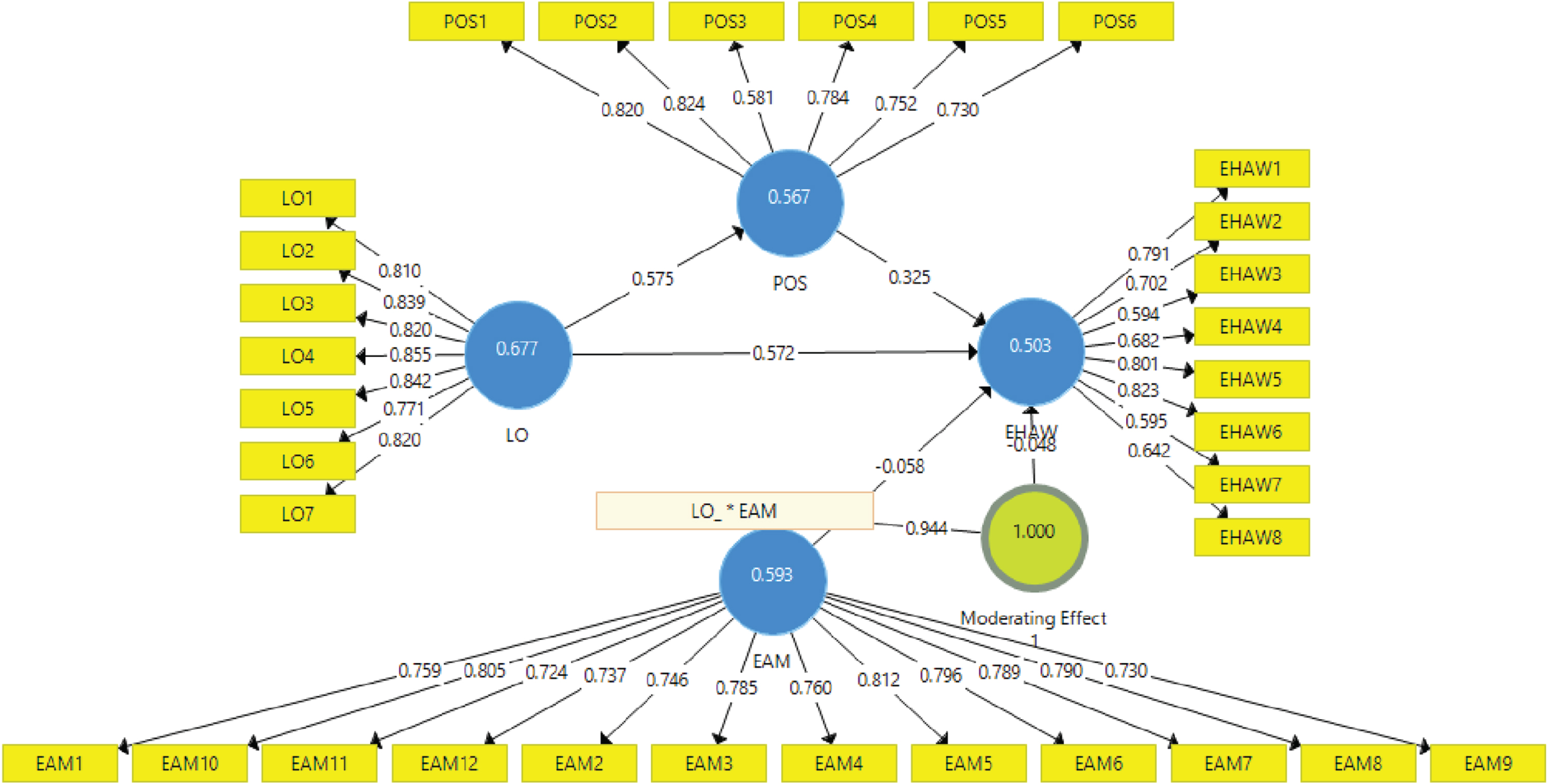
Research Framework. LO: Learning Organization, POS: Perceived Organizational Support, EHAW: Employee Happiness at Work, EAM: Employee Achievement Motivation.
The findings for the direct relationship between LO and HAW are presented in Table 4. The first hypothesis was related to the positive influence of LO on employee HAW. The path analysis results show significant values (β = 0.760, p = 0.000) confirming the positive influence of LO on HAW.
Direct effect
Direct effect
β= Beta, STDEV = Standard Deviation. Criteria for hypothesis acceptance is p value < 0.05.
For examining the mediation effect, the authors followed Preacher & Hayes [116] and used the bootstrapping method with 5000 subsamples with maximum of 2,000 iterations. According to the second hypothesis, POS mediates the relationship between LO and HAW. As per the expectations, results of the mediation estimates (β = 0.188, p = 0.000) confirm that the mediation of POS is statistically significant between LO and HAW. Mediation effect values are available in Table 5. Whereas, Table 6 shows the R-square values.
Mediating effect
Mediating effect
β= Beta, STDEV = Standard Deviation. Criteria for hypothesis acceptance is p value < 0.05.
R-squared
Above R-square value shows that the model explains significant change in the dependent variable.
As proposed in the third hypothesis, the authors examined the interaction effect of the moderator EAM for the relationship between LO and HAW. The interaction term was formed by multiplying the independent and moderating variables: LO*EAM. The insignificant values of moderation test (β = 0.043, p = 0.385, i.e., > 0.005) suggest that the proposed moderation was not statistically supported. Hence, the hypothesis H3 was not supported, i.e., EAM does not moderate the relationship between LO and HAW. Moderation effect values are shown in Table 7.
Moderating effect
Moderating effect
β= Beta, STDEV = Standard Deviation. Criteria for hypothesis acceptance is p value < 0.05.
Discussion
LO has potential to enhance positive emotions at work [47, 64] and it could also improve professional orientation of teachers in educational institutes [63]. Furthermore, POS could positively affect employee-employer relationships [73]. Provided this, present research focused employees of higher education institutes and proposed that LO predicts their HAW through POS as a mediator and achievement motivation as a moderating variable. Furthermore, this study applied AMO and RBV models as theoretical frameworks to test the hypothesized model.
According to the results, hypothesis 1 was supported which suggests that LO could significantly create and enhance HAW. Although, we could not find any published study which investigated LO as a predictor of HAW, still, our findings may be compared with few earlier studies. For example, the study of Salas-Vallina et al. [39] which concluded that 3-dimensional HAW and organizational learning are high correlates. In a similar manner, Salas-Vallina and Alegre [9] reported that engagement (a dimension of HAW) was highly correlated with organizational learning capability.
A recent exploratory study by Chadha and Chhajer [69] also supports our results which concluded that organizational-level learning and psychological well-being of employees are strong and positive correlates. Furthermore, our findings could also be compared with recent and earlier studies which suggest that LO could predict dimensions of HAW. For example, a recent work by Wang and Rashid [70] revealed that LO improves job satisfaction and indirectly leads to organizational commitment in lecturers of HEIs. In a similar way, the study of Chang and Lee [46] revealed that LO positively affects job satisfaction. Similarly, the study of Malik and Garg [47] concluded that LO predicts engagement. Whereas, the study of Lau et al. [48] suggests that LO leads to affective commitment. We reiterate that our findings are not only consistent with these studies but also offer new insights by suggesting that LO could also explain HAW (i.e., a broader construct composed of three dimensions).
Besides, the present study findings also established that POS mediates the relationship between LO and HAW. Therefore, hypothesis 2 was also supported. Recent study by Sihag and Dhoopar [82] support our results which concluded that POS could be a mediator to enhance performance of teaching and non-teaching staff in HEIs amidst COVID-related crises. Moreover, as LO and HAW are broader constructs, which comprise various dimensions, our study findings may be compared with earlier literature which evidences that POS mediated between dimensions of LO and dimensions of HAW. For example, Emerson [59] found that POS could mediate the relationship between culture of change and learning and the job satisfaction. Similarly, Yang et al. [51] found significant mediation of POS between mentoring for learning and psychological fit and the work engagement. Whereas, Hawkins [60] found that POS could potentially mediate between perceived learning culture and affective commitment. Our study findings are not only consistent with these studies but also uncover a holistic perspective to link LO (a multi-dimensional construct) with another multi-dimensional construct i.e., HAW, through POS mediation.
Contrary to our hypothesizing, employee achievement motivation could not moderate the nexus between LO and HAW. Therefore, hypothesis 3 was not supported. Moderation of achievement motivation between LO and HAW was a novel proposition and is not found in the previously published literature. There may be a number of reasons due to which the moderation effect could not be statistically supported in our study. For example, in universities/HEIs the organizational members may perceive that capacity building programs, learning new things, or trying new learning technologies is one of the regulatory requirements [117]. Anecdotal evidence also suggests that some university employees perceive that learning and professional development is need of the day and sometimes it is perceived as a part of organizational culture. Another reason may be that in collectivistic societies like Pakistan, people may not perceive organizational learning opportunities as a source of achieving competitive edge among their rivals. Because literature suggests that there are cross-cultural differences with respect to individuals’ achievement motivation among people of various nations. Please see studies of Maehr [118] and Trumbull and Rothstein-Fisch [119].
Finally, support for direct and mediating hypotheses suggest that AMO and RBV could be applied as theoretical underpinnings for testing our hypothecated relationships. Earlier studies also applied AMO and RBV to understand the process of achieving organizationally-desirable outcomes at work, for example, Bos-Nehles et al. [54], Diaz-Gonzalez & Dentchev [56], Salas-Vallina et al. [40] and Kellner et al. [53]. In our case, AMO and RBV are integrated frameworks to understand a relatively unique process of creating (individual-level) HAW through (organization-level) learning interventions. Application of AMO may be understood with the help of following example. During the times of crises, i.e., the pandemic, a university as a LO implements new educational technologies and adopts the industry’s best practices to impart quality education. Furthermore, it also supports and encourages its educators to nurture their abilities, adopt new practices and learn emerging teaching trends. In addition, the university also invests on training and development of its workforce, i.e., teachers and academic administrators. Such organizational practices motivate the educators to enhance their work-related abilities for performing better at work. Similarly, when organization offers various learning opportunities (i.e., using new technologies, seminars, cross-functional trainings, collaborations, team building activities, etc.), the educators feel valued at work. We argue that this nurturing of abilities, motivation and opportunities also make them feel that their employer enables them to navigate the paradigm shift (i.e., shifting to the new normal). Provided this, we argue that such positive perceptions provide positive emotional experience to the educators and could contribute to their subjective well-being, i.e. HAW. Our findings are well-supported by a recent review by Bos-Nehles et al. [54], which concluded that ability, motivation and opportunity triad improves positive individual behaviors and attitudes in work settings (through various mechanisms).
From RBV lens, the process of creating happiness may also be understood with the help of another example which follows. During the crises situations, i.e., the pandemic, a university, as a LO, forms alliances and strategic partnerships with public and private organizations and adopts new technologies, industry trends, educational systems and best practices. Furthermore, the university invests alot to develop its workforce as unique and valuable resource. This way, its employees provide competitive advantage to the university as inimitable human resources. Besides, these organizational efforts make employees feel that they have unique capabilities as compared to their peers in other organizations and they feel valued and esteemed. Such positive feelings create positive affect and contribute to their HAW. Our findings could also be specifically related with recent study of Diaz-Gonzalez and Dentchev [56], which concluded that adopting RBV lens helps to explain a university’s/HEI’s competitive edge and unique market positioning based on multitude of inimitable resources.
Theoretical contributions and managerial implications
Theoretical contributions
This research offers three-fold contributions to the existing literature. First, it unfolds that LO model could be a potential antecedent to the educators’ HAW in post-pandemic era of educational disruptions. It uncovers a nuanced view of HAW and enriches the fast-emerging literature which investigates antecedents of workplace happiness, i.e., Charles-Leija et al. [45] and emphasizes that learning at work could be a source of improving psychological health of employees. Furthermore, it argues that exploring the links between post-pandemic learning interventions and subjective well-being could be an insightful investigation to prepare for future pandemics. Although, few earlier studies suggest that LO could be a vital determinant of HAW dimensions. For example, it improves job satisfaction [46], engagement [47], and affective commitment [48], but our study goes a step further and offers a holistic perspective by suggesting that besides its potential to derive HAW dimensions (separately), learning organization could also explain the broader three-dimensional HAW. We reiterate that when employer develops itself as a learning-oriented organization, it improves employees’ positive perceptions. Whereas, positive perceptions ultimately fuel employee commitment, satisfaction and engagement at work (HAW). Based on this, we argue that present study’s stance of adopting LO model as a tool to achieve HAW through indirect path of POS offer new insights to the existing literature.
Second, our study enhances existing knowledge related to the applications of AMO and RBV frameworks. Building upon the recent studies related to application of AMO and RBV in organizational contexts, for example, Lu et al. [120] and Khanra et al. [121], it integrates AMO and RBV in a single model to explain HAW in a disruptive higher education industry. On one hand, it stresses that AMO could well-explain how learning could lead to happiness, i.e., employee abilities at work, motivation to perform better and opportunities to enhance their performance could create positive perceptions and positive affect. On the other hand, it draws upon the RBV to demonstrate that post-pandemic learning interventions could not only develop inimitable and unique workforce but also improve the experience of positivity and higher well-being of employees. Despite widespread application of AMO and RBV theories in developing human resources, there seems limited literature to integrate both the theories to explain the nexus between organization-level variables i.e., LO and individual-level psychological outcomes, i.e. HAW. Present study, therefore, reiterates that AMO and RBV could be used together for achieving positive employee outcomes at individual-level. Third, this study introduces rarely tested mediator and moderator, i.e., POS as a mediator and achievement motivation as a boundary condition for the relationship between LO and HAW. In line with our hypothesizing, POS emerged as a mediator between LO and HAW. However, we could not find support for moderation of achievement motivation, but still, this finding could help future research to validate insignificance of the moderation in other industries and contexts.
Moreover, in the past, POS emerged as a feasible mediator between learning-related (organization-level) variables and HAW dimensions. For example, culture of change and learning and the job satisfaction [50], mentoring for learning and psychological fit and the work engagement [51] and perceived learning culture and affective commitment [52]. Our study, on the other hand, contributes by arguing that POS is also a feasible and underexplored psychological mechanism between learning organization and HAW.
Managerial implications
Present study argues that universities/HEIs could foster HAW if following recommendations are considered by the practitioners and/or university authorities:
Heads of universities, i.e., rectors and vice chancellors could adopt the model of LO during post pandemic era. Because providing learning opportunities, adopting state of the art educational technologies and devising professional development plans would positively affect their employee perceptions, i.e., they would perceive that employer takes care of their capacity building for uncertain times. Such efforts not only make them competitive but also improve their employability i.e., by developing latest skills and abilities, which may generate positive feelings of being valued at work and could contribute to their work engagement, commitment and satisfaction (HAW). Focus should be on such practices, activities or events which are not only in high demand for imparting quality education but are also rewarding for the employees. For example, instilling the need to learn new trends and technologies and similarly, incentivizing employees to shift their approach to market-oriented teaching approaches could be a good choice. Because when employees realize that organization supports them in learning new skills, and incentivize them as well, it could enhance positive feelings among them, which is vital to HAW. HRD (human resource development department) should consider rolling-out such training and development programs which highlight the importance of learning opportunities as a source of improving their experience at work and as a tool to enhance their employability. For example, team learning through outdoor team building activities, participation in international conferences, etc. which may improve positive perceptions and ultimately enhance HAW dimensions among employees, i.e., job satisfaction, engagement and affective commitment.
This way universities/HEIs could achieve their vision, goals and objectives through boosting employee HAW across various departments and campuses.
Limitations
Present study has few limitations. This study focused universities/HEIs which are usually non-profit and non-business organizations. Provided this, research findings may not be generalized in pure profit-making organizations. Similarly, the study’s focus was a service industry and given this, the recommendations may be used for manufacturing firms with due caution. Moreover, there are cross-cultural variations in employee perceptions related to learning opportunities. Therefore, applying present study’s findings to achieve desired outcomes (i.e., HAW as an outcome of learning opportunities) should consider contextual and territorial limitations. Besides, as this research was a cross-sectional one, it offers less rigor as compared to the longitudinal study format. Finally, the study results were purely based on employee responses which could have suffered from self-report bias.
Areas for further research
This research is probably one of the very few studies which connect learning with employee happiness in organizations. It opens doors for further academic and managerial research in the domain of employees’ psychological health and subjective well-being through LO model. Future studies may consider application of current model in cross-generational, cross-organizational or cross-functional perspectives. Future researchers should consider broadening the horizon of present research by changing the context or workforce type, i.e., it may be studied in case of millennial workforce which is going to dominate the future of work. Some other moderating and mediating variables may be added in the framework, for example, thriving at work, cynicism, envy, workplace fun, work-life integration, post-pandemic work design, emotional intelligence, culture of joy and green HRM practices etc. As achievement motivation could not emerge as a moderator in present study, we recommend to test it in other countries/sectors. Other theoretical frameworks may also be tested for creating HAW in future, for example, theory of planned behavior, institutional theory, social comparison theory, Schein’s multi-layered culture, tournament theory, broaden and build theory, etc.
Conclusion
This research primarily investigated whether LO indirectly predicts HAW by improving employee perceptions of organizational support. Drawing on RBV and AMO frameworks, present study revealed that LO is an antecedent to happiness of university educators in the unprecedented times, i.e., post-pandemic era. It emphasized that AMO and RBV may be applied to understand the process of creating and boosting HAW during turbulent times. We may conclude that employing the model of LO indirectly enhances subjective well-being of educators and make them adaptable, employable and unique. We believe that theoretical and practical implications of present study could be useful for universities and HEIs and could help the authorities in developing a better strategy for future pandemic preparedness.
Footnotes
Acknowledgments
There are no acknowledgements and authors did not receive funding from any agency/sponsor.
Author contributions
CONCEPTION: Faisal Qamar and Niaz Ahmed Bhutto
METHODOLOGY: Sadia Nisar and Minahil Khaliq
DATA COLLECTION: Sadia Nisar, Sadam Hussain and Khalil Ahmed Channa
INTERPRETATION OR ANALYSIS OF DATA: Faisal Qamar, Niaz Ahmed Bhutto and Niaz Hussain Ghumro
PREPARATION OF THE MANUSCRIPT: Faisal Qamar, Sadam Hussain, Sadia Nisar and Minahil Khaliq
REVISION FOR IMPORTANT INTELLECTUAL CONTENT: Faisal Qamar, Sadia Nisar and Niaz Ahmed Bhutto
SUPERVISION: Niaz Ahmed Bhutto, Khalil Ahmed Channa and Niaz Hussain Ghumro.