



Abstract
BACKGROUND:
Due to the COVID-19 pandemic, many employees lost their jobs. At the same time, millions of individuals have been forced to relocate because of a “new normal, “ which requires them to work from home offices. Working from home poses difficulties for employees whose employers do not provide appropriate support to their home workplaces. Hence, it significantly affected employee performance and organizations.
OBJECTIVE:
This study utilizes stress theories to evaluate perceived job insecurity and perceived employability during COVID-19. The research examined perceived job insecurity and the resulting work stress, which led to adverse work outcomes.
METHODS:
The authors collected information from two multinational corporations and gathered longitudinal data in two waves. The authors used hierarchical regression for our data analysis.
RESULTS:
The findings indicated a substantial positive relationship between perceived job insecurity and work stress. Job insecurity in working environment has also increased, adversely affecting employee productivity. It follows from the moderated mediation analysis that perceived employability significantly impacts indirectly on work stress and outcomes.
CONCLUSION:
This study expands our knowledge and adds to the literature on workplace stress theories regarding COVID-19.
Keywords



Introduction
Changes in socio-economic conditions, global pandemics, and shifting economic cycles have traumatized employees about their perceived job insecurity [1, 2]. This is because employees are skeptical about their job prospects and unwanted shifts in the landscape of technology, the labor market, organizational culture, and practices [3, 4]. Lazarus and Folkman (1984) assume that this skepticism about insecurity among employees increases stress about their future within and outside the labor market, adversely affecting productivity and mental health [5]. The theory assumes that stress occurs when employees’ perceived capabilities cannot cope with perceived demands. Less productivity will endanger job prospects, hurt them financially, and keep them in a devastating emotional state [6].
Losing one’s job has severe economic consequences as one faces uncertainty about losing economic privileges and stability [8, 9]. People who perceive COVID-19 and changing technology as unclear situations become psychologically stressed, compromising their resources and well-being [10]. Workers facing an unpredictable future cannot cope efficiently, resulting in distress symptoms. This causes employees to have a higher stress level and adverse workplace outcomes over time. Hence, to achieve sound health among employees, peaceful working conditions are required for smooth working to mitigate the damaging effects of job insecurity. However, this topic is still under-researched in COVID-19 and in the presence of shifting technology situations, despite Dc Cuyper et al. [11] and Soomro [12] calling for exploring perceived job insecurity and work stress in longitudinal studies.
In COVID-19, technology applications accelerated the output of several corporate processes, including supply chains, HRM, marketing, and finance. In the fast-paced, ever-evolving landscape of change, organizations asked workers to demonstrate skills to keep their jobs, regardless of age, experience or job titles in the pandemic. Employability skills are of paramount interest in COVID-19 that help make a worker an impactful employee. In such situations, employees require technical and workplace skills to perform a specific role and how to do so effectively. Several parts of the business in the new normal need the latest technology tools [13, 14], from internal operations to the outward output of the activities, and from small processes to significant activities. Subsequently, we examined perceived job insecurity along with work stress, perceived employability, and job outcomes in the face of COVID-19 [15]. Each of these connections under unexpected circumstances adds to the literature. Hence, the authors utilized CORT and stress theory to examine perceived job insecurity during COVID-19.
According to the theory of stress [16], stress is a mismatch or imbalance between perceived external or internal demands and personal resources that leads to stress. The theory assumes that stress is an external stimulus, response, and transaction between the individual and the environment. While COR theory Hobfoll [17] argues that employees experience stress when there is a threat to resources, when there is a chance of resource depletion, that is, perception of job insecurity, a person may rebound from a traumatic condition by reviewing their skills, which increases the chances of employment. Thus, the authors contend that work stress might be exacerbated by perceived job instability, negatively impacting employee job satisfaction and organizational commitment during COVID-19.
This study makes some of its contributions. The study’s primary contribution is that it adds to stress theory and COR theory; the authors have thoroughly understood the suggested time-dependent relationship among study variables in innovative practices, shifting technology, and COVID-19 [4, 19]. It is a personally impactful event that has never occurred globally and beyond anything seen in nearly a century. The pandemic has badly impacted global economic growth and disrupted life in all nations and communities [20–22]. This is the point where this study contributes to the existing literature. For this, the authors collected longitudinal data from two waves of employees working in two MNCs in the study context. Furthermore, the authors investigated perceived job insecurity concerning work stress, perceived employability, job satisfaction, and organizational commitment. All of these relationships in unprecedented times would contribute to the literature. For instance, job insecurity relates to more work stress, which can translate into working even harder to avoid being laid off and employees continuing their services in these organizations. This study has yet to look between those mentioned relationships, causes over time using stress theory and CORT based on a literature review. Thus, it contributes to understanding perceived job insecurity and workers’ job outcomes during COVID-19. Figure 1 illustrates the hypothesized research model.
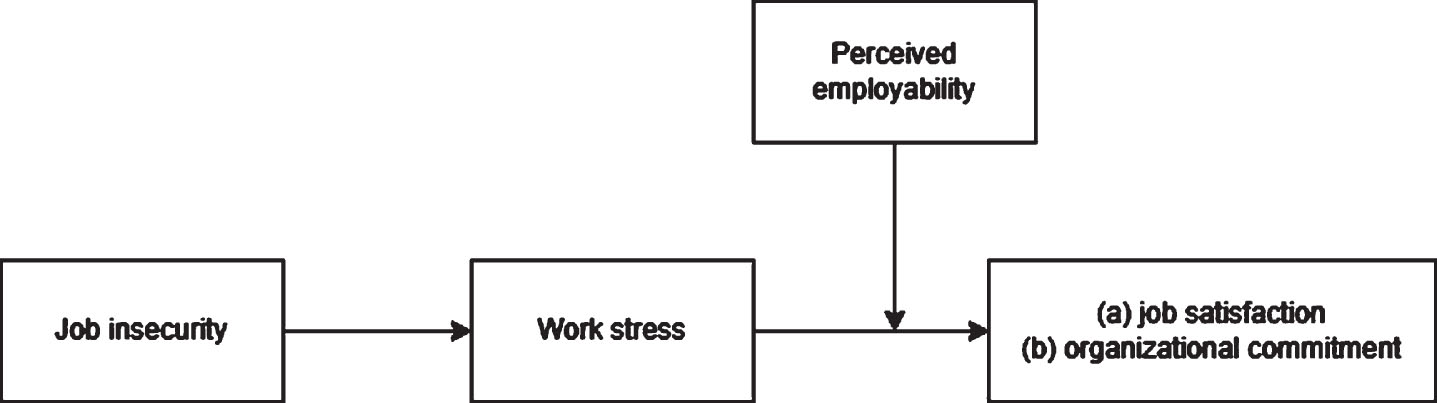
Research model.
Job insecurity is theorized as an individual’s subjective perception [23]. It is conceptualized as “perceived powerlessness to maintain desired continuity in a threatened job situation” [24]. It focuses on an individual’s subjective assessment of their job circumstances [18]. Subjective JI feelings refer to the perception created in workers’ minds that their jobs are insecure [27]. It is distinct from the objective type, where the job/work contract itself is insecure, for example, the contingency nature of the job or contractual one [28]. Subjective JI is strongly related to strain outcomes, whereas objective JI represents a substantial risk of job loss [29, 30], leading to negative outcomes i-e. JS and OC.
Locke [31] described JS as “a happy or good emotional state arising from the evaluation of one’s job or employment experiences” (p. 1304). Literature indicates that it is described as “how satisfied a person is with their employment”. We argue that JS may also be seen from a larger perspective, such as COVID-19, which influences an individual’s quality of working life. Thus, it may be conceptualized in terms of its interactions with workplace stress in COVID-19. According to Meyer and Allen [24], OC refers to a person’s psychological ties to the organization. In relation to COVID-19, we contend that employees’ organizational commitment and psychological attachment to the organization may be in peril. Thus, we want to know how they feel about their work and how committed they are to their organizations. Therefore, this work will contribute to filling the gap in the preceding research, particularly during pandemics. This study sought to examine work stress, JS and OC while also incorporating perceived employability role, which is one of the study’s contributions.
According to the stress theory, researchers argue that perceived JI is adversely associated with work outcomes and affects workers’ attitudes, triggering undesirable strain reactions in COVID-19 [28]. In addition, the findings of many studies significantly support that perceived JI adversely affects workers’ health and well-being [11, 33–35]. Particularly during pandemic times, it reflects uncontrollability [36], which prevents one from concentrating on the job and dealing with such a situation is a withdrawal from it [37]. Similarly, it establishes a psychological barrier between oneself and work in an organization to minimize the possibility of job loss [38]. As a result, perceived JI adversely impacts employees’ OC, JS and work engagement due to continuous JI in organizational settings [33, 40], enhancing further insecurity among workers.
CORT [41] links perceived JI to employee attitude outcomes. CORT defines resources as “objects, personal characteristics, environments, or energies that an individual values” [38]. Thus, people seek to accumulate and protect scarce resources [42]. We argue that COVID-19 is an intervening time, and this situation is described as stressful, extra-job demands, and inadequate resources within a work setting, which can engender undesirable outcomes [43]. Accordingly, when a worker feels insecure about the job in these work settings, he/she tries to limit the loss of job resources, for example, by exerting less work, which in turn may contribute to lower levels of job satisfaction [44]. For instance, COVID-19 caused itself among employees, creating their resources in the form of work attitudes, including job satisfaction and performance.
In addition, COR theory argues that employees feel a cognitive and practical reaction to the threat of resource loss (i-e. perceived JI in the case of COVID-19) [45]. Prior perceived JI studies are systematically related to lack of confidence, uncertainty, and workplace deviation (but not COID-19), leading to burnout and other health-related outcomes [33, 46–48]. Therefore, the authors propose the following hypotheses based on the above review:
Hypothesis 1: Job insecurity is positively associated with employee work stress.
Hypothesis 2: Work stress has a significant negative relationship with a) job satisfaction, b) organizational commitment.
Hypothesis 3: Perceived employability significantly relates to a) job satisfaction, b) organizational commitment.
Role of perceived employability
In this era of dynamic change, companies do not provide equal job security opportunities for their lifetime. Continuous change and learning provide employees with project-based jobs that enhance their employability. At the same time, the age of lifetime employment from the organization is a concept of the past. By contrast, workers need to focus more on lifetime employability skills after the pandemic [49]. It is a new concept of job insecurity, where workers will not have the job for the rest of their lives but will be able to get a job, no matter how loyal they are to their job and profession. In this regard, employees need to develop skills to succeed in a rapidly changing environment. These skills are intended to help them keep updated with fast-changing workplace settings and unexpected emergencies such as COVID-19.
Employability is described as “a collection of achievements, understandings, and personal characteristics that increase an individual’s likelihood of obtaining employment and succeeding in their chosen occupations” [50]. From the concept of employability, workers can develop their skills and participate in development opportunities offered by their employers, such as various development pieces of training and workshops that enhance employees’ skills. It helps workers create an attractive resume and develop value within their current organization. This indicates that employees are motivated and want to progress within the company. For instance, creativity is a skill and process that can be enhanced and cultivated. The process of acquiring knowledge can be the foundation for mastering a way of thinking. Employees can learn to be creative by testing, surveying, assuming, and using their imagination and information. Hence, workers can improve their job skills and help get employment by developing skills [49, 52].
In normal work settings, employees can request additional training if offered or certificate courses that enhance their skills. Even if not available, they can research training and certification opportunities. It helps them prepare for success in challenging times or when lay-off occurs. Research shows that new skills create flexibility and shape workers according to their situation. In COVID-19, the development of employable skills has not been extensively documented in organizational studies. Consequently, this study adds to the literature on organizational settings concerning employable skills by evaluating how COVID-19 has influenced the acquisition of employeable skills. Similarly, new skills can help respond to unexpected changes such as COVID-19, efficiently and effectively. Research suggests that the perception of getting another job in difficult times buffers the negative impact of perceived insecurity on depression, irritation, illness, and life satisfaction [51, 53–55]. In summary, the authors hypothesize the following:
Hypothesis 4: Perceived employability moderates the relationship between work stress and (a) JS, b) OC. Its conditional positive effect between work stress is stronger among employees having low PE and vice versa.
Methods
Participant and Procedure
The authors collected data from two MNCs employees and tested their hypotheses. Both prominent MNCs employ approximately 3000 people directly, and thousands indirectly. The study of job insecurity and the resultant stress in these companies during a pandemic is important because of its significant importance to the country’s human development and economic growth. Research in these companies can significantly affect employee satisfaction and performance, ultimately leading to improved outcomes.
The data collection approach was based on a non-probability approach, which is a combination of convenience sampling and snowball sampling. This enabled researchers to obtain data from respondents facing perceived JI and stress in their organizations. The authors accessed employees using personal and professional networks because collecting data during the pandemic was difficult. We also requested that employees link us with other similar employees in their respective organizations during the pandemic. These employees facilitated access to colleagues, allowing us to collect maximum data from other participants. Asking employees to rate their views on job insecurity, perceived stress, and work outcomes can provide valuable insights into the experiences and perceptions of the pandemic. They may have a more direct experience of experiencing job insecurity and work stress during a pandemic at workplaces and may be better positioned to provide feedback on the specific factors that contribute to their commitment and job satisfaction.
The authors adopted established questionnaires that were distributed to the concerned employees. Data collection took approximately four months from September to December 2020. A two-wave longitudinal data approach was used with a two-month time difference between Times 1 and 2. We chose two MNCs in Pakistan to generate a research sample. Both companies operate in a fast-moving consumer goods (FMCG) sector. We collected two-wave longitudinal data from the concerned employees. A longitudinal study can allow researchers to discover various developments/changes in employee behavior. This study measures the characteristics of employees during COVID-19 at two points in time to see individual changes and variations directly. A two-wave longitudinal design remains dominant in research [56]. Dormann and Zapf (2002) found that the longitudinal effects of workplace stressors on JS and OC require at least two waves.
All procedures followed in this study were performed under the ethical standards of the responsible committee on human experimentation and the Declaration of Helsinki. Informed consent was obtained from all patients included in the study. Participants were given a consent document outlining the intent of the research and their readiness to participate at the start of the data collection. Since they agreed to participate in the study, informed consent was obtained from them to complete the survey. In addition, they were assured of the confidentiality of their data. Further, the authors informed them about the focus and nature, that is longitudinal. Therefore, the authors briefed and requested them to specify their email contact at T1, so it became easier for researchers to contact them to collect Time 2 data when two months were over.
In authors distributed 1200 sample forms to part-time employees. At T1 of data collection, the authors received 455 responses (38%); at T2 of data collection (i-e. occurred after two months), the authors received 400 responses (at a rate of 33%). After collecting the data, we examined the missing data and conducted a dropout analysis (cf. Goodman & Blum, 1996). Dropout analysis was performed to determine whether the process of selecting dropout cases at T2 was selective. Consequently, no variation was observed between the two respondents. (i-e. T1 and T2). Finally, we obtained 385 sample cases after dropout analysis (i-e. The response rate was 32%).
Measures
Job insecurity: De Witte [57] used four items to assess perceived job insecurity. Sample questionnaire “I am concerned about the future of my career”. The scale’s reliability was (0.93) for T1 and (0.83) for T2.
Work stress: Netemeyer, Maxham, and Pullig [58] used four items to indicate work stress. The questionnaire includes “I’m anxious because of my work”. The scale’s reliability was (0.94) for T1 and (0.78) for T2.
Perceived employability: Rothwell et al. [59] used sixteen items to collect employability based on personal and occupational characteristics, both within and outside the person’s current company. The scale’s alpha reliability was was (0.88) for T1 and (0.91) for T2.
Job satisfaction: Luthans [52] used five items to collect job satisfaction data. The scale alpha reliability was (0.83) for T1 and (0.84) for T2.
Organizational commitment: Allen and Mayer [32] used three items to measure organizational commitment. The alpha reliability of questionnaires (0.87) for T1 and (0.86) for T2. The alpha reliabilities indicate high relation to all the study’s variables, indicating high reliability among the raters.
Mean, Standard Deviation, Correlations, and Reliability Coefficients on diagonal
Mean, Standard Deviation, Correlations, and Reliability Coefficients on diagonal
N = 385, Correlations is significant at *p < 0.05 **p < 0.01***p < 0.01.
Descriptive statistics used to summarise the respondents’ demographics. For common method bias, authors led Harman’s single-factor test [60] authors did it because all study variables were self-rated. Hypotheses were tested using hierarchal regression in SPSS. Hierarchal regression analyses were conducted to examine the relationships between perceived job insecurity, work stress, perceived employability and job outcomes. At a (p < 0.05) the results were found to be statistically significant. Please see Table 1 for descriptives.
Table 1 provides mean scores of perceived job insecurity and respondents’ perceived work stress, JS, OC and perceived employability mean scores are also available for both times (i-e. T1 and T2). A positive correlation exists between JI and perceived stress. In contrast, a significant negative correlation exists between perceived job insecurity and job satisfaction, while a significant positive correlation exists between perceived job insecurity and organizational commitment. It should be noted that the correlation coefficients between employee organizational commitment and work stress in our data analysis are positive. However, it must be negative. One possible explanation is the COVID-19 and high inflation rate, meaning that more job insecurity relates to more work stress, which can translate to working even harder to avoid being laid off. In addition employee perception of perceived job insecurity and resultant stress act in ways that they must not laid off and attached to organizational goals and mission. Due to this motivation, they strive hard to better organizational objectives, eventually leading them to preserve their jobs. In this way, they are more committed, make extra efforts that must be recorded, and manage value within day-to-day activities.
A positive association exists between employability and the other variables. In our results, these correlations are surprising, for example, positive relationships between perceived stress and perceived employability, while perceived employability should reduce stress. Similarly, job insecurity is positively correlated with perceived employability, which is contradictory. The literature indicates that employability is concerned with individual attributes or abilities that maintain employment at an appropriate level [61]. Employability is affected by several factors. According to the results of this study, it is not only the ability to have a job or maintain it in a dynamic context (COVID-19), but also the use of one’s talent to advance professionally throughout one’s working life. For instance, adaptability is one of the qualities that workers require in the COVID-19 situation or, more appropriately, in today’s world. Adaptability can be a barrier for people and can affect their employability. This implies that workers must react quickly to changing situations in which they are unprepared. As many industries are in constant flux today, the ability to adjust or change makes an individual more employable. Please seeTable 1.
Hypotheses Testing
At T1 and T2, Hypotheses 1–3 indicated that perceived JI has a positive relationship with WS and a negative relationship with JS and OC. WS negatively causes JS and OC. The effects in Table 2 show support for T1 and T2 in that JI is significantly related to WS for T1 (b = 0.902, p < 0.001) and T2 (b = 0.235, p < 0.001), supporting Hypothesis 1 that perceived JI is positively associated with employee work stress. WS adversely affected JS for T1 (b = –0.370, p < 0.01) and T2 (b = –0.452, p < 0.01), and OC T1 (b = –0.549, p < 0.01) and T2 (b = –0.678, p < 0.01) statistically supports Hypothesis 2, which states that work stress has a statistically negative relationship with JS and OC. In addition, perceived employability was positively associated with JS at T1 (b = 0.957, p < 0.01), T2 (b = 0.397, p < 0.01), and OC at T1 (b = 0.552, p < 0.001), and T2 (b = 0.649, p < 0.001), providing support for Hypothesis 3 that perceived employability has a statistically positive relationship with JS and OC. Please see Table 2 for a direct hypothesis summary.
Results of direct hypotheses at T1 and T2
Results of direct hypotheses at T1 and T2
N = 385, *p < 0.05 **p < 0.01.
Hypothesis 4: According to the effects of PE moderation results, the workplace stress conditional positive link is more significant for employees with high perceived employability and vice versa. For the analysis in process macro, authors set ‘generate codes for visualizing interactions’ and set ‘mean center’ to construct products in the options menu. Furthermore, the authors set the conditioning values for the moderator variable. Time 1 in table two shows that the relationship between work stress and JS, as well as OC, is (b = 0.068, p < 0.01) and (b = 0.052, p < 0.01) are significant. This suggests that perceived employability moderates the effects on JS and OC.
The authors used a traditional “a point approach,” in which the interplay of the correlations between work stress JI and JS and work stress and OC at three locations along the moderator’s scale was determined (Hayes, 2018). At -ISD on PE, it causes positively to JS (b = 0.8550, se = 0.1362, p < 0.001), and for OC (b = 0.5795, se = 0.1287, p < 0.01). At the mean PE, it significantly affected JS (b = 0.4258, se = 0.0482, p < 0.001), and OC (b = 0.2683, se = 0.050, p < 0.01). At a +ISD PE, work stress also has a positive effect to JS (b = 0.3443, se = 0.0455, p < 0.001) and for OC (b = 0.5326, se = 0.0482, p < 0.01). (Table 3, Time 1).
Results of moderated mediation at Time 1
N = 385, *p < 0.05 **p < 0.01.
Table 4 shows that the relationships between work stress and job satisfaction, WS, and organizational commitment (b = 0.0907, p.01) and (b = 0.0688, p.01) are statistically significant. This suggests that perceived employability moderates work stress in JS and OC (Table 4). At -ISD on perceived employability, a significant effect was observed for JS (b = 0.6409, se = 0.1535, p < 0.001), and OC (b = 0.2861, se = 0.1769, p < 0.01). Regarding perceived employability, the effect of work stress was significant for JS (b = 0.1016, se = 0.0393, p < 0.001) and OC (b = 0.0884, se = 0.0393, p < 0.01). For a +ISD, perceived employability and work stress were significantly associated with JS (b = 0.0599, se = 0.0389, p < 0.001) and OC (b = 0.0877, se = 0.0352, p < 0.01). The authors see that as perceived employability progresses from low to high for both JS and OC, the slopes become more favorable.
Results of moderated mediation at Time 2
N = 385, *p < 0.05 **p < 0.01.
This study aims to analyze research on perceived job insecurity following the view that work is crucial for employees [44, 47] in the face of a dynamic change. Primarily, employment fulfills various fundamental human needs. In contrast, the prospect of losing employment means that the person is inaccessible to essential human needs [3]. It leads to strain symptoms that generate fear of losing one’s job [62, 63]. In our analysis, perceived job insecurity was adversely linked to JS and OC. Perceived employability buffers the negative effects of work stress on employees’ perceived work stress.
This research adds to the current literature on CORT and organizational studies. The authors discuss what they understand from this study’s results and understand the buffering effect even better. Drawing on CORT, the present study hypothesized that perceived JI causes work stress and impacts employees’ JS and OC over time. Additionally, perceived employability buffers the negative effect of work stress on employees’ JS and OC. Few studies, to the best of the author’s knowledge, use longitudinal data and have hypothesized and tested such moderating effects [64]. The findings of this study suggest several suggestions for administrators to achieve innovative outputs from their employees. They must work closely with employees to enhance their skills. Employees also need to focus on their employability skills, such as organizational skills. For instance, they use organizational tools to improve skills, that is, lists and calendars, and learn to prioritize tasks. Adaptability is one of the qualities that workers currently require. This means that workers need to react quickly to changing situations because many industries are in constant flux today. The ability to adjust or change makes an individual more employable. Thus, organizational managers provide various types of training that train them to adjust quickly in changing situations.
Many cross-sectional experiments have discovered that perceived job insecurity causes work stress [54, 66]. The longitudinal research findings supported and increased the understanding of the repercussions of perceived JI by showing how workers’ perceptions of losing jobs cause adverse work stress. More specifically, the results indicate that employees feel stressed when they perceive job insecurity (threat of resource loss). They participate in various trainings and workshops to enhance their employability skills to recover from loss and gain additional resources. For example, if a worker has completed professional development training or certification, it decreases the tendency to reduce JS and OC, and vice versa. However, if an employee has completed no course or certification, it can enhance the direction of reduced job satisfaction and organizational commitment. This study’s results incorporate previous studies’ results, indicating that perceived job insecurity is a precipitant of work stress [58, 59] and affects employee JS and OC [27, 67].
Furthermore, the study examined the moderating effect of perceived employability on employee work outcomes. The findings revealed moderation of perceived employability on both JS and OC, which in this study were significant. The study’s data indicate that perceived employability buffers the negative effect of work stress on job outcomes. Earlier studies of perceived employability showed that it buffers workers’ stress and job satisfaction [51, 54]. Perceived employability in this study acts as a coping strategy for employees who fear losing their job. According to CORT, when employees fear the threat of resource loss, it pushes them to acquire new resources and allows them to regain control over them. Thus, employees’ perception of resource loss due to job stress results in positive outcomes (i.e., acquiring and regaining resources), leading to higher organizational commitment and job satisfaction.
According to the stress theory, employees use various coping strategies to address their work stress. These strategies are broader and related to (1) workers’ emotions, (2) workers’ avoidance behavior, and (3) workers’ problem-focus. Various studies on perceived employability found that employees’ emotion-focused approaches and problem orientations toward stress moderate the relationship between work stress and job satisfaction [68]. Similarly, positive outcomes for problem-focused coping techniques arise when pressure is manageable [53, 59]. As a result, increasing perceived employability can be viewed as a problem-solving method. This demonstrates that employers regard the various certifications and courses associated with them as a resource advantage and mitigate the detrimental effects of job stress. Consequently, perceived employability decreases work stress and increases worker satisfaction and organizational commitment. Yeves et al. [54] described that the greater the chances of perceived employability at work, the greater the employee satisfaction and organizationalengagement.
More specifically, this study’s moderated mediation results revealed that perceived employability-mediated work stress indirectly affected work outcomes. This indicated a moderate relationship between work stress and JS and OC for Times 1 and 2. Our study assumes that perceived employability significantly moderates the indirect effect of both variables. Moreover, the perception of JI was stronger among those with a significantly higher perceived employability. These results are consistent with Kolmos and Holgaar (2019) work and Nam [48], who found that perceived employability was significantly related to JS and OC. As discussed, employees with a higher perception of resource loss affect their psychological well-being and have fewer employability skills. In comparison, employees with a lower perception of resource loss see themselves as highly employable. Hence, employees’ perceptions of employability can be seen as a resource gain to cope with the perception of losing a job. Various issues can cause work stress, such as ageism, technology, war on terror, political change, and economic conditions [69, 70]. This calls for future research on this aspect of Pakistan.
Practical implications
This study has several practical implications. The findings are especially relevant because organizations will continue to face contagious diseases and various challenges. Accordingly, organizational members must proactively learn and employ new technological tools in a dynamic organizational context. Research findings indicate that the pandemic has compelled organizations and employees to look closely at themselves and see jobs and careers that enhance their well-being [71]. Organizations need to emphasize well-being programs to help employees manage the stress brought about by various challenges while still performing their jobs efficiently. Therefore, organizations must regularly set up fitness sessions in their daily work life, a win-win strategy to support mental health and keep employees calm and more productive.
Daily work life, i-e. 9 to 5 did not seem as vital to many organizations and individuals as it once did. One of the critical lessons that organizations and employees have learned during the pandemic is remote work. It is how you stay connected, even when you are not physically present in the workplace. Therefore, leaders must introduce flexible work schedules that enable employees to work when suitable to balance their personal and professional lives. Flexible work policies after the pandemic can demonstrate concern for employees’ quality of life and attract employees who want more freedom in the workplace.
Although the COVID-19 pandemic is present in some regions of the world, it continues to pose a serious threat to public health in many others. Therefore, research on job insecurity during the pandemic remains pertinent to public health officials and policymakers. Additionally, the COVID-19 pandemic’s lessons on job insecurity can guide future responses to similar crises. For instance, to avoid negative mental and physical health effects, governments and businesses may need to prioritize job stability and financial support for employees during crises.
Moreover, during COVID-19, workers perceived themselves as less employable due to shifting technology and were unable to cope due to organizational policies and practices; they began to experience greater job insecurity and higher stress levels. Workers who focused on employability skills learned the workplace skills that enabled them to thrive. Employability skills reduce perceived job insecurity, lowering stress and increasing employee wellbeing. Furthermore, because employability skills protect against the negative consequences of job instability, organizations and workers can participate in learning interventions for career planning and development. It is beneficial to use and implement technological tools even after the pandemic. Technology tools should personalize the user experience while automating manual activities and reducing paperwork. COVID-19 has accelerated the desperate need for specialist digital skillsets to help employees become more aligned with today’s myriad technologies that enhance their organizational trust and satisfaction with work. The conclusions of this study can affect businesses and managers. They might need to consider how job insecurity affects mental health and devise plans to help staff members cope with uncertainty. The practical ramifications of this study emphasize the necessity of further investigation into the long-term effects of the COVID-19 epidemic on societal health, economy, and employment. These insights will enable us to support people and communities in need and to better prepare for future emergencies.
Limitations
This study has some limitations. First, we collected two-wave data: T1 and T2. Longitudinal data analysis is performed simply, so it may affect the cause-effect relationship of the study variables. Despite this constraint, the results were consistent with those of previous studies. Despite this limitation, the authors suggest that future researchers test the hypotheses using multilayer data. The second limitation is related to self-reported data. It apprehends the risk which is related common method bias. However, many studies using self-reported data have correlations among study variables that are different in size. In contrast, published studies show that “using a self-report methodology is no guarantee of finding significant results”. Future research could expand the current study’s scope by examining links utilizing employability constructs such as the dispositional model [72] or the competence model. Furthermore, perceived employability was studied here as a moderator and it copes perception of perceived job insecurity. Certain studies suggest that perceived employability may encourage deviant behavior [35]. Future research should investigate the impact of gender, age, and education on such elements of employability.
Conclusion
Our study provides significant support to the existing literature on organizational studies. First, the relationship between and employee workplace outcomes informed us that perceived job insecurity was related to employee work stress, leading to adverse work outcomes. Therefore, these findings contribute to the job insecurity literature. They support the notion that job insecurity hurts employee well-being, which can adversely cause JS and OC. Second, perceived employability literature supported the impact of work stress on employee outcomes [54]. The present research contributes to perceived employability literature as a coping mechanism that buffers job satisfaction and organizational commitment. In doing so, this study answers calls for research examining how perceived employability provides support to employees at workplaces.
Footnotes
Acknowledgments
The authors have no acknowledgments.
Author contributions
CONCEPTION: Shuaib Ahmed Soomro, Akhtiar Ali, Agha Amad Nabi and Suhaib Ahmed
METHODOLOGY: Shuaib Ahmed Soomro
DATA COLLECTION: Shuaib Ahmed Soomro
INTERPRETATION OR ANALYSIS OF DATA:
PREPARATION OF THE MANUSCRIPT: Shuaib Ahmed Soomro, Akhtiar Ali, Agha Amad Nabi and Suhaib Ahmed
REVISION FOR IMPORTANT INTELLECTUAL CONTENT: Suhaib Ahmed