



Abstract
Background
The Industry 4.0 and 5.0 models are dynamic, still under research and unsolved implementation for industrial manufacturers. The paradigm “Green Deal” goals launched by the European Commission is apparently difficult to define concrete action plans. The good practices of the manufacturing industry are punctual. The health crisis of COVID-19 proves the necessity of a solid economy, with customized fields of industry-engines, located on countries proximity or associated. The productive operational chain with a multi-sequence activity processed by human labor becomes critical.
Objective
The paper aims to identify Industry 4.0 and 5.0 concepts in both scientific character and pragmatic relevance, useful for productive organizations performing in the current business with difficult predictability environment.
Methods
The methodology approach the grounded theories, combining the inductive and deductive methods. Next to the data collection provided from other authors research, a qualitative method apply to several case studies as empirical methodology to explore the situations in which the designed model has not a single set of outcomes.
Results
The principles CE become useful by transferring their meaning of waste reduction from material resources to human resources whether measuring tools are applied. I4.0 and I5.0 technical factors become means to recuperate the human factor within a culture of human centricity values.
Conclusions
By applying the CE principles, a mutual benefit organization-society is revealed, organization add values by hiring smart specialist from society I5.0 previously trained by organizational professional reconversion with technical support I4.0. The contribution is measured by reducing the waste, hence the cost of community unemployment rate.
1. Introduction
Following the social impact generated by the industry 4.0 stage, which according to some critical research has been characterized as the stage of technological determinism, the idea and concept of Industry 5.0 emerged as a counterpoint. to focuses on the central role of the human workforce, the skills of the operators and the skills of cooperation with machines and robots, as well as the flexibility of production processes and the impact on the environment [1]. The moment of the health crisis marked by the Covid19 pandemic, is the relevant example, in which the possibilities of functioning of all vital areas of mankind, as well as those related to industrial production, could be tested. The facilities offered by the new digital tools through communication at IOT (internet of things) level and the information resources of Big Data, cloud computing and storage have been able to partially compensate and maintain the functioning of the economic environment at survival level. At the same time, the bottlenecks in vital areas such as the manufacturing industry generating consumer goods, services related to tourism or the hospitality industry, in which the human factor is the main focus as a beneficiary but also as a service provider, must be taken into account. In these conditions, there is a clear need for solutions to balance activities that put people back at the center of attention and reshape the skills needed to meet the interests and the common good. The comfort zone created by the effervescence of innovations coming from Industry 4.0, in addition to the obvious advantages offered by technologies, has however led to a lack of focus on the development of human initiative, leadership training and management adapted to the new challenges. The classic scientific management concept has developed the initial terms of performance, human factors and work frame provided by equipment and ergonomy. Actually the interaction is extended to be as collaborative relationship human factor- robot -equipment.
The emergence and definition of Industry 5.0 can be seen as a natural consequence of the unresolved aspects of the industry 4.0 phase and can be seen as an opportunity to develop the scientific framework for defining concepts in the social sciences and humanities with a focus on the human factor to be educated and the outcome of human-machine interaction [2]. The same authors conclude that collaborative work of human-robot nature demands a high level of qualitative performance, which is based on motivation and job satisfaction compared to the monotonous, boring and directly supervised type of occupation. The manufacturing for consuming products is identified with a “job shop production” work profile and requires specific skills to be available on the job, having coherent managerial strategies to facilitate operational success. The adoption of this type of work model needs to be achieved with the implementation of strategic decisions and managerial changes at the organization level with the involvement of top level, project managers with dedicated budgets, human resource management, information technology with coverage of all aspects of safety and security of the organization [2].
Starting from this objective and taking into account the current activity, related to an industrial manufacturing field of clothing industry, still active in Romania, we considered useful this study aimed at integration solutions in the sphere of the actual digital universe, for man-driven manufacturing industry, such as construction or textile and leather clothing industry, which are little focused or even ignored. An opportunity has been seen of creating a cross point between the grand statements at the level of European Commission and concrete working steps to support pragmatic society, which is living in the time of Industry 5.0. The analysis of the paper is based on deductive and inductive methods using literature, on the concepts of the two waves of the industrial revolutions 4.0 and 5.0, with impact on the organizational human resources in particular on the performance of the human factor active in the industrial environment. The intense concern of the developed countries at the European community level, regarding the effects on the economy from the perspective of digital technologies and the revitalization of the industrial fields, is noted, but at the same time there is a lack of interest at the national project level in Romania for this topic, which probably led to the low volume of study materials at the domestic level, most of the information obtained being taken from exploratory research available in journals, magazines, international conferences. The concern regarding the acute shortage of active labor force for productive activities into the manufacturing trade has determined a more wide spanning of research including political released vision of European Commission, disseminating the concepts of human centricity Industry 5.0 and circular economy (CE). As long as the focus is related to human factor and waste reduction on any kind of area, by using a lateral thinking, the keyword of “product waste” used by CE principles was replaced by “human resource waste” Therefore the judgment was going further to develop the working system and measuring tools aiming as well the applicability of suitable concepts Industry 4.0 and 5.0. Next to circular economy principles launched by transformative vision for Europe [3].
A profound support was offered by the results of several paper works which offer recent insights onto the link among sustainability of human resources, management system and organization [4] which could be applicable together with the new vision proposed by our research. Further new nuances could be disseminated related to a needful managerial competence capable to trigger the company performance. This is based on the values built and nourished inside the manufacturing organizations which only occur when the leadership shares the values that influence ethics at work and have a more involve relationship with all business stakeholders [5]. The research of environmental frameworks which make possible the performance diagnose and its stimulative factors has been facilitated by results of other authors looking into the risks, in the current globalized world placed generically under the 4.0 index, inspired by the fourth industrial revolution [6]. the sources of risks arise due to a company’s digital transformation with regard to the choice of the working models configuration, employees’ recruitment & hiring, training, working planning, organization & control, and setting up working regulations [6].
2. Objective
The paper aims to identify Industry 4.0 and 5.0 concepts that have both scientific character and pragmatic relevance, which can become useful for productive organizations that need to adapt and perform in the current business environment characterized by frequent and major changes with difficult predictability.
They are based on formulating answers to several questions as follows: What is the appropriate definition in order to transfer the content of circular economy principles from product items to human resources? What is the managerial system to be applied for human resources in order to obtain fulfillment of circular economy principles? Which of the concepts from Industry 4.0 and 5.0 could be applicable, next to the circular economy of human resource (HR)
3. Methodology
The research methodology is based on qualitative approach combining the recent literature review, primary data collection from articles published in the last 7–8 years and several case studies as empirical inquiry to explore the situations in which the personal model has no single set of outcomes. The same case studies have the explanatory role to presume causal links in real life farther complex for experimental strategies. In parallel, it drawn on established formal theories of human resource management, in particular performance management and the recent concept of circular economy principles (CEP) joined by the technologies key drivers of Industry 4.0 (I4.0) and key drivers Industry 5.0 (I5.0) launched by European Commission.
3.1. Research context
The research follows the performance of human resources and drivers in the dynamic environment of technological innovations, but also the real limits and economic consequences of the last two years of the Covid 19 pandemic, recently overcome by the outbreak of the Russian-Ukrainian military conflagration. The suspension of non-essential product activities with massive staff restructuring and the “nobody is irreplaceable” threats made by organizations or the lack of coherent qualification systems for “digital” jobs have created the opposite effect on the labor market, with human resources fearing and holding back employers. The results have become visible in the public services sectors, which despite the claimed possibilities of digitization and automation are facing a shortage of physical “blue collar” labor (see the crisis of airport staff in Europe, of flight staff, of employees in the hospitality industry and road transport). Less publicly visible, but with the same problems, is the manufacturing industry, which will be exemplified in this paper on two case studies of prestigious companies in the Romanian garment industry.
Looking at the evolution of the means of production and technological facilities, the discrepancy between technical progress and the precariousness of managerial tools for the development of human resources to create interest in manufacturing jobs becomes evident. The main I.4.0 feature given by the manufacturing entity in today’s industry is the “SMART FACTORY” which requires SMART employees. Candidates will be attracted using persuasive SMART managerial strategies capable of convincing them that their future job is important and useful for both them and the organisation. This phrase is based on the thesis research developed by Anouk de Boulte, in 2018 [13]. The idea is reinforced by authors Snell and Morris in 2019 [11], the general framework of factors impacting human resources at present, in an organization that can be “smart,” requiring tailored managerial solutions to prevent negative effects.
3.2. Data collection and analysis
The methodology was approaching the research strategy of “grounded theory” which combine the inductive and deductive methods, starting from the data offered by social, technology, economy, ecology and political (STEEP) factors which predict and explain the reason of developing the transition from Industry 4.0 to 5.0 as actual result of diverging industrial revolution. The deductive approach is justified by the result of the personal hypothesis of shifting vision from technical determinism 4.0 to human centric concept 5.0, due to unbalanced influence of technical factor upon the ecosystem, business and organizations through era of Industry 4.0. On the other hand the proposed solution to re-balance the system, by applying certain principles of circular economy onto the human resources performance management is reinforced by other viewers researches which allow building the model of performance through the mixed of competences. This last hypothesis could be considered for further tests on management and business organizations to confirm its validity. Altogether the references and cited authors complete and recognize the personal construction based on method of Collins and Hussey(2003) of grounded theory with inductive deductive approach The current work started from the research and conceptualization of both stages 4.0 and 5.0 industrial waves from the perspective of various researchers, focusing on understanding the concept of circular economy (CE) and identifying the possibility of applying its principles in human resource performance management. The challenge launched by this research niche is major, as it seeks a transformation of theoretical terms into useful managerial tools and the motivation instrument of human capital to participate in organizational decision-making.
Actual stage of research is still ongoing to maximize the arguments in favor of this idea, as the existing theoretical data base is vast and need a proper dissemination. For the actual sequence of paper work the theoretical background is prepared with the following concepts, explained along the next chapter.
4. Theoretical background
4.1. CE thinking
Regenerative, circular economy approaches develop a social vision frame for systems solutions, and above all systemic transformation to enable sustainable core business activities and industry models. This is the part of core of Industry 5.0 global drivers and gather three key systems principles, each led by a focus on design theory. The three principles can be summarized as: Design out waste and pollution. Keep products and materials in productive use and circulation. Regenerate natural systems
The circular economy should be used as a model that considers economic activity from a business eco-systems perspective and is based on increased use of renewable energy and materials. This framework was released by the European Commission’s Green Deal and for being at the core of an Industry 5.0 approach [3]. The authors of this concept declare that can be applied and used to guide solution development at many levels, including product and product service, system design through to business ecosystem, value chain, and supply chain set-up and relationship transformation. A systemic Industry 5.0 approach will also necessitate a realignment of policy, to support business innovation and transformation aligned with regenerative circular economy principles and to encourage all companies to orient away from linear, extractive, wasteful and polluting practices. There are best practice examples of companies which are now actively investing in new product service solutions, many of which represent a fundamental shift in approach, led by design, including rethinking material choices, sourcing, supply chain practices and relationships, product packaging, distribution, services models, digital channels and logistics relationships, and marketing and communication. As we could notice a keen focus on the product waste reduction, but this final result should include into the formula the item of HR availability which actually is in a profound crisis due to ageing, health pandemic and reluctancy toward manufacturing jobs.
4.2. Main concepts related I4.0 and I5.0
The set of most representative concepts were sorted out from the annexed illustrations belonging to associated enabling technologies I4.0 and I5.0 as illustrated onto the annexed Figs. 1 and 2.


From the mentioned data collection, were chosen those already implemented with positive results such as:
4.3. Key drivers’ industry 5.0
Instead of the technicist vision based on concepts that only revolve around new technologies, the European Commission’s 2019 documents define 3 key principles as being at the heart of the Industry 5.0 paradigm as presented on annexed Fig. 3: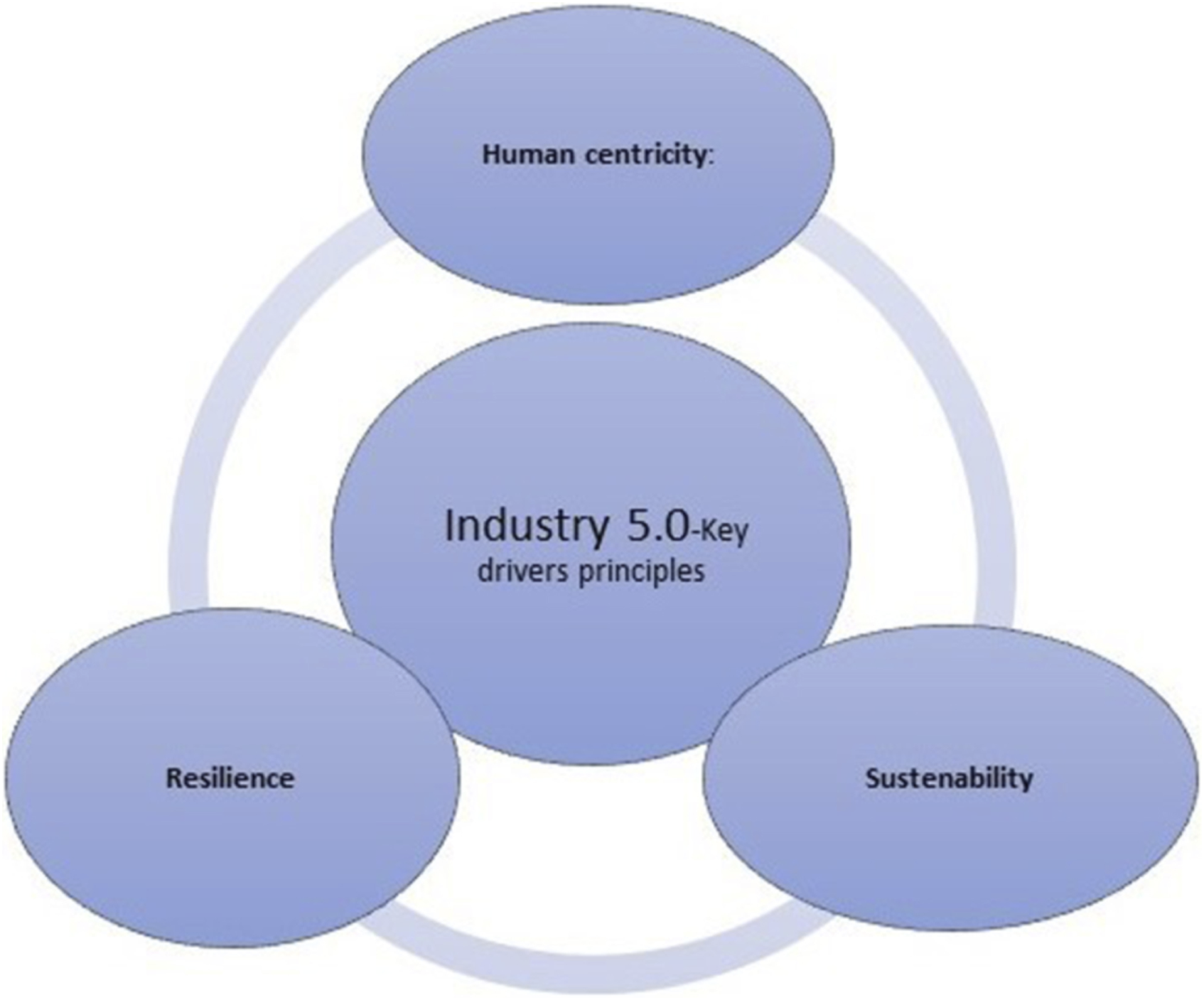
4.4. HR management processes
The human resources management activities in a production organization, particularized on the manufacturing sector have not changed in the actual circumstances of the new industrial revolution, observed to the existing status in Romanian companies. They start from the idea of group management and management based on objectives at the level of the organization, under the conditions of minimal expenditure on personnel. Taylorism efficiency is active both at the level of “white collars” and “blue collars”. At the same time new concepts and operating principles of the industrial technological wave based on IOT (Internet of things), Simulation, AR, Industrial robots and ML require new personnel policies and procedures on the issue of upgrading existing staff to learn on the job. For strategic level managers, but especially for line managers, involved in solving operational tasks, a parallel responsibility is related to the personnel tasks, with the complete typical human resource management activities, especially for production operators as follows: Selection of human resources. Induction and integration of apprentices. Professional training on specific jobs and production operations. Periodical performance measurement and assessment of employees. Staff structuring upon specific jobs. Policy implementation referring to internal discipline rules. Policy implementation and control the compensation and rewards system. Team motivation. Set-up of adequate communication channels. Safe and security regulation implementation. Action plans to facilitate the company objectives implementation; as for example, a new IT platform and ERP integrated system set-up need a project management assignment with detailed measures directed to each work department involved.
All these tasks are complex and need to be undertaken in combination with other activities or specific projects related to operational flow, material assurance, IT equipment or budgeting. In this respect, the HR/personnel departments through their specialists can provide support and specific actions, as follows: Establish the HR strategies, on long terms, taking into account to innovate and use the technological facilities offered by the Industry 4.0 entities; Consultancy and profiled services exemplifies by the needed documents of contracts, job description design, job analysis and design, job profiles; Undertaking the operational tasks of recruiting, selection, induction, and initial training on the job, assigned to either specialists or instructors.
In view of the changes brought about by the phenomenon of digitization, IOT, or ML, in which most of these activities can be automated, and especially in conditions of a degree of automation of processes and the expansion of industrial robots assisted or not by human staff, the question arises whether and how much of the bureaucratic staff is necessary. Imperatively, the category of consultants and personnel managers is entering a new framework of action and role playing, due to the changes that may occur in job descriptions, the way of performance evaluation for semi-automated or robot-assisted industrial processes, as well as the continuity of training topics and methods, which require IT specialists, innovative technicians, and qualified engineers, permanently connected to technological changes. Therefore, the new profiles and communication facilities brought by Industry 4.0 demand customized competencies upgrading the job profiles. Consequently, the entire process of HR management requires a complete revision of all the activities starting with selection and recruiting the personnel and particular approach for the manufacturing operations related to: Induction of new employees, keeping in mind the actual lack of attractivity of routine or time investment for skilled or manual productive activities. This is confirmed by the research and paradigm issued by Schoenhals in 2021 [10] who identified the perception of coercion determined by regular, mandatory or not audience recognized tasks. Training methods and career development to stimulate the transformation into a HPWS (high performance work system) which is based on the features of egalitarianism and engagement, shared information and trust, knowledge development, performance reward linkage [11];
Updating performance management system of measuring the results, in order to lead towards a fair and motivating system of rewarding human resources, taking into account besides the organization’s objectives, mostly the measurement of competencies which are created inside the company. They could become more visible working to fulfill the need of recognition of people. This is an immediate consequence of mass customization feature of actual industrial revolution. It is not just a market demand, it is a reflection on each individual who need to feel the consideration for his particular contribution.
4.5. High performance work system (HPWS) principles
The approach of methodology provided by literature review is represented by HPWS concept with its particular parameters providing relevant points to develop a model solution for creating the interaction between an organization and potential HR labor force based on common goal. Once the interaction is obtained, this results into a performance which could be increased as much as the elements of HPWS are introduced into the sociotechnical system of organization. Herein a brief list of the main parameters of HPWS summarized from the book of Snell and Morris [11] regarding the management of human resources: -Egalitarianism and engagement: represent the principle of inclusion, people want a sense that they are members, not just workers, in a organization. Moving power downwards in organizations empowering employees which could be obtained through job enlargement, enrichment and self-managing work teams [11]. -Shared information and trust: when employees are given timely information about the nature of their own work, business performance and strategies, they are more likely to make good suggestions for improvement and cooperation in major organizational change [11]. Knowledge development: represent the shift from touch labor to knowledge work. Because of the dynamic and fast pace of technical change, knowledge and skill requirements must also change rapidly, with continuous learning [11]. Performance reward linkage: when companies reward their employees based on their performance, workers are naturally pursuing outcomes that are mutually beneficial to themselves. Often include group and organizational incentive pay and even skill-based pay [11].
4.6. Performance management concepts
Upon scattering the concepts related to the associated term of HR performance stimulative factors and performance diagnose, a sharp conclusion indicated the skills and competences of human resources needed to be enhanced by intensive factors which help attractiveness on manufacturing jobs and retention as well. Under these circumstances the technologies and also the key principles of industry 5.0 would contribute to reduce, improve the working environment and support the culture of human centricity within the organization. The preliminary analysis of HR performance optimization is presented on the annexed Fig. 4.
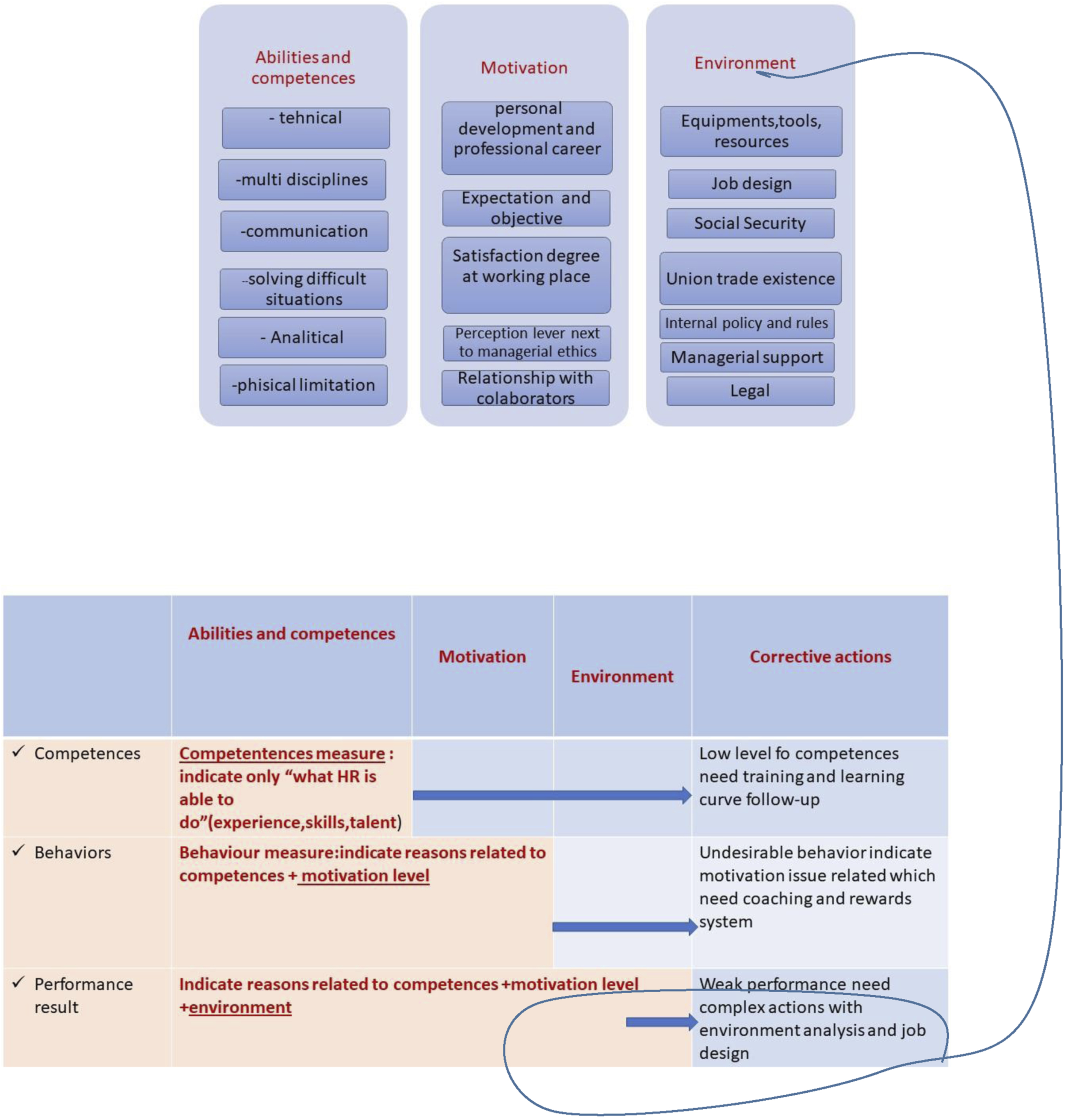
HR Performance diagnose and stimulative factors [8].
5. Results
Data analysis upon mentioned concepts provides several information: The performance diagnosis carried out through the analysis of the industry 4.0 and 5.0 drivers confirm the need to involve environmental factors, which in this case can be represented by the context characterized by the Industry 4.0 + 5.0 concepts and the principles of human centricity as presented above. Using the dissemination method to focus on the internal environment, the performance analysis will focus on the specific conditions of a manufacturing production organization exemplified on the critical positions difficult to attract human resources in the organization, represented by the productive operators at the bottom of the organizational pyramid.
Analysis of data collected by Zizic et al. [3] showed that there are improvements in organizational performance after the use of Industry 4.0 technologies. Important organizational performance indicators such as volume of units produced, line speed, capacity, quality and profitability increased and costs decreased afterwards introduction of I4.0 technologies.
Another important complementary aspect noted in the study by Zizic et al (2022) is the issue of the ethical use of Industry 5.0 technologies, to create human resource performance in the organization. This issue is closely related to human centricity, but overlaps with sustainability, as low ethical standards produce an unsustainable society. Industry 4.0–5.0 factors can be a source of learning, to obtain the adequate set of competences adapted to the manufacturing industry. Increasing the individual and team performance of employees is based on the development of the 4.0–5.0 competences mix, as with ethical use of I4.0/I5.0 technologies to become a sustainable organization. On their turn, the principles of CE could become useful as guiding map transferring their meaning and scope of waste reduction from the material resources to human resources (HR) whether the managerial system and suitable measuring tools are applied. Thus, I4.0 and I5.0 technical factors become the means to grow the organization and recuperate the human factor together within a culture of human centricity values. Furthermore, an adequate design of job profile must be constructed in order to appreciate and reward specifically the competences which are providing the employees with performance.
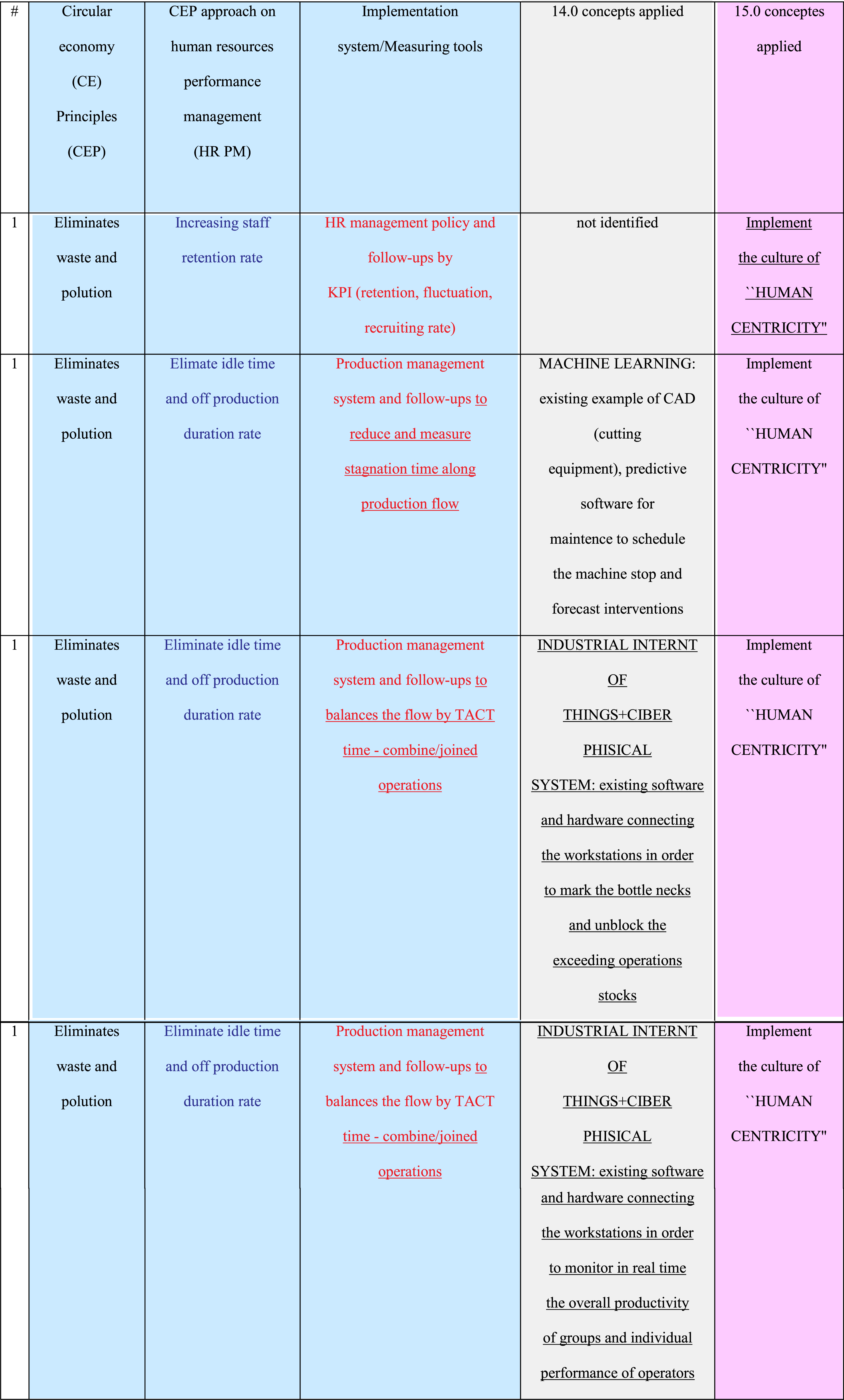
The analogy between the CE principles applied on “product” element and “human resource “is set for further judgment, extended onto the key drivers I 5.0 (see Fig. 3) with most comprehensible technologies. As long as HR need to reduce the decalage between the comprehensive knowledge of high end technologies which are far more advanced, most of key drivers are belonging to I4.0. HR has to understand the exploiting the basic rules of digitalization, learn how to co-exist with them and to eliminate the fear against the danger of replacing their role.
The following relation is developed by using the CE principles and approach a systemic vision to HR performance against HR waste (see Tables 1 and 2, presented onto annexes 5–6).
CEP extrapolated to HR waste elimination.

CEP extrapolated to HR regeneration and active extended life.
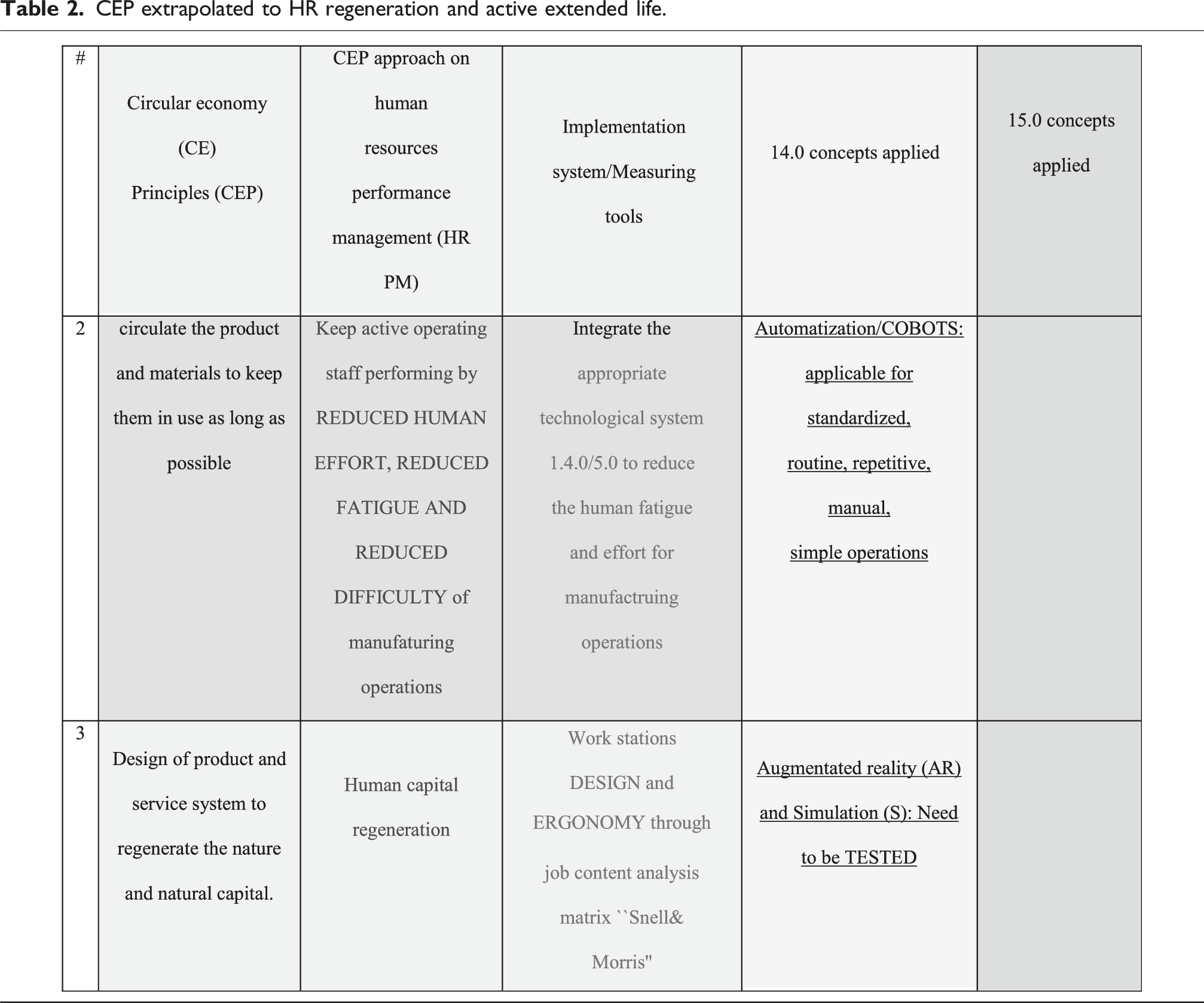

Special attention was drawn to principle 3. The organization’s offer to attract human resources for performance depends on job analysis and job design, as presented in the statistical data provided by H.G. Adamkova [12] for ensuring job satisfaction. Starting from the assumption that performance is based on the formation of competences, these can correspond to the type of HPWS (high performance work system) approach that combines the essential competences of the specific productive activity with the general competences proposed by the World forum of Work in 2019 [8] related to I 4.0 + 5.0 industrial phase. The competency-based job analysis approach resulting in appropriate job design [11] can be further developed by introducing the industry 4.0 competency matrix as proposed onto the research of next chapter and the competency-based reward system, shown in Fig. 5 onto annex 7.
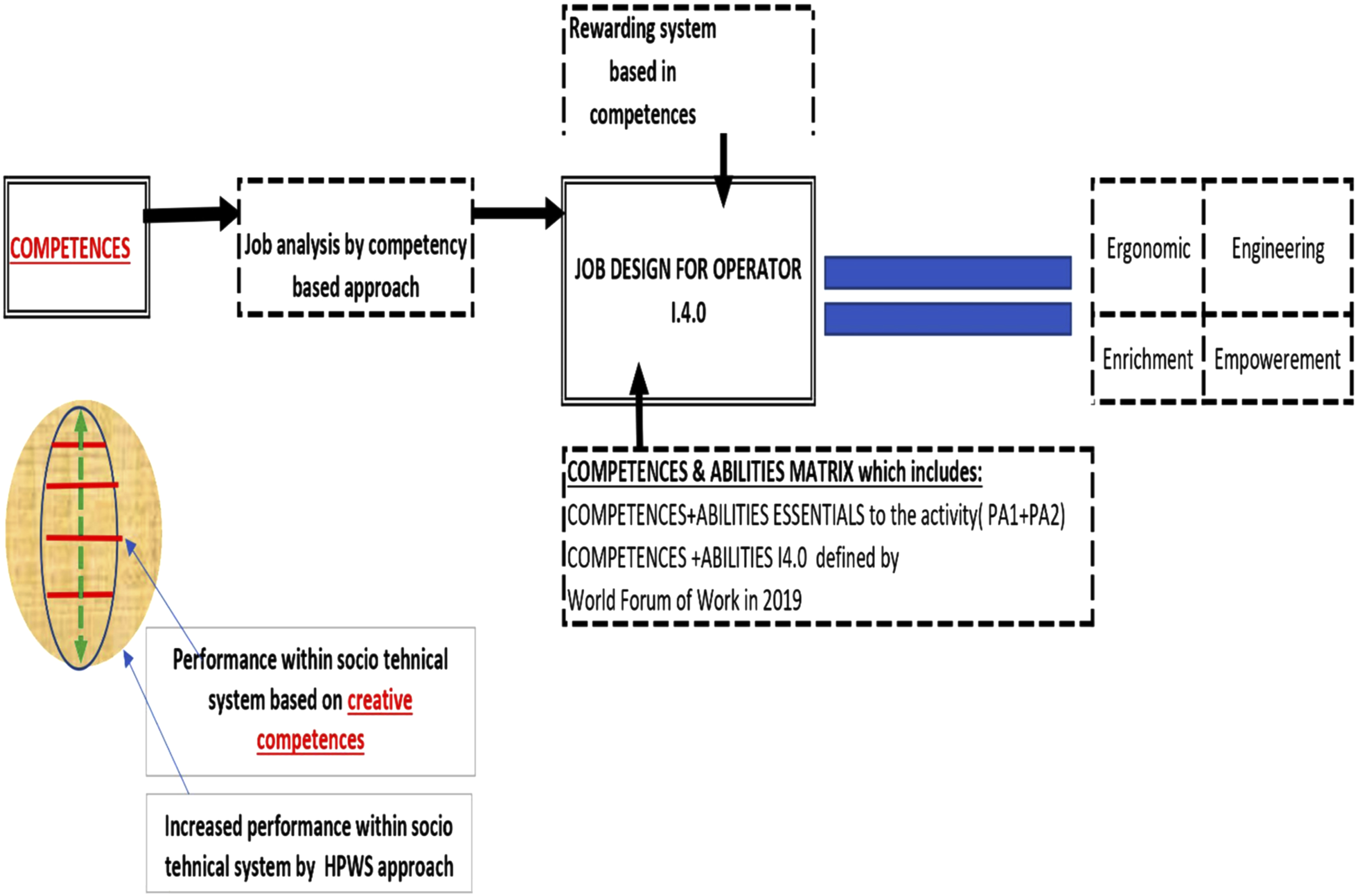
Job design HR I.4.0 based on competency-based approach.
6. Discussion and conclusions
The automatization level and industrial robots could not replace yet the human interaction with the machine which is decisive in this trade. The methodology is based only on literature review because the concepts and academic contributions are still new and subjected to empirical trials.
For social and human sciences is unfolding directions of performance research and concepts looking for updated incentive factors to motivate and attract the human resources for manufacturing industry. Industry 4.0 factors can be a source of learning, to obtain the mix of competences adapted to the manufacturing industry.
Increasing the individual and team performance of employees is based on the development of the 4.0–5.0 competences mix, developing the concept of mass customization at the level of incentive factors which stimulate the contribution of each employee through their skills and developed knowledge.
Thus, Industry 4.0 factors could become the opportunity to grow the organization into the race for competitive advantage in relation to CE principles applied on HR performance. The work experience of enterprises which succeeded to survive during the pandemic crisis shall be used as best practices, to build new direction of human performance research, available for broad spectrum of industrial activities, not only in the IT industry niche.
The European concepts of circular economy + Green Deal‘ or “Industry 5.0” could be seen as answers to the question what normative basis should be considered for the governance of network-society. Industry 5.0 addresses the challenges of a functional and fragmental differentiated society, with possible interpretation for punctual concrete organizations environment and human resources. The actual crisis of HR labor force shall be a continuous topic of concern and at the end of viable solutions for society.
6.1. Theoretical and managerial implication
Meanwhile the implications of phenomenon Industry 4.0–5.0, for the internal environment such organizations and their human resource management, besides the external environment (communities and people) should be emphasized. The main stakeholders of industrial plants such as entrepreneurs, top managers and also middle managers are deeply responsible for sustaining the human resources for an improved performance, respecting human needs. The new circumstances are calling for new strategies inside the organizations, on top management behalf to identify the needed working competences of their own specialists, customizing the 10 set of skills defined by World Manufacturing Forum according to the new type of working flows, activities or equipment. The equitation shall take into account the components of reconversion and training for all the population segments, to enable a smart investment and benefit of getting the value of experience and practical knowledge of seniors, combining with the agility and creativity of new generation born on the digital era. The external environment represented by communities will get the benefit of growing as “Smart digital cities” by formal and vocational education which shall be sustained by institutions and government policies. The main objective to be followed is a mutual relation and common benefit, whereas the organizations are adding value by hiring smart specialists, resulting from the society and meanwhile the internal organizational training and professional reconversion support the various human resources, reducing the cost of unemployment rate for the communities.
6.2. Contribution with practical implication
The Industry 4.0 and 5.0 factors are treated as facilities to become the opportunity for organizations growing towards the race for competitive advantage. The people shall develop their practical skills with the support of facilities provided by the new stage of industrial revolution, chosing and adapting systematically the suitable main technology and equipment. The measuring tools of competencies mix model propose specific targets which could be comprehended by all categories of human factors from managerial level to practical execution. The research approach a field less explored, but representative for the manufacturing industry which at the end is the engine for society progress and existence. Therefore, the concern shall be focused on creating the attractivity for practical work with the adapted competencies and stimulation and rewarding system for human capital.
6.3. Limitations
The actual research and models construction recognize certain limits, as is still based on literature review and scholastic studies which are already demonstrated and recognized, but the personal experiment, case study or a survey are necessary to add value. The actual study is a first stage following the researching work related to the topic of human resources development and performance into Industry 4.0–5.0, therefore the work is still ongoing for more results and more applicable fields of activities/
The methodology is based only on literature review because the concepts and academic contributions are still new and subjected to empirical trials.
Further existing limitation is represented by the small base of examples provided by one manufacturing industry as apparel and clothing production. One the other hand, this field of activity is enough representative because the labor human factor is the main element to provide performance for the company.
The automatization level and industrial robots could not replace completely the human interaction with the machine which is decisive in this trade. Furthermore, the human factor is vital to keep the society in control over the digital phenomenon and develop the needed set of competences, on the other hand the elements of culture, traditions of handicrafts and the value of human manufacturing to be appreciated beyond the simple result of products. The domain is large and complex, the actual paper work used only a selection of concepts which are considered suitable to be applied for the human resources at the base of pyramid. They are defined as production operators who are vital to keep the engine of manufacturing and need specific tools to be effective and performant. The extent of the paper could not allow more development which are programmed already for the next research steps.
6.4. Future research direction
The activities are complex and in the last 15–20 years, due to cost and control difficulty, the vertical flow of activities has broken down into small and medium sized companies, being difficult to manage in a compact holding (from the production of raw material, with many components), to specialized textile finishing treatments, to the assembly of a manufactured product. The SME (small and medium enterprises) concept allowed digitization by type of activity, starting from this feature of moderate size, being more flexible, having a more efficient control over the flow, obviously simplified due to the reduction of the managed segment.
In terms of acquired skills, employers require trained operators, able to interact and manage new technologies, installed to increase productivity and profitability of companies. For operators, education will be essential in securing jobs, but also in acquiring new employment options. In particular, the category of traditional operators needs to be redefined from the perspective of the managerial models identified within this ongoing research, as they become participatory specialists in the creative as well as in the decision-making process of smart factory entities. A pragmatic specialist profile is the one defined, whereby the categories of personnel should not be divided into operators and hyper-engineers, but “augmented” workers and specialists, able to mix diverse skills, in which personal attributes are motivationally valued, customized according to creativity, dexterity and ability to use digital 4.0 equipment and technologies. This is the suggestive new perspective and also proposed paradigm to upgrade the job profile. Furthermore the framework must be extended, becoming more inclusive for the social category of migrants and young or senior women to escape from lower educational zone, without the possibility of earning a satisfactory income or career advancement. This is the case of the potential candidates for textile and clothing industry, considered at the end of industrial manufacturing scale, due to the unclear status between productive industry or handicraft activity. This is a major limitation which could work against the efforts of research and practical trials to prove the validity of the defined models.
There is a need for a profound change in the attitude and behavior of employers, in the mentality of society, which obviously leads to the need for radical transformations that governments must adopt through middle, academic and vocational education upon a national project.
Footnotes
Acknowledgments
No acknowledgements.
Author contributions
CONCEPTION: Luminita Cristina Simion
METHODOLOGY: Luminita Cristina Simion
DATA COLLECTION: Luminita Cristina Simion
INTERPRETATION OR ANALYSIS OF DATA: Luminita Cristina Simion
PREPARATION OF THE MANUSCRIPT: Luminita Cristina Simion
REVISION FOR IMPORTANT INTELLECTUAL CONTENT: Luminita Cristina Simion and Silvia Avasilcăi
SUPERVISION: Silvia Avasilcăi
Author Biographies