



Abstract
BACKGROUND:
“Silence” is a common phenomenon in the operation of enterprises, where some instances of silence can uphold organizational harmony, while other forms can exacerbate organizational issues, hindering intra-organizational information transfer and decision-making and affecting organizational innovation.
OBJECTIVE:
This study aims to explore the relationship between humble leadership style and employee silent behavior, verifying the mediating role of psychological contracts in this relationship.
METHODS:
Based on the social exchange theory, hypotheses are validated using descriptive statistical analysis, correlation analysis and the SEM structural equation modeling testing.
RESULTS:
The findings indicate a significant negative correlation between humble leadership and employee silence. Humble leadership significantly inversely predicts permissive and defensive dimensions of employee silence, while the correlation with the prosocial dimension is insignificant. Moreover, psychological contracts partially mediate the impact of humble leadership on permissive silence and defensive silence among employees.
CONCLUSION:
The study helps managers comprehend how humble leadership, characterized by the traditional Chinese “humility” culture, affects employee silence. Especially within Chinese enterprises, where employees are influenced by traditional Chinese thought and exhibit historical dependency on silent behavior, probing whether the humble leadership style can effectively encourage employees to provide constructive suggestions for organizational development is particularly meaningful.


Introduction
In recent years, enterprises have been dealing with an increasingly uncertain and competitive environment due to economic globalization. The operating mode, which relies solely on the management of organizational leaders, is no longer sufficiently flexible to respond to environmental changes. Employees now have a relationship with enterprises that goes beyond simple labor. Their active participation and offering of of extra-role behaviors have become a driving force for organizational change, innovation, and market stability [1, 2]. However, there is a common phenomenon of “silence” within companies. Some silence may maintain organizational harmony, while others could lead to the expansion of organizational problems. This phenomenon is more common in Chinese enterprises due to the influence of traditional Chinese culture, such as the “Doctrine of the Mean” and “Silence is golden” [3].
Employee silence is intentional non-speaking behavior, where employees purposefully withhold or filter thoughts, opinions, or views related to work and the organization. Since Morrison and Milliken [4] introduced the concept of organizational silence in 2000, scholars have devoted increasing attention to examining it as an individual behavior and exploring its content, structure, formation mechanisms, and influencing factors. Most scholars believe that employee silence can have adverse effects. At the organizational level, it discourages communication and learning among employees [5], hinders the improvement of organizational innovation and R&D capabilities [6, 7], and leads to a decrease in the quality of organizational decision-making [8]. At the individual level, long-term silence can make employees feel neglected, leading to emotional exhaustion [9], reduced job satisfaction and enthusiasm for work, and even lead to job burnout [10]. Some scholars believe that moderate concealment of certain information is beneficial to organizational stability and interpersonal harmony and helps keep business secrets [11].
Therefore, it is necessary to clarify the mechanisms that generate employee silence. Scholars mainly discuss it from the perspective of individual, organizational, and colleague factors. However, there has been little research on the impact of humble leadership on employee silence and the relationships and mechanisms involved between these various dimensions. With the turbulently changing organizational environment, humble leadership has emerged as a prominent “bottom-up” leadership style [12]. Leaders are no longer just corporate executives but must develop together with employees [13]. Influenced by traditional Chinese thoughts, employees have a historical dependency on silent behavior. Therefore, it is worth exploring whether a humble leadership style can effectively encourage employees to provide constructive opinions for the organization. This could serve as a valuable starting point for further exploration.
To further explore the black box of the role of humble leadership style and employee silence, it is important to consider the internal psychological state of employees. According to social learning theory, people’s behaviors are formed under the multiple influences of self-regulation and external situational factors [14]. This shows that although individual behavior is affected by external factors, what is crucial is the self-reinforcement process and the role of subjective initiative. The psychological contract is an implicit, informal internal agreement linking the organization and employees psychologically and affecting employee satisfaction and behavioral choices [15]. Therefore, this paper intends to explore the transmission mechanism of humble leadership on employee psychological contracts from the perspective of psychological contracts.
Literature review and research hypotheses
Concept definition
Humble leadership
Owens and Hekman introduced “Humble Leadership” as an independent concept in 2012. Subsequently, scholars have primarily investigated it from two perspectives: personal traits and behavioral attributes [16]. The perspective of personal traits posits that humility is a positive individual quality, inherent and immutable, devoid of variability and imitability [17]. In contrast, the behavioral perspective emphasizes that humility can be shaped as a leadership style through external actions [18]. Drawing upon the research by scholar Feng Jingming, this paper contends that humble leadership is a leadership style that maintains sound subordinate relationships through behaviors such as objectively recognizing one’s shortcomings, affirming others’ merits and contributions, and engaging in humble learning. Owens and Herman’s dimensional division concerning humble leadership includes self-awareness, appreciation of others, and openness. Self-awareness entails leaders being able to evaluate themselves honestly and objectively based on their deficiencies; appreciating others is the leader’s ability to recognize and affirm the merits and contributions of others; openness implies being receptive and capable of learning from new ideas and suggestions.
Psychological contract
In 1962, Levinson first defined the psychological contract as the unspoken mutual expectations between organizations and their employees [19]. Subsequent scholarly research has delved into the connotations of psychological contracts through various aspects, such as expectations and perceptions of responsibilities, primarily from the perspectives of individual employees and the bi-lateral plane of organization-employee interactions [20, 21]. From the employee perspective, this paper defines a psychological contract as an internal agreement harbored by the employee, wherein the employee anticipates reciprocity from the organization in return for their contributions. Building on Li Yuan’s three-dimensional structure, psychological contracts are classified into transactional, developmental, and relational psychological contracts. The transactional dimension underscores explicit wealth exchanges between organizations and members, encompassing material foundations and benefits like tangible rewards; the developmental dimension pertains chiefly to personal and career growth, including prospects for individual future and job outlook; the relational dimension is related to the humanistic environment in which the employee is situated and organizational care, involving aspects like superior trust, respect, and performance recognition.
Employee silence
In their research, Rosen and Tesser first identified that some individuals choose to remain silent on matters of personal concern to avoid the repercussions of transmitting unfavorable news [22]. Extensive research has been conducted by scholars into the concept of silence, which has become a widely discussed phenomenon. Subsequent analyses of the silence existence within organizations have been performed by various researchers, such as Athanassiades [23], Noelle-Neumann [24], and Argyris [25]. Integrating the concepts and dimensions proposed by Dyne [26], this study perceives employee silence as the deliberate retention or filtration of thoughts, opinions, or viewpoints related to work and the organization by the employee. Moreover, it categorizes it into three dimensions based on distinct motivations: acquiescent silence, defensive silence, and prosocial silence. Acquiescent silence is characterized as a passive conformist behavior, where employees believe their thoughts or suggestions are insufficient to alter the existing organizational or work status quo. Defensive silence is a proactive self-protective behavior, a strategic action chosen by employees who fear leaving a negative impression on leaders or colleagues or feel incapable of dealing with the consequences of voicing out. Prosocial silence is an altruistic behavior wherein employees intentionally withhold or filter their opinions out of concern for organizational interests or collaborative efforts among colleagues, exemplifying a form of altruistic organizational citizenship behavior.
Research hypotheses
The impact of humble leadership behavior on employee silence
Under the influence of traditional Chinese culture, most employees tend to filter or conceal their thoughts in specific situations [27]. Employee behavior is subject to the influence of leadership styles [28, 29], where positive leadership behavior facilitates the formation of trusting relationships between subordinates and leaders, thus reducing silent behaviors [30]. Leadership approaches emphasizing communication with employees help employees gain autonomy in their work. As a result, employees are more inclined to express their opinions and views to the organization [31]. On the other hand, subordinates are more prone to articulate their thoughts and opinions when they perceive that leaders are receptive to the views of others [17, 32]. Humble leaders are capable of acknowledging their shortcomings and encouraging reflection. They are more likely to bridge the gap with employees, thereby alleviating employees’ apprehensive psychology of maintaining silence for fear of misspeaking [33]. Humble leaders who pay attention to and appreciate the strengths and talents of subordinates can not only stimulate employees’ innovative drive and work enthusiasm, fostering a positive, innovative atmosphere within the organization but also encourage employees to boldly display their talents, enhancing organizational recognition and value belonging in their work, thus reducing the likelihood of subordinates withholding opinions. Concurrently, such harmonious interpersonal relationships improve employees’ organizational identification and work enthusiasm, reduce the sense of distance from the organization, and stimulate more extra-role behaviors.
Based on the above analysis, this article proposes hypotheses H1-1, H1-2, and H1-3.
The impact of humble leadership behavior on psychological contracts
Research concerning the relationship between humble leadership and psychological contracts is currently limited. Through literature analysis, this study identifies influential relationships between various leadership styles and psychological contracts [34]. Within the Chinese context, leaders, serving as spokespersons for enterprises, exert influence over employee attitudes and behaviors through their leadership style; charismatic leadership, for instance, can effectively enhance employee psychological contracts, thereby elevating work performance [35]. Leadership styles characterized by openness, inclusiveness, and affability tend to facilitate material and emotional satisfaction for employees. As a result, employees exhibit heightened positive behaviors in interactions with leaders as a form of reciprocation [36]. It can be observed that leadership styles embodying “humility” can impact the realization of employee psychological contracts. Humble leaders who are candid about their shortcomings, engage in self-reflection and actively seek feedback foster a positive working atmosphere between superiors and subordinates. This approach also effectively amplifies employee work autonomy, which is closely linked to psychological contracts’ developmental and relational dimensions. Such leaders, ever keen to learn and readily recognizing and affirming the merits and contributions of their subordinates, can elevate employee innovative consciousness and facilitate the realization of self-worth among employees. In light of the above analysis, hypothesis H2 is proposed in this research.
The impact of psychological contracts on employee silence
Numerous scholars have introduced the variable of psychological contracts when researching employee behavior. For instance, in surveying Chinese private enterprises, Lee Chao-Hsing discovered that violations of psychological contracts significantly diminish employee work performance and organizational citizenship behavior, concurrently elevating intentions to leave [37]. Research by Zhang Qin indicates that psychological contracts play a significant predictive role regarding dissent behavior. Corporate care for employees promotes the active provision of suggestions under a “win-win” vision [38]. Yu Huaying’s analysis concludes that relational psychological contracts have a substantial negative impact on employee silence; positive interpersonal relationships and a conducive working atmosphere effectively address detrimental silent behaviors [39]. When the reciprocity of what employees expect to receive and contribute aligns, heightened satisfaction and loyalty are observed [40], fostering a willingness to establish common goals with the organization and reducing acquiescent silence. Positive interpersonal relationships and working atmospheres are beneficial in mitigating and ameliorating interpersonal conflicts stemming from the expression of divergent opinions and perspectives [41], thus reducing defensively silent behaviors rooted in self-preservation. Correspondingly, harmonious interpersonal relationships can expedite cultivating a robust corporate culture, facilitating enhanced cohesion and collective honor among organizational members. Employees may opt to withhold their views and maintain silence in specific situations. Based on the preceding analysis, this study proposes hypotheses H3-1, H3-2, and H3-3.
Mediating role of psychological contracts
Research on the impact and mechanistic actions among humble leadership, psychological contracts, and employee silence remains inconclusive. Numerous studies have indicated the existence of mediating variables between organizational factors and employee behavior. Psychological contracts are cognitive inclinations formulated through the interplay of employee cognitions, behaviors, and ambient environments, and they serve as pivotal conduits through which external factors such as leadership style and organizational culture influence employee behavioral manifestations [42]. Scholar Zhao Chenhui researched the relationship between union practices and employee organizational citizenship behavior. They concluded that psychological contracts can exert a significant mediating effect, validating their positive impact on employee organizational citizenship behavior [43]. Similarly, scholar Lei Gang believes charismatic leadership can effectively enhance psychological contracts, thereby elevating work performance [35]. Scholar Zhang Min investigated the influence of human resource attributions on voicing behavior and affirmed the mediating role of relational and transactional psychological contracts. The research indicates that when an organization provides care and assistance to employees, it is conducive to maintaining favorable psychological contracts. This, in turn, encourages employees to actively voice suggestions, leading to a “win-win” situation for the organization and employees [44]. Predicated upon Social Exchange Theory, humble leadership readily cultivates trusting relationships between superiors and subordinates. Leaders who provide care and job recognition can efficaciously facilitate the realization of psychological contracts among employees. When employees perceive that various dimensions of the psychological contract are enriched and satisfied, they tend to exhibit positive reciprocating behaviors [45], thereby becoming more inclined to express their views and insights related to work. Based on the above analysis, this study proposes the following hypotheses.
In summary, this paper establishes the Conceptual Model in Fig. 2.1.

Research model.
Data collection and sample
The survey questionnaires were primarily distributed to employees of enterprises in regions such as Jiangsu, Zhejiang, Shanghai, Anhui, and Shandong, specifically encompassing developed cities like Shanghai, Hangzhou, Nanjing, Wuxi, Hefei, and Jinan. The questionnaire survey was conducted among employees from various organizations, including private enterprises, foreign enterprises, and public institutions. A total of 250 questionnaires were distributed. After excluding those with a high missing rate, 213 valid questionnaires were ultimately obtained, yielding a validity rate of 85%. Among the participants, the male percentage was 51.64%, and the female percentage was 48.36%, presenting a relatively balanced gender ratio. The sample consisted mainly of individuals aged 25–35, accounting for 56.81%. Those aged 25 and under comprised 29.11%, while individuals aged 36–45 accounted for 8.92%. Among the respondents, 43.66% held undergraduate degrees, and 30.52% possessed postgraduate degrees or above, indicating a generally high educational level among the participants. 45.07% of the participants had a working tenure of 1–3 years, constituting the highest proportion. Regarding the nature of the participants’ organizations, private enterprises accounted for 36.62%, state-owned enterprises 31.92%, and foreign or joint ventures 15.02%, showcasing a comprehensive nature of the surveyed organizational types. From a positional level perspective, 64.41% of the participants were grassroots employees, and 20.09% were grassroots management, indicating that most participants were grassroots employees or managers within enterprises.
Measurement methods
This research employs established scales to measure the surveyed data through a literature review. Each item is scored between 1 and 5 using a Likert 5-point scoring method, where 1 to 5 respectively corresponds to “strongly disagree,” “disagree,” “neutral,” “agree,” and “strongly agree” to distinguish individual perspectives on each item. The questionnaire primarily comprises three sections: an introduction, a personal information section, and a scale measurement section. The first part explicitly states the research purpose and precautions; the second part specifies the basic information of the survey subjects, and the third part entails the scale test items. Detailed scales can be found in the appendix.
(1) Humble Leadership Scale Design
Scales measuring humble leadership are scant, with the predominant measure being a three-dimensional nine-item scale proposed by Owens and Herman in 2009 [16]. Chinese scholar Qu Qing translated Owens’s three-dimensional scale in 2013, and achieved commendable reliability and validity in empirical research [46]. Based on the questionnaire translated by scholar Qu Qing, this study set a three-dimensional scale with nine measurement items to ensure internal consistency in measurement results. Through Cronbach’s α coefficient testing, the reliability value of the humble leadership scale was determined to be 0.914, and the Kaiser-Meyer-Olkin (KMO) value of humble leadership was 0.863, reaching a significance level of 0.05, with a cumulative variance explanation rate of 59.442%.
(2) Psychological Contract Scale Design
Research on psychological contract scales is relatively mature. Representative scales include those designed by foreign scholars like Rousseau [47] and Millward [48] and Chinese scholars such as Li Yuan [20] and Chen Jiazhou [49]. Dimensions of the scales mainly involve transactional, relational, training, and developmental aspects. This study adheres to Li Yuan’s 21-item three-dimensional scale for measurement. After conducting Cronbach’s α coefficient testing, the reliability value of the psychological contract scale was 0.933, and the KMO and Bartlett’s sphericity test results showed that the KMO value for psychological contracts was 0.828, achieving a significance level of 0.05, with a cumulative variance explanation rate of 63.718%.
(3) Employee Silence Scale Design
Extensive research has been conducted on the scales for measuring employee silence. One frequently utilized scale is the three-dimensional scale proposed by Dyne [26], which encompasses acquiescent, defensive, and prosocial silence and is grounded in human motivation. This scale has been employed in empirical research by Chinese researchers such as Yi Hongtao [50] and Zhang Yanghui [51]. In the present study, drawing upon the foundation of the scale designed by Dyne and the translations provided by domestic scholars, a scale consisting of 12 items was established. The reliability coefficient (Cronbach’s alpha) of the employee silence scale was denoted as 0.835, and the KMO measure was 0.818, achieving a significance level of 0.05, thus indicating an overall satisfactory validity and reliability of the scale. The cumulative variance explained by the factors was 63.718%.
Results
This paper employs SPSS 20.0 statistical software to perform validity, reliability, and correlation analyses on the gathered data. The study employs structural equation modeling to conduct confirmatory factor analysis and hypothesis testing, so confirming the scale’s effectiveness and dependability, as well as assessing the validity of the offered hypotheses in the research.
Correlation analysis
Employing the Pearson correlation coefficient method and utilizing SPSS 20.0, the study examines the relationships among humble leadership, psychological contracts, and employees’ acquiescence, defensive, and prosocial silence, yielding mean values, standard deviations, and correlation coefficients for the variables. The data are detailed in Table 4.1.
Mean, standard deviation, and correlation coefficients of variables
Mean, standard deviation, and correlation coefficients of variables
Note: **. Indicates a significant correlation at the 0.01 level (two-tailed); *. Indicates a significant correlation at the 0.05 level (two-tailed).
The overall mean score for the humble leadership variable is 3.10, with the psychological contract exhibiting an overall mean of 3.17 and employee silence possessing an overall mean of 3.07. Specifically, the scores for acquiescent silence, defensive silence, and prosocial silence are 2.68, 3.25, and 3.28, respectively. The data reveals that the score for employee silence is moderately high, indicating that employees are inclined to withhold or filter their thoughts and perspectives concerning work throughout the work process. Additionally, the skewness and kurtosis values of the measurement data are approximately±1, conforming to the requirements of a normal distribution.
Pearson correlation analysis demonstrates that humble leadership and employee silence are negatively correlated at 0.01, with a correlation coefficient of –0.505. Humble leadership and psychological contract are significantly positively correlated at the 0.01 level, and their correlation coefficient is 0.461. The psychological contract and employee silence are negatively correlated at 0.01, with a correlation coefficient of –0.333. Humble leadership is negatively correlated with acquiescent and defensive silence behaviors but not significantly correlated with prosocial silence.
Confirmatory Factor Analysis (CFA) is employed before hypothesis testing to assess the convergent and discriminant validity of the measurement model. The results of the confirmatory factor analysis are presented in Table 4.2. The baseline model consists of three factors: Humble Leadership (HL), Psychological Contract (PC), and Employee Silence (SB). The fit indices (χ2= 1585.477, df = 816, RMSEA = 0.110, CFI = 0.679, TLI = 0.661, SRMR = 0.103) meet the established criteria, indicating a significant advantage over other nested models. The three-factor baseline model exhibits strong discriminant validity, hence offering empirical evidence for further hypothesis testing.
Confirmatory factor analysis results
Confirmatory factor analysis results
Note: HL = Humble Leadership, PC = Psychological Contract, SB = Silent Behavior; CFI = comparative fit index, TLI = Tucker-Lewis Index, RMSEA = root mean-square error of approximation; CFI and TLI values greater than 0.9 indicate good fit; for the RMSEA, a value less than 0.1 is indicative of good fit.
During SEM 1, the relationship between humble leadership and acquiescent quiet is examined, with the psychological contract acting as a mediating variable. This is seen in Fig. 4.1. The model demonstrates a good fit, as indicated by the statistical values: χ2 / df = 2.736 < 3, CFI = 0.915, TLI = 0.908, RMSEA = 0.068. The study found that humble leadership has a strong negative impact on acquiescent silence (β= –0.471, p < 0.01), confirming hypothesis H1-1. Additionally, humble leadership has a considerable positive impact on the psychological contract (β= 0.404, p < 0.01), supporting hypothesis H2. The psychological contract has a negative effect on acquiescent quiet, as indicated by the regression coefficient (β= –0.259, p < 0.1), thus confirming hypothesis H3-1. The mediating effect was assessed by employing the bootstrap approach with 2000 bootstrap samples.
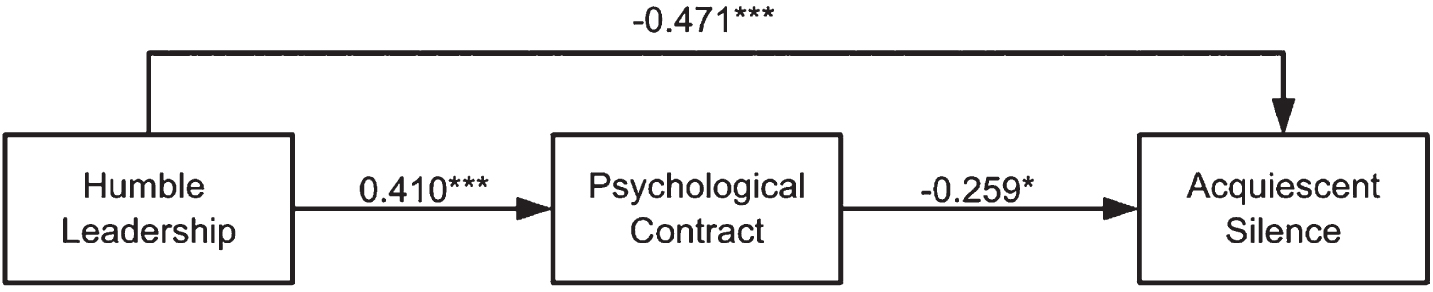
Parameter estimation of the effect of Humble Leadership on Acquiescent Silence. Note: ***p < 0.01, **p < 0.05, *p < 0.1.
The overall impact of modest leadership on acquiescent quiet is –0.667, with a 95% confidence interval (CI) = [–0.844, –0.489], indicating a significant effect as it does not include 0. The direct relationship between the psychological contract and acquiescent silence is represented by a path coefficient of –0.259 (p < 0.1). Additionally, the mediating effect of humble leadership through the psychological contract on acquiescent silence is statistically significant, with an indirect effect of –0.144 and a 95% confidence interval of [–0.307, –0.199], which does not include 0 (Table 4.3). Thus, hypothesis H4-1 is confirmed.
Mediation effect results based on bootstrap
In SEM 2, using psychological contract as a mediating variable, the mediating mechanism of humble leadership on defensive silence is tested (Fig. 4.2). The model fits well (χ2 / df = 1.836 < 3, CFI = 0.934, TLI = 0.914, RMSEA = 0.072). The impact of humble leadership on defensive silence is significantly negative (β= –0.472, p < 0.01), supporting hypothesis H1-2; the impact of humble leadership on the psychological contract is significantly positive (β= 0.403, p < 0.01), supporting hypothesis H2. The psychological contract negatively impacts defensive silence (β= –0.289, p < 0.1), supporting hypothesis H3-2. The mediating effect was tested using the bootstrap method with 2000 bootstrap samples.

Parameter estimation of the effect of Humble Leadership on Defensive Silence. Note: ***p < 0.01, **p < 0.05, *p < 0.1.
The total mediating effect of humble leadership on defensive silence is –0.622, with a 95% confidence interval (CI) = [–0.773, –0.470], which does not include 0. Specifically, the path coefficient from the psychological contract to defensive silence is –0.289 (p < 0.1). The mediating effect of humble leadership through the psychological contract on defensive silence is significant with an indirect effect of –0.130 and a 95% confidence interval of [–0.773, –0.470], excluding 0 (Table 4.3). Thus, hypothesis H4-2 is confirmed.
SEM 3 investigates the influence of modest leadership on prosocial silence. χ2 / df = 1.916 < 3, CFI = 0.927, TLI = 0.908, RMSEA = 0.057 indicate that the model suits the data well. Supporting hypothesis H2 is the finding that the influence of modest leadership on prosocial silence is marginally positive (β= 0.011, p > 0.1), while its effect on the psychological contract is statistically significant (β= 0.414, p < 0.01). Given the lack of significance of the direct impact of modest leadership on prosocial silence, the mediating effect remains unexplored.
Research has found that humble leadership has a significant impact on employee silence. Specifically, humble leadership behavior has a substantial negative effect on acquiescent and defensive silence among employees, while it does not have a significant correlation with prosocial silence. Simultaneously, the psychological contract plays a partial mediating role in the effect of humble leadership behavior on acquiescent and defensive silence. Hence, humble leadership behavior can influence employees’ acquiescent or defensive silence behaviors by affecting their psychological contracts.
Theoretical significance
Firstly, grounded on positive leadership styles, this paper explores the mechanism of employee silence and delves into the relationship among various dimensions of the variables, providing theoretical support to break through employees’ passive silence. The study demonstrates a reverse impact relationship between humble leadership and employee silence. It is affirmed that a leader’s self-scrutiny and openness to new things are more effective at sparking employees’ work motivation and disrupting their negative silence [52]. Furthermore, it elucidates the specific relationship between humble leadership and the dimensions of employee silence. Humble leadership fosters a relaxed and joyful organizational atmosphere, encouraging employees to exhibit extra-role behaviors. It also reduces employees’ deliberate choice of non-speaking behaviors due to self-protection and concerns and ameliorates employees’ passive, compliant silence resulting from neglecting company issues and low engagement.
Secondly, based on Social Exchange Theory, this paper further identifies that the psychological contract can play a partial mediating role in the effect of humble leadership behavior on employees’ acquiescent and defensive silence behaviors. Existing studies scarcely reveal the mechanism of humble leadership affecting employee silence through the intermediary variable of the psychological contract. This result aligns with the Social Learning Theory that an individual’s behavior is jointly determined by the environment acting on the individual and the individual itself [14]. Also, it corroborates the research conclusion of Scholar Qiu Na that “the psychological contract plays a mediating role between leadership behavior and employee behavior"[34]. From the perspective of the psychological contract, humble leaders can break through passive silence through objective self-cognition, appreciation of subordinates’ strengths and contributions, and an open-minded approach to new information. It helps to strengthen the bond between employees and organizational development and gradually alleviates the psychological reservations that may arise when employees speak out.
Practical significance
The theoretical model proposed in this study can serve as a reference for enterprises’ management practices. The research indicates that silent behavior is prevalent among current corporate employees. Under the influence of traditional Chinese culture, mobilizing the voicing enthusiasm of knowledge-intensive employees is vital for enterprises’ sustainable development [53]. Knowledge-intensive employees demonstrate substantial autonomy and notable creativity [54], making leadership particularly pivotal for them [55]. In organizational management, leaders should focus on “humility” by objectively perceiving oneself, being willing to appreciate others, and encouraging employees’ ideas and suggestions, which can effectively reduce their acquiescent and defensive silence behaviors.
Moreover, this paper substantiates that psychological contracts play a facilitating role in the relationship between humble leadership and employees’ acquiescent and defensive silence. Thus, managers should pay attention to the positive role of psychological contracts in breaking employee silence in daily work. Enterprises need to establish a “people-oriented” management philosophy, construct and refine an objective and fair appraisal reward and punishment system, strengthen employee training and trust, and actively create a harmonious and united interpersonal atmosphere. Furthermore, leaders need to improve their communication, decision-making, and coordination abilities, pay attention to the psychological states of employees, and establish a team culture atmosphere that encourages positive suggestions.
Research limitations
Although this study strictly followed research norms in its narration, it had some limitations due to limited resources. The data for this research was mainly gathered through online platforms and on-site distribution, neglecting to adopt more diversified approaches, such as organizing specialist supervision during form completion. Furthermore, most participants were employees with 1–3 years of work experience, predominantly distributed in areas such as Jiangsu, Zhejiang, Shanghai, Anhui, and Shandong, which does not comprehensively represent the overall situation. The survey questionnaires, filled out by employees, inherently reflect the issues of concern to them, inevitably embodying subjectivity and unilaterality. Obtaining data from various sources, such as an employee’s colleagues and supervisors, could enhance objectivity in future research. The humility-oriented leadership, psychological contract, and employee silence scales utilized in this research were modified from established scales, which might exhibit certain applicability biases. While concluding that humble leadership and psychological contracts affect employee silence, it should be acknowledged that employee silence is a complex psychological and situational behavioral tendency precipitated by various factors, as per the motivational research on employee silence. Therefore, further in-depth exploration is required to understand it better.
Conclusions
This research scrutinizes the impact of the humble leadership style on employee silence, incorporating psychological contracts as a mediating variable. By exploring the relationships among psychological contracts, humble leadership style, and employee silence, this paper corroborates its central viewpoint: employees’ psychological contracts influence their work attitudes and behaviors and play a partially mediating role in the relationship between humble leadership and employee silence. The study utilizes statistical methodologies, such as questionnaire surveys, data processing, and analysis, to elucidate the interrelationships among the three variables. It provides valuable references and suggestions for relevant scholars and enterprise managers.
Author Contributions
All authors have read and agreed to the published version of the manuscript.
Conflict of interest
The authors declare no conflict of interest.
Ethical considerations
The study did not require institutional ethical approval as it involved a survey administered as part of a training program, ensured anonymity of responses, and provided participants with the option to decline participation. Informed consent was obtained from all subjects involved in the study.
Funding
This research was funded by The General Project of Philosophy and Social Science Research in Jiangsu Colleges and Universities in 2023, Project name: Investigation of the Impact Mechanism of Humble Leadership on Counselor Silence, Project number: 2023SJSZ0390.
onecolumn