



Abstract
Background
Talent management plays an essential role as part of the HRM function in managing all employees, resulting in high performance. The role of human resources management has rapidly changed from focusing solely on recruitment, employee benefits and payroll to strategic human resources, focusing on sustaining and driving business strategies.
Objectives
This study sought to determine the extent to which electronic human resource management and talent management principles were used in Jordanian universities. Additionally, it examined how electronic human resource management, including its components of hiring, training, and performance evaluation, might affect talent management in public universities.
Methods
The study sample, which included 470 faculty members, deans of faculties, and heads of departments at Jordanian universities, was given a questionnaire. Using the statistical software SPSS, simple and multiple regression were used to test the study’s hypotheses. The arithmetic means, and standard deviations were utilized to determine the levels of application of the study variables from the faculty’s point of view.
Results
The results of the study revealed that the application level of electronic human resource management and talent management is medium. There is a statistically significant effect of electronic human resources management on talent management. Multiple regression was used to test the sub-hypotheses that showed a statistically significant effect of training and electronic performance evaluation on talent management and the absence of an effect of electronic recruitment on talent management.
Conclusion
Jordanian universities use electronic human resources management for operational rather than strategic purposes. Therefore there is no need to improve the infrastructure for electronic human resources management and talent management and align that with the general strategy of universities.
Keywords
1. Introduction
Universities face many technical challenges that led to the inevitability of moving from the logic of traditional management to modern management by integrating the means and applications of technology with administrative systems, and this led to the emergence of what is called electronic management. Human resource management is an effective engine for the development of universities. Attracting, employing, developing and keeping the human element in these organizations and trying to bring it to achieve its permanent competitive advantage.
Jordanian universities face many challenges that threaten their ability to compete, especially after the Corona crisis (2019), which created many pressures on these universities, whether at the level of their internal or external environment, which prompted them to change their working methods and focus on the human element working in them.
This requires universities to take advantage of modern technology and communication means in order to attract distinguished individuals and pay attention to workers with distinguished experiences, skills and capabilities by working to subject them to the best training programs, especially electronic ones, and working to benefit from electronic programs for performance evaluation to find out their weaknesses and work to improve them and identify Their strengths and work to enhance them in order to improve the organizational effectiveness of these universities.
The subject of talent management(TM) enjoys a high degree of interest from practitioners and academics, and many organizations have adopted the application of talent management, realizing that the talents of workers are the engine of their business success and that the process of attracting and retaining talent is of increasingly strategic importance. Talent management has an essential role in strengthening the position of organizations among its competitors, as its success is based on the presence of talented individuals among its employees. No matter how much capital, technology and infrastructure the organization possesses to enhance its growth, it needs an efficient and qualified human resource to achieve its goals. Thus the need arises for talent management in organizations.
Although many scholars have increasingly studied electronic human resource management(EHRM), most of these studies were concerned with the impact of electronic human resource management on creativity and organizational performance, such as the study of Alshalabi [1] and the study of Aljarrah and Abudawla [2] and its impact on intellectual capital. Such as the study of Aldaadi and Alzahrani [3] and some studies examined the level of talent management in universities, such as the study of Alhaziazi [4] and the study of Seyam [5], but there is no single study that attempts to test the impact of electronic human resource management on talent management in particular. Therefore, this study came to fill the gap in this field in Jordan.
2. Theoretical background and review of literature
2.1. Electronic human resource management
Daft [6] defined human resources management as the department responsible for carrying out several activities that include recruiting, maintaining and developing human resources so that they can deal with the organization’s strategies, policies and change management.
Electronic human resource management is required to transition from traditional work to informational applications about human resource practices in order to obtain data and information to make appropriate decisions about human resource management and the completion of work efficiently, at the lowest cost, and as quickly as possible. This will reduce administrative work costs [7].
The concept of electronic management is one of the modern concepts that have increased interest in it recently, as Hamdouna [8] believes that electronic management is the complete transformation from paperwork to electronic business, with what this requires of a shift in the tools and mechanisms used in management to its electronic counterpart in order to optimum saving of time and effort.
Nurshabrina & Adriani [9] defined (EHRM) as the actual application of a set of practices and strategies for human resource management through its internal network and the capabilities provided by the Internet.(EHRM) uses technology in human resource management functions and communication through technology directed through networks between the organization and its employees [10]. Naima [11] indicated that (EHRM) is the use of modern means of communication, advanced technology, and various applications and software available through internal and external networks to manage human resources.
As a result of globalization and changes in the required workforce quality, electronic human resources management was adopted to improve strategic human resource direction, lower labour costs and administrative costs, facilitate human resource management functions, increase organizational productivity rates, and present more significant opportunities.
The motives for integrating technology with human resources vary, as they may be operational, relational, or transformational, where we find that the operational motives are concerned with human resource activities in management, such as payroll and personal information management. In contrast, the relational motives are concerned with human resource functions assisting the organization’s operations, such as recruitment, selection, training and performance evaluation. As for the transformational motives, they focus on human resources functions that have a strategic advantage, such as changing the organization’s operations, strategic reorientation, knowledge management, and competitive advantage [12]. (EHRM) is linked to every human resource management practice, including electronic recruitment, electronic training, and electronic performance evaluation. Recruitment is defined as the process of obtaining the appropriate number and quality of human resources. This process occurs in light of job analysis and human resource planning. The recruitment process begins with recruitment, selection, and appointment. E-recruitment is considered one of the most important areas in which electronic, human resources can be used. E-recruitment means attracting, selecting and appointing human resources through communication, technology, modern software and the Internet. E-recruitment systems facilitate the process of announcing vacancies, dealing with job applicants and tracking candidates’ requests for jobs, and providing the possibility of linking this information to other human resources management functions [13].
Training is defined as providing employees with new skills, abilities and knowledge and modifying their behavior positively. The importance and benefits of the practice of electronic training are that it helps to determine the needs of human resources in the long term in light of the strategic objectives of the organization and to improve and develop the knowledge, capabilities and skills of working individuals in line with the long-term goals of the organization and to achieve competitive advantage and improve the areas of job performance for workers [14].
E-training means studying the necessary training needs for workers and helping them develop the knowledge and skills necessary for work and improving their level of performance in their jobs by using electronic means such as video tapes, documentary software, remote communication and the use of other electronic means of communication [15].
The business must determine the employees’ training requirements in order to improve the success of e-training programs and ensure that staff members understand the value of training opportunities and how they will affect their career paths. E-training is a kind of education that uses computers and the software they contain, whether on private networks, public networks, or the Internet. E-learning has expanded. Flexible, open, and distance learning is one of the most popular types of flexible training [16].
Majeed and Abbas [17] define employee performance evaluation as a system that aims to determine the efficiency of employees for their work for purposes related to both the organization and the individual. The performance appraisal process achieves a set of goals that must be reached, including achieving justice, accuracy in the process of determining rewards, identifying individuals who can be promoted, and knowing the good cadres among all employees.
As for the electronic performance evaluation, it means measuring the level of employee performance electronically and evaluating their performance based on electronic forms based on specific criteria, and providing them with feedback on their performance electronically [13].
2.2. Talent management
Talent management (TM) is a strategy that seeks to achieve the organization’s goals, contributes to its continuity, and allows it to face challenges that may arise in the organization’s environment by attracting, developing, retaining, and evaluating talent. It is also concerned with providing job satisfaction and security for talented workers. This motivates them to exert their utmost efforts and employ their energies and capabilities, which is reflected in organizational performance [18].
(TM) depends on planning the organization’s needs for immediate and future human resources from the talented resources and attracting them, and evaluating the talented at all organizational levels in the organization, in order to develop and enrich their knowledge and preserve the talented by encouraging them and managing their career path [19]. (TM) is a series of sequential steps represented in attracting, developing, and retaining talent. It also requires integrated strategies designed to improve recruitment and development processes, retain people with distinguished skills and competencies, and prepare to meet current and future organizational needs for talent from inside and outside the organization, as talent management enhances the competitive advantage [20].
Farndale et al. [21] defined talent management as focusing on employees’ capabilities, and skills to achieve competition, develop new employees, retain existing employees, and attract talented employees with high experience to work in companies and institutions. Kim et al. [22] defined talent management as a cluster of processes that seeks to articulate a strategy designed at focusing on planning the organization’s immediate and future need for talented workers and attracting them, and diagnosing the quality of talent available at all organizational levels to develop its knowledge by adopting a set of objective criteria and development programs and working on preserving talented people by providing them with suitable conditions and encouraging incentives to support them and manage their career path.
To manage human talent, many processes have been covered by many studies and research. The researchers agreed that there are five main elements of talent management: attracting talented people, developing talented people, retaining them, evaluating talented people, and job replacement.
(TM) is based on a set of rules and foundations that start with attracting the most talented individuals so that they are most suitable for the organization’s current and future needs and are able to adapt and raise productivity within organizations. The talent recruitment process also focuses on several screening methods in order to screen a specific number of strong candidates from more significant numbers of applicants, with high speed and efficiency [23]. Talents are attracted from inside or outside the organization, and organizations use many means to effectively recruit talented people, which may cost them more time and financial resources [24].
Talent development can be defined as building the knowledge, skills, and capabilities of others and helping them develop and achieve their potential, contributing to their organizations’ success. Talent development is an investment for human resources in the long term, as it provides each talent in the organization with the training needs that are appropriate for it in order to improve and improve the abilities and skills that the talent possesses. The development of talents in the organization takes place through the implementation of training programs that work on the participation and education of high-performance employees, which leads to improving their skills and distinguishing organizational performance [25].
Performance appraisal refers to the measures and criteria used to evaluate job performance, employees’ accomplishment of the tasks entrusted to them and meeting business needs. Talented workers can be involved in evaluating themselves either by inviting them to make evaluation forms by clarifying their achievements or through an evaluation interview [26]. Organizations take many dimensions when evaluating talented people, such as customer feedback, performance indicators, and the personal performance of the talented. Organizations provide rewards based on employee evaluation. Fair evaluation motivates talented people, increases their loyalty to their organizations, and improves performance [24].
Preserving talent is one of the fundamental processes in talent management. The focus is on keeping the talented within the organization, by providing various motivational, material and moral policies to preserve talent. Those with competencies within the organization, and providing career path plans, promotion and their involvement in decision-making, so direct compensation is In the form of wages and rewards for high performance of the tasks entrusted to them and maybe indirect such as social and health benefits and participation in decision-making [27]. The key to retaining talented people is to link the goals of the organization with the goals of the talented and provide them with opportunities that they may not get anywhere else, which will create a stronger team of managers and executives in the future, and will save the organization the costs of attracting and hiring in the long term, retaining talented people is a necessity Fundamentals of talent management because it creates among the talented people the feeling that the organization’s leaders give them care and attention, which generates loyalty for them to the organization [28].
2.3. The relationship between electronic human resource management and talent management
Alkerdawy [29] conducted a study on international banks operating in Egypt to examine the mediating role of electronic human resource management in the relationship between (EHRM) ambidexterity and talent management. The findings of the study showed that there is a mediating role for (EHRM) in the relationship, and there is a positive association between (EHRM) ambidexterity and talent management.
Kohestany & Yaghoubi [30] conducted a study aimed at examining the impact of talent management on preserving human resources in the Iranian municipality of Zehedan, where the results of the study showed the presence of an effect between the two variables, as well as the existence of an impact on the variables of social responsibility, management support, performance management, and incentives on preserving human resources.
Abzari et al. [31] conducted a study at Isfahan Medical University in Iran to define the impact of (EHRM) sub-systems on talent management strategies. The study concluded that there is an impact of recruitment and selection systems, electronic performance appraisal, electronic compensation, electronic training on talent management strategies.
Abujumaa [32] conducted a study on Jordanian recruitment companies. The study’s results revealed a statistically significant effect of the use of (EHRM) in its dimensions of electronic recruitment, electronic training and electronic performance evaluation in the application of (EHRM) in its dimensions of attracting, developing, and retaining talent.
Amushila & Bussin [33] conducted a study at the University of Science and Technology (NUST) in Namibia. The study results showed a relationship between talent management practices and employee retention from the point of view of the administrative body.
Alshalabi [1] conducted a study on Jordanian public universities to determine the mediating effect of talent management in the relationship between organizational symmetry and organizational creativity. The study reached a set of results, the most prominent of which was that the level of (TM) in public universities is high, and there is no effect of organizational symmetry on organizational creativity.
Bradley [34] conducted a study at Australian higher education sector to find out the practices of human resource management and talent management in universities and to know the reliability of talent management with the organization’s strategy and academic performance indicators. The study found a weakness in the alignment between university strategy and talent management.
Aljarrah and Abudawla [2] conducted a study on official Jordanian universities to determine the impact of talent management on organizational belonging. The study reached a set of results, the most important of which is that the level of application of talent management strategies in universities is average, and there is a positive impact of talent management on the level of organizational belonging.
Alsharari and Shehadeh [35] conducted a study on Jordanian commercial banks. The results of the study indicated that there is a statistically significant impact of (EHRM) on organizational performance.Besides, there is a statistically significant effect of the electronic recruitment dimension on organizational performance, and there is no statistically significant effect of the electronic training and evaluation dimensions on organizational performance.
Seyam [5] conducted a study on the Islamic University of Gaza, where the study found that there is ambiguity in the concept of talent management in middle and upper management and the existence of a relationship between university strategies and the talent management system at the university.
Aldaadi and Alzahrani [3] conducted a study aimed at identifying the reality of applying talent management to faculty members and employees at Umm Al-Qura University in Saudi Arabia from the point of view of academic leaders. The study reached a number of results, the most main of which is that the degree of application of talent management is medium, and there are no statistically significant differences between the average responses of the members of the study community about the reality of applying talent management according to the variable of academic rank, number of years of experience and job title.
Alyozud and Hijjawi [36] conducted a study on the Jordanian Telecom Company, where the results of the study showed that there is a statistically significant effect of (EHRM) with its combined dimensions (electronic recruitment, electronic training and electronic performance evaluation) on intellectual capital and the existence of an impact of (EHRM) on intellectual capital with the empowerment of workers as a modified variable in the Jordanian telecom companies.
Katouah and Abu Hussein [37] studied Jordanian commercial banks. The results of the study indicated that there is a statistically significant effect of the dimensions of electronic human resources management systems in their dimensions of recruitment, evaluation, selection and training on the quality of operations in their dimensions of response, reliability and credibility.
2.4. Hypotheses formation
After revising the theoretical framework and earlier studies, it is possible to formulate the hypotheses of the study as follows: The main hypothesis: There is no statistically significant effect at (α ≥ 0.05) of (EHRM) with its dimensions (e-recruitment, e-training and e-assessment) on talent management in Jordanian universities. The first sub-hypothesis: There is no statistically significant effect at (0.05 ≥ α) of electronic recruitment on talent management from the point of view of the academic staff in Jordanian universities. The second sub-hypothesis: There is no statistically significant effect at (0.05 ≥ α) for electronic training on talent management from the point of view of the academic staff in Jordanian universities. The third sub-hypothesis: There is no statistically significant effect at (0.05 ≥ α) of the electronic assessment on talent management from the point of view of the academic staff in Jordanian universities.
3. Paper objectives
This study aims to know the reality of (EHRM) and talent management in public universities from the point of view of faculty members and the impact of (EHRM) on talent management. One of the aspects of the importance of this study scientifically is the contribution to the enrichment of the Arab library, as this study is one of the few studies that examine (EHRM) and its relationship to talent management in Jordanian universities, which is hoped to be the nucleus of future studies on this subject. It is also hoped that the findings of the study will help identify the reality of the application of electronic (EHRM) and talent management for faculty members in public universities, which will benefit those in charge of the selection, selection, development and development of faculty members to identify the advantages and shortcomings of the current situation, which helps to develop it. The applied importance of this study is highlighted in the resulting proposal for developing electronic human resource management and talent management in universities and its reflection on the development of these talents to achieve scientific progress for these universities.
4. Methodology
4.1. Study population and sample
The study population consisted of the academic staff faculty in Jordanian public universities in which reached (6931). The researcher used the simple random sample method, where the researcher distributed (520) and (486) questionnaires were retrieved (16) of which were not valid for analysis, bringing the total number of valid questionnaires for analysis purposes to (470) questionnaires.
4.2. Study instrument
The researcher relied on a questionnaire containing of three parts. The first part included the demographic and functional variables of the study sample (sex, age, years of experience, job position).The second part (EHRM) through three dimensions electronic recruitment, electronic training, and electronic performance evaluation, based on Sharairi and Shehadeh [34], Abujuma [32] Alzayoud and Hijjawi [36] using (15) phrases.
The third part the variable talent management. It was measured through four dimensions: attracting talents, developing talents, evaluating talents, and preserving talents, depending on each Aljarrah and Abudawla, [2] and Aldaadi and Alzahrani, [3]. The respondents were asked to determine the extent to which they agree with every statement in the second and third parts of the study tool by a scaled five-point Likert measure of 5 (strongly agree), 4 (agree), 3 (neutral), 2 (disagree), and 1 (strongly disagree). The measure was calculated using the following equation: the upper limit of the measure (5) - the lower limit of the measure (1) / the number of required categories (3) = 1.33
Then adding the answer 1.33 at the end of each category, The categories and degree of approval become as follows: (from 1.00 - less than 2.33 is low), (2.33–3.66 is medium) and (3.67–5.00 is high).
4.3. Validity and reliability of the study tool
To test the study’s validity, reliance was made on the content’s validity, as the study’s management was presented to a group of specialized arbitrators from Jordanian university professors. In light of the observations made by the arbitrators, the researcher made amendments to confirm the precision and validity of the paragraphs. The approximate validity was used through the values of (AVE), whose values for the dimensions of the study were higher than (0.50), and these values indicate an acceptable approximate validity for the study variables.
4.4. Methods of data collection
The data gathering of the study relied on two main types of data sources: Secondary data: The researcher reviewed available books and research related to the subject of the study to provide sufficient coverage of (EHRM), talent management, and browsing the universities’ websites. Primary data: The researchers relied on collecting data related to the study in the field through the questionnaire, which was distributed and collected to analyze and interpret the effect between its variables.
5. Results
This part of the study relates to the statement of the values of the arithmetic means, standard deviations and the relative importance of the independent study variable, (EHRM) and its dimensions, and the study variable talent management and its dimensions.
5.1. Respondents’ demographic profile
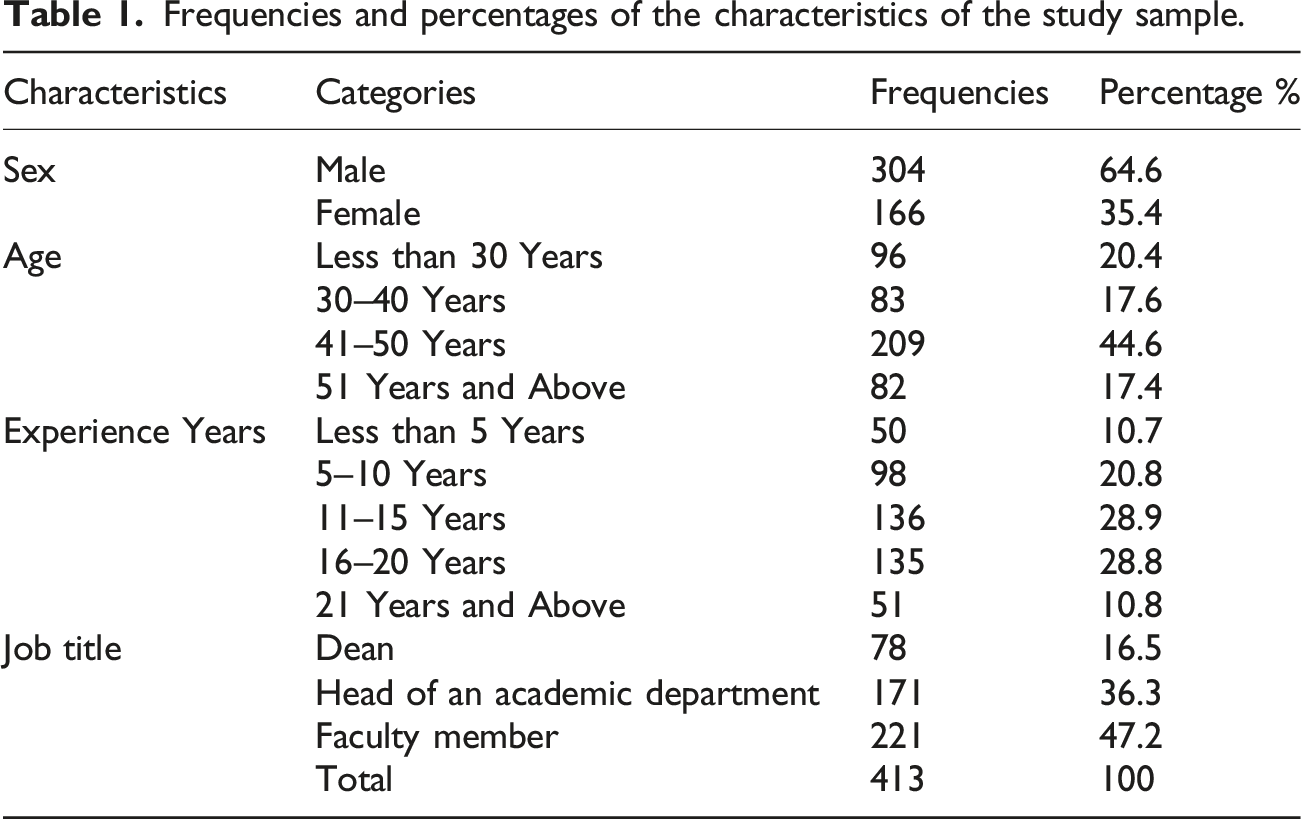
These data and results were interpreted after entering the data and processing it statistically through the (SPSS) program. Table 1 represents the frequencies and percentages of the characteristics of the study sample.
Frequencies and percentages of the characteristics of the study sample.
5.2. Analysis of the study question
The first question: What is the level of practice of (EHRM) and talent management from the point of view of faculty members? Averages and standard deviations were extracted for the dimensions of (EHRM), the axis of (EHRM) as a whole, and the axis of talent management from the point of view of faculty members.
Table 2 shows that the level of (EHRM) practice, from the point of view of the deans, heads of academic departments, and faculty members in Jordanian universities, was of a medium degree, with an arithmetic mean of (2.57) and a standard deviation of (0.42), and this shows the convergence of the answers of the sample members towards the practice of electronic human resources management. The table also shows that the level of talent management application by Jordanian universities is average, with a mean (2.85) and a standard deviation (0.92).
The arithmetic means and standard deviations for the level of practice of electronic human resource management and talent management.
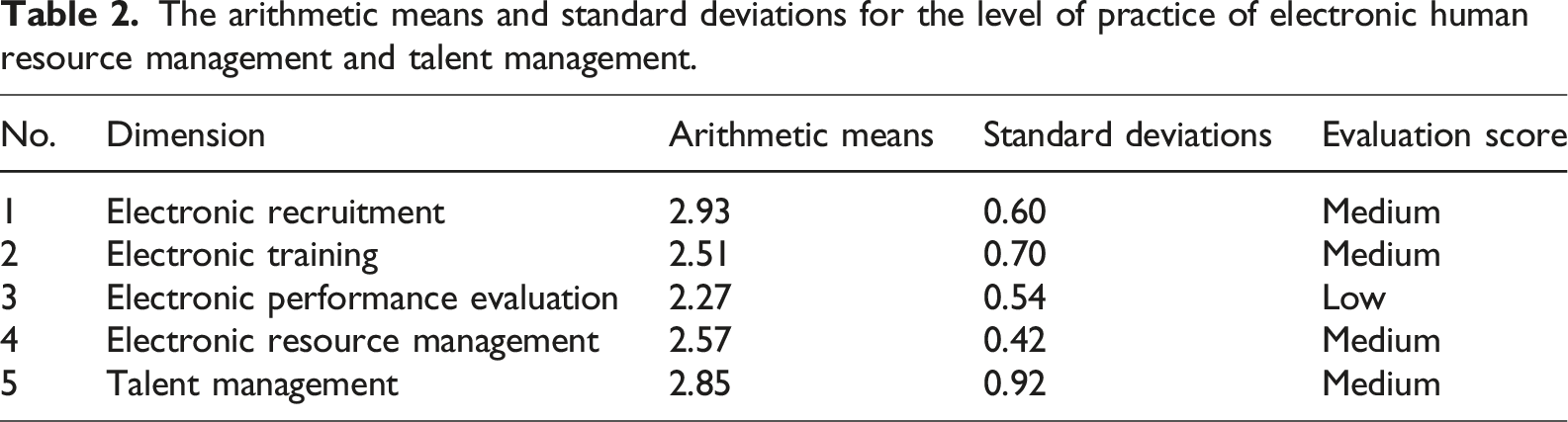
It also appears from Table 2 that the averages of the respondents’ answers to the dimensions of (EHRM) ranged between (2.27–2.93); the highest was for the electronic recruitment dimension with an arithmetic mean (2.93), a standard deviation of (0.60) and an average evaluation score, then came after the electronic training, with an arithmetic mean (2.51) and a standard deviation (0.70), finally came the electronic performance evaluation dimension with an arithmetic mean (2.27), a standard deviation (0.54) and a low evaluation score.
5.3. Testing of study hypothesis
Hypothesis 1 (H1) states that there is no statistically significant effect of (EHRM) on talent management (TM) in Jordanian universities. Hypothesis (H1-1) states that electronic staffing has no statistically significant effect on talent management (TM) in Jordanian universities. Hypothesis (H1-2) states that electronic training has no statistically significant effect on talent management (TM) in Jordanian universities. Hypothesis (H1-3) states that electronic evaluation has no statistically significant effect on talent management (TM) in Jordanian universities
To test the first hypothesis, the researcher will use the linear regression between the independent variable, (EHRM) and the dependent variable, talent management. Table 3 displays that the value of (F) is (46.975), with a statistical significance of (0.000), less than (α ≤ 0.05), representing interpretive and predictive power of using simple linear regression between the independent variable ((EHRM)) and dependent variable (TM), therefore, a single linear regression model is suitable for evaluating the causal relationship between the independent variable (EHRM) and dependent variable (TM). It has been demonstrated that the value of the correlation coefficient is (0.302), the value of (R2) is (0.091), and the adjusted variable (R2) value is (0.089), which indicates that the independent variable (EHRM) can account for (30.2%) of changes in the dependent variable (TM). The rest is as a result of other factors.
Results of simple linear regression for the main hypothesis.

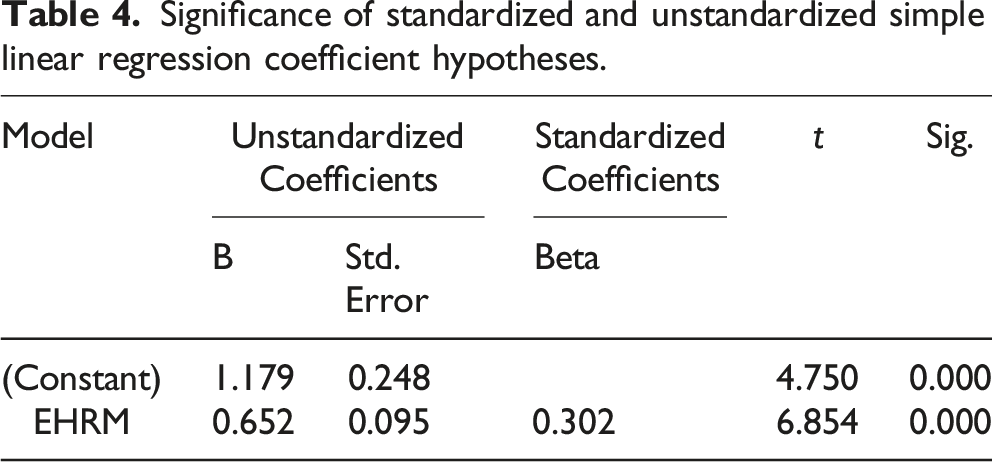
Table 4 clarifies the presence of a statistical significance for a constant of simple linear regression formula, (t) value is (4.750) and with a statistical significance of (0.000) where it is less than (α ≤ 0.05), which displays the significance of constant of a simple linear regression model with a value of (1.179). Moreover, there is a statistical significance for standardized and unstandardized simple linear regression formula associated with the independent variable (EHRM) in which value of (t) is (6.854), with a significance of (0.000) that is less than the significance level (α ≤ 0.05) which suggests rejection of null hypothesis and accepting alternative hypothesis which states there is statistically significant impact at the level (α ≤ 0.05) for Electronic human resources management on talent management at Jordanian universities.
Significance of standardized and unstandardized simple linear regression coefficient hypotheses.
For testing sub-hypotheses, the researcher will use linear regression between independent variables; electronic staffing, electronic training and electronic evaluation and the dependent variable; talent management. Thus, we have Table 5 which shows the presence of a statistical significance for a constant of multiple linear regression formula, where the value of (t) is (7.323) with a statistical significance of (0.000), which is below the level of (α ≤ 0.05), demonstrating the significance of constant.Furthermore, there is no statistical significance for a coefficient of multiple linear regression formula related with independent variable electronic staffing, where the value of (t) is (1.743) with a statistical significance of (0.082), where it is above significance level (α ≤ 0.05), which proposes accepting the null hypothesis that: There is no a statistically significant impact (α ≤ 0.05) for electronic staffing on talent management.
Standardized and unstandardized simple linear regression coefficient hypotheses.
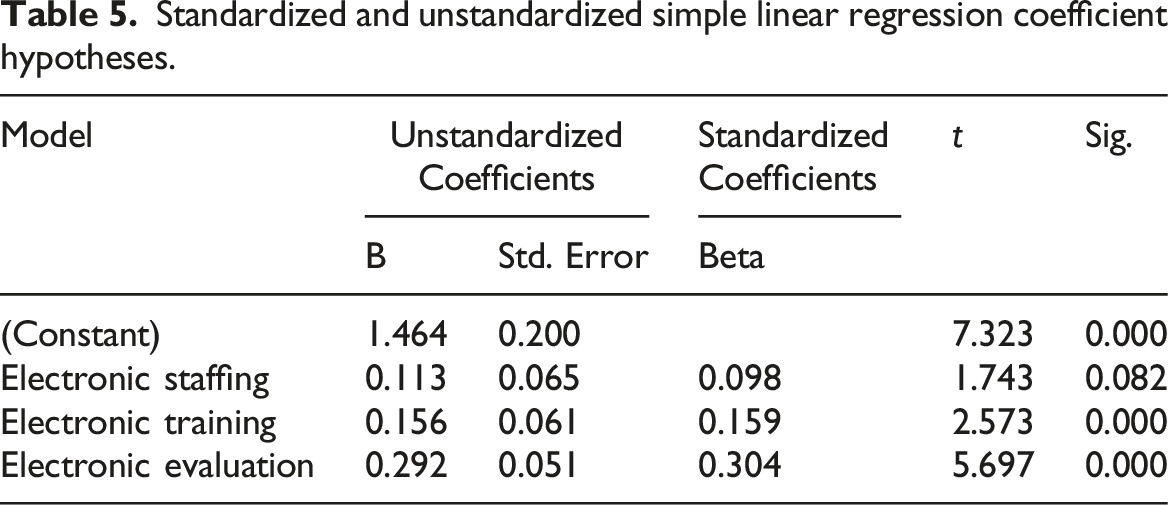
Table 5 shows the existence of a statistical significance for a coefficient of multiple linear regression formula connected to independent variable electronic training, in which value of (t) is (2.573), with a statistical significance of (0.000), that is below significance level (α ≤ 0.05), recommends rejection of null hypothesis and acceptance of alternative hypothesis stating that: There is a statistically significant impact (α ≤ 0.05) for electronic training on talent management. Besides the existence of a statistical significance for a coefficient of multiple linear regression formula connected to independent variable electronic evaluation, in which value of (t) is (5.697), with a statistical significance of (0.000), that is below significance level (α ≤ 0.05), suggests rejection of null hypothesis and acceptance of alternative hypothesis stating that: There is a statistically significant impact (α ≤ 0.05) for electronic evaluation on talent management.
6. Conclusions
The study results presented that the level of (EHRM) practice from the point of view of deans, heads of academic departments, and faculty members in Jordanian universities, was of a moderate degree. This result is consistent with the study of Aldaadi and Alzahrani [37]. The study results showed that the level of application of employment and e-training is medium, and the level of application of performance evaluation is low. This means that the level of practice of (EHRM) is still in public universities for operational motives such as salaries, personal information and some recruitment steps such as receiving applications, holding some remote training programs and performance evaluation.
The study results also presented that the application level of talent management in public universities is average. This result is consistent with Aljarrah and Abudawla [2] study, which showed that the application level of talent management is average, and the study of Aldaadi and Alzahrani [3]. This result differs from the study of Alshalabi [1], which showed that the talent management application level is high. The researcher believes that there is a similarity in some functions of human resource management and talent management, such as recruitment, selection, development, and evaluation, and this requires the existence of harmony and compatibility between the electronic systems of both concepts.
The results of the study showed that there is a statistically significant impact of (EHRM) on talent management. This result is consistent with Abzari et al. [31] and the study of Abu Jumaa [12]. The researcher believes that one of the main tasks of (EHRM) in organizations is the optimal retention of human resources and the need to recruit and develop talents. Talents are vital resources that must be managed to achieve the best results. Talent management is a secret weapon for talent acquisition. Therefore, universities must be able to provide the necessary training, retain quality staff for a long time, and utilize them in the most strategic role.
Talent management has become necessary for organizational development to raise performance levels by attracting, developing, developing and retaining talent within the organization. The administrative organizations that achieve excellence care about development trends and achieving undefined competition.Thus the researcher recommend Jordanian Universities to: Set clear criteria for identifying talented faculty members and adopting them when recruiting and appointing, where the performance of all faculty members is evaluated and compared to the standards set for identifying talents from faculty members. Improve the following infrastructures to conduct (EHRM) efforts and forecast human resource needs in (EHRM) such as Infrastructures for the organization’s hardware and software in (EHRM). Besides increasing staff skills in information technologies and the implementation of training programs in the use of electronic human resource management Harmonization of talent management in universities with the university’s general strategy and performance indicators Providing the appropriate infrastructure for the application of electronic training in public universities by adopting the latest technology and means of communication.
Although this study offers numerous insights there are a few limitation that should be considered. First, Objective limits the study was limited to the reality of the application and importance of electronic human resource management and talent management for faculty members. Second, spatial limitations the application of the study was limited to Jordanian public universities. Third, this study was conducted during the second semester of the academic year 2021.
Footnotes
Acknowledgments
The author has no acknowledgments.

Author Biography