



Abstract
Background
In the current post-pandemic context, the main characteristics of workplaces have changed radically. Among the most prominent aspects of the post-pandemic workplace are hybrid arrangements, wide-spread remote work as the main work arrangement and increasing automation and robotization. These changes pose major concerns in terms of workplace wellness and occupational health and safety, primarily due to emerging or insufficiently analyzed risks in the workplace.
Objective
Especially in the post-pandemic world, where emerging risks in the workplace add to the pre-existing organizational challenges, the key to preventive and proactive organizational behavior is integration of ergonomics in current work environments, irrespective of the type of work arrangement (remote, in office, manufacturing plants, etc.). Starting from this idea, the authors aimed to create an intervention model and to support the decision-making process to ensure successful implementation of ergonomic interventions.
Methods
The article presents a new perspective on workplace risk management and enhancement of workplace wellbeing based on a framework that encompasses workplace risk assessment, proposal of ergonomic interventions, and the managerial and financial evaluation of the proposed interventions.
Results
A key contribution to the literature in the field is represented by case studies on two companies, where cost-benefit analysis (CBA) was performed to assess validity of the proposed framework.
Conclusions
The paper is a valuable contribution to the literature in the field of ergonomic interventions due to the innovative approach proposed by the authors. Innovation through combination is the key to a framework that addresses the real need of practitioners aiming to improve working conditions and ensure work-life balance across industries.
Keywords
1. Introduction
The Covid-19 pandemic has created an unexpected context: the need for a sudden transfer of many jobs from the traditional context (work performed through physical presence at work) into remote work for reasons of health protection. Many workers and employers were not prepared to create or adapt to ergonomic conditions in remote work, resulting in the emergence of ergonomic and psychosocial risk factors [1]. However, the lack of knowledge and training has been increasingly addressed through training sessions and informative materials in various languages to minimize the negative consequences of poor ergonomics.
The intensified interest in remote work conditions took away the public attention from a more vulnerable category of employers: SMEs. Due to limited resources, SMEs are recognized to face major challenges in addressing occupational health and safety (OHS) risks and ergonomics-related faults. Although ergonomics as a science and practice is common worldwide, the lack of awareness on the benefits of implementing it in all types and sizes of enterprises leads to the need of promoting ergonomics and of researching on conception of frameworks to enhance implementation of ergonomics. The financial and technical efforts of an ergonomic intervention become visible once the ergonomists provide consulting services. Oftentimes, what is missing is the list of benefits generated by the proposed intervention, especially because most of these benefits are intangible and very difficult to transform into monetary units. Therefore, creating a framework that would complement the ergonomic intervention itself with a cost-benefit analysis, investment opportunity analysis and decisional support would provide managers with satisfactory information to approve and effectively implement the proposed ergonomic intervention.
This article aims to present a framework for the conception of ergonomic interventions and the substantiation of the managerial decision-making process based on cost-benefit analysis (CBA) and additional other relevant methods. The framework is applied in the case of two companies to demonstrate the relevance and usefulness of the proposed framework.
The structure of the paper is as follows: introduction, a literature review on the importance of ergonomic interventions (in Section 2), cost-benefit analysis for ergonomic interventions –a theoretical perspective and implications in managerial decision substantiation (in Section 3), an applicative application of the presented framework in the case of two companies (in Section 4), discussion (in Section 5) and conclusions (in Section 6).
2. The cost-benefit analysis for ergonomic interventions: Literature review
Ergonomics as a science is not novel. The literature in the field has demonstrated in numerous instances that ergonomics is a vital part of workplace wellness. The wide variety of issues, flaws, and OHS risks in the workplace generates as many situations as possible where the sole method for improvement is through ergonomic interventions [2]. When discussing manufacturing systems, numerous interventions studied in the literature refer to technological improvements, software/hardware acquisitions, and other related investments [3]. In their case, CBA can be performed with ease, as the benefits are tangible and with immediate results. Furthermore, ergonomic interventions should not be limited to existing working conditions: When introducing new technologies in the workplace, CBA for ergonomic implications of the respective technology should also be performed [4–8].
The financial and management rationale for improving workplaces and implementing ergonomic interventions must be adequately substantiated [9, 10]. Relevance of ergonomic interventions should be considered from various perspectives, since ergonomics creates benefits in terms of efficiency, productivity, improved financial performance, higher employee retention, improved employee satisfaction, improved OHS, and improved work-life balance [11]. From this perspective, ergonomic interventions are a significant category of investments. Oftentimes, these represent major financial efforts for companies, becoming a real challenge for managers in the decision-making processes. The key challenge is related to the fact that ergonomic interventions have multiple intangible benefits (i.e., benefits that cannot be translated into monetary correspondents) [11].
Therefore, depending on the perspective of different authors, CBA is considered a valuable instrument for demonstrating the effectiveness and efficiency of ergonomics [9], and for determining the financial rationale of ergonomic interventions [11]. Even more interesting findings are offered by Guimaraes et al. [12], who highlight the additional benefit of improved quality of life as a compensation for the psychological disturbance perceived because of the changes generated by the ergonomic intervention.
Investments are a cardinal vehicle of social and economic development, with a particular focus on the business environment. However, for many ergonomic interventions, the added value is indirect and intangible, creating a context where the conventional approach to investment is difficult to implement [13]. Although ergonomic interventions are likely to have a long-term positive impact, they are more difficult to justify than investments that have more obvious and immediate rewards [13]. Implementing the best ergonomic intervention at the lowest cost is one of the main goals of a decision to invest in an ergonomic intervention [14].
Most companies are willing to implement interventions with costs below a certain threshold, so a complex analysis is not necessary for small-value investments [11]. The benefits obtained may be significantly greater the more complex the ergonomic intervention is. As a result, ergonomic interventions can call for investments that are more expensive and/or complex in work systems where the minimum legal OSH requirements are met and at least some of the ergonomic principles are respected [15]. In their situation, a thorough examination of the available options is necessary to decide on the best course of action and to justify that choice from a technical, economic and financial standpoint. Numerous proposals for strategies in this direction are found in the literature, all of which focus on the idea of CBA.
The main differences in various approaches to CBA arise from the cost categories included, while monetization of benefits is typically adapted to the specifics of the intervention. The study of Abad et al. [16] proceeded to a simple approach for CBA, where the only cost considered was the ‘pain cost’, defined as the cost of the interventions aimed at pain reduction and calculated as a one-time cost. On the other hand, numerous studies focused on the social and economic implications of a specific intervention [4, 7, 10, 14, 17, 18]. Another approach is to use renowned software instruments, such as the Washington State CBA tool [19]. What all these approaches lack is the focus on the organization where the interventions should be implemented. When leaving aside the costs supported by individuals or society, there is little information to be analyzed in terms of the costs incurred and the actual benefits solely at company level [11]. The relevance of this approach can be observed only in the context of substantiating the management decision, as the financial implications for the company (regarded as an investment and not a cost) can be compensated or complemented by intangible benefits such as avoidance of fines by complying with national OHS legislation or improved work-life balance of employees leading to increased employee retention rate [11].
3. Materials and methods: Managerial decision substantiation of ergonomic interventions
3.1. General considerations regarding ergonomics intervention model
The framework presented in this section relies on the Ergonomics Intervention Model (EIM) described by Boatca [11] and Boatca et al. [2]. Starting with the identification of occupational health and ergonomics issues in the workplace and finalizing with the final decision to implement the ergonomic intervention(s), the authors conceived a methodological framework described in Fig. 1.
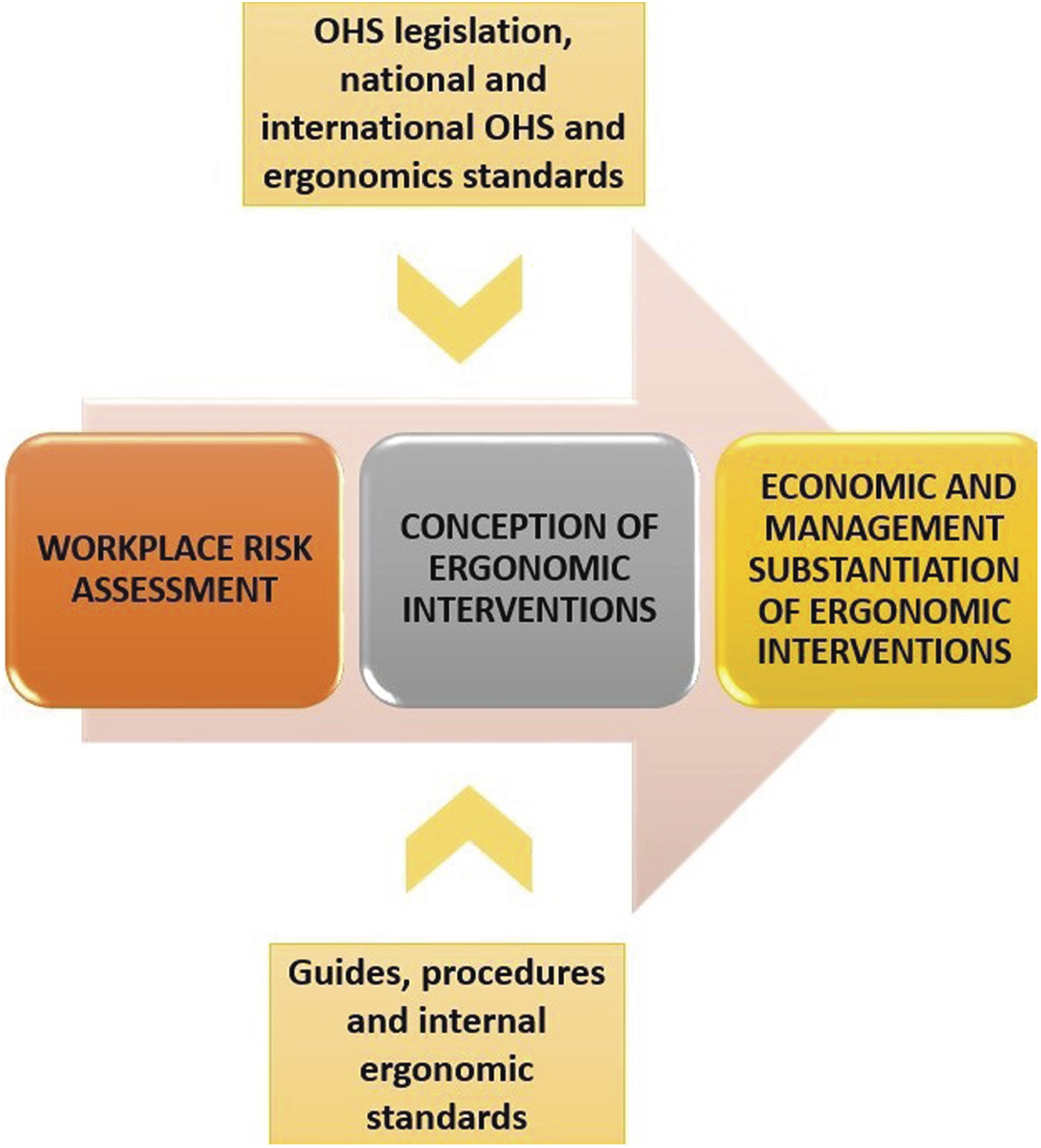
Ergonomic Intervention Model - Proposed Methodological Framework (source: adapted after [11]).
The methodological framework considers OHS legislation, national and international standards as input and general guide for performing the risk assessment and conception of ergonomic interventions. At the same time, internal ergonomic standards (where they exist) and other guidelines represent input to the conception of ergonomic interventions and influence the decision-making process in relation to the implementation of the proposed interventions. Thus, the guidelines and internal standards lead to customization of otherwise general ergonomic interventions.
The framework consists of three major steps: workplace risk assessment, conception of ergonomic interventions, and economic and management substantiation of ergonomic interventions. The first step, the workplace risk assessment, should be performed according to the objectives of the ergonomists and managers; therefore, it can include a general workplace risk assessment, or it can involve a detailed analysis of specific issues at a certain workplace. It should be underlined that this step is always customized to the needs and requirements of the company, and therefore it can include risk assessment methods that serve the objectives set by the company and are aligned with the expertise of the ergonomists.
The second step is derived from the former and consists of the proposal of specific actions with various time spans for implementation. Risks of high severity or frequency must be prioritized; also, all identified risks must be addressed with feasible solutions, defined as ergonomic interventions.
In the following subsection, the authors will provide a detailed perspective on the last step of the ergonomic intervention model, respectively, for economic and management substantiation of ergonomic interventions.
3.2. Proposal for the conceptual framework for economic and management substantiation for implementation of ergonomic interventions
The International Social Security Association (ISSA) has created a model to assess the return on investment (ROI) of OHS prevention activities [20]. Both a quantitative approach (values expressed on a cardinal scale) and a qualitative approach (values measured on an ordinary scale) approach can be taken to prevent the condition. The ISSA approach states that the effectiveness of prevention is reflected in the balance between the advantages and drawbacks of prevention efforts [20]. Given that both quantitative and qualitative criteria are needed for the evaluation of ergonomic interventions, the ISSA approach can be modified to develop a generalized methodological framework for estimating investments to improve workers’ well-being at work. Based on this methodology, the establishment of a focus group proves crucial to defining the analysis criteria for the overall utility method, as well as to identifying the costs and benefits of ergonomic interventions. Hodor et al. [21] highlight that the maximum global utility method is a renowned instrument for substantiation of managerial decisions for several decades. This was the rationale for including this method in the proposed framework, with the aim of a more comprehensive approach in the decision-making process.
The advantages of enhanced working conditions are not necessarily in direct connection with economic efficiency because, in some cases, the costs do not outweigh the costs [22]. Promoting only investments that are deemed profitable from an economic point of view is, in fact, erroneous. Thus, Dascalescu [23] emphasizes that a relevant approach from the point of view of ergonomics involves the calculation of the net economic cost of investments in health and safety, which can be calculated as follows:

CNE is the net economic cost of investments in health and safety;
CINV – the investment cost calculated as the sum of the direct and indirect costs of the investment;
COHS – costs of OHS risks avoided (economic costs of accidents at work and occupational diseases eliminated by investment);
CB – collateral benefits seen as side effects of the investment (e.g., improving product quality, increasing productivity, improving employment relationships).
Considering this assumption, the entire justification for choosing ergonomic interventions refers to the classification and rationing of the applicability of each suggested intervention. Since both the maximum global utility method and the CBA are used as tools for ranking ergonomic interventions, it is in no way intended to eliminate any of the corrective measures aimed at preventing and improving work conditions.
To ensure a comprehensive approach to the implementation of ergonomic interventions, Fig. 2 details the methods used for analysis and classification of the interventions. The conceptual framework of the proposed methodology includes the following steps: Methodological framework for substantiation of ergonomic interventions from economic and management perspectives. Organizing a focus group with experts in the fields of ergonomics and organizational management to validate the analysis criteria for CBA. Compiling a ranking of ergonomic intervention options using the maximum global utility method. Analysis of ergonomic intervention options at the top of the ranking using cost-benefit analysis. Selecting the best decisions based on the analyses from the previous steps.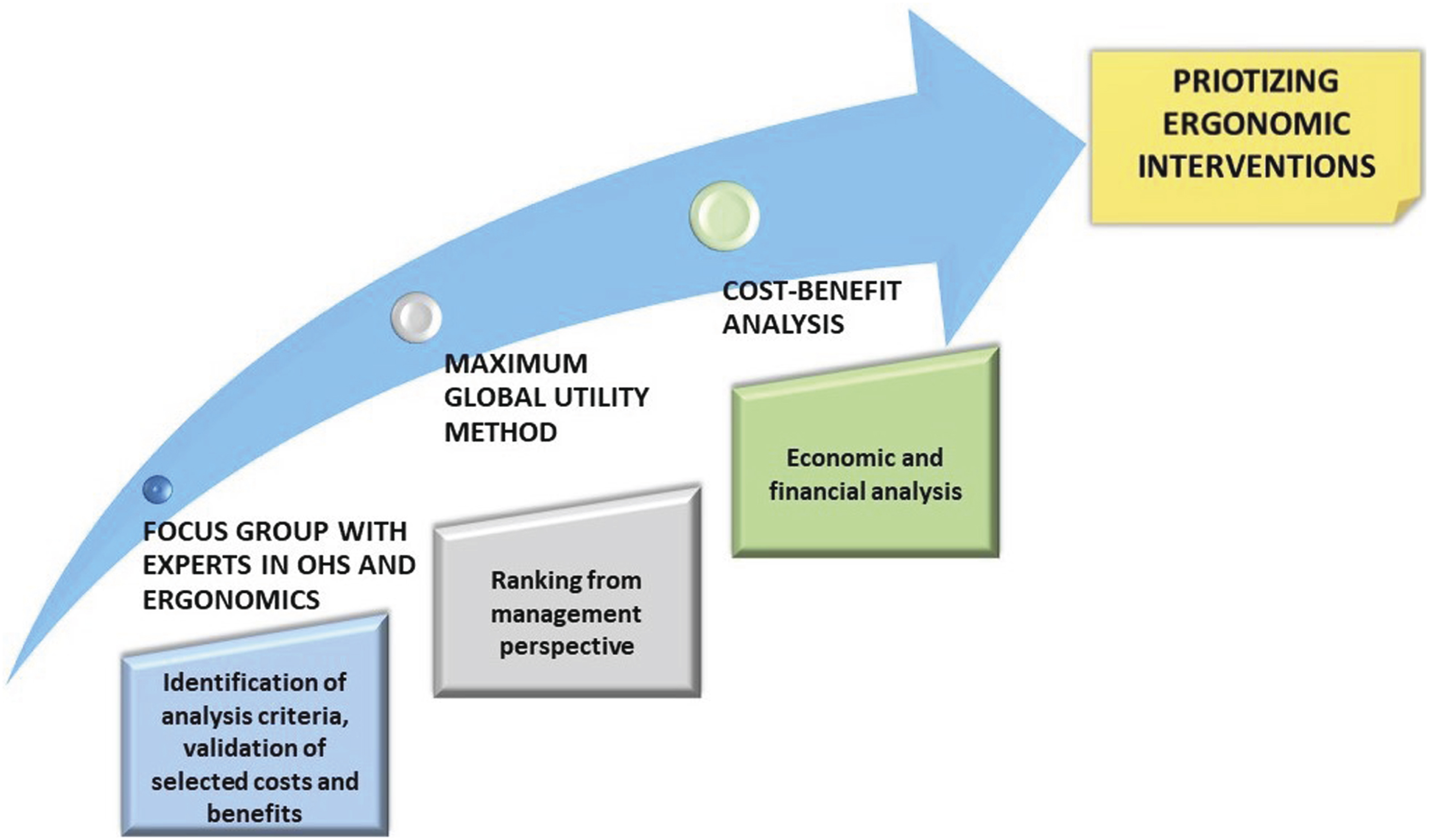
The entire rationale for investment decisions in ergonomic interventions takes into consideration OSH legislation and applicable national and international standards, as the entire process of optimizing the work system must take these into account. Noncompliance with the legislative rules in force leads to contravention sanctions for noncompliance with certain OHS laws [11].
4. Case studies for validation of proposed framework
The Ergonomics Intervention Model was applied in two companies operating in West Romania. The first company is a waste management services provider, while the second is a furniture manufacturer. For both companies, the risk assessment process consisted of general risk assessment, ergonomic risk assessment, and physical environment assessment. For each company, the risk assessments were performed in two workplaces characterised by intensive manual operations. The study was carried out in the COVID-19 pandemic period, in compliance with the sanitary restrictions imposed at the time.
For each workplace, the authors proposed multiple ergonomic interventions and provided the economic cost of each solution, as a starting point for the analysis. In the case of the waste management company, two categories of workplaces were under analysis: recyclable waste sorting (six employees/shift) and operation of the PET bottle compressor (two workers/shift). Thus, nine ergonomic interventions were proposed, focussing on the main identified issues, namely ergonomic risks, organising flaws, and poor air quality. For the furniture manufacturer, the analysed workplaces were assembly of furniture and special operations (i.e., cladding wood boards with curved edges, grinding and other finishes applied to wooden pieces with irregular shapes or textile material additions). In the case of these workplaces, two employees/shift was the regular work arrangement. Therefore, ten ergonomic interventions were proposed to reduce the following identified risks: awkward postures, repetitive hand movements and heavy lifting, poor lighting, exposure to high noise, high levels of dust emissions, and thermal discomfort. So, the input data for the proposed model consisted of a set of solutions addressing specific issues for each of the workplaces under analysis, correlated with the costs incurred by each of the solutions (which are ergonomic interventions, proposed by the authors under their role as consultants in the field of ergonomics).
An important note is imposed here: considering the idea highlighted in section 2, that ergonomic interventions are at peril of not being implemented due to the lack of awareness and to limited understanding of the major positive effects generated by these interventions, the information further presented in this section is aimed at addressing this limitation.
The initiating hypothesis is that the proposed approach involves the perception of ergonomic interventions as investments; thus, the authors considered it mandatory to provide estimations of economic costs for all categories of interventions, irrespective of the time necessary for implementation. Following this, the analysis continued with the third step of the framework, the economic and management substantiation of ergonomic interventions.
Based on the conceptual framework presented in Section 3, the first activity of the third step was to organize an online focus group using the Zoom platform; the discussion was attended by OSH practitioners, specialists in risk assessment and OHS training, as well as academic staff with extensive experience in ergonomics. The result of the focus group was the establishment of criteria to prioritize ergonomic interventions. The same criteria were used for the maximum global utility method: The degree of extension of the proposed solution, distinguishing global solutions and solutions for a particular job/risk identified. The severity of the identified risk –urgent, requiring immediate interventions; medium-term interventions (1–5 years) and long-term interventions (5–10 years). Purpose of the intervention: interventions for job setup, occupational safety interventions, interventions in the physical work environment, interventions for reduction of ergonomic risks.
The second activity was the analysis of the proposed interventions using the maximum global utility method, based on the criteria presented above. Table 1 summarises the results of this activity for each workplace in the two companies. For each ergonomic intervention, regarded as investment options, the utility function was calculated.
Summary of the analysis of proposed ergonomic interventions using maximum global utility method.
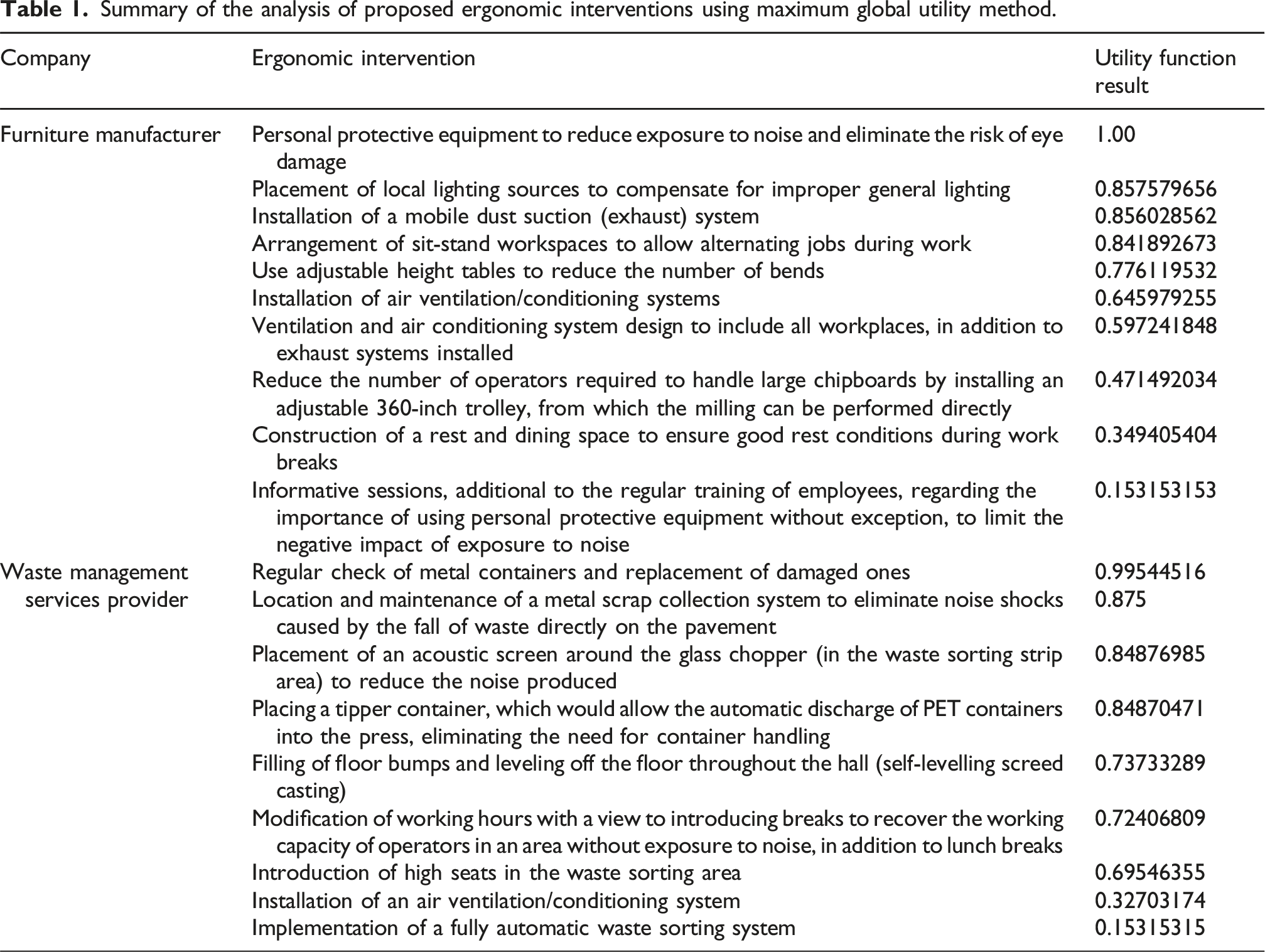
Based on the results obtained, the interventions were ranked, to highlight the managerial perspective of the decision-making process. The utility method provided interesting information, as some of the ergonomic interventions that were easy to implement in the short term or were urgently required due to the severity of the consequences were not placed at the top of the ranking by applying the utility function. This underscores the importance of not excluding ergonomic interventions based on limited criteria, demonstrating the need for a comprehensive approach to the decision process. Moreover, unilateral approaches to ergonomic interventions and management decisions should not be considered as appropriate, proving the necessity of combining interdisciplinary approaches to managerial decision-making processes (similar to the interdisciplinary approach that stands at the heart of ergonomics).
The third activity was the CBA, which was focused on the implications of the ergonomic interventions at company level. Analyses at society level are not novel when discussing about workplace risks and workplace wellbeing. However, the literature on CBA performed at company level in the area of workplace risks and ergonomics is scarce, leaving an unaddressed space that reflects an actual pain point of many companies that consider the option of implementing ergonomic interventions. To limit the benefits to those quantifiable at company level, costs such as hospitalization or compensation for temporary or permanent incapacity for work have been excluded, as these are covered by the National Health Insurance Fund and the National Pension Fund, respectively, while costs incurred by the human operator for own-initiative health investigations, or the cost of loss of human life, cannot be considered, given that these costs cannot be assessed at company level. Table 2 presents the overall net economic cost and ROI of the ergonomic interventions for both companies. Depending on the type of risk or fault addressed, specific equivalent benefits were identified (e.g., the cost of a specific risk or fault can be the economic value of the intervention that solves the problem or the production loss, while the benefit can be avoidance of the cost incurred by payment of a specific number of sick leave days for the injured employee(s)).
Cost-benefit analysis of the proposed ergonomic interventions for the analyzed companies.
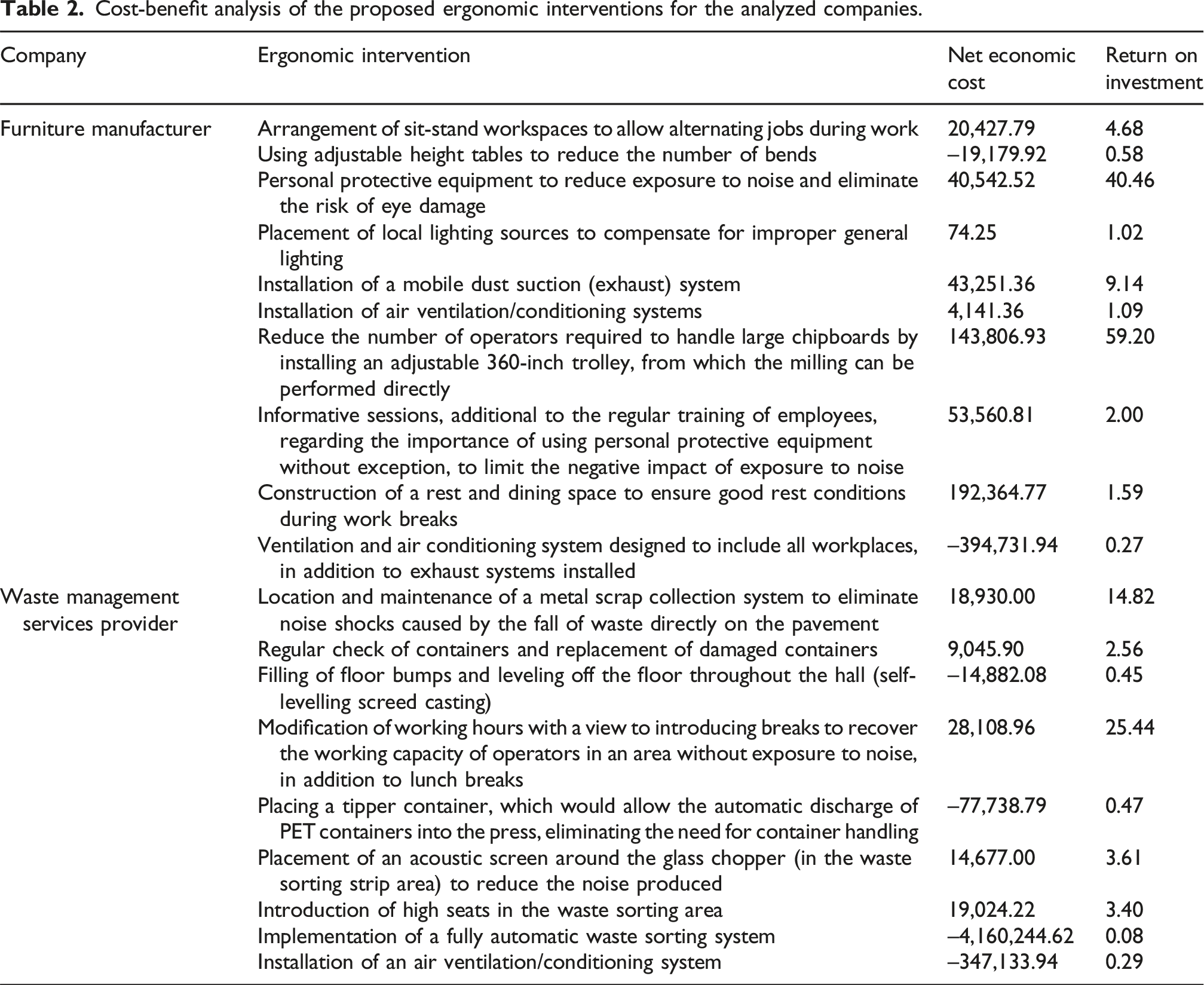
The CBA significantly changed the perspective created by the maximum global utility method. The net economic cost was calculated as the difference between costs and benefits translated into monetary values. The lowest ROI was identified in the case of an ergonomic intervention involving a high financial effort. Typically, this category of interventions is long-term investments, with complex implications on the work system. However, all proposed interventions had positive ROI, demonstrating the sanity and relevance of the proposed measures. From the financial perspective, the CBA allowed ergonomists to fully support their proposals to the management teams of the two companies. Also, CBA quantifies in monetary values benefits that are not necessarily easily visible to managers. Thus, this type of analysis has twofold benefits: on the one hand, it provides sufficient data for managers that are responsible for making the decisions regarding the interventions to be selected. On the other hand, it raises awareness on the importance, usefulness, and positive long-term impact of each intervention on the overall organisational performance. The most important takeaway is that managers are more prone to accept and opt for at least one intervention when they understand the whole set of implications and benefits generated, as compared to the traditional approach where ergonomists only present several technical solutions, leaving the rest of the decisional process in the responsibility of the managers (who typically lack awareness on the long-term positive implications of these solutions).
Finally, the last activity consisted of a discussion with managers, OHS specialists, and employees in the analysed companies to collect feedback from them and to decide the route for the proposed interventions. As mentioned above, none of the ergonomic interventions was excluded, as all represented solutions to specific risks identified in the studied workplaces.
5. Discussion
Consistent with the findings of Heidarimoghadam et al. [24], ergonomic interventions have been shown to be quite ineffective if implemented as singular solutions to multifactorial problems at work. Thus, the framework proposed in this paper represents a valid solution to this drawback, as it involves a complex combination of solutions, with different implementation implications: time, costs, benefits, reduction of risk severity or frequency, and implementation complexity.
MacLeod [25] proposed a similar approach, demonstrating the need for a framework for decision making, with benefits that include participation of nontechnical personnel, a qualitative approach to problem solving, extensive use of ergonomics with the purpose of continuous improvement [25]. Despite the focus on simplicity and participatory ergonomics, the framework proposed by MacLeod lacks the CBA. Thus, the framework proposed in this paper represents a more comprehensive and detailed approach to supporting managers in making decisions about investments in ergonomic interventions.
The efficiency of the proposed model is further supported by the positive feedback received from the two companies, which admitted to benefiting from a set of valid solutions to key issues in the analyzed workplaces, highlighting the fact that the CBA and decisional support provided along with the ergonomic interventions significantly increased confidence in approving the investments necessary for implementation of the interventions. An important observation is the fact that ergonomic interventions should not be excluded from the decision-making process based on the analysis performed using the proposed framework, as all interventions should be implemented. Therefore, the outcome of such an analysis is the prioritization of ergonomic interventions based on valid criteria, supporting a long-term proactive approach to ergonomics and OHS in companies.
However, the proposed framework should be revised every 6-12 months to ensure continuous improvement of the work system until the best possible working conditions are achieved. Garcia et al. [26] led an ergonomic intervention process that included CBA and a continuous improvement process, obtaining positive results for the workplace analyzed (in the service industry). Prevention through ergonomics is the optimal approach for avoiding undesired costs, errors, and productivity failures [27].
Baber and Young [28] bring to light evidence on how an ergonomics method can and should be validated. Unlike other sciences, ergonomics has a peculiar particularity: oftentimes, methods are validated through experiments or interventions, leading to the fact that if the initial hypotheses are met/validated it is very likely that the methodology itself serves the proposed purpose [28]. Therefore, the authors consider that the proposed framework is a valid method for ergonomic interventions and managerial and financial substantiation for implementation in companies, as the model was successfully implemented in two companies operating in different industries.
6. Conclusions
In the post-pandemic world, characterized by a slow economic recovery, companies became even more reluctant regarding expenses [29]. Despite its significant contribution to workplace wellbeing and increased organizational performance, ergonomics remains a secondary preoccupation in the eyes of managers worldwide. The proposed framework, part of a larger ergonomic intervention model, aims to minimize the odds of managers rejecting ergonomic interventions because they are regarded as additional costs incurred by the company. Furthermore, this framework helps managers understand that ergonomic interventions are investments with long-term benefits for the company, increasing the chances of a positive attitude towards ergonomics.
The article demonstrates the utility and validity of a novel framework for the conception and implementation of ergonomic interventions. The economic and management perspectives bring to light one of the most frequent pain points in ergonomics: the actual implementation of ergonomic interventions, due to the high costs of such proposals, while the benefits are mostly intangible and visible in the medium and long term.
The implementation of the proposed framework in two companies operating in different industries and with different business sizes (the waste management services provider is a large public company, while the furniture manufacturer is a medium private company), further supports the validity of the framework. Based on the positive feedback received from company managers and OHS specialists, the authors concluded that the model serves its purpose. Therefore, the proposed framework should be implemented in other companies, to further analyze the results obtained.
A proposed improvement of the presented study is connected to the necessity of expanding the application of the proposed framework in various industries and across countries, so that more data on the effectiveness of the approach could be collected. After such an ambitious attempt, the framework can generally be accepted as a reliable instrument for substantiating the management decision-making process for the implementation of ergonomic interventions.
Footnotes
Acknowledgments
The authors have no acknowledgments.
Author contributions
CONCEPTION: Maria –Elena Boatca, Anca Draghici, Sabin Ioan Irimie and Brigita Gajsek
METHODOLOGY: Maria –Elena Boatca, Anca Draghici
DATA COLLECTION: Maria –Elena Boatca, Sabin Ioan Irimie, Brigita Gajsek, Anca Draghici
INTERPRETATION OR ANALYSIS OF DATA: Maria –Elena Boatca, Anca Draghici
PREPARATION OF THE MANUSCRIPT: Maria –Elena Boatca, Sabin Ioan Irimie, Anca Draghici and Brigita Gajsek
REVISION FOR IMPORTANT INTELLECTUAL CONTENT: Anca Draghici, Brigita Gajsek
SUPERVISION: Anca Draghici
Author Biographies