



Abstract
BACKGROUND:
e-lancing rapid growth poses new challenges in talent management. Gig workers have become an alternate workforce to the organization, which offer technical skills, flexible working hours and cost-effective solutions. This study extends the conceptualization of employee value proposition in the context of freelancers.
OBJECTIVE:
The purpose of this study is to investigate the role of freelancer value preposition and platform trust in shaping platform usage intentions. The reflective-formative model is designed to comprehend the freelancer value proposition.
METHODS:
Online survey method was used and data was collected from 454 freelancers with the help of an adapted questionnaire. PLS-SEM is applied to test the hypothesis.
RESULTS:
The results exhibit that the Developmental Value (DV), Economic Value (EV) and Social Value (SV) contribute positively in the Freelancer Value Proposition. Furthermore, it shows that attitude towards the use of platform partially mediate platform usage intentions; Moreover, Platform trust has a positive impact on platform usage intentions.
CONCLUSIONS:
Based on the freelancer value proposition, the study emphasizes on the need to develop relationship with gig-workers in order to fulfil the rising demand of sustainable workforce and to remain competitive in the dynamic business environment.



1. Introduction
The digital revolution is reshaping the business practices around the world. Workplace dynamics are continually evolving; as a result, new trends are emerging in the labor market. Prior research explored that full-time jobs are gradually disappearing and are being replaced by short-term employment [1]. Furthermore, studies also reported that the young generation prefers gig work because of work flexibility, autonomy, and high empowerment [2, 3]. Jack Ma, founder of the Alibaba group of companies, anticipated the future of the workforce at CNBC in the following words: “I think in the next 30 years, people will only work four hours a day and maybe four days a week” [4].
The growth of gig work has been substantial in the past few years. Approximately 36% of American adults work as gig workers, and two-thirds of American companies work with freelancers to reduce labor costs [5, 6]. Most business organizations feel positive about outsourcing, and human resource is among the top outsourcing options [7]. In particular, IT firms are adopting the outsourcing phenomenon, and the trend shows that outsourcing of IT based projects will significantly increase in the near future [8].
Moreover, the advent of the COVID-19 pandemic acted as a catalyst for businesses to hire gig workers [9]. Specifically, during pandemic times, knowledge work is increasingly performed virtually [10]. Considering this, the freelancing industry and gig works are expected to grow in the near future.
e-lancing is characterized as a sharing economy phenomenon, where clients place their projects and freelancers connect with them via online platforms [11]. e-lancing platforms are virtual marketplaces for freelancing activities. In the past few years, e-lancing platforms have become an alternative workplace for professionals. Freelancers are also named as “part-time employees” of companies because of the “hybrid” nature of employment; they are self-employed entrepreneurs who work on outsourced projects of organizations [12]. Due to the nature of employment, studies have also used the terms “gig workers” and “platform workers” for freelancers [13, 14].
The freelancing industry is not only competitive for freelancers but also becoming competitive for e-lancing platforms. More than hundred freelancing platforms are competing for the maximum market share. Freelancing platforms face rigorous competition to acquire more clients and freelancers. The qualified pool of freelancers also attracts clients and generates demand for the platform. Clients prefer to visit freelancing platforms that offer a large pool of qualified professionals. Typically, e-lancing platforms focus more on the satisfaction of clients and ignore the interest of service providers [15]. To ensure the best service quality to clients, platforms often compromise the rights and benefits of freelancers. Freelancers, being independent contractors, remain deprived of employment benefits. They do not receive any privileges from the client company nor from the freelancing platform. Nemkova et al. [16] highlighted the concerns of gig workers regarding platform dependency and emphasized the role of the platform in the client– freelancer relationship. Furthermore, they suggested that improved platform design and relationship management have the potential to develop a sustainable workforce.
The freelancing industry is pivotal for economic growth, particularly in developing countries such as Pakistan [17]. IT exports crossed the 2 billion mark in Pakistan in year 2020–21, and considering the trends, it has the potential to become a 10 billion dollar industry [18]. In terms of sales volume, Pakistan is 4th largest e-lancing marketplace after India, Bangladesh, and the United States [19]. Studies found that Pakistani youth and fresh graduates are inclined toward freelancing and gig work because of flexible work hours and autonomy [20, 21]. Despite its significant growth, the gig economy has not received much attention from HR scholars and business practitioners. Freelancers are now a major part of the workforce and refereed as ‘part-time employees’ [22], but few insights are available about industry attractiveness and relationship management with freelancers [23]. Meijerink and Keegan [24] emphasized the development of HRM policies in the gig economy and emphasized on the development of relationships with platform workers. However, there is a gap in the literature about HR policies about gig-workers and there are limited studies on platform relationship management. Considering the changing HR landscape and its impact on organizations, the importance of gig workers is inevitable which sets the foundation of this study.
Organizations can maintain a dynamic workforce along with a traditional workforce by developing relationships with gig workers/freelancers. Employee relationship management practitioners suggested that the value proposition is a useful tool for developing strategic policies for healthy and long-term employee relations [25]. It is important to identify the factors that generate value for freelancers and retain them in e-lancing platforms. This study will help freelancing platforms understand their service providers and build strong relationship with them. Moreover, this study will help outsourcing companies develop an understanding and develop strategies for their “part-time employees.” This study has three main research questions:
What factors contribute to the value proposition of freelancers?
Does the value proposition influence platform usage attitude and behavioral intentions?
Whether platform trust moderates the relationship between platform usage attitude and platform usage intentions?
2. Literature review
The sharing economy concept emerged from the barter system [26]. In ancient times, people used to trade goods in exchange for goods because they could not produce all the desired goods. The trade of goods in exchange for goods is termed the “barter system” and has been a common practice since ancient times. In recent times, the sharing economy has been identified as peer-peer exchanges for buying/selling and renting goods and services using internet platforms (Ganapati & Reddick, 2018), whereby people optimize the usage of under-utilized resources to obtain better exchange value. This phenomenon is widely adopted in the fields of economics, management, information technology, and engineering. Sharing economy is a broader concept, and different terminologies can specify its application in various contexts, i.e., gig economy [27], collaborative economy [28], demand economy [29], peer to peer sharing [30], crowed based capitalism [31], and e-lancing [11]. The e-lancing term is used for the arrangement of freelancers and clients via platforms, which provide a marketplace to generate services on demand [11]. Like any other sharing economy model, there are three parties in the e-lancing platform. The first party is “client,” who posts projects on the e-lancing platform and creates the demand for work. The second party is “freelancer,” who fulfils the demand and provides the required services. The third party is the “platform,” which creates a bridge between the client and freelancer. The e-lancing platform creates a virtual marketplace for freelancers and clients. Sharing economy models create value for users, business organizations, and society [32].
2.1. Value proposition
In recent years, internal marketing scholars and professionals have focused on developing strong relationships with service providers. Heskett [33] proposed the service– profit chain theory to explain the relationship between employees, customers, and an organization’s profitability. According to the service-profit chain theory, employees are the starting point of the organization’s profitability. Employees initiate profitability by transforming the value for customers, and then customers create value for the organization in terms of financial equity. Value proposition sets grounds for a better long-term relationship and provides a strong foundation for employee relationship management [34]. Employee Value Proposition (EVP) concept is driven from the concept of “customer value proposition,” which is very popular in the marketing management discipline. Aloo and Moronge [35] defined employee value proposition as a “combination of attributes that employees consider as the value or gain from the employment, such could be a set of rewards, benefits, work policies, and practices gained by an employee in return for their work.” By extending the definition of Aloo and Moronge [35], the freelancer value proposition can be defined as “the sum of all the values that a freelancer seeks from an e-lancing platform in exchange for services” [36]. Freelancers who seek benefits from the e-lancing platform in a similar way as employees seek from the employer organization. Value proposition not only helps to manage current employees but also attracts potential employees and generates a qualified pool of applicants. Many studies documented the importance of value proposition in the context of corporate employees [37, 38], but the extent literature provides no guidelines for gig workers/freelancers.
2.2. Dimensions of the freelancer value proposition
Previous studies identified various sets of values desirable by employees. Ambler and Barrow [39] suggested that economic values, psychological values and functional values are major contributors to the value proposition. Berthon [40] protracted the work of Ambler and Barrow [39] and suggested five sets of employee values: economic value, departmental value, social value, application value, and interest value. Jiang and Iles [41] measured value propositions in the context of employee-based brand equity, which comprises economic, social value, development value, interest value, and brand trust. Value preferences differ across cultures and geographical regions; for example, social and esteem values were reported as the most significant values for retention of Chinese employees [42]. A study conducted in India suggests that an employee value proposition must have potential career values, such as, justice values, employee engagement values, feel good values, comfort values and esteemed values [43]. Therefore, there is no universal set of values that is desirable to all employees. The value proposition differ for each industry and cannot be generalized to all industries [44]. Taking these factors into consideration, we conducted a qualitative study and semi-structured interviews of freelancers [45]. We explored that economic value, social value, developmental value, autonomy value and hedonic values are major dimensions of value proposition. Based on the literature mentioned above, and prior interviews with freelancers, the following dimensions of the freelancer value proposition can be considered.
Economic value is defined as “the value that assesses the extent to which an organization provides above-average monetary benefits” [40]. The economic value comprises all monetary benefits such as salary, commission, bonus, incentive, and compensation. Economic value is an important extrinsic motivational factor that has proven to be a major attraction for participants in all sharing economy models, including e-lancing [28, 47].
e-lancing models bring economic benefits to all three participants, including clients, service providers, and platforms. Clients find it more economical as compared to traditional services [48]. Based on the business model, the platform earns money in the form of commission, transaction fee, markup, and advertisement fee. In addition, freelancers earn a handsome amount of money in exchange for their services [49]. Economic value motivates freelancers and clients to participate in e-lancing [50]. Studies found that economic value is a strong motivational factor that positively influences the behavior of service providers in e-lancing phenomenon [27, 51].
Social interaction is an essential aspect of human beings. People often seek like-minded individuals who share similar interests. Social value refers to “the combination of psychological benefits provided by an employer to improve the social status of employees” [52]. Social value is an important extrinsic motivational factor that engages participants to contribute to sharing economy platforms, especially knowledge- sharing platforms [53]. Participation in the sharing economy helps individuals gain a reputation among peers and social acceptance [54]. Jabagi et al., [55] suggested that social networking and social badging keep gig workers motivated. Another study’s findings suggest that content writers and open source project contributors participate in knowledge sharing and academic competitions to gain a reputation among peer groups [56]. Self-based rewards are more important for collaborative consumption participants compared with enjoyment in the process of sharing [57]. A study on social media usage enlightened the fact that recognition is the most important motivational factor for users [58]. individuals can build long-term relationships with another user by sharing pictures, videos, text messages, and other interpersonal activities.
Developmental value is defined as “the degree to which an organization provides opportunities to employees in career growth, recognition, professional development, confidence, and career-enhancing experience” [40]. Developmental value is a multidimensional construct, and organizations provide developmental value through several means, such as career development, skills development, and professional development. Developmental value ultimately contributes to employee satisfaction and job commitment [59]. Lack of professional opportunities and work-related factors affect turnover intentions [60]. Studies suggest that organizations that offer better developmental opportunities have more satisfied employees and higher productivity [61]. Employees prefer organizations that offer better opportunities for skill development, professional development, and career advancement. Potential employees also evaluate a firm’s attractiveness on the basis of career growth opportunities [43].
Developmental value is an essential motivational factor in e-lancing that helps freelancers develop their profile and advance their skill set. Fresh graduates join e-lancing to gain professional experience, which opens new horizons of career opportunities. These platforms not only help freelancers develop technical skills but also provide global exposure and experience in handling multinational projects. Developmental values are a source of intrinsic motivation that helps employees to remain and grow in any industry. Higher developmental value helps reduce turnover intentions [62].
Hedonic value is a combination of enjoyment, fun, pleasure, excitement, and perceived benefits that a person experiences while using a product, service, or performing any activity. From the customer’s perspective, it is evident that hedonic value plays an essential role in the shopping of luxury products and the use of recreational services [63]. Shopping is not only related to fulfilling a need but also a fun activity, and hedonic value is critical to purchase intention [64].
In sharing economy platforms, hedonic value influences the engagement behavior of participants. Hedonic value is an intrinsic motivational factor that plays a vital role in social communication and knowledge sharing platforms [65]. The studies also found that enjoyment is the driving force behind participation in online information-sharing platforms [66, 67]. Freelancing could be a passion for some people, and some may find it enjoyable compared to traditional jobs.
“The willpower of a person that when, how, and to what extent he should do his job” is referred to as autonomy [68]. In traditional organizations, higher autonomy values result in positive job-related outcomes, such as job satisfaction and commitment [69]. Similarly, low autonomy leads to adverse outcomes such as higher employee turnover, frustration, and low job satisfaction [70]. The role of autonomy is also essential in temporary organization and project-based jobs [65, 71]. In temporary organizations, employees have more autonomy and job flexibility than permanent employees, and they are more motivated toward their work [72]. Freelancers have autonomy in making decisions about project choice, working schedule, wage rate, and working process. Autonomy value can motivate freelancers to engage in the e-lancing platform.
2.3. Attitude and behavioral intentions towards the use of the platform
The Theory of Reasoned Action (TRA) explains that goal attainment and future behavior can be predicted with the help of attitude, which is the foremost determinant of behavior [73]. Human beings transform their attitude into action to attain goals [73]. Attitude is related to the current perception of a phenomenon based on knowledge, whereas behavioral intentions are possible future responses to that phenomenon. The ideology of a phenomenon can differ from its actual behavior. It is recommended to separately account for attitude and behavior for the emerging phenomenon [74].
Studies have suggested that value proposition has a direct impact on attitude and behavioral intentions in the corporate sector [75, 76]. In knowledge sharing, attitude mediates the relationship between behavioral intention and motivational factors [77]. Another study in the context of collaborative consumption identified a weak mediation effect of attitude on the relationship between behavioral intentions and motivational factors [28]. Because the freelancer value proposition construct is in the developmental phase, we measure attitude and behavior separately.
2.4. Platform trust
Trust is all about confidence in the integrity of an organization [78]. Platform trust plays a significant role in sharing economy models and helps to develop customers, leading to favorable financial outcomes [79]. Trust also plays a vital role in the employer relationship.
Erkmen and Hancer [80] examined the role of brand trust from an employee’s perspective and found that brand trust significantly contributes to employee commitment. Trust also improves perceptions of the employer and corporate image, which in turn increases job satisfaction and employee satisfaction [81]. An exciting study in the aviation industry shows that trust contributes to employee as well as in customer value [82].
3. Methods
Quantitative research methodologies were used and questionnaire was developed to collect the primary data.
3.1. Research instrument and measures
All items were adapted from previous studies and modified according to the context of this study. The Instrument contains 40 Items and 8 constructs. There are 4 items related to demographics, 5 items for Economic Value [47, 83], 5 items for Developmental Value [84, 85], 5 items for Social Value [86, 87], 3 items for Hedonic Value [28], 4 items for Autonomy Value [72], 6 items for Platform Brand Trust [25, 88], 4 items for attitude towards use [28, 73] and 4 items for behavioral intentions towards use (Bhattacherjee, 2001, Hamari et al., 2016). All items were measured on a five-point Likert scale anchored by “Strongly Disagree” (1) to “Strongly Agree” (5).
3.2. Data collection and sampling
There are around 2.37 million active Pakistani freelancers [90]. For the data collection process, convenient sampling technique was used. An online questionnaire was circulated among various freelancing groups on Facebook (i.e., Upwork freelancers, Pakistani freelancers, freelancing with Hisham Sarwar, freelancer in Pakistan). In the online survey, participants were provided with written information stating that the collected data would be used solely for empirical research. We assure that their personal information will be treated with the utmost confidentiality. Furthermore, we assure you that the collected data will not be used for any commercial purposes. Participation in the survey was voluntary. Data collection and analysis methods comply with the terms and conditions of freelancing platforms and do not violate platform or user rights. After data cleaning, the total sample size was 454 respondents. The sample fulfilled the sufficiency criteria suggested by Barclay [91] (ten times rule) and the PLS-SEM criteria suggested by Hair [92].
Table 1 shows the demographic distribution of the sample size. The sample contained 454 respondents: 279 male (61.5 percent) and 175 female (38.5 percent) respondents. 384 respondents were part-time freelancers (84.4 percent), and 71 respondents were full-time freelancers (18.6 percent). The sample included 179 beginners (41.1%), 159 middle level (34.6%), and 116 expert freelancers (24.6%). Demographics suggested that the sample is dominated by part-time freelancers, and male representation is also higher in the sample. Overall, the Pakistani freelancing industry is also dominated by male freelancers and part-timers [93]. Partial least squares structural equational modelling was used for data analysis.
Demographic profile of the respondents

4. Data analysis and results
Variance based PLS-SEM approach is gaining popularity in social sciences and endorsed for higher-order constructs (HOCs) and complex modeling. Hair [94] suggested that PLS is appropriate if the research objective is theory building. SmartPLS3 software is used for data analysis because it is suited for exploratory studies and provides path analysis by reduced the error term [95]. Data analysis is performed in two phases; measurement model and structural model, as recommended by Hair [95].
4.1. Measurement model
In the measurement model, we assess reliability and validity of first-order constructs. Outer loadings are extracted with the help of SmartPLS factor loading algorithm. Items which showed insufficient factor loadings were dropped from the measurement model in order to increase the significance of the overall model [96]. Literature suggests that outer loadings of items should be greater than the cut-off value of 0.7, but in exploratory studies slightly lesser values are also acceptable provided that measurement model exhibits overall convergent and discriminant validity [94, 97].
Cronbach Alpha and composite reliability (CR) are used for assessment of reliability in the scale. Cronbach Alpha shows internal consistency among the items; whereas, CR is considered as a tool to measure convergent validity [95]. Table 2 shows that all the constructs show good reliability, Cronbach alpha values are approximately equal or above the cutoff value of 0.7, and composite reliability (CR) values are also above the threshold level (0.7).
Measurement Model Reliability and Convergent Validity

The overall validity of the scale is assessed with the help of convergent and discriminant validity. Convergent validity reflects the level of agreement among multiple indicators related to one construct. Convergent validity established when average variance extracted (AVE), composite reliability (CR), and factor loadings are greater than the threshold of 0.5 [94]. Table 2 shows that constructs hold convergent validity, and indicators converge in their respective constructs. Discriminant validity is a very critical quality criterion of the measurement model. Discriminant validity ensures that reflective items of constructs have a strong relationship within the construct in contrast to other constructs of the model [94]. We used Fornell and Larcker criteria for the assessment of discriminant validity, which suggests that the square root of AVE should be greater than the correlation value of other constructs [98]. In Table 3, diagonal values represent the square root of AVE, which is greater than the correlation values of other constructs of the model. Hence, the measurement model holds discriminant validity.
Discriminant validity
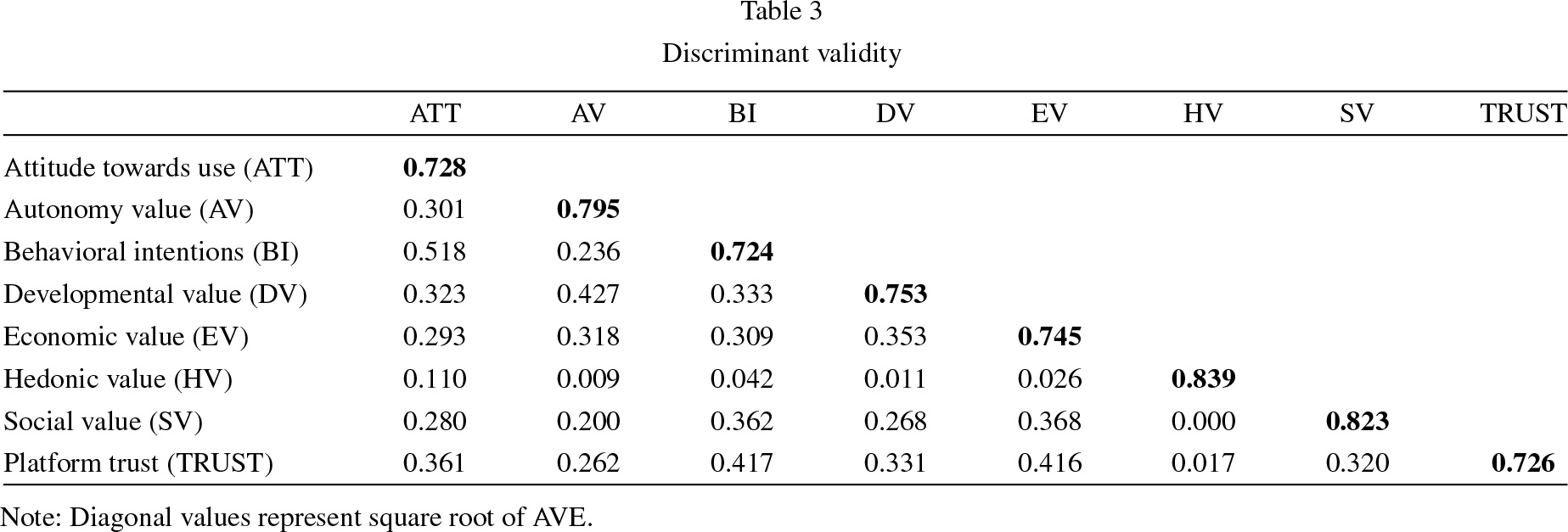
Note: Diagonal values represent square root of AVE.

Conceptual framework. (Source: Authors)
Common Method Bias (CMB) is a potential concern in survey data, which may lead towards inflated path analysis. CMB was assessed with the help of variance inflation factor (VIF) values. Inner VIF values of autonomy value (1.277), economic value (1.301), social value (1.189), developmental value (1.332), hedonic value (1.001), platform trust (1.519) and attitude towards use (1.311) were below the cutoff value of 3.3 as suggested by [99]. Thus, there is no potential issue of common method biasness.
For higher order formative construct, outer weights of first order reflexive construct should be significant [94, 100]. Figure 2 shows outer weights of DV (0.406), AV (0.460), EV (0.278) and SV (0.299) are significant (p < 001). Outer weight of HV (0.159) is insignificant (p < 001).
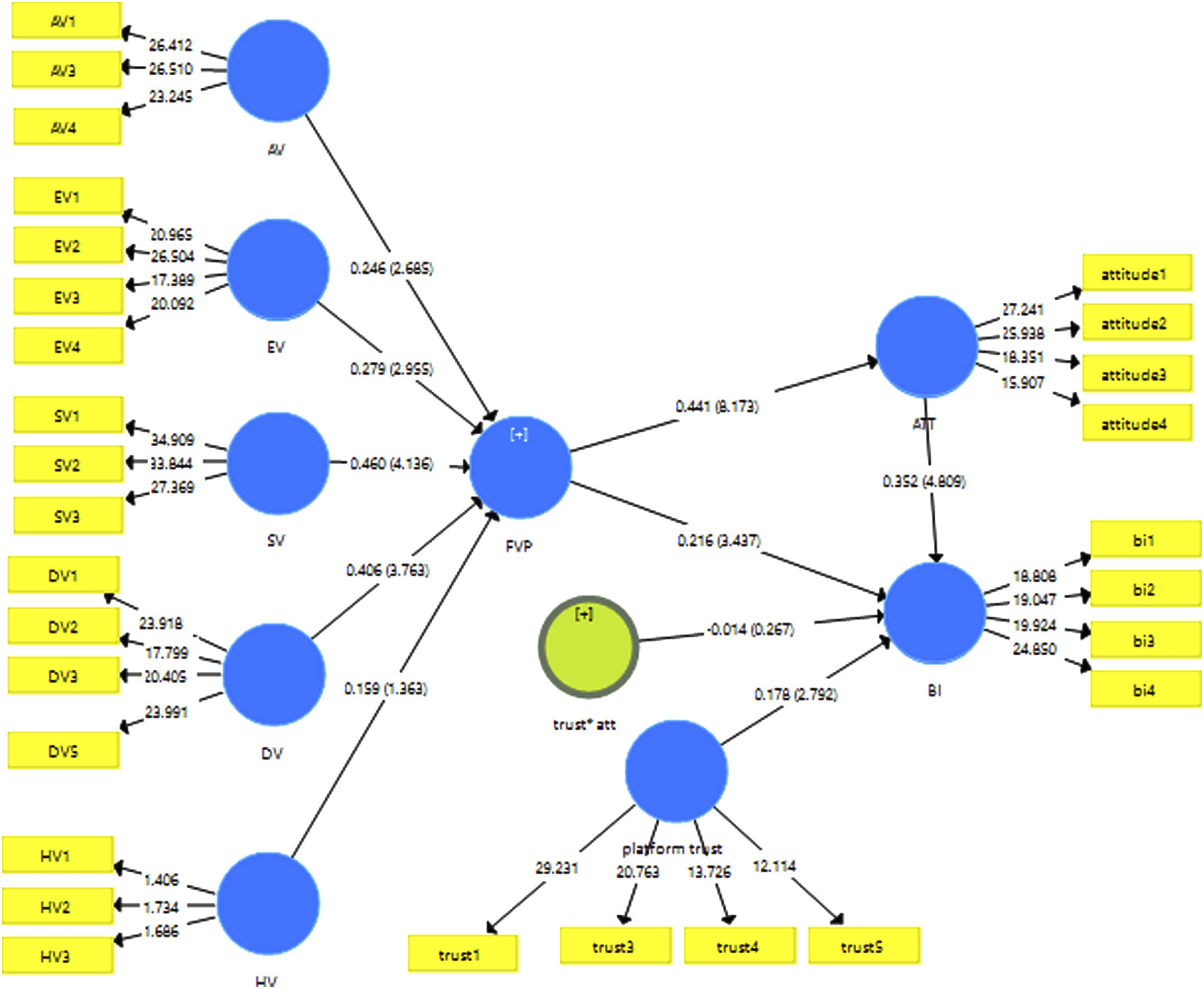
PLS SEM path analysis (Source: Authors)
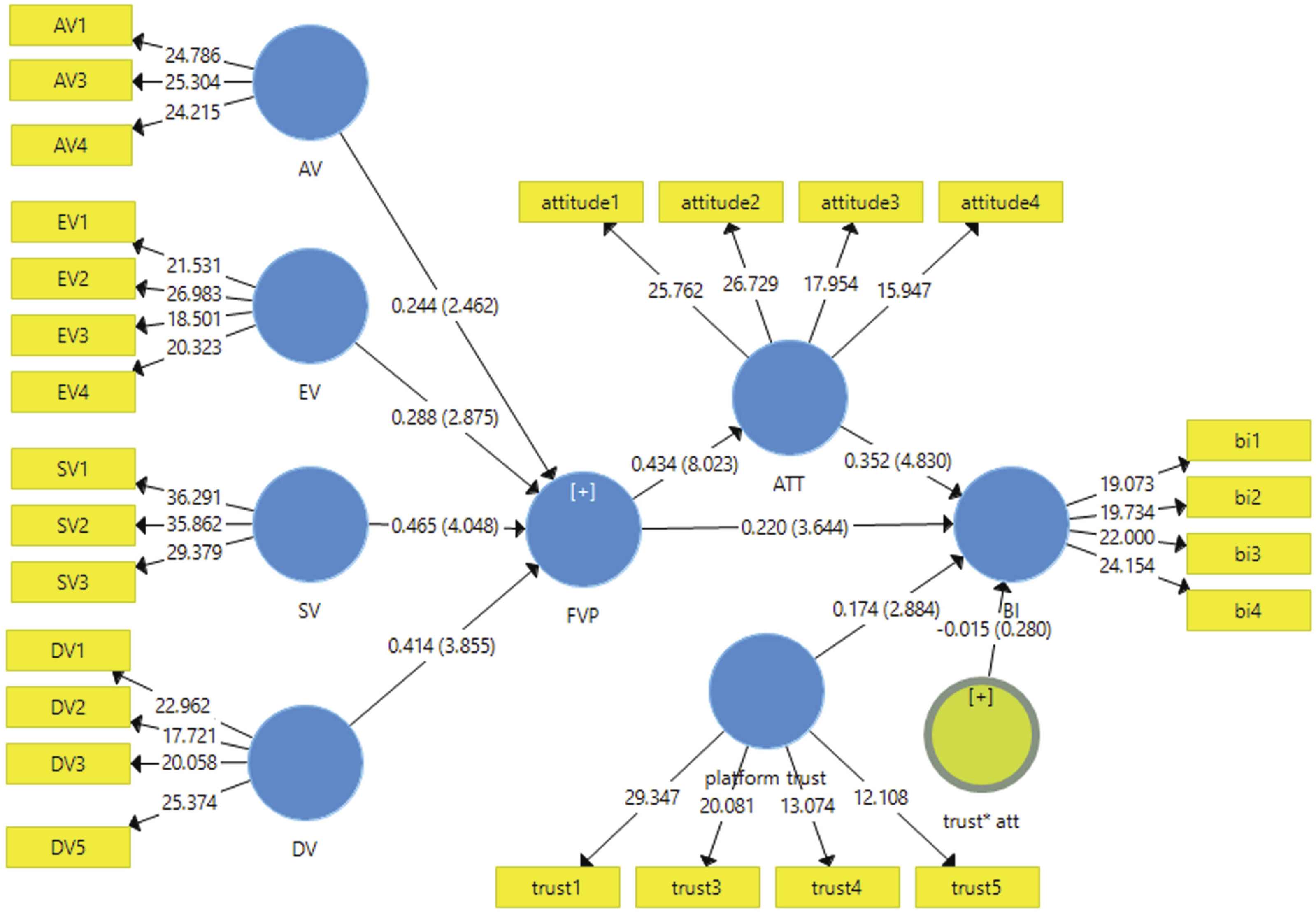
Revised PLS-SEM path analysis (Source: Authors)
Research guidelines suggest that in the process of construct development, if the formative dimension is insignificant and does not affect the operational definition of the construct, then the researcher can eliminate them [99, 101]. Addition or removal of variables influences weights and significance of higher-order dimensions [92, 96]. The conceptualization and construct development process required validation from different data samples over time [102]. As this study is exploratory in nature, and the freelancer value proposition construct is in the developmental phase, we can remove insignificant dimensions in order to have a better model-fit.
4.2. Structural model
After the removal of HV, we perform PLS-SEM algorithm and bootstrapping with 5000 samples to assess statistical significance of the structural model. Table 4 shows that the overall statistical model explains 36.4 percent variance and SRMR value 0.09, which is acceptable [92, 104]. Blindfolding is performed to test the predictive relevance of model PLS-SEM. The calculated Stone– Geisser’s value for this model (Q2 = 0.175) meets the given criterion (i.e., Q2 > 0) for the predictive relevance of our study model.
PLS-SEM path analysis
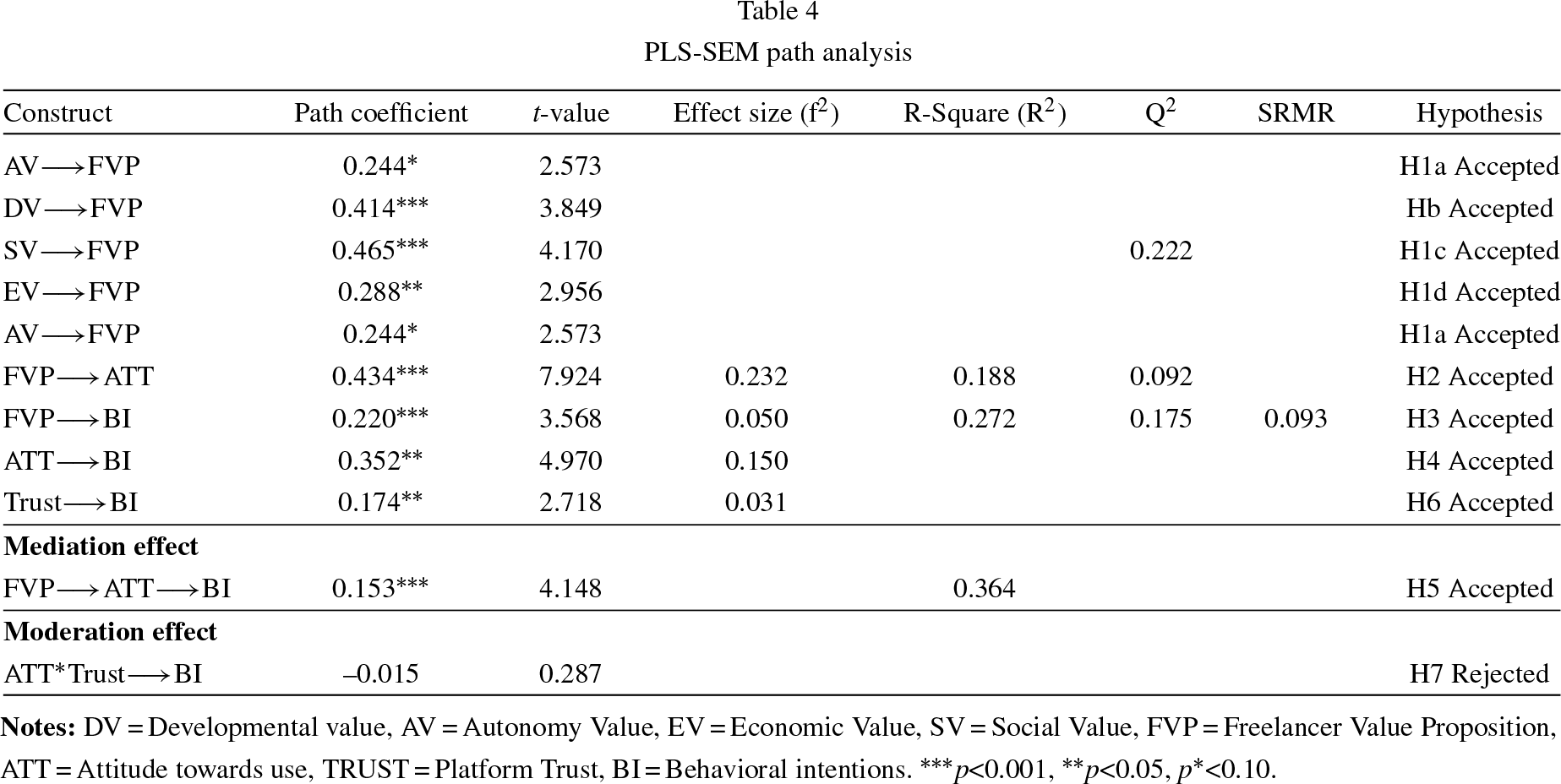
As Table 3 shows that Developmental Value (β=0.414; t = 3.849; p < 0.01), Economic Value (β=0.288; t = 2.956; p < 0.01) Autonomy Value (β=0.244; t = 2.573; p < 0.01), and Social Value (β=0.465; t = 4.170; p < 0.01) have a positive and significant relationship with freelancer value proposition. Thus, we accepted H1b, H1d and H1c. Moreover, the effect size (f2) measures the strength of independent variables in predicting the dependent variable. According to Aguinis et al., [105], the effect size can be classified as follows: f2≤0.02 represents small effect, f2≤0.15 represents medium effect and f2≤0.35 represents substantial effect. Developmental value and social value have substantial effect on freelancer value proposition; whereas, economic value and autonomy value show medium effect.
5. Discussion
e-lancing has become an important service industry sector, and the tremendous growth in freelancing has disrupted the traditional HRM practices. IT firms outsource work to freelancers to increase efficiency and productivity. Freelancers are independent employees; however, they become an important part of organizations and are considered “part-time employees”. Despite the important working role of freelancers and the significant growth of outsourcing, this sector could not receive much attention from HR professionals and researchers. This study focuses on the employee-relationship link between an e-lancing platform and freelancers. The main objective of this study was to determine the factors that contribute to the freelancer value proposition. We found that developmental value, social value, and economic value significantly contribute to the freelancer value proposition, and the platform company can increase perceived value by working on these dimensions. e-lancing platforms not only act as a bridge between freelancer and client; platforms are enterprises and freelancers serve these e-lancing platforms and should be treated like employees. Outsourcing companies can also consider these value proposition dimensions to maintain a good working history with freelancers. The second objective was to investigate whether the freelancer value proposition is positively related to platform usage attitude and behavioral intentions. We found that freelancer value proposition has a significant and direct relationship with platform usage attitude and behavioral intentions, as previous studies found that employee value proposition has a direct impact on behavioral intentions [75, 76]. The third objective was to investigate the role of platform trust in shaping platform usage intentions. The results suggest that platform trust plays an important role in shaping the behavioral intentions of freelancers and has a positive and significant relationship with behavioral intentions. However, the moderating role of platform trust was not found in this study and requires further exploration. Possible reasons could be cultural factors i.e., skepticism towards technology, trust interpersonal relationships rather than online relationships, and it could also be situational factors i.e., payment issues, lack of local support, communication barriers, scams and frauds [66, 106].
5.1. Practical implications
Following implications are suggested based on results of the study. Social value (SV) found to be an important motivational factor for job satisfaction and commitment in the corporate world. In freelancing, social value associated with recognition and reputation among peers. Platforms can develop virtual communities of freelancers where interaction is possible with likeminded professionals and enable them to develop professional networks. Moreover, platforms can increase social value by introducing recognition certificates (e.g., high achievers, important performance benchmarks, client feedback, success stories). Upwork freelancing platform features top performers based on job success rate, income, job category and bill rate. These top performers are often influencers and act as brand ambassadors for platforms. For example, Hisham Sarwar was featured as one of the top freelancers of guru.com, and he has a strong fan-base on social media as freelancing instructor and motivational speaker. Thus, he promotes the platform guru.com during his freelancing lectures. Freelancing platforms can also provide an option to interlink with other social networking platforms (e.g. LinkedIn, Twitter). Platforms can also send greeting messages on special days (i.e. birthday).
Developmental value is another key dimension of the freelancer value proposition. Skill development plays a vital role in the career of freelancers. Most platforms provide initial training and demonstration videos about platform layout and functionality, but technical skill development training is a missing link. Skill development training on the job leads to higher employer attractiveness [107]. Platforms should focus on the technical development of their freelancers, which not only help retain freelancers but also serve as starting point for long-term relationship. Platforms can launch different technical courses and certifications to enable freelancers to gain specific skills. The platform can have videos and an assistance team to help freelancers to get certified. Recognition of certification on profile will help freelancers to get more projects, and it will also benefit clients to find the right freelancer for the job. The rating system is often misleading and could not provide conclusive information about specific skills. It is also observed that most freelancers have ratings above the midpoint, and clients are not able to assess their competencies and skills.
Economic value is an extrinsic motivational factor that influence participation of service providers in all sharing economy platform. Most part-timers join freelancing platforms to earn extra money in addition to their regular salary from the employer organization. Normally, freelancers have the liberty to make decisions about remuneration (i.e. wage rate, project bit, working hours, No. of projects). However, platforms can also play a vital role to improve economic value. Platforms can charge less commission fee than other platforms, and can also introduce short- and medium-term economic investment plans/incentives. Furthermore, the ease of wage payment can also contribute to economic value. Freelancing platform normally holds the payment of freelancers to ensure quality services for clients. Freelancers often face payment issues because clients could not communicate requirements properly, and freelancers invest their time and efforts according to initial project description. Miscommunication of project requirements leads to payment disputes. Fiverr.com introduced upfront payments to ensure smooth payment transfer to freelancers. Clients have to pay in-advance, and platform transfer money to freelancers upon completion of the project. The banking system of developing countries is also an obstacle to a smooth payment delivery process. The platform should consider the regional constraints of the banking system. Although Payoneer cards successfully tackle most payment constraints, but there are still some connectivity issues with local banks and Payoneer accounts.
Autonomy Value (AV) is an inherited benefit of freelancing, platforms offer wide range of projects and freelancers have the liberty to choose projects. Freelancing gives them a sense of ‘be your own boss’. Platforms can help to increase this value by developing trust among freelancers. Individuals may struggle to complete a project due to constraints, i.e. lack of skills. On request of a freelancer, the platform can assist in completion of the project by connecting to other experienced freelancers. Platform trust affects freelancer’s attitude towards use of the platform. Platform branding strategies can also impact freelancer engagement and behavioral intentions.
5.2. Limitations and future directions
No study is immune to limitations, and this study also has some limitations. Convenient sampling technique was used, which is a popular and widely used technique in social sciences, but convenient sampling has inherited drawbacks, i.e., lack of generalizability. Freelancer value proposition provides the grounds for better understanding of platform-freelancer and client-freelancer relationship. To validate the dimensions, we strongly recommend to replicate the study across different regions and freelancing platforms. Since, this study is pioneer in exploration the freelancing value proposition construct, further studies can include hedonic value and autonomy value as dimensions of freelancer value proposition. It will be interesting to measure the relative importance of each dimension of freelancer value proposition based on demographics (i.e. experience, gender, project type, nature of freelancing). Value proposition is a systematic process of identification of value set and development of value delivery system. Forthcoming studies can focus on developmental strategies and their effects on freelancer value proposition. Platform trust moderation was not proved; there are a wide range personal, cultural and situational factors that could influence behavior [66, 106]. To determine the factors which influence platform trust, futures studies can be conducted in Pakistani context. Mix-method research and case study approach is highly recommended for future studies, to provide realistic findings for identification, development and improvement of value proposition.
6. Conclusion
e-lancing has become an important aspect of the workforce, and effective talent management strategies are required to build sustainable workforce. The value proposition is an effective tool for relationship management, and this study shows that value proposition has a positive effect on the attitude and behavioral intentions of freelancers. Organizations, including platform companies and outsourcing companies, must offer higher value propositions to improve relationship with gig workers. Improved relationships lead to better service quality and productivity. This study concludes that developmental value, economic value and social value are strong determinants of freelancer value proposition, and organizations can strengthen relationship with gig workers by maneuvering on these value determinants. Platform trust plays a significant role in shapinggig worker’s attitude and behavioral intentions. Organizations must develop relationships with gig workers to fulfill the future workforce demand, and to remain competitive in the dynamic business environment.
Footnotes
Acknowledgments
We are thankful to respondents and anonymous reviewers for their time and valuable input for the study.
Author contributions
Conflict of interest
None to report.