



Abstract
BACKGROUND
The current challenging time necessitates looking beyond designated, traditional, and role-based sources of leadership and instead looking at a range of more inclusive leadership styles. This is the first endeavor to investigate how a sustainable leadership style drives work engagement by mediating the effects of perceived organizational support and mental health. These factors generate unique pathways yet to be assessed in the literature.
OBJECTIVE
Drawing on the conservation of resources theory, our study strives to analyze a sequential mediation framework for employee engagement under the influence of sustainable leadership along with the mediating effects of perceived organizational support and mental health.
METHODS
Data collection was performed during COVID-19 at different times, with an interval of three weeks, from 365 healthcare workers in Pakistan’s private and public sector hospitals. Data analysis was performed using SEM and PROCESS Macro by Hayes.
RESULTS
The study reveals that in overcoming challenges like COVID-19, perceived organizational support and a health worker’s mental health play a vital role in explaining the association between sustainable leadership style and work engagement.
CONCLUSION
The findings of the current study will inspire the administration of healthcare institutions to invest resources that foster a supportive environment for their workers by employing sustainable leadership practices, reducing the effects of overwork and pressures faced by frontline workers during the COVID-19 pandemic. If healthcare workers are left on their own to tackle the challenges of the pandemic, disengagement, which leads to higher absenteeism and lower productivity, may topple the whole system.
Keywords




1. Introduction
1.1. Background
The current research investigates how and when a sustainable leadership style influences work engagement. Research on the link between leadership and employee engagement, precisely the transformational leadership style, has determined enduring effects on employee attitudes and behaviors [1]. Scholars, however, have started emphasizing examining a variety of more inclusive and adaptable leadership styles, in addition to defined and formal sources of leadership, to respond to the contemporary cultures of the organizations, which have flexibility, agility, and responsiveness as their defining traits [2, 3]. With the potential to develop a novel leadership paradigm in organizations, the sustainable leadership theory has increased in prominence and attention within the last decade, owing to much discussion and advocacy [4]. Nevertheless, the psychological processes that link sustainable leadership style to work engagement have not yet been examined.
The COVID-19 epidemic serves as a stark wake-up call for organizations worldwide. In a short period, COVID-19 has changed the global scenario, leaving long-lasting repercussions on people and global economies [5]. It confers an unprecedented challenge to health, the economy, the world of work, and the workforce, and numerous organizations are faced with the threat of their existence [6, 7]. Initial studies have shown that, since the outbreak of the worldwide health catastrophe, employees’ productivity has toppled by a drastic 35% reduction [8, 9]. It has created a volatile environment for people and placed an enormous strain on their personal resources to handle the resulting challenges.
1.2. Significance
In the face of exceptionally crucial and emotionally demanding situations, employees in many countries are expected to work more effectively with fewer resources. Due to today’s increasingly severe conditions, numerous experts ask whether focusing on common well-being criteria like satisfaction and commitment, which are indicators of being calm, satisfied, and relaxed, is still enough to achieve good performance [10]. Accordingly, employees’ satisfaction and commitment may not help them reach their full potential, as they prefer to be passive and uninvolved. It is, however, suggested that to achieve high performance, managers require their staff to be proactive, dedicated, and enthusiastic about their work. In other words, these organizations need engaged staff [11]. Work engagement could answer today’s most pressing dilemma in the public and private sectors, leading employees to active and full performance [12]. It is assumed that high levels of work engagement are linked to exemplary service delivery, increased client satisfaction, and improved service quality [13]. It assists organizations in mitigating anomalies of low morale, disengagement, absence from work, and other ailments that might cost businesses more than $440 billion in lost productivity each year. According to Gallup’s latest survey, disengagement in employees results in a 37% higher absence from work, an 18% lower productivity, and a 15% drop in profitability. If translated into dollars, the cost of having disengaged employees reaches 34% of their annual salary [14].
1.3. Research gap
Due to its importance, work engagement has become a significant concern for many organizations, and many studies have looked into the probable causes and repercussions of engagement [15, 16]. Although the research on interventions is growing, there is a scarcity of evidence on which to base interventions [16]. Consequently, the earlier research emphasizes “that additional mediating and moderating variables in future studies would be able to refine the hypothesized model and develop more detailed findings” [17, p. 15]. The current study addresses this gap and investigates that if individuals possess valuable personal resources of mental health, their capability to get engaged in their work will be affected, particularly in challenging times like COVID-19.
Additionally, a previous study indicates that “leadership, work climate, and organizational support act as the main antecedents of engagement” [18, p.3]. However, “although quite a lot is known about the association between transformational leadership and engagement—researchers are beginning to look beyond designated, formal and role-based sources of leadership, to look at a range of more inclusive leadership styles” [19, p.6]. The current study addresses this call and proposes that sustainable leadership styles strive for an engaged workforce and enhance employees’ perception of organizational support. Further, as leadership and organizational support bind individuals to a course of action [20, 21], we propose that perceived organizational support may be an essential mediating mechanism that explains how sustainable leadership translates into the mental health of employees that fuels engagement at the workplace. Further, to add in literature where very few studies have evaluated the mental health effects on productivity gains [22].
We respond to Tulucu et al.’s [23] research call, “It is critical to explore and examine the factors which affect work engagement not only directly but also indirectly via some mediating mechanisms i.e., personal and psychological resources need further investigation as it is essential for nurses to maintain their psychological and mental health to do their jobs properly.” Our study responds to these entreaties and examines factors related to mental health that generate unique pathways yet to be assessed in the literature (see Fig. 1).
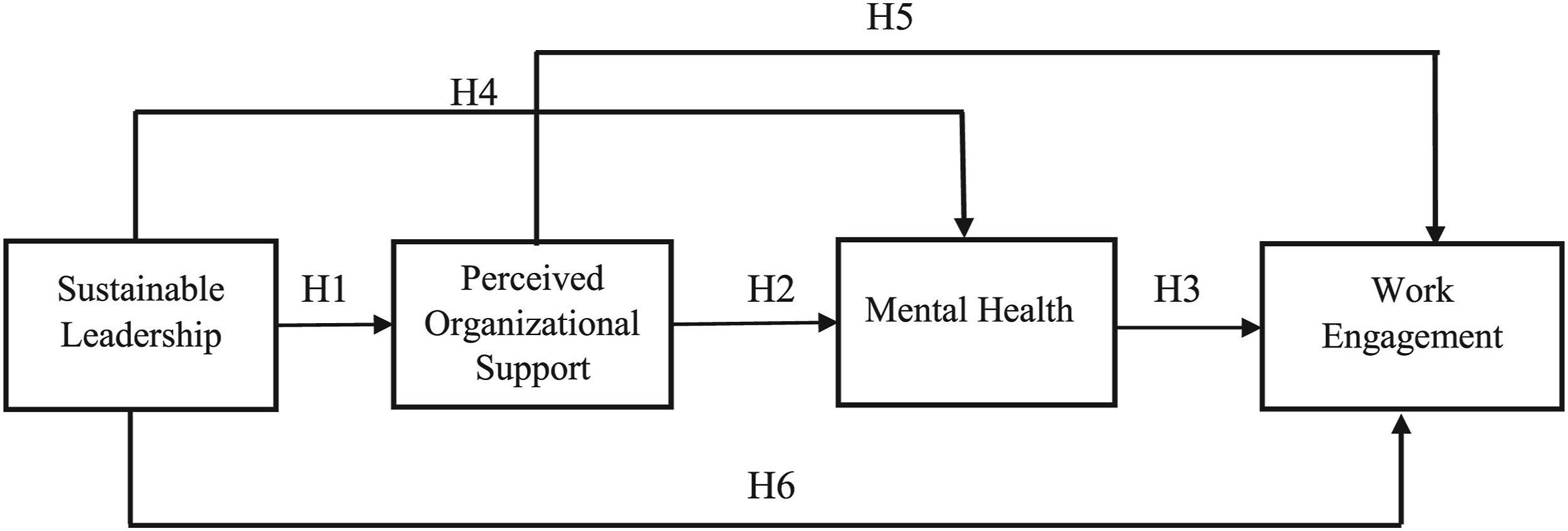
Theoretical model.
1.4. Objectives
This study analyzes how personal and job resources contribute to resource conservation for work engagement, drawing on Hobfoll’s [24] conservation of resources (COR) theory. The sequential mediating impact of contextual and personal factors on work engagement is investigated through an empirical approach applied to the health sector, i.e., public and private hospitals positioned in Pakistan’s emerging yet relatively under-studied context. By researching in Pakistan’s context, the study responds to Chriscaden et al. [6, p. 599] assertion that “psychological research emphasizes the value of using different contextual cues in experimental priming stimuli to induce different psychological states because unique causes in real life trigger these cognitive and emotional states”. Hence, the different contexts of culture and occupational segments may help to learn the triggering confounding psychological states concerning work engagement.
2. Theoretical framework and hypotheses development
2.1. Sustainable leadership and perceived organizational support (POS)
Sustainable refers to something maintained over time, tolerating change, and supporting and holding assurance [25]. It strikes a balance between immediate and long-term goals and constructs the present without endangering the future [26]. With the help of a sustainable style of leading, an enterprise can endure the inevitable catastrophes that may surround it over time [27]. The phrases “sustainable” and “leadership” reference progressing toward the future. Sustainable leadership has gained popularity as it is a “modern values-oriented approach to leadership that emphasizes leading as being”. [28, p.278). A sustainable style of leading is influenced by the context and how the leader responds to demands, as opposed to traditional leadership study, which places more emphasis on an individual’s skills and attributes 29]. Stoker et al.’s [30] research emphasizes the role of situation as an antecedent that determines leaders’ conduct; they claim that context affects how a leader responds to various demands and external pressures. This supports the argument made by Avery and Bergsteiner [27] that instead of being a prescriptive, one-size-fits-all strategy, a sustainable leadership style is decided by the context in which it exists or emerges. The employees perceive a leader’s favorable or unfavorable treatment as an indication that their organization favors or disfavors them.
The organizational support theory contends employees’ propensity to ascribe human-like characteristics to the organization [31, 32]. According to Levinson [33], activities performed by an organization’s agents are frequently considered as indications of the organization’s intention rather than credited exclusively to the agent’s motives. Furthermore, employees consider that their supervisor’s assessments are regularly communicated to upper management, further adding to employees’ association of leader’s support with POS [34]. Grounded on the organization’s personification, workers take their leader’s positive or negative conduct as a representation of the organization’s favorable or unfavorable treatment towards them.
Based on the above discussion, the current study contends that a sustainable leader augments employees’ support and caring perception of their organization.
2.2. POS and mental health
The progression of employees’ perceptions and beliefs that there is a deep concern in support of employees’ well-being on behalf of the organization is inferred as ‘organizational support’ [35]. According to Rhoades & Eisenberger [36], support from the organization is viewed as the organization’s facilitation for positive reciprocity that gives employees the ability to perform well to repay the organization’s positive influences. POS drives social, emotional, and instrumental support
A social-ecological perspective drives the concept of workplace health. ‘Ecology’ addresses the interaction between humans and their environment, emphasizing the contextual factors of social, cultural, and institutional settings [37]. Multiple personal and environmental attributes influence an individual’s or group’s health condition at the workplace. From a social-ecological perspective, workplaces are considered complex systems containing numerous social and environmental settings that impact an employee’s physical and mental health [38]. The capacity of an organizational environment echoes the cumulative impact of several environmental influences on several facets of employee health.
Cohen and Wills [39] contend that four functions of support safeguard employees from the adverse effects of job-related mental stress. First, organizational support by showing respect and appreciation contributes to establishing acceptance for employees irrespective of their deficiencies. Second, organizational support facilitates an informational function of offering sufficient information that assists in defining, comprehending, and coping with stressful occurrences at the workplace. Third, organizational support provides the function of social companionship that creates sound affiliations, satisfies the need for companionship, and diverts employees from mental stress. Lastly, it facilitates instrumental function by providing material resources and services that help deal with mental stress, i.e., adequate job autonomy and flexibility, which lessen the effect of mental stress and enhance mental well-being [39]. All four functions of organizational support enhance employees’ mental health by reducing stress. The perception of employees that their organization is valuing them may increase their belief in their abilities to cope with stress [40]. Based on the above discussion, the following hypothesis is formulated:
2.3. Mental health and work engagement
The literature defines engagement as a ‘fulfilling, positive work-related state of mind characterized by vigor, dedication, and absorption [41, p. 74). Antecedents of vigor positively predict good health and proactivity in employees 42]. To date, there is a scarcity of studies addressing the association between work engagement and mental health. Research conducted by Hakanen et al. [43] for Finland concluded that a positive association exists between work engagement, self-rated health, and functionality. The study performed on Swedish healthcare personnel by Demerouti et al. [44] also revealed fewer health-related problems and lower levels of anxiety and depression in the engaged workforce. Wefald [45] has also endorsed Shirom’s stance that engagement, specifically vigor, is linked with health.
Most previous research accounts for the relationship between physical health and work engagement. The current study considers mental health’s association with engagement to address the work and health ecology in the changing workplace settings. COR theory assumes that individuals endeavor to accrue and guard resources to cope well with stressful conditions and prevent adverse outcomes. The theory proposes that individuals invest their resources to develop more resources for gain spirals. Job resources and work engagement mutually foster gain spirals. Mental health is a resource that employees develop because of favorable ecological conditions at the workplace. Possessing crucial job resources fosters employee engagement with time [46]. As ascertained by social exchange theory, the norms of reciprocity advocate a sense of obligation. If employees feel that the organization values their well-being [47] and mental health, they respond to it with a positive attitude through their engagement at work [23], something all organizations strive for. This discussion leads to the following hypothesis:
2.4. POS as a mediator between sustainable leadership and mental health
The framework of organizational support theory implies that supervisory support increases employees’ perception that the organization values them. They are being treated as valuable and cared for by the organization and upshots positive emotions with lesser health issues [36, 48]. Since the acts of supervisors are generally taken as agents of the organization, possessing the obligation to direct and evaluate the performance of subordinates, employees consider their leader’s favorable or unfavorable positioning to represent the organization’s support [31, 49]. Sustainable leaders are fair in their dealings and get support from their followers. Individually and collectively, they engage in conscious behavior that produces outcomes that foster, uphold, and perpetuate sound economic, social, and environmental systems [50]. The focus of sustainable leadership is to benefit everyone, not just a small group of stakeholders at the expense of everyone else. It increases rather than decreases material and human resources [51]. Consequently, employees may have a feeling of pleasure, happiness, or optimism if their superiors care for their rights, dignity, and welfare or attend to their beliefs and concerns [27]. Hence, this study proposes that it will enhance their mental health when employees perceive their supervisors as sustainable.
Based on the above discussion, we hypothesize as:
2.5. Mental health as a mediator between POS and work engagement
Lately, health has grasped the attention of researchers on the motivational axis of the job demands-resources model, whereas earlier, it was primarily drawn around strain and taken along the health impairment axis of the model [52]. Although social support possesses a long history of reconnaissance concerning health, far less research exists that associates connections between POS and health [53]. Numerous researchers have started contending that health-oriented outcomes and work engagement possess a positive relationship, which needs further exploration [15]. Organizations are instigating to comprehend the advantages of offering a supportive work environment to their workforce, precisely those conditions that uphold healthiness [53]. The inordinate emphasis on support by the organizations is shown in a more significant concern for physical health and a greater focus on offering psychologically healthy worksites for employees [53]. Healthier personnel tend to be more productive with less absenteeism due to illness, and they can focus better and feel better [54]. Feeling valued makes people feel good [55]. Research backs the claims that the perception of organizational support promotes employees’ feelings of being valued, which more likely enhances positivity in their mood [36]. People with higher mental well-being and lower levels of stress and mental agony are those who are acknowledged and appreciated [56]. Research contends that low POS serves as a stressor that results in negative emotions and vice versa [53]. Furthermore, Shirom [42] contends that positive emotions cause an ascending spiral to mental health over time. Empirical research reveals a positive relationship between self-rated health and engagement [43]. Based on the above discussion, it could be hypothesized as:
2.6. Sequential mediation effect of POS and mental health
A leader’s demeanor significantly impacts followers. Moreover, the conservation of resource theory tenets implies that workplace resources are invested in building new resources [24]. Followers, as per expectations, reciprocate by building more resources with the received material and socioemotional resources. Sustainable leaders believe in developing human and material resources rather than depleting them. Their focus remains on spreading benefits to all [51]. The norms of reciprocity of organizational support theory also suggest that employees who feel valued by their leaders and their organization feel obliged to reciprocate by contributing to achieving organizational goals. By engaging Hobfoll’s stance of the COR theory [24], it is ascertained that employees have restrained physical and emotional resources. This scarcity of resources indulges them in extra efforts, opting for different behaviors to protect, maintain, and accumulate resources for the future. One such behavior is work engagement. Most likely employees are engaged when they get pleasure from their work and have energy for work. Macey et al. [57] endorsed that equipping employees with motivation, freedom, and capacity leads them to high engagement at their work. COR theory advocates that gain cycles develop on themselves, as represented in the engagement framework. When individuals get resource gains and positively feel the recompenses of dedication and absorption, they experience better well-being and positive health and become more capable of investing resources into the engagement activity [58].
To conclude, a supportive workplace setting establishes vital stipulations for nurturing employee engagement. Workplaces that extend support from leaders and organizational resources play a vital part in employees’ mental health, enabling them to engage at higher levels. Based on the above discussion, it could be hypothesized as:
3. Methods
3.1. Participants and procedures
Data was gathered from 365 medical practitioners employed at Pakistan’s governmental and private hospitals, mainly from Lahore, Islamabad, Karachi, Sialkot, and Faisalabad. We concentrated on one sector so that “the unknown sources of variance due to organization type could be controlled” [59, p 224]. Further, we chose a sample from the healthcare sector, like many recent pieces of research [60, 61], to provide a mechanism to help healthcare institutions face challenging times. 68 hospitals provided data for the study; 45 were public, and 23 were private. 251 healthcare providers from public hospitals (69%) and 114 from private hospitals (31%) were selected using simple random selection techniques. A priori power analysis was performed using G*Power version 3.1.9.7 to determine the minimal sample size required to test the study hypothesis [63]. The following criteria were set for participation in the study: Having a practitioner qualification certificate, being employed by a hospital as an official staff member, and willingly taking part in the survey were prerequisites for participation. Exclusion criteria include postgraduate students, physicians doing refresher training, and those who do not wish to participate in the research. Because of the burden frontline workers faced throughout the pandemic, we used a split questionnaire technique to gather data. Earlier research offers a basis to incorporate the split questionnaire technique to minimize the load for respondents [62].
To minimize common method bias, this study opted for a two-wave time-lagged study design with a 3-week interval between predictor and criterion variables [64]. The data for mediators, independent and dependent variables was collected at different periods. At T1 (Time 1), respondents were asked to report their demographic data like their age, educational background, marital status, gender and type of hospital. They were also asked to fill out their responses for sustainable leadership and POS. At Time 2, 21 days after the first response, the same respondents were asked to rate their mental health and engagement at the workplace. This temporal separation may minimize the respondent’s tendency to become influenced by using previous responses to answer succeeding questions, thus reducing method bias.
Further, to eliminate evaluation concerns and social appropriateness, respondents were assured that the confidentiality of their identities would be upheld and that their responses would solely be used for research purposes. It was also assured to respondents that their participation in the survey remained voluntary, which could be withdrawn if they felt so at any time without any forfeit. Finally, to prevent interviewer bias, self-administered questionnaires were used.
To correctly match the responses from employees during the two separate periods, both sets of questionnaires for T1 and T2 were coded. At time 1, 434 of the 510 health professionals contacted answered the survey (response rate 85%). After three weeks, at Time 2, we approached those 434 employees who already provided their input on sustainable leadership and POS to rate their mental health and tendency to engage at the workplace. After the two sets of data were matched, our sample of 365 health workers was complete. This resulted in an overall response rate of 84%. Of the 365 respondents, 142 (38.9%) were male, and 223 were female (61.1%). Most of the respondents (55.1%) fall in the age bracket of 25–34 years, whereas 19.7% fall in the age range of 35 to 44 years. The demographic information revealed that about 69.6 % of the employees were associated with public sector hospitals, while 30.4% served in private sector hospitals.
3.2. Measurements and scales
We employed well-established and commonly used scales to measure the variables in the current research. The specifics of the scales utilized in this study are summarized below.
3.2.1. Sustainable leadership
Healthcare workers responded about their perception regarding the sustainable leadership style of their supervisors at Time 1 using Di Fabio and Rosen’s [26] four-item scale. A sample item from the scale measures is “My leader (supervisor) develops, rather than exhausts the human resources that work with him/ her” (1 = “strongly disagree” to 5 = “strongly agree”).
3.2.2. Perceived organizational support
Participants rated POS at Time 1 using Coyle-Shapiro and Conway [65] seven-item scale. A sample item from the scale is “My hospital cares about my wellbeing” (1 = “strongly disagree” to 5 = “strongly agree”).
3.2.3. Mental health
We assessed a health worker’s mental health at Time 2 using the 4-item scale adapted by Han et al. [66]. A sample item includes “Association with this hospital makes me think that I am a valuable and important person” (1 = “strongly disagree” to 5 = “strongly agree”).
3.2.4. Work engagement
At time 2, a three-item survey designed by Schaufeli et al. [67] is used to inquire about the level of work engagement of health professionals. One of the sample items from the measure is “At my work, I feel bursting with energy” (1 = “almost never” to 5 = “very often”).
3.3. Control variables
In light of the prior studies, some demographic factors, such as gender, age, hospital type, and marital status, were controlled [68]. Age was controlled since studies show that work engagement [69], POS [70], and mental health [71] change with an increase in age. Gender was also controlled owing to its variance in mental health [72] and work engagement. It is contended that the attitude-performance equation in the field of organizational studies should take gender variations into account, as Amason and Allen [73] contended that POS among males was generally more than females. Further, Banihani et al. [74] investigated the influence of gender on work engagement since men can more easily show it than women.
Marital status is controlled because, in the literature, its connection to employee engagement is established. Healthcare workers who were married showed more engagement towards their work [75]. Lastly, hospital type was controlled as workers having temporary contractual jobs with private sector hospitals may report lower levels of organizational support and mental wellbeing due to heightened job insecurity [76].
3.4. Analytical approach
Analysis of research hypotheses was performed in two steps. At first, mediation analysis was carried out through Preacher and Hayes [77] PROCESS macro. It examined the direct impact of sustainable leadership on POS, POS on mental health and the indirect impact of sustainable leadership on mental health through POS and the indirect impact of POS on work engagement through mental health. To remove the possibility of type-1 error, we analyzed the effects of mediation by means of the Sobel test and bootstrapping tests [78]. Secondly, we analyzed the sequential mediation to test the sustainable leadership impact on work engagement through POS and mental health.
4. Results
4.1. Descriptive analysis
Table 1 reports the mean, standard deviation, reliability estimates (Cronbach Alpha), and item inter-correlations among the variables of the study. The direction of the correlation coefficients confirms our anticipations and establishes initial backing for our proposed hypotheses. Results reveal that sustainable leadership is positively and significantly related to POS (r = 0.36, p < 0.01). Results reveal a positive association between POS and mental health (r = 0.20, p < 0.01). Moreover, mental health is found to be significantly correlated with work engagement (r = 0.13, p < 0.05). These strong correlations in the predicted direction provide initial backing for the proposed hypotheses.
Mean, standard deviations (SD), and correlations
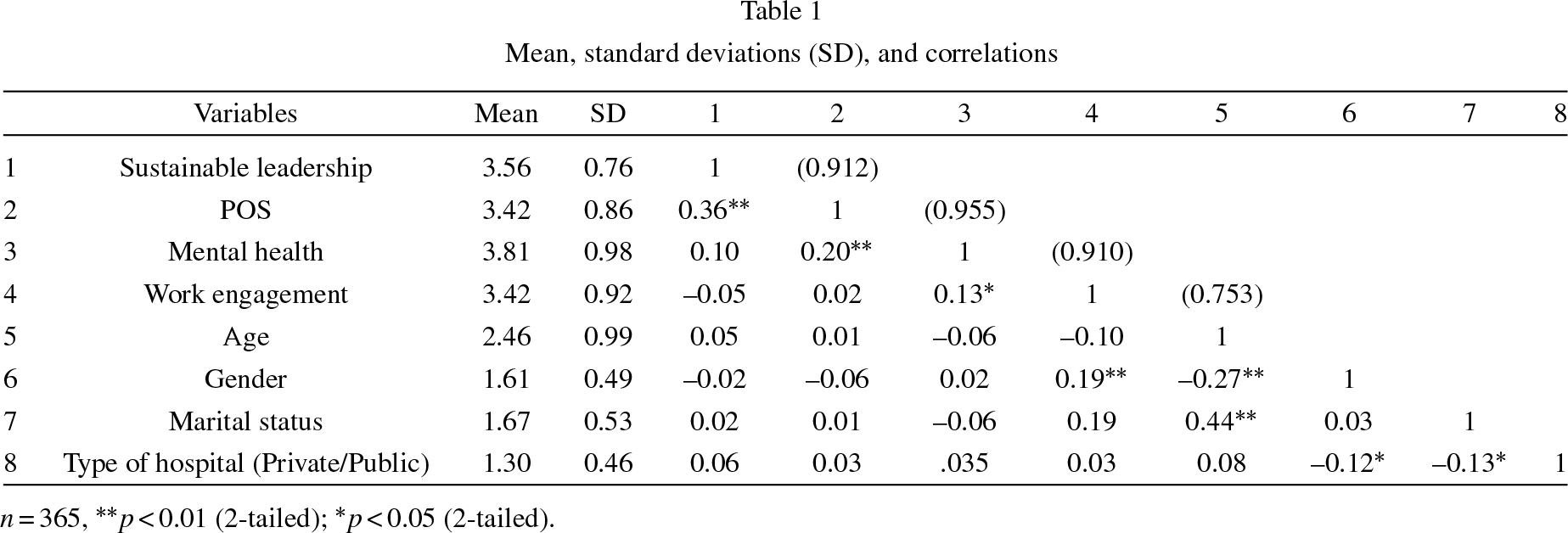
n = 365, **p < 0.01 (2-tailed); *p < 0.05 (2-tailed).
4.2. Validity of constructs
4.2.1. Confirmatory factor analysis (CFA)
To ensure the goodness of fit for the study variables, a measurement model was assessed using CFA and AMOS 21.0 prior to testing the hypotheses. This study computed Chi-square test statistic, Comparative fit index-CFI, goodness of fit-GFI, Tucker Lewis Index- TLI, and root mean square error of approximation- RMSEA to evaluate the fit indices for CFA. According to Kline [79, 80], for an acceptable fit, the Chi-square value should be less than 3, whereas RMSEA scores less than 0.05 and CFI and GFI scores need to be greater than 0.90. According to CFA, sustainable leadership, POS, mental health, and work engagement-four factors of the measurement model showed a good fit. According to the expectations, the data fitted sufficiently for the four-factor model (χ2/df = 1.704, RMSEA = 0.044, GFI = 0.982, CFI = 0.917) in comparison with 3-factor, 2-factor and 1- 1-factor models (see Table 2). These findings demonstrated that it is justified to examine the four constructs distinctively.
Fit indices for CFA
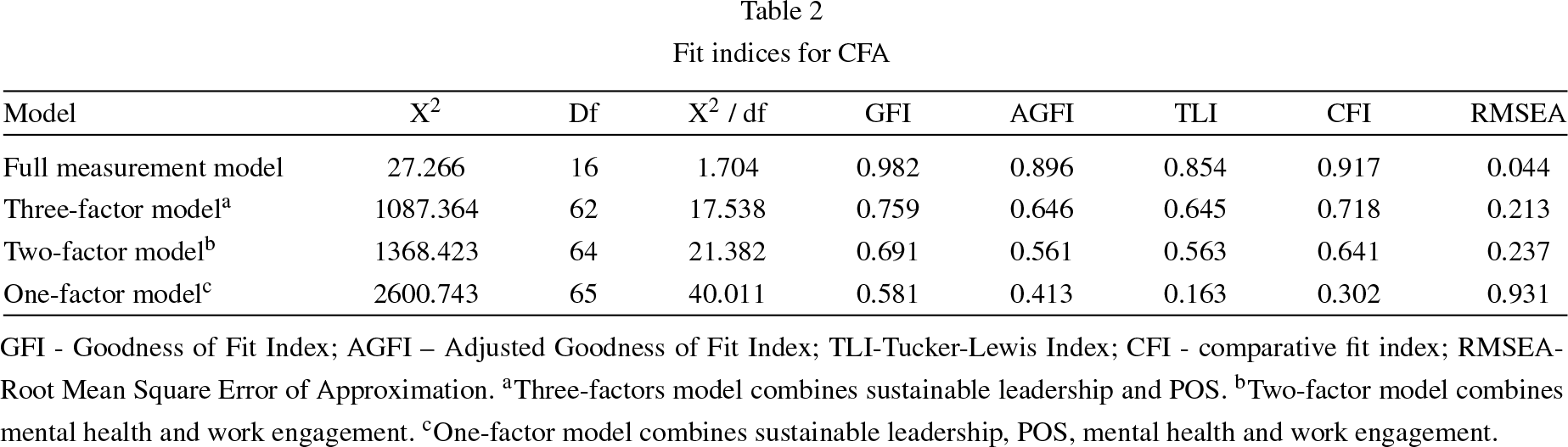
GFI - Goodness of Fit Index; AGFI – Adjusted Goodness of Fit Index; TLI-Tucker-Lewis Index; CFI - comparative fit index; RMSEA- Root Mean Square Error of Approximation. aThree-factors model combines sustainable leadership and POS. bTwo-factor model combines mental health and work engagement. cOne-factor model combines sustainable leadership, POS, mental health and work engagement.
Finally, for the measurement scale’s validation of internal consistency, composite reliability (CR) was computed (see Table 3). The results are found to fall within the acceptable criteria proposed by Fornell and Larcker [81]. CR is found to be greater than 0.70, hence validating the reliability of our construct. Further convergent validity is also found within the recommended range specified. Since AVE stands at greater than 0.5 for all study variables. Additionally, to assess the overlapping of unrelated constructs, the discriminant validity is also computed. The results are found acceptable as MSV is less than AVE for all constructs.
Convergent and discriminant validity
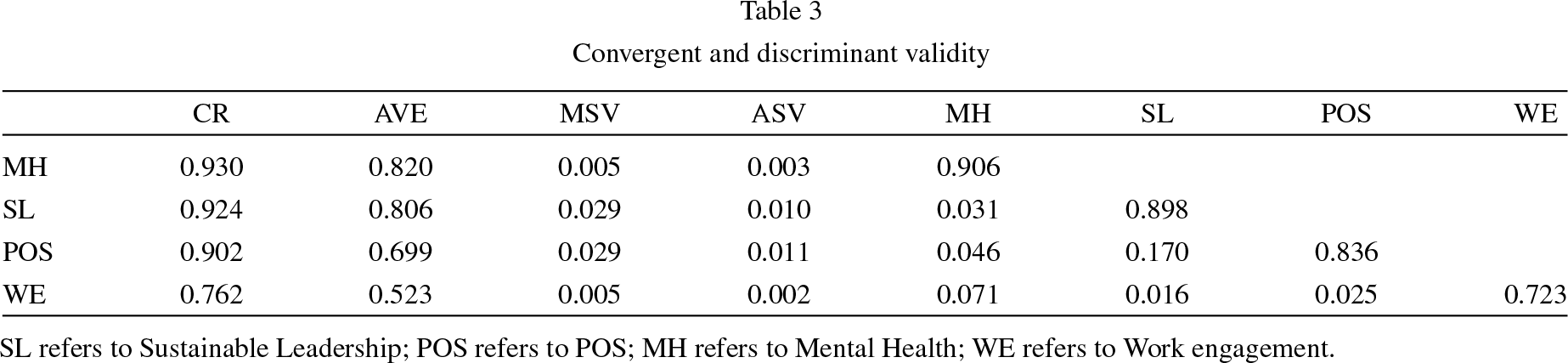
SL refers to Sustainable Leadership; POS refers to POS; MH refers to Mental Health; WE refers to Work engagement.
4.3. Hypotheses testing
We examined the effect of sustainable leadership (independent variable) on health workers’ engagement (dependent variable) through POS (mediator) and their mental health (mediator). The outcomes of Process Macro illustrated (Table 4) that the direct effect of sustainable leadership on POS was significant and positive (β= 0.40, t = 7.26, p < 0.001), providing support for Hypothesis 1. As expected, for Hypothesis 2, an employee’s POS impacts mental health (β= 0.23, t = 3.91, p < 0.001) positively and significantly. Further, a positive and significant association of mental health with work engagement is shown by the results (β= 0.12, t = 2.41, p < 0.05), supporting 3rd hypothesis. Lastly, the simple mediation outcome, as shown in Table 4, establishes the indirect effect of sustainable leadership on mental health. Moreover, the mediation model was also analyzed using the Sobel test. This test authenticates whether a mediator explains the relationship between independent and dependent variables. The results of the Sobel test exhibit the positive and significant unstandardized indirect effect of 0.087 as z = 3.07, p < 0.05. The results of the Sobel test were validated using bootstrapping (see Table 4) with a similar effect value of 0.087, as a 90% bootstrap confidence interval where the indirect effect did not contain a zero value (0.470, 0.142). This provides support for Hypothesis 4. We applied the same process to assess the indirect influence of POS on work engagement. The results in Table 4 established that the unstandardized indirect effect of 0.028 was positive and significant, as the Sobel test indicates, z = 2.00, p < 0.05. The bootstrapping, without assuming the shape of the sampling distribution, verified the Sobel test results (Table 4) with a similar indirect effect value of 0.028, as a 90% bootstrap confidence interval. Also, the indirect effect range did not have a zero value (0.008, 0.057). This provides support for Hypothesis 5.
Results of regression with direct and indirect effects

SL refers to Sustainable Leadership; POS refers to Perceived Organizational Support; MH refers to Mental Health; WE refers to Work engagement.
Finally, in Hypothesis 6, we proposed an association between a sustainable style of leading and employees’ work engagement mediated by POS and mental health in a sequential mediation process. The result showed that POS mediated the relationship between sustainable leadership and mental health, and subsequently, mental health mediated the relationship between POS and work engagement. We formally tested the hypothesis and found significant results for sequential mediation at a 90 % confidence interval between 0.003 and 0.025, providing support to hypothesis 6 as the value of the upper and lower limit is positive and does not contain a zero value. The results showed that sustainable leadership with higher POS and mental health resulted in higher levels of work engagement. The hypotheses results are summarized in Table 5.
Hypotheses status summary
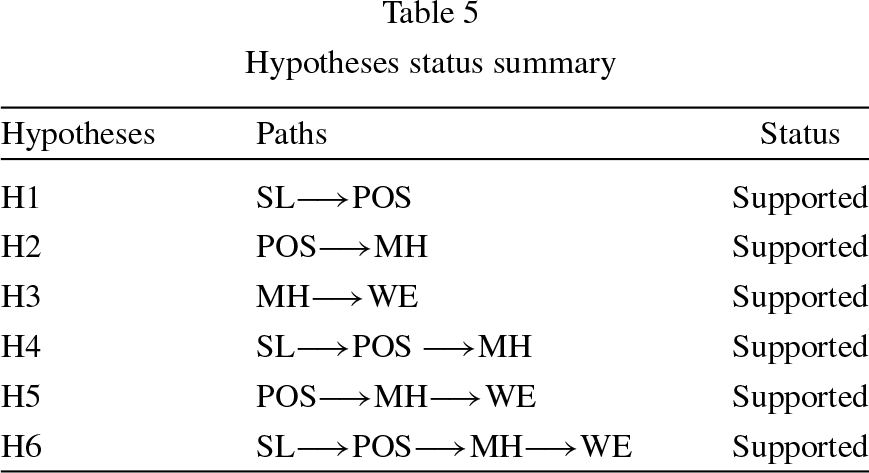
Sustainable leadership’s direct effect on work engagement has not been found. However, the indirect effect shows a significant relationship. Thus, we established that POS and mental health fully mediated sustainable leadership and employee work engagement.
5. Discussion and implications
By espousing a multi-theoretical perspective on sustainable leadership, the core objective of the current study was to analyze how sustainable leadership might intensify employees’ propensities that would explicate their work engagement during the challenging times of the pandemic. The sustainable leadership-workplace engagement relationship is explained by employing the theory of resource conservation. The assertion of COR theory is based on an individual’s efforts to preserve, safeguard, and accumulate important resources. Stress levels rise when people see a discrepancy between resource investments and gains or a suspicion of resource loss in an unreceptive atmosphere [82]. The stress literature reveals that stressful situations drain cognitive reserves and push individuals into emotional weariness, resulting in employee disengagement [83]. To avert resource loss or imbalances, individuals use their own resources or resources from the environment [24, 84]. This suggests that resources do not just offer security against resource loss, but also, they possess the capacity to establish positive work-related behaviors [84].
5.1. Key findings
Using SEM (structural equation modeling) by employing AMOS and PROCESS macro by Hayes, this research established that engagement at work may not necessarily follow directly from sustainable leadership. Instead, it triggers through sequential mediation of POS and mental health. The current study introduces POS as an important descendant of sustainable leadership, making a credible contribution to the theory. Furthermore, these findings may have far-reaching ramifications. Suppose POS and the mental health of employees are influenced by sustainable leadership. In that case, other attitudes and behaviors relating to the workplace that are linked to these factors also may impact sustainable leadership. For example, POS is positively associated with positivity in work attitudes and behaviors, for instance, job satisfaction, commitment, job engagement, organisational citizenship behavior and reduced intentions for turnover [85]. Further, employees’ mental health leads to good emotional health and reduced absenteeism with fewer days of cut back on work [86]. According to the experts, mentally healthy adults have optimum mental function, satisfying relationships, fruitful activities, and the ability to adapt. Therefore, the results of this study highlight how sustainable leadership may indirectly affect a wide range of employee attitudes and behaviors outside of work engagement.
The previous literature on work engagement focuses on organizational aspects of a job that are functional in achieving work engagement, yet engagement differs as per the resources individuals perceive themselves [87]. Further, as leadership and organizational support binds individuals to a course of action [20, 21], our study finds that POS may be an essential mediating mechanism that explains how sustainable leadership translates into the mental health of employees that fuels engagement at the workplace. The results of this study have been established by earlier research. According to the literature, a leader’s response to diverse demands and external influences depends on the context [30], which makes context an antecedent for leaders’ behavior. This is consistent with the assertion made by Avery and Bergsteiner [27] that a sustainable leadership style is determined by the context in which it originates rather than being a rigid “one-size-fits-all” strategy. The employees perceive a leader’s favorable or unfavorable treatment as an indication that their organization favors or disfavors them. As a result, through POS, a social exchange process is initiated, making employees feel compelled to contribute to the achievement of the organization’s aims and objectives in the hopes of getting bigger rewards for doing more on the organization’s behalf. A healthier workforce is more productive, more focused, and happier with less sickness and absenteeism [54]. With empirical evidence, this study combines job and personal resources that, particularly in an Asian context, aid in resource conservation for work engagement.
5.2. Practical implications
The COVID-19 pandemic has shown that environmental sustainability, health, social and economic development are deeply intertwined in the existing time of worldwide integration and are accompanied by accumulating challenges that even put the system’s resiliency and stability in peril [88, 89]. Recurring crises are unavoidable if our societies cannot transition from brittle to more robust and sustainable economies. According to systems theory, ‘wicked problems’ lack a clearly defined solution. Instead, these issues require societies to work together to find solutions by looking at a variety of options and involving a wide range of stakeholders [90]. This study will provide practical implications for hospital administration in creating environments where positive values, such as sustainable leadership, POS, and mental health, could be strengthened to increase engagement at the workplace. The findings will inspire the administration of healthcare institutions to invest resources that foster a supportive environment for their workers by employing sustainable leadership practices. With support and empathy, challenging times can mitigate the detrimental consequences of excessive workload and stress on frontline workers’ mental health. If healthcare workers are left on their own to tackle the challenges of the pandemic, disengagement, which leads to higher absenteeism and lower productivity [14, 91], may topple the whole system.
5.3. Limitations
The study contains certain limitations that need to be accounted for in the interpretation of results. First of all, standard method variance and mono-method bias are limitations of the study [64, 78] because all of our measurements were done through self-reported questionnaires. Hence, inflation or deflation of relationships among variables may occur in mitigating these foreseen problems. We opted for a two-wave time-lagged study design with a 3-week interval between predictor and criterion variables [64]. Further, to eliminate evaluation concerns and social appropriateness, respondents were assured about the confidentiality of their identities. Future studies may employ alternate data-gathering techniques to minimize mono-method bias [92]. For instance, to verify our proposed model, supervisors’ appraisals may be used to evaluate employee engagement levels.
The second limitation relates to the correlational nature of our study, which prevents us from drawing causal links among the study variables. In order to counteract this deficiency, future research may, therefore, aim to employ longitudinal and experimental techniques to investigate the causal relationship between the study variables. The research’s generalizability is the third limitation of this research. As the research is conducted in an Asian setting, its results may be distinct from the Western locale due to Asia’s unique contextual and cultural aspects [89]. Hence, replications of our research in the Western context may validate our findings for future studies. The fourth limitation of the study is regarding the conceptual framework that captures a few of the job and personal resources as mediators due to time constraints.
5.4. Future research
Future studies may use personal resources as moderators, mainly if the resource of hope and resilience is possessed as a personal resource, the health worker’s capability to get engaged in their work may increase. Moreover, as opposed to negative emotions that hold instant and urgent adaptative ways to handle threatening survival issues, the broadened thought-action repository instigated by positive emotions may be beneficial in the long term and indirectly [93]. Future studies may opt for a positive psychology approach that may play a part in the mental health of employees, as well as their functioning and engagement.
6. Conclusion
This research expands the fields of organizational behavior by introducing a sequential mediation approach that examines the association between sustainable leadership and work engagement via the sequential mediation effect of POS and employees’ mental health. Drawing on COR theory [24], the sequential mediation for the hypothesized model finds that sustainable leadership drives work engagement, and POS and mental health of an employee function as the connecting mechanism that influences the relationship between sustainable leadership and workplace engagement. In our opinion, future research in this area will help managers better grasp how personal resources and employees’ general wellbeing may boost their capacity for work engagement.
The study also offers some implications. To help the general patient and the victims of novel COVID-19, hospitals should develop and implement training and mentoring initiatives for healthcare workers. Our research contributed to the positive psychology and organizational behavior literature by underlining the importance of sustainable leadership and POS. Consequently, using the validated interventions from this study is a promising strategy for raising employee engagement.
Footnotes
Acknowledgments
The authors have no acknowledgements.
Author contributions
CONCEPTION: Fouzia Ashfaq
METHODOLOGY: Ghulam Abid, Fouzia Ashfaq
DATA COLLECTION: Fouzia Ashfaq, Sehrish Ilyas, Ahmed Faseeh
INTERPRETATION OR ANALYSIS OF DATA: Fouzia Ashfaq, Sehrish Ilyas
PREPARATION OF THE MANUSCRIPT: Fouzia Ashfaq, Ahmed Faseeh
REVISION FOR IMPORTANT INTELLECTUAL CONTENT: Ghulam Abid
SUPERVISION: Ghulam Abid
Ethics approval
The Research Ethics Committee of Lahore College for Women University approved this Research vide Diary No ORIC/LCWU/22/15 dated 18th January 2022.
All procedures performed in studies involving human participants were in accordance with the ethical standards of the institutional committee. Participants gave informed consent to participate in the study before taking part.