



Abstract
Probabilistic abstract argumentation combines Dung’s abstract argumentation framework with probability theory in order to model uncertainty in argumentation. In this setting, we address the fundamental problem of computing the probability that an argument is credulously or skeptically acceptable according to a given semantics. Specifically, we focus on the most popular semantics (i.e., admissible, stable, semi-stable, complete, grounded, preferred, ideal, ideal-set), and show that computing the probability that an argument is credulously or skeptically accepted is FP# P-complete independently from the adopted semantics, in the cases when computing it is not trivial (i.e., when skeptical acceptance is assumed under the admissible and ideal-set semantics).
Introduction
Several argumentation frameworks have been proposed, with the aim of suitably modeling disputes between two or more parties. Typically, argumentation frameworks model both the possibility of parties to present arguments supporting their theses, and the possibility that some arguments rebut other arguments.
A powerful yet simple argumentation framework is that proposed in the seminal paper [11], called abstract argumentation framework (AAF). An AAF is a representation of a dispute in terms of an argumentation graph 〈A, D〉, where A is the set of nodes (each called argument) and D is the set of edges (each called defeat or, equivalently, attack). Basically, an argument is an abstract entity that may attack and/or be attacked by other arguments, and an attack expresses the fact that an argument is in conflict with another argument.
Several semantics for AAFs, such as admissible, stable, preferred, complete, grounded, semi-stable, ideal-set and ideal, have been proposed [2, 12] to identify “reasonable” sets of arguments, called extensions. Basically, each of these semantics corresponds to some properties that “certify” whether a set of arguments can be profitably used to support a point of view in a discussion. For instance, under the admissible semantics, a set S of arguments is an extension if S is “conflict-free” (i.e., there is no defeat between arguments in S) and is “robust” against the other arguments (i.e., every argument outside S attacking an argument in S is counterattacked by an argument in S). This means that one using the set of arguments S in a discussion does not contradict her/himself, and can rebut to the arguments possibly presented by the other parties.
As a matter of fact, in the real world, arguments and defeats are often uncertain. For instance, consider an argument a (or a defeat δ) encoding an interpretation or a translation of the description of a fact reported in a reference text. Then, a (or δ) may be uncertain in the sense that the original paragraph may have interpretations other than that encoded by a (or δ).
Thus, several proposals have been made to model uncertainty in AAFs, by considering weights, preferences, or probabilities associated with arguments and/or defeats. One of the most popular approaches based on probability theory for modeling the uncertainty is the so called constellations approach [8, 31]: the dispute is represented by means of a Probabilistic Argumentation Framework (PrAAF), that consists in a set of alternative scenarios, each represented by an argumentation graph associated with a probability. The various works in the literature investigating PrAAFs can differ in the assumption on how the probability distribution function (pdf) over the scenarios is specified. For instance, in [31], the pdf is defined “extensively”, by enumerating all the possible scenarios and, for each of them, the value of its probability. On the other hand, in [29], the restriction that arguments are independent among them and that defeats are independent among them and conditional to arguments is assumed, and this is exploited to simplify the way probabilities are specified: the pdf is not explicitly specified, as it is implied by the marginal probabilities associated with arguments and defeats.
As regards reasoning over an argumentation framework, in the deterministic setting, two classical problems supporting the reasoning over AAFs have been deeply investigated and used in practical applications:
Basically, the relevance of these problems is that solving
The complexity of
As regards
Complexity of CA
sem
(a) , SA
sem
(a) , P-CA
sem
(a) and P-SA
sem
(a) .
Complexity of
However, to the best of our knowledge no work has been done for characterizing the complexity of
In this paper, we focus on the constellations approach with independence proposed in [29] and analyze the complexity of
In this section, we briefly recall some basic notions about computational complexity, and concisely overview Dung’s abstract argumentation framework, and its probabilistic extension introduced in [29].
Complexity
The computational complexity of the problem addressed in this paper is related to the complexity classes of counting problems. A counting problem f is a function from strings over a finite alphabet into integers. # P is the complexity class of the functions f such that f counts the number of accepting paths of a nondeterministic polynomial-time Turing machine [33]. Although the problem addressed in the paper is closely related to # P, strictly speaking, it cannot belong to it, since the outputs of our problem are not integers. In fact, we deal with the class FP#P, that is, the class of functions computable by a polynomial-time Turing machine with a # P oracle. In this regard, note that a function is FP#P-hard iff it is # P-hard, and thus to prove that a problem is FP#P-hard it suffices to reduce a # P-hard problem to it.
Abstract Argumentation
An abstract argumentation framework [11] (AAF) is a pair 〈A, D〉, where A is a finite set, whose elements are referred to as arguments, and D ⊆ A × A is a binary relation over A, whose elements are referred to as defeats (or attacks). An argument is an abstract entity whose role is entirely determined by its relationships with other arguments. Given an AAF
Given arguments a, b ∈ A, we say that adefeatsb iff there is (a, b) ∈ D. Similarly, a set S ⊆ Adefeats an argument b ∈ A iff there is a ∈ S such that adefeatsb.
A set S ⊆ A of arguments is said to be conflict-free if there are no a, b ∈ S such that adefeatsb. An argument a is said to be acceptable w.r.t. S ⊆ A iff ∀b ∈ A such that bdefeatsa, there is c ∈ S such that cdefeatsb. Given a set S ⊆ A of arguments, we define S+ as the set of arguments that are defeated by S, that is, S+ = {a ∈ A s.t. S defeats a}.
Several semantics for AAFs have been proposed to identify “reasonable” sets of arguments, called extensions. We consider the following well-known semantics [4, 12]: admissible (
A set S ⊆ A is said to be: an admissible extension iff S is conflict-free and all its arguments are acceptable w.r.t. S; a stable extension iff S is conflict-free and S defeats each argument in A \ S; a complete extension iff S is admissible and S contains all the arguments that are acceptable w.r.t. S; a grounded extension iff S is a minimal (w.r.t. ⊆) complete set of arguments; a semi-stable extension iff S is a complete extension where S ∪ S+ is maximal (w.r.t. ⊆); a preferred extension iff S is a maximal (w.r.t. ⊆) admissible set of arguments; an ideal-set extension iff S is admissible and S is contained in every preferred set of arguments; an ideal extension iff S is a maximal (w.r.t. ⊆) ideal-set extension;

The AAF 〈A, D〉
Given an AAF
We now review the probabilistic abstract argumentation framework proposed in [29].
Basically, the value assigned by P A to an argument a represents the probability that a actually occurs, whereas the value assigned by P D to a defeat (a, b) represents the conditional probability that a defeats b given that both a and b occur.
The meaning of a PrAAF is given in terms of possible worlds, each of them representing a scenario that may occur in the reality. Given a PrAAF
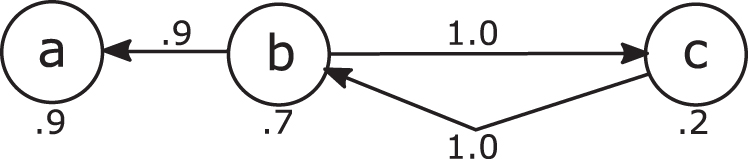
The PrAAF 〈A, P A , D, P D 〉
□
An interpretation for a PrAAF
Observe that the probabilities of the possible worlds sum up to 1. □
The probability that an argument a is credulously (resp. skeptically) acceptable according to a given semantics sem is defined as the sum of the probabilities of the possible worlds w for which a is credulously (resp. skeptically) acceptable according to sem, i.e., accC(w, sem, a) =
The following example shows usages of this definition.
Obviously, computing
In this section we characterize the complexity of
Upper bound
We first prove the statement for sem = semad. First observe that M nondeterministically guesses a subset of arguments in A and defeats in D so that each leaf of the resulting computation tree is a possible world At each leaf, let w be the guessed world, and I (w) its probability, the computation tree is then split again d · I (w) times to reflect the probability of the guessed world (for each Finally, M checks in polynomial time if a is an acceptable argument in the world w w.r.t. the admissible semantics.
Thus, the number of accepting paths of M is
To prove the statement for sem ∈ {
Specifically, for sem ∈ {
Therefore, since
Lower bound
To prove that
We define the PrAAF associated to φ A = {a, c1, …, c
k
, x1, …, x
n
}; D = {(c
i
, a) | i ∈ [1 . . k]} ⋃ (C
h
=X
i
∨X
j
)∈φ {(x
i
, c
h
) , (x
j
, c
h
)}; P
A
(a) =1.0, ∀i ∈ [1 . . k] P
A
(c
i
) =1.0, and P
D
(δ) =1.0 for each δ ∈ D. A
w
= A \ {x
i
| i ∈ [1 . . n] ∧ γ (x
i
) = D
w
= D \ {(x
i
, c
j
) | i ∈ [1 . . n] ∧ j ∈ [1 . . k] ∧ γ (x
i
) = false});
Moreover, let γ be a truth assignment for the propositional variables x1, …, x
n
. We define as
It is easy to see that given a possible world
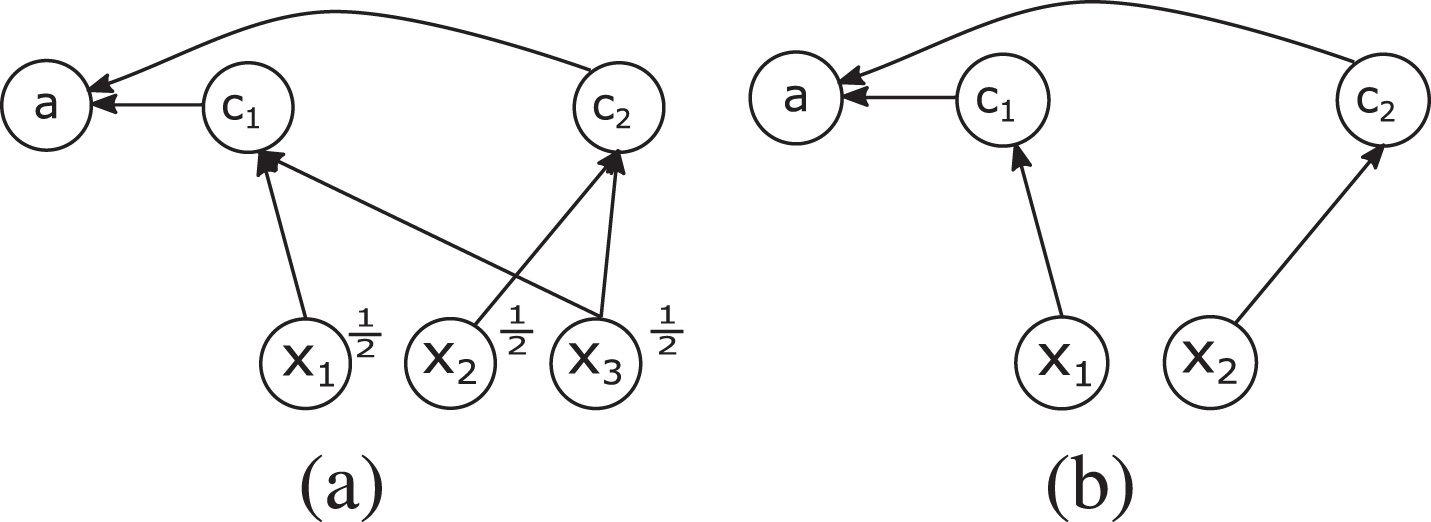
Graphical representation of the PrAAF
Reasoning by contradiction assume that there exists a truth assignment γ for X1, …, X
n
such that
Since x
i
l
∈ A
w
, and (x
i
l
, c
j
) ∈ D
w
,
as otherwise S would not be an admissible extension as there would be a c
j
attacking a which is not attacked by any argument in S.
Since γ (φ) is false it must be the case that there is a j ∈ [i . . k] such that C
j
= X
l
∨ X
h
and γ (X
l
) = γ (X
h
) =
We now prove that for each truth assignment γ for x1, …, x
n
the fact that γ (φ) is true implies that
Let S be the set of arguments {a} ∪ {x
i
| i ∈ [1 . . n] ∧ γ (X
i
) = true}. We show that S is an admissible extension reasoning by contradiction. Since S is not an admissible extension it must be the case that there is a j ∈ [1 . . k] such that C
j
= X
h
∨ X
l
and both x
h
∉ S and x
l
∉ S. Hence, by construction of S it holds that γ (X
h
) = γ (X
h
) = false which, in turn, implies that γ (φ) = false, thus contradicting that γ is a truth assignment γ for x1, …, x
n
such that γ (φ) is true. This implies that for each truth assignment γ for x1, …, x
n
the fact that γ (φ) is true implies that
Consider the set of arguments
Furthermore, since
Moreover, since
Finally, it is straightforward to see that
Hence, for possible world
Since for each possible world
Hence, as the above described reduction from the # P-hard problem # P2CNF to
For each truth assignment γ for X1, …, X
n
it holds that γ (φ) is true iff
We now prove that
We now prove that γ (φ) is true only if
The fact that S′ is the unique extension for
As regards the proof of the if part, since Lemma 1 ensure that if
Since for each possible world
Hence, as the above described reduction from the # P-hard problem # P2CNF to
The main state-of-the-art approaches for handling uncertainty in AAFs by relying on probability theory can be classified in two categories, based on the way they interpret the probabilities of the arguments: those adopting the classical constellations approach [8, 31] and those adopting the recent epistemic one [27, 32]. As regards the epistemic approach, probabilities and extensions have different semantics, compared with the constellations approach. Specifically, the probability of an argument represents the degree of belief in the argument (the higher the probability, the more the argument is believed), and a key concept is the “rational” probability distribution, that requires that if the belief in an argument is high, then the belief in the arguments attacked by it is low. In this approach, epistemic extensions are considered rather than Dung′s extensions, where an epistemic extension is the set of arguments that are believed to be true to some degree. The interested reader can find a more detailed comparative description of the two categories in [25].
We now focus our attention on the approaches classified as constellations, as the complexity characterization provided in our work refers to this class of PrAAFs. [13] addressed the modeling of jury-based dispute resolutions, and proposed a PrAAF where uncertainty is taken into account by specifying probability distribution functions (pdfs) over possible AAFs and showing how an instance of the proposed PrAAF can be obtained by specifying a probabilistic assumption-based argumentation framework (introduced by themselves). In the same spirit, [31] defined a PrAAF as a pdf over the set of possible AAFs, and introduced a probabilistic version of a fragment of the ASPIC framework [30] that can be used to instantiate the proposed PrAAF. [9] addresses the problem of computing all the subgraphs of an AAF in which an argument a belongs to the grounded extension, and [10] extends it by focusing on computing the probability that an argument a belongs to the grounded extension of a probabilistic abstract argumentation framework. In particular, [10] assumes to receive a joint probability distribution over the arguments as input. In fact, providing a joint probability distribution usually means specifying the probability values for all the possible correlations, i.e., P (a), P (a ∧ b), P (a ∧ b ∧ c) . . . and so on. This is analogous to providing the probabilities for all the possible AAFs (since defeats are considered as certain).
Differently from [13, 31] proposed a PrAAF where probabilities are directly associated with arguments and defeats, instead of being associated with possible AAFs, and independence among pairs of arguments/defeats is assumed. After claiming that computing the probability P sem (S) that a set S of arguments is an extension according to sem requires exponential time for every semantics, [29] proposed a Monte-Carlo simulation approach to approximate P sem (S). [8, 19] build upon [29]: [8] characterizes different semantics from the approach of [29] in terms of probabilistic logic, as a first step in the direction of creating a uniform logical formalization for all the proposed AAFs of the literature, in order to understand and compare the different approaches. [19], instead, showed that computing P sem (S) is actually tractable for the admissible and stable semantics, but it is FP#P-complete for other semantics, including complete, grounded, preferred and ideal-set. Furthermore, [20] proposed a Monte-Carlo approach to efficiently estimate P sem (S) based on the polynomiality results of [19]. In [29], as well as in [13] and [31], P sem (S) is defined as the sum of the probabilities of the possible AAFs where S is an extension according to semantics sem.
In the above-cited works, probability theory is recognized as a fundamental tool to model uncertainty. However, a deeper understanding of the role of probability theory in abstract argumentation was developed only later in [24, 25], where the justification and the premise perspectives of probabilities of arguments are introduced. According to the former perspective the probability of an argument indicates the probability that it is justified in appearing in the argumentation system. In contrast, the premise perspective views the probability of an argument as the probability that the argument is true based on the degrees to which the premises supporting the argument are believed to be true. Starting from these perspectives, in [25], a formal framework showing the connection among argumentation theory, classical logic, and probability theory was investigated. Furthermore, qualification of attacks is addressed in [26], where an investigation of the meaning of the uncertainty concerning defeats in probabilistic abstract argumentation is provided.
The computational complexity of computing extensions has been thoroughly investigated for classical AAFs [3, 23] with respect to several semantics (a comprehensive overview of argumentation semantics can be found in [1]). In particular, [16] presents a number of results on the complexity of some decision questions for semi-stable semantics, while [14] focuses on ideal semantics; complexity results for preferred semantics can be found in [17].
Complexity results about skeptical and credulous acceptance under admissible, complete, grounded, stable and preferred semantics have been provided in [6, 15], while [14] characterizes the complexity of skeptical and credulous acceptance under ideal and ideal-set.
Conclusion and future work
Focusing on the constellations approach with independence, as proposed in [29], in this paper we characterized the complexity of
Footnotes
Assigning probability equal to 0 to arguments/defeats is useless.