



Abstract
Weighted knowledge bases for description logics with typicality provide a logical interpretation of MultiLayer Perceptrons, based on a “concept-wise” multi-preferential semantics. On the one hand, in the finitely many-valued case, Answer Set Programming (ASP) has been shown to be suitable for addressing defeasible reasoning from weighted knowledge bases for the boolean fragment of
Keywords
Introduction
Preferential description logics have been studied in the last decades to deal with inheritance with exceptions in ontologies, based on the idea of extending the language of Description Logics (DLs) [9, 53], allowing for non-strict forms of inclusions, called typicality or defeasible inclusions, of the form
A (conditional) knowledge base (KB) comprising typicality inclusions enables defeasible reasoning, as in fact the prototypical properties of concept C are not necessarily enforced on all individuals in C. For example, horses are normally tall, but atypical horses not being tall exist. Some control on the strength of the applicability of typicality inclusions (which, otherwise, may depend on specificity, as in the rational closure and in its refinements mentioned above) can be obtained by assigning them a rank, that is, a natural number as large as strong is the expressed property. The resulting ranked DL knowledge bases [44], which strongly relate to the ranked knowledge bases by Brewka (2004), are interpreted according to a concept-wise multi-preferential semantics, that is, by associating a preference relation to single concepts, so to identify the most typical instances of a concept. A finer control can be obtained by assigning weights to typicality inclusions, hence obtaining weighted DL knowledge bases [3, 45], where the weight w in a weighted typicality inclusion (
Weighted knowledge bases, under a fuzzy φ-coherent semantics, have been used to provide a logical interpretation of MultiLayer Perceptrons (MLPs, [51]), which can be represented as weighted KBs, by encoding synaptic connections as weighted typicality inclusions [3, 45]. This approach allows for the verification of properties of the MultiLayer network in the form of graded typicality inclusions
The problem of deciding φ-coherent entailment from a weighted KB is decidable in the finitely-valued case, for the
The relationships between preferential and conditional approaches to non-monotonic reasoning and argumentation semantics are strong. Let us also mention, the work by Geffner and Pearl on Conditional Entailment, whose proof theory is defined in terms of “arguments” [40], and the work by Dung [34]. While for Dung-style argumentation semantics and for Abstract Dialectical Frameworks, the relationships with conditional reasoning have been deeply investigated [24, 67], this is not the case for gradual argumentation [5, 54]. Nevertheless, the strong similarities between a multilayer neural network and a weighted argumentation graph, have suggested that an argumentation graph can as well be regarded as a weighted KB (a set of weighted typicality inclusions), and that the semantics of weighted KBs with typicality, in their different variants, can give rise to new gradual argumentation semantics, called, respectively, coherent, faithful and φ-coherent semantics [42, 43]. This has suggested as well a conditional approach for defeasible reasoning over a weighted argumentation graph, which builds on a gradual semantics [1].
In this paper, we consider the argumentation semantics mentioned above in the finitely-valued case, with the aim of establishing a formal correspondence between weighted KBs in the boolean fragment of
Note that the relationships between weighted conditional KBs and MLPs easily extend to the proposed gradual semantics, which captures the stationary states of MLPs. This is in agreement with the previous results on the relationships between argumentation frameworks and neural networks by Garces, Gabbay and Lamb [33] and by Potyka [61].
In Section 2, we recall the definition of the boolean fragment of a many-valued DL with typicality and of weighted knowledge bases. In Section 3, we introduce the many-valued coherent, faithful and φ-coherent semantics for weighted argumentation graphs, and study their relationships. In Section 4 we relate the φ-coherent semantics to other gradual semantics in some well-known gradual argumentation frameworks. In Section 5 we develop a preferential interpretation of the gradual semantics introduced in Section 3. Section 6 aims to establish a mapping from a weighted argumentation graph G and a weighted KB with typicality. The mapping suggests an algorithm for defeasible reasoning over an argumentation graph under the φ-coherent semantics, in the finitely-valued case, and also provides a
Background:
with typicality and weighted knowledge bases
This section summarizes the required background on the weighted many-valued description logic with typicality [2, 46]
Let us consider the finitely-valued set of truth degrees
Let N
C
be a set of concept names and N
I
be a set of individual names. The set of
(i) A ∈ N C , ⊤ and ⊥ are concepts;
(ii) if C and D are concepts, then C ⊓ D, C ⊔ D, ¬ C are concepts.
Following the same notation as for fuzzy DLs in [58], an
A finitely many-valued interpretation (for short, interpretation) is a pair I = 〈Δ
I
, ·
I
〉, where Δ
I
is a non-empty domain and ·
I
is an interpretation function that assigns to each individual name a ∈ N
I
a value a
I
∈ Δ
I
in the domain, and to each concept name A ∈ N
C
a function
The interpretation function ·
I
is also extended to axioms as follows:
The definition of satisfiability of graded inclusions and assertions also follows [58].
I ⊨ C ⊑ D θl if (C ⊑ D)
I
θl; I ⊨ C (a) θl if C
I
(a
I
) θl; for a set S of axioms, I ⊨ S if I ⊨ E for all E ∈ S; I ⊨ K if
If I ⊨ Γ, we say that IsatisfiesΓ or that I is a model of Γ (for Γ being an axiom, a set of axioms, or a KB). An axiom E is entailed by K, written K ⊨ E, if I ⊨ E holds for all models I of K.
The typical elements of C are those belonging to C with the greatest positive truth degree. Formally, the interpretation of typicality concept
When (
Weighted typicality inclusions for a concept C have the form (
The defeasible TBox
(
(
(
i.e., a student normally has courses and is young, but she usually does not have a boss (negative weight). Accordingly, a young student who has courses and does not have a boss is more prototypical than a young student having courses and a boss.
The idea is that the most typical instances of concept Student are the ones satisfying the properties with a positive weight and falsifying the properties with negative weight. In the two valued case, one can evaluate how typical are two domain individuals john and tom as Students, by considering the weight of these individuals with respect of concept Student, i.e., by summing the (positive or negative) weights of the defeasible inclusions satisfied, resp., by john and tom, and comparing them. The higher the weight the more prototypical is the individual.
In many-valued DLs, each domain individual belongs to a concept to some degree. For instance, in a given interpretation I, john may be young with degree 0.7, i.e., Young I (john) =0.7. This is considered in defining the weight of a domain individual x with respect to a concept C.
Given an interpretation I = 〈Δ
I
, ·
I
〉, the weight of x ∈ Δ
I
wrt a distinguished concept C is given by
The higher the value of weight
C
(x), the more typical is x relative to the defeasible properties of C. Such a weight is expected to be related to the degree of membership of x in C, and this can be enforced based on a monotonically non-decreasing function
Besides the φ-coherent semantics, alternative, weaker semantics have been considered for weighted knowledge bases in the fuzzy case, namely, the coherent and the faithful semantics [3]. They require that the relative weights of domain individuals with respect to a concept C should agree with the preference ≺ C on individuals, and they can be formulated by replacing the φ-coherence condition (1) in the definition of φ-coherent model (Definition 3), respectively, with the coherence condition: x ≺ C yiff weight C (x) > weight C (y),
or with the (weaker) faithfulness condition: x ≺ C y ⇒ weight C (x) > weight C (y).
As usual in preferential semantics, one restricts to canonical models, which are large enough to contain all the relevant domain elements, i.e., a domain element for any possible valuation of concepts.
A query E of the form
According to the above definition, for every distinguished concept C, the degree of membership of typical C-elements is the same in all canonical φ-coherent models; it is the highest degree of membership among all φ-coherent models. Without loss of generality, we can as well restrict to a unique canonical model, as in defeasible
As MLPs are usually represented as a weighted graphs [51], whose nodes are units and whose edges are the synaptic connections between units with their weight, it is very tempting to extend the different semantics of weighted knowledge bases considered above, to weighted argumentation graphs.
Consider the simple case when only named concepts can occur in the defeasible TBox
If we regard the named concepts A
i
, A
j
, … ∈ N
C
occurring in the defeasible TBox
Let a weighted argumentation graph be a triple

Example weighted argumentation graph G.
This definition of weighted argumentation graph is similar to that of weighted argument system in [35] where, however, only positive weights are allowed, representing the strength of attacks. Here, a pair
Let
Let R- (A) =
We exploit such a notion of weight of an argument with respect to a labelling to define some argumentation semantics for a graph G, which adapts the semantics in [42, 43] to the domain of argument valuation
σ is a coherent many-valued labelling of G if, for all arguments σ is a faithful many-valued labelling of G if, for all arguments given a non-decreasing function
Observe that the notion of φ-coherent many-valued labelling of G is defined through a set of equations, as in Gabbay’s equational approach to argumentation networks [37]. The notions of coherent, faithful and φ-coherent many-valued labelling of a weighted argumentation graph G do not put constraints on the labelling of arguments without incoming edges, provided the constraints on the labellings of all other arguments can be satisfied, depending on the semantics considered. In particular, our definition of weighted argumentation graph above, does not consider a base score, (i.e., an initial valuation of arguments) as usual in argumentation frameworks. In essence, we want to consider all the possible initial valuations for the arguments without incoming edges. We refer to Section 4 for a comparison between the φ-coherent semantics and the frameworks of gradual semantics studied by Amgoud and Doder [5] and by Potyka [61].
It can be proven that the relationships between the faithful, the coherent and the φ-coherent semantics, stated for the fuzzy case in [42], also extend to the finitely-valued case. Let
Item (1) is obvious from the definitions of coherent and faithful many-valued labellings. For item (2), let us assume that φ is monotonically non-decreasing and that σ is φ-coherent many-valued labelling of G. Then, for all
For item (3), let us assume that φ is monotonically increasing and that σ is φ-coherent many-valued labelling of G. Then, for all
The “⇒” direction holds with the same proof as for item (2), as φ is monotonically non-decreasing. For the “⇐” direction, let
In the following, for the φ-coherent semantics, we will make the assumption that
Restricting the domain of argument valuation to the finite number of values in
In [42, 43] it has been shown that, for labellings with values in [0, 1], the notion of φ-coherent labelling relates to the framework of gradual semantics studied by Amgoud and Doder [5], by considering a slight extension of their gradual argumentation framework so to deal with both positive and negative weights, to capture the strength of supports and attacks. The notion of bipolar argumentation has been widely studied in the literature [6, 61]. In particular, an extension of the bipolar argumentation framework QBAFs by Baroni et al. [10] which includes the strength of attacks and supports has been developed and studied by Potyka [61].
Let us observe that, since MultiLayer Perceptrons (MLPs) can be mapped to weighted conditional knowledge bases [3], they can as well be seen as weighted argumentation graphs, with positive and negative weights, under the proposed semantics. In this view, φ-coherent many-valued labellings of a weighted argumentation graph correspond to stationary states [51] of the network, where each unit in the network is associated to an argument, synaptic connections (with their weights) correspond to attacks/supports, and the activation of units correspond to the values of the corresponding arguments in a many-valued labelling. This is in agreement with previous work on the relationship between argumentation frameworks and neural networks investigated by d’Avila Garcez, Gabbay and Lamb [33] and more recently by Potyka [61]. Note that cycles are admitted both in weighted KBs and in weighted argumentation graphs, so that the φ-coherent many-valued labellings of a weighted argumentation graph represent the stationary states of a recurrent network.
To clarify the relationships between our semantic definition and the above mentioned frameworks, we exploit a reformulation (developed in [42, 43]) of the φ-coherent semantics in the framework of gradual semantics studied by Amgoud and Doder [5], accounting for varied-strength attacks. Then, we will compare with the framework studied by Potyka [61], which also deals with positive and negative weights.
First, let us consider an initial valuation of arguments by introducing, as in [5], a function
Then, let us consider a notion of evaluation method which deals with positive and negative (real valued) weights, as considered in [43]. An evaluation method for a graph
f : [0, 1] × Range (g) → [0, 1]
Function h is intended to calculate the strength of an attack/support by aggregating the weight on the edge between two arguments with the strength of the attacker/supporter. Function g aggregates the strength of all attacks and supports to a given argument, and function f returns a value for an argument, given the strength of the argument and aggregated weight of its attacks and supports.
Following [5], a gradual semantics S is a function assigning to any graph
A gradual semantics S is based on an evaluation method M iff,
…,
where B1, …, B n are all arguments attacking or supporting A, i.e., R- (A) = {B1, …, B n } 2
We can now consider a specific evaluation method M
φ
= 〈 h
prod
, g
sum
, f
φ
〉 which is intended to capture the φ-coherent semantics (see [43]), where the functions h
prod
and g
sum
are defined as in [5], i.e., h
prod
(x, y) = x · y and
The evaluation method M φ = 〈 h prod , g sum , f φ 〉 provides a characterization of the φ-coherent many-valued labelling for an argumentation graph, in the following sense.
Vice-versa, if σ is a φ-coherent many-valued labelling for G, then there are a function σ0 and a gradual semantics S based on the evaluation method M
φ
= 〈 h
prod
, g
sum
, f
φ
〉 for the graph
Amgoud and Doder [5] study a large family of determinative and well-behaved evaluation models for weighted graphs in which attacks have positive weights in the interval [0, 1]. For weighted graph G with positive and negative weights, the evaluation method M φ cannot be guaranteed to be determinative (that is, we cannot guarantee that there is a unique semantics S of G based on M φ ), even under the conditions that φ is monotonically increasing and continuous. In general, there is not a unique semantics S based on M φ , as there is not a unique φ-coherent labelling for a weighted graph G, given a basic strength σ0. This is not surprising, considering that φ-coherent labellings of a graph correspond to stationary states (or equilibrium states) of a deep neural network [51].
In particular, unless the network is feedforward (and the corresponding graph is acyclic), stationary states cannot be uniquely determined by an iterative process from an initial labelling σ0. On the other hand, a semantics S based on M
φ
satisfies some of the properties considered in [5] and, specifically: Anonymity (the strength of an argument does not depend on its identity), Independence (the strength of an argument depends only on arguments that are related to it with a path), Directionality (the strength of an argument does not depend on argument’s outgoing arrows). Also Equivalence, Maximality and Reinforcement are satisfied, provided they are properly reformulated to deal with both positive and negative weights (i.e., by replacing Att (x) in the formulation in [5], with R- (x) so to consider both attackers and supporters of an argument x). With this reformulation, Equivalence (the strength of an argument depends only on the argument’s basic strength, the weights of its direct attacks/supports and the strengths of its direct attackers/supporters), Maximality (the strength of an argument is equal to the argument’s basic weight if the argument is not attacked/supported), hold, Reinforcement (the strength of an argument is sensitive to the quality of attackers/supporters) hold. A reformulation of Attack-sensitivity, with the meaning that, the higher the (real) weight π (B, A) of a pair
However, a semantics S based on M φ cannot be expected to satisfy the properties of Neutrality Weakening, Proportionality, Resilience and Counting (even if properly reformulated to deal with both positive and negative weights). In fact, function f φ completely disregards the initial score σ0 (A), for those arguments A having incoming edges in a graph G (even if their strength is equal to 0 or their weight is 0). In particular, it is not the same for an argument to have a support with weight 0 or no support or attack at all: Neutrality does not hold.
The work by Potyka [61] considers a quantitative bipolar argumentation frameworks (QBAFs) similar to [10] and exploits an influence function based on the logistic function to define an MLP-based semantics σ
MLP
for QBAFs. In particular, an edge-weighted QBAF is a quadruple
where φ
l
is the logistic function and
Potyka in [61] studies convergence conditions both in the discrete and in the continuous case, as well as the semantic properties of MLP-based semantics, by analyzing the properties that hold at the fixed-point of u MLP . It is proven that all properties proposed in [7] are satisfied. As we have seen above, our semantics based on φ-coherent models fails to satisfy some of the properties in [5] (which extend the properties in [7] to account for weights of attacks): the strength of an argument is insensitive to the argument’s base score, when the argument has at least an attacking or a supporting argument, while it coincides with the base score when the argument has no attacking or supporting arguments.
The next section introduces a notion of preferential interpretation of an argumentation graph G under an argumentation semantics. Section 6 establishes a mapping between the φ-coherent semantics of a weighted argumentation graph and the φ-coherent semantics of the corresponding weighted knowledge base.
A preferential interpretation of a weighted argumentation graph under the φ-coherent semantics
The strong relations between the notions of coherent, faithful and φ-coherent labellings of a gradual argumentation graph and the corresponding semantics of weighted conditional knowledge bases have suggested an approach for defeasible reasoning over a weighted argumentation graph [42, 43] which builds on the φ-coherent semantics of the argumentation graph.
This approach has been generalized in [1] to develop a preferential interpretation of an argumentation graph with respect to an arbitrary gradual semantics, provided the semantics satisfies the assumption that the domain of argument interpretation is equipped with a preorder relation (an assumption also considered by Baroni, Rago and Toni [10, 11] in their definition of a Quantitative Bipolar Argumentation Framework, QBAF). This provides a general approach for the verification of conditional properties of an argumentation graph, under a gradual semantics, based on the preferential interpretation that can be constructed from the labellings of the graph in that semantics.
Here we restrict to weighted graphs and to the φ-coherent semantics introduced in Section 3, with the aim of extending the proof methods for conditional reasoning from weighted KBs to the verification of graded conditionals over a weighted argumentation graph, as well as identifying the complexity of the problem and developing translations from weighted KBs to weighted argumentation graphs, and vice-versa.
In the following, we introduce a propositional language to represent boolean combination of arguments and a many-valued semantics for it over the domain
The preferential semantics relies on the argumentation semantics of a graph G (as the ones introduced in Section 3), to provide an interpretation built from the many-valued labellings of G in that semantics. Such an interpretation is then used for the verification of properties concerning arguments in the graph G and, in particular, we will consider conditional properties.
Given an argumentation graph
Let ⊗, ⊕, ⊳ and ⊖ be the truth degree functions in the truth degree set
A many-valued labelling
σ (α ∧ β) = σ (α) ⊗ σ (β), σ (α ∨ β) = σ (α) ⊕ σ (β), σ (α → β) = σ (α) ⊳ σ (β), and σ (¬ α) = ⊖ σ (α). Based on the choice of the combination functions, a labelling σ uniquely assigns a truth degree to any formula of
The semantics of an argumentation graph G is then (abstractly) identified by a pair
Preferences with respect to arguments
Given a semantics
Relation σ < α σ′ means that labelling σ is preferred to labelling σ′ with respect to the boolean combination of arguments α; that is, σ represents a situation more plausible than σ′ for argument α to hold.
The preference relation < α is a strict modular partial order relation on Σ.
For instance, σ = (1, 4/5, 0, 1, 1/5, 1) is preferred to all other labellings with respect to < A 6 , being the only one with σ (A6) =1.
Under Gödel logic with standard involutive negation, for G in Fig. 1, with n = 5, the boolean combination of arguments A1 ∧ A2 ∧ ¬ A3 has 4 maximally preferred labellings, with σ (A1 ∧ A2 ∧ ¬ A3) =4/5.
When the truth value set is [0, 1], the set Σ of many-valued labellings of a graph in the faithful, coherent, φ-coherent argumentation semantics may be infinite, and the preference relations <
α
are not guaranteed to be well-founded, as there may be infinitely-descending chains of labellings. This is not the case when
Let us define the preferential interpretation of a graph with respect to the set of many-valued labellings determined by its semantics.
We have made explicit the preference relations < α on the set of labellings Σ of the graph, for boolean combinations of arguments α, although such preferences are induced by the labellings in Σ.
Language
The interpretation of a typicality formula
When σ (
Graded implications
Given a preferential interpretation I of a weighted argumentation graph, we can define the satisfiability in I of a graded implication, having form α → β ≥ l or α → β ≤ u, with l and u in
We can now define the satisfiability of a graded implication in an interpretation I.
On the other hand, for instance, the strict implication A6 → A1 ∧ A2 ≥ 1/5 does not hold in I.
Notice that the valuation of a graded implication (e.g., α → β ≥ l) in a preferential interpretation I is two-valued, that is, either the graded implication is satisfied in I (i.e., I ⊨ α → β ≥ l) or it is not (i.e., Inotmodelsα → β ≥ l). Hence, it is natural to consider boolean combinations of graded implications, such as
(
((
by defining their satisfiability in an interpretation I in the obvious way, based on the semantics of classical propositional logic.
The preferential interpretation I of a graph G in a gradual semantics can be used to validate properties of interest of an argumentation graph, expressed by graded implications.
Next, we first define a mapping of argumentation graphs to weighted KBs under the φ-coherent semantics (Section 6). In Section 7, we use such a mapping to obtain an upper bound on the complexity of φ-coherent entailment (Definition 4) for
Mapping argumentation graphs to weighted KBs under the φ-coherent semantics
Let us establish a relationship between weighted argumentation graphs under the φ-coherent semantics for
Let us consider a weighted argumentation graph
By interpreting arguments
w ((A
j
, A
i
)) = w
ji
}
Note that, for any boolean combination of arguments α (e.g., α = A1 ∧ (A2 ∨ ¬ A3)) there is a correspondent boolean concept (e.g., C
α
= A1 ⊓ (A2 ⊔ ¬ A3)), obtained by replacing the connectives ∧, ∨ and ¬ with the DL operators ⊓, ⊔ and ¬. Let us consider the semantics of logic
Sketch. Given the interpretation
Let Δ
I
= Σ; for all x
j
∈ N
I
, for all A ∈ N
C
, A
I
(σ
j
) = σ
j
(A).
As usual in
Hence, by construction,
so that the preference relations
This holds as well for preferences <
α
with respect to boolean combinations of arguments α, as each boolean combination of arguments α corresponds to a boolean concept C
α
, and it is easy to prove that
From the fact that each labelling σ j ∈ Σ is a φ-coherent labelling of G, one can prove that the φ-coherence condition (1) is satisfied for each domain element in Δ I and for each concept C occurring on the left hand side of a weighted inclusion. Hence, the model I is a φ-coherent model of K G .
To prove that I is a canonical φ-coherent model of K
G
, one has to prove that, for any φ-coherent model J = (Δ
J
, ·
J
) of K
G
and domain element z ∈ Δ
J
, there must be an element y ∈ Δ
I
such that, for all concept names A
i
occurring in K
G
,
Thus, I is a canonical φ-coherent model of K
S
. It is easy to prove that, for each graded implication
Observe that the proof above does not depend on the choice of the truth degree set
We can exploit the correspondence established by Proposition 3 to provide a proof method for verifying the conditional properties of an argumentation graph G under the φ-coherent semantics. As we have seen from the proof of Proposition 3, the set Σ of all the φ-coherent many-valued labellings of G can be regarded as the domain of a canonical φ-coherent model of the knowledge base K
G
. This allows the entailment algorithms developed for weighted
This section is devoted to establishing the exact complexity to determine if a graded implication
In the following, we show that verifying whether a graded implication
Given the mapping from Section 6, and the
To complete the proof of Theorem 2, we provide a strict lower bound to the complexity of entailment.
In the following, we prove the above claim by providing a reduction from the problem
We let the set of arguments
In the following σ denotes any φ-coherent labelling for G. Our construction comprises Gadgets used in the reduction from node for each x ∈ vars (Γ), nodes A
x
, A¬x and arcs A
x
for each i = 1 . . n, node C
i
and arc ⊤ node Sat and arc node Even0 and arc ⊤ nodes Even
i
, Eveni,1, Eveni,2 and the following groups of arcs: ⊤ ⊤ ⊤ 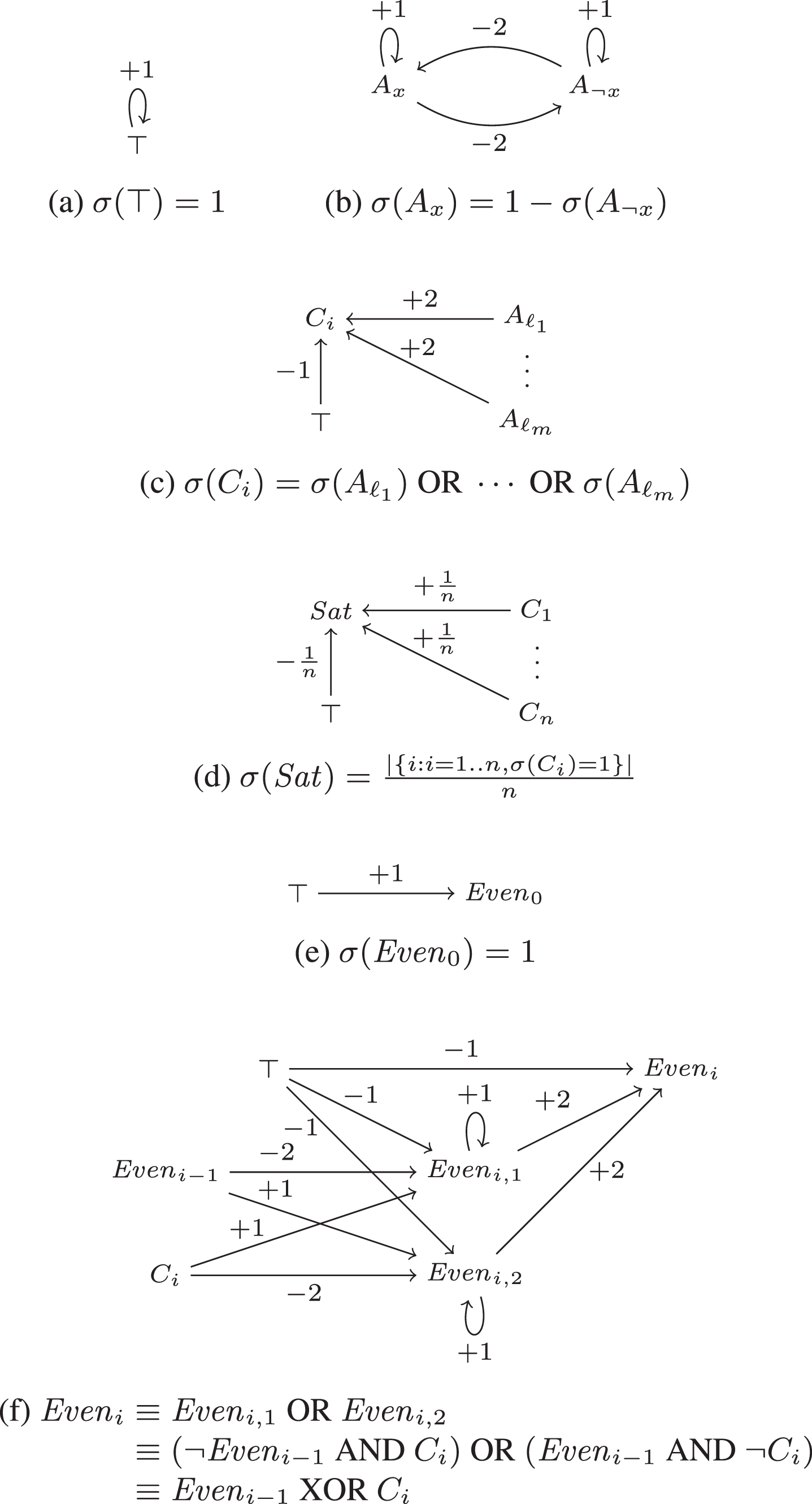
Essentially, the above construction enforces a crisp valuation for vars (Γ), so that each φ-coherent labelling σ is one-to-one with a boolean assignment I
σ
= {x ↦ σ (A
x
) ∣ x ∈ vars (Γ)} for Γ. Moreover, σ (C
i
) = I
σ
(γ
i
) for all i = 1 . . n, and
All in all,
To complete the proof of Proposition 5, we show that the graded implication
An interesting question is whether a weighted knowledge base can be encoded into a weighted argumentation graph, under the φ-coherent semantics. In this section we show that, under some conditions, the answer is positive. Specifically, we describe an encoding of a KB for the case when ABox is empty, the function φ is the one used in Section 7 to prove the lower bound result, and the choice of combination functions is as in Łukasiewicz logic. We also assume that the DBox in the weighted knowledge base K does not contain occurrences of concept ⊥ on the left hand side of weighted inclusions.
First, let us consider the simpler case when the TBox is empty, and no complex concept is contained in the DBox
Let
The following correspondence can be easily proven.
Note that a formula α C is obtained from a concept C by replacing the operators ⊓ and ⊔ occurring in C with connectives ∧ and ∨. The correspondence above does not depend on the choice of the function φ.
We aim at generalizing the result above to the case when the DBox may contain occurrences of complex concepts and TBox is a set of strict graded inclusions C ⊑ Dθl (we still assume the ABox is empty). To this purpose we show that: (a) we can replace the complex concepts in the DBox with new atomic concepts by adding some new TBox axioms; (b) we can encode the resulting TBox into the DBox. For the encoding in step (b), we choose a specific function φ, namely, we let
For step (a), let
Let us call
For step (b), we start from the knowledge base
As we have assumed that TBox
Let us consider an
We encode each inclusion axiom C ⊑ D θ l occurring in
First we show that we can represent any boolean combination of concepts, based on Łukasiewicz t-norm, s-norm, implication and negation function, where a ⊗ b = max {a + b − 1, 0}, a ⊕ b = min {a + b, 1}, a ⊳ b = min {1 − a + b, 1} and ⊖a = 1 − a. For each boolean combination of concepts C occurring in
For each complex concept occurring in the TBox, we add a set of defeasible inclusions in the DBox, as follows: We represent intersection B1 ⊓ B2 by introducing a new concept name AB1⊗B2, and the following weighted inclusions in
We represent the union B1 ⊔ B2 by introducing a new concept name AB1⊕B2, and the following weighted inclusions in
We represent the complement ¬B by introducing a new concept name A⊖B, and the following weighted inclusions in
To enforce the inclusion B1 ⊑ B2 we introduce a new concept name AB1⊳B2, and the following weighted inclusions in
The weighted axioms above enforce a φ-coherent interpretation to satisfy the following conditions in
Any boolean concept C can then be represented by a concept name A C , and the typicality inclusions above allow to define the interpretation of C, based on the interpretation of concept names occurring in C according on the meaning of combination functions.
Let us consider an inclusion axiom C ⊑ D ≥ l (the other cases for θ are similar). It requires that, for all domain individuals x, C
I
(x) ⊳ D
I
(x) ≥ l. As in an interpretation I it holds that
First we introduce a concept name A
l
whose interpretation is
The value of the implication
Hence, one can require that C
I
(x) ⊳ D
I
(x) ≥ l for all elements x, by requiring that, for all domain elements x,
For any given x, if
Observe that in step (b) the encoding of the typicality inclusions C ⊑ D ≥ l only introduces in the DBox weighed inclusions over named concepts.
After steps (a) and (b), The resulting weighted knowledge base
In the encoding we have taken a specific choice of the function φ and combination functions. Whether the encoding can be extended to other choices of function φ and combination functions is a matter of further investigation.
A weighted argumentation graph G could be enriched with a set of strict graded implications of the form α → β θl (with α and β boolean combinations of arguments), so to filter out some of the labellings (i.e., those that do not satisfy the graded implications) in a similar way as done in weighted knowledge bases with TBox axioms. However, based on the mapping in this section, strict graded implications could be encoded in the weighted graph itself.
Implementation and empirical assessment
As a consequence of the mapping of a weighted argumentation graph into a weighted KB in Section 6, on the one hand the model checking approach developed in [12] for weighted knowledge bases with finitely-many values can be extended to the argumentation semantics with truth degree domain
Therefore, we extended the
Implementation
The

Base encoding expanded with weight constraints enforcing φ-coherence, with θ ∈ {≥ , ≤ , > , <}, θ> ∈ {> , ≥}, and θ< ∈ {< , ≤}.
Given an input graph
The @-term
Based on the mapping in section 6, the ASP-based system described in section 9.1 has been tested for synthetic argumentation graphs. The graphs were generated with a given number of nodes; arcs with random weights were generated between random nodes, up to a given number of “forward” arcs (from a node i to a node j > i) and “backward” arcs (from i to j < i). The proportion of backward arcs was chosen to be large enough in order to obtain graphs with loops, which constrain the number of φ-coherent labellings; but not too large, which would overconstrain the labellings, producing graphs with no φ-coherent labellings. The resulting number of labellings is related to the number of resulting “input” nodes, i.e., nodes with no incoming arcs, and the size of the domain
Figures 4–5 provide results on the largest graphs in the benchmark, with 60 nodes and about 300 support/attack arcs (270 forward arcs plus 27 backward ones), evaluated in a domain of argument valuations of size 5 and 10, with running times on an Intel Xeon 5520, 2.26 GHz.
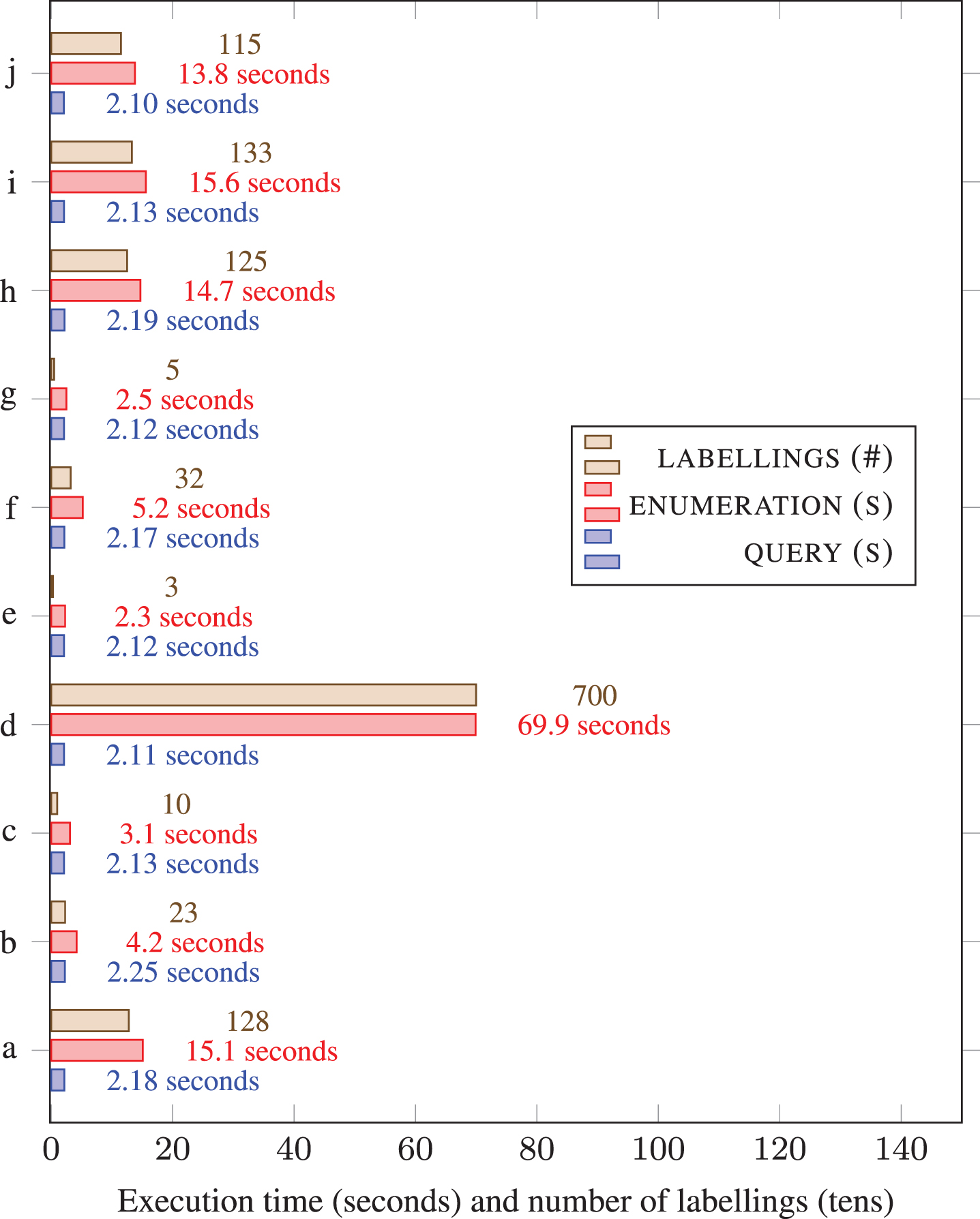
Results for domain of argument valuation

Results for the same graphs and queries in Fig. 4 using as domain of argument valuation
There are large variations in the number of labellings (3–700 and 4–12002 resp.) and the time for enumerating them (2.3–69.9 s, 2–1255 s, i.e., around 7–10 solutions per second). In spite of that, graded conditionals can be verified in much shorter times, with very small variations (in the range 2.10–2.25 s in one case, 2.02–2.28 s in the other one).
This also holds for different sets of graphs (with 20 nodes and 30+3 arcs; 40 nodes and 120+12 arcs) where, for some of them, there are too many labellings for enumerating them within a timeout of 30 minutes; running times for evaluating graded conditionals are however always in the range 0.7–1.5 seconds.
Defeasible reasoning over weighted KBs with typicality is a computationally intensive task, that has been previously addressed for logic
The work in this paper aims at extending the proposed approach for reasoning about some gradual argumentation semantics, namely, the coherent, faithful and φ-coherent semantics, first proposed in the fuzzy case [42] and in the finite many-valued case [1], stemming from the strong similarity between weighted knowledge bases and weighted argumentation graphs.
In this paper we establish relationships and mappings between the φ-coherent semantics of weighted KBs with typicality and the respective semantics of a weighted argumentation graph, by further proposing an approach for defeasible reasoning over a weighted argumentation graph, building on the gradual semantics.
We show that a weighted argumentation graph can be mapped to a weighted knowledge base with empty ABox and TBox. The many-valued labellings of the argumentation graph give rise to a preferential interpretation over which graded typicality implication can be verified. The mapping suggests that simplified versions of the ASP encodings proposed for weighted KBs can be adopted for verifying the satisfiability of such graded implications over the argumentation graph, and also provides a
Our approach for defeasible reasoning over weighted argumentation graphs has been suggested by the strong relationships between weighted argumentation graphs and neural networks (namely, multilayer networks for acyclic argumentation graphs, and recurrent networks for argumentation graphs with cycles). In this regard, our approach is inline with the work by Garcez, et al. [33] and by Potyka [61].
The work by Garcez, et al. [33] combines value-based argumentation frameworks [13] and neural-symbolic learning systems by providing a translation from argumentation networks to neural networks with 3 layers (input, output layer and one hidden layer). This enables the accrual of arguments through learning as well as the parallel computation of arguments.
The work by Potyka [61] considers a quantitative bipolar argumentation frameworks (QBAFs) similar to [10] and exploits an influence function based on the logistic function to define an MLP-based semantics σ MLP for a QBAF. As we have seen in Section 4, our semantics based on φ-coherent models fails to satisfy some of the properties studied in [5] and in [61].
Let us further consider Ranking-based semantics for argumentation frameworks [8, 19] and Fuzzy Argumentation Frameworks by Jenssen et al. [54].
A ranking-based semantics for argumentation frameworks [8, 19], transforms any argumentation graph into a ranking on its set of arguments. In such frameworks a ranking relation on arguments is a total and transitive binary relation ⪯, where a ⪯ b means that argument b is more acceptable then argument a.
Note that the degree of argument in a many-valued labelling σ induces a ranking relation on arguments, which is used in the definition of the coherent and faithful semantics (see Definition 5). In our approach, we also consider preference relations in Section 5, to define the preferential semantics of the conditional logic. However, these are preferences between many-valued labellings (that is, many-valued valuations).
Unlike the Fuzzy Argumentation Frameworks by Jenssen et al. [54], where an attack relation is a fuzzy binary relation over the set of arguments, here we have considered real-valued (positive or negative) weights associated to pairs of arguments. This makes the computation of the strength of an argument in our semantics more similar (although not equivalent) to [61].
In general, unlike all the frameworks mentioned above, our approach aims at verifying conditional properties of a weighted argumentation graph, and it is based on a preferential conditional semantics, which builds on the gradual argumentation semantics and exploits a notion of typicality in the formalization of (graded) conditional properties. In this regard, it also relates to the fuzzy extension of rational closure by Casini and Straccia [28], but for being based on a many-valued multi-preferential semantics and on a different closure construction.
Our work also builds on the fuzzy and many-valued extensions of description logics, which have been widely studied in the literature [16, 64]. The finitely-valued case is also well studied for DLs [15, 38], and in this paper we have considered the boolean fragment
The semantics has strong relations with KLM preferential semantics [56] and with other preferential semantics exploiting weights, such as Kern-Isberner’s c-representations [55], where the weights of falsified conditionals represent penalty points, and the algebraic semi-qualitative approach by Weydert [66], exploiting ranking measures over a ranking algebra. The specificity of our many-valued approach is that we exploit a concept-wise multi-preferential semantics, in which preferences ≺ C are associated with the different concepts C. This also makes our formalism different from the one considered by Casini and Straccia [29], in their rational closure construction for fuzzy logic.
Concerning the relationships between argumentation semantics and conditional reasoning, Weydert [67] has proposed one of the first approaches for combining abstract argumentation with a conditional semantics. He has studied “how to interpret abstract argumentation frameworks by instantiating the arguments and characterizing the attacks with suitable sets of conditionals describing constraints over ranking models”. In doing this, he has exploited the JZ-evaluation semantics, which is based on system JZ [66]. Although in this paper we have focused on the coherent, faithful and φ-coherent semantics for weighted argumentation, our approach for conditional reasoning over an argumentation graph does not commit to a specific gradual semantics. As shown in [1], it aims at providing a preferential and conditional interpretation for a large class of gradual argumentation semantics, provided that the domain of argument interpretation is equipped with a preorder relation.
For Abstract Dialectical Frameworks (ADFs) [24], the correspondence between ADFs and Nonmonotonic Conditional Logics has been studied by Heynink et al. [52] with respect to the two-valued models, the stable, the preferred semantics and the grounded semantics of ADFs.
In [62] Ordinal Conditional Functions (OCFs) have been interpreted and formalized for Abstract Argumentation, by developing a framework that allows to rank sets of arguments with respect to their plausibility. An attack from argument a to argument b is interpreted as the conditional relationship, “if a is acceptable then b should not be acceptable". Based on this interpretation, an OCF inspired by System Z ranking function is defined. In this paper we focus on the gradual case, based on a many-valued logic.
While in this paper we have assessed our encoding approach for conditional reasoning over weighted argumentation graphs, in [3] acyclic weighted knowledge bases have been considered in the verification of conditional properties of some trained multilayer feedforward networks for the recognition of basic emotions. The co-existence of strict inclusions and defeasible weighted inclusions in weighted KBs allows for combining empirical knowledge with elicited knowledge for reasoning and for post-hoc verification. The possibility of encoding strict TBox axioms by a set of weighted inclusions, may suggest further alternative modes of combination. The interplay of different functions φ i which may be used for different units, is also a direction that can be considered for weighted argumentation graphs, as done for weighted knowledge bases [3], by associating different functions φ i to different arguments A i in the graph.
Footnotes
Acknowledgements
We thank the anonymous referees for their helpful comments and suggestions that helped to improve the paper. This work was partially supported by the INDAM-GNCS Project 2024 “LCXAI: Logica Computazionale per eXplainable Artificial Intelligence”. Mario Alviano was partially supported by Italian Ministry of University and Research (MUR) under PRIN project PRODE “Probabilistic declarative process mining” (CUP H53D23003420006), under PNRR projects FAIR “Future AI Research” (CUP H23C22000860006), Tech4You “Technologies for climate change adaptation and quality of life improvement” (CUP H23C22000370006), and SERICS “SEcurity and RIghts in the CyberSpace” (CUP H73C22000880001); by Italian Ministry of Health (MSAL) under POS projects CAL.HUB.RIA (CUP H53C22000800006) and RADIOAMICA (CUP H53C22000650006); by Italian Ministry of Enterprises and Made in Italy under project STROKE 5.0 (CUP B29J23000430005); by the LAIA lab (part of the SILA labs).

Note that α and β in a strict or a conditional implication are boolean combination of arguments, and cannot contain implications.