



Abstract
Energy harvesting is one of the most important technologies in green communication. Wireless systems usually have different traffic loads and available renewable energy, and thus we consider the energy cooperation technology to decrease renewable energy waste. In this paper, a flexible spectrum sharing scheme among multi-systems is proposed. To be specific, the wide-band spectrum is divided into several narrow band carriers. Each system can flexibly select these narrow carriers which are not needed to be adjacent, and different systems can share the same narrow band carriers, which can improve the spectrum efficiency. Then, the carrier-aggregation technology is adopted to aggregate these narrow band carriers into wide-band spectrum to support each wireless system. Furthermore, we study the energy cooperation among multi-systems to improve the renewable energy efficiency. Accordingly, the proposed model is formulated into a multi-objective mixed integer optimization problem. To solve it, simplex-dominance is presented to replace the Pareto-dominance in the established MOEA/D-M2M. The simplex-dominance can effectively improve the convergence performance by producing more selection pressure towards Pareto front. The Lagrangian dual method is also adopted to optimize the transmit power to eliminate the co-channel interference caused by the spectrum sharing. In final simulation, the comparison between the proposed joint renewable energy cooperation and spectrum sharing scheme and some benchmarks has been carried out. Experimental results prove that the proposed scheme can effectively improve the spectrum efficiency, and decrease the GHG emission. In addition, the MOEA/D-M2M based on simplex-diminance is compared with NSGA-II, and the results shows the effectiveness of the proposed algorithm.
Keywords
Introduction
With the exponential increases of wireless high-speed data traffic, the energy consumption of wireless networks has grown sharply. In this case, green communication with the goal of reducing energy consumption has drawn a lot of attention from the communications community in recent years. In green communication, renewable energy plays an increasingly important role in powering the communication systems [1, 2, 3, 4]. On the other hand, from the commercial point of view, more energy consumption means more cost, and energy cost constitutes a great portion of the total cost of wireless cellular networks. Thus, the operators of such networks are also motivated to power their system with renewable energy to reduce operational costs and greenhouse gases (GHGs).
The field of renewable energy harvesting (EH) has attracted significant attention in the past few years for the above reasons. However, due to the intermittency of renewable energy and the different traffic loads of wireless systems, the amount of renewable energy harvested by different systems is variable at any given moment. This will cause a significant energy waste since the amount of the energy collected by the low-load systems can be very large, while that of collected by the high-load systems can be small. One practical solution to mitigate the variability of renewable energy is to use capacity-limited and expensive batteries to temporarily store the energy for future use. However, it is far too much for just one system to manage the fluctuations. Based on this, an energy cooperation scheme is proposed for wireless cellular networks in which one system’s excessive energy can be shared with the other ones to improve renewable energy efficiency.
In addition to the energy, the scarcity of spectrum resources has become increasingly intense with the sharp increase of wireless terminals (e.g., smart phones, tablet computers, and wearable devices). Great effort has been made by the wireless communication industry to improve the utilization of the limited spectrum resources. Spectrum sharing technology is a promising technology for improving spectrum utilization efficiency [5, 6]. In spectrum sharing technology, different wireless systems can share the same spectrum resources to enhance the overall system throughput. The problem is that the spectrum sharing scheme can cause significant interference. Therefore, the transmit power of each system should be carefully optimized to eliminate the co-channel interference [7].
In fact, energy cooperation and spectrum sharing are not independent, but complementary. For example, we assume two wireless systems: the first has sufficient renewable energy and high traffic loads, and the second has light traffic loads and insufficient renewable energy to support the operation of the base station (BS) equipment. In this case, it is beneficial that the first one share part of the renewable energy with the second one, and the second one share part of its spectrum with the first one. Considering the energy and spectrum at the same time is important, but it is not a trivial problem.
In this paper, we propose a joint renewable energy cooperation and spectrum sharing scheme among multi-systems. To the best of our knowledge, this work is the first attempt to consider energy cooperation and spectrum sharing simultaneously. In the proposed scheme, each wireless system can draw (share) excessive energy from (to) other systems, which can enhance renewable energy efficiency. In the proposed energy cooperation scheme, each BS can also purchase the energy from the traditional grid because of the unstable supply of renewable energy. The systems can then increase the transmit power to maximize the throughput, which will increase the GHG emissions significantly. Thus, the throughput objective and GHG emission objective are conflicting. Therefore, the proposed scheme can be formulated as a multi-objective optimization problem, and the goal is to achieve a good tradeoff between the throughput and GHG emission. In addition to energy cooperation, we also propose a flexible spectrum sharing scheme among multi-systems to improve the spectrum efficiency based on carrier-aggregation technology. In the first scheme, we divide the wide-band spectrum into some narrow-band carriers. Each system can flexibly select the narrow-band carriers that are not needed to be adjacent, and different systems can share the same frequency bands with each other. Then, carrier-aggregation technology is adopted to aggregate these narrow-band carriers to support each wireless system.
Some previous researches aim to optimize thethroughput and GHG emission (power consumption) by combining them in a weighted sum, and then choose one signal objective optimization algorithm to solve the problem. In [17], a joint energy and spectrum cooperation scheme is proposed, and this scheme is modeled as a multi-objective optimization problem. Then, a weighted sum method is applied to combine the throughput and power consumption into one objective. Finally, the authors in [17] adopts the Lagrangian dual method to optimize the signal objective optimization problem. Although this method can optimize these conflicting objectives simultaneously, the main drawback is that a relative weight and a tradeoff should be predefined.
Fortunately, multi-objective optimization approaches
can overcome the aforementioned drawback ofweighted sum method since they treat objectives independently without assuming a tradeoff. Based on this, we propose an improved decomposition-based evolutionary multi-objective algorithm, in which a new dominance relation, called simplex-dominance, is presented to replace Pareto-dominance. The proposed simplex-dominance can effectively improve the convergence rate by expanding both the proportions of the dominant and dominated regions of one certain point in the objective space. Furthermore, we optimize the carrier assignment, energy procurement, and energy cooperation using the MOEA/D-M2M based on simplex-dominance (MOEA/D-M2M-S), while the transmit power of the systems is optimized by an algorithm based on the Lagrangian dual method. It is worth nothing that the proposed simplex dominance can also be applied to the many-objective optimization problems due to its increase of selection pressure.
The main contributions of this paper are summarized as follows:
We propose a joint energy cooperation and spectrum sharing scheme among multi-systems. To the best of our knowledge, this work is the first attempt to consider energy cooperation and spectrum sharing at the same time. We model the proposed energy cooperation and spectrum sharing problem as a multi-objective mixed-integer optimization problem. To solve it, we propose an improved MOEA/D-M2M to optimize the carrier assignment, energy cooperation, and energy procurement variables. In order to further enhance the performance of the algorithm, the transmit power is optimized by the Lagrangian dual method. The performance of the proposed joint energy cooperation and spectrum sharing scheme and the MOEA/D-M2M based on simplex dominance are verified by simulation. The numerical results show that the proposed joint energy cooperation and spectrum sharing scheme and the MOEA/D-M2M based on simplex dominance can significantly improve system throughput and decrease consumption of traditional energy.
The rest of the paper is organized as follows. Related works are introduced in Section 2, and the system model is described in Section 3. In Section 4, we analyze the formulated optimization problem. In Section 5, the MOEA/D-M2M based on simplex dominance is presented. In Section 6, simulation results are provided to evaluate the performance of the proposed algorithm. Finally, we conclude this paper in Section 7.
In this section, we intend to introduce the related works underlying energy cooperation, spectrum sharing, and the multi-objective evolutionary algorithm.
Energy harvesting and energy cooperation
EH technology makes it possible for wireless networks to reduce their dependence on traditional energy by using renewable energy. As a result, EH has become one of the core techniques for green communication, and has also become a research hotspot in recent years [8, 9]. Most of the studies on EH technology only consider the scenario in which the EH equipment is part of the BS. However, it is beneficial when terminals can also make use of renewable energy. In [9], a scenario in which the users schedule their individual transmissions according to the users’ statistical EH profiles was considered, and both the infinite-capacity-battery and finite-capacity-battery cases were studied. In addition to solar and wind energy, the energy harvested from ambient radio frequency signals has also attracted much attention [10]. In [10], the authors proposed a new wireless EH protocol for the underlying cognitive relay network. In the protocol, the secondary nodes can harvest energy from the primary network while sharing the licensed spectrum of the primary network. Wireless energy transmission can improve the flexibility of energy transmission compared to wire-line transmission. However, when the energy is transferred using wireless energy transfer technology, the wireless energy transfer link will cause significant interference in the wireless information transfer link. In [11] an algorithm was proposed to jointly optimize the subchannel allocation and the power allocation for both the wireless energy transfer link and the wireless information transfer link to decrease the interference between both links. Owing to finite-capacity batteries, EH technology has also been widely applied in sensor networks [12, 13, 14, 15, 16]. In [12], the energy costs of both sensing and transmission are considered for EH sensor networks, and two complementary delay metrics are proposed. Then, the authors of [12] analytically derived the statistics of these two metrics. For the management of renewable energy, future renewable energy estimation is necessary and important. The authors of [13] proposed an energy prediction algorithm that uses the light intensity of fluorescent lamps in an indoor environment. This algorithm can be used to accurately estimate the amount of energy that will be harvested by a solar panel using a weighted average for light intensity. In [14], a pro-energy prediction model was proposed that leveraged past energy observations, which can be used to accurately estimate future energy availability.
Owing to the intermittency of renewable energy and the different traffic loads of wireless systems, the harvested energy in some wireless systems may be excessive, and for other systems it may be insufficient, which leads to significant energy waste. To overcome this problem, an energy cooperation scheme was proposed, and has attracts much attention [17, 18, 19, 20, 21, 22, 23]. In most of the works focused on energy cooperation, energy cooperation is formulated as an optimization problem [18, 19]. In [18], energy cooperation is formulated as a linear program to minimize the amount of energy drawn from a conventional energy source. Finally, an online energy cooperation algorithm was proposed to solve the problem; specifically, the authors of [19] proposed an energy cooperation scheme in which a user wirelessly transmits a portion of its energy to another EH user. Then, a Lagrangian formulation and the resulting KKT optimality conditions are adopted to determine the energy management necessary to maximize the system throughput. Coordinated multi-point (CoMP) transmission can effectively mitigate the inter-cell interference by the cooperation among multi-cells. In [20], the energy cooperation scheme in the CoMP system was studied. Specifically, a practical CoMP system with clusters of multiple-antenna BSs, each powered by hybrid power supplies, was proposed. Meanwhile, in each cluster, all BSs share their individually harvested energy with each other for cooperative transmission. A similar scenario was also considered in [21], in which the authors proposed an energy trading scheme between the CoMP system with local renewable energy generation and the smart grid. Owing to the unevenness of the renewable energy supply and communication energy demand over distributed BSs, the authors of [21] proposed a joint energy trading management scheme for the cooperative BSs. Wireless transmission can also be applied in the energy cooperation scheme. To maximize the network throughput in the energy cooperation scheme, each wireless system expects to transfer its energy to another one as little as possible, and to draw the energy from other ones as much as possible. Therefore, the interests of each wireless system conflict with each other. [23] considers the green technique of wireless communication, and proposes an energy cooperation scheme in heterogeneous communication network.
Spectrum sharing
Spectrum sharing technology is a promising technology for improving the efficiency of the spectrum resource [5, 6, 7, 24, 25]. The authors of [6] proposed a novel best cooperative mechanism (BCM) for wireless energy harvesting and spectrum sharing in 5G networks. In the BCM, secondary users harvest energy from both ambient signals and a primary user’s signals. In addition, the secondary users can act as relays for primary users and harvest energy from the primary users’ signals simultaneously. In [6], the authors considered a cooperative spectrum sharing architecture in which the secondary user is assumed to be a cellular network. Finally, a novel fractional-frequency-reuse-based dynamic resource allocation algorithm for the secondary network was proposed. Cognitive radio is one of the most famous spectrum sharing techniques. In [7], a cognitive wireless powered communication network was proposed, which consists of a single hybrid access point with constant power supply and distributed wireless powered users. The cognitive network can share the same spectrum for its downlink wireless energy transfer and uplink wireless information transfer with an existing primary communication link, which will lead to interference among these links. To maximize the cognitive networks’ throughput, the transmit power is optimized under the constraints applied to protect the primary user transmission. In [23], the authors combined the advantages of EH and spectrum sharing, and considered EH-aided multiuser communication in spectrum sharing networks.
Recently, spectrum aggregation has attracted significant attention as one of the promising techniques for improving spectrum efficiency. A small-scale spectrum aggregation and sharing scheme was proposed in [26], in which an interference model was presented that takes into account the limitations of both transmitter and receiver frequency selectivity.
Sensor networks comprise the core technique of the coming Internet of Things and of the vehicle of networks. Spectrum sharing for sensor networks has been widely studied. A two-phase protocol for energy as well as spectrum harvesting along with information transmission was proposed in [27]. In the proposed scenario, a sensor node that acts as a decode-and-forward relay for the primary user will harvest energy from primary transmission and will use that harvested energy to assist the primary user in achieving the required rate of communication by transmitting its data to the destination.
The massive multiple-input multiple-output (MIMO)
technique, which equips hundreds or even thousands of antennas, has become a hot research topic due to its numerous potential advantages. There are also many works that consider spectrum sharing for massive MIMO systems [28, 29]. In [28], a new spatial spectrum-sharing strategy for massive MIMO was presented. The discrete Fourier transform was applied to obtain the terminals’ angular information to discriminate the cognitive radio terminals.
Multi-objective evolutionary algorithm
Multi-objective optimization problems (MOPs) exist widely in the real world [30, 31, 32, 33, 34, 35, 36, 37, 38, 39, 40, 41, 42, 43], and have become a hot research topic in the field of optimization theory. There are some challenges for the traditional optimization methods in solving MOPs, especially when the Pareto front of the MOP is not convex. Multi-objective evolutionary algorithm (MOEA) is one of the most powerful tools with which to solve a MOP [44]. NSGA-II [45] is one of the most famous MOEAs based on Pareto-dominance. In NSGA-II, the individuals are selected for the next-generation population according to Pareto-dominance. When two individuals are incomparable according to Pareto-dominance, the crowding distance is conducted to maintain the diversity. One of the most famous MOEAs based on decomposition is MOEA/D [46]. In MOEA/D, the original optimization is decomposed into some simple single-objective optimization subproblems, and each subproblem is optimized simultaneously.
Dominance relation plays an important role inMOEA’s solution sorting. Currently, the Pareto dominance and hypervolume indicator are popular dominance relation. Comparing with Pareto dominance, the hypervolume indicator can describe the good and bad degree of solutions more accurately through measuring the volume of the dominated portion of the objective space bounded from below by a reference point. In [47], the authors propose a progressive preference articulation mechanism within a multi-objective framework based on evolution strategy search and hypervolume indicator selection. The authors in [48] propose an evolutionary algorithm based on an evolution strategy framework, in which a novel selection mechanism making use of an adaptive grid to perform a local approximation of the hypervolume indicator is introduced. In our previous work [49], we propose a simplex dominance to improve the selection pressure.
Energy cooperation and spectrum sharing cellular networks.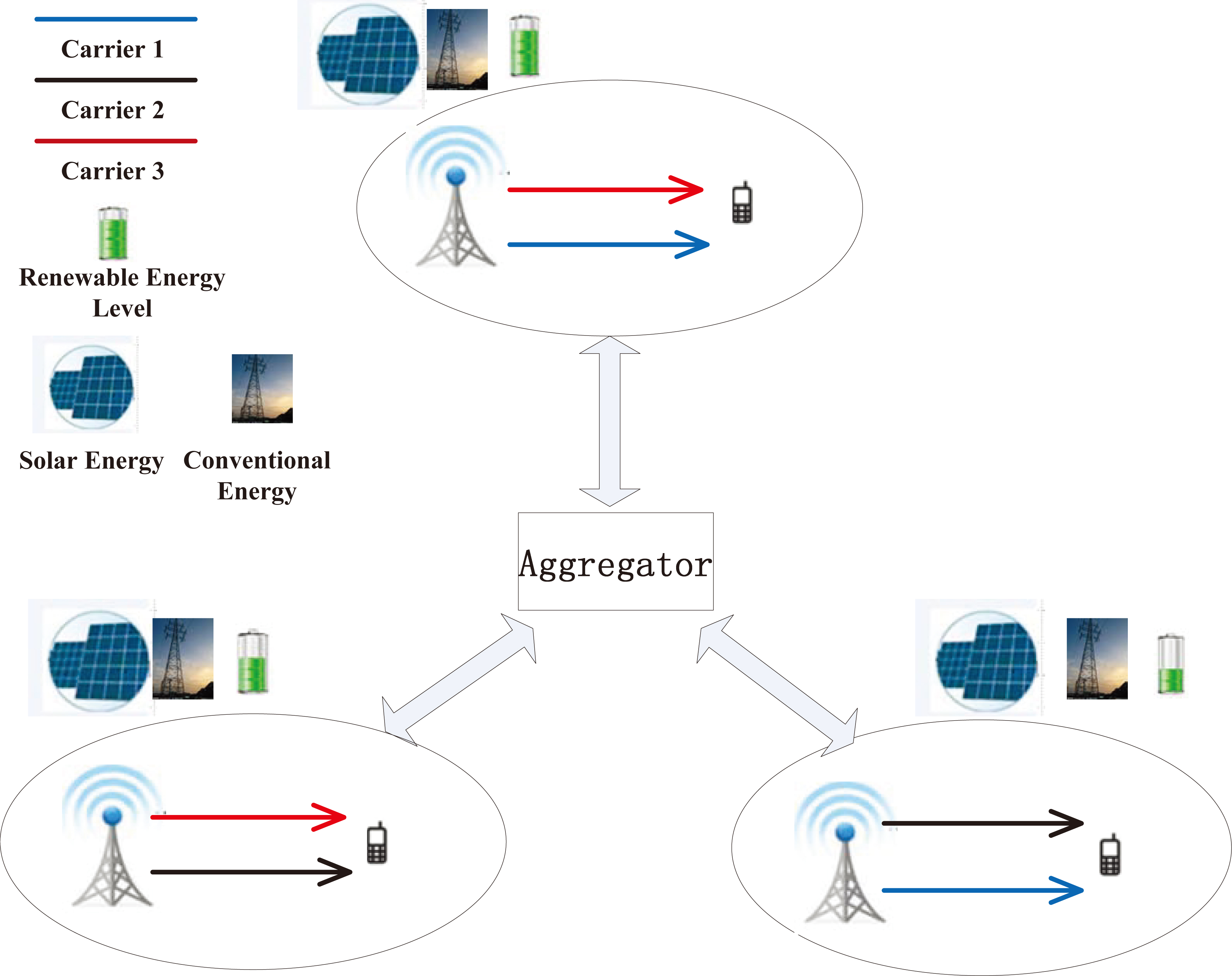
In this paper, we consider a renewable-energy-powered wireless cellular network with
The time-slotted model is considered in this paper. In each time slot, we assume that the EH rate is constant and that the EH rate in each time slot is independent. Indeed, the harvesting rate of both wind and solar energy can be seen as fixed in the window of seconds. Therefore, the length of the time slot is also set as the window of seconds. In particular, our analysis is performed in one time slot in the following.
To improve renewable energy and spectrum efficiency, we propose a joint energy cooperation and spectrum sharing scheme among multi-systems. Our objectives are to maximize the network throughput and minimize the GHG emissions at the same time. Here, we will give a detailed description of the proposed model, and will formulate the joint energy cooperation and spectrum sharing scheme as a multi-objective mixed-integer optimization problem.
Spectrum sharing
As mentioned, most of the previous works considering spectrum sharing only considered two systems, since the complexity of spectrum sharing increases significantly when the number of systems increases. In this paper, we propose a flexible spectrum sharing scheme among multi-systems based on carrier-aggregation technology. In the proposed scheme, we first divide the wide-band spectrum into
Network throughput
In each cell, we let a particle represent all the mobile terminals to simplify the problem. When the spectrum sharing scheme is performed, the mobile terminals will be interfered with by other BSs. The transmit rate of the th BS denoted by can be expressed as
where
Then, the total system throughput can be expressed as
In this paper, it is assumed that each BS can not only make use of the renewable energy, but also the energy purchased from the traditional grid, since the local renewable energy firm is capacity-limited and subject to an uncertain power supply due to the environmental changes. We also assume that the EH in each time slot is constant. To maximize the network throughput, the cellular system would expect to purchase the energy from the traditional grid as much as possible. However, to reduce the GHG emissions, the energy of the grid cannot be purchased without limitation. Therefore, an energy cooperation scheme is proposed to obtain a tradeoff between the network throughput and GHG emission.
First, BS
When BSs purchase energy from the grid, it will lead to the GHG emission. Here, we introduce the pollutant emission function. The pollutant emission function can be modeled into a function of energy procurement as follows [16]:
where
Then, the total GHG emission of the wireless networks can be obtained:
It can be seen that
In this paper, the objective is to improve the energy and spectrum efficiency. In order to do this, a joint energy cooperation and spectrum sharing scheme is proposed, so that the cellular system can make the best of the renewable energy. However, due to the limitation of the renewable energy supply, the cellular system should purchase the energy from the traditional grid, which will cause GHG emissions. Thus, we should carefully optimize the energy sharing amount, narrow carrier assignment, energy procurement, and transmit power to obtain a good tradeoff between network throughput and GHG emissions. The optimization problem can be formulated as follows:
where
The problem
Power allocation using lagrangian dual method
In the work, the carrier assignment, energy procurement and energy cooperation are optimized using the proposed MOEA/D-M2M-S. When these issues are fixed, it can be observed in problem
When the carrier assignment, energy procurement and energy cooperation are fixed, problem
It can be obtained that Problem
It can be seen that
is concave. Therefore, Eq. (13) is concave since it is the linear combination of some concave functions. Moreover, constraint Eq. (14) is a linear function. Hence, the above problem is a convex optimization problem with respect
where
Therefore, the corresponding dual function can be obtained:
Differentiating Eq. (4.1) with respect to
where
Then, the subgradient algorithm is used to optimize the dual function as follows:
MOEA/D-M2M is a current multi-objective optimization algorithm based on decomposition. In this paper, we propose an improved MOEA/D-M2M algorithm, in which a new dominance relation called sim- plex-dominance is presented. In the proposed simplex-dominance relation, both the proportions of the dominant and dominated regions of one certain point will be expanded, which can effectively improve the selection pressure of the population. Thus, simplex-dominance improves the convergence rate of the algorithm. In the following subsection, we introduce the framework of MOEA/D-M2M.
MOEA/D-M2M
Here, we introduce the framework of MOEA/D-M2M, and its details can be referred to in [44]. In MOEA/D-M2M, the original multi-objective optimization problem is decomposed into
for any
Simplex-dominance in the case with three points.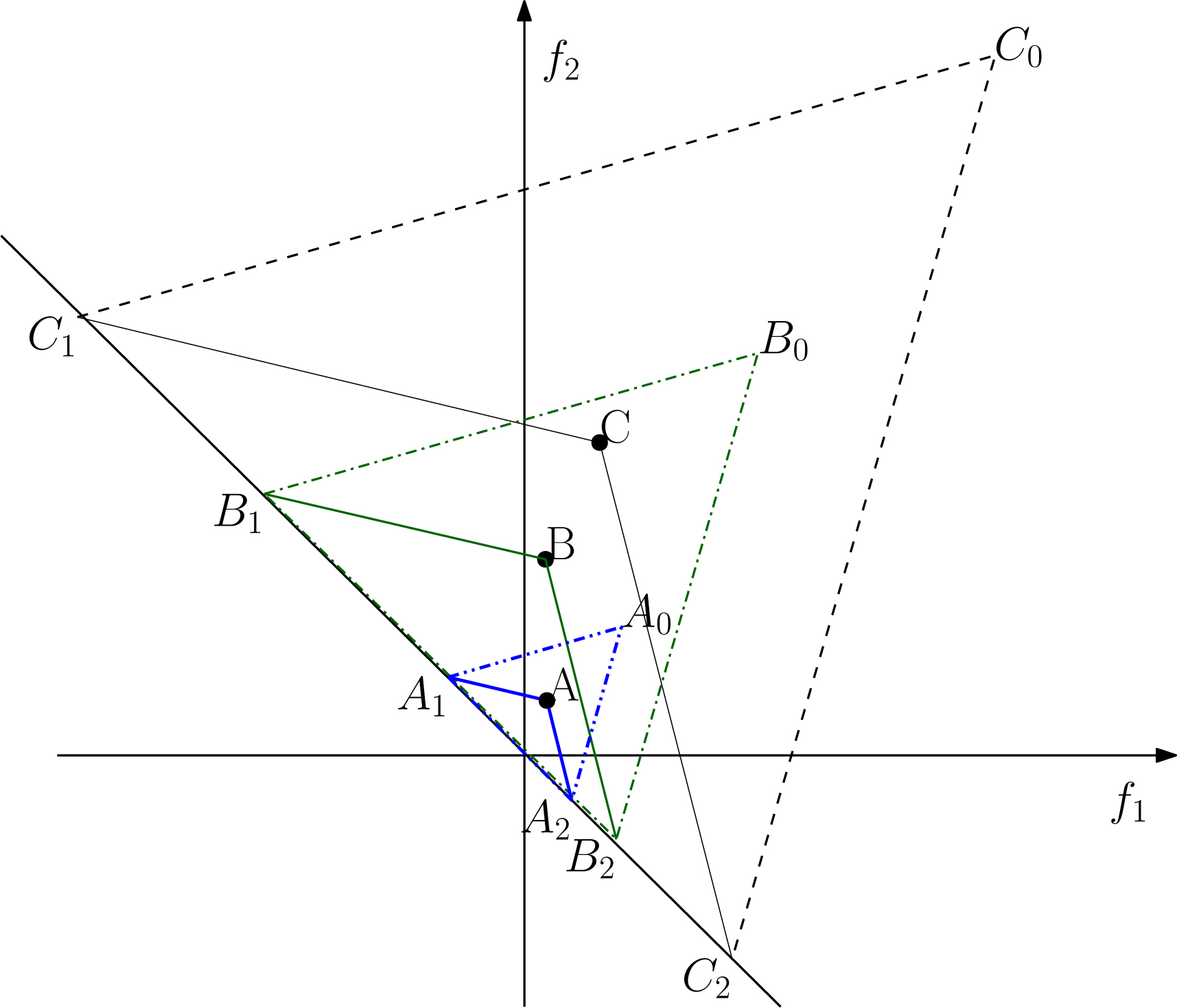
In the proposed improved MOEA/D-M2M, each subproblem can be solved by a MOEA based on the proposed simplex-dominance. Comparing with the Pareto-dominance, our proposed simplex-dominance can expand both the proportions of the dominant and dominated regions of one certain point in the objective space, which can enhance the selection pressure to improve the convergence rate. Here, we give the details of the simplex-dominance as follows.
Considering a multi-objective optimization problem with
Let
In the proposed simplex-dominance,
Considering any two distinct points
Here, we give the formulation of the simplex-dominance in detail. Indeed, as in the foregoing analysis, the intercept corresponding to the hyperplane passing through the points
From Fig. 2, it can be seen that these corresponding simplexes of the points in objective space are similar to each other. Therefore, it is only needed to study the intercept of one point, and another points’ intercepts can be easily obtained in a similar way. For simplicity, the point
Considering that the barycenter of the geometric object formed by the
that is, the
In the regular tetrahedron, 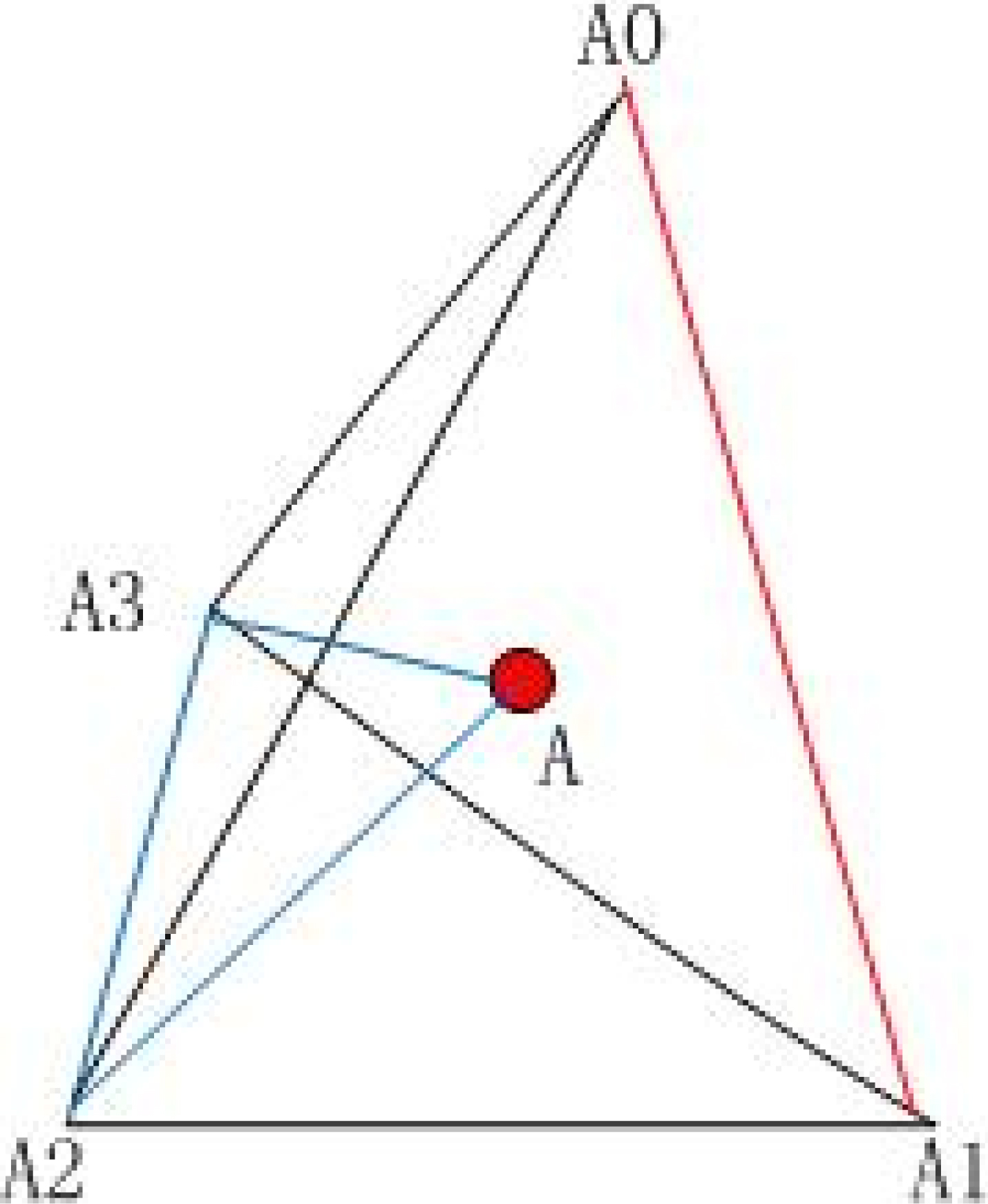
In addition, according to the Pythagorean theorem, we have
Note that simplex
Combining these equations, we obtain
Therefore, the
We can then easily obtain that
Similarly, for any point
Thus, the definition of simplex-dominance relation can be given as follows:
For any two distinct points
where
There are some good properties that are satisfied by the simplex-dominance.
First, the simplex-dominance satisfies with transitivity: if
Second. the dominant and the dominated areas of a point under the simplex-dominance relation are larger than that in the Pareto-dominance relation. This means that the new dominance relation is conducive to a better convergence of population. Figure 4 depicts the dominant and the dominated areas of a point
Indeed, from a geometric point of view, it is easy to obtain in simplex-dominance, that both the dominant and the dominated region proportions of one certain point are
Furthermore, it can be easilyproved that the simplex-dominance is consistent with Pareto-dominance. In other words, if
Furthermore, it can be easily proved that the simplex-
dominance is consistent with Pareto-dominance. In other words, if
The proposed algorithm works as described in Algorithm 1.
Experimental setup
Here, we demonstrate the effectiveness of the performance of our proposed joint energy cooperation and spectrum sharing scheme and the improved MOEA/D-M2M. In the numerical simulation, all
Description of simplex-dominance in two-dimensional space.
The total GHG emission vs the sum rates of the wireless network. 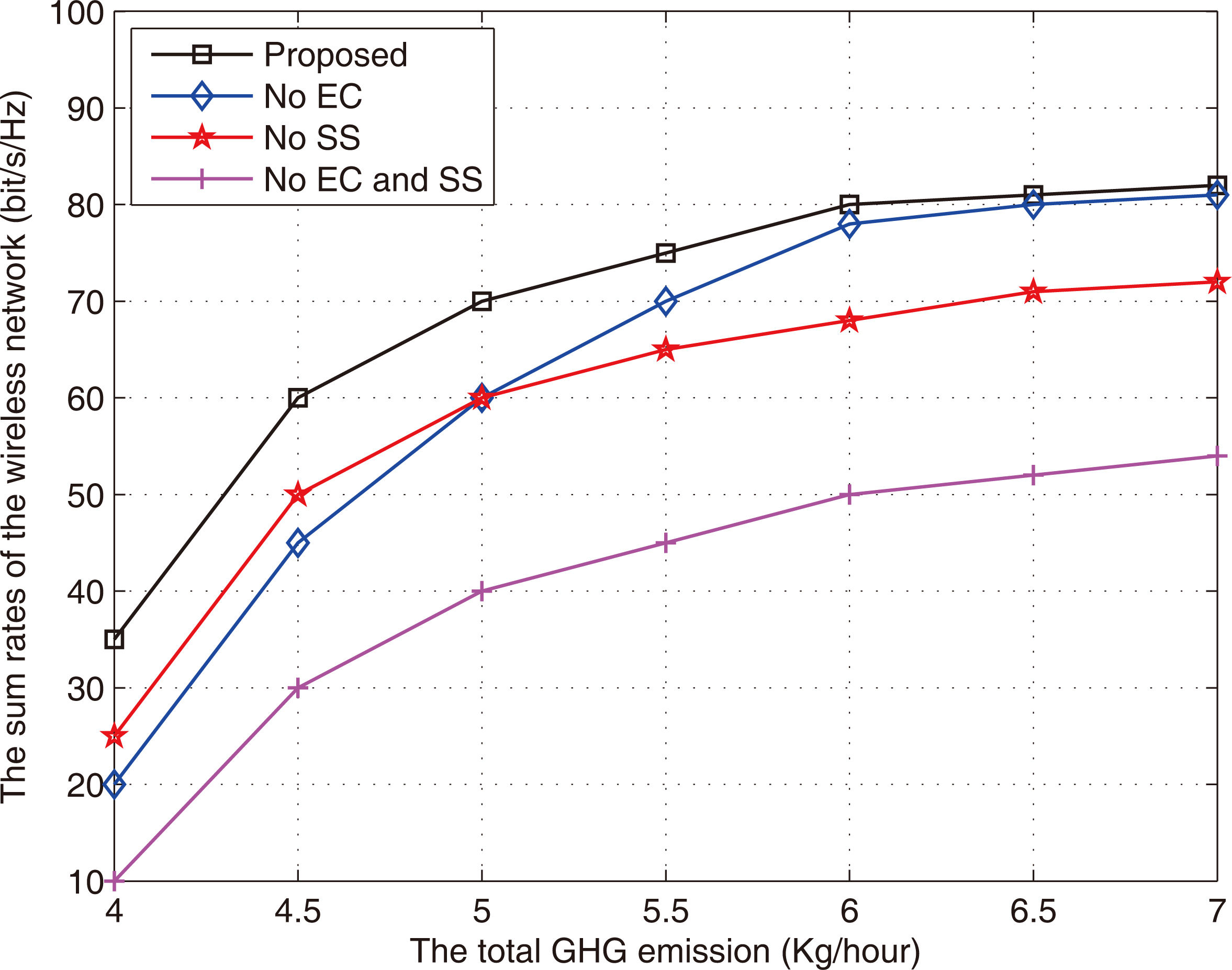
In this section, we compare the performance of the proposed MOEA/D-M2M-S with that of NSGA-II. We conduct the proposed algorithm with the number of the subproblems
Here, the advantages of the proposed energy cooperation and spectrum sharing scheme are evaluated by comparing it with some benchmarks. These benchmarks are as follows:
No energy cooperation: In this benchmark, there is no energy cooperation, and there is only the spectrum sharing scheme.
No spectrum sharing: In this benchmark, there is no spectrum sharing, and only energy cooperation.
No energy cooperation and spectrum sharing: In this benchmark, there is no spectrum sharing and the energy cooperation.
Figure 5 shows that the total system throughput obtained by the proposed algorithm compared with the aforementioned benchmarks. It can be seen from the figure that the total system throughput increases with increasing GHG emission, which demonstrates that the throughput objective and GHG emission objective are conflicting with each other. That is, more conventional energy should be purchased to improve the throughput, which results in more GHG emissions. It can also be observed that when the GHG emission is small, the curve slope is greater than that in the case with more GHG emissions. It can be explained that energy cooperation can efficiently improve renewable energy efficiency. From Fig. 5, we can also observe that the performance gap between the proposed scheme and the No Energy Cooperation becomes small when the GHG emission is greater than 6.8 kg/h. This result can be explained by the fact that when traditional energy is sufficient, the wireless cellular system can improve its throughput by procuring energy from the traditional grid. However, when the available traditional energy is constrained, the proposed energy cooperation scheme has obvious advantages in improving the renewable energy efficiency of the wireless networks. However, it can also be observed from Fig. 5 that, when the demand of traditional energy is high, the No Energy Cooperation case outperforms the No Spectrum Sharing case. This result illustrates that when the data traffic load is high, spectrum sharing exhibits better performance in improving the energy efficiency.
We next consider energy cooperation for the scenario with two BSs, where one harvests sufficient renewable energy and the other’s harvested energy is insufficient. Figure 6 plots the sum rates comparison between these two BSs. It can be seen that the sum-rates of these two BSs are conflicting, and the sum-rate of BS1 increases without the decrease of sum-rate of BS1 in the beginning of energy cooperation. This result illustrates the benefit of energy cooperation which can improve the renewable energy efficiency and decrease the renewable energy waste.
Conflict between BS1 and BS2 in energy cooperation case.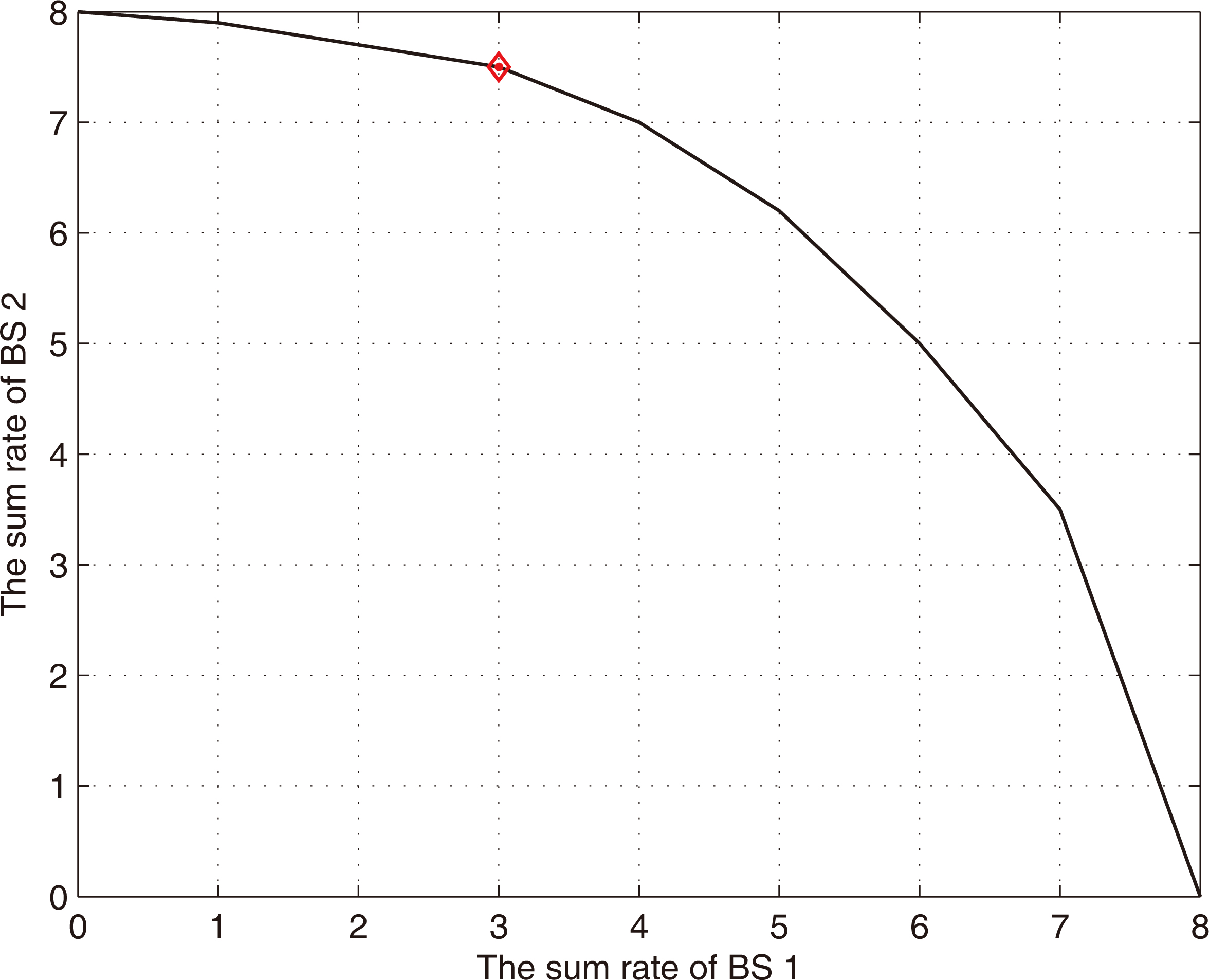
Sum rates of three BSs with one BS harvesting enough energy and the other two BSs harvesting insufficient energy. The red point denotes the no cooperation benchmark.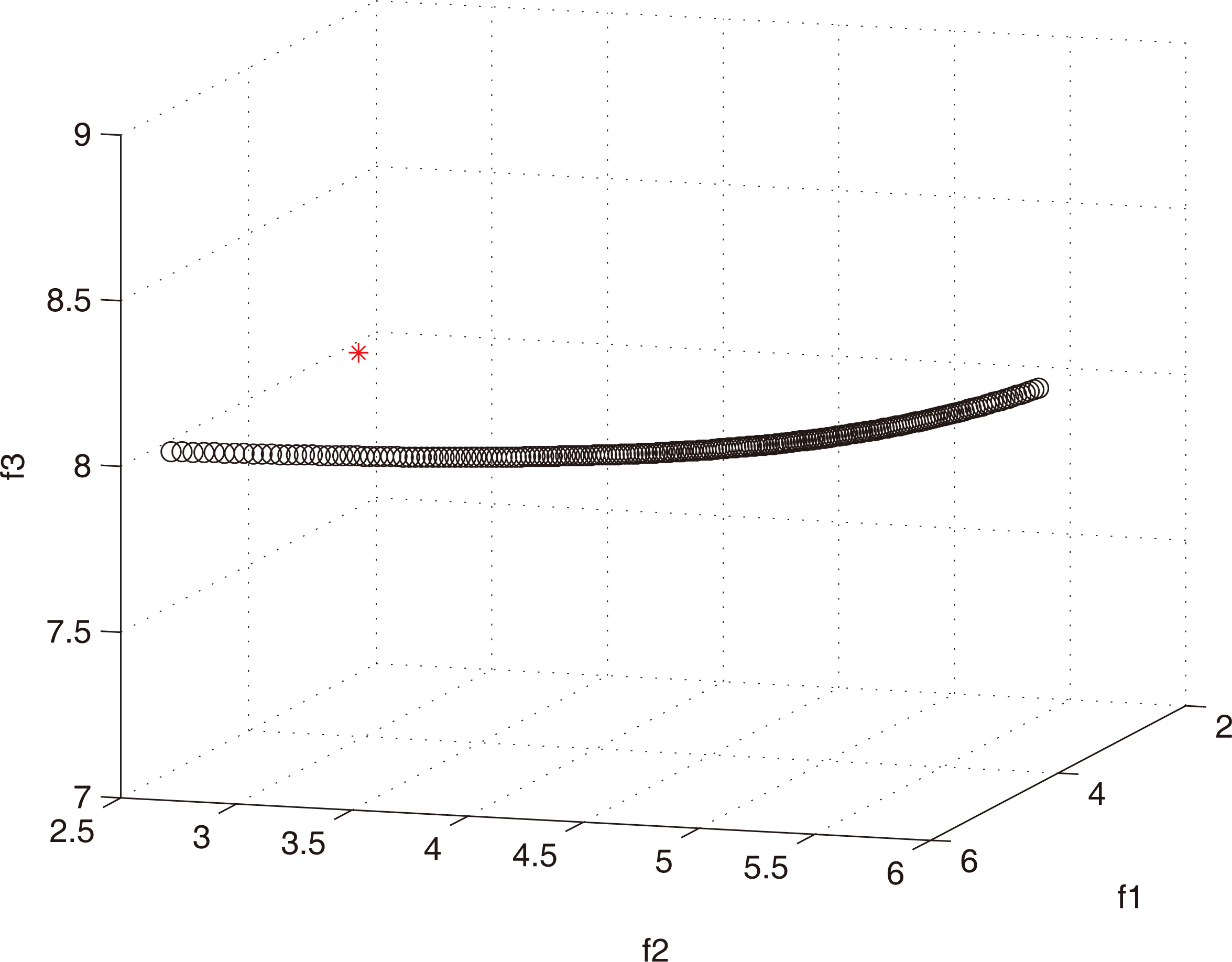
Sum rates in two cases vs GHG emission.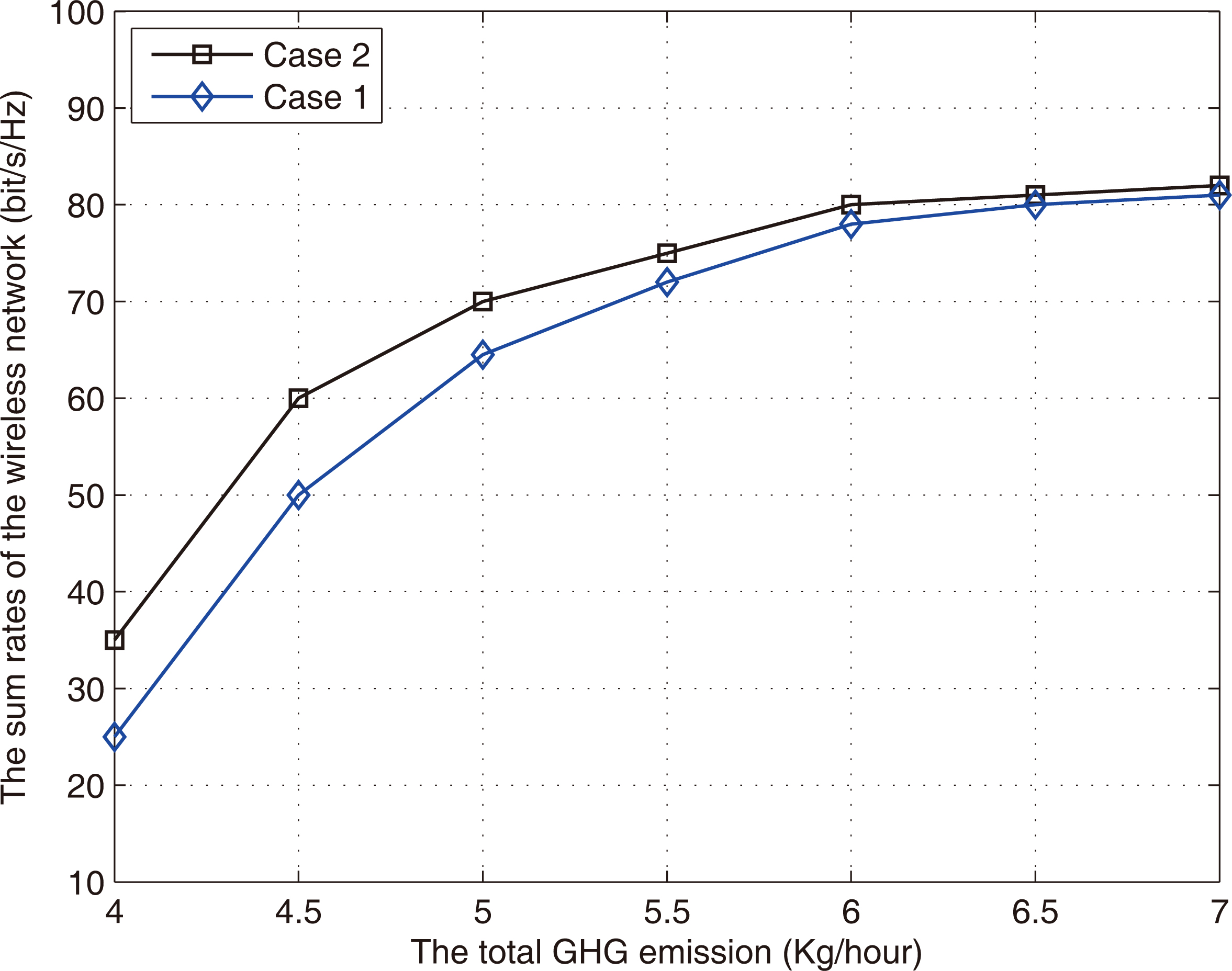
Figure 7 shows the scenario with three BSs, in which the GHG emission is constrained. In this scenario, BS1 harvests sufficient renewable energy and the harvesting energy of BS2 and BS3 are insufficient due to the intermittency of renewable energy. In this case, BS1 only shares the redundant energy with BS2 and BS3. From Fig. 7, it can be observed that the objectives of BS2 and BS3 are conflicting, and the proposed energy cooperation scheme can significantly improve total system throughput compared with the No Energy Cooperation case. Meanwhile, the proposed energy cooperation can enhance the energy efficiency by 75 persent compared with the No Energy Cooperation benchmark since the redundant energy of BS1 is wasted in the No Energy Cooperation case. The result illustrates that the proposed energy cooperation scheme can significantly improve renewable energy efficiency and overcome the renewable energy intermittency.
Objective function (OF) values for 30 realizations of the proposed MOEA/D-M2M-S algorithm
Sum rates in two cases vs GHG emissions.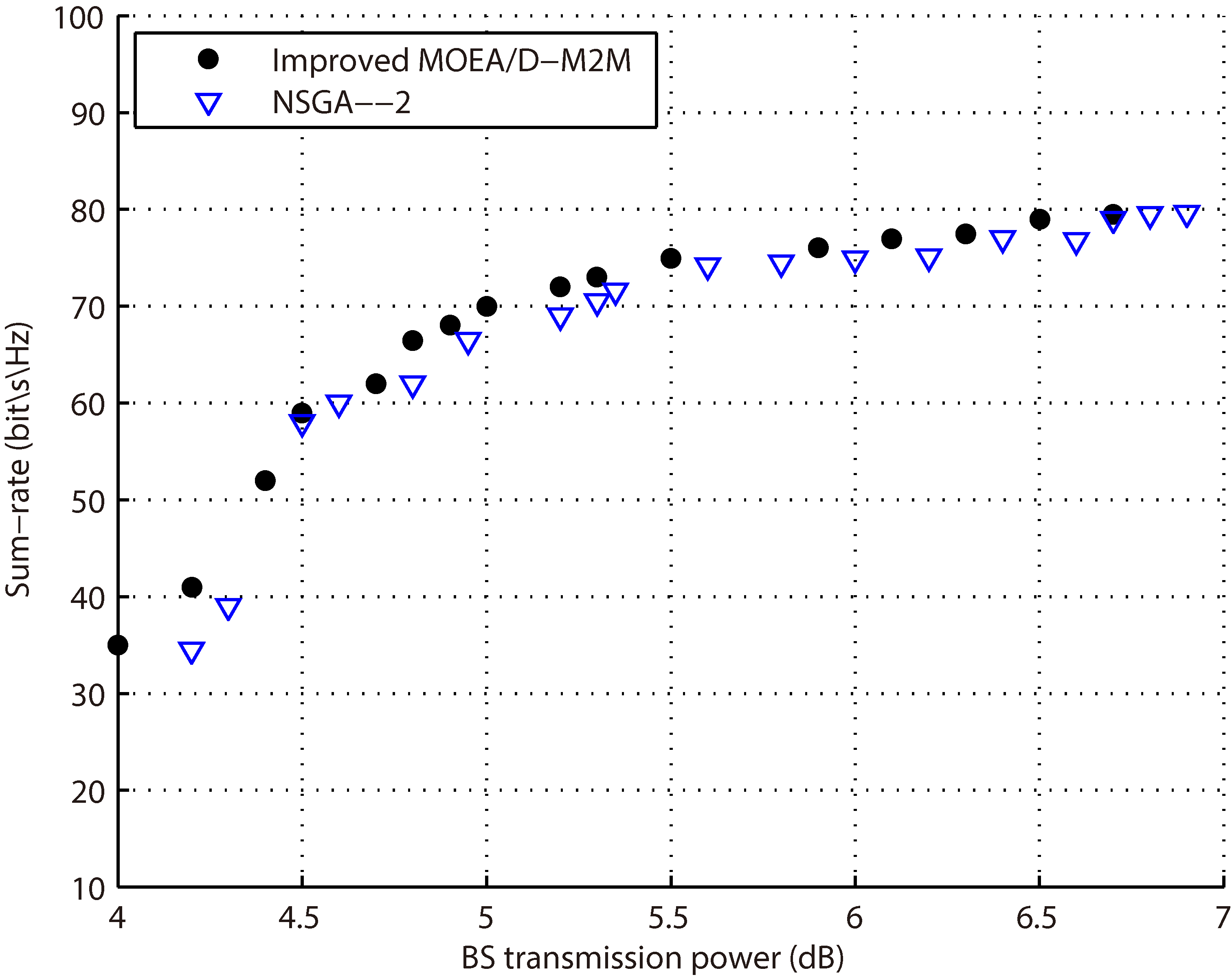
Finally, we consider a nine-BS scenario to evaluate the influence of the number of BSs joining the proposed scheme on cooperation performance. In this scenario, there are three BSs with sufficient harvested energy, while the harvested energy of another six BSs is insufficient. We consider two different cases:
Case 1: The nine BSs are divided into three groups averagely, and the proposed energy cooperation and spectrum sharing scheme is performed in each group independently;
Case 2: The nine BSs join the proposed energy cooperation and spectrum sharing scheme at the same time.
Figure 8 shows the total system throughput versus GHG emission in Cases 1 and 2, respectively. We observe that the performance of Case 2 has better performance than Case 1 when the GHG emission is constrained. This is because it is probable that the harvesting energy gap among BSs is small when the number of BSs joining the cooperation is little. Meanwhile, it will improve the flexibility of spectrum sharing when the number of BSs joining in spectrum sharing is large. This result illustrates that it is necessary to design an energy cooperation and spectrum sharing scheme among many systems.
Here, we compare the performance of the proposed MOEA/D-M2M-S algorithm with that of NSGA-II, and the result is shown in Fig. 9. From Fig. 9, it can be observed that, although the results obtained by these two algorithms are close in some parts, the proposed MOEA/D-M2M-S achieves a better convergence performance comparing with NSGA-II.
Table 1 shows the numerical results associated with each objective function for 30 realization of the proposed MOEA/D-M2M-S, and the best, worst, average value and standard deviation are presented. The small standard deviation of results obtained in all the realization illustrates the stability of the proposed algorithm.
Conclusion
We have proposed a joint energy cooperation and spectrum sharing scheme to improve the energy-spec- trum effectiveness for wireless cellular networks. Furthermore, a multi-objective optimization problem has been formulated. To solve it, an evolutionary multi-objective algorithm has been proposed. In which, the simplex dominance has been presented to improve the convergence performance through increasing the selection pressure. In addition, the Lagrangian dual method has also been integrated into the proposed MOEA/ D-M2M-S to optimize the power allocation to eliminate the co-channel interference. The simulation has shown the efficacy of the proposed energy cooperation and spectrum sharing scheme and MOEA/D-M2M-S in comparison with some counterparts. Therein, the energy cooperation and spectrum sharing scheme has been compared with several benchmarks: No Energy Cooperation, No Spectrum Sharing, No Energy Cooperaiton and Spectrum Sharing. From Fig. 5, the simulation result has proved that the proposed joint cooperation scheme can effectively improve the system throughput, and reduce the GHG emission by improving the renewable energy efficiency. In addition, we have compared the proposed MOEA/D-M2M-S with NSGA-II, and the result has been shown in Fig. 9 and it has illustrated that MOEA/D-M2M-S features good spread solutions and high precision.
Footnotes
Acknowledgments
This work was supported in part by the National Natural Science Foundation of China under Grant 61673121, in part by the Projects of Science and Technology of Guangzhou under Grant 201804010352.