



Abstract
Consumer-centric energy management approaches are emerging as a major solution for future power systems. In this context, intelligent home management systems should control different kinds of devices existing in the houses assuring convenient comfort levels and understanding the users’ behaviour. At the same time, the home management systems should be able to interact with other actors such as energy communities, aggregators, and system operators. The main contribution of this work is a new methodology allowing intelligent management, in near real-time (1 minute), of different types of energy resources existing in a smart home. The energy resources include appliances and other loads, micro-generation, and electric vehicles. The proposed system includes a permanent evaluation of the operation state of each energy resource considering their functional model and the behaviour and comfort level defined by the users. Participation in demand response programs reducing the power consumption limits is also considered showing the advantage of the proposed approach. The case study contains two scenarios considering a demand response program of power limitation with 120 minutes duration. To guarantee the participation in these demand response events, the system should evaluate the priority of each device according to its model. A domestic consumer with 45 energy resources (appliances, generation, and electric vehicles) is used for demonstration purposes.
Keywords
Introduction
In smart grids, consumers can act as active actors controlling their energy resources in an intelligent way [1]. Consumers can manage the use of energy by controlling consumption, generation, and storage. In smart grids, consumers can act as active actors controlling their energy resources in an intelligent way [1]. Consumers can manage the use of energy by controlling consumption, generation, and storage. To be possible the effective participation of the consumers in future power systems management, several approaches have been proposed, with an emphasis on smart grids and microgrids concepts [2]. In this context, smart home management systems have been developed in the scope of smart grids to provide more adequate and efficient interaction between the system operator or aggregation entities, and the consumers allowing the monitoring and better control of the appliances and other energy resources existing in the house.
Smart homes enable the monitoring and control of appliances, generation and storage devices, installed in the house. The monitoring is developed based on sensors, the “Internet of Things” IoT and smart appliances where several sensors are integrated into the device using low consumption solutions [3]. The control is assured by the actuators and remote control (e.g., Zigbee). This concept can be extended considering the integration of external communications [4]. External communications allow the information exchange with third party entities (energy communities, aggregators, utilities, etc.). Among other services, external communications enable the interaction with other management systems such as the ones used by energy communities, virtual power plants or system operators, enabling the possibility to participate in demand response (DR) programs/events. The conditions of participation in DR services should be pre-established between the utilities and the consumers and integrated into the smart home management system (HMS) algorithms.
The advanced functions of the HMS should include the management of the most important appliances, the generation units, and the electric vehicles considering the interactions with the external operators, security functions, comfort levels among others [5]. These new requirements imply the inclusion of new functions and algorithms in the HMS existing until now. The main focus of the new algorithms should be on the trade-off between the comfort level for the users and the efficiency of the use of existing devices. Regarding efficiency, we are considering the energy efficiency and the global costs of operation (energy bill) [6]. The HMS should identify the operation context (e.g. number of persons in the home) and try to adjust the comfort level accordingly. This identification can be done using learning algorithms such as the ones proposed in [7]. Another important aspect to be included in the HMS is the energy cost in different periods of the day (Time-of-Use DR programs) and the energy generated by the internal generation units. According to the most recent regulation, the consumers can not inject energy into the network meaning that all the energy generated in the house should be consumed in the house. In other words, consumption should be adjusted to follow the generation. When incentive-based DR is activated, new power limits can be imposed and the comfort levels can be slightly changed minimizing the impact on the comfort levels. In that case, the systems should have an intelligent mechanism to identify the user profile adjusting the importance of different actions [8]. This capacity is important to increase the acceptance of the system actions and the global performance of the systems.
This paper proposes a near real-time energy resources management method with a dynamic evaluation of the operation conditions of the energy resources existing in a smart house. The system can manage different appliances and other loads, distributed generation, electric vehicles. The participation in demand response events limiting the maximum power consumption is also included in the proposed methodology. Bi-directional flows of energy (network to house and house to the network) have been introduced considering different prices for buying and selling energy.
Demand Response can be implemented in different ways according to the system operators’ and retailers’ needs. DR can define load curtailment with minimum event duration of 15 minutes up until more than 5 hours [9].
After the present introduction section, Section 2 summarizes several concepts used in house management systems in the domestic consumers’ context. The description of the methodology proposed in the paper for the simulation platform of the intelligent management system is introduced in Section 3. Section 4 describes the case study with the characterization of the scenarios and results of near real-time energy resources management. The main conclusions and contributions of the work are presented in the last section.
Home energy management systems – overview
The development and implementation of management systems to control the energy consumption may have an impact on the consumption efficiency and in the efficient management of local power grids, avoiding or delaying the need to reinforce the grid and at the same time increasing the quality of service [10]. To improve the efficiency of domestic consumers, the HMS aims to provide required comfort levels, minimize energy consumption, maximize energy production, and thus reduce operation and maintenance costs. To assure efficient management it is important to identify the consumptions by floor, room, device/load and electric vehicle charge. Concerning the generation units, it is necessary to characterize the stochastic behaviour of generation units by the type of technology (photovoltaic – PV, wind, etc.), and finally, identify the characteristics of electric vehicle discharge [11]. An overview of the integration in HMS of intelligent applications, distributed generation, electric vehicles and demand response will be detailed in the following subsections.
House management systems with advanced methodologies
The HMS concept has been significantly developed in recent years, for example, in [12], more accurate communications, protocols and control methods are proposed. In [13] the integration and virtualization of residential gateways are specified and the robustness and efficiency of IoT devices are discussed in [14]. In [15] is proposed the use of “intelligent” sockets, enabling the control of devices and the measurement of power consumption. Additionally, the system is capable to identify the consumption profiles considering the users’ location through the installation of motion sensors.
The integration of DR events in the HMS is an important challenge for future HMS, to take monetary advantages from the participation in DR events. The solutions proposed in [16] allow a better understanding of the energy usage of consumers with different profiles, necessities, and use contexts, through the profiles collected according to several factors which influence the consumption [17]. Nowadays, several HMS solutions are projected for companies and organizations but, the wide use of HMS is still yet not a reality.
Management of distributed generation in HMS
The distributed generation systems in microscale allow the decentralization of electricity production and make the end consumer an active participant in the electric system. The micro or small-scale generation resources, namely wind generators, photovoltaic panels and combined heat and power (CHP) unit, can be included in the intelligent home management system. Nevertheless, PV systems are more adapted for urban use. The problem for the installation of micro wind generators in urban areas refers mainly to the turbulence and lack of wind due to the presence of obstacles and tall buildings [18]. With the installation of photovoltaic micro-units in domestic consumers, the main goal is to use the energy produced directly for consumer needs. If was not possible to consume the generated energy, the HMS should inject the energy into the main grid or store this energy in residential batteries or electric vehicles. In [19] is proposed a model including domestic consumers connected to the grid in which each one has installed photovoltaic panels to produce electricity.
Some works are developed to implement the micro distributed generation in HMS of the house/buildings. In [20] is introduced a tool that combines building, utilities, and emissions databases, and building models in a user-friendly interface. Several strategies are performed to obtain a dynamic dispatch of distributed generation units from detailed physical modelling. To minimize the building energy costs, [21] summarizes the distributed generation performance capabilities by a parametric study and it is developed using an economic dispatch strategy. The strategy is to dispatch several micro-generators, based on distributed generation (DG) technologies, to meet the annual demand of the building energy, exploring the impacts of distributed generation (DG) and building characteristics on capacity factors.
Management of electric vehicles in HMS
Electric vehicles (EVs) can be classified into three types, hybrid electric vehicles (HEVs), plug-in electric vehicles (PHEVs) and full battery electric vehicles (BEVs). The HEVs have internal combustion allowing a higher travelling range compared to the other two technologies, but the battery of PHEVs and BEVs can be externally recharged [22]. For the HMS in the domestic consumers, it should be considered the charge and discharge of the electric vehicles connected to their electrical network. Electric vehicles can be seen as storage units with the capacity to store energy when the distributed generation is producing in excess or when the energy prices are high [23]. However, it is important to assure the necessary energy in the vehicle batteries to the driving needs. Some authors proposed methods to manage the charge and discharge of electric vehicles in the context of the smart grids such as presented in [24], considering the use of a hybrid metaheuristic approach [25] with simulated annealing and ant colony optimization techniques to manage the energy resources in the virtual power player operating of a smart grid considering vehicle-to-grid (V2G) technology. Other technics such as the ones based on swarm optimization [26, 27], Spiking Neural P System [28], decomposition techniques [29, 30] or multi-objective functions [31, 32], can also be used for the same purpose. Research on distributed computing and on on a cluster of workstations [33, 34, 35, 36] can also be useful for the present application.
The electric vehicles management in the context of the HMS is also studied by several authors to analyze the vehicle’s charge effect on total house consumption, taking into account the time that vehicle leaves the house, the time when arrives and the distance travelled between the previous two times. The author in [37] presents a method for smart charging of electric vehicles according to the production of the photovoltaic system, with the total consumption of consumer and users preferences. The different user profiles of electric vehicles, which depend on users’ needs and their driving patterns, can promote changes in the daily consumption diagram if the penetration of electric vehicles was high [38].
Management of demand response events in HMS
Small end consumers can offer more flexible participation in DR events when compared with large consumers (industry and large commerce) [39]. The automatic participation of advanced HMS in demand response events, considering the consumers’ perspective, enable the automatic management of the loads and generation units considering the user’s preferences and the consumption/prices and limits.
Aggregation entities can manage the participation of small consumers in DR programs. One of these entities is the curtailment service provider (CSP) which manages more than one consumer to participate in DR programs, providing services to the consumers and system operators [40]. Time-of-Use (ToU) program is the most popular demand response program being available in most of the utilities. The main objective of the ToU program is to decrease the consumption of energy in domestic consumers when the electricity price is high [41].
State of the art summary and main contributions
The participation of HMS in DR events is a complex process due to the inclusion of all resources, including electric vehicles and microgeneration each one with different operating conditions. The capacity of these systems to aggregate functions to manage the consumption and generation provided from different types of resources can support the system operators. In [42], a scheduling algorithm for electric vehicles used as a storage system and appliances was proposed with the objective function of maximizing the use of generated energy (self-consumption). The appliances used in the house are divided into three types and the electric vehicles have a distinct characterization. The system obtained good results regarding resources scheduling, however, it does not consider the interaction with demand response programs. In this way, the work presented in [43], proposes a system to reduce peak load consumption taking into account a house of a single-family managing only two appliances. The work shows important results to reduce the peak consumption by shifting the loads with higher consumption, but several types of loads and energy resources are not included.
Several authors have been contributing to the development of house management systems improving the architecture, security and protocols to achieve the efficient management of a domestic consumer with a different type of resources. However, the dynamic management of the different types of energy resources in the domestic consumer, considering the diverse conditions of operation of each resource to obtain better comfort to the users is a lack in the context of the home management system. All resources presented in domestic consumers like generation systems, electrical appliances, electric vehicles, among others, enables a complex set of management strategies also from the consumer’s point of view.
The main contributions of the present paper are:
The near real-time dynamic energy resources management model implemented in-home management system enables the adaptive management between all loads, micro-generation, electric vehicles and grid connection. The dynamic scheduling of all resources in each minute changing the weight factor of each one in real-time ensures the impact minimization in comfort levels of the user during demand response events. The methodology applies the context identification and the user’s profiles inputs to adapt the resources scheduling, for example, adapting the charge needs of electric vehicles with the available generation. The inclusion of operation requirement of loads, micro-generation units, electric vehicles and grid connection, to determine the minimum time of functioning represents a crucial role of the proposed methodology to participate in demand response events. Additionally, the house management system adapts the power limit of the demand response event with the consumption and generation ensuring the power limit with variable values during the event.
The proposed methodology is initiated by an event trigger that can be a time routine (in this paper the algorithm is executed every minute), by a user’s interaction with the system or by a demand response event (external event). The methodology is activated, at least, every minute and the optimization considers this time horizon. As presented in Fig. 1, and detailed described in Section 3.1, after the trigger, the system evaluates if the power consumption is higher than the defined power limit. In this case, the system will update the status of each device and according to its model, will define a priority (weight). These values will be used in the optimization to determine the control actions to be applied to the energy resources. The update of the priorities is managed by the algorithm and the users do not need to change these priorities manually.
The two main algorithms included in the proposed methodology are presented in Sections 3.1 and 3.2. First, after each optimization, an algorithm will compare the state of each device/resource with its model. A priority level is determined considering the connection/disconnection time and the impact that the state can have in the operation of the device as well as on the comfort level of the users. The second method defines the power consumption of each device/resource considering the priority level defined in the first algorithm.
Process of the DERP method to determine the priority of each resource.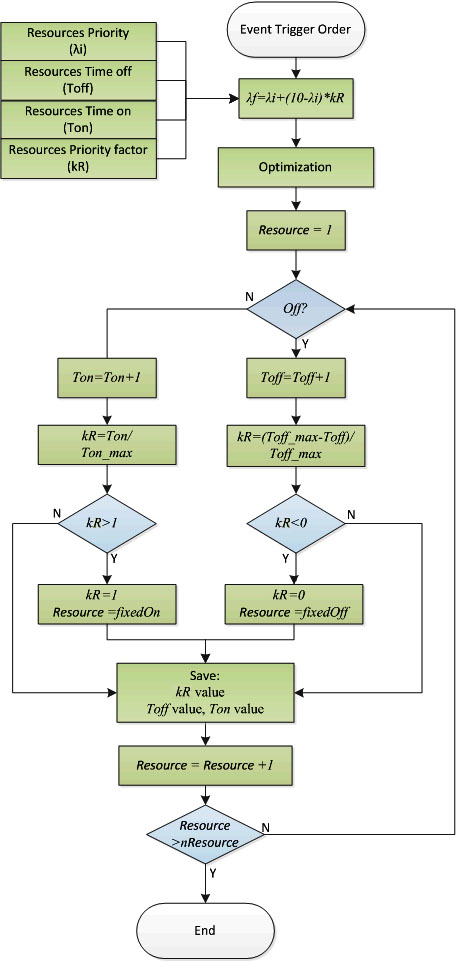
DERP decisions during power limit event
In the previous work [40], the priorities of the loads are defined in a dynamic load priority approach according to the user profile, comfort level and load models. In the proposed work, the methodology is extended to consider a more realistic scenario where the generation, electric vehicles and bi-directional connection with the main network are considered.
Beyond loads like refrigerators, EVs can contribute to the event by discharging some energy if the EV battery is sufficiently charged, instead of cutting consumption in some loads. In this way, a dynamic energy resources priority (DERP) variation is necessary to take adequate decisions during the demand response event considering two different situations as shown in Table 1.
where:
This algorithm can be activated in different operation situations namely when:
the grid operator or aggregator requires a consumption reduction; a consumption reduction is required due to the higher price of electrical energy; the reduction of the consumption defined by the user; the consumption increases (including the EVs charge or inject power in the grid) due to overproduction (caused by wind or solar radiation excess) to avoid the generation curtailment.
Diagram of the battery state in electric vehicle [44].
Production profile of the photovoltaic system on a winter day.
The dynamic variation has a characterization for each energy resource that depends on the
The characterization of the loads are based on the characteristics of the devices but also takes into account the past consumption of each one. In the first approach, theoretical models are included as a reference. However, these models are updated, considering a learning function that adjusts the initial models to the measured consumptions.
The loads have some distinct characteristics, for example, in the case of the refrigerators, according to the system database presented in [40], the refrigerator is on for 11 minutes (between 8:33 PM and 8:44 PM), and off for 52 minutes (between 8:44 PM and 9:36 PM). In the case of EVs, normally, the EVs are charging to achieve maximum battery capacity, 7 hours if the battery is fully discharged. With the application of the DERP method, the EVs can have a variable charging with the application of a
Analyzing Fig. 2, it is possible to see that the electric vehicles are being charged from an initial value to full charge before their departure time.
Figure 3 presents photovoltaic panels’ generation profiles for a winter day in Porto-Portugal (PV system installed in the roof of the research centre). The profile shows that the photovoltaic system is producing for about 540 minutes (between 8:00 AM and 5:00 PM). The DERP method for this resource should maintain on overall minutes to supply the loads and electric vehicles charge, or to inject power into the grid. In the case of injected power on the grid, the time on and off depends directly on the load demand and micro-generation energy produced.
The proposed methodology evaluates the variation on the energy resources priority factor
The first step of the optimization process is to define a final factor
The dynamic resources management considers an optimization process with more complex information due to the presence of different types of energy resources which form the basis of the proposed algorithm. The optimization algorithm is modelled as a mixed-integer linear programming problem and has as the main goal guarantee the electricity consumption limits (
Besides, it is defined and incorporated in the problem formulation of the EVs priority factors. In the case of vehicle charging, the system can stop the charging process to reduce the total consumption in the house. If eventually, the battery of the EV is sufficiently charged, according to the user’s preferences, the management system can discharge some energy instead of cutting consumption in some loads or moments with a lack of DG energy generation. In the formulation are also defined and incorporated the priority factors for DG resources allowing to inject power in the grid by incorporating the priority factor for the grid case.
As described above, the system should define the importance for each load, for each electric vehicle, both for charge and discharge, for each micro-generation resource as well as for the injected power in the grid in each specific context according to the dynamic method developed.
The objective function to determine the resources that should continue in service is presented in Eq. (3.2):
where
The power balance constraint is presented in Eq. (3.2) where the energy consumed should be provided by the available supplying sources. When the balance cannot be achieved, the variable
Whereas Eqs (3.2) and (3.2) refer to the maximum and minimum limits of loads, respectively. If the load is discrete (On/Off), the variable
In the case of electric vehicles, the charge and discharge mode of the battery depends directly on the priority factors associated with them which are compared with the loads’ priority factors, as well as the technical constraints that limit the amount of the charge (5) and discharge (6) energy. Equation (3.2) refers to the charge limit of the EVs batteries up to its maximum capacity whereas Eq. (3.2) refers to the discharge limits of EVs batteries up to its minimum energy imposed by vehicle owners, taking into account the minimization of the batteries degradation. Equation (3.2) refers to the power balance of EVs and Eq. (3.2) imposes that the EV battery cannot charge and discharge simultaneously.
In the case of distributed generation constraints, Eqs (3.2) and (3.2) refer to the maximum and minimum limit of micro-generation, respectively. In this case, the decision is imposed only for combined heat and power systems (CHP) by the binary variable
In the case of power exchange with the main grid constraints, Eq. (13) indicates the maximum and minimum power limit that the management system can inject/absorb which is defined by contract or by technical limits. Equation (14) stands for the cases where an additional active power limit
The case study presents the application of the proposed methodology with participation in a demand response event. Two different scenarios are tested with different energy resources taking into account the same demand response information: 120 minutes (2 hours) after 7:30 PM and a limited power consumption reduction.
In the case study, a domestic consumer of a multi-family building considers 45 resources divided into 40 loads, 2 EVs, 2 DG units and grid connection (to sell energy). The domestic consumer has different conditions to change profile consumption. Thus, each resource considers individual characteristics to implement the DERP method namely, the type of resource (loads, EVs, etc.), the type of use (lights, Heating, Ventilating and Air Conditioning (HVAC), Vehicle-to-Grid (V2G), PV, etc.), the maximum power (consumption/generation), the amount of time on or off for each resource (resources models), the priority for each resource, the resources which can be turned off (non-priority loads) and the control type for each resource (variable or discrete). This dataset intends to model a domestic consumer, however, consumers with different characteristics or devices can be easily implemented.
Domestic consumer characteristics
The case study considers a simulation of an active domestic consumer. Some of the devices are real and others are virtual simulations of the devices considering the measurement of their real behaviour. The values have been obtained in measurement campaigns. The domestic consumer simulation considers the profile of different appliances and devices such as refrigerators, microwaves, photovoltaic panels, wind generators and electric vehicles. The general information of the domestic consumer is presented in Table 2.
General information of the domestic consumer
General information of the domestic consumer
Diagram with the identification of the characteristics of each resource.
The resources management module uses the diagram presented in Fig. 4 to characterize the domestic consumer resources considering different aspects namely: type, control, classification, time, and power. In Table 3, the loads are divided by house division. In the other away, Table 4 presents the classification of all the resources according to the characterization mechanism. The characteristics of each device/resource can be obtained and adjusted based on its historical behaviour.
Loads for each domestic consumer division
Characteristics of the resources in the domestic consumer
In the present case study, two scenarios are presented considering long-duration demand response events. Both scenarios are compared with the Base Scenario presented in Figs 5 and 6 which corresponds to the scenario without the optimization system and demand response event.
Consumption profile considering the charge of EVs for a winter profile.
Energy profile of the domestic consumer comparing the generation with consumption for a winter day.
The case study is performed on a winter day. To obtain the power limit during the DR event, the proposed system uses the conditions according to Table 5. The characteristics of the two scenarios are the following:
The power limit is 1600 W when the difference between the consumption and generation is higher than 1600 W. If the difference is less than 1600 W, the power limit corresponds to the value of this difference, and, if generation is higher than consumption, the power limit is indicated by the generation value. In the present case, the demand response event has 120 minutes of time duration starting at 7:30 PM which corresponds to a peak consumption time. Being a winter scenario, in this period the PV generation is 0.
These scenarios have been proposed to demonstrate the applicability of the proposed methodology in different contexts of operation and consider a realistic duration of demand response events [46]. The EVs are not connected to the installation between 8:00 and 19:00.
Power limit conditions
The results obtained in scenario A of the case study are presented and discussed in the present subsection. An optimization process for a DR event of 120 minutes with the power limit indicated in Table 5 is considered. Figure 7 shows the resources profile of the domestic consumer between 7:30 PM and 9:30 PM, representing the detailed consumption and generation for each resource. Also, it is compared the results with the Normal Consumption (the resources consumption before the use of the DERP).
Power results profile for each resource type in the point of view of Supplied Power (a) and Consumed Power (b) with demand response event of 2 hours in scenario A.
Power results profile for each resource type in the point of view of Supplied Power (a) and Consumed Power (b) with demand response event of 2 hours in scenario A.
Generation mode results of the dynamic resources priorities for EV1 discharge (a) and wind (b) in demand response event.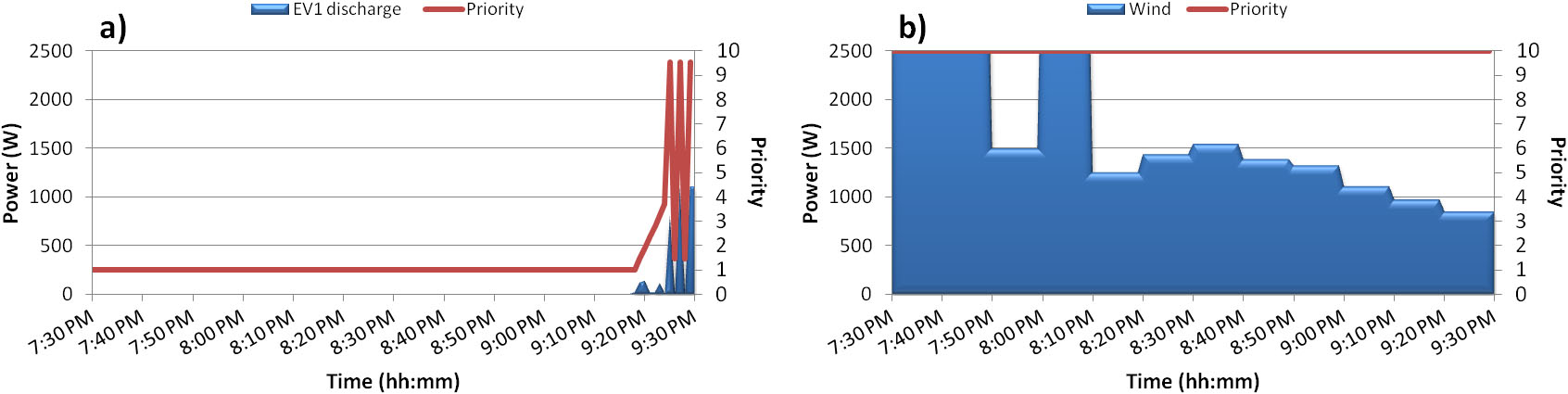
Figure 7a shows that the power supplied by the grid is used when the generation is not enough for all consumption including the EVs charge. For example, between 7:30 PM and 7:50 PM, the consumption of the domestic consumer is guaranteed by wind generation. The EV discharge is used at the end of the DR event to support the loads in this period. It happens when the generation reaches a lower capacity during the event. Comparing the power profile before and after the application of the DERP method, it is possible to see the change in the power profile due to the capacity of the DERP method to adapt the power consumption to the power generation. This causes a more constant consumption profile, contradicting the variable consumption represented in Fig. 7a by the red line.
The profile presented in Fig. 7b represents the instant demand power consumed by the loads. The profile shows the use of EV charge in moments when the other loads have less needed to be used. With electric vehicles, the management system can store the power generated provided by a wind generator and afterwards, the power can be used the next day by the user through, for example, the travel to own job, instead of charging the EVs during the night using the power provided by the grid, which is more expensive for the consumer. At the same time, in some moments of the DR event, the domestic consumer inject power into the grid instead charge the EV due to the need for the grid in a peak period of the day (can provide the active participation of domestic consumer using the system in the context of the smart grids).
The effectiveness of the DERP method is verified by the results presented in Figs 8 and 9 with the application of the method considering six resources with characteristics presented in Subsection 5.1:
ElecSpaceHeating (heating/cooling type, discrete control, permanent resource, Ton: 9, Toff: 7) RoGenTs (light type, variable control, permanent resource, Ton: EV1 discharge (V2G type, variable control, essential resource, Ton: 20, Toff: 20) EV2 charge (V2G type, variable control, essential resource, Ton: 20, Toff: 20) Injected in the grid (grid type, variable control, non-priority resource, Ton: 30, Toff: 30) Wind (wind generator type, discrete control, permanent resource, Ton:
Figures 8 and 9 show the different resource results comparing the power state with the priority to analyze the evolution of the resource priority for each resource. The results obtained depends directly on the characteristics of the resource. To better understand the method applied it is important to analyse it. The priority values change between 0 and 10 but it has two distinct conditions that depend on the resource types and characteristics:
Consumption mode (loads, EVs charge mode, injected in the grid): being the factor 10 used for the lowest priority loads and factor 0 for the highest priority ones; Generation mode (micro-generation and EVs discharge mode): being the factor 0 used for the lowest priority loads and factor 10 for the highest priority ones.
In Eq. (3.2) of Section 4, the optimization process uses a priority value
ElecSpaceHeating (ID Load 16): priority is between 2 and 10 during the demand response event. Between 7:30 PM and 8:43 PM, the user does not need the load in the state on although with priority value 2. When the user turns on the load, the priority value changes according to the dynamic method (Fig. 8a); RoGenTs (ID Load 35): priority is between 1 and 2 due to its characteristics. Lights only are disconnected by the user indication, so it should be connected (on) the entire time. In the dynamic method, it is possible by factor EV2 charge (ID EV 2): The resource priority value change between 9 to 10 and the power value depends on the other resources of the house causing a variable power charge of the EV. It is important to verify the higher charge of EV when the micro-generation increases (Fig. 8c); Energy Sale (ID Grid 1): is a resource with a constant priority being it always 9.8. Being this resource a non-priority resource, the system depends directly on other resources to turn on the injected in the grid. It happens when the when micro-generation is higher and with decreasing of power generated, this resource is no more used (Fig. 8d).
In the case of generation mode, the resources with a higher
EV1 discharge (ID EV 1): priority is 1 and the only change is at the end of the DR event when the power provided by micro-generation is less and the domestic consumer has a power limit of 2000 W. In this case, the system needs to supply the other loads of the house with higher priority using the power stored in the battery of EV1 (Fig. 9a); Wind (ID DG 2): it is the resource with high priority in the domestic consumer being it always 10 (higher priority in the case of generation side). The system uses the maximum power generated by the wind generator due to the maximum priority for the system. In this case, the dynamic method always set the factor
The results obtained in scenario B of the case study are presented and discussed in the present subsection.
It is considered an optimization process like in scenario A with the power limited indicated in Table 3 but without electric vehicles. Figure 10 shows the resources profile of the domestic consumer between 7:30 PM and 9:30 PM, representing the detailed consumption and generation for each resource. Also, it is compared the results with the Normal Consumption (consumption before the application of the DERP).
Figure 10a shows the external supplier is used when the generation is not enough to supply all the load demand. It is also important to verify in Fig. 10a the higher use of the energy sale due to the lack of EVs storage capacity, so the systems need to inject power in the grid or curtail the generation units. Comparing the power profile before and after the application of the DERP method without EVs, it is possible to see the end of the peak consumption, corresponding now to the maximum of the wind production (4000W). Therefore, when the generation is equal to 4000W, most of the energy is injected into the main grid. The DERP method results in a more constant consumption profile compared with the variable consumption of the normal consumption (red line).
Power results profile for each resource type in the point of view of Supplied Power (a) and Consumed Power (b) with demand response event of 2 hours in scenario B.
The results presented in Fig. 10b are the power demand for different devices. The use of energy sales in this scenario increases significantly. The management system of the domestic consumer needs to inject power into the grid instead of charging the EVs due to the lack of the last one.
The effectiveness of the DERP method is verified by the results presented in Fig. 11 with the application of the method considering four resources with characteristics presented in Subsection 5.1:
ElecSpaceHeating (heating/cooling type, discrete control, permanent resource, Ton: 9, Toff: 7) RoGenTs (light type, variable control, permanent resource, Ton: Injected in the grid (grid type, variable control, non-priority resource, Ton: 30, Toff: 30) Wind (wind generator type, discrete control, permanent resource, Ton:
Figure 11 shows the obtained results comparing the power state with the priority to analyse the evolution of the resource priority for each resource. The results depend directly on the characteristics of the resource and to better understand the method applied it is important to analyse it. The priority values change between 0 to 10 but it has two distinct conditions that depend on the type of resource and its characteristics:
Consumption mode (loads and power injected in the grid): being the factor 10 used for the lowest priority loads and the factor 0 for the highest priority ones;
Generation mode (micro-generation): being the factor 0 used for the lowest priority loads and factor 10 for the highest priority ones.
Consumption and generation mode results of the dynamic resources priorities for ElecSpaceHeating (a), RoGenTs (b), energy sale (c) and wind (d) in demand response event.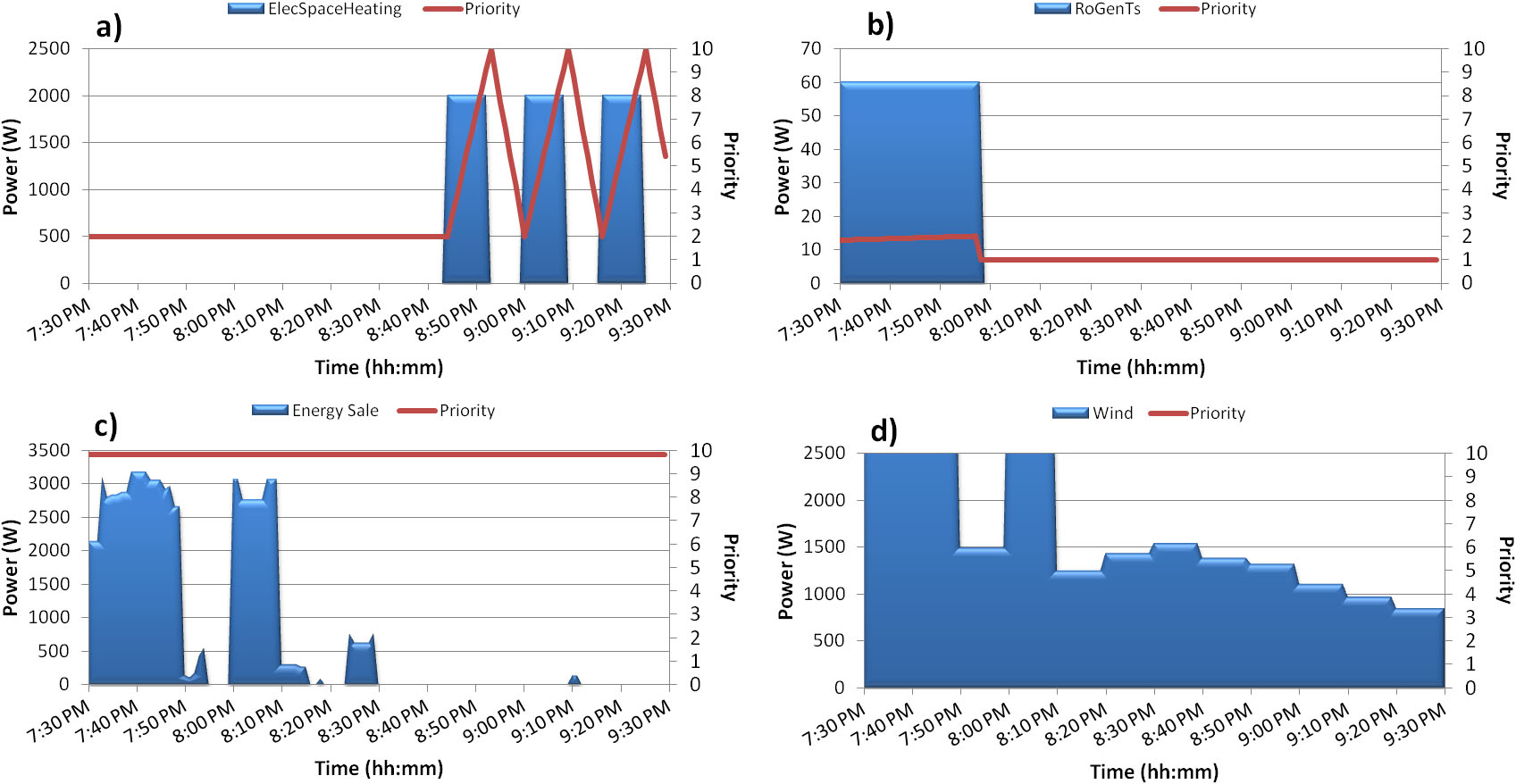
The analysis for each resource priorities as follows:
ElecSpaceHeating (ID Load 16): obtain the same result of scenario A when priority is between 2 and 10 during the demand response event (Fig. 11a); RoGenTs (ID Load 35): obtain the same results of scenario A. In the same way. lights only are disconnected by the user interaction (Fig. 11b); Energy Sale (ID Grid 1): the resource has a constant priority (always 9.8). Without EVs, this resource represents higher importance on the consumption side. With the capacity to inject power in the grid, the system uses the excess of generation, in this scenario provided by the wind generator, injecting the power in the grid instead charge EVs which happens in scenario A. The energy sale is used when the wind generator provides more power than the power demand. So, the power not used by loads is injected into the grid. This imposes a contract between the consumer and the grid operator (Fig. 11d). In the case of generation mode, the analysis for each resource priority in the scenario is as follows: Wind (ID DG 2): it is the resource with high priority in the domestic consumer being it is always 10 (higher priority in the case of generation side) and the system uses the maximum power generated by them (Fig. 11b).
The proposed methodology is applied in two different scenarios comparing the results with the base scenario (without application of the DERP method). In both scenarios, a demand response event is considered with 120 minutes time duration with different power limits during the event. The power limits are defined by the DR program and previous agreements. When the power generation is higher than the power consumption, the power limit corresponds to the power generation. The main difference between scenarios is the presence of EVs which make changes in the sale of energy. The energy sale is more used in the scenario without EVs (scenario B), otherwise, the system uses the excess of power to charge the own EVs (scenario A). The scenario considering the EVs also considers the V2G capability allowing the use of some loads which is not possible, through the power limit, at times when the generation is lower than consumption or does not exist.
The method was applied in the demand response event of long duration being the results important to verify the importance of the EVs and the grid connection to sell energy. Another important result is the use of the storage in the moments with high DG generation namely the charge of EV when the wind generator is producing in maximum instead of charge EV in night periods. This result represents the use of power when it is free for the user (only considering the marginal costs) and not when the need to buy energy (night periods). Also, the EV charge is more used than sale energy in moments with high DG generation because is cheaper for the user to charge EV instead of sale energy than sale energy and after charge the EV. This information is guaranteed by the system through priority value for each one. A final consideration is the capacity of the system to guarantee the consumption limit.
Conclusions
The new vision of domestic consumers shows the need to manage not only the demand but also the generation and the storage systems. The present paper presents a dynamic energy resources management method to control different types of resources in a domestic consumer (loads, distributed generation, electric vehicles and grid connection). In this way, it is important to discuss the impact of the different resources of domestic consumers from the point of view of the bi-directional power management (consumption and generation).
This paper presents a dynamic energy resources priority (DERP) method with the main goal to change the resource priorities during the demand response event. The priority is changed taking into account the characteristics of each resource namely, the loads, distributed generators, electric vehicles and grid connection. The optimization module uses the resource priorities for each instant to optimize the use of power (generation and consumption). In this way, for each minute, resources with higher priority are scheduled instead of the resources with lower priority. The proposed methodology can obtain a better management of the consumer with different types of resources in demand response events of a long duration.
To apply the methodology, a case study with two scenarios is presented. The scenarios show good results being the electric vehicles and grid connection important resources to adapt to the excess of energy produced. At the same time, even the less power generation, the management system guarantees the power limit following the user preferences.
It is important to mention that the proposed methodology is very flexible and can be used in other types of houses, with different devices, and commercial and industrial installations. The main difference will be in the modelling of devices behaviour that should be measured and included in the library of the device available in the solution.
Footnotes
Acknowledgments
This work was supported by national funds through FCT, Fundação para a Ciência e a Tecnologia, under project UIDB/50021/2020.