



Abstract

This story begins in 1985, when at age 22, I became the World Chess Champion after beating Anatoly Karpov. Earlier that year, I played what is called simultaneous exhibition against 32 of the world’s best chess-playing machines in Hamburg, Germany. I won all the games, and then it was not considered much of a surprise that I could beat 32 computers at the same time. To me, that was the golden age. Machines were weak, and my hair was strong.
Just 12 years later, I was fighting for my life against just one computer in a match called by the cover of Newsweek “The Brain’s Last Stand”. No pressure.
From mythology to science fiction, human versus machine has often been portrayed as a matter of life and death. John Henry, called the steel-driving man in the 19th century African American folk legend, was pitted in a race against a steam-powered hammer bashing a tunnel through mountain of rock. John Henry’s legend is a part of a long historical narrative pitting humanity versus technology. And this competitive rhetoric is standard now. We are in a race against the machines, in a fight or even in a war. Jobs are being killed off. People are being replaced as if they had vanished from the Earth. It’s enough to think that the movies like The Terminator or The Matrix are nonfiction.
There are very few instances of an arena where the human body and mind can compete on equal terms with a computer or a robot. Actually, I wish there were a few more. Instead, it was my blessing and my curse to literally become the proverbial man in the man versus machine competition that everybody is still talking about. In the most famous human-machine competition since John Henry, I played two matches against the IBM supercomputer, D
But I guess that’s fair. There is no day in history, no special calendar entry for all the people who failed to climb Mt. Everest before Sir Edmund Hillary and Tenzing Norgay made it to the top. And in 1997, I was still the world champion when chess computers finally came of age. I was Mt. Everest, and D
D
Soon, machines will be taxi drivers and doctors and professors, but will they be “intelligent”? I would rather leave these definitions to the philosophers and to the dictionary. What really matters is how we humans feel about living and working with these machines.
When I first met D
And then I sat across the chessboard from D
I fought back after this devastating blow to win the first match, but the writing was on the wall. I eventually lost to the machine but I didn’t suffer the fate of John Henry who won but died, “with his hammer in his hand.” It turned out that the world of chess still wanted to have a human chess champion. And even today, when a free chess app on the latest mobile phone is stronger than D
What I learned from my own experience is that we must face our fears if we want to get the most out of our technology, and we must conquer those fears if we want to get the best out of our humanity. While licking my wounds, I got a lot of inspiration from my battles against D
My idea came to life in 1998 under the name of Advanced Chess when I played this human-plus-machine competition against another elite player. But in this first experiment, we both failed to combine human and machine skills effectively. Advanced Chess found its home on the internet, and in 2005, a so-called Freestyle Chess tournament produced a revelation. A team of Grandmasters and top machines participated, but the winners were not Grandmasters, not a supercomputer. The winners were a pair of amateur American chess players operating three ordinary PCs at the same time. Their skill of coaching their machines effectively counteracted the superior chess knowledge of their Grandmaster opponents and much greater computational power of others. And I reached this formulation: A weak human player plus a machine plus a better process is superior to a very powerful machine alone, but more remarkably, is superior to a strong human player plus machine and an inferior process. This convinced me that we would need better interfaces to help us coach our machines towards more useful intelligence.
Human plus machine isn’t the future, it’s the present. Everybody has used online translation to get the gist of a news article from a foreign newspaper, knowing it’s far from perfect. Then we use our human experience to make sense out of that, and then the machine learns from our corrections. This model is spreading in investing, in medical diagnosis, security analysis. The machine crunches data, calculates probabilities, gets 80 percent of the way, 90 percent, making it easier for analysis and decision-making of the human party. But you are not going to send your kids to school in a self-driving car with 90 percent accuracy, even with 99 percent. So we need a leap forward to add a few more crucial decimal places.
Twenty years after my match with D
There’s one thing only a human can do. That’s dream. So let us dream big. Thank you.
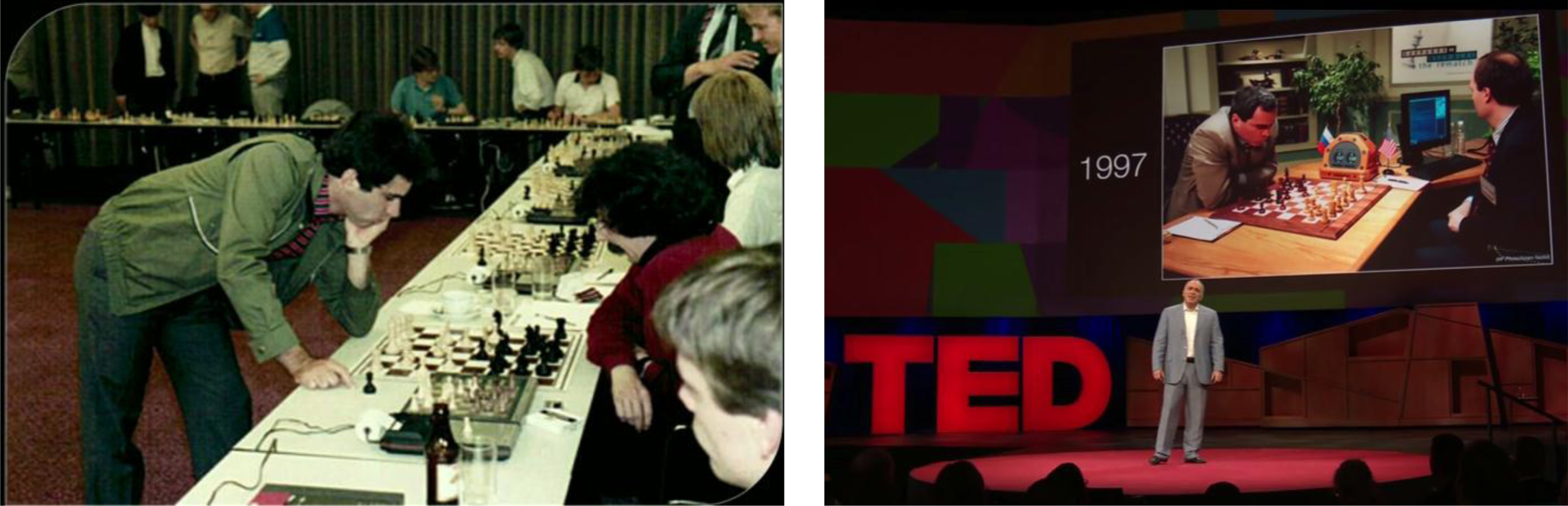
(left) 32-0 simultaneous against 32 machines (Hamburg, 1985); (right) v D