



Abstract
The 21st Computer Olympiad was held in New Taipei City, Taiwan, from July 7 to 13, 2018. One team from China could not attend due to visa problems. In total, nine teams from four countries participated in the EinStein Würfelt Nicht! (EWN) tournament, as listed in Table 1. EWN is a two-player zero-sum stochastic game designed by Althöfer in 2004 (Althöfer, 2011). The game is played on a 5×5 board with a dice. Two players, Red and Blue, respectively own six pieces numbered one to six. At the beginning of a game, red and blue pieces are placed in the top-left and bottom-right corners of the board respectively. The order of the pieces for the two colors should be rotationally symmetric for fairness. The players roll dice in each move to determine which pieces can be moved. The goal of the game is to move one piece to the opponent’s corner or capture all opponent pieces. The detailed game rules can be found in the paper by Chu et al. (2017).
A round-robin system was applied for the tournament. Each program played eight games against all other programs. The initial positions were determined by rolling dice. For each initial position, two games were played with the two programs alternating as the first player. The final ranks were determined by the total numbers of games won by the programs. The detailed scores and the final ranks are listed in Table 2.
The participants of the EWN tournament in the 21st Computer Olympiad
The participants of the EWN tournament in the 21st Computer Olympiad
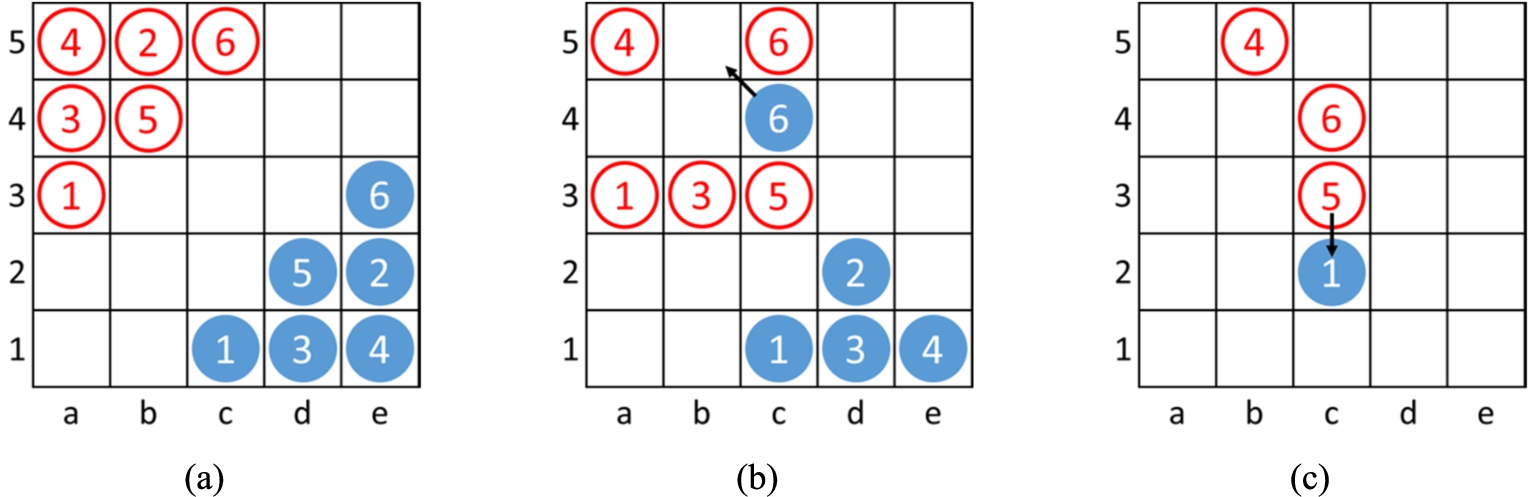
This report comments on two games, one between
Game 1:
The detailed scores and the final ranks
a3 b5 a4 a5 b4 c5 c1 e2 d1 e1 d2 e3, 1. B 2 e2 d2 2. R 5 b4 c3 3. B 6 e3 d3 4. R 2 b5 c4 5. B 6 d3 c4 6. R 2 a4 b3 7. B 6 c4 b5 8. R 1 a3 b3 9. B 2 d2 c2 10. R 2 a5 b5 11. B 5 e1 d1 12. R 6 c5 c4 13. B 4 d1 c2 14. R 3 b3 c2 15. B 4 c1 c2 16. R 5 c3 c2
The initial position of the game is shown in Fig. 1(a). In this game, Blue was the first player. At the 7th move, Blue rolled the number of six and moved its  from c4 to b5, as shown in Fig. 1(b). With a probability of 1/3 (rolling the number of five or six), Blue could win on its next turn by moving the
  to the target square a5. At the 8th move, Red rolled one and captured its own
  to increase the probability of moving
  (the only piece that could capture the opponent
  ). With the
  captured, the probability of moving
  increased from 1/6 to 1/2 (rolling two, three, or four allows Red to move
  ). The strategy succeeded as Red rolled two and captured the opponent
  on the 10th move, which resolved the crisis of losing on the next opponent move. Finally, Red won the game by capturing all blue pieces on the 16th move, as shown in Fig. 1(c).
The commented game between
Game 2:
b5 c5 b4 a5 a3 a4 e2 e3 d2 e1 c1 d1, 1. R 2 c5 d4 2. B 3 d2 c3 3. R 6 a4 a3 4. B 1 e2 e3 5. R 4 a5 b4 6. B 4 e1 d2 7. R 4 b4 c3 8. B 3 d2 c3 9. R 3 d4 d3 10. B 2 e3 d3 11. R 2 a3 b2 12. B 2 c3 b3 13. R 3 b2 c2 14. B 6 d1 c2 15. R 1 b5 c4 16. B 5 c1 b1 17. R 1 c4 d3 18. B 2 b3 a4 19. R 1 d3 e2 20. B 5 b1 a1 21. R 1 e2 e1
The initial position of the game is shown in Fig. 2(a). In this game, Red was the first player. After Blue captured the opponent  on the 14th move, as shown in Fig. 2(b), Red had only one piece remaining, i.e.
  , and no longer needed to roll the dice for the rest of the game. On the next (15th) move, Red moved its
  to c4, which had a probability of 1/2 to lose on the 16th move if the opponent rolls one, two, or three to capture
  by
by  . However, Blue ended up rolling five. Red then captured the opponent
  on the 17th move to eliminate the threat, though the probability for the opponent to move
  (the piece closest to the target square a5) was increased from 1/2 to 2/3. On the 20th move, Blue had a probability of 2/3 to win if one, two, three, or four is rolled, in which case
  can be moved to the target square a5. However, Blue rolled five and missed the chance to win, as shown in Fig. 2(c). As a result, Red won on the 21st move by moving its
  to the target square e1.

The commented game between

An EWN game set given to the winning team.
Althöfer, the designer of EWN, provided an EWN game set with a wooden board and glass pieces as a reward to the winning team. The game set, as shown in Fig. 3, was awarded to the authors of