On July 24–25, 1976, the computer program Chess 4.5 participated in the Paul Masson Chess Classic Tournament. The program achieved an impressive result. This article describes my recollection of this event and its aftermath.
Introduction
In 1976, Chess 4.5, a computer chess program written by David Slate and Larry Atkin of Northwestern University, was invited to compete in the fourth annual Paul Masson Chess Classic, a five round tournament held on July 24–25 at the Paul Masson vineyards in Saratoga, California. The tournament was divided into sections by United States Chess Federation rating classes, e.g. the B section (1600–1799) matched only B-class players against each other. Going into the contest I had only a vague idea of the program’s strength against human opponents. In 1974 it did achieve a performance rating of about 1734 in a small local tournament, but I had serious doubts that it could repeat that feat under what I imagined were the more difficult conditions of a big event like the Paul Masson. The possibility of winning cash prizes might inspire our opponents to play above their usual levels. Up to that time the only chess program with substantial experience in “official” human tournaments was Richard Greenblatt’s pioneering program Mac Hack VI, which played in several competitions in the late 1960’s and achieved a rating in the 1500’s.
Meanwhile a discussion had been going on among computer scientists, philosophers, psychologists, etc., about how well computers could compete, both currently and in the future, against human players. The “optimists”, usually computer scientists, claimed that computers would, before long, surpass humans in chess playing strength. Artificial intelligence researcher Herbert Simon predicted in 1957 that this would happen within ten years (Simon and Newell, 1958). Likewise, the “pessimists” tended to dismiss these predictions as outlandish as well as insulting to the mysterious and sublime nature of human intelligence, which they imagined was necessary to play chess above a rudimentary level. Philosopher Hubert Dreyfus was an example of the latter, and was challenged to and lost a famous game to Mac Hack VI in 1967 (Greenblatt, 2005). This game provided considerable amusement but did little to settle the issue.
So, with highly uncertain prospects Chess 4.5 was entered into the B section of the Paul Masson. During the tournament I was in Saratoga to enter the moves for the program into a printing terminal which also showed the computer’s responses. Control Data Corporation generously let us use the latest and fastest model of the type of computers Chess 4.5 ran on: the still experimental Cyber 176. The machine was located in Minnesota and tended by David Cahlander, who provided much appreciated assistance to us for this tournament and other events involving our program.
Paul Masson Classic Chess Tournament
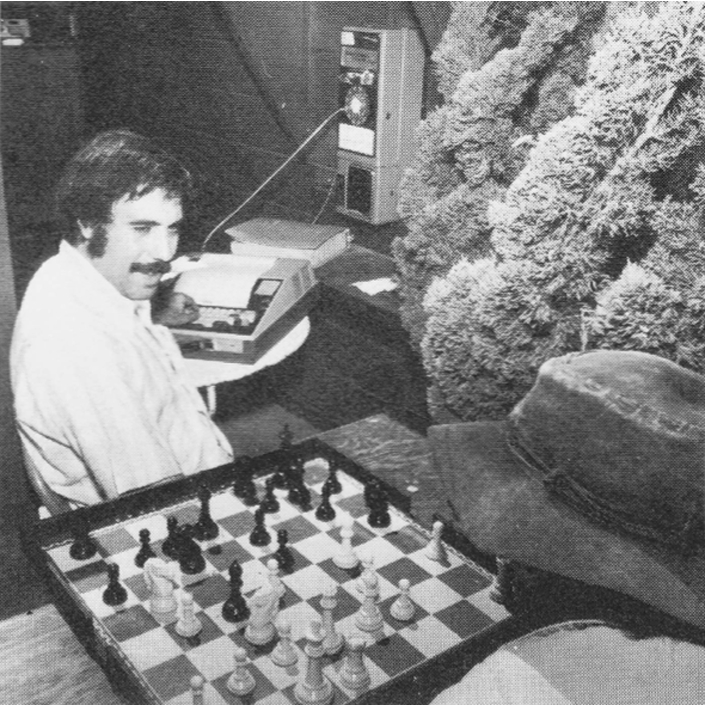
As has been recounted elsewhere, Chess 4.5 finished the event with a perfect 5–0 score (Frey, 1977), a feat that changed at least some people’s minds about the potential abilities of chess programs. But the most amazing thing to me was the fact that the program got through the tournament at all. From the beginning it was beset with problems. The program was supposed to communicate over a telephone line from the Cyber 176 in Minnesota to the vineyards and my terminal. There was something wrong with Paul Masson’s phone lines that rendered them unusable for data communications. A solution was found just in time in the form of an outdoor payphone whose handset was secured onto an acoustic modem using whatever materials were at hand. We also had to arrange for the connection not to require coins to be continually inserted during the games. The whole makeshift setup had to be occasionally adjusted to keep the connection active. As I recall, although most of the tournament was held outdoors, the table for our games was originally supposed to be located indoors. But to use the payphone we had to position our table outdoors close to the phone booth, which caused additional problems. This was my first trip to California, having grown up in Chicago, and I knew of the phrase “Warm California Sun” only indirectly, like from the pop tune “California Sun” (written by Joe Jones and first recorded in 1960). But at the tournament, in July, with a hot sun overhead, I experienced it firsthand, and so did our computer terminal, which apparently overheated and started making typing mistakes. I feared the terminal might die of heat stroke even if I didn’t, but fortunately the organizers found an umbrella to cover the table, and this fairly quickly restored our terminal back to health. Playing outdoors in the vineyards also brought another nuisance not usually encountered during chess tournaments: bees. I remember a bee landing on our chess clock and staying there for a while during one of the games, and the program’s opponent and I had to overcome our natural reluctance to pester bees with our hands in order to push the buttons. Chess 4.5 also faced the problem that the Cyber 176, although considerably faster than the computers our program had previously run on, was not entirely stable and occasionally crashed during the tournament. But each time its caretakers managed to bring it back to life just in time to finish our games successfully.
I went into the tournament fearing that Chess 4.5 might lose all its games, either by being outplayed or because of technical problems. As the tournament progressed and the program won game after game, what might be called a paradigm shift in the perception of Chess 4.5’s strength (and with it the playing strength of computers in general) took place. Some of our human opponents complained that the computer was a bully, clearly too strong to play in the B section, where its presence unfairly crippled the prospects of those who had to play against it. Like something out of a science fiction story, perhaps by Isaac Asimov, opponents of the computer organized a revolt against its participation and, at one point, took control of the microphone used by the tournament staff for announcements in order to voice their grievances. After some confusion, the tournament staff wrestled the microphone back from the rebels and restored order. Our opponent had walked away from the board in protest, and I had to track him down and persuade him to finish our game.
In hindsight I wish I had kept better notes about the tournament. You never know when they might come in handy 44 years later. After such a long time, my memory is rather hazy about the details. During the games I was mostly focused on just dealing with issues and events as they arose. I can’t recall much about how our opponents reacted, except for the “revolt of the humans.” I remember feeling good at the time about winning game after game, mostly because that was more pleasant than the alternative of losing and/or defaulting. It was only at the end of the tournament that I had a chance to reflect on the result.
Afterwards
After the tournament, chess master and chess program developer Hans Berliner observed that “to produce a perfect score against that caliber of competition should require a rating in the neighborhood of 1950.” It seems quaint now, in the era of super-grandmaster programs for PCs and DeepMind’s AlphaZero, to talk about what in human terms was really a fairly modest chess performance, but in 1976 Chess 4.5 at the Paul Masson was a big deal (although soon to be eclipsed by many bigger deals). Looking back at the history of computer chess and the debates over how strong, relative to humans, chess programs might become, what strikes me most is the excessive confidence many people on both sides of the argument had in the idea that playing chess at a high level was a strong indicator of intelligence. I think the truth is that chess, despite its complexities as a game, is perhaps a bit too simple a system to serve well as the (or a) drosophila of artificial intelligence, as computer scientist John McCarthy referred to it (attributed to McCarthy, but he credits Russian scientist Alexander Konrod (McCarthy, 1989)), making an analogy to the utility of learning about genetics by studying fruit flies. In my opinion, natural language understanding is a much better choice (for example, computer science pioneer Alan Turing’s “Turing Test” (Turing, 1950)).
After the tournament I visited John McCarthy at Stanford and told him what had happened at the Paul Masson. He had several years earlier collaborated with Alan Kotok and others at M.I.T. to produce the Kotok–McCarthy program (Wikipedia, 2020), which was arguably the first real chess program. I recall little of our conversation. He probably congratulated me but I can’t remember even that. McCarthy used to show up at the computer chess panel sessions at the annual ACM tournaments and ask a good question: “What does this all have to do with artificial intelligence?”, presumably referring to the brute force alpha-beta searches that characterized several of the programs, including ours. I never had a good answer for him at the time.1
And, perhaps, even with over half a century of computer chess activity, the computer chess community still might not have a good answer for him!
When I visited McCarthy after the Paul Masson, I remember wandering the corridors looking for him and found a small office where I inquired of the occupant where I might find McCarthy. The occupant turned out to be, of all people, the original computer checkers man himself, Arthur Samuel. He was working at a terminal on something. We had a brief conversation, but I can’t remember the details, although I have a vague recollection of him saying that he still, at the age of 74, preferred hands on computer work rather than the management positions that many older programmers “advance” into.2
Samuel remained a professional programmer until his passing at the age of 88 in 1990. His final years were spent working on developing the first implementation of Donald Knuth’s TeX typesetting system.
As it turned out, this visit was to lead to an interesting telephone conversation. Sometime after I returned home to Evanston, Illinois and my job at Northwestern University, I received a message at my office requesting that I make a collect call to professor William Shockley. I wondered what William Shockley, who had shared the Nobel Prize in Physics in 1956 for inventing the transistor, might possibly want to speak to me about. So I called him, and he gladly accepted the charges and also asked if it was okay if he recorded the conversation. I said yes, and he began by congratulating me on Chess 4.5’s performance at the Paul Masson, which John McCarthy had related to him. He said that he was working on a study of artificial intelligence for the U.S. Navy, and wanted to include some information in his report about Chess 4.5’s result, which he thought was a significant milestone in the development of AI. I tried to play down what Chess 4.5 had accomplished, attributing much of it to luck, and also expressing my opinion that it didn’t actually have much to do with AI. He was undeterred in his enthusiasm, and it seemed to me that he was overly eager to jump to conclusions based on skimpy evidence. I had also heard of Shockley’s controversial opinions about the connection between human intelligence, race, and genetics, and his suggestions for applying eugenics to keep humanity from evolving into a bunch of dullards. I wondered to what extent those ideas were also the product of a tendency to “rush to judgment”. I was looking for a way to sort of “accidentally” segue our conversation onto this topic, and I thought that perhaps a particular word, such as “controversial”, might do the trick. When he next expressed some notion about the connection between chess and AI, I replied that that was a controversial idea. Sure enough, it worked: he admitted he was no stranger to controversy, and began to expound on the urgent need to confront what he was convinced were unpleasant truths about the impending fate of humanity unless certain measures to limit the reproduction of “less fit” individuals were undertaken. I decided to drop the subject rather than get into a long and probably futile debate about it. He thanked me for my input on Chess 4.5’s performance at the Paul Masson tournament, and that ended the call.
David Slate operating Chess 4.5 at the Paul Masson tournament. Note the teletypewriter and telephone in the background (Control Data, 1976).
All in all I enjoyed the Paul Masson tournament and its aftermath. Chess 4.5 acquitted itself well, I survived exposure to the warm California sun, and I had an interesting conversation with a Nobel Prize winner.
References
1.
Control Data (1976). No wine for one winner in Vineyard Chess Meet. Contact for Control Data People, 2(10).
2.
Frey, P. (Ed.) (1977). Chess Skill in Man and Machine (pp. 243–247). New York: Springer.
3.
Greenblatt, R. (2005). Oral history of Richard Greenblatt. Computer History Museum.
4.
McCarthy, J. (1989). The fruitfly on the fly. International Computer Chess Association Journal, 12(4).
5.
Simon, H.A. & Newell, A. (1958). Heuristic problem solving: The next advance in operations research. Operations Research, 6(1 (Jan.–Feb.)), 1–10. doi:10.1287/opre.6.1.1.
6.
Turing, A. (1950). Computing machinery and intelligence. Mind, 59(236), 433–460. doi:10.1093/mind/LIX.236.433.