



Abstract

Our founding President, Benjamin Mittman, has a unique and hallowed place in the history of the ICCA1
The International Computer Chess Association (ICCA) was the forerunner of the ICGA. In 2002, the ICCA changed its name to the ICGA, reflecting the association’s broader interests and activities, and the broader relevance of computer game-playing to world culture and to the science of Artificial Intelligence.
When AI was founded as a discipline, at the Dartmouth Workshop of 1956, one of the goals of this nascent science was to create a chess playing computer program capable of defeating the human World Champion. That goal was finally achieved in 1997 when Garry Kasparov lost a famous match to IBM’s
Ben was born on December 24th 1928 in Chicago. The son of immigrants from Eastern Europe, Ben spent most of his youth in Albany Park, at Hibbard Elementary School and Von Steuben High School, and being elected President of his graduating class. After attending the two-year program of the University of Illinois at Navy Pier, he earned a B.S. degree in Mathematics from the Illinois Institute of Technology (IIT).
In 1950 Ben married Barbara Goldman, who he had met while they were both hitchhiking, and they moved to California where Ben received an M.S. degree in Mathematics from UCLA. The Korean War was on, so a services deferment was needed. They soon moved to Seattle where Ben worked for Boeing, performing flutter and dynamics calculations for the then-secret Bomarc ground-to-ground missile. In those days Ben’s calculations were carried out using a Frieden desk calculator, for tasks such as inverting 3 × 3 matrices.
Ben realized that draft deferment would probably be needed for another ten years or more, so he invited his draft board to draft him and they obliged. His army “career” turned out to be what he later described as “unbelievably productive and fascinating” – after 17 weeks of infantry basic training he enlisted for an extra year to study Russian at the Army Language School in Monterey, a skill that the Army never saw fit to use. Instead, Ben was shipped to Europe, ending up finally in Paris where he and Barbara lived in a student pension and he worked as a draughtsman, drawing maps at SHAPE2
Supreme Headquarters Allied Powers Europe.
In 1956 Ben and Barbara returned to the USA with their new baby, Robert, and Ben entered the computer field, working with a Univac 1105 at the IIT Research Institute. In 1964 he was transferred to Paris to run the European office of IITRI’s APT (Automatically Programmed Tools) program. By then he and Barbara also had a daughter, Joanne. It was from Paris, in 1966, that Ben was lured to Evanston, by Northwestern University, as Director of the Vogelback Computing Center. One of his first responsibilities at Northwestern was to raise sufficient funds to have the computing center join a growing community of universities that were installing a new generation of large-scale, scientific computing systems such as the IBM 7090 and IBM 360 series, and the CDC 6400. Ben was successful in obtaining a grant from the National Science Foundation, and after a six-month study Northwestern decided to install its own CDC 6400.
In the spring of 1968 two Northwestern University undergraduates, Larry Atkin and Keith Gorlen, developed a chess program in their spare time, joining forces the following year with physics graduate student David Slate. At the time computer chess was very much in its infancy, but Ben allowed this student team to have as much computer time as they needed on the mainframe at Vogelback.
By 1970 there were many universities in the USA and elsewhere with computer systems that were, to some extent at least, at the disposal of students and researchers, and this encouraged a few individuals and teams to develop primitive chess playing programs. The rationale of these enthusiasts was born partly of their interest in chess as a pastime, and partly because it was perceived that programming ideas and techniques employed in the development of a computerized grandmaster might well be useful in other areas of Artificial Intelligence research. Thus, the Association for Computing Machinery hosted the first United States Computer Chess Championship3
This championship was initially called the ACM United States Computer Chess Championship. It was renamed the ACM North American Computer Chess Championship in 1975, and renamed again the ACM International Computer Chess Championship in 1991.
I first learned of the existence of Vogelback in 1970, when the Slate-Atkin-Gorlen team won the tournament in New York with their program
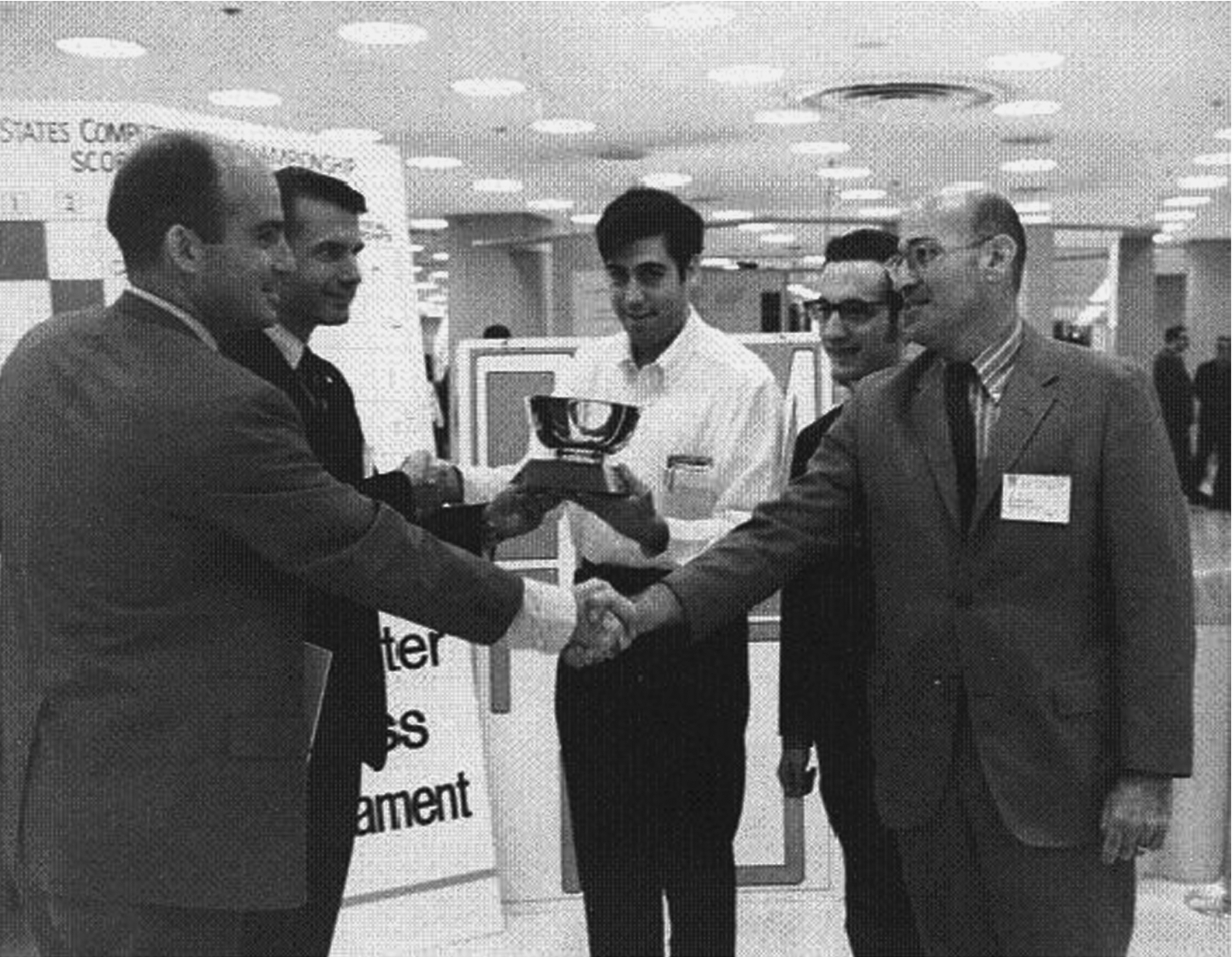
Dave Slate accepts first prize from ACM representative Sam Matsa, for winning the 1st North American Computer Chess Championship in 1970 with Chess 3.0. Monty Newborn is far left, Ben Mittman is far right. Larry Atkin is between Ben and Dave4.
News of the New York tournament spread throughout the world’s chess media and computer media, and the ACM judged the event to be such a success that it was decided to repeat it in 1971. (In fact, the event became a regular in the ACM calendar, continuing until 1994.) I studied the games played by the six programs competing in the New York tournament and had been unimpressed, to say the least, with their chess prowess. But 1970 was just the start of a new era in this microcosm of Artificial Intelligence. True, the standard of play by the winning Northwestern program in 1970 was way below the level required to challenge strong human players, but to a chess master the moves did suggest that somewhere inside the program a novice chess player was lurking. And Ben deserves a huge amount of credit for continuing to support the Northwestern chess program by making ever more time available on the university’s Control Data Corporation 6400 mainframe.
In 1971 I was invited by Ben (and Monty Newborn of Columbia University) to be the tournament director and commentator at the Second ACM United States Computer Chess Championship, which was held at the Hilton Hotel on Chicago’s Michigan Avenue. Seven years earlier, on my first trip to the USA at the age of 19, I had visited a concert violinist friend who was staying at that Hilton while he was performing in Grant Park, and I wondered then what kind of a millionaire one would have to be to afford such luxury. Now I was there as an invited guest, thanks to Ben.
I remember very well the day I first met Ben and the Vogelback chess team. I came down from my room at the Hilton, into the ballroom where the computer tournament was going to take place, and was immediately taken by Ben, with Dave Slate and Larry Atkin, to a steak lunch. For me that was the start, not only of an amazing and thoroughly enjoyable era in my life which continues to this day, being part of the then nascent computer chess community, but it was also the beginning of a warm, firm, lifelong friendship with Ben and Barbara Mittman.
While I was in Chicago for the 1971 ACM tournament I visited Vogelback for the first time. My computing resources at Glasgow required that I prepare my programs on 8-hole punched paper tape, submit them in a cardboard box, and then wait for a computer run to disgorge the results. Vogelback was on a completely different level from the University of Glasgow Computer Science Department, with computer facilities the like of which I could only dream about. Dave Slate, Larry Atkin and Keith Gorlen were fortunate indeed in having access to such computing facilities, but there was one other factor that played a huge role in their success and in the advances being made throughout the 1970s in the world of computer chess. That extra factor was Ben, who had the great foresight to realize what an important role his computer center could play in the world of AI. It was Ben who made the prescient decision to allow his team to continue to have free rein with the facilities at Vogelback for the development of their chess program.
Photo by courtesy of Monty Newborn, from The Computer History Museum.
It is no exaggeration to say that, had Ben Mittman not continued to support Slate and Atkin,5
Keith Gorlen having dropped out of the team to pursue other interests.
Following my trip to the USA in 1971 I had the pleasure of revisiting Vogelback from time to time while Ben was still its head. During the 1970s the Slate-Atkin program dominated the world of computer chess, winning almost every computer tournament in which it competed. Under Ben’s leadership Northwestern University’s program won the ACM event eight times between 1970 and 1979. It evolved through different versions, with
I was repeatedly invited back to the ACM events as tournament director and commentator, and it was during my third spell in this role that Ben instigated a major leap forward for computer chess. By then he had become addicted to the milieu. As Ben, Monty and I were having breakfast on the morning after the last round of the tournament, Ben exclaimed: “Gee. This has been great. What can we do next?”
The result of that breakfast and that question was the birth of the World Computer Chess Championship. Ben knew some of the big wigs in IFIP,6
The International Federation for Information Processing – the world’s leading organization at the time for computing professionals.
The first World Championship was won by the Soviet program
The International Chess Federation.
Ben realised shortly before the Toronto event that computer chess would make faster progress if it had its own governing organisation, so he started one! Thus, the International Computer Chess Association (ICCA) was born in 1977, and Ben was elected unanimously to be its President for its first three years. The former (human) World Chess Champion Mikhail Botvinnik was present in Toronto as guest of honour, which gave Ben the pleasure of using the fluent Russian he had learned many years earlier at the Army Language School. I recall Botvinnik being impressed with Ben’s fine command of Russian.
In 1980, at the 3rd World Computer Chess Championship in Linz, Austria Ben was re-elected President of the ICCA (again unanimously). A highlight of that year’s events was the presence of Claude Shannon as the guest of honour, where Ben thoroughly enjoyed Shannon’s demonstration of some of his collection of multi-purpose Swiss Army knives.
Photo: Gift of Benjamin Mittman to the Computer History Museum.
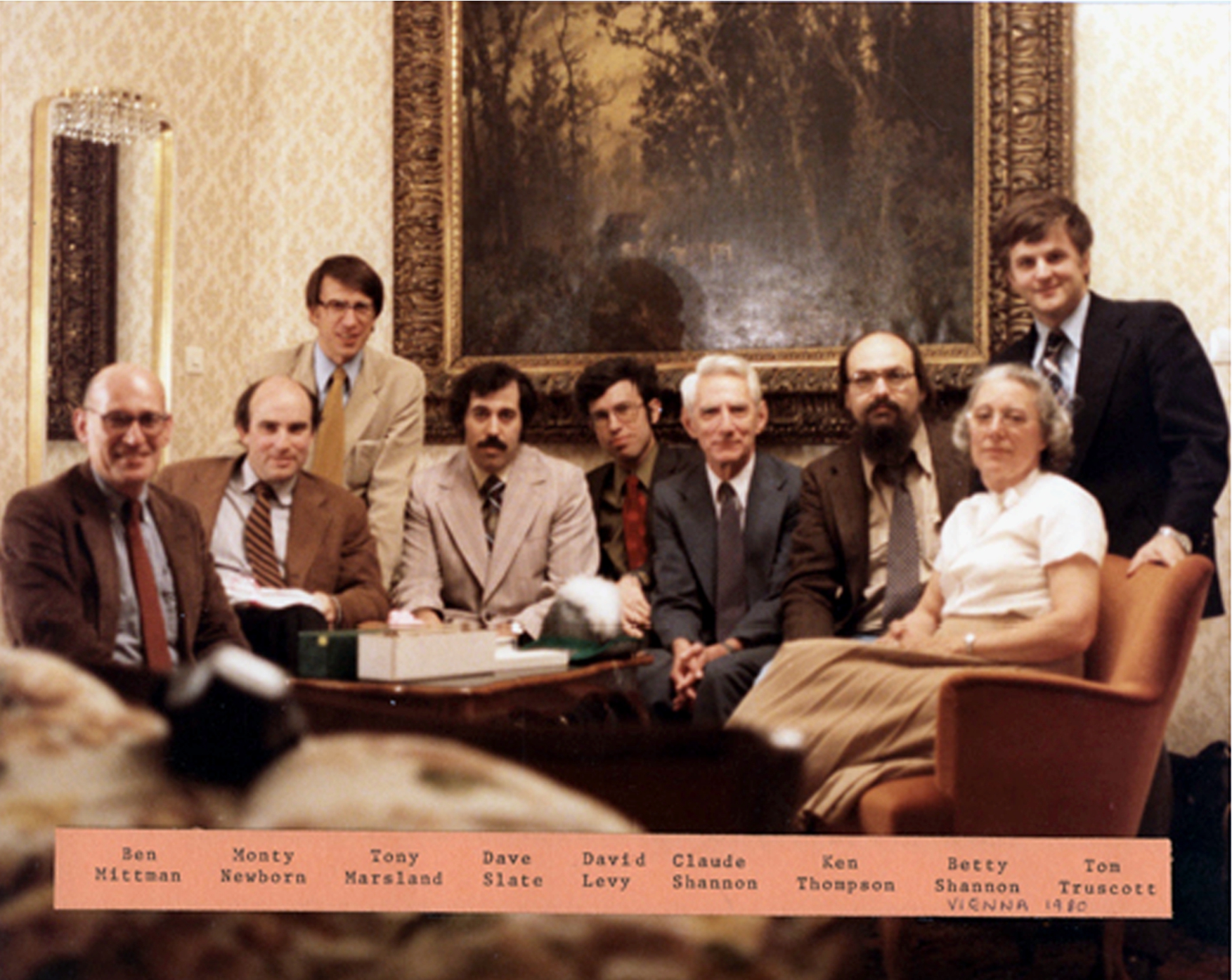
Computer Chess pioneers in the Sacher Hotel, Vienna, Austria 1980: Ben Mittman, Monty Newborn, Tony Marsland, Dave Slate, David Levy, Claude Shannon, Ken Thompson, Betty Shannon, Tom Truscott8.
The Northwestern University chess program’s successes put computer chess firmly on the map of developments in AI, making Vogelback a key location in the AI world at that time. And it created so much interest within the AI community that many other programming groups joined the race to develop the first grandmaster level chess program. Ben’s influence on all of this cannot be overstated. The many tournaments that Ben helped to organize and promote provided the incentive for chess programmers everywhere to improve the playing strength of their programs.
In 1983 Ben resigned from Vogelback to accept an appointment at the Kellogg School of Business as Professor of Information Systems. At Kellogg, Ben established the Center for Technology in Management, and remained there until his retirement in 1990. Ben and Barbara then began splitting their time between Evanston and Paris, where Ben continued to focus on his photography and Barbara on her painting. Barbara had always shared Ben’s love of Paris – she had studied there, and more than once had taken charge of the “year abroad” students from the French department at the University of Illinois at Chicago, where she was a professor and head of department.
Ben’s great interest in black and white photography began some fifty years earlier, during his sojourn in Paris while working at SHAPE. One of his major projects during his retirement was called Paris Then and Now, for which Ben found many drawn and painted images of various Paris scenes, created a century or two earlier. He identified the locations from where the original artists created their images of those scenes, and from those locations he photographed the same scenes. The juxtaposition of those pairs of images formed a wonderful exhibition, that was shown publicly in New York and elsewhere.
Another of Ben’s major photo projects was a study of famous flea markets of Paris. This was followed in 1994 by his most famous photographic work, the restoration of the Pont Neuf – the oldest bridge in Paris which was completed in 1607. By 1994 the Pont Neuf had fallen into very bad condition, having had its previous major restoration in the mid-19th century. Ben’s photo in Fig. 4 shows what the blacked and broken stonework looked like in 1994, before restoration.
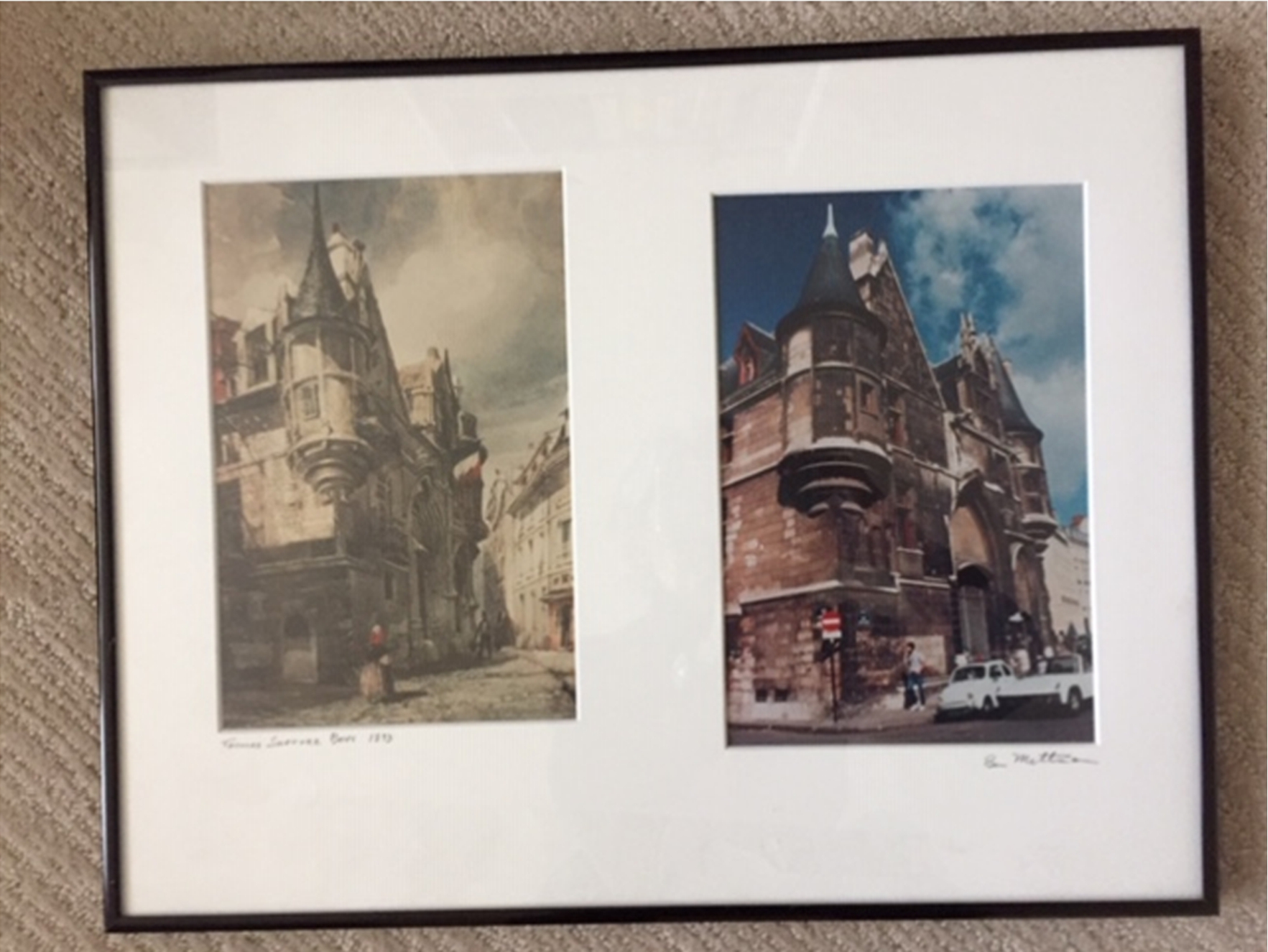
A pair of images from “Paris then and now”.
And Fig. 5 shows is what the first arch looked like after the restoration was completed.
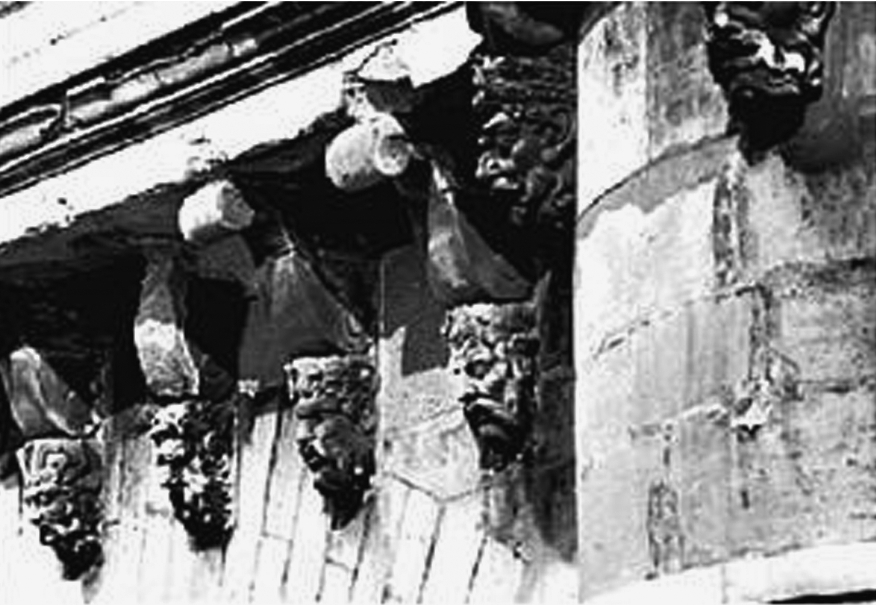
Part of the Pont Neuf before restoration.
The restoration, which was completed at the end of April 2007, was the subject of an exhibit of 50 of Ben’s photos that was held in the Mairie9
Town hall.
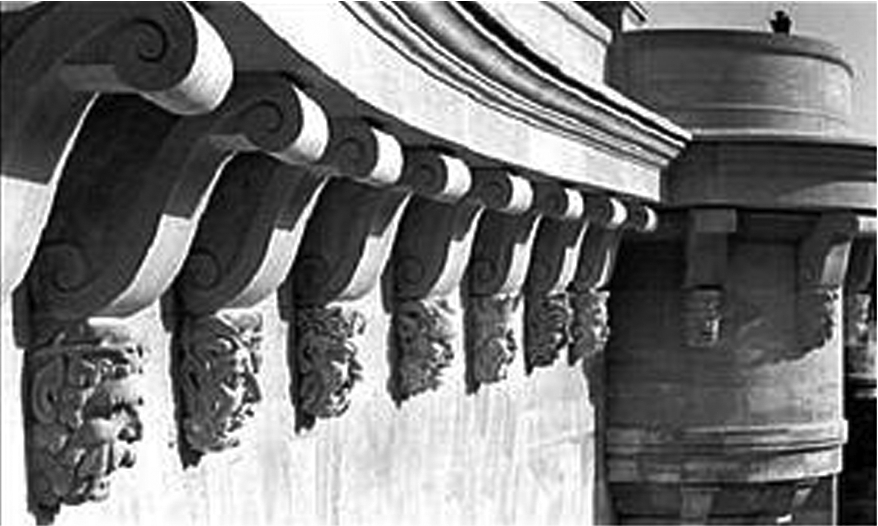
That same part after restoration.
Subsequently the City of Paris purchased the entire show for its municipal archives. The Northwestern University Library had a special section on its web site that described Pont Neuf and Ben’s project. Ben created this record of the restoration process using only black & white film, in recognition of the bridge’s 400 year history. As can be seen from his photos, Ben was particularly fascinated by the re-sculpting of more than half of the 384 mascarons10
Faces or masks.
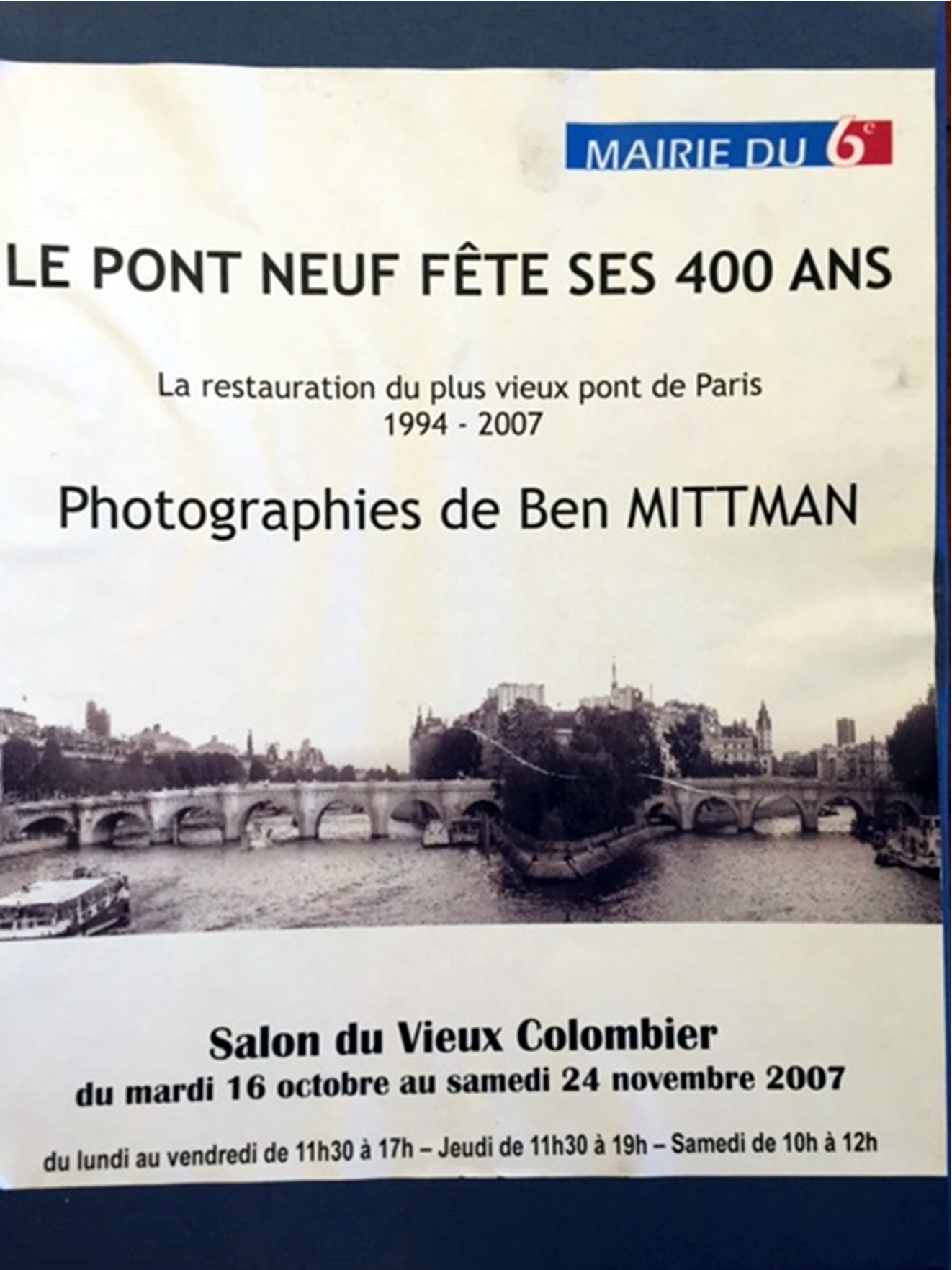
Brochure of Ben’s Pont Neuf photo exhibition in Paris.
Several of Ben’s photos from this project can be accessed at various websites,11
My thanks to Scott Krafft, Kevin B. Leonard, and Martin Antonetti at Northwestern University for their help in locating these images. My thanks also to Barbara Mittman and Joanne Mittman for providing some of the source material for this article.
During Ben’s later years he and Barbara would continue to return to the USA, from April to September every year, where Ben loved to play golf with his friends12
Ben had also been a keen tennis player in his earlier years.
Artificial intelligence, and computer chess in particular, owe a great debt to Ben Mittman, but he was also a wonderful man in so many other ways. He was a sheer delight to know, to be with, and to work with. I miss him terribly, and he is missed by so many others.