After an absorbing bonus match between two NN-engines,1
This was between the TCEC20 second and third, Leela Chess Zero and Komodo Dragon: 57½-42½ to Leela.
the knockout TCEC Cup 8 started on Tuesday, Feb. 23rd, 2021 (Haworth and Hernandez, 2021a; 2021b; TCEC, 2021). The top 32 engines of TCEC20 all took part, see Fig. 1. Most were trying out new versions in preparation for TCEC21: ‘kudos’ to their ever-active authors: eleven engines were not updated.2
In seed order, the engines not updated were Stoofvlees, rofChade, SlowChess, RubiChess, Xiphos, Defenchess, Vajolet2, Fritz, Tucano, Combusken and Pirarucu.
The ‘equal distance’ pairing was again used, seed s playing seed in round r (rather than seed ), assuming all matches went with the seeding. Thus, seed plays if all survive long enough. This pairing also adheres to the Postponement Principle of keeping top seeds apart but stiffens the competition for the top quarter of the seeds and reduces the likelihood of protracting early matches far into a tie-break. This time, the second-named engine ‘B’, initially and usually the lower seed, was given more opportunity to perform, taking White first. Matches were ‘best of four’ and tie-breaks consisted of further ‘same opening’ contests, i.e., mini-matches of two games.
Second author Nelson allocated openings of 4, 8, 12 and 16 ply to the first four rounds: Jeroen Noomen’s openings for the finals came from his Superfinal books for TCEC seasons 9–19. Both chose randomly with some regard for frequency over the board providing the usual variety of play.
As these engines are not subject to injury, loss of form, weather or personal distractions, few upsets were expected in the early rounds but it was at least interesting to see some underdogs putting up a strong fight in this coliseum of computer chess. Several engines are clearly improving rapidly with their adoption of the new NNUE combination of minimax/alpha-beta search and NN-evaluation.
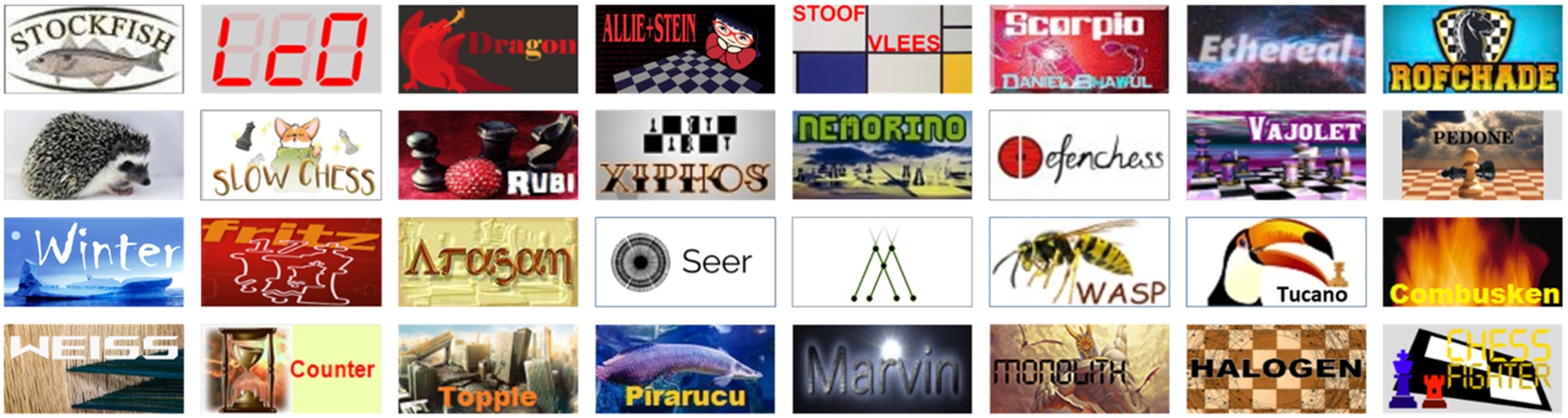
TCEC Cup 8 engines (CPW, 2021; TCEC, 2021) in seed order (StockfishChessFighter).
The matches of rounds 1 and 2
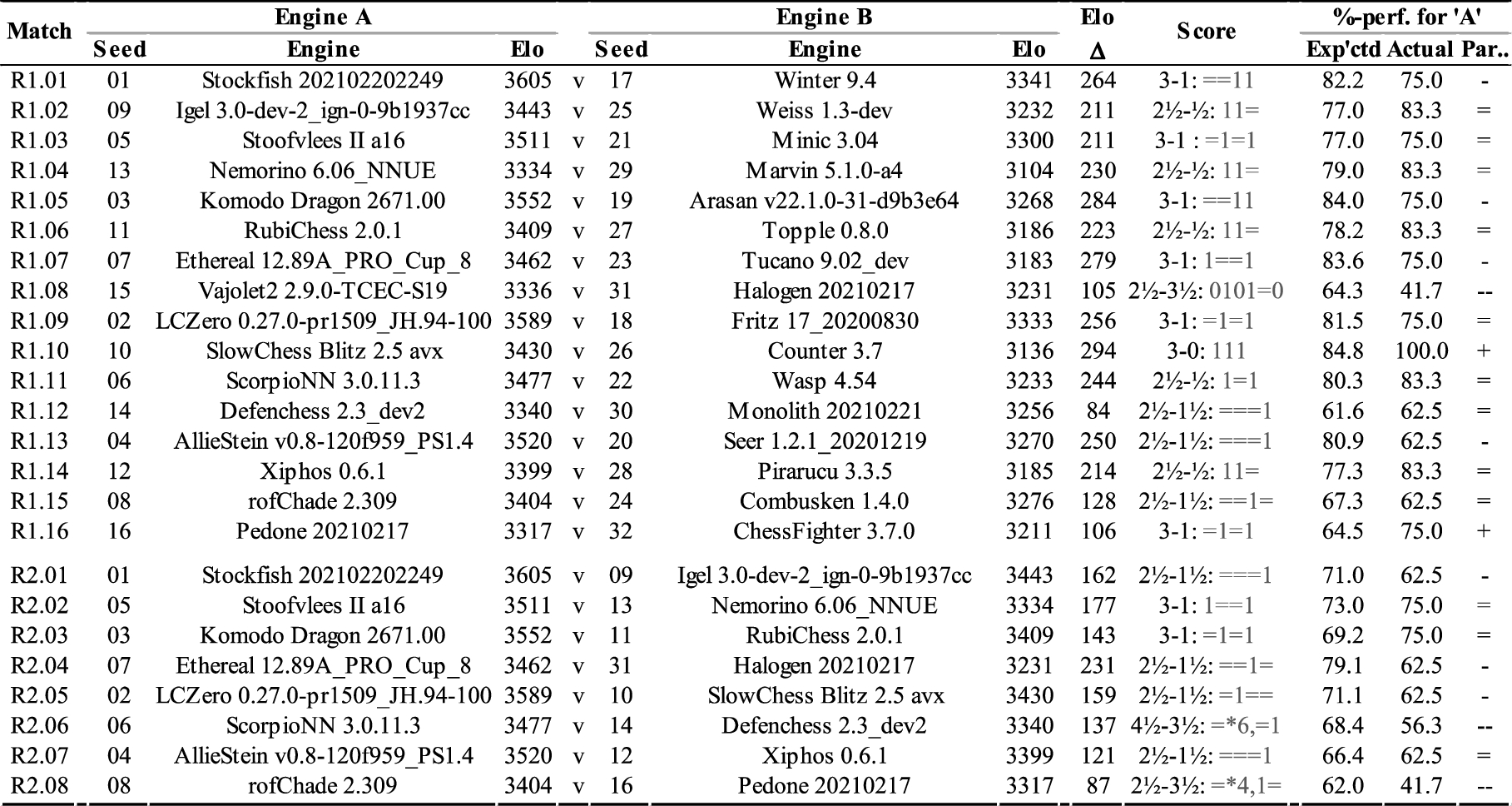
Winter, Arasan and Tucano were the first engines to play better than par. Monolith had the best chance to overturn the seedings with a nominal Elo deficit of just 81. Notably, Seer later achieved three draws against fourth seed AllieStein. While resistance was not futile, it was in each of these cases sadly unavailing. However, there was one cupset and what a scrap it was – no quarter given. Seeded low down the order at 31, Halogen beat Vajolet2 by three bloody strikes to two. In this stand-out match, there were five wins in six games. Halogen newly sported an innovative, ‘incrementally updated’ neural network developed and trained using the OpenBench framework from Andrew ‘Ethereal’ Grant (2021). In some sort of coincidence, Ethereal and Halogen were to meet in match four of the next round with NNUE support on both sides.
So,
Alongside the ‘Actual’ column, ‘+’ (‘-’) indicates an excess (shortfall) of a ½-point vis-à-vis Engine A’s ‘par’ score.
with one exception, the top half of the seeding remained intact. The average Elo deficit for round 2 was reduced to 152, higher seeds now expected to average a 70% score. Stockfish–Igel also featured NNUE on both sides as did Komodo Dragon–RubiChess. What now distinguishes one NNUE engine from another: net dimensions, training, ? We welcome input on this.
TCEC Cup 8: the results of the round 1 and 2 matches from engine A’s perspective3
The first five matches ended in the regulation four games so none of the three all-NNUE contests was as protracted as expected. Igel, Halogen and Slowchess Blitz recorded notable but losing performances. Then Defenchess stopped the show, rescuing one apparently lost game after another, and taking the match with ScorpioNN to eight games. Four of these were over 100 moves and one, g21, was over 200 moves long. ScorpioNN may have missed wins in games 1, 2 and 6 but eventually prevailed. Will Defenchess find a permanent home in at least Division 1 in TCEC season 21?
AllieStein–Xiphos finished in an unusual PPP-r draw. Pedone let a win slip away in game 33 with 52.c4 which kibitzer Crystal also expected. Via Karsten Müller, the redoubtable endgame analysts Petronijevic and Sullivan (2021) independently confirmed that c4 was a mistake and that 52.Rg4 won with subtle play: it would have been fascinating to watch. The self-stalemate engineered by rofChade came in five moves so it’s strange that kibitzing engine Crystal, a more tactical version of Stockfish by Joseph Ellis, fell into this trap. Unshaken by this missed opportunity, Pedone finally provided the upset of the round, finding sufficient advantage in the Scandinavian tiebreak opener where rofChade did not.
The quarter-final, semi-final, bronze and final matches
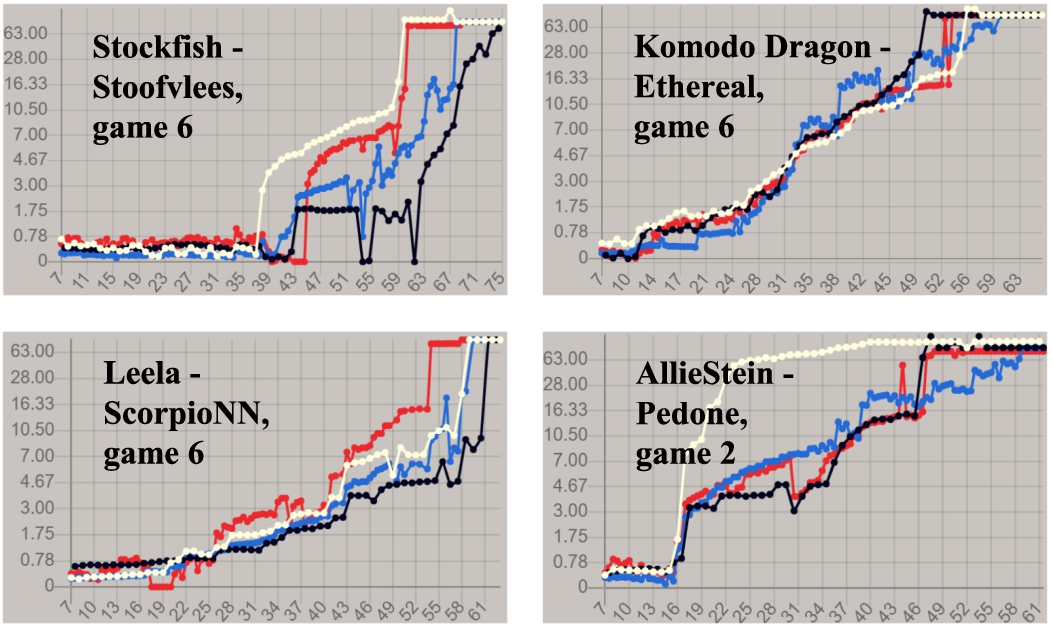
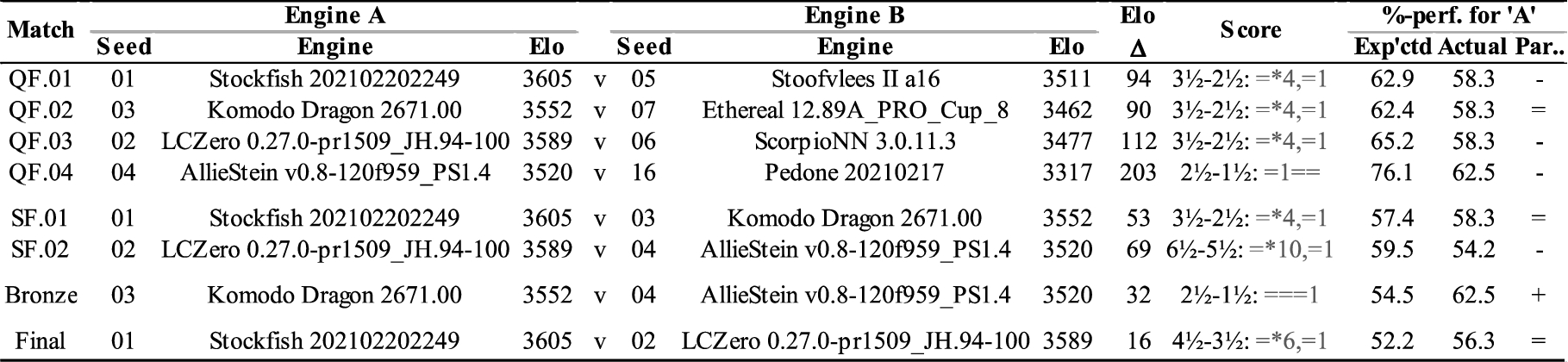
With the departure of rofChade, we were looking at the first all-NN TCEC Cup quarter-final. The Elo delta would have averaged 103 but was up at 125 with Pedone in the lists. The top four had looked solid if unspectacular so far. Stockfish–Stoofvlees moved into extra time and became the first of three six-game matches, the favourites just prevailing in each case. Leela-ScorpioNN treated us to an asymmetric RR-q battle from move 20. AllieStein saw an early opportunity in its second game against Pedone at move 16 and moved easily to a lead it did not give up. The evaluation graphs of Fig. 2 indicate the nature of the four wins.
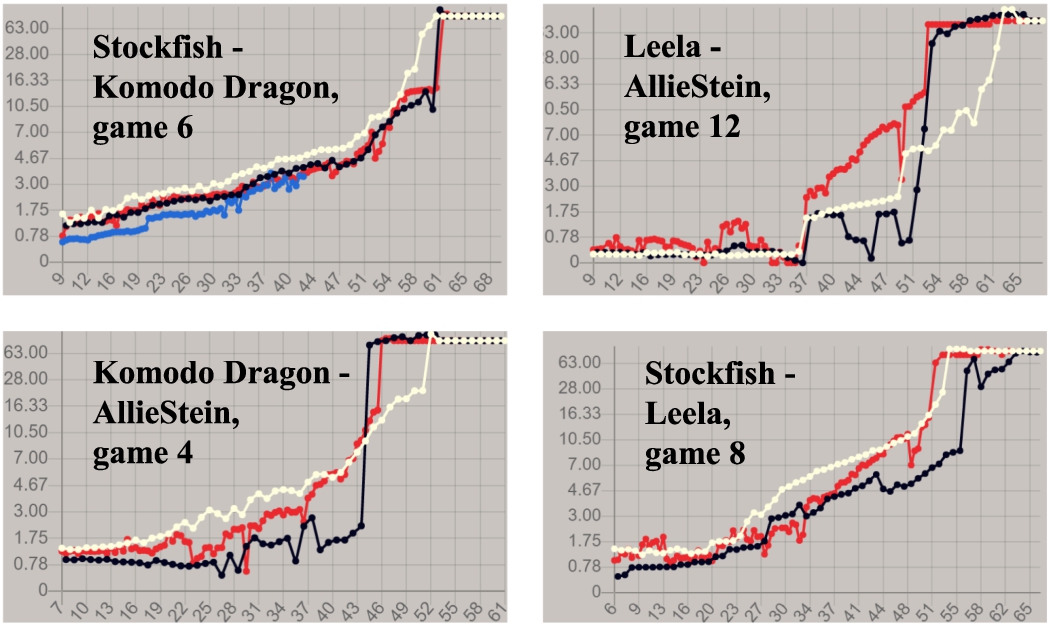
Another first! Stockfish–Komodo Dragon was the first all-NNUE TCEC Cup semi-final match. Elo and training-time were both on the side of Stockfish. After five draws, it was immediately clear that Stockfish was much more positive than The Dragon about White’s chances in the mandated Pirc opening. It climbed away without hesitation to an effortless win, see Fig. 3. Leela Chess Zero and AllieStein were in the trenches for eleven draws before Leela finally got the advantage of two passed pawns in a QR-qr endgame featuring the heavy pieces. The bias of the last opening was the largest but was still assessed by the engines as less than 0.3 ‘pawns’.
The evaluation graphs for the four decisive quarter-final games.
Both the Bronze match and the Final were contests between NNUE and NN engines, minimax search with alpha-beta cut off versus Monte Carlo search. In the Bronze match, AllieStein seemed to have good chances in game 3, a well biased Czech Benoni defence opening. These peaked around move 66 but then dropped suddenly and evaporated: a missed chance perhaps. Komodo Dragon in reply moved smoothly away as White while AllieStein was unaware of what was to come, see Fig. 3.
In the Final, the first three openings seemed to have a bias of less than 0.6 ‘pawns’ but the fourth opening, the Scandinavian Defence, seemed more attractive to Stockfish at ‘+0.9’. After six draws, Leela again failed to score in game seven. In reply, Stockfish always felt more than one pawn ahead, moved away from move 20 and hardly took a step backwards. Thus, classic minimax search with alpha-beta cut off triumphed two-nil over Monte-Carlo search. Once again, ‘benchmark’ Stockfish picked up the two major TCEC trophies. Our congratulations to all its many connections.
TCEC Cup 8: the results of the QF, SF, Bronze and Final matches from engine A’s perspective
Evaluation graphs: Semi Final match games 6 and 12, Bronze match game 4 and Final game 8.
References
1.
CPW (2021). https://tinyurl.com/icga046. Biographies of chess engines, authors and developers.
2.
Grant, A. (2021). https://github.com/AndyGrant. Andrew Grant, Ethereal and OpenBench.
3.
Haworth, G.McC. & Hernandez, N. (2021a). The 20th Top Chess Engine Championship: TCEC20. ICGA Journal, 43(1), 62–73. http://centaur.reading.ac.uk/95189/adds pgn files and further data.
4.
Haworth, G.McC. & Hernandez, N. (2021b). TCEC Cup 8. ICGA Journal, 43(1), 88–91. This note plus supplementary pgn files with game completions athttp://centaur.reading.ac.uk/96309/.
5.
Petronijevic, Z. & Sullivan, C. (2021). Private correspondence re the r2 g33 ‘stalemate’ game.
6.
TCEC (2021). https://tcec-chess.com/#x=archive. The TCEC archive site.