



Abstract
In this paper we investigate the game of Konane, using Combinatorial Game Theory and game-specific solving strategies. We focus on narrow rectangular boards (
The initial board contains black and white stones in a checkered pattern, with a gap of two adjacent empty squares to enable moving. Only capture moves are possible. Depending on the exact location of the initial gap (the setup) we have four classes of initial Konane boards (two for Linear Konane), namely all combinations of a horizontal or vertical setup in the middle of the board or at a corner.
For solving narrow Konane boards two notions proved very useful. First, we define moves that cannot be prevented by the opponent as safe moves of a player. Second, two fragments are independent if there is no way they can ever interact.
Using these two notions Linear and Double Konane have been completely solved. Triple Konane was solved except for the horizontal corner setup. For Quadruple Konane only the vertical setup in the middle of the board was solved.
Introduction
Konane, also known under the name Hawaiian Checkers, is a traditional two-player game invented by the Hawaiian Polynesians. It is played on a rectangular board, by two players governing the black and the white stones. Every move is a capturing move diminishing the number of opponent stones. The first player unable to move loses the game, the opponent being the winner. The game is a perfect-information game with no chance involved. By these characteristics it is a combinatorial game (Albert et al. (2007); Berlekamp et al. (1982); Conway (1976); Siegel (2013)). Hearn (2009) has shown that Konane is PSPACE-complete.1
Note that this paper has two contradicting rules for determining the winner in Konane (Hearn (2009), pages 288 and 297), i.e. that the first player unable to move wins or loses the game, respectively. In fact these two definitions denote the normal and misère play condition in combinatorial games. All other literature on Konane inspected uses the normal play condition, and we stick to this convention. However, the proof of the PSPACE-completeness does not depend on the play condition and hence applies to either Konane variant.
Traditionally the game was played on rectangular boards with 8 to 13 rows and 8 to 20 columns, though other sizes were also reported, like a
We can view the board as consisting of two sets of squares, the dark squares that only can contain black stones and the light squares reserved for white stones. For illustrative purposes in all diagrams in this paper we use gray cells for dark squares and white cells for light squares.
Note that (multi-)jumping does not change the type of squares (dark or light) of jumping stones.
The literature is vague about the exact initial removal of the two stones (the setup), except that they must be removed either from the middle of the board or from a corner and that they should be orthogonally adjacent. Sometimes the setup is part of the game, where Black starts by choosing to remove a black stone from the middle of the board or from a corner, followed by White choosing to remove a white stone horizontally or vertically adjacent to the black stone removed. After that the actual game starts. We will describe the exact setups used in Section 3.

A single-capture move (above) and a multi-capture move (below) in Konane.
The literature on Konane is scarce. In 1976 a short introductory paper appeared suggesting Konane as a suitable vehicle for teaching AI methods (Gyllenskog (1976)). A few papers deal with building Konane playing programs, based on neural networks (Thompson (2005)) or based on a plain
Ernst (1995) in Playing Konane Mathematically gives a first and most appropriate research on Konane for our purpose. Ernst first gives values of positions and patterns; however, unlike our analysis the Konane positions he investigated are on infinite strings. He next investigates the notion of penetration of a fragment, being the largest distance a piece within a fragment can reach with any sequence of legal moves outside the boundary box of the fragment in some direction. The idea is that when the orthogonal distance between two fragments is larger than the sum of their penetrations towards each other, they never can interact, and consequently the component value is the disjunctive sum of the values of the fragments (see further Section 3.2).
Chan and Tsai (2002) in
Dos Santos and Silva (2008) show in Konane has Infinite NIM-Dimension that in Konane any nimber
Finally a recent bachelor thesis by Kirk (2020) reports solving many Konane boards based on
Combinatorial game theory for Konane
Konane is a two-player, perfect-information game without chance. The game necessarily ends due to the fact that every move is a capturing move, lowering the number of stones on the board by at least 1. By these rules Konane belongs to the class of combinatorial games, for which a whole theory has been established, the Combinatorial Game Theory (further CGT in short) (Berlekamp et al. (1982); Conway (1976)). Under the usual win condition for combinatorial games the last player able to move wins the game, i.e., as soon as a player is unable to move they lose. Both players have different moves, so Konane belongs to the category of partizan combinatorial games.
In this section we give a small introduction to the CGT as applicable to Konane. For a more thorough introduction we refer to several text books on CGT, like the notorious On Numbers and Games by Conway (1976) and the magnificient Winning Ways series (Berlekamp et al. (1982)). More recently (Albert et al. (2007)) and (Siegel (2013)) are good introductory texts. In the following we show values for several Konane positions, that are helpful in solving larger Konane positions in the remainder of the paper. Whereever we give CGT values for Konane positions we have checked them using the CGSUITE software package (Siegel (2020)). Moreover, with the help of Kirk’s 2020 solving program it was checked if our values belong to the outcome classes found by her program.
Konane and CGT
Like all partizan combinatorial games Konane positions are represented by their options, which are the positions which can be reached in one move, separately for the left player (Black) and the right player (White). Formally, a position G is represented as The class The class The class The class
Konane positions with integer values
For Linear Konane positions consisting of alternate pairs of a black stone and a white stone starting with a black stone at a corner we show that they have zero (outcome class
If there are k such pairs with

Linear Konane positions with zero or positive integer values.
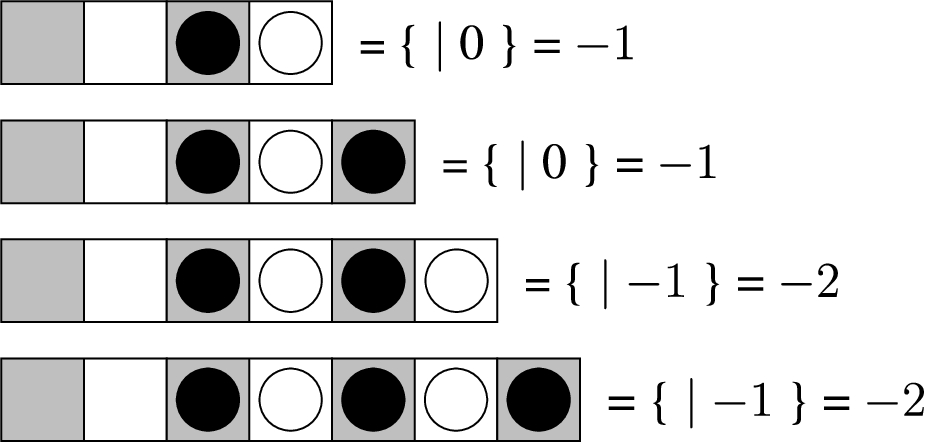
Another type of positions with negative values is obtained from the ones in Fig. 2 by adding one additional black stone directly to the right of the chain. Then it is White that can move, without Black being able to interfere, so the values are the negatives of the ones from Fig. 2, as shown in Fig. 3.
Note that any position without possible moves for either player has value

Linear Konane positions with zero or negative integer values.
These examples show that Konane positions can have any integer CGT value.
Apart from integer values Konane positions can also have fractional numeric values, as exemplified in Fig. 4.
Of course symmetrical positions with reversed roles for Black and White have negative fractional values. By combining Konane positions with appropriate numeric values it is evident that positions can have any value of the form
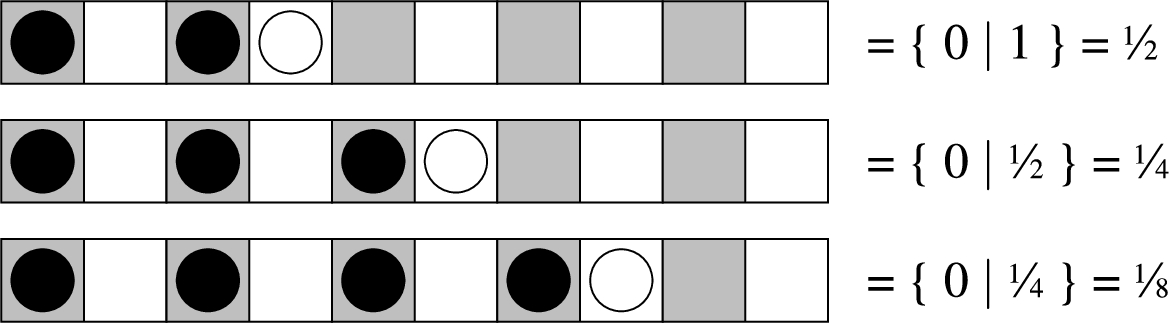
Linear Konane positions with positive fractional values.
Konane positions also can have infinitesimal values (which are values smaller than any positive number and larger than any negative number). Some of these are exemplified in Fig. 5.
All Konane positions in Fig. 5 have infinitely small values, incomparable with 0, where the first player to move wins (so belong to outcome class
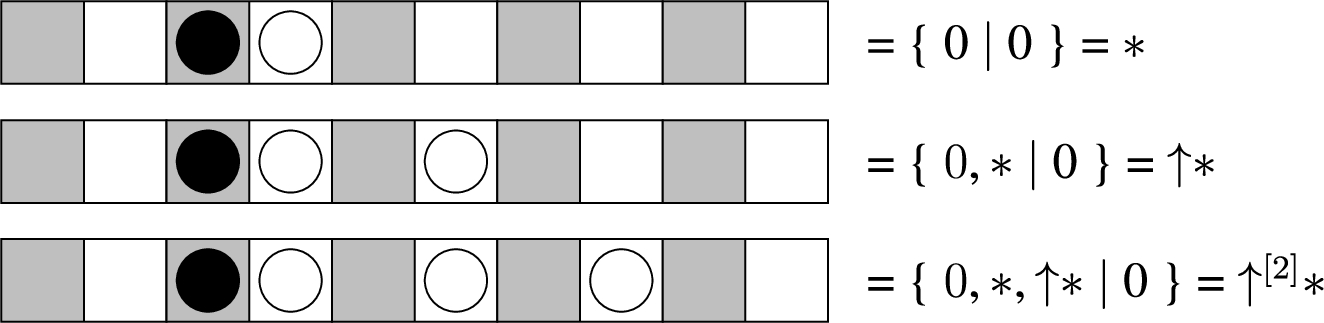
Linear Konane positions with infinitesimal values.
The value
It is easy to prove that for Konane a position with value
In Konane any position with value
The proof is done by induction. The base case is any position with value
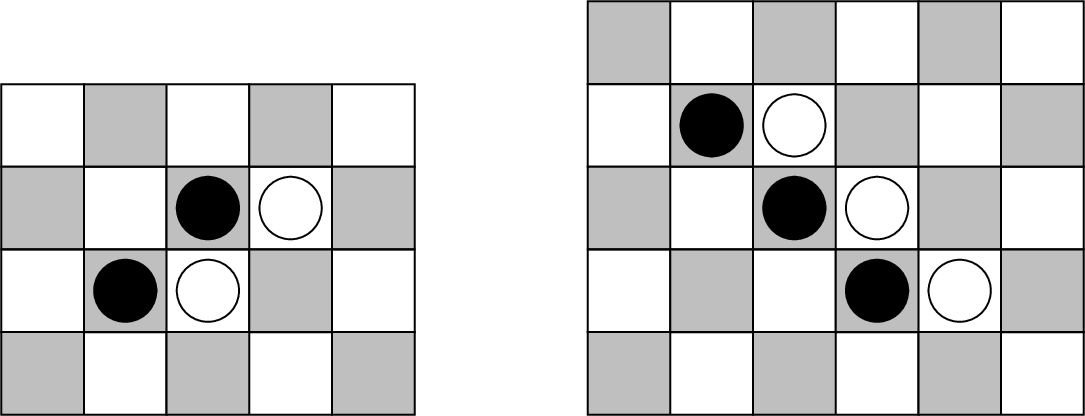
Examples of
Larger nimbers rarely occur in Konane, though Dos Santos and Silva (2008) give a construction to build a Konane position with an arbitrary nimber value, which means that Konane is a game with infinite Nim-dimension.
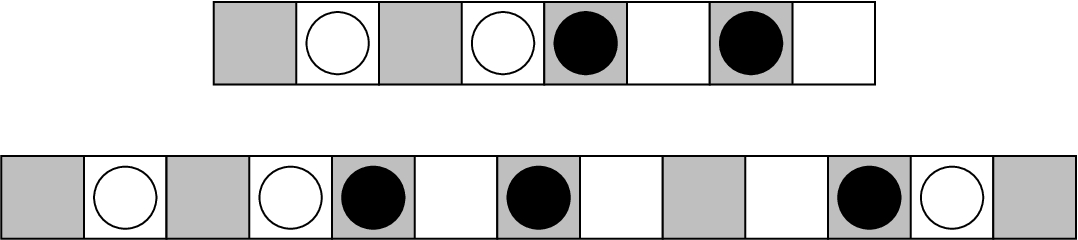
Examples of linear
In this section we define some preliminary notions used throughout the remainder of this paper. As a convention, when an
Setups of starting positions
As already mentioned in the introduction, there are several possibilities for the starting position on a given rectangular board. We define four initial setups, two at the middle of the board (denoted as M-setups) and two at a corner (denoted as C-setups). These setups mark which two stones are removed from a rectangular board completely filled with black and white stones in checkered pattern to enable the players to start moving.
The setups defined below are the ones most often used, though rarely other setups are mentioned. We note that the solving techniques described in this paper mostly can be applied to such setups as well (but possibly leading to other outcomes).
Setups at the middle of the board
As said the precise rules of the game are not completely clear on which two squares should be emptied before the game starts when the middle of the board is chosen. We fix these in the following definitions, depending on the number of rows and columns being odd or even. The Horizontal-Middle setup (H-M-setup) consists of removing two horizontally adjacent stones from the board as follows. If the number of rows is odd, this removal occurs at the middle row, otherwise from the row immediately below the horizontal middle of the board. From this row, if the number of columns is odd, the middle stone is removed plus the stone immediately to the left of it, otherwise the two stones adjacent to the centre of the board are removed. The Vertical-Middle setup (V-M-setup) consists of removing two vertically adjacent stones from the board as follows. If the number of columns is odd, this removal occurs at the middle column, otherwise from the column immediately to the left of the vertical middle of the board. From this column, if the number of rows is odd, the middle stone is removed plus the stone immediately below it, otherwise the two stones adjacent to the centre of the board are removed.
If a corner is chosen to start a game, we again have some freedom in the exact setups. We fix these setups in the following definitions. The Horizontal-Corner setup (H-C-setup) consists of removing two horizontally adjacent stones from the left-down corner. The Vertical-Corner setup (V-C-setup) consists of removing two vertically adjacent stones from the left-down corner.
To enhance legibility we will sometimes omit the exact setup used from the board notation when it is clear from the context.
Konane fragments can possibly interfere or they are definitely unable to interfere. To describe this more precisely we use the notion of independence of fragments. Two Konane fragments are called independent if there is no sequence of legal moves such that any stone in one fragment ever can capture any stone in the other fragment.
We give an example position on the
Though rather complicated at first sight, closer inspection reveals that all fragments are independent. There are five fragments (within the dashed boxes), three in the upper row and two in the lower row. Since the middle row is empty the fragments in the upper row cannot interfere with those in the lower row. Moreover, since the fragments within a row are always separated by (at least) 3 empty squares, they also cannot interfere (see Theorem 2 in Section 4.1 for a formal proof). The fragments in the upper row, from left to right, have values
If White starts, the single capture in the ↓∗ fragment leads to a sum value of 0, losing for Black. If Black starts there are two sensible moves: the black move in the ∗ fragment is countered by White multi-jumping in the ↓∗ fragment, while the black move in the ↓∗ fragment is countered by White moving in the ∗ fragment, both leading to a position with value 0, so losing for Black. Other Black moves are even worse.
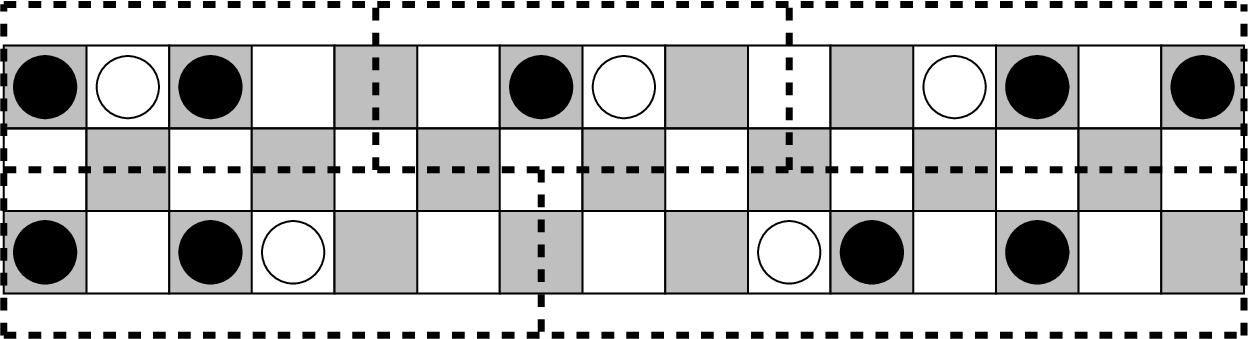
A position with five independent fragments.
In partizan combinatorial games, where players can build a reserve of moves, called safe moves, the number of safe moves often plays a pivotal role in solving the game. This is, e.g., the case for the well-known game of Domineering (Uiterwijk (2014)), but as will be shown this also holds for Konane, especially for narrow boards.
A safe move in a Konane position is defined as follows. A move in Konane is safe if the opponent cannot prevent this move. This means that there is no way that the opponent can remove the capturing stone of the safe move nor can move the stone to be captured by the safe move.
Examples of safe moves in Linear Konane are given in Figs 2 and 3. Note that in the third position from above in both figures the number of safe moves of Black/White is two, of which one is a future safe move (becoming available after the first safe move is played). Likewise, in the fourth position from above in both figures the number of safe moves of Black/White is three, of which two are future safe moves.
According to the Combinatorial Game Theory, the number of black safe moves is added as positive integer to the total CGT value of the position, the number of white safe moves as negative integer.
Obviously only the H-setups apply to Linear Konane. In this section we first give a better specification of independence of fragments for
Independence of Linear Konane fragments
For
If a
Suppose arbitrarily that the separation of three empty squares involve from left to right a dark, a light and a dark square, indexed by integers i,
For starting positions of Linear Konane we can even do better, as expressed in the following theorem.
If a
First note that if there is a gap of exactly two neighbouring squares, the gap is bordered by one black stone at one side and one white stone at the other side. On the black-border side only White can move and all his moves are safe. On the other side only Black can move and all his moves are also safe. Further, when a player is able to make a multi-jump, the longest multi-jump is always best.5 This can be proven using CGT, since refraining from making a longest multi-jump grants the opponent the opportunity to use a stone, that could have been captured. Since this will never hurt the opponent (delaying the use of any safe moves as long as possible is always beneficial), they will gratefully accept this opportunity. As a consequence, the longest multi-jump is always dominating shorter jumps with that stone and we know from CGT that such dominated options can be neglected.
Note that due to Theorem 3 the CGT values of the starting positions of Linear Konane are easy to determine, since every
Using Theorem 3 we are able to provide values for arbitrary
boards for
In Fig. 9 we give CGT values for the four smallest non-trivial
We now distinguish four cases for larger linear boards, always applying Theorem 3 to determine the CGT values.
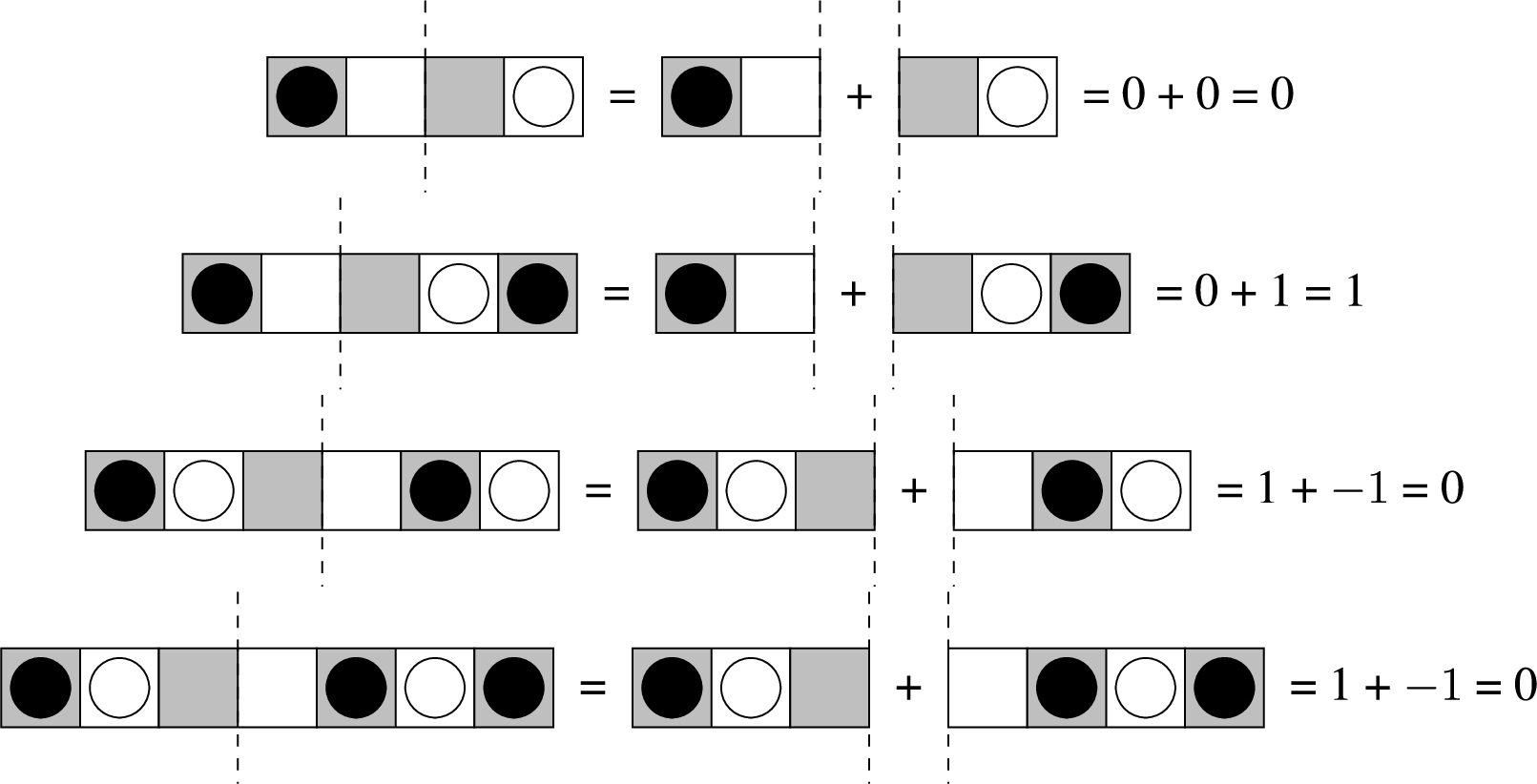
The initial boards and values for the
In Fig. 10 we give the starting positions for the
In the upper position the left part has value
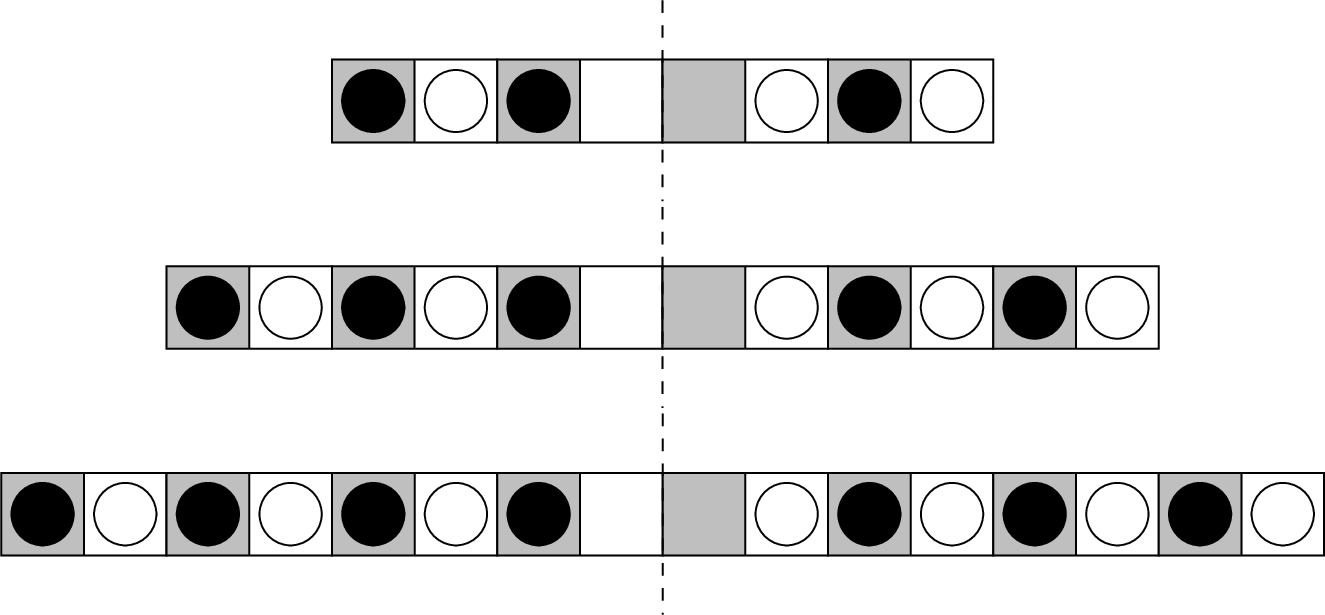
The starting positions for the
In analogy with Fig. 10 we give in Fig. 11 the starting positions for the
In the upper position the left part has value
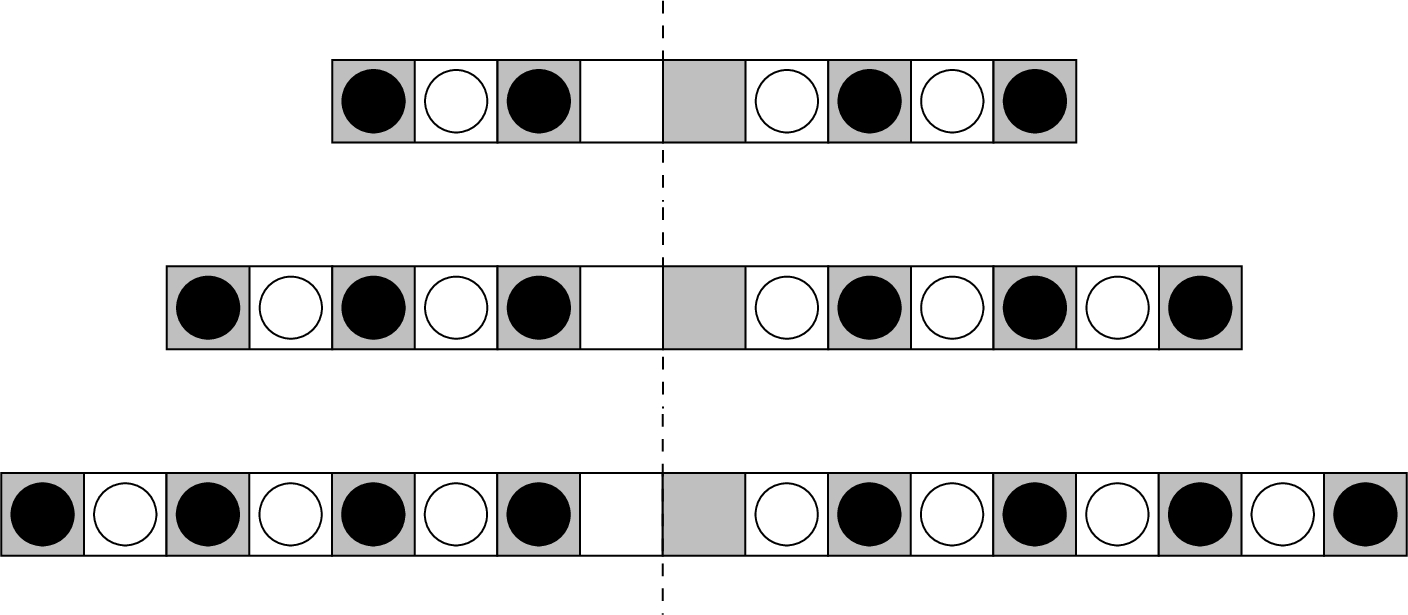
The starting positions for the
We give in Fig. 12 the starting positions for the
In the upper position the left part has value
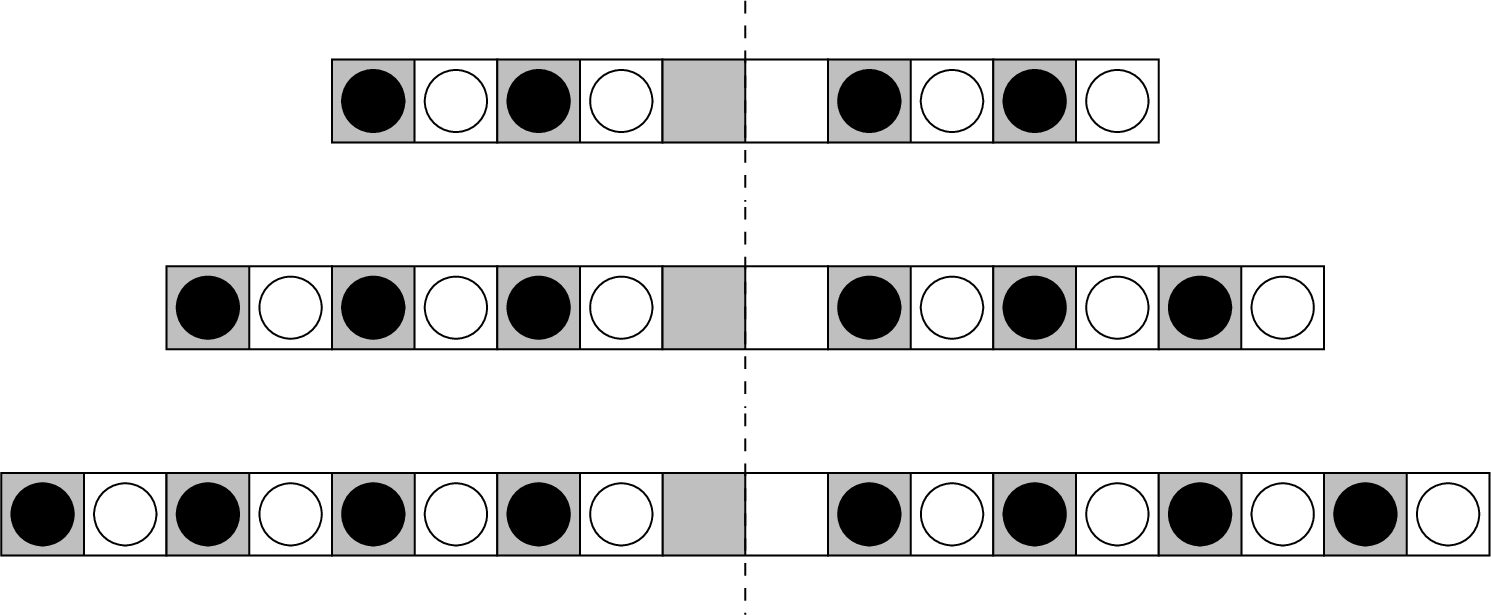
The starting positions for the
We give in Fig. 13 the starting positions for the
In the upper position the left part has value
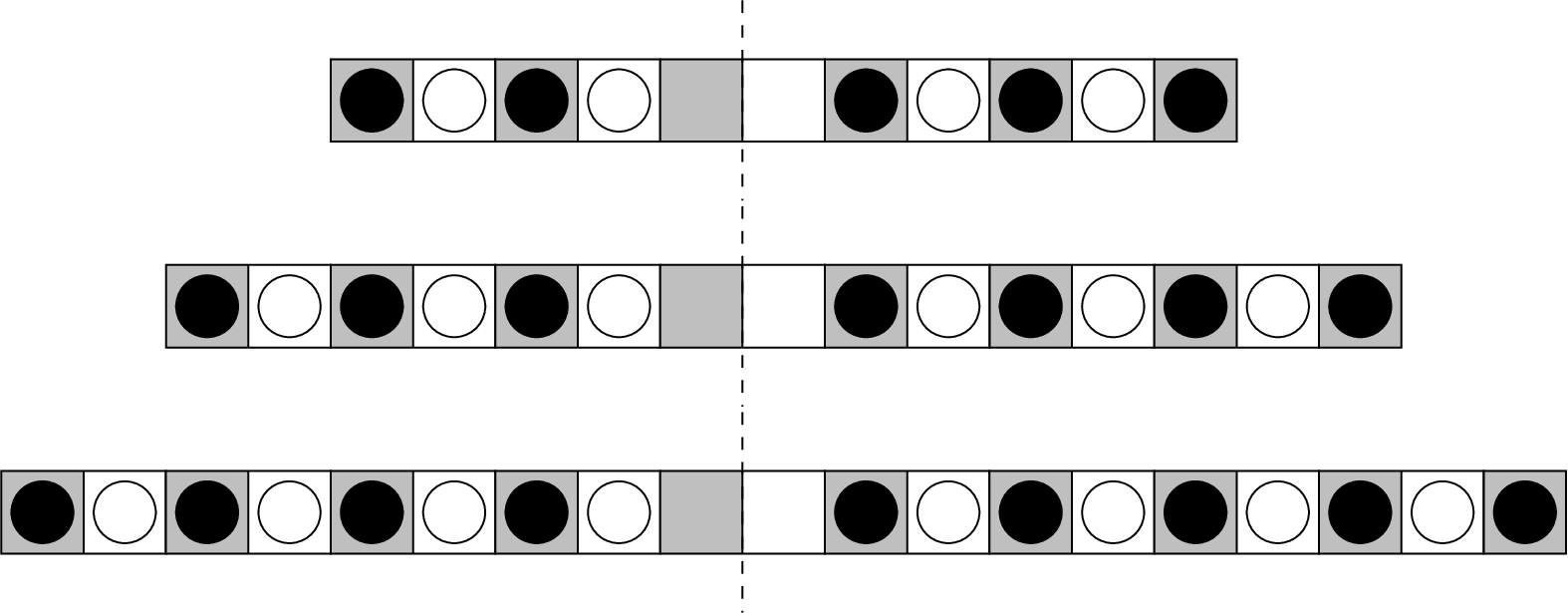
The starting positions for the
We summarize our results in the following Theorem 4.
This follows directly from the base cases (
The smallest
Obviously this pattern continues, leading to Theorem 5.
The CGT value of an
This follows directly from the pattern depicted above. □
As defined here the term “completely solved” is not the same as “strongly solved” as proposed by Allis (1994). The latter means that the value of any position resulting from legal play is known, whereas the first term only concerns the starting position of a board.
The initial boards and values for some
With Double Konane we denote finite
CGT values of
-V-M Konane boards
Using the Vertical setup we always start with a completely filled board, except that one column (so two vertically adjacent squares) in the middle of the board is empty.
On further investigation Double Konane appears to be a trivial game. The underlying cause is that on a Every If Black starts, after every black move White has the option to “copy” this move in the other row, maintaining exact opposite-color symmetry of the two rows. This guarantees White to make the last move and win. If White starts, Black wins using the same strategy. So the board is a second-player win with CGT value 0. □
In Fig. 15 (upper position) we see that whoever plays first (suppose Black) has only two (symmetric) options. Choosing the left-to-right move the second position in Fig. 15 is reached. According to the strategy White, having three options, can choose the symmetric one in the other row, leading to the third position in Fig. 15. White can always use this strategy, guaranteeing him the last move and win (in this example leading to the final position in Fig. 15). Of course when White starts, Black can follow similarly, leading to a black win. Note that this strategy can be applied to any
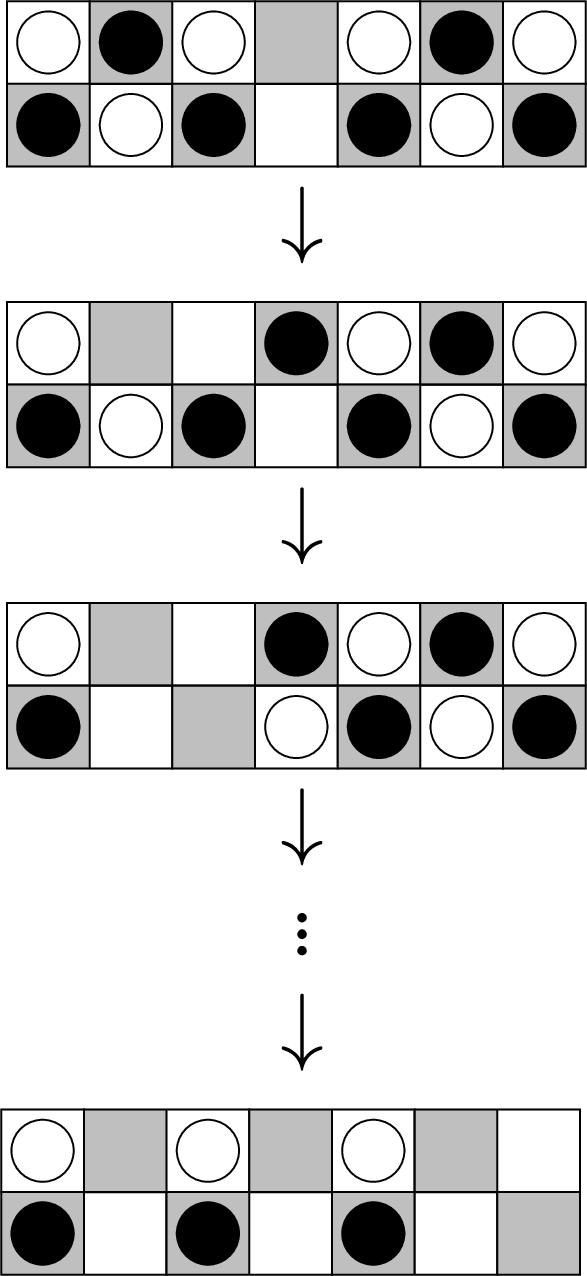
Example game on the
Although this strategy guarantees the second player a win, it does not necessarily lead to the shortest win. Note that in the starting position, in one row only Black can play, in the other row only White. Suppose again that Black starts. After every black move in one row, White can respond in the same row, until Black is out of moves and White wins. Since Black never can play in the other row, this game necessarily is shorter. Applying this to the
Using the Horizontal setup, a Double Konane board contains one fully filled row, whereas the second row has 2 horizontally adjacent empty squares in the middle of the row.
Double Konane with this setup is also trivial. The underlying cause is that again no vertical moves are possible, but also that no moves in the completely filled row are possible. As a consequence Double Konane using the Horizontal setup essentially is a Linear Konane game with an adjacent full row not interacting with the game. This is expressed in Theorem 7.
Every
The proof trivially follows from the upper row being unable to interact with the game, since neither vertical moves are possible using this row nor horizontal moves in this row. □
It is evident that the upper row has no influence whatsoever on the possible moves, and that the lower row is just a Linear Konane board (in this specific case the
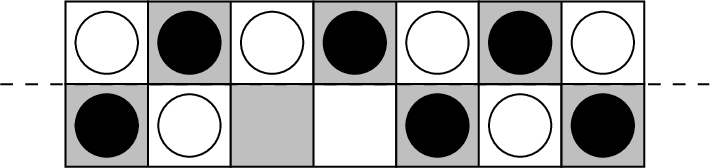
The initial position of the
For Double Konane with V-C-setup the second player can again use the opposite-colory strategy as in Double Konane with V-M-setup to secure the win. This is expressed in Theorem 8 and exemplified by Fig. 17. Every The proof is identical as the proof of Theorem 6. □
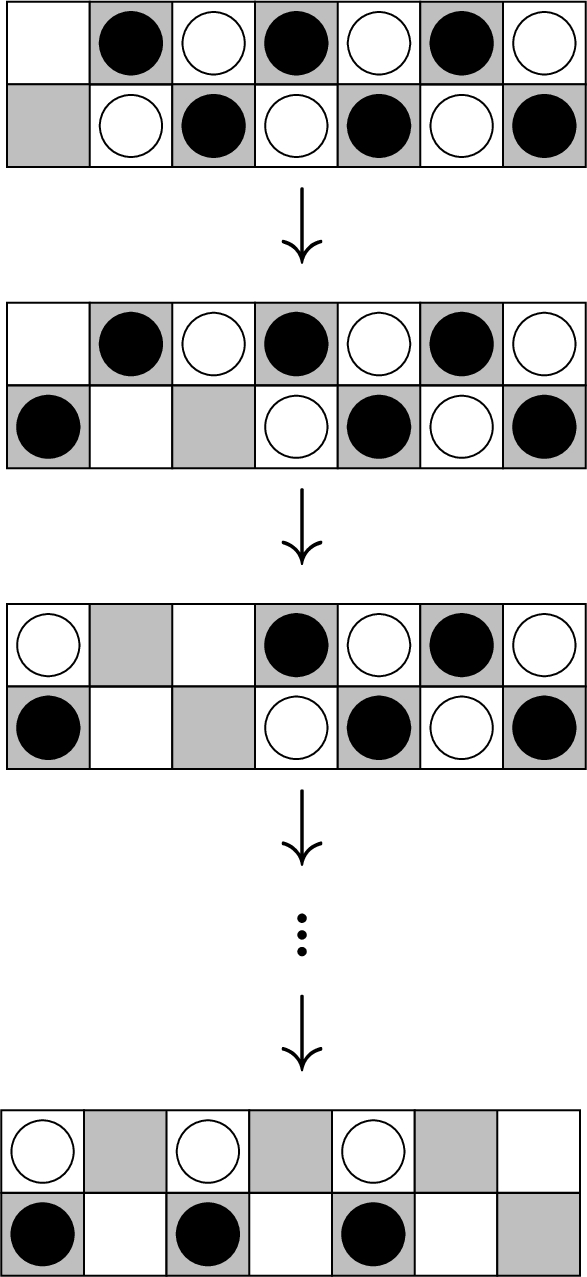
Example game on the
Regarding Double Konane boards with the H-C-setup the same reasoning as in Double Konane with the H-M-setup reveals their CGT values as expressed in Theorem 9 and exemplified in Fig. 18.
Every
The proof is identical as the proof of Theorem 7. □
This position is equivalent with the
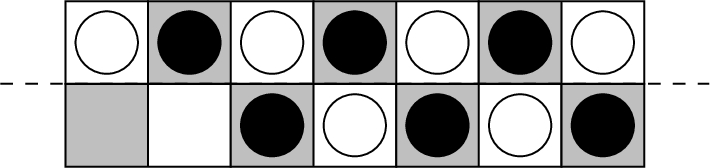
The initial position of the
As a consequence of the theorems in this section, Double Konane with either Horizontal or Vertical setup in the middle of the board or at a corner is also completely solved.
In this section we investigate
CGT values of
-V-M Konane boards
Using the V-M-setup we always start with a completely filled board in a checkered fashion, except that one column contains a single stone at the upper row (so two vertically adjacent squares below it are empty) in the middle of the board.
On further investigation Triple Konane with V-M-setup also is trivial. The underlying cause is that on a Every The proof is identical as the proof of Theorem 6. □
Although this board is not equivalent with the
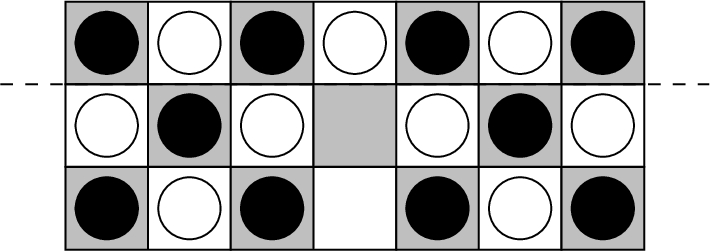
The initial position of the
Like in Double Konane this strategy not necessarily results in a shortest win for White. However, Theorem 10 guarantees that the second player can always win Triple Konane boards with V-M-setup.
Using the H-M-setup we always start with a completely filled board, except that the middle row contains two adjacent empty squares in the middle of the board.
On further investigation Triple Konane with the H-M-setup also is trivial. The underlying cause now is that on a
Every
The proof trivially follows from both the lower and the upper row being unable to interact with the game, since neither vertical moves are possible using these rows nor horizontal moves in these rows. Since the middle row starts with a white stone at the left side, the value of a
This position shows that any
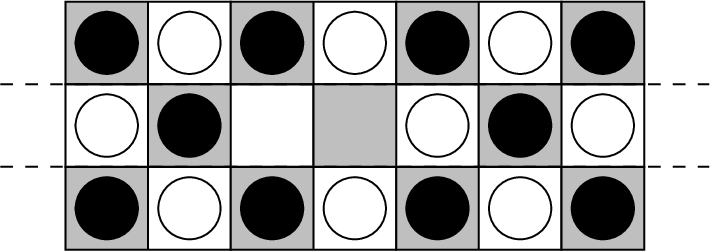
The initial position of the
For the V-C-setup in Triple Konane the same opposite-color strategy as in Triple Konane with the V-M-setup guarantees a win for the second player. This is expressed in Theorem 12 and exemplified in Fig. 21. Every The proof is identical as the proof of Theorem 6. □
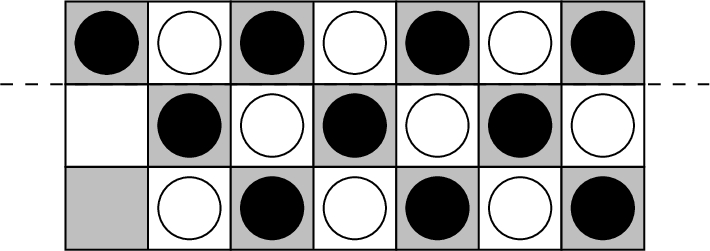
The initial position of the
As a consequence of the theorems in this section, Triple Konane with either V-M- or H-M-setup as well as with V-C-setup is also completely solved. For Triple Konane with H-C-setup no general proofs have been found, so their CGT values have to be determined “by hand”.
In analogy with Double and Triple Konane we denote finite
CGT values of
-V-M Konane boards
Using the V-M-setup we effectively start with a Double Konane board with V-M-setup, flanked above and below by a completely filled row. Therefore, Quadruple Konane with the V-M-setup also is trivial. The underlying cause is that at the start the lower and upper row are completely filled, so both players can only start in one of the two middle rows with a horizontal move. Now the second player can adopt again the opposite-color strategy to secure a win, as expressed in Theorem 13. Every The proof is identical as the proof of Theorem 6. □
Theorem 13 shows that any
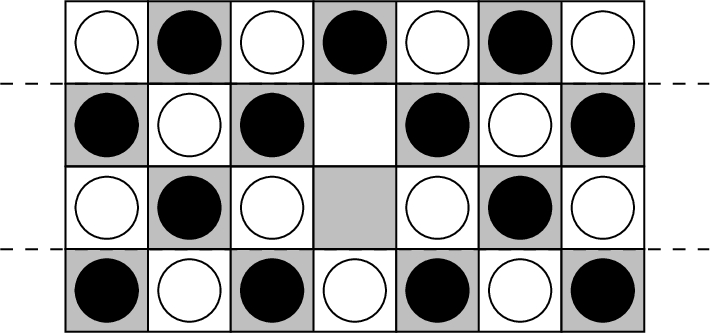
The initial position of the
We showed that the concept of safe moves is important for Konane. Moreover, from CGT it is known that a position with independent fragments has as value the sum of the values of the fragments. For Linear Konane we showed that a gap of three subsequent empty squares guarantees independency of the fragments. If only safe moves are present, we proved that this gap can be narrowed to just two empty squares. Based on these findings with the support of a useful copy strategy we then solved many classes of narrow Konane boards.
Firstly, for Linear Konane we proved that
Secondly, for Double Konane with both vertical setups (in the middle of the board and at a corner) an easy copy strategy proved that all boards are second-player wins (value 0). For both horizontal setups (middle and corner) we showed that their values are equal to the corresponding Linear Konane boards, ignoring the fully-filled row. Therefore, Double Konane is also completely solved.
Thirdly, for Triple Konane boards with both vertical setups (middle and corner) the same copy strategy of Double Konane proved them to be second-player wins (value 0), whereas the horizontal setup in the middle of the board was again equivalent to Linear Konane, ignoring both fully-filled rows. The horizontal corner setup has not been solved so far.
Fourthly, for Quadruple Konane we were only able to solve boards with the vertical setup in the middle of the board using the copy strategy, being second-player wins (value 0). For the other three possible setups no general solutions were found.
As mentioned in Section 1.1 sometimes the setup is part of the game, with Black having the choice of removing a black stone either from the middle of the board or at a corner, after which White has the choice of removing a white stone horizontally or vertically adjacent to the black stone removed. In this case the outcome of a game is determined fully by the dimensions of the board. For Linear Konane Black only wins
For future research we are interested in other strategies and/or patterns to determine values for classes of Konane boards unsolved so far. For the missing Triple and Quadruple Konane classes we determined values of several small and medium-sized boards, but were unable to find any patterns. Maybe deeper analysis might reveal useful insights.