



Abstract
Bat algorithm (BA) has the advantage of fast convergence, but there is still room for improvement in accuracy and stability of solution. An efficient and robust fusion bat algorithm (ERFBA) is proposed to overcome these defects. In the population reconstruction, an effective diversity population (EDP) is reconstructed by designing a multi-strategy opposition-based learning with disturbance. In the exploration, an adaptive constraint step whale optimization algorithm is presented to obtain the promising regions with fewer blind spots by exploring EDP. In the exploitation, we design a new BA local search strategy by novel combination between dynamic regulation and Cauchy mutation to get accurate and stable solution. Numerous experiments show that ERFBA has remarkable advantages in accuracy and stability for many high dimension, unimodal and multimodal problems. Moreover, the proposed algorithm is further tested and applied in areas of intelligent data analysis and intelligent design. The results show that the overall performance of the proposed ERFBA is better than other existing algorithms.
Keywords
Introduction
Optimization is the key technology in the field of intelligent data analysis [1, 54]. Therefore, it is important to study optimization techniques before using them to solve data analysis problems. However, with the rapid development of modern industries [17, 22, 58, 71], there are a large number of complex problems which cannot be solved effectively by traditional methods. This change has brought new challenges in the field of optimization [9, 23, 61, 70, 75]. For such problems, meta-heuristic algorithms (MAs) show their superiority, due to their easy implementation and excellent search capability. This is why MAs have been considered as a better choice for solving many optimization problems [8, 25, 60, 74, 76].
In this context, many MAs were proposed to solve optimization problems. Such as Genetic Algorithm (GA) [15], Differential Evolution (DE) [51], Artificial Bee Colony (ABC) [19], Cuckoo Search (CS) algorithm [62]. Especially in recent years, more and more novel MAs have been proposed, such as Bat Algorithm (BA) [63], Grasshopper Optimisation Algorithm (GOA) [48], Sine Cosine Algorithm (SCA) [33], Whale Optimization Algorithm (WOA) [35], Salp Swarm Algorithm (SSA) [34], etc., which have attracted great research interest.
BA is one of the popular and new MAs, due to its advantages of few parameters, simple model and rapid convergence. As a consequence, BA has been widely applied in various complex optimization problems, such as association rule mining [49], continuous optimization problems [6], online control problems [50], image processing [73], classifications [36] and other problems. These show that BA has its promising efficiency for some practical issues. However, Original BA also has some disadvantages such as being easy to trap into local optima and unstable optimization results [11], which still need to be further improved.
Therefore, some modifications of BA have been proposed to improve its performance, such as iBA [2], I-BAT [3], CBA [12] and HBA [26], and these modifications of BA have proved to be promising effect on their specific issues. However, there are still three problems to be further considered. On the first hand, with the emergence of a large number of complex engineering models, the higher performance optimization algorithms have become imperative requirement in this field. On the second hand, as a young meta-heuristic algorithm, the inadequacy of accuracy and stability still puzzle the BA algorithm. Finally, according to the theorem of “no free lunch” [57], there is no universally better algorithms for solving all optimization problems. Thus, higher performance variants of BA is still in progress.
Based on the above analysis, the aim of this paper is to develop an efficient and robust fusion bat algorithm (ERFBA) that has better exploration and exploitation ability to obtain global optimum with high accuracy and stability. And the major contributions are listed as follows:
First, we design a multi-strategy OBL with disturbance (MD-OBL) to reconstruct an effective diversity population (EDP). Second, we propose an Adaptive Constraint Step Whale Optimization Algorithm (ACS-WOA) to enhance its exploration ability by obtaining the promising regions as far as possible. Third, we propose an improved BA local search strategy based on Dynamic Regulation and Cauchy Mutation (DR-CM-BA) to enhance the local search ability, ensure that a solution with high accuracy and stability can be obtained from the promising regions produced by ACS-WOA. Fourth, some experiments and comparisons are conducted to show that the proposed algorithm can achieve higher accuracy and better stability than other existing algorithms in many benchmark functions, especially for multi-dimension function optimization. Moreover, the proposed algorithm is further tested by two real world problems in the field of intelligent data analysis, the results show that it can also solve the optimization of gear ratio easily and obtain very good classification rate in multi-layer perceptron training.
The rest of this paper is organized as follows: Section 2 introduces the related works. Section 3 describes the theoretical basis. Detailed explanation about ERFBA is in Section 4. Section 5 presents the experimental results and analysis based on benchmark functions. Section 6 shows the experimental results and analysis based on two application problems. Some conclusions and prospects are given in Section 7.
Related works
In recent years, some modifications of BA have been proposed to improve its performance. According to the literature [30], there are two main types of improvements in different variants of BA, including the variants of its own mechanism and hybrid algorithms combined BA with other optimization methods.
The first one mainly depends on its own characteristics. For example, Meng et al. proposed a novel bat algorithm (NBA) which combined the bats’ habitat selection and their self-adaptive compensation for Doppler effect into basic BA, and then designed a new local search strategy to improve the performance of bat algorithm [30]. Xie et al. proposed a novel method that a differential operator was introduced to accelerate the convergence speed, and the Lévy flights trajectory was used to improve the population diversity [59]. Zhu et al. proposed a novel quantum-behaved bat algorithm to improve the convergence speed, and to escape from local optimum as far as possible [79]. Gan et al. introduced both iterative local search and stochastic inertia weight into BA so as to effectively avoid local optimum and obtain stable results [11]. Yong et al. proposed a novel bat algorithm based on collaborative and dynamic learning of opposite population in CSCWD2018 [66], in which dynamic learning of opposite population was used to improve the diversity of population.
The second one mainly focuses on hybridizing with other optimization methods to improve the performance of BA. For example, Wang and Guo combined the harmony search with BA to improve the global search ability, and then a mutation operator was used to update the positions of bats so as to speed up convergence of BA [56]. Murugan et al. hybridized artificial bee colony with Chaotic based self-adaptive search strategy and BA to escape from local optima [38]. Yilmaz and Küçüksille used invasive weed optimization which has a good exploration capability to improve the search ability of BA [65].
Theoretical basis
In this section, bat algorithm considered as the basis of ERFBA will be explained in Section 3.1. Moreover, the models of two methods adopted to improve the bat algorithm will be also introduced in Sections 3.2 and 3.3, respectively.
Bat algorithm
The bat algorithm (BA) was proposed to solve the optimization problems by Professor Yang in 2010. As a novel meta-heuristic algorithm, it mainly simulates the behavior of bats to search food and circumvent obstacles in the global search space.
Based on the text step of bat algorithm described in [63], the basic pseudo-code of the bat algorithm is described in Algorithm 1.
In Algorithm 1,
Whale optimization algorithm
The Whale Optimization Algorithm (WOA) was proposed by Mirjalili and Lewis in 2016, as a novel meta-heuristic optimization algorithm, it has strong global search capability due to its diversified search methods, including encircling prey, bubble-net attacking and search for prey. In this way, this advantage can be used to compensate for the shortcomings of bat algorithm.
According to the literature [35], the basic process of WOA is described as follows:
(1) Encircling prey
In this stage, humpback whales can locate and surround their prey without knowing the prior information of the optimal solution in the search space. The mathematical model of this stage is represented as follows:
where
where
(2) Bubble-net attacking
The behavior of bubble-net attacking is achieved by the following two methods.
a. Shrinking encircling mechanism
The shrinking encircling mechanism is achieved by decreasing the value of
b. The spiral updating position
The Eq. (6) shows the process of the spiral updating position, which mimics the helix-shaped movement of humpback whales to search the prey.
where
It is worth noting that humpback whales choose either the shrinking encircling mechanism or the spiral updating position to search for target with a 50% probability during the process of optimization as Eq. (7).
where
(3) Search for prey
In this exploration phase, while
where vector
Finally, the pseudo-code of the WOA is described in Algorithm 2.
Before introducing elite opposition-based learning, opposition-based learning (OBL) will be explained first. OBL is a new intelligent computing technology [53], which has been effectively applied to improve the performance of the meta-heuristic algorithms [18, 42]. In the existing literatures, this method is mainly used to improve population diversity by evaluating the current solutions and the opposition solutions with fitness function simultaneously, and then the better solutions among them will be chosen to participate in next generation evolution. The basic method of OBL proposed by Tizhoosh is described as the Eq. (10).
where
where
Based on the basic theory of OBL, Wang et al. proposed a generalized opposition-based learning (GOBL) to improve the search capability [55], let
where
Afterwards, based on OBL and GOBL, an elite opposition-based learning (EOBL) strategy was used to enhance the convergence rate [77]. The definition of EOBL is described as the following equations by [77]:
Let the elite individual
where
In addition, if the elite opposition solution is not in the constraint interval, the following equation will be used to adjust it.
where
This section mainly explains the core idea and basic pseudo-code of the proposed ERFBA. In order to overcome the problem that the bat algorithm has the insufficiency in accuracy and stability of optimization results, a fusion framework of BA is proposed, which includes three components inspired by the characteristics of different methods.
In the reconstructing population, because the population with original random initialization is hard to obtain the effective diversity population, so we introduce a new opposition-based learning technique, and design a Multi-strategy OBL with Disturbance (MD-OBL) to reconstruct effective diversity population (EDP) and reinitialize cross-border positions to the periphery of the current optimal solution as far as possible. In the exploration, based on original WOA, we design an Adaptive Constraint Step Whale Optimization Algorithm (ACS-WOA) which has better global search ability to reduce blind spots of optimization and obtain the most promising regions as far as possible by exploring EDP. In the enhanced exploitation, we design an enhanced BA local search strategy with Dynamic Regu- lation and Cauchy Mutation (DR-CM-BA) to exploit the promising regions. Our method can not only reproduce more excellent individuals with potentiality for next generation evolution, but also can avoid all the bats flying to the super bat. As a result, a more stable and higher accuracy solution can be obtained.
In a word, the fusion framework of BA is composed of three parts, including MD-OBL, ACS-WOA and DR-CM-BA. The relationship among them can be expressed as Fig. 1.
A fusion framework of BA.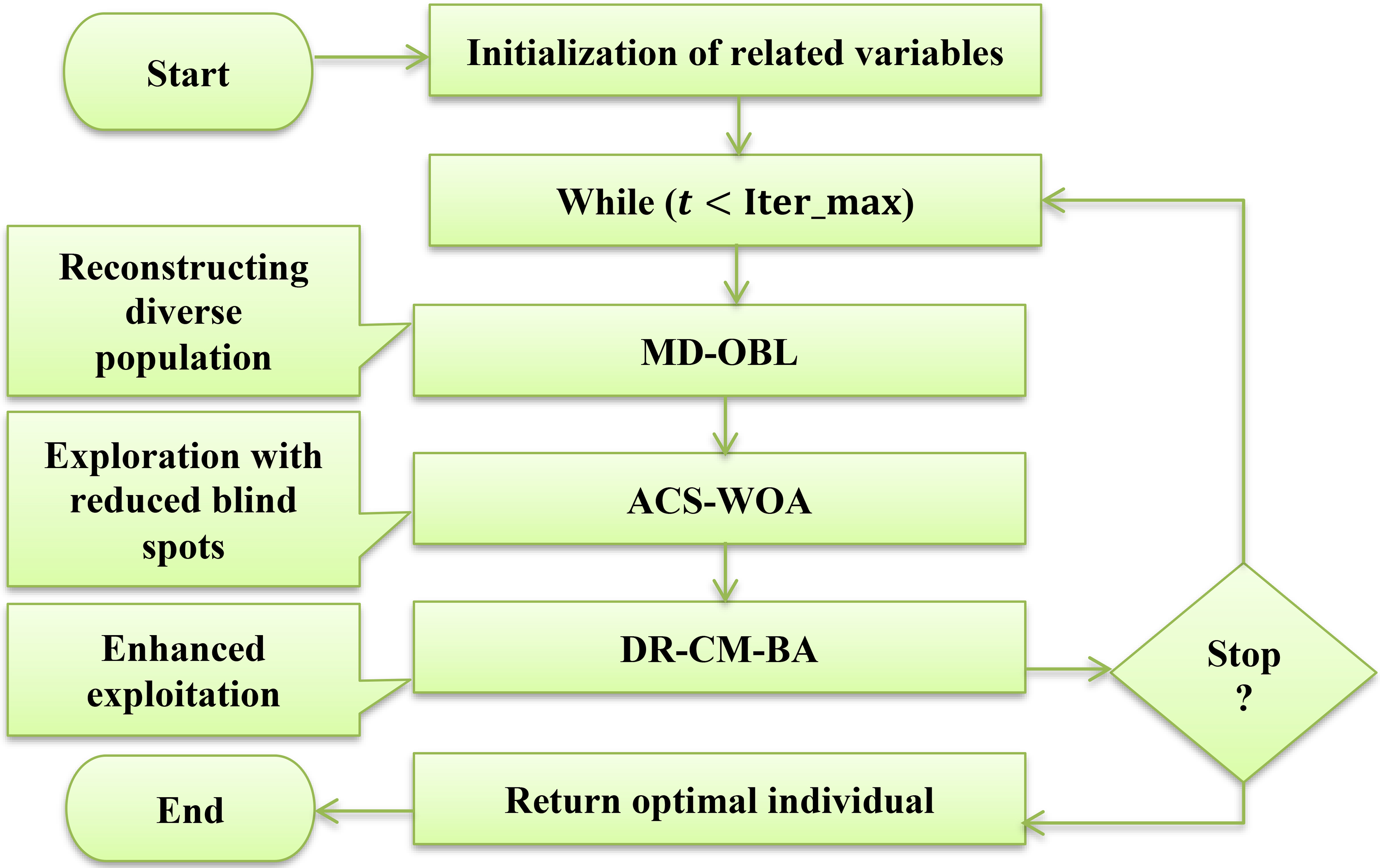
The population diversity is related to the search efficiency of BA, if we adopt all of the opposite solutions generated by general individuals in the whole evolutionary process, it will be blind and affect the convergence rate. In addition, the bat algorithm may get stuck in evolutionary stagnation in the later stage, just like other heuristic algorithms.
Therefore, in order to solve above problems, we introduce elite opposition-based learning (EOBL) strategy and asynchronously combine it with GOBL.
EOBL uses the elite opposite solution produced by elite individual to activate population and improve the convergence rate of meta-heuristic algorithms.
Based on our idea of asynchronous combination of EOBL with GOBL, we propose a Multi-strategy OBL with Disturbance (MD-OBL) to restructure an effective diversity population (EDP).
First, we introduce the opposite solution generated by general individual in the early stage of evolution to improve the diversity of population. In addition, like other heuristic algorithms, the bat algorithm is easy to fall into local optimum in the late of evolution, and then evolution will slow down or even stagnate. In order to overcome this defect, we use the elite opposite solution generated by elite individual to activate the population in the late evolution, and the convergence rate will also be improved. Meanwhile, two different OBL strategies can be separately adopted with self-adaption in early or late evolution stages. Furthermore, the elite opposite solution will be mutated to maintain population diversity. During the MD-OBL, we design an adjustment strategy based on stochastic area correction (SAC). Once the bat positions are out of the boundary, it will be adjusted to the periphery of current optimal solution by SAC as far as possible.
Therefore, after above analysis, we rewrite two items of Eq. (12) as two new items to generate opposite solution of general individual as following reorganized Eq. (19):
Different from Eq. (12),
And we rewrite two items of Eq. (16) as two new items to generate elite opposite solution as following reorganized Eq. (20):
where
Then we continue to use a new Eq. (21) to disturb the elite opposite solution so as to keep the diversity of population as follows:
Meanwhile, during the whole MD-OBL, when two kinds of opposite solutions are out of the pre- defined boundary, a new Eq. (22) is designed to reinitialize them to the periphery of the current optimal solution as far as possible.
Based on the above analysis, the basic pseudo-code of proposed MD-OBL is described in Algorithm 3.
In the exploration stage, although MD-OBL can produce an effective diversity population (EDP), the original bat algorithm has insufficient capacity in global searching which is easy to cause blind spots of optimization. There should be a better exploration ability to get the promising regions with fewer blind spots as far as possible.
Therefore, in this paper, we introduce strong global search ability from the whale optimization algorithm and fuse the ability in exploring the EDP obtained from MD-OBL.
However, simple application of whale optimization algorithm is still not enough to solve problem effectively, because the exploration in the original WOA algorithm overly depends on the size of
Therefore, we design an Adaptive Constraint Step Whale Optimization Algorithm (ACS-WOA). In our method, an adaptive constrained step with cosine function is designed to replace the original step constrained by the value of
Specifically, the original Eqs (8) and (9) of WOA are replaced by our new Eq. (23) which is more concise as follows:
where
The walking step can flexibly change between the interval (
Based on the above analysis, the key parts of ACS-WOA are described by the following pseudo-code in Algorithm 4.
In the exploitation stage, although ACS-WOA can obtain the promising regions with fewer blind spots, the stability of local search for the global optimal solution is still inadequate. There should be better exploitation ability in this stage.
Therefore, in the exploitation stage, we propose a more flexible local search method, which is improved from BA.
However, the original BA does not reprocess the poor individuals, which may have the potential to become excellent individuals. Thus the promising individuals of original BA may be lost. Moreover, in the later stage of evolution, bat individuals tend to approach super bat, this can make the original BA fall into local optimum.
In order to solve above problems, we propose an effective BA local search strategy based on Dynamic Regulation and Cauchy Mutation (DR-CM-BA). Different from the original BA, the proposed Dynamic Regulation (DR) can reproduce promising individuals to update poor individuals. In addition, we adopt Cauchy mutation to keep the diversity of updated individuals and escape from local optimum as far as possible.
The detail of the proposed DR-CM-BA is as follows.
Firstly, poor individuals can be screened out from the population by evaluating the original individual and the current new individual with fitness function simultaneously during the searching process of DR-CM-BA.
Secondly, poor individuals will be reprocessed by new Eq. (24), which can dynamically update them to approach the current optimal solution once the current pulse rate
Thirdly, inspired by literature [14], we introduce the well-known Cauchy inverse cumulative distribution function in Eq. (25) and rewrite it into Eq. (26), then the updated individuals will be mutated by Eq. (26).
The reason for choosing this operation is that Cauchy mutation operation is an effective method to enhance the probability of escaping from local optimum [64], and it has been widely used to improve the search ability of existing algorithms [14, 20, 45].
The major mathematical models are described as following equations.
where
As a result, the proposed DR-CM-BA not only allows more excellent bat individuals to participate in the next generation evolution, but also avoids the situation that all the updated bat individuals approach the super bat.
Based on the above analysis, the basic pseudo-code of proposed ERFBA is presented in Algorithm 5.
Experiment and analysis
To investigate the effectiveness of the proposed ERFBA, it is necessary to implement the statistical and comparative analysis on the performance of involved algorithms. Therefore, we organize different experimental activities with comprehensive comparison. First, we use nine classical benchmark functions to test the performance of the proposed ERFBA, and then compare it with BA and NBA on low dimensional functions, convergence results and high dimensional functions to measure the accuracy and stability of the solution. Second, in order to comprehensively verify the superiority of the proposed ERFBA, we compare it with recent heuristic algorithms in more benchmark functions. Finally, in order to further test and validate the fusion capability in ERFBA, several comparative analysis of different components in ERFBA have been carried out.
Experimental settings
Parameters settings
The parameter settings of algorithms are decided by repeated tests in this paper, and there is no fixed theoretical standard. The parameters of related algorithms are set as in Table 1. In addition, in order to analyze the performance of the algorithms with fairness, we utilize the same number of iterations or function evaluations as the stopping condition for each algorithm, and each algorithm will be run 30 times independently for meaningful statistics on each benchmark function.
Parameter settings of seven algorithms
Parameter settings of seven algorithms
In the experiment, we will use four statistic indicators which include “Min”, “Max”, “Ave” and “SD” to measure the accuracy and stability of solution, these four statistic indicators represent the best value, worst value, mean value, and standard deviation value for each algorithm in multiple independent runs, respectively. According to the literature [69], the corresponding values of the four statistical indicators are calculated by the formulas shown in Table 2.
Formulas of four statistical indicators
Formulas of four statistical indicators
In Table 2, variable
In this subsection, we will introduce the individual optimized by the algorithm and their representation as follows.
First, for optimization individuals, we randomly initialize a set of solutions containing
Second, some information of individual optimized by the algorithm is represented in Eqs (27) and (28).
where
In the experiment, we use two groups of benchmark functions to test the performance of the involved algorithms. The first group contains 9 well-known classic benchmark functions [52], and the second group contains 23 benchmark functions [35].
Moreover, these benchmark functions which are minimization problems have diversified characteristics including continuous unimodal and multimodal functions. The multimodal functions are complex in shape and have many local optimums, except for the global optimal solution. Therefore, these test functions can better measure the performance of involved algorithms.
Comparison with variants of BA on 9 classic benchmark functions
In this subsection, we have tested the effectiveness of the proposed ERFBA from three aspects. First, we measure the accuracy and stability of ERFBA by four statistical indicators on nine classic benchmark functions, some information of these functions are shown in Table 3, where
Nine classical benchmark functions
Nine classical benchmark functions
Formulas of nine classical functions
In this subsection, The statistic results of all involved algorithms with 200 iterations in 30 independent runs are shown in Table 5. Four statistical indicators include “Min”, “Max”, “Ave”, and “SD”, they are used to measure the accuracy and stability of solutions obtained by involved algorithms. In addition, underlines and bold numbers of Table 5 represent the best results of all involved algorithms.
Statistic results of involved algorithms on nine classical functions
Statistic results of involved algorithms on nine classical functions
According to the results in Table 5, the proposed ERFBA has the following two advantages.
First, from the indicator “Min”, ERFBA can locate the global optimum of 7 functions (F1, F2, F3, F4, F7, F8, F9), and ERFBA can achieve higher accuracy in function F6 than NBA, while NBA can obtain the same global optimum only in 5 functions (F2, F3, F4, F7, F8), and the original BA has not found the global optimum in nine functions. Moreover, from the indicator “Ave”, ERFBA outperforms other algorithms except function F2 which is still the same as NBA and over BA. Therefore, on the whole, the proposed ERFBA outperforms other algorithms in accuracy.
Second, from two other indicators (“Max” and “SD”), ERFBA outperforms other algorithms except function F2. Even for function F2, ERFBA can still obtain the same results as NBA and outperform BA. The quality of optimums found by original BA is the worst. Therefore, the proposed ERFBA overall outperforms other algorithms in stability.
In a word, the proposed ERFBA has high accuracy and stability on nine classical benchmark functions, which demonstrates the strong exploration and exploitation capability of ERFBA.
In order to further verify the ability of ERFBA to locate global optimum, ERFBA is compared with BA and NBA in the form of the convergence results in this subsection. The convergence results of related algorithms on nine test functions are shown in Fig. 2, in which the abscissa represents the number of evaluations of fitness functions, and the ordinate represents the average of the current global optimum over 30 runs. For fair comparison, the evaluation times of all involved algorithms are consistent, each function is evaluated at least 5000 times or more, especially for functions with complex terrain, the more evaluation times can be allowed.
Convergence results of related algorithms on nine classical benchmarks.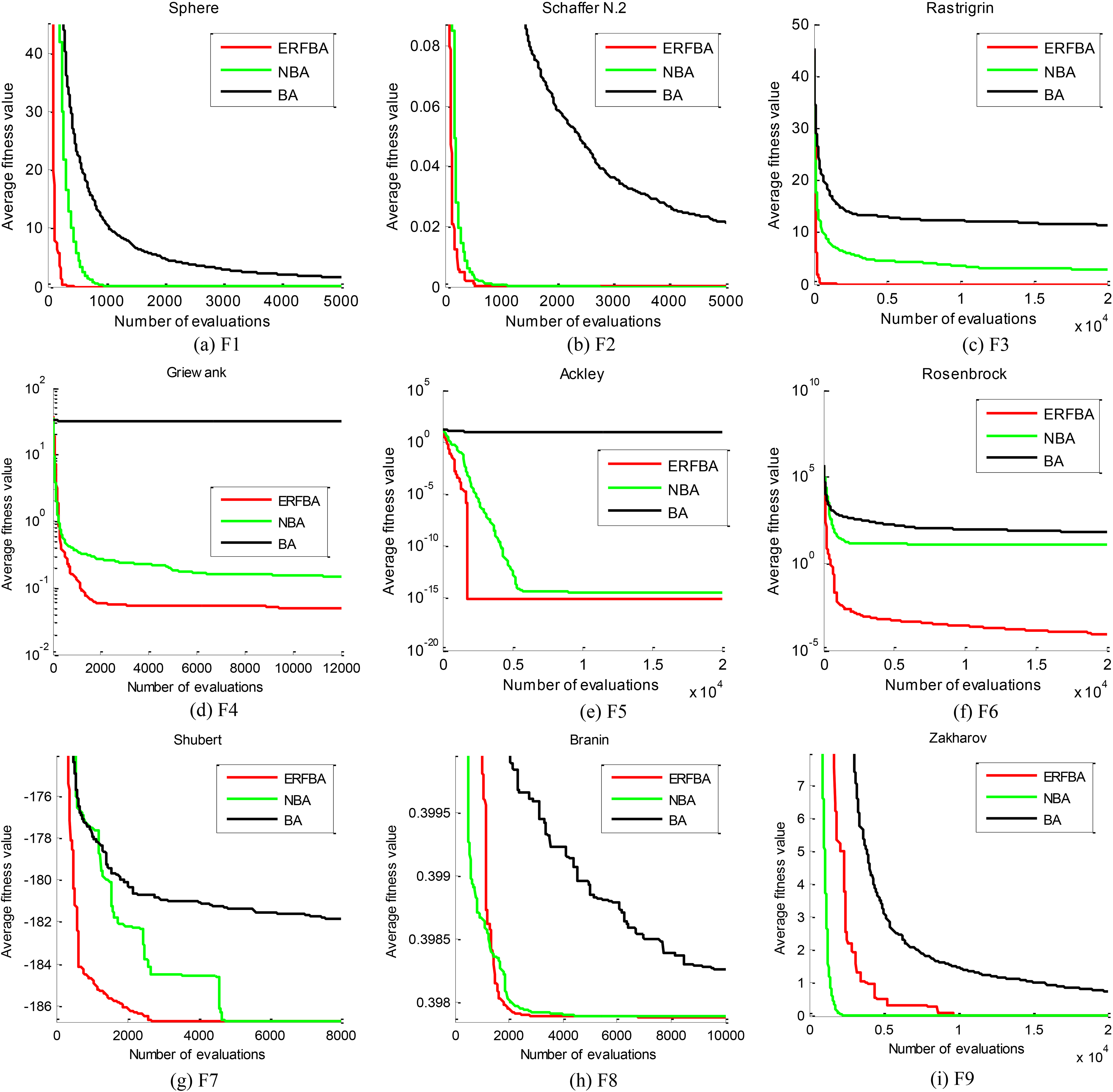
According to the convergence results from Fig. 2, for functions F1, F2, F7, and F8, BA cannot converge to the global optimum, the proposed ERFBA can converge to the global optimum, and even ERFBA converge to the global optimum with much faster rate than NBA. For functions F4, F5, and F6, compared with BA and NBA, the proposed ERFBA not only achieves lower average fitness value, but also has faster convergence rate. For function F3, ERFBA is the only one to obtain the global optimum among the three algorithms. For function F9 as shown in Fig. 2i, BA cannot converge to the global optimum, though NBA has faster convergence rate than ERFBA, the proposed ERFBA can achieves a higher accuracy of optimum than NBA as shown in Table 5.
In brief, the proposed ERFBA has converged to global optimum on six functions, and the convergence accuracy is still higher than that of BA and NBA on the remaining three functions F4, F5 and F6. Therefore, the proposed ERFBA has located the better quality of optimum than BA and NBA on nine classical benchmark functions.
Moreover, the experimental results also demonstrate that the convergence rate of the proposed ERFBA can be effectively improved with the elite solution produced by multi-strategy OBL with disturbance (MD-OBL).
In this subsection, we choose high-dimensional functions with unfixed dimensions from above 9 classic benchmark functions to further verify the stability and accuracy of the proposed ERFBA. The optimization results of these high-dimensional functions are shown in Table 6.
Comparison on high-dimensional functions
Comparison on high-dimensional functions
The global optimum of each function
The formulas of 23 functions
Comparisons of recent algorithms (
Comparisons of recent algorithms (
Comparisons of recent algorithms (
As shown in Table 6, when compared with BA and NBA, both Min and Ave found by ERFBA outperform that found by BA and NBA in six functions, while NBA only outperforms BA. Therefore, the best accuracy is achieved by ERFBA, and the second best accuracy is achieved by NBA, while BA is the worst among them in accuracy.
Also shown in Table 6, for Max and SD, the proposed ERFBA outperforms other two algorithms. The best stability is achieved by ERFBA, while BA and NBA are competitive in stability.
In a word, the proposed ERFBA still keeps the similar accuracy and stability in high-dimensional problems as that in Table 5, while the stability and accuracy of other algorithms obviously decrease.
Therefore, the proposed ERFBA has obvious advantages in solving high-dimensional function optimization.
In order to comprehensively test the superiority of the proposed ERFBA, we compare it with recent heuristic algorithms in more functions. Then, we use average (Ave) and standard deviation (SD) to measure its performance with the 23 benchmark functions, where
The bold and underlined fonts in Tables 9–11 indicate that the best averages (Ave) and best standard deviations (SD).
According to the results in Tables 9–11, ERFBA outperforms WOA, SCA, SSA and GOA in standard deviation (SD) for 22 functions. Moreover, ERFBA outperforms them in both SD and Ave for functions
In short, according to the analysis results of the above two indicators on more functions than that of previous Section 5.3.1, the proposed ERFBA still has higher average accuracy and better stability for many unimodal functions and multi-modal functions, which also demonstrates that the fusion idea of ACS-WOA and DR-CM-BA has the strong exploration and exploitation capability.
BA compared with Hybrid1, Hybrid2 and ERFBA
BA compared with Hybrid1, Hybrid2 and ERFBA
In this subsection, we further test and validate the fusion capability among different components of the proposed ERFBA, which consists of MD-OBL (diversity), ACS-WOA (exploration) and DR-CM-BA (exploitation). We have done the following activities.
Firstly, we improve BA with MD-OBL to search for the best solution, this approach is called Hybrid1. Secondly, we improve BA with the fusion of MD-OBL and DR-CM-BA to search for the best solution, this approach is called Hybrid2. Thirdly, we improve BA with the fusion of MD-OBL, DR-CM-BA and ACS-WOA to search for the best solution, this approach is ERFBA.
After that Hybrid1, Hybrid2 and ERFBA are compared with each other, and they are also compared with BA. The statistic results of all involved algorithms with 200 iterations in 30 independent runs are shown in Table 12.
As shown in Table 12, compared with the original BA, Hybrid1 has greatly improved the accuracy and stability in function F1, F2, F4, F5 and F9 by the fusion of MD-OBL and BA.
However, for functions F3, F6, F7 and F8, Hybrid1 still needs to be improved. So we design the Hybrid2 by the fusion of MD-OBL and DR-CM-BA to search the better solutions.
Also as shown in Table 12, Hybrid2 has achieved the better results than Hybrid1 in functions F3 and F6, while it still keeps the same results as Hybrid1 in 5 other functions (F1, F2, F4, F5, F9), and there is also a function F7 that is competitive with Hybrid1.
Moreover, Hybrid2 is still insufficient for multimodal functions F7 and F8, which can measure the global search ability of meta-heuristic algorithms. Therefore, we design ERFBA by the fusion of MD-OBL, DR-CM-BA and ACS-WOA to overcome the above shortcomings.
Also as shown in Table 12, ERFBA has achieved the better results than Hybrid2 for multimodal functions F7, F8 and unimodal function F6, while it still keeps the same results as Hybrid2 in other 6 functions.
In short, compared with BA, Hybrid1 and Hybrid2, the proposed ERFBA not only has the best global search ability, but also has the best local search ability.
This subsection further demonstrates that the three components can be fused together and the fusion idea of MD-OBL, DR-CM-BA and ACS-WOA is effective.
Testing on two real world problems
In order to further verify the practical application ability of the proposed ERFBA, we have done some simulations with two real world problems, including the classical gear rate optimization and the multi-layer perceptron training.
Intelligent design: Gear ratio optimization
In this subsection, we further test the optimization performance of the proposed ERFBA in an intelligent designing of gear train [47].
This problem is mainly to optimize a gear ratio of compound gear train with three gears. The optimization results of the proposed ERFBA and other algorithms are shown in Table 13, in which the data of the compared algorithms comes from the literature [21].
The mathematical model of gear ratio optimization is described as follows:
where
The comparison results of different algorithms
A group of well-known meta-heuristic algorithms are compared with the proposed ERFBA. The parameters setting of ERFBA are the same as Section 5.1. ERFBA has run 30 times for meaningful analysis. In addition, the total number of fitness evaluations for all algorithms is 20000.
The experimental results show that the ERFBA can solve the optimization of gear ratio easily. Meanwhile, compared with other algorithms, it has obtained the best results in three indicators of best (Min), average (Ave) and standard deviation (SD).
In recent years, meta-heuristic algorithm has become an important method to solve intelligent data analysis problems [7, 37, 43, 44]. In order to further verify the application performance of the proposed ERFBA, we also use ERFBA to train Multi-layer perceptron (MLP) which is meaningful in the field of intelligent data analysis.
The three standard classification datasets of MLP come from Machine Learning Repository in University of California at Irvine (UCI) [5]. Table 14 shows the relevant information of the three datasets which have also been used and described in the literature [32].
In this subsection, the population size of all algorithms is 200. Other parameters are set in the same way as Section 5.1. All of the algorithms run 10 times for meaningful analysis and the number of iterations is 200.
Three indicators including the best classification rate (Best), the worst classification rate (Worst) and the average classification rate (Mean) are used to measure the performance of the related algorithms.
Databases of 3-bits XOR, Balloon and Breast Cancer
Databases of 3-bits XOR, Balloon and Breast Cancer
The Fig. 3 shows the model structure of MLP in the literature [32]. It is critical to transform the training of multi-layer perceptron into a heuristic search problem [4]. In this section, we will use the popular method which comes from the literatures [31, 32] to train MLP as follows:
The problem of training multi-layer perceptron is represented by the following mathematical equation.
where
Therefore, according to Eq. (30), we can see that the individuals optimized by the algorithm have been initialized into different settings of weights
After the initialization of individuals, the fitness evaluation function also needs to be determined so as to evaluate the performance of MLP. According to the literature [32], Mean Square Error (MSE) shown in the Eq. (31) is utilized to calculate the difference between the expected output of each sample and the actual output obtained from MLP, and then the average of Mean Square Error (MSE) is utilized to measure the performance of MLP by the Eq. (32). In this way, the fitness evaluation function of algorithms can be expressed by the Eq. (33).
where
Finally, according to the above method, the classification results of the three datasets are shown in Tables 15–17, respectively.
Classification rate of XOR
MLP with one hidden layer.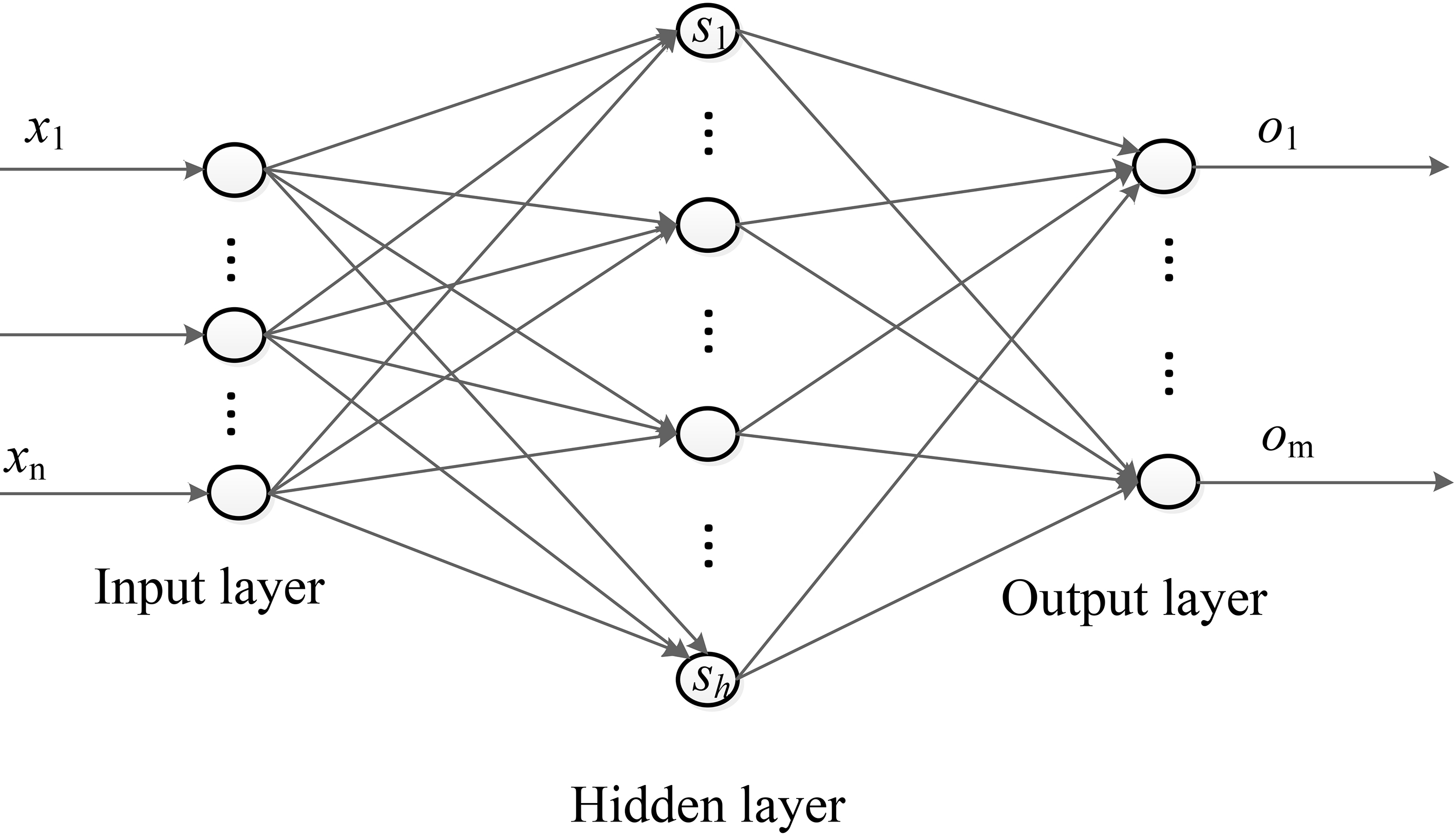
Classification rate of Balloon
Classification rate of Breast Cancer
From the experimental results shown in Tables 15–17, for the dataset of Breast Cancer which includes more samples than the other two datasets, ERFBA has better classification rate than BA in three indicators of Best, Worst and Mean, and ERFBA has better classification rate than NBA in two indicators of Worst and Mean. Thus ERFBA wins BA with a score of 3-0 and wins NBA with a score of 2-1 in three indicators.
For small test sample datasets in XOR and Balloon, the classification rate of both ERFBA and BA can reach 100% in three indicators of Best, Worst and Mean.
The experimental results further prove that the proposed ERFBA can be well applied for the training of multi-layer perceptron.
The accuracy and stability of solution obtained by original BA are still inadequate. In order to overcome the weaknesses, an efficient and robust bat algorithm with fusion of OBL and WOA is proposed. In the population reconstruction, we present MD-OBL to reconstruct effective diversity population. In the exploration, we present ACS-WOA to obtain the promising regions with fewer blind spots. In the exploitation, we present DR-CM-BA to get accurate and stable solution.
The experiments have demonstrated the superiority of the proposed ERFBA on both the benchmark functions and application problems. Compared with the original bat algorithm and other recent algorithms, the results show that ERFBA has outperformed other algorithms in accuracy and stability for many optimization problems. Meanwhile, we find that the proposed ERFBA has obvious advantages for solving high-dimensional optimization problems in accuracy and stability. In addition, it also achieves satisfactory results in intelligent design and intelligent data analysis.
In future, we will continue to improve BA or other meta-heuristic algorithms to solve other intelligent data analysis problems [10, 13, 24, 40, 41, 46]. In addition, we will try to develop high-performance co-evolutionary or multi-objective algorithms, and employ them to solve complex problems such as multimedia applications [67, 68, 72] and collaboration applications [16, 27, 28, 29, 39, 78]. Moreover, we will discuss and study the effects of noise and missing values on training MLP.
Footnotes
Acknowledgments
This work is supported by National Key R&D Program of China, Grant No. 2017YFB0503004.