



Abstract
Krill herd algorithm (KHA) is an emerging nature-inspired approach that has been successfully applied to optimization. However, KHA may get stuck into local optima owing to its poor exploitation. In this paper, the orthogonal learning (OL) mechanism is incorporated to enhance the performance of KHA for the first time, then an improved method named orthogonal krill herd algorithm (OKHA) is obtained. Compared with the existing hybridizations of KHA, OKHA could discover more useful information from historical data and construct a more promising solution. The proposed algorithm is applied to solve CEC2017 numerical problems, and its robustness is verified based on the simulation results. Moreover, OKHA is applied to tackle data clustering problems selected from the UCI Machine Learning Repository. The experimental results illustrate that OKHA is superior to or at least competitive with other representative clustering techniques.
Introduction
Over the last few decades, optimization problems have been sprung up in various fields such as engineering design [1] and management science [2]. A variety of optimization techniques are proposed to solve these problems, which can be generally categorized into classical methods and meta-heuristics [3]. In comparison to classical methods, meta-heuristics are independent of realistic situations and more robust on complex problems. Therefore, meta-heuristics are widely applied to combinatorial optimization, and the most prominent ones listed in the literature are particle swarm optimization (PSO) [4], ant colony optimization (ACO) [5], biogeography-based optimization (BBO) [6], artificial bee colony (ABC) [7] and the krill herd algorithm (KHA) [8], etc.
Inspired by the collective behavior of krill, KHA is first introduced to solve optimization problems in 2012 [8]. In the krill-based algorithm, the movement of each krill is determined by three components [9]: (1) movement induced by other individuals, (2) foraging activity, (3) random diffusion. Both exploration and exploitation strategies are considered in KHA, which are based on foraging motion and induced process, respectively [10]. Hence, KHA is more powerful when compared with other classical optimization techniques. Another remarkable advantage of KHA is its simplicity, for there are few adjustable parameters, which makes it easy to be implemented and suitable for parallel computation [11]. Owing to its excellent performance, KHA is widely applied to solve numerical and practical optimization problems [12].
Studies have shown that KHA may trap into local optima when applied to complicated problems [8]. In the past few years, lots of work has been done to enhance the performance of KHA. The detailed description is given in Section 2. This paper concentrates on the incorporation of a robust operator to improve the performance of KHA. Most of the existing KHA hybridizations are based on a stochastic search, so there is no guarantee for a fast convergence rate. For example, in [13], a new solution is obtained by a random crossover between the current solution and a candidate solution found through lévy flight. Obviously, the useful information in the two solutions is underutilized, and a better result is not guaranteed at every time. Therefore, a more reasonable construction strategy of a solution is needed to incorporate with KHA. Given the above discussion, the main contributions of this paper are threefold:
An orthogonal learning (OL) mechanism is incorporated to enhance KHA’s performance for the first time, and an improved method named orthogonal krill herd algorithm (OKHA) is obtained. Unlike the existing hybridizations, OKHA is based on the statistical analysis rather than a stochastic crossover. At each iteration of OKHA, the best solution can be discovered in limited trials based on the analysis of available information. In this way, OKHA could make full use of historical data to conduct a deep search, resulting in faster convergence and better accuracy. The proposed algorithm is applied to solve CEC2017 numerical problems. The simulation results show that OKHA is more robust and stable than other hybridizations of KHA presented in the literature. To further assess the effectiveness of OKHA, it is employed to tackle data clustering problems collected from UCI Machine Learning Repository. The simulations conducted on six standard datasets demonstrate the superiority of OKHA compared with some other well-known clustering algorithms presented in the literature.
The rest of this paper is organized as follows. Section 2 presents the related work of the modified krill herd algorithms. Section 3 introduces the basic knowledge of the KHA and OL mechanism. Section 4 presents the proposed OKHA in detail. Section 5 provides the experimental results on CEC2017 numerical optimization problems. Section 6 introduces the proposed OKHA into data clustering problems in comparison with some other clustering techniques. Finally, Section 7 concludes with the present research and future work.
The krill herd algorithm is a class of swarm intelligence algorithm proposed for optimization, which has been proven to be better than most representative metaheuristics [8]. Even though there exists a vast majority of research work on KHA to provide higher convergence speed and a better solution. In general, these work can be categorized into three parts: parameter-tuning methods [14, 15, 16, 17, 18], hybrid operators [19, 20, 21, 22, 23, 24, 13] and problem-based modifications [25, 26, 27]. A detailed description of these methods is given as follows according to their classification.
There are two critical factors in KHA, namely inertia weights and step size, which could balance exploration and exploitation. Hence, much research has been done to develop an appropriate adjustment strategy. In [14], various chaotic maps are employed to adjust the inertia weights during the search process to enhance the exploration. It is demonstrated that the incorporation of a proper chaotic map could improve the performance of KHA. In [15], a fuzzy system is utilized to fine-tune the parameters dynamically based on its optimization progress. In [16], an entropy-based inertia weight krill herd algorithm (EBIEKHA) is developed, in which the inertia weights are changed adaptively according to the variation of population entropy. The higher performance of EBIWKHA is verified on CEC2017 problems when compared to other strategies. In [17], a linear decreasing step is utilized to make a trade-off between exploration and exploitation. In [18], the adjustment strategy of step size is further developed, and a global exploration operator is proposed to avoid a quick saturation.
Various operators inspired by other algorithms have been incorporated into KHA to tackle its deficiency. In [19], inspired by the Stud genetic algorithm, an updated crossover operator called stud selection and crossover (SSC) operator is proposed to speed up the convergence of KHA. In [20], a krill migration (KM) operator, which is derived from Biogeography-based optimization, is combined with KHA to make full use of global information. In [21], the optimization procedure is divided into two phases, and the local mutation and crossover (LMC) operator is incorporated into the second phase to enhance the reliability of KHA. In [22], a hybrid differential evolution (HDE) operator is used to help KHA search for an optimal solution within a given region. In [23], in order to help KHA escape from the local minimum, a krill selecting (KS) operator, rooted in Simulated annealing, is introduced to accept a few not-so-good solutions with a low probability. In [24], two operators, namely krill updating (KU) and krill abandoning (KA), are introduced into KHA to absorb the merits of cuckoo search. In [13], a local Levy flight (LLF) operator is added into the basic KHA for a careful search at the end of optimization, and then a better solution can be obtained.
Summarization of the related works.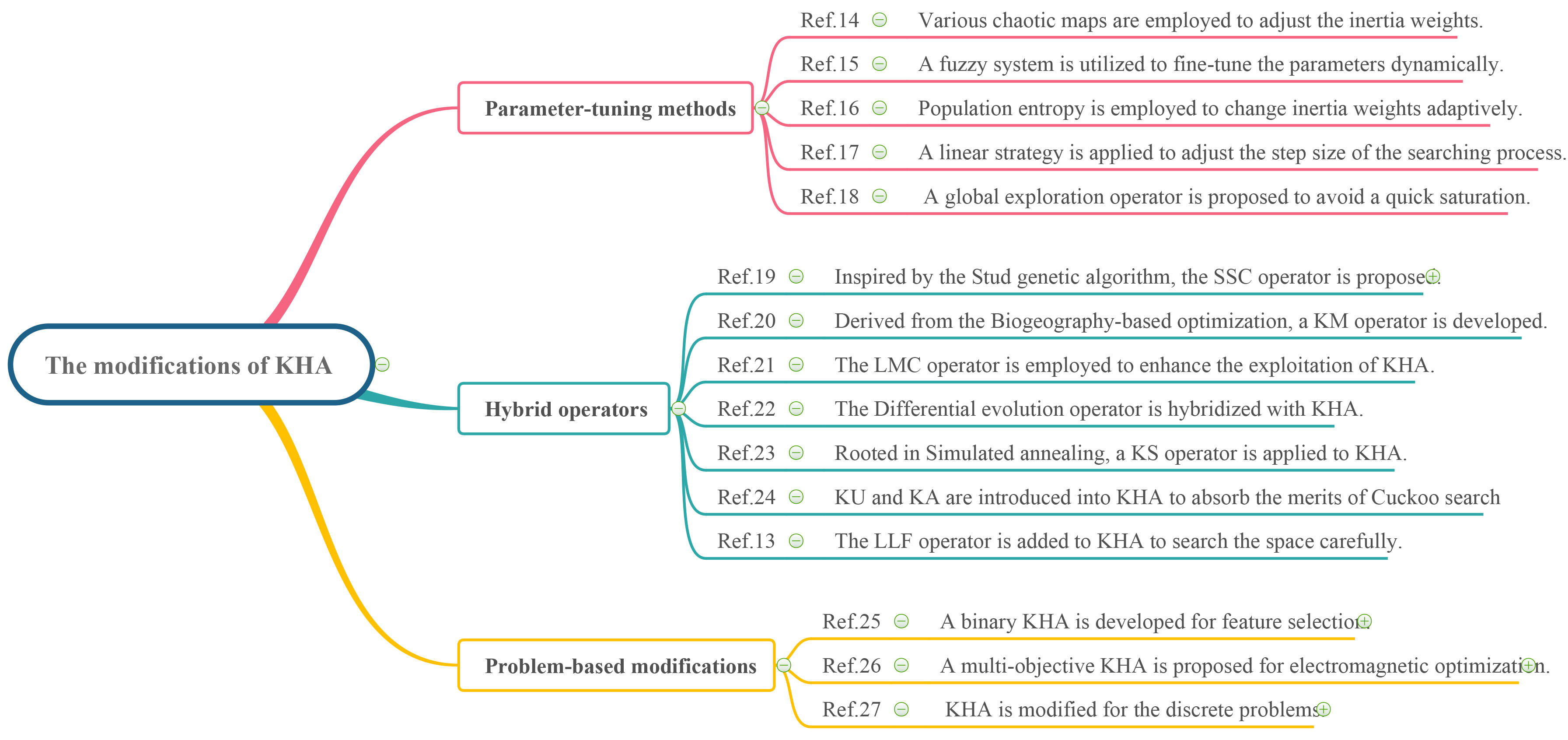
When faced with different optimization problems, KHA needs to be modified to cope with new situations. In [25], KHA is modified based on the binary concept for tackling a feature selection problem. In [26], a new multi-objective KHA is proposed to solve multi-objective optimization problems. In [27], it is demonstrated that the discrete KHA outperforms others when it comes to graph-based network search and other discrete problems.
A brief illustration is given in Fig. 1 to provide the links between the algorithms mentioned above. For more description of the modified KHA, readers can refer to [10, 12].
In this section, the standard krill herd algorithm and orthogonal learning mechanism are discussed in detail.
Krill herd algorithm
KHA is a novel meta-heuristic algorithm for optimization, which is inspired by the herding behaviors of krill swarms [8]. In this algorithm, the time-dependent position of each krill is influenced by three motions described as [9]:
movement induced by other individuals; foraging activity; random diffusion.
For a clear and simple description, the problem space is supposed to be
where
The first motion of the
where
The second motion of the
where
The third motion of the
where
Factors and levels of the chemical reaction experiment
Based on the three motions mentioned above, the position vector of the
where
In general, the search process of KHA can be described as shown in Algorithm 1. For more details of the descriptions mentioned above, please refer to [8, 9].
[h] Krill herd algorithm[1] Initialize the parameters:
The concept of orthogonality is derived from geometry, and it is widely applied to engineering problems. In [28], an orthogonal convolutional neural network is proposed to automatically classify the sleep stage, resulting in faster convergence and better performance. In [29], the effects of different factors on the microporous layer are studied by using an orthogonal testing method. The water management of the fuel cell can be improved based on its analysis. In [30], the influence of structural parameters on the launching process is investigated based on orthogonal tests, and the guidance of controlling the system performance is given. Unlike the usage of orthogonality in the works as mentioned above, an orthogonal learning (OL) mechanism is introduced in this paper not to adjust parameters but to construct a promising solution for our research objectives. In the mechanism, one individual could learn useful information from two exemplars and construct a better solution with a few searching combinations.
A simple chemical reaction experiment is shown in Table 1 to illustrate the process of the OL mechanism. Three major factors influence the conversion ratio, namely temperature (
Orthogonal array
OA is a table predefined to select several representative combinations for the OL strategy. The representativeness of the selected combinations in OA embodies in two aspects: equalizing decentralization and neat comparability. Equalizing decentralization means that each level appears at the same time in each column, and neat comparability suggests that any two columns include a full and balanced combination of levels.
In general, OA can be described as a matrix
The construction of an orthogonal array
In
OA of the chemical reaction experiment
FA is a critical process of the OL mechanism, which could evaluate the effects of all factors with different levels based on the experimental results of OA. Then, the best combination can be constructed according to the analysis of FA.
Let
where
For the above-mentioned chemical reaction experiment, an example of calculating
FA of the chemical reaction experiment
After obtaining all
For a clear understanding, the execution procedure of the OL mechanism is given in Algorithm 3.2.3.
[h] Orthogonal learning mechanism[1] A series of vectors
The orthogonal krill herd algorithm
In this section, a novel krill herd algorithm with an OL mechanism is proposed for the first time. Analogous to other hybridizations in [19, 20, 21, 22, 23, 24, 13], OKHA also attempts to discover a better solution to replace the current one, further to accelerate its convergence. However, there is a substantial difference in the construction of solutions. In the existing literature, a new solution is discovered based on a random crossover, which may be easy to implement. Still, it does not guarantee a better solution. In OKHA, a more reasonable construction strategy is presented, based on a statistical analysis of historical data. At each iteration, the available information is fully utilized, and the best combination could be discovered with several representative trials. Therefore, OKHA is more robust when compared with others.
Similar to other biologically-inspired meta-heuristics, the search process of OKHA can be divided into two phases: exploration and exploitation. In the first phase, KHA is applied to cluster krill individuals into limited areas and generate a series of updated solutions. In the second phase, the OL mechanism is employed to improve the quality of solutions for each krill individual. Specifically, OA is utilized to sample a small number of representative combinations by considering all factors in two exemplars; FA is then employed to measure each factor, further to construct the best solution based on the analysis. In this way, a better solution could be guaranteed at each iteration, and an in-depth search could be conducted in searching space. Both the powerful exploration ability of KHA and the excellent characteristics of the OL mechanism are completely exerted in the proposed algorithm. Here, the framework of OKHA is described in Algorithm 4.
[h] Orthogonal krill herd algorithm[1] Initialize the parameters:
Simulation and analysis
In this section, the performance of OKHA is evaluated through experiments on numerical optimization. To verify the effectiveness of OKHA, eight well-known hybrizations of KHA are presented for comparison. These algorithms include the krill herd algorithm with crossover operator (KHA-C) [8], SKH [19], BBKH [20], MSKH [21], DEKH [22], SAKH [23], CSKH [24], LKH [13]. They are all employed to solve CEC2017 numerical problems [31], the codes of which can be obtained from
For all tested algorithms, the same parameters are used:
Specific parameters settings
Specific parameters settings
For the evaluation of the effectiveness of OKHA, the experimental results are analyzed in three aspects: quantitative, qualitative, and compared using a Wilcoxon rank-sum test.
Several data indexes are illustrated in Appendix A to evaluate the performance of different algorithms on CEC2017 numerical problems. They include the average values, the best values, variances, and normalized performance indexes, which are given in Tables A1–A5, respectively. The values in these tables are derived from the best minima found by each method over 60 Monte Carlo runs, and the optimum of each function is marked in bold. For example, the value of OKHA is marked in bold on
It is noted that the performance index (PI) [32] is defined as:
where
The real PIs and normalized PIs of
In Table A1, it is showed that OKHA performs the best on 25 functions except
Performance comparison on 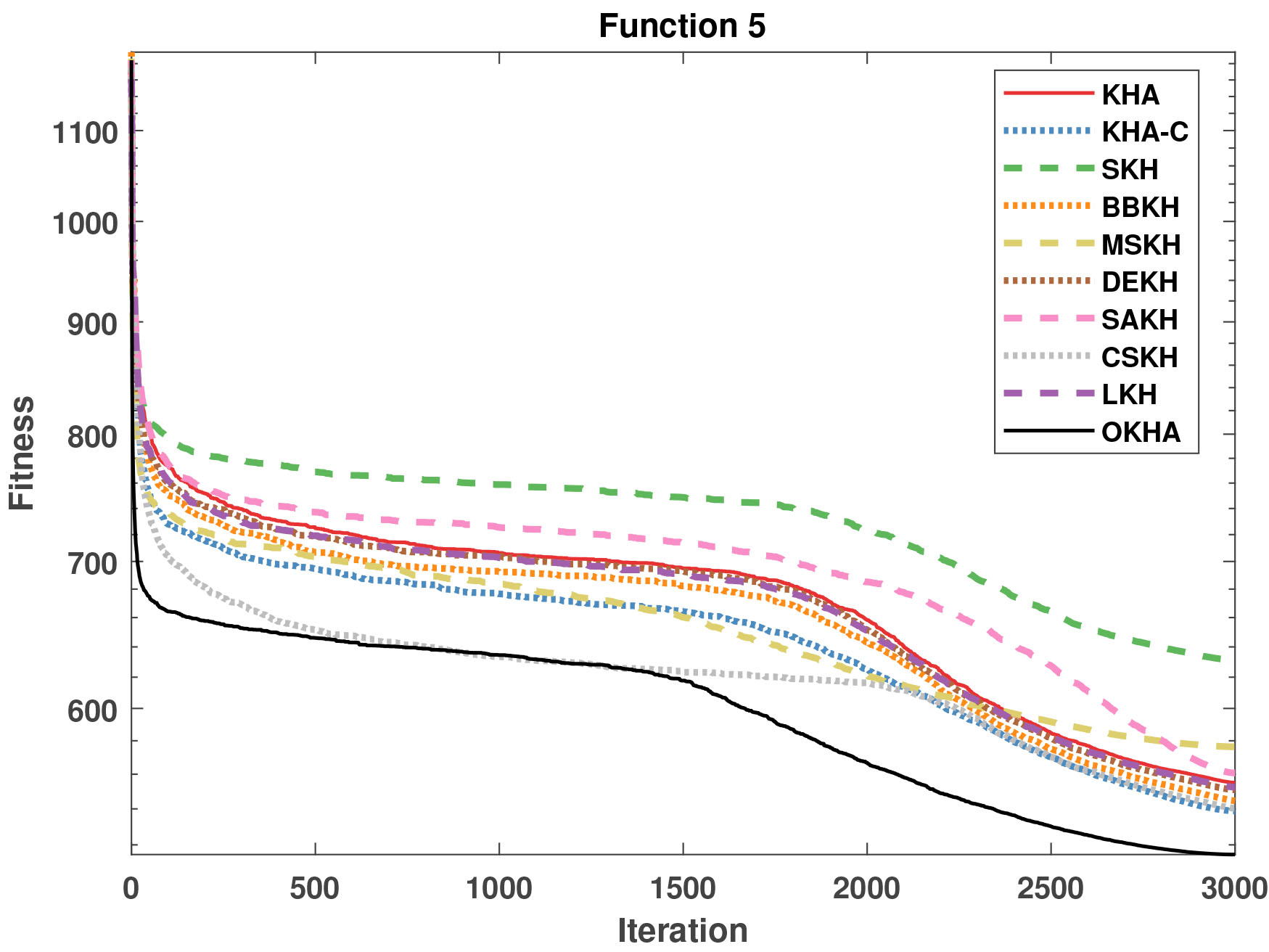
Performance comparison on 
Performance comparison on 
Performance comparison on 
Performance comparison on 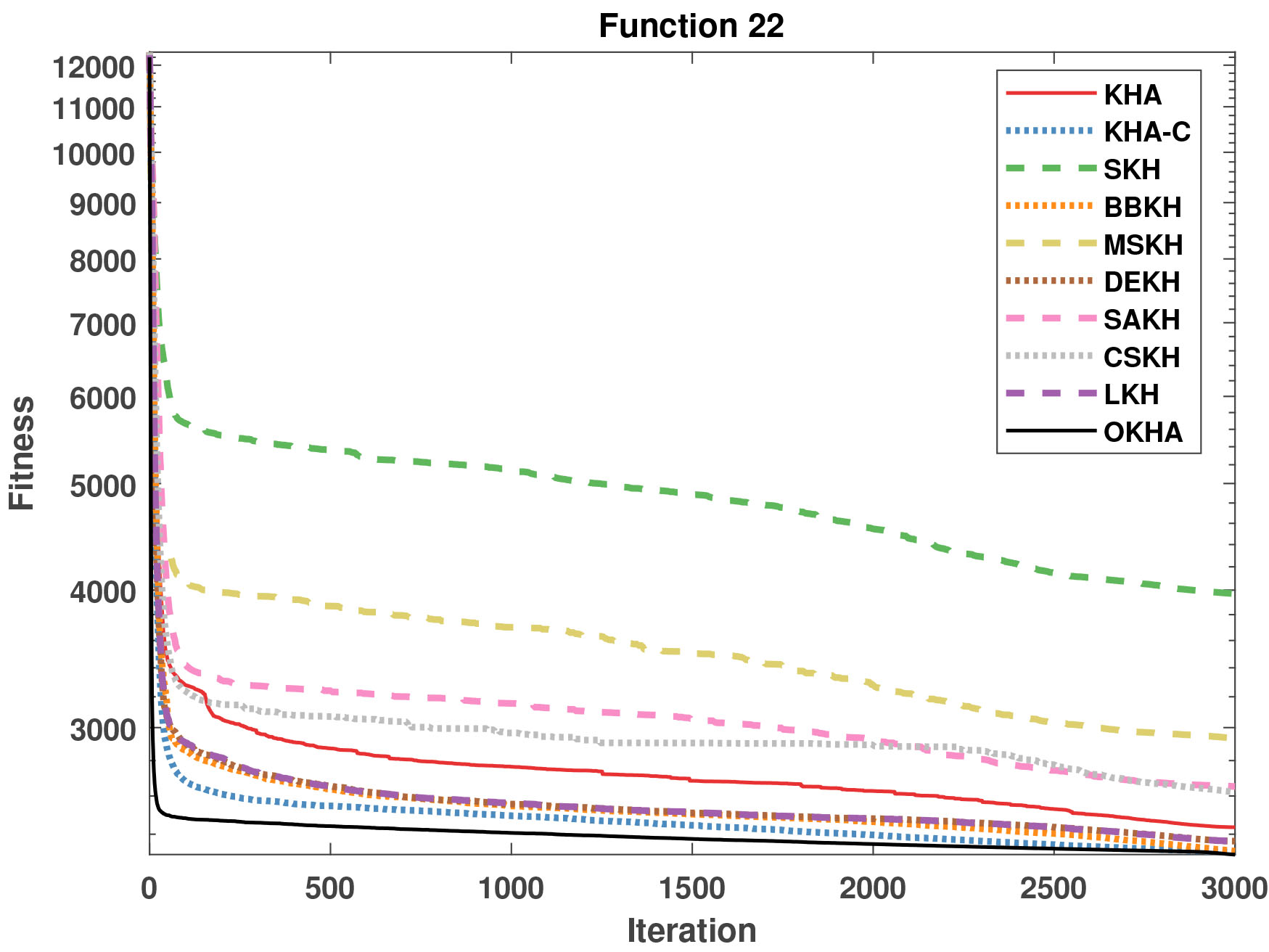
Performance comparison on 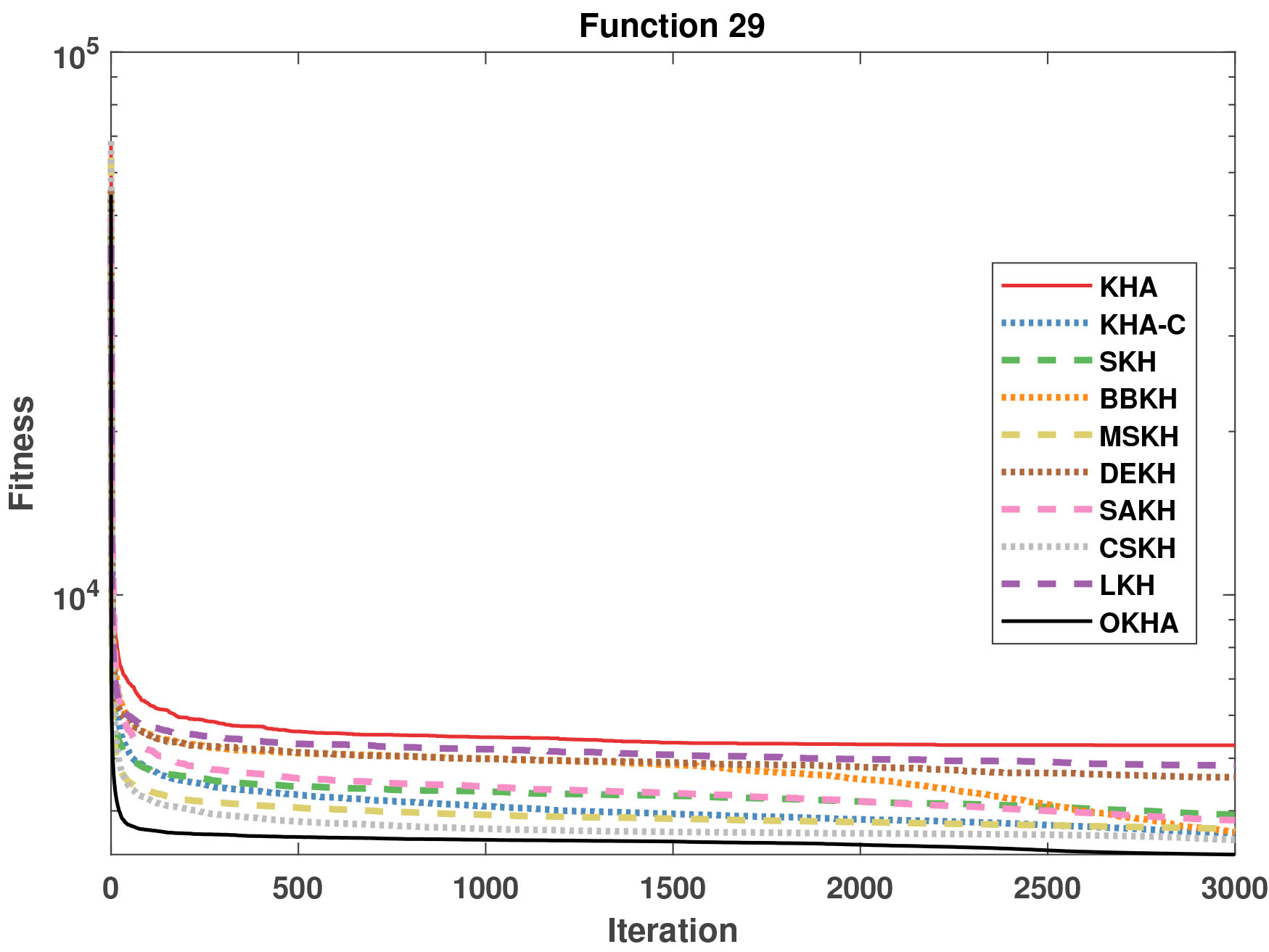
In this section, several convergence graphs are drawn to give a direct comparison between OKHA and other compared algorithms. Due to the limitation of the paper, six representative problems are chosen from each type of CEC2017 benchmark functions, which are provided in Figs 2–7. Among these selected functions,
Figure 2 shows that OKHA is superior to other hybridizations, and CSKH ranks second. Figure 3 indicates that OKHA is not better than CSKH at the beginning phase; later on, OKHA catches up with and surpasses CSKH by its powerful searching ability. In conclusion, it is found that CSKH cannot keep a good balance between exploration and exploitation on multimodal problems: at the beginning of the iteration, CSKH is capable of robust searching ability, and its convergence is faster than others; at the later phase, CSKH cannot search the limited areas well. On the contrary, OKHA is still noticeable owing to its robust exploitation.
In Figs 4 and 5, it is observed that the values of OKHA are less than others in every generation, which fully demonstrates the superiority of OKHA. At the beginning of the searching process, OKHA could spend less time finding candidate areas, which further obtains a faster convergence rate. At the later searching phase, OKHA can exploit the candidate areas carefully to conduct an in-depth search, further to find a better solution. These all indeed show the effectiveness and robustness of OKHA in solving hybrid problems.
In Figs 6 and 7, it is found that OKHA outperforms other compared algorithms on each iteration. However, there are some shortcomings in OKHA that need to be made up. The convergence of OKHA is the fastest at the beginning phase, and its growth rate slows down at the later phase. That’s because the OL mechanism is so powerful that the population diversity declines drastically with the iteration. May be an operator that could increase diversity needs to be considered. In conclusion, the performance of OKHA on combinatorial problems is better than other hybridizations, and some improvements need to be considered.
Based on the analysis described above, OKHA has a better performance than other compared algorithms on most functions. It has a robust searching ability and fast convergence rate. These all demonstrate the effectiveness of the OL mechanism in keeping a trade-off between exploration and exploitation.
Wilcoxon rank-sum test
In this section, a Wilcoxon rank-sum test is provided in Table A5 to distinguish OKHA and other algorithms statistically. The test is based on the final results of 60 independent runs on every function, and the level of significance is set as
Besides, the computational time of all algorithms applied to CEC2017 problems is provided in Table 6. The values in the table are standardized on the same scale. The least wasted-time is normalized to 1.00E+00, and other values are scaled down by the same proportion. For instance, the value of SKH is 1.35E+00, which means that the consuming time of SKH is 1.35 times as much as KHA’s. It is observed that BBKH is the quickest modified method of KHA, and OKHA is the slowest. That stems from the fact that the process of OL mechanism is much too time-consuming. However, in real-world engineering, it is the fitness function evaluation that is by far the most expensive part of an optimization procedure. Moreover, it must be noted that the OL mechanism is more time-saving than exhaustive trials in terms of finding an optimum in each iteration.
The relative computational time of all algorithms
The relative computational time of all algorithms
Data clustering is an unsupervised classification method that could partition a group of data into several clusters, thereby the data in the same cluster have higher similarity than in different clusters [33]. In this section, OKHA is employed to tackle data clustering problems in comparison with several representative clustering techniques proposed in the literature.
Descriptions of data clustering problems
The goal of data clustering is spliting
where
The real PIs and normalized PIs of
The experimental results of various algorithms on datasets
In summary, the aim of data clustering algorithms is to find an optimum matrix C to minimize the squared error function
In this section, six datasets are selected from the Machine Learning Repository of UCI to verify the effectiveness of OKHA. The detailed description of these datasets is listed in Table 7.
In order to validate the effectiveness of OKHA in tackling data clustering problems, several popular clustering algorithms are selected for comparison. They include
There are four indexes in Table 8, which are the mean value, the best value, variance, and ranking. It is noted that the values of ranking are based on the analysis of three other indexes, and the final ranking values are based on the ranking values on the six datasets. In terms of the mean value, OKHA performs the best on four datasets, and it is still in the top three on another two datasets. It is demonstrated that OKHA can always find a suitable solution on the clustering datasets. As for the best value, OKHA is superior to other compared algorithms on all datasets, which reflects the robust searching ability of OKHA. For the variance, OKHA is the best on CMC and Iris, and it has an above-average performance on the other four datasets. In conclusion, the proposed OKHA could find a better solution with a small variance compared to other clustering techniques. Moreover, this conclusion is confirmed by the final ranking results.
Conclusion
The krill herd algorithm (KHA) is a robust nature-inspired method for optimization. However, its performance is not-so-good on complicated problems owing to its poor local searching ability. In this paper, an orthogonal learning (OL) mechanism is introduced to enhance KHA’s performance for the first time, yielding a hybrid algorithm named orthogonal krill herd algorithm (OKHA).
Distinguished with the existing hybridizations in the literature, OKHA is dependent on a statistical analysis instead of a random crossover. Owing to the OL mechanism’s excellent characteristics, the available information in historical data is fully utilized, and the best combination can be discovered in each iteration. In this way, an in-depth search could be conducted, and a faster convergence could be obtained. To evaluate its effectiveness, OKHA is applied to solve CEC2017 numerical problems. The experimental results illustrate that OKHA is superior to the other 8 hybridizations.
To further assess the validity of OKHA, it is employed to data clustering in comparison with 6 representative techniques. Based on the performance on six real datasets, it can be concluded that OKHA is superior to or at least competitive with other compared algorithms.
To sum up, the presented modification in this paper is effective and robust.
Our future research will focus on three issues. Firstly, for more verification, the OKHA would be applied to solve other practical engineering problems, such as path planning and constrained optimization. Secondly, in order to analyze the superiority of OKHA, mathematic methods would be used to make a theoretical explanation. Thirdly, other hybridizations would be considered to improve the performance of KHA.
Footnotes
Acknowledgments
This work is supported by National Natural Science Foundation of China under Grant No. 61573200, 61973175.
Appendix A
In order to visualize the performance of different algorithms on all testing functions, the experimental results of 60 trials are given in Tables A1–A5.
The average function values of different algorithms
Functions
KHA
KHA-C
SKH
BBKH
MSKH
DEKH
SAKH
CSKH
LKH
OKHA
7.86E+08
5.39E+05
2.30E+06
1.26E+07
2.68E+04
7.78E+08
1.30E+06
3.89E+07
7.48E+08
1.06E+40
5.62E+12
4.18E+16
7.95E+19
3.38E+05
3.42E+34
5.37E+13
2.53E+16
1.60E+36
4.63E+04
6.49E+04
4.01E+03
6.04E+04
7.71E+04
3.14E+04
5.77E+04
7.51E+04
3.07E+02
1.03E+03
4.92E+02
5.08E+02
5.26E+02
4.92E+02
1.03E+03
4.89E+02
1.03E+03
4.75E+02
5.55E+02
5.39E+02
6.31E+02
5.45E+02
5.76E+02
5.51E+02
5.61E+02
5.26E+02
5.53E+02
6.02E+02
6.01E+02
6.20E+02
6.01E+02
6.04E+02
6.01E+02
6.10E+02
6.01E+02
6.02E+02
7.74E+02
7.64E+02
8.41E+02
7.69E+02
8.02E+02
7.75E+02
8.13E+02
7.77E+02
7.74E+02
8.54E+02
8.38E+02
9.14E+02
8.50E+02
8.73E+02
8.46E+02
8.62E+02
8.27E+02
8.48E+02
1.03E+03
9.05E+02
2.00E+03
9.09E+02
9.48E+02
1.04E+03
1.21E+03
9.23E+02
1.03E+03
3.85E+03
3.21E+03
4.32E+03
3.69E+03
3.71E+03
3.80E+03
4.36E+03
2.81E+03
4.10E+03
3.14E+03
1.29E+03
1.32E+03
1.82E+03
1.23E+03
4.13E+03
1.22E+03
1.24E+03
4.39E+03
1.28E+08
4.60E+06
8.46E+06
5.48E+06
2.01E+06
1.16E+08
2.87E+06
5.73E+06
1.25E+08
5.53E+07
9.78E+04
1.00E+05
2.94E+06
6.96E+07
4.19E+04
1.05E+06
5.92E+07
6.28E+04
4.81E+04
1.75E+04
1.24E+04
3.29E+04
1.01E+04
7.70E+04
5.94E+03
6.40E+03
3.85E+05
5.74E+06
7.03E+04
3.53E+04
6.62E+05
1.46E+04
3.15E+06
1.51E+05
8.02E+05
2.02E+04
2.75E+03
2.18E+03
2.53E+03
2.08E+03
2.42E+03
3.36E+03
2.39E+03
1.97E+03
3.08E+03
2.80E+03
1.93E+03
2.13E+03
2.03E+03
2.00E+03
2.39E+03
1.95E+03
1.92E+03
2.34E+03
5.76E+05
3.72E+05
1.26E+05
3.05E+05
1.94E+05
1.19E+06
1.04E+05
1.29E+05
1.27E+06
8.33E+06
7.29E+05
7.90E+05
6.52E+05
1.75E+04
7.60E+06
2.22E+05
1.79E+05
5.60E+06
2.32E+03
2.25E+03
2.40E+03
2.29E+03
2.29E+03
2.25E+03
2.33E+03
2.22E+03
2.27E+03
2.36E+03
2.34E+03
2.43E+03
2.34E+03
2.38E+03
2.36E+03
2.37E+03
2.33E+03
2.36E+03
2.44E+03
2.31E+03
3.97E+03
2.32E+03
2.93E+03
2.37E+03
2.65E+03
2.51E+03
2.37E+03
2.72E+03
2.69E+03
2.75E+03
2.69E+03
2.75E+03
2.72E+03
2.74E+03
2.67E+03
2.71E+03
2.88E+03
2.85E+03
2.91E+03
2.85E+03
2.91E+03
2.87E+03
2.89E+03
2.84E+03
2.87E+03
3.16E+03
2.89E+03
2.92E+03
2.90E+03
2.89E+03
3.22E+03
2.89E+03
2.89E+03
3.19E+03
4.11E+03
3.51E+03
3.98E+03
3.64E+03
4.36E+03
4.28E+03
3.22E+03
3.44E+03
3.89E+03
3.30E+03
3.20E+03
3.27E+03
3.22E+03
3.23E+03
3.30E+03
3.22E+03
3.30E+03
3.19E+03
3.41E+03
3.22E+03
3.26E+03
3.24E+03
3.22E+03
3.42E+03
3.21E+03
3.21E+03
3.41E+03
5.28E+03
3.64E+03
3.94E+03
3.66E+03
3.71E+03
4.61E+03
3.85E+03
3.54E+03
4.85E+03
1.34E+07
1.95E+06
2.91E+06
1.53E+06
5.09E+04
1.81E+07
1.80E+06
4.17E+05
1.73E+07
Total
0
0
0
0
2
0
2
1
0
The best function values of different algorithms
Functions
KHA
KHA-C
SKH
BBKH
MSKH
DEKH
SAKH
CSKH
LKH
OKHA
5.72E+08
3.23E+05
2.72E+05
8.10E+06
1.05E+04
6.11E+08
8.17E+05
2.45E+07
4.66E+08
1.08E+35
5.08E+07
3.53E+07
2.02E+16
2.07E+02
5.12E+31
5.68E+10
3.23E+13
5.99E+31
2.31E+04
2.54E+04
3.07E+02
4.25E+04
3.01E+02
5.17E+04
1.42E+04
3.53E+04
5.90E+04
8.15E+02
4.69E+02
4.36E+02
5.01E+02
4.03E+02
8.00E+02
4.28E+02
8.14E+02
4.42E+02
5.29E+02
5.23E+02
5.53E+02
5.18E+02
5.38E+02
5.29E+02
5.44E+02
5.13E+02
5.29E+02
6.01E+02
6.00E+02
6.02E+02
6.00E+02
6.00E+02
6.01E+02
6.02E+02
6.00E+02
6.01E+02
7.52E+02
7.49E+02
7.86E+02
7.49E+02
7.67E+02
7.56E+02
7.90E+02
7.43E+02
7.55E+02
8.29E+02
8.18E+02
8.61E+02
8.20E+02
8.40E+02
8.20E+02
8.38E+02
8.15E+02
8.23E+02
9.75E+02
9.00E+02
9.58E+02
9.05E+02
9.00E+02
9.82E+02
9.34E+02
9.12E+02
9.83E+02
2.37E+03
1.86E+03
2.76E+03
2.68E+03
2.23E+03
2.38E+03
2.82E+03
1.69E+03
3.01E+03
1.97E+03
1.18E+03
1.20E+03
1.44E+03
1.14E+03
3.13E+03
1.17E+03
1.19E+03
2.66E+03
6.44E+07
2.68E+05
4.67E+05
2.08E+06
2.73E+05
5.34E+07
5.68E+05
3.31E+06
5.89E+07
1.95E+07
2.25E+04
2.20E+04
9.04E+05
2.70E+07
1.34E+04
3.90E+05
1.61E+07
1.53E+04
4.04E+03
2.02E+03
1.66E+03
6.75E+03
7.66E+03
1.95E+03
1.99E+03
1.92E+04
1.54E+03
7.32E+05
9.86E+03
4.19E+03
9.20E+04
7.29E+05
4.04E+03
5.33E+04
1.24E+05
3.44E+03
2.08E+03
1.68E+03
1.94E+03
1.68E+03
1.89E+03
2.35E+03
1.99E+03
1.69E+03
2.31E+03
2.53E+03
1.77E+03
1.80E+03
1.83E+03
1.78E+03
2.14E+03
1.78E+03
1.79E+03
2.05E+03
1.44E+05
4.92E+04
4.64E+04
1.13E+05
2.95E+04
2.16E+05
2.85E+04
2.34E+04
2.07E+05
2.43E+06
1.32E+04
3.34E+04
1.01E+05
8.25E+05
3.21E+03
4.39E+04
9.66E+05
2.16E+03
2.19E+03
2.08E+03
2.26E+03
2.10E+03
2.07E+03
2.12E+03
2.14E+03
2.04E+03
2.10E+03
2.32E+03
2.32E+03
2.37E+03
2.32E+03
2.34E+03
2.33E+03
2.31E+03
2.32E+03
2.30E+03
2.36E+03
2.30E+03
2.31E+03
2.32E+03
2.30E+03
2.35E+03
2.31E+03
2.32E+03
2.35E+03
2.69E+03
2.66E+03
2.69E+03
2.66E+03
2.67E+03
2.69E+03
2.69E+03
2.65E+03
2.68E+03
2.84E+03
2.83E+03
2.85E+03
2.83E+03
2.87E+03
2.85E+03
2.86E+03
2.82E+03
2.84E+03
3.05E+03
2.88E+03
2.89E+03
2.89E+03
3.09E+03
2.88E+03
2.89E+03
3.06E+03
2.89E+03
3.25E+03
2.81E+03
2.84E+03
2.84E+03
2.80E+03
3.22E+03
2.82E+03
2.88E+03
3.21E+03
3.25E+03
3.18E+03
3.21E+03
3.20E+03
3.20E+03
3.25E+03
3.20E+03
3.25E+03
3.17E+03
3.32E+03
3.20E+03
3.21E+03
3.22E+03
3.15E+03
3.32E+03
3.20E+03
3.14E+03
3.32E+03
4.75E+03
3.40E+03
3.57E+03
3.52E+03
3.43E+03
4.18E+03
3.60E+03
3.34E+03
4.32E+03
5.66E+06
1.57E+05
1.88E+05
8.69E+05
1.23E+04
7.49E+06
2.64E+05
1.15E+05
8.56E+06
Total
0
0
0
0
5
0
2
1
0
The variance of different algorithms
Functions
KHA
KHA-C
SKH
BBKH
MSKH
DEKH
SAKH
CSKH
LKH
OKHA
1.33E+16
1.80E+10
1.76E+12
5.09E+12
1.07E+08
9.72E+15
9.59E+10
4.14E+13
8.06E+15
1.23E+81
1.07E+26
7.15E+34
1.52E+41
2.72E+12
4.85E+69
1.12E+28
3.71E+33
1.93E+73
1.16E+08
6.84E+08
4.50E+07
6.65E+07
1.12E+08
4.85E+07
1.60E+08
4.38E+07
3.99E+02
1.05E+04
7.48E+01
9.52E+02
5.12E+02
9.23E+03
4.93E+02
8.44E+01
1.06E+04
1.14E+02
2.87E+02
2.75E+02
1.37E+03
1.72E+02
4.05E+02
1.89E+02
1.26E+02
6.59E+01
2.90E+02
1.03E+00
5.49E-02
8.57E+01
2.41E-01
4.01E+01
2.22E-01
1.65E+01
1.14E-02
8.06E-01
1.07E+02
1.15E+02
9.68E+02
1.29E+02
2.92E+02
1.43E+02
1.54E+02
8.64E+02
1.17E+02
1.86E+02
1.05E+02
8.25E+02
2.19E+02
2.79E+02
1.59E+02
1.34E+02
5.64E+01
1.40E+02
8.29E+02
1.31E+01
1.71E+06
3.77E+00
6.45E+03
9.13E+02
1.20E+05
3.02E+01
5.19E+02
4.33E+05
3.79E+05
3.39E+05
3.66E+05
3.72E+05
4.50E+05
9.36E+05
3.51E+05
3.66E+05
3.76E+05
3.36E+03
3.61E+03
4.19E+04
2.49E+03
2.66E+05
5.37E+02
7.38E+02
4.56E+05
1.26E+15
1.24E+13
7.09E+13
4.73E+12
2.56E+12
8.86E+14
7.92E+12
1.87E+12
1.02E+15
4.51E+14
3.98E+09
4.13E+09
1.25E+12
5.95E+14
3.12E+08
1.75E+11
5.91E+14
1.01E+09
7.51E+08
2.65E+08
1.58E+08
2.53E+08
4.15E+07
1.53E+09
1.67E+07
1.05E+07
3.09E+10
8.62E+12
1.87E+09
7.36E+08
1.44E+11
1.48E+08
2.44E+12
2.24E+09
2.05E+11
1.44E+08
8.18E+04
4.95E+04
6.76E+04
4.10E+04
8.35E+04
5.73E+04
2.00E+04
2.15E+04
1.31E+05
2.62E+04
1.38E+04
3.01E+04
6.44E+03
2.44E+04
1.24E+04
8.54E+03
1.02E+04
1.28E+04
6.94E+10
1.02E+11
7.44E+09
1.21E+10
2.02E+10
2.12E+11
4.32E+09
2.85E+11
4.09E+09
1.76E+13
2.62E+11
5.56E+11
1.67E+11
1.54E+13
1.14E+11
5.47E+09
6.34E+12
3.02E+08
6.27E+03
5.65E+03
1.19E+04
4.64E+03
2.00E+04
5.14E+03
9.77E+03
4.92E+03
3.97E+03
2.45E+02
8.19E+01
1.25E+03
9.18E+01
5.26E+02
4.27E+02
6.25E+02
4.26E+01
3.48E+02
1.37E+05
7.75E-01
3.52E+06
5.13E-01
1.39E+06
3.03E+01
1.10E+06
3.38E+05
2.70E+01
2.86E+02
1.43E+02
8.81E+02
2.22E+02
1.31E+03
3.54E+02
5.18E+02
7.45E+01
2.98E+02
3.07E+02
6.83E+01
2.19E+03
1.97E+02
6.92E+02
2.43E+02
2.31E+02
2.58E+01
1.56E+02
3.22E+03
2.96E+00
5.41E+02
9.15E+00
2.98E+00
5.24E+03
6.19E+00
1.38E+00
7.45E+03
3.34E+05
3.12E+05
1.28E+06
2.15E+05
4.94E+05
2.20E+05
5.49E+05
1.14E+05
2.88E+05
4.11E+02
1.19E+02
1.69E+03
5.59E+02
3.04E+02
1.34E+02
1.60E+02
4.01E+02
1.47E+02
2.12E+03
2.18E+02
7.46E+02
1.87E+02
9.13E+02
1.59E+03
1.91E+02
1.94E+03
2.16E+02
5.98E+04
2.00E+04
5.86E+04
5.87E+03
2.65E+04
2.21E+04
1.48E+04
9.50E+03
2.79E+04
3.21E+13
1.52E+12
2.81E+12
2.30E+11
1.30E+09
3.31E+13
1.16E+12
1.57E+10
3.63E+13
Total
0
0
0
2
3
1
3
0
0
The normalized PIs of different algorithms
Functions
KHA
KHA-C
SKH
BBKH
MSKH
DEKH
SAKH
CSKH
LKH
OKHA
1.00E+00
6.79E-04
2.93E-03
1.61E-02
2.73E-05
9.90E-01
1.65E-03
4.95E-02
9.52E-01
1.00E+00
5.33E-28
3.96E-24
7.53E-21
3.19E-35
3.24E-06
5.09E-27
2.40E-24
1.52E-04
5.99E-01
8.41E-01
4.83E-02
7.82E-01
1.00E+00
4.05E-01
7.48E-01
9.75E-01
5.87E-05
1.00E+00
4.90E-02
7.76E-02
1.08E-01
4.95E-02
9.93E-01
4.42E-02
9.88E-01
2.00E-02
3.59E-01
2.22E-01
1.00E+00
2.70E-01
5.38E-01
3.24E-01
4.06E-01
1.15E-01
3.37E-01
7.91E-02
2.94E-02
1.00E+00
3.82E-02
2.13E-01
6.92E-02
4.70E-01
2.58E-02
7.82E-02
3.16E-01
2.12E-01
1.00E+00
2.58E-01
6.01E-01
3.29E-01
7.10E-01
3.46E-01
3.10E-01
4.05E-01
2.45E-01
1.00E+00
3.58E-01
5.92E-01
3.19E-01
4.82E-01
1.30E-01
3.39E-01
1.21E-01
4.46E-03
1.00E+00
7.93E-03
4.35E-02
1.25E-01
2.83E-01
2.07E-02
1.22E-01
7.83E-01
5.10E-01
9.84E-01
7.16E-01
7.22E-01
7.60E-01
1.00E+00
3.40E-01
8.92E-01
6.18E-01
5.69E-02
6.65E-02
2.17E-01
3.93E-02
9.20E-01
3.39E-02
4.23E-02
1.00E+00
1.00E+00
3.54E-02
6.57E-02
4.23E-02
1.51E-02
9.10E-01
2.19E-02
4.43E-02
9.79E-01
7.95E-01
1.16E-03
1.19E-03
4.20E-02
1.00E+00
3.55E-04
1.48E-02
8.50E-01
6.56E-04
1.13E-01
3.25E-02
1.92E-02
7.30E-02
1.31E-02
1.89E-01
2.12E-03
3.35E-03
1.00E+00
1.00E+00
9.88E-03
3.76E-03
1.13E-01
1.45E-04
5.48E-01
2.40E-02
1.38E-01
1.12E-03
6.50E-01
3.24E-01
5.21E-01
2.66E-01
4.59E-01
1.00E+00
4.43E-01
2.03E-01
8.43E-01
1.00E+00
1.87E-01
3.66E-01
2.75E-01
2.46E-01
6.18E-01
2.04E-01
1.70E-01
5.64E-01
4.05E-01
2.31E-01
1.98E-02
1.73E-01
7.77E-02
9.35E-01
7.33E-04
2.20E-02
1.00E+00
1.00E+00
8.56E-02
9.29E-02
7.63E-02
6.10E-05
9.12E-01
2.46E-02
1.95E-02
6.71E-01
7.21E-01
4.97E-01
1.00E+00
6.44E-01
6.42E-01
4.88E-01
7.70E-01
4.11E-01
5.51E-01
4.29E-01
2.41E-01
1.00E+00
2.61E-01
6.08E-01
4.49E-01
5.28E-01
1.61E-01
4.26E-01
8.10E-02
4.21E-03
1.00E+00
9.94E-03
3.79E-01
3.92E-02
2.11E-01
1.26E-01
3.95E-02
6.86E-01
3.99E-01
9.79E-01
3.98E-01
1.00E+00
6.52E-01
8.98E-01
2.39E-01
6.38E-01
6.61E-01
3.15E-01
1.00E+00
3.30E-01
9.42E-01
5.82E-01
7.47E-01
1.85E-01
5.81E-01
8.10E-01
1.70E-03
9.76E-02
2.58E-02
1.52E-04
1.00E+00
5.90E-03
9.39E-03
9.00E-01
8.10E-01
3.47E-01
7.07E-01
4.40E-01
1.00E+00
9.37E-01
1.18E-01
2.87E-01
6.35E-01
1.00E+00
1.56E-01
7.48E-01
2.82E-01
3.88E-01
9.52E-01
2.88E-01
9.46E-01
4.99E-02
9.84E-01
3.81E-01
5.00E-01
4.54E-01
3.71E-01
1.00E+00
3.38E-01
3.54E-01
9.94E-01
1.00E+00
1.69E-01
3.17E-01
1.76E-01
2.01E-01
6.61E-01
2.71E-01
1.17E-01
7.82E-01
7.37E-01
1.06E-01
1.59E-01
8.32E-02
1.61E-03
1.00E+00
9.84E-02
2.18E-02
9.57E-01
2.02E+01
5.69E+00
1.48E+01
6.94E+00
9.14E+00
1.97E+01
8.76E+00
4.27E+00
1.95E+01
Rank
10
3
7
4
6
9
5
2
8
1
Functions
KHA
KHA-C
SKH
BBKH
MSKH
DEKH
SAKH
CSKH
LKH
3.56E-21
3.56E-21
3.56E-21
3.56E-21
4.88E-20
3.56E-21
3.56E-21
3.56E-21
3.56E-21
3.56E-21
3.56E-21
3.56E-21
3.56E-21
7.10E-13
3.56E-21
3.56E-21
3.56E-21
3.56E-21
3.56E-21
3.56E-21
6.22E-20
3.56E-21
5.37E-05
3.56E-21
3.56E-21
3.56E-21
3.56E-21
3.56E-21
2.71E-20
8.26E-14
3.56E-21
6.49E-11
3.56E-21
3.02E-04
2.96E-16
3.56E-21
3.56E-21
4.35E-21
3.56E-21
5.58E-21
3.56E-21
3.56E-21
3.56E-21
1.73E-17
3.56E-21
3.56E-21
3.56E-21
3.56E-21
3.56E-21
3.56E-21
3.56E-21
3.56E-21
3.56E-21
3.56E-21
1.66E-20
3.51E-19
3.56E-21
8.31E-20
3.74E-21
1.23E-20
3.56E-21
5.90E-19
1.36E-20
3.74E-21
1.43E-20
3.56E-21
5.58E-21
3.56E-21
6.48E-21
3.56E-21
5.44E-16
5.86E-21
3.56E-21
3.56E-21
3.56E-21
3.56E-21
3.56E-21
3.56E-21
3.56E-21
3.56E-21
3.56E-21
5.37E-20
2.00E-16
1.01E-20
1.01E-19
1.56E-19
7.92E-20
1.43E-20
2.09E-11
1.36E-20
3.56E-21
3.56E-21
3.56E-21
3.56E-21
3.56E-21
3.56E-21
3.56E-21
3.56E-21
3.56E-21
3.56E-21
3.74E-21
3.56E-21
3.56E-21
3.74E-21
3.56E-21
3.56E-21
3.56E-21
3.56E-21
3.56E-21
2.66E-03
1.84E-04
3.56E-21
8.73E-16
3.56E-21
9.53E-05
3.56E-21
3.56E-21
2.12E-20
3.39E-10
1.37E-05
2.23E-20
4.14E-07
5.86E-21
1.46E-02
3.56E-21
3.56E-21
2.09E-16
1.81E-03
3.56E-21
3.05E-03
3.56E-21
6.20E-03
3.56E-21
3.56E-21
3.56E-21
3.93E-21
3.56E-21
4.35E-21
3.56E-21
3.56E-21
3.56E-21
5.31E-21
3.56E-21
3.56E-21
2.12E-20
5.31E-21
4.35E-21
1.17E-20
3.56E-21
7.90E-21
2.99E-20
3.56E-21
1.23E-20
2.18E-10
3.33E-02
2.17E-17
2.78E-05
5.58E-21
4.41E-03
4.57E-21
3.56E-21
1.12E-20
4.88E-20
3.56E-21
3.56E-21
1.17E-12
1.06E-20
3.56E-21
3.56E-21
6.35E-17
3.56E-21
6.22E-20
1.26E-17
5.32E-17
1.66E-20
8.73E-16
3.89E-17
3.56E-21
3.56E-21
3.56E-21
3.56E-21
3.56E-21
3.56E-21
6.85E-20
4.13E-21
3.56E-21
3.56E-21
3.56E-21
3.56E-21
3.56E-21
3.56E-21
3.56E-21
3.56E-21
3.56E-21
3.56E-21
3.56E-21
3.56E-21
3.56E-21
3.56E-21
3.56E-21
3.56E-21
3.56E-21
8.30E-21
3.56E-21
3.56E-21
3.56E-21
3.56E-21
3.56E-21
3.56E-21
3.56E-21
3.56E-21
6.81E-21
3.56E-21
3.56E-21
1.20E-18
6.85E-20
3.56E-21
4.47E-13
3.56E-21
3.06E-10
3.56E-21
3.56E-21
1.66E-20
4.41E-02
8.77E-01
1.59E-06
2.18E-10
1.12E-20
3.32E-07
7.29E-06
1.17E-19
3.56E-21
2.44E-07
3.56E-21
1.43E-20
1.98E-19
3.56E-21
1.22E-19
2.35E-02
3.56E-21
3.56E-21
8.30E-21
3.93E-21
3.56E-21
2.12E-20
3.56E-21
5.12E-20
1.23E-20
3.56E-21
3.56E-21
4.13E-21
3.56E-21
3.56E-21
3.56E-21
3.56E-21
3.56E-21
6.81E-21
3.56E-21
3.56E-21
3.56E-21
3.56E-21
3.56E-21
1.97E-10
3.56E-21
3.56E-21
3.56E-21
3.56E-21
Total
30
30
29
30
29
30
28
30
30