



Abstract
Hospital readmission is a major cost for healthcare systems worldwide. If patients with a higher potential of readmission could be identified at the start, existing resources could be used more efficiently, and appropriate plans could be implemented to reduce the risk of readmission. Therefore, it is important to predict the right target patients. Medical data is usually noisy, incomplete, and inconsistent. Hence, before developing a prediction model, it is crucial to efficiently set up the predictive model so that improved predictive performance is achieved. The current study aims to analyse the impact of different preprocessing methods on the performance of different machine learning classifiers. The preprocessing applied by previous hospital readmission studies were compared, and the most common approaches highlighted such as missing value imputation, feature selection, data balancing, and feature scaling. The hyperparameters were selected using Bayesian optimisation. The different preprocessing pipelines were assessed using various performance metrics and computational costs. The results indicated that the preprocessing approaches helped improve the model’s prediction of hospital readmission.
Introduction
Hospital readmission or re-hospitalisation is defined as a patient’s admission to a hospital either to the same or different hospital after being discharged, within a certain period, typically thirty days [92]. Hospital readmission has major financial implications for the healthcare system in many countries. It is also a crucial issue in the United States (US) [42]. These financial implications include increased operating revenues per patient, increased operating expenses per patient, and increased healthcare resources such as beds, doctors, and overtime pay for the staff, as well as related treatments. In theory, readmission risk is determined 1) as a quality metric of the hospital and 2) to target the delivery of resources to high-risk patients [52]. According to Laudicella et al. [54], the Centre of Medicare and Medicaid Services (CMS) in the United States, The National Centre for Health Outcomes Development (NCHOO) in the United Kingdom, and the Australian Institute of Health and Welfare (AIHW) in Australia informs the public about hospital readmission rates to indicate healthcare quality. These quality metrics serve as a benchmark for hospital management – to improve healthcare quality by reducing readmission rates. At the same time, this metric helps patients select hospitals that offer better care. Following this development, the research community has started to establish models for predicting hospital readmission rates.
Conventionally, models that predict hospital readmission usually target three groups, namely all-cause readmission, certain population diseases, and specific patient attributes. Kansagara et al. [52] reviewed the risk prediction models for the first target group. The study described the models’ performance and assessed their suitability for clinical or administrative use. The study found that most readmission risk prediction models had poor discriminative performance but should be further improved. This result might be due to the complex nature and many inherent limitations of predicting readmission risk. Most of the models incorporated variables such as medical comorbidity and past utilisation, while a few studies considered variables associated with overall health and function, the severity of illness, and social determinants of health. Similarly, Zhao et al. [105] reviewed the risk factors that could be widely generalised for all causes of unplanned re-hospitalisation, regardless of the target population or location. The study found that comorbidity indices could be considered as highly generalisable risk factors while health insurance was country-specific. Besides, the study found that about 34 risk factors were not specific to any population or location.
Meanwhile, a detailed review of the second target group was also done with a focus on certain population disease risk prediction models rather than all diseases. Ross et al. [80] contributed an essential review of the readmission of patients with the most critical disease, i.e., heart failure (HF). The study also reviewed the characteristics of patients that would be readmitted because of heart failure. Additionally, predictive analytics was conducted via a statistical model. The study found that Logistic Regression and Cox proportional hazards regression were the most commonly used analytics models. Conversely, the patient-level characteristics considered for the population included sociodemographic attributes (age and sex), comorbid conditions (diabetes mellitus and hypertension), and HF severity attributes (systolic ejection fraction).
Elsewhere, Rao et al. [76] reviewed the re-hospitalisation of stroke patients. They concluded that the common causes of readmission in this population were recurrent stroke, infections, and cardiac conditions. Moreover, Ali et al. [4], in their review of readmission after a hip fracture, concluded that patient-related factors such as age, comorbidities, and functional status were stronger predictors than hospital-related factors. Recently, Smith et al. [84] reviewed the performance of models that predicted the readmission of patients with Acute Myocardial Infarction (AMI). The study found that up until the time of the review, the existing risk prediction for AMI readmission had modest discrimination ability with uncertain generalisability because of methodological limitations. Most models incorporated demographic, comorbidity, and utilisation metric variables.
The third target group involves specific patient attributes, focusing only on certain criteria of the patient. For example, Garcia-Perez et al. [37] conducted a systematic review focusing on elderly patients. The study highlighted the need to investigate this group further, especially specific characteristics such as prior utilisation, length of hospital stay, morbidity, and poor functional ability.
Recently, many studies have started to use machine learning (ML) to predict hospital readmission due to the powerful capability of ML. Studies in this field applied different objectives, target populations that are readmitted, threshold readmission lengths (either 30-day readmission or other durations), and machine learning preprocessing pipelines, and classification algorithms. For instance, Artetxe et al. [9] conducted a systematic review of methods for predicting hospital readmission risk. The study found that machine learning models had evolved in recent years – from 2010 until now – reaching its peak in 2015. Additionally, some studies, for example, Futoma et al. [36], Tong et al. [90], and Frizzell et al. [35], also compared the performance of different machine learning models. However, these studies mainly focused on comparing several machine learning classifiers, with not much focus on preprocessing methods. The most challenging task in machine learning is preprocessing. This phase also consumes the most time in the model development process.
This study established the following research aims:
To provide an overview of the most commonly used preprocessing techniques and machine learning models for predicting hospital readmission from 2010 to 2019. To provide an in-depth analysis of the effect of different preprocessing pipelines on the overall performance of readmission risk predictive models. To introduce Bayesian optimisation to tune machine learning hyperparameters, as the literature has shown that this method could improve the overall performance of machine learning predictive models.
Hence, this paper adds to the existing body of work in this field three-fold. First, the impact of preprocessing pipelines, based on predictive models outlined in [9], were analysed, starting from the year 2010. Additionally, some recent studies that were not included in the review paper [9] were also analysed. Second, this study presented an analysis of the impact of different preprocessing pipelines, including feature selection, missing value imputation, data balancing, feature scaling, and classification algorithms on the overall performance of readmission risk predictive models. To the best of the authors’ knowledge, this is the first study to assess the suitability of commonly used preprocessing pipelines with overall hospital readmission predictive models. Finally, an alternative approach to existing predictive methods was introduced; namely, a powerful hyperparameter optimisation technique called Bayesian optimisation. To date, this approach has not yet been actively explored in addressing the readmission problem. This paper assesses the overall performance of the model based on two measures: a) classification evaluation metrics and b) computational cost.
The remainder of this paper is organised as follows: Section 2 presents the related works, while Section 3 elucidates the methodology of the hospital readmission framework. This methodology is divided into feature selection, missing value imputation, class imbalance, feature scaling, classification algorithm, and hyperparameter optimisation. Section 4 discusses the experimental data, the evaluation metrics, and the results of the analysis. Section 5 discusses the results and Section 6 presents the conclusion to this study and recommendations for future works.
Predictive modelling using ML models in hospital readmission has evolved in recent years. Numerous studies in light of readmission application had focused on the performance of the classification model, in comparison to preprocessing methods. Data preprocessing is beneficial in many ways, especially to ease the process of predictive modelling. In ML classifications, one can improve the quality of data and ensure useful information before proceeding to the next task.
Missing value imputation is the first preprocessing technique highlighted in the readmission study which refers to a missing critical value of an important attribute in an instance. Many medical datasets in existing databases have test groups that are absent or with incomplete information. This scenario might be due to several factors such as the lack of time due to clinical routines or the patient’s inability to perform a test [60], as well as insufficient monitoring [26]. Every value in a medical record is crucial for an accurate diagnosis. Besides, [41] mentioned that missing values and instances are common when utilising a common digitalised database, such as the Electronic Medical Record (EMR). This situation emerges because of the data collection method employed, especially when different facilities and multiple systems are involved. Among the common missing value imputation methods used are complete case deletion (CC) analysis, single imputation using mean/median and mode imputation (MMI), and multiple imputations by chained equation (MICE).
Nijhawan et al. [70], Mortazavi et al. [69], Lin et al. [59], and Leary et al. [55] used CC deletion analysis for the readmission task, while Zolfaghar et al. [107], AbdelRahman et al. [1], Shadmi et al. [82], Agrawal et al. [2], Golas et al. [41] and Wang et al. [100] used MMI. Meanwhile, Tulloch et al. [91] and Hatipoglu et al. [46] used MICE for the same task. However, these studies did not explain why they used missing imputation. Hence, this current review further analyses and assesses these imputation approaches (i.e., CC, MMI, and MICE) to determine their suitability to prediction tasks.
Another preprocessing method involved in the readmission task is feature selection, which has been widely applied in data analytics as it enables the researcher to identify the most significant variables in a dataset. In the medical domain, feature selection identifies the key factors associated with a disease and its specific risk conditions. For instance, feature selection helps the researcher to select a compact subset of attributes that helps maximise discrimination capability while reducing model complexity and overfitting [78]. At the same time, feature selection helps increase model interpretability [50]. It is common for readmission studies that use filter methods to employ univariate analysis, see [45, 15, 101, 72, 70, 104, 28, 107, 93, 81, 34, 12, 53, 65, 59, 62, 16, 92, 88, 49, 33, 19, 89, 55, 22, 46]. Firstly, filter feature selection operates on the characteristics of the data; it evaluates attributes without a classification algorithm. Then, it ranks the characteristics accordingly to decide whether the data should be removed from or kept in the dataset. Under the filter feature selection approach, readmission studies have also used multivariate analysis [39, 27, 36], Mutual Information-based methods such as information based on the Gini index [47, 1, 25, 79], Minimum-Redundancy-Maximum-Relevance (mRMR) [50], and Kullback-Leibler divergence [41].
The second frequently used feature selection was from the wrapper-based method. In contrast to the filter model, which selects variables independent of any classifier, the wrapper method uses a specific classifier to evaluate the performance of selected attributes. Previous studies that have applied the wrapper technique, especially forward selection, backward elimination or stepwise selection, include van Walraven et al. [94], Lopez-Aguila et al. [61], Allen et al. [5], Wallmann et al. [97], Allison et al. [6], Morris et al. [68], Pereira et al. [74], Tulloch et al. [91], Vigod et al. [96], Kaur et al. [53], Mortazavi et al. [69], Dorajoo et al. [30], Agrawal et al. [2], Greenwald et al. [43], Brauer et al. [17], Leary et al. [55], and Lim et al. [58].
Besides missing value imputation and feature selection, handling data imbalance is an acknowledged problem in hospital readmission as reported by Artetxe et al. [9]. Data balancing is applied to correct a class imbalance, which occurs when the number of instances, especially the target class (i.e. patient readmitted) is relatively very small compared to the other class [60]. Hospital readmission prediction involves a high class imbalance, resulting in a predictive model that is biased towards predicting the negative class (not readmitted) [51]. Of all the studies that had applied data balancing, about 70% used the resampling strategy [47, 98, 106, 69, 50, 44], 20% used the cost-sensitive strategy [69, 99] and the remaining used the ensemble strategy [92].
Apart from the commonly utilised preprocessing techniques mentioned above, the feature scaling approach is also crucial especially when the numerical values display wide variation. Only two studies have stated the use of feature scaling, wherein the related methods are normalisation [44] and standardisation [41]. Multiple studies pertaining to hospital readmission had adopted the preprocessing approach as part of their predictive modelling framework. As such, this study focused on the performance of classifier, while the impact of the different preprocessing methods is not discussed. The framework of hospital readmission is discussed in the next section, along with the detailed explanation of each preprocessing technique employed in this study.
The overall framework for predicting hospital readmission.
The overall framework for the selection of hospital readmission preprocessing methods and Machine Learning modelling is shown in Fig. 1. This figure provides an overview of the preprocessing approaches and machine learning classifiers used in previous hospital readmission predictive studies. The initial task starts with cleaning the collected data. Then, the subjects for the study, which are inpatient admission records, are identified. Since the task requires examining patients that could be readmitted in the future, patients that have died were removed. In this early phase, the most suitable study variables and the most appropriate data cleaning processes were determined based on proper domain insight and data familiarity. With reference to past studies concerning readmission and domain knowledge, only features potentially associated with hospital readmissions were retained.
Preprocessing pipeline
Before conducting any predictive analysis, it is important to ensure that a good dataset is chosen. In other words, the dataset must be clean and complete. The dataset for this study was denoted as
Missing value imputation
From the current investigation on the readmission problem, surprisingly, only about 20% of the studies reported using missing value imputation for preprocessing. Among the common missing value imputation methods used are complete case deletion (CC) analysis, single imputation using mean/median and mode imputation (MMI), and multiple imputations by chained equation (MICE). In most situations, simple techniques such as mean imputation, CC analysis, and missing-indicator methods were commonly used due to their ease of implementation. However, these simple techniques lead to biased results [29]. Besides, CC is generally not recommended because it leads to poor prediction and substantial bias [8] although it has been used widely because of its simplicity. The CC analysis, or also known as case-wise or list-wise deletion, removes all rows that have lost information while missing-indicator methods replace missing values with new dummy variables. On the other hand, MMI is one of the most commonly used methods for tackling many problems, including readmission tasks. This method simply replaces missing data in a numerical attribute with a mean value and replace a missing value in nominal or categorical data with a mode value.
Multiple imputations are improvements to the simple techniques mentioned above. Multiple imputations aim to reduce the uncertainty of missing data by creating several different plausible imputed sets of data and then combining the results obtained [38]. The first step in this method is to impute the missing values by sampling the predictive distribution of the observed data and creating multiple copies of the dataset. The imputation process must fully consider all uncertainties when predicting the missing value by injecting the appropriate variability when the true values of the missing data are not known. The second step is to use standard statistical methods to fit the selected model to each of the imputed datasets [86]. The multiple imputation method used in most of the readmission task is MICE, also known as the fully conditional specification of sequential regression multiple imputations. MICE is a more flexible approach, even for large data that contains hundreds of variables, as compared to the initially developed multiple imputation methods, which are based on normal joint distribution [11]. Algorithm 1 presents the MICE pseudo-code.
MICE algorithm
The observed value of the first variable, assigned as “one variable”, will be a dependent variable while the other variables will be taken as independent variables. The regression model only considers the non-missing instances to predict the missing instance in every “one variable”. The steps will be repeated for the second variable, and the procedure to impute the next variables is repeated for several cycles [11].
Feature selection
In general, there are three types of feature selection, namely filter, wrapper, and embedded. There are two main steps in the filter algorithm. Firstly, it ranks the attributes based on a chosen criterion. Then, it selects the highest-ranking attributes to input into the classification model. The feature ranking is evaluated either based on univariate or multivariate analysis. In the univariate technique, each attribute is ranked independently of the feature space, while multivariate techniques evaluate attributes according to batch [2]. Univariate analysis is the most commonly used technique in readmission studies due to its simplicity. Besides, it often works well in practice. The technique is usually combined with a regression-based classifier. This technique selects a list of variables with strong relationships to the target variable. To do this, it performs a statistical test such as Pearson’s correlation, the student
The second feature selection method is the wrapper method. Typical wrapper models perform two main steps. Firstly, it searches the subset of attributes. Secondly, it evaluates the selected subsets by looking at the performance of the classification models. Some techniques for the search strategies include hill-climbing, best-first, and Greedy search [2, 95]. Many readmission studies have used Greedy search strategies as part of the wrapper feature selection. Greedy search makes the optimal choice at each step to find a subset of attributes with the highest evaluation. The algorithm uses forward selection and backward elimination. Forward selection begins with an empty set of variables that is gradually added into a larger and larger subset. Meanwhile, backward elimination starts by considering all sets of features and then progressively removing the least important ones.
Finally, the third feature selection method is the embedded technique. The embedded model learns the attributes that best contribute to the model accuracy when the model is being created. It usually achieves an accuracy comparable to the wrapper model and efficiency comparable to the filter model. This method performs feature selection during learning. In the same way, it simultaneously achieves model fitting and feature selection. Readmission studies normally use regularisation embedded methods to reduce fitting errors. Examples of regularisation techniques are LASSO, Ridge, and Elastic net regularisation, which are often used together with LR [98, 73, 36, 69]. Subsequently, the medical profession prefers LASSO because it can reduce the number of predictors whenever possible; thus, making it easier to accommodate various medical information [90].
Some studies have also used other approaches for feature selection. These methods do not fall into the three categories mentioned above and are mainly end-to-end prediction models such as Random Forest, Decision Tree, and Neural Networks [10, 7, 56, 82]. Besides, some studies also used knowledge-driven features such as the LACE index or the HOSPITAL score. Min et al. [66] considered these knowledge-driven features in comparison to their additional features. In this study, the most frequently used techniques for each category are examined, namely the univariate approach for filter feature selection, Recursive Feature Elimination (RFE) for wrapper feature selection, and LASSO for embedded feature selection.
Data balancing
Several strategies have been developed to address this issue. Some of these strategies include resampling (under-sampling, over-sampling or hybrid), and applying cost-sensitive and ensemble models (including bagging and boosting). Based on the current review, only 13% (eight studies) applied a data balancing algorithm, whereas the rest did not report or consider any data balancing approach. This study investigated the resampling approach because it was used the most. The idea behind resampling is to provide a balanced dataset distribution [32]. In under-sampling, the number of negative patterns is reduced to balance the ratio between two classes. However, when the number of positive instances is extremely low, the negative resampling patterns might not represent the negative classes as a whole and will lead to the loss of some important information. The default under-sampling technique, yet the simplest is by randomly selecting sample from the majority class and remove the remaining sample from the training dataset. The pseudo-code for this case is shown in Algorithm 2.
Under-sampling algorithm
The extension approaches used to identify the characteristics of the overall majority class were determined after considering the heuristics or learning models that detect redundant samples to remove or useful samples to retain. Identifying the overall characteristics of the majority class was integral to select subsets that could be mixed with the minority class, in order to better discriminate these two classes. Among the techniques employed were clustering the majority class and selecting the samples that behaved more like the majority class [103], selecting the samples majority class with minimum distance to the closest or furthest minority class [64], as well as removing the samples of majority class that are close to the boundary of minority class [31].
Meanwhile, oversampling attempts to balance the ratio of different classes by increasing the number of positive patterns. Nevertheless, this approach tends to overfit the data, although it will not lose any information [63, 57]. As a result, some formulations for oversampling have been introduced, such as SMOTE [20]. Many applications, including readmission studies, have used SMOTE.
Feature scaling
Machine learning algorithms sometimes do not perform well when faced with numerical features containing different scales. For example, the values of feature A could range from 5 to 30,000, while the median could only range from 10 to 100. Feature scaling is important to scale the data within a particular range and to help ease computation. Target variables usually do not require feature scaling, especially classification tasks, because most of the time, the output variable is already within range. Based on the current investigation of the readmission problem, many studies did not use feature scaling probably be due to different foci of interest. However, this study aims to determine the impact of using different preprocessing approaches, and hence the impact of using different feature scaling approaches, as well. Generally, the two most commonly used feature scaling techniques are normalisation and standardisation.
Normalisation, or also known as min-max scaling, shifts and rescales a value in the range of zero to one. Each value in numerical features
In line with the above finding, standardisation shifts the value to a zero mean and a standard deviation of one, which is the unit variance. Each value (in numerical features) will be subtracted with the mean value and divided by the standard deviation. The equation for standardisation is represented by Eq. (2). The data will be rescaled, so it has the properties of a standard normal distribution. The rescaling value is not bound to a specific range, unlike normalisation. This technique is very useful if the data contains multiple variables, and if it has different scales to make comparison easier.
After the data were analysed using several preprocessing techniques, the data were ready for modelling and evaluation phases. The next phase involved technical tasks with an emphasis on computation. Both domain knowledge and technical expert were required for model evaluation to validate the overall performance of the prediction models and to verify the significance of the results.
This paper attempts to present an overview of the most common machine learning models that are suitable for classification. These models include individual models and ensemble models. All the common machine learning models were compared to assess the suitability of each model in predicting re-hospitalisation. The suitability was assessed in terms of accuracy and other performance measures. Previous studies only compared selected models and chose the one with the highest accuracy. It is not suitable to compare the models used in these studies because of the different settings involved, such as the number of instances, the length of readmission, etc. Therefore, the overall suitability of the machine learning models was not analysed.
Based on the overview of previous studies, Logistic Regression was the most widely used machine learning technique, representing about 70% of the models predicting hospital readmission. It is the most commonly used model because it uses a binary response variable that indicates “yes”or “no” [90]. The next most-used model is RF, which comprises 11% of the studies, followed by SVM, used in about 9% of the studies, while the remaining studies used other ML models. However, the Neural Network is now becoming more popular and has emerged as of the most competitive models due to its ability to learn readmission task complexities.
For the model, let
The
Logistic Regression forms a linear decision boundary between instances. Logistic Regression is commonly used for outcome variables measured on a binary scale. LR has also been widely used in many medical applications to predict whether or not a patient has cancer. Almost all readmission studies have applied LR. Here, the aim is to estimate the distribution of
where
The Support Vector Machine forms a linear decision boundary between instances that maximises the margin between classes. SVM is well suited for complex classifications within a small to medium dataset volume. The main idea of SVM is to find a hyperplane that divides the dataset into two classes or multiple classes. Although linear SVM is efficient for handling many problems, many real-world problems are not even close to being linearly separable. To handle the nonlinear problems, a similarity function is used, where new features are computed depending on the proximity to particular landmarks. One commonly used similarity function is the Gaussian Radial Basis Function (RBF). In this readmission task, SVM with RBF is considered [40].
The Decision Tree recursively partitions the data, separating the different partitions at the leaf level to a different class. The partition at each level is created using split criteria. The criteria are considered using a condition on a single feature or multiple features. The algorithm will search for the pair of single features and thresholds that produce the purest subset. Once the first split is successful, the sub-subset is then split with the same rule and so on, recursively. The process is stopped after the maximum depths is reached or if the split cannot be found, which can reduce the impurity. The “Gini” index or entropy calculates the impurity. The Decision Tree is preferred because of its ability to interpret decisions [21].
The Random Forest is an ensemble method that uses a combination of Decision Tree predictors during training. It outputs the prediction by averaging all individual trees [18]. The Random Forest trains many independent and identically distributed trees on bootstrap samples, growing trees deep enough to minimise bias, averaging the output of all trees to lower the variance of the noise, and minimising the correlation between trees to reduce variance [50]. The Random Forest reduces high variance and overfitting problems for deep Decision Trees by averaging multiple deep Decision Trees.
The Gradient Boosting Classifier is an ensemble boosting method that trains weak learners sequentially to form a strong model. Most of the weak learners used are Decision Trees. Each subsequent Decision Tree is trained with data that has been classified incorrectly by the previous classifier. This allows the model to focus more on difficult-to-predict cases gradually [79].
Many widely used machine learning algorithms take a significant amount of time to train because some configuration variables must first be setup before training. These variables are called hyperparameters. Some example hyperparameters are the learning rates for most of the machine learning models, the maximum depth of the Decision Tree, the regularisation strength, and the choice of similarity function for SVM and others. Hyperparameters in general significantly affect the success of machine learning models, as poorly-configured algorithms could lead to the worst prediction accuracy and vice versa [13]. The objective function in machine learning involves many dimensions because it considers model hyperparameters [24]. These processes prolong the training time for the model.
Hyperparameters are commonly set either manually (trial and error) or by default. More sophisticated setup methods are the grid search and the random search. These approaches explore a few combinations of hyperparameters with different searching procedures. Another robust hyperparameter optimisation approach is Bayesian optimisation. This approach is also called Sequential model-based optimisation (SMBO). SMBO is a probabilistic model-based approach; it builds a probability model of the objective function. This model maps the input value to the probability of loss. To form a probabilistic model, SMBO uses previous results, such as the smaller number of trees or the similarity function of the “linear” or “Gini” criterion. This technique will likely produce the lowest error. The term “previous result” in the Bayesian language is called prior belief, while the updated belief or hypothesis is called the posterior.
Let the given data be
Where
Where
Dataset description
This study used public data from the UCI Machine Learning repository. This repository stores the inpatient hospital admission data of 70,000 diabetes patients. It also has 100,000 medical records from 130 hospitals in the United States for over ten years, from 1999 to 2008 [87]. The dataset includes over 50 variables such as demographics, admission information, laboratory test results, medication, and status of readmission (whether or not a patient has been readmitted to the hospital within 30 days). In this study, only the binary outcomes were considered, i.e., patients that were not readmitted were taken as “no”, while patients readmitted within 30 days were taken as “yes”. This process helped eliminate patients who were readmitted after more than 30 days. Subsequently, the total number of instances left was about 67,000. The 30-day readmission threshold was focused on because it is the most widely used readmission threshold in the literature [9]. Hence, the percentage of readmitted patients in this study was 17.15%, which refers to 11,357 data points.
Experimental evaluation
The dataset was divided into a ratio of 0.7:0.3 for training and testing. In this study, four evaluation metrics (precision, recall, AUC, and accuracy) were used to measure the discrimination performance of each pipeline. The idea behind this step is to measure the efficiency of the model in separating the readmitted and non-readmitted groups. Before proceeding to the details of these evaluation metrics, it is important to understand the definition of the terms true positive (TP), false negative (FN), false positive (FP), and true negative (TN) with respect to the readmission problem. In this case, TP refers to the people who are hospitalised and were predicted to be hospitalised, FN refers to people who are hospitalised and were predicted not to be hospitalised, FP refers to people who are not hospitalised and were predicted to be hospitalised, and TN refers to people who are not hospitalised and were predicted to not be hospitalised.
Precision is the rate at which the readmitted patients have been correctly predicted (out of the total predicted positive class, which are readmitted patients (P: TP/(TP
The area under the Receiver Operating Characteristics (ROC) curve (AUC) is another common performance measure. Instead of plotting Precision versus Recall, the ROC curve plots TPR versus False Positive Rate (FPR), which represents the patients that were not readmitted but were classified as readmitted patients. A perfect classifier would have an AUC equal to one. Accuracy measures correctly predicted patients. Accuracy is sometimes not the preferred method to measure the performance of a classifier, especially when imbalanced datasets are involved, as this measure tends to classify the negative class perfectly.
Preprocessing performances
The overall preprocessing approaches and the frequency of use in readmission tasks are illustrated in Fig. 2, in which FS denotes feature selection, MV is missing value imputation, and DB signifies data balancing. Studies that predicted readmission using machine learning models from 2010 to 2019 were reviewed. Figure 2 shows that univariate analysis was the most frequently used feature selection approach. From the current investigation, most of the studies that used Logistic Regression prediction models tended to use the univariate analysis to identify the most significant variables. This result might be due to the suitability of the univariate analysis with Logistic Regression. At the same time, univariate analysis has long been established as a statistical approach. The next important finding from Fig. 2 shows that almost 80% of the studies did not report using any procedure for missing value imputation or imbalanced data. Most of the studies used MMI for the imputation of missing values since MMI is easy to use. As for data balancing, most studies used resampling, with oversampling being the preferred method due to its better generalisation results [106].
The frequency of preprocessing techniques used in hospital readmission studies.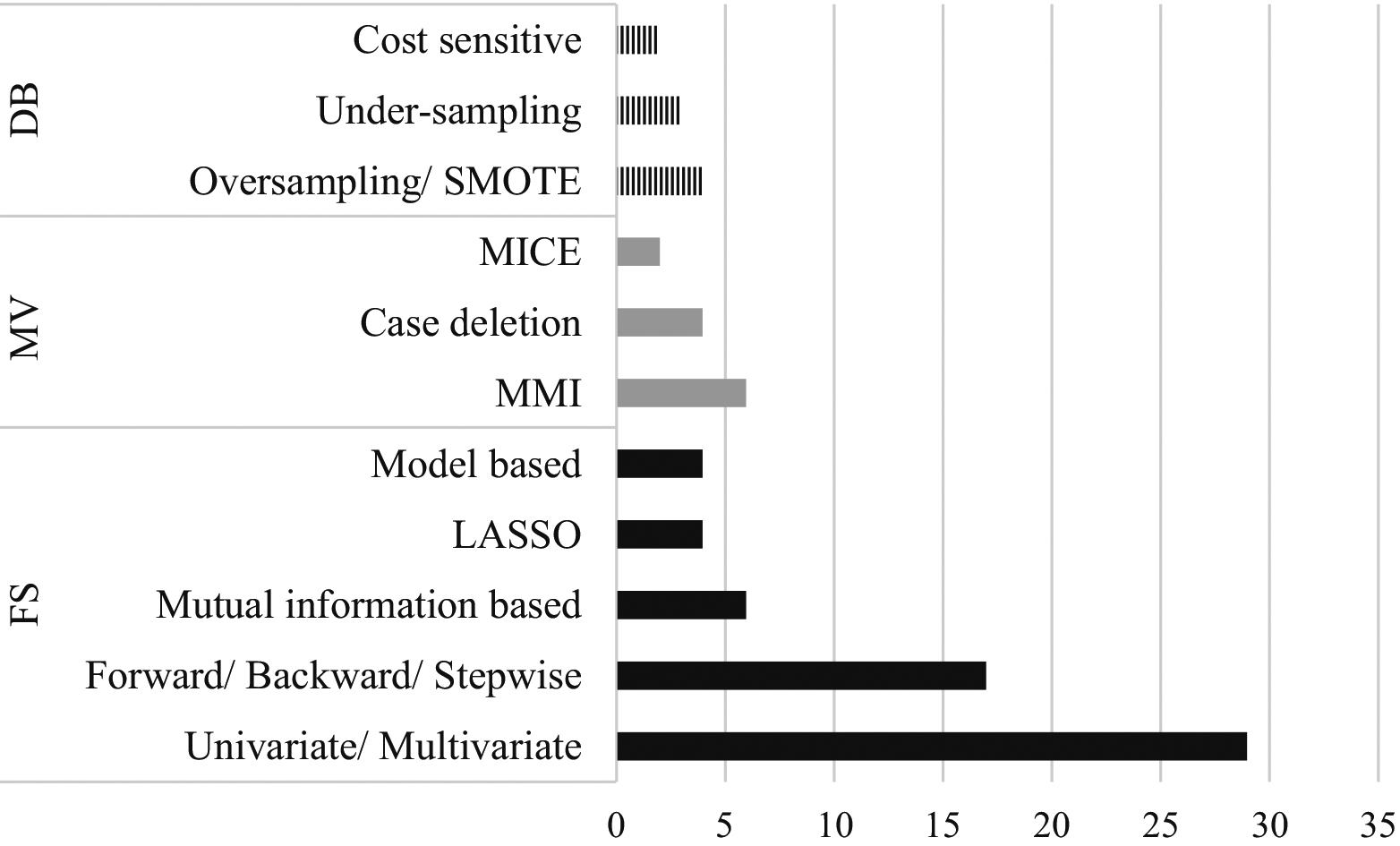
In the next section, the impact of each preprocessing approach is reported and discussed. Firstly, readmission discrimination performance is reported. Secondly, the time it takes to tune the Bayesian hyperparameters to optimise the ML models is discussed. The results reported are based on testing performance. Most of the machine learning algorithms assumed numerical inputs; hence the categorical variables were transformed into one-hot encoding before feature selection was made, after imputing the missing values. This technique is a common practice in many applications that deal with categorical data. This paper excluded deep learning analysis because preprocessing is implicitly integrated into the learning pipeline [66]. This study aimed to analyse the different preprocessing methods and the impact of each method on the prediction accuracy of the machine learning models.
The two most common imputations used in readmission studies are MMI and MICE. Of the two, MMI is more preferred because it is easy to use and is not computationally heavy. Table 1 presents the impact of different missing value imputation methods on model performance.
The impact of different missing value imputations on model performance
The impact of different missing value imputations on model performance
According to the overall performance results listed in Table 1, studies that used missing value imputation had better overall performances in comparison with studies that did not (i.e., those that used CC analysis). For example, the imputation technique improved the AUC for LR, DT, RF, SVM, and GBC. The CC analysis or the removal of all the missing values led to poor prediction because the information removed might have contained some important information for prediction, and so some generalisation of the data could have been lost.
However, some of the classifiers such as
In comparing MMI to MICE, interestingly, MICE techniques led to high AUC scores in almost all the machine learning models considered. The result could be due to the way MICE works, i.e., it allows some information from other variables by building a regression equation for the imputation process. This consideration of other predictors during the imputing process helps the researcher to select the most promising imputed values that in return help the overall prediction. Besides, LR is among the most affected models when used with MICE, where the difference in the AUC score in comparison to MMI was high (0.036). Since the foundation of the LR classifier is almost similar to MICE, these approaches share almost similar information (weight) with other variables. Therefore, it can be concluded that MICE is very suitable to use with LR.
On the other hand, MMI obtained a moderate AUC score. In most of the cases, it performed less than MICE but at the same time better than CC. This situation is because MMI simply imputes the mean or the mode of the overall data in a column, which often leads to bias, especially when there is a high range of values in specific features.
The impact of different feature selection methods on the performance of the ML models was quantified, as shown in Table 2. This study considered the most frequently used feature selection category based on the studies. The results showed that the univariate Chi-Square filter method, the RFE wrapper method, and the LASSO embedded method were the most used feature selection categories. Therefore, these categories were compared.
The impact of different feature selection algorithms on the ML model performance
The impact of different feature selection algorithms on the ML model performance
AUC was used to evaluate the overall performance of the models because it is the most commonly used measure in many readmission studies and imbalanced cases. The next performance measure used to examine the overall prediction performance was accuracy. Table 2 shows that studies that used feature selection selected better variables for the final prediction models and helped with the overall performance in comparison with studies that did not. For example, feature selection helped improve the performance of
On the other hand, the performance of the AUC score for tree-based models such as DT and RF does not provide a significant difference either applying the feature selection or not. The reason for this case is that RF can work well with a large number of features as it builds the ensemble model from the subspace of data using DT. Hence, the tree-based models do not give much impact on any feature selection used.
Of all the feature selection methods, LASSO had the best performance (in terms of AUC and accuracy). LASSO outperformed other feature selection methods that used LR, NB, RF, and SVM. LASSO is an embedded technique, so it adds a constraint to the model to prevent overfitting and to improve generalisation. The weak features are forced to have a zero coefficient, so only the most impactful features are left. Also, this technique effectively captures dependencies between variables.
Conversely, RFE is underperformed compared to the other feature selection methods in most of the models. The reason for this case might be related to how RFE works. RFE recursively removes the features using a Greedy search to obtain the best subset. The remaining variables are then re-ranked by training a classifier. The weak features will be removed, so this could lead to reduced performance, as the weak features might still be useful when combined with other features. However, a past study justified that RFE is more suitable for small sample problems [23] and is less scalable to large datasets [48].
This study considered resampling as the data balancing method, as it was the most used method in previous hospital readmission studies. Hence, this study compared the random under-sampling approach and the over-sampling approach. SMOTE was selected for the over-sampling approach because past readmission studies used this method the most. Most of these studies did not consider using data balancing. Hence, the performance of different data balancing methods was compared to highlight the importance of this method. Table 3 presents the result of this comparison.
The impact of different data balancing approaches on model performance
The impact of different data balancing approaches on model performance
It is justified that recall is as important as AUC score when evaluating the performance of the data balancing approach in handling the imbalanced data in a readmission dataset. Recall or TPR evaluates the extent to which the True Positive class has been correctly predicted out of the Total Positive classes. According to the overall performance results in Table 3, data balancing led to a more stable performance. Here, it can be seen that the AUC of some classifiers such as
Of the data balancing approaches used, under-sampling had the best AUC score for all the classifiers. It can also be seen that under-sampling led to a more stable performance (in terms of recall and accuracy) in most of the cases. Based on Table 3, the Recall score was very low for almost all of the classifiers when SMOTE was used. This result is because under-sampling eliminates the sample of the majority class while oversampling replicates the majority class. The reason why under-sampling works well for this dataset is that the ratio of imbalanced data was nearly one-fifth of the overall dataset and comprised a handful of positive cases of around more than ten thousand instances. Additionally, the resampled negative class can represent the whole negative pattern of the data, so a stable performance is achieved.
Most of the studies did not report using feature scaling to predict readmission. Hence, this study investigated the impact of feature scaling on different classifiers. Table 4 presents the results of comparing the model performance when different data scaling approaches were used.
The impact of different feature scaling approaches on model performance
The impact of different feature scaling approaches on model performance
According to the results listed in Table 4, the feature scaling approaches did not show significant differences, despite specific models showing some minor differences. The reason might be due to the nature of the data itself. Feature scaling is very useful when the data has different scales across different features. This method turns all the features into comparable units. The studies reviewed only had ten numerical features, while the rest consisted of categorical features that had been transformed into a one-hot-encode label. Additionally, not all the numerical features had very large scales. For example, the range varied from [1–132], [0–6], [1–81], and [0–60] for the number of lab procedures, the number of procedures, the number of medications, and the number of diagnoses, respectively. Therefore, the small difference in scales caused feature scaling to have no significant impact on model performance.
Subsequently, moving into the details of the results, some of the findings may reveal some useful information. The Tree-based classifier, as can be seen in the Random Forest, was not affected by feature scaling, similar to some cases that used the Decision Tree. This result is possibly due to the splitting criteria that order the values in each attribute and then calculate the Gini or entropy split. Additionally, Naïve Bayes and Logistic Regression also presented consistent AUC values in Table 4. This result might also be due to the nature of the classifiers. For example, the model’s priors are determined from the count in each class, not by the actual values in Eq. (1). Hence, Naïve Bayes was not affected by feature scaling. For Logistic Regression, the coefficients represent the strength of the impact of each variable on the target variable. If the features do not affect the outcome, a broad range of data will render the corresponding coefficients of the regression algorithm small, so it will not affect the prediction as much.
Nevertheless,
Under Bayesian optimisation, 100 maximum evaluations were set for each preprocessing combination and machine learning classifier to tune the hyperparameters. This setting was chosen based on several previous papers related to practical Bayesian optimisation [85, 75]. Then, studies that did not use feature selection and studies that used LASSO were compared because the overall tuning time for LASSO and other feature selection methods was not much different. Besides, LASSO also had the best performance. Table 5 shows the hyperparameter tuning time using Bayesian optimisation for different feature selection methods and data balancing techniques. The reported tuning times are presented in the format of hh: mm: ss indicating hours, minutes, and seconds, respectively.
Bayesian hyperparameter tuning time (hours: minutes: seconds) for different feature selection methods and data balancing approaches
Bayesian hyperparameter tuning time (hours: minutes: seconds) for different feature selection methods and data balancing approaches
Naïve Bayes has no hyperparameters, so it does not need tuning. Therefore, this classifier was not included in the assessment. Table 5 shows a notably lower computational cost when LASSO feature selection is used. Additionally, data balancing using SMOTE oversampling had a very high computational cost, taking more than double the time it took for under-sampling approaches, especially for the
Bayesian hyperparameter tuning time (hours: minutes: seconds) for the SVM model
Of the ML models, SVM demonstrated the highest computational cost, especially in combination with SMOTE and not apply feature selection. GBC and
Preprocessing is a challenging task, especially when the data is noisy, severely skewed, and contains hundreds of attributes. In this study, four preprocessing approaches were considered, which are missing value imputation, feature selection, data balancing, and feature scaling. The combination of all these methods was evaluated based on the AUC, precision, recall, and accuracy of all the ML classifiers.
Missing value imputation is an important task, especially when there is a huge number of missing instances. In most of the readmission studies, MMI was used because it is easy to use and has a low computational cost. However, this study showed that using multiple imputations (i.e. MICE) could improve the overall classification performance, as shown in Table 1. This is because MICE allows the use of some information (e.g., the degree of the relationship between other attributes) for the imputation process. These imputation values can then be used for imputing other attributes.
Secondly, feature selection was shown to improve the performance of the ML models. Even though in some cases, the performance of the models that did not use feature selection was almost the same as that of models using feature selection, feature selection still helped reduce the overall computational cost. Of the feature selection methods considered in this study, LASSO showed the most outstanding performance. The reason for this result is that LASSO removes weak features by shrinking them to zero coefficients, hence only leaving the most impactful features.
Thirdly, data balancing was proven crucial for handling imbalanced data. It can help identify the behaviour of minority samples (i.e. readmitted patients). Resampling techniques were studied, namely undersampling and oversampling, using SMOTE. Table 3 shows that data balancing helped produce a more stable performance compared to when no data balancing was used. Another important finding is that under-sampling outperformed SMOTE in most of the cases in this study. This is because of the nature of the data, which can be considered not too heavily skewed. Besides, at the same time, the resampling of negative instances could represent the whole negative pattern in the data.
Finally, the last preprocessing approach considered in this study was feature scaling. This method is also an essential step to apply when the data is not in the same range. The commonly used feature scaling approaches are standardisation and normalisation. Based on the findings in Table 4, it can be concluded that feature scaling had no significant impact on classifier performance. This is mainly because of the nature of the data used in this study, which has a numerical data range that is not too large. However, the ML models in this study that used the NB, LR, DT, RF, and GBC classifiers were unaffected by scaling methods while those that used the
On the other hand, hyperparameter optimisation is also an important process in predictive modelling. This study used Bayesian hyperparameter optimisation, which is an effective way to tune hyperparameters. Hence, the effect of the computational time of different preprocessing approaches on the performance of different ML models was investigated to provide the researcher with some insight on the suitability of this optimisation method with different pipelines.
Based on the experiment involving each approach, the hyperparameter tuning for every ML model together with SMOTE data balancing led to triple the computational costs compared to the under-sampling approach. In the same way, every ML model that used hyperparameter tuning with no feature selection also had higher computational costs than the models that did not use feature selection. The computational cost increased when both the above approaches were combined (i.e. no feature selection and SMOTE). On the other hand, the hyperparameter tuning also differs for each ML model. Regardless of the preprocessing approach selected, SVM took a very long time to tune the hyperparameters. In contrast, DT took a very short time to tune the hyperparameters. Hence, DT is very suitable for fast decision making and fast predictions.
Overall, the results showed a modest to good testing. The results might be incomparable across other related studies, as they varied depending on the target population or disease, the availability of the features in a database, and the length of readmissions. When classification performance and computational cost were combined, RF with MICE imputation, LASSO feature selection and under-sampling framework gave the best performance. Additionally, the second proposed combination were the ML classifiers of LR, GBC and SVM with MICE imputation, LASSO embedded feature selection and under-sampling framework. The third best combination that has a similar pipeline for ML classifiers above are MICE imputation, Univariate Chi-Square filter feature selection and under-sampling framework.
Conclusion and further study
This study evaluated the effect of preprocessing and machine learning pipelines on hospital readmission prediction. It can be concluded that the most promising pipeline was the combination of the RF classifier for the ML model with MICE imputation, LASSO feature selection, and under-sampling data balancing as the preprocessing framework. The same preprocessing method also works well for other ML classifiers such as GBC, SVM, and LR. Machine learning has emerged as a promising approach in recent years, more so than other statistical modelling techniques, especially for predicting readmission risk. Hence, most of the existing studies had prepared an overall workflow limited to the baseline of the models. Also, these studies tended to follow established procedures.
Based on the ML prediction studies reviewed, most did not focus on preprocessing approaches. Overall, most of the studies used feature selection with only 20% applying missing value imputation and 13% addressing the imbalanced class problem. However, missing value imputation could be irrelevant in some cases due to the completeness of the data in hand. In contrast, class imbalance is a well-known problem that affects overall discrimination performance. Most of the studies used MMI as the missing value imputation approach, which is also the simplest. Meanwhile, the univariate feature selection was the most commonly used approach.
Bayesian optimisation has increasingly been used in many applications in recent years, as it helps choose the appropriate set of hyperparameters for each model. The right combination of preprocessing methods may help reduce computational costs and improve discrimination performance. This study only considered a maximum evaluation of 100 due to the computational cost. For future research, the number of assessments might be increased to further improve the selection of hyperparameters. Moreover, a comparative study could be done to assess the impact of different numbers of evaluations on different datasets. In sum, this study considered the effect of selected preprocessing methods on the performance of the machine learning classifiers. Besides, this study only considered existing datasets, so the results might not generalise the overall performance of readmission prediction. Hence, further comparative studies should be done to assess the impact of other available preprocessing techniques with different readmission datasets to better generalise the effect of preprocessing pipelines on predictive performance.
Another challenge in readmission prediction refers to the curse of dimensionality due to the large data sets involved with many potential predictor variables. Theoretically, the incorporation of additional variables into the model yielded better prediction, thus enabling information storage. Nonetheless, it rarely helps in practical as the convergence to obtain those solutions might be increasingly slow due to the potential presence of noise and redundant variables [71]. Solutions that had effectively managed the curse of dimensionality were feature selection and dimensionality reduction, wherein both had minimised the input variable. The capability of input variables reduction displayed in this study using feature selection techniques is applicable for supervised learning [67]. Feature selection had enhanced the overall prediction performance in this study. On the other hand, the dimensionality reduction methods, such as principal component analysis (PCA), is applicable for both supervised and unsupervised data and may be further investigated by future researchers in comparative studies to address the curse of dimensionality, and to determine the suitability of these approaches in studies related to hospital readmission.
The prediction of hospital readmission is a naturally complex problem, as explained in [52]. Besides, predicting hospital admission is not as easy as predicting death, so high discrimination performance is also not easily achieved [9]. The machine learning models might have limited overall performance because of the lack of relevant data, although more complex models have been used. With the improvements to the whole machine learning framework, which includes the preprocessing pipeline, prediction performance can also be improved. Meanwhile, although it is known that no one model fits all, this study offered some insight into the importance of applying preprocessing for machine learning models. Hence, future studies could refer to this study to explore other preprocessing pipelines for machine learning classifiers, especially for readmission tasks, and for other medical problems in general.
Footnotes
Acknowledgments
The financial support received from the University of Malaya (IIRG004B-19HWB), Universiti Kebangsaan Malaysia, and the Ministry of Higher Education Malaysia are gratefully acknowledged.
Conflict of interest
The authors declare no conflict of interest.