



Abstract
Economic dispatch problems (EDPs) can be reduced to non-convex constrained optimization problems, and most of the population-based algorithms are prone to have problems of premature and falling into local optimum when solving EDPs. Therefore, this paper proposes a hybrid quantum-behaved particle swarm optimization (HQPSO) algorithm to alleviate the above problems. In the HQPSO, the Solis and Wets local search method is used to enhance the local search ability of the QPSO so that the algorithm can find solutions that is close to optimal when the constraints are met, and two evolution operators are proposed and incorporated for the purpose of making a better balance between local search and global search abilities at the later search stage. The performance comparison is made among the HQPSO and the other ten population-based random search methods under two different experimental configurations and four different power systems in terms of solution quality, robustness, and convergence property. The experimental results show that the HQPSO improves the convergence properties of the QPSO and finally obtains the best total generation cost without violating any constraints. In addition, the HQPSO outperforms all the other algorithms on 7 cases of all 8 experimental cases in terms of global best position and mean position, which verifies the effectiveness of the algorithm.
Keywords
Introduction
Economic dispatch (ED) is of vital importance for effective operation of an electric power system. Solving the ED problems properly can not only optimize the allocation of resources, but also can promote the transformation of the power company’s production scheduling mode to the greatest extent. In addition, reducing the loss of resources can also effectively reduce environmental pollution to a certain extent. An ED problem can be mathematically formulated as a constrained nonlinear optimization problem, the objective of which is to minimize the total short-term cost of operating the generators by properly dividing the total load demand among the available generators [1]. In order to tackle such kind of problems effectively, researchers have proposed many optimization methods, including traditional gradient-based and metaheuristic methods.
The traditional gradient based methods such as linear programming,
Metaheuristic algorithms, particularly population-based random search techniques, are known to be effective in solving complex nonlinear optimization problems [10]. They also had been used and achieved promising performances in many machine learning tasks, the most typical filed is the feature selection [13, 14]. In addition, two well-known classes of population-based search techniques, namely evolutionary algorithms and swarm intelligence optimization algorithms, had shown effectiveness in solving ED problems [15]. The most widely used optimizers of these kinds include particle swarm optimization (PSO) [16], the bee colony Optimization (BCO) [17], firefly algorithm (FA) [18], artificial bee colony algorithm (ABC) [19], Kho-Kho optimization (KKO) algorithm [20], whale optimization algorithm [21], tunicate swarm algorithm [22], and some recently proposed metaheuristic algorithms [23]. Compare to the other metaheuristic algorithms, PSO is simpler, more robust, has fewer parameters to be adjusted, and is easy to converge [28]. However, PSO is prone to fall into the local minimum, and thus it is difficult to obtain a satisfying solution. Recently, various PSO modifications were presented. For example, Maedeh et al. proposed a phasor particle swarm optimization (PPSO), which uses a phasor angle to replace the control parameter of PSO to solve different types of ED problems [29]. The QPSO algorithm is inspired by quantum mechanics and trajectory analysis of the canonical PSO [30], and its motivation is to improve the search ability of PSO by designing new update equation of particle positions different from that of the canonical PSO.
The QPSO performs well on many optimization problems, especially on continues and non-constrained optimization problems [31]. However, for complex constrained optimization problems like ED problems, the QPSO algorithm lacks strong local search capabilities, and the convergence speed is slow, so that it still has room for improvement. For instance, in order to improve the convergence performance of the QPSO, Zhao et al. proposed a DE-CQPSO (Differential Evolution-Crossover Quantum Particle Swarm Optimization) algorithm, which utilizes the fast convergence of differential evolution and controls the particle diversity by using crossover operators of genetic algorithms [33]. To maintain the diversity of the particle swarm, the QPSO combined with cultural evolution mechanism named CQPSO was proposed [34].
Recently, some hybrid metaheuristic algorithms, which combine their strengths with each other, are presented and performed well in terms of improving the shortcomings of PSO when solving ED problems recently. To accelerate the convergence speed and reduce the total number of evaluations of the algorithm when solving ED problems, Juan designed a hybrid optimization framework based on the adaptive simulated annealing (ASA) and genetic operators [35]. The hybrid DE (differential evolution) and PSO algorithm (DEPSO) designed was the relatively simple hybrid PSO algorithm, but performs well on eight optimization problems [36]. In the evolutionary particle swarm optimization (E-PSO) algorithm, mutation, crossover, and selection in genetic algorithm are implemented to enhance the ability of skipping local optimal points [28].
Therefore, in this work, we propose a hybrid QPSO (HQPSO) algorithm for solving ED problems, by incorporating the Solis and Wets local search method and evolution operators into the QPSO. The purpose of using the Solis and Wets local search method is to enhance the local search ability and fasten the convergence of the QPSO algorithm, which is desirable for the algorithm to find a solution of higher precision for the constrained optimization problem at the later stage of the search process. Although the local search method on the one hand can enhance the solution precision of the problem, it can on the other hand make the algorithm prone to be stuck into local optimal area of the search space. Thus, in order to further improve the algorithmic performance, we propose to couple the algorithm with evolution operators, namely, crossover and mutation, which can give some disturbance to the current positions of the particles to help the particles escape the local optimal area. With the combination of the Solis and Wets search and evolution operators, the HQPSO algorithm obtains a better balance between the local search ability and global search ability. The rest of the paper are organized as follows. Section II is the mathematical statement of ED problems. Section III presents the details of the proposed HQPSO algorithm, and section IV describes the implementation of the HQPSO for ED problems. The experimental results and analysis are given in section V, and some conclusions are provided in the final section.
The economic dispatch problem
The goal of an ED problem is to minimize the total fuel cost subjected to some constraints of a power system [46]. The cost function of an ED problem can be generally formulated by:
With
where
where
where
Active power balance can be expressed as the following equality constraint:
Where
In addition, the total generated power of the system
The generation of each generator should be within the interval between its minimum bound
In the actual operation process of each generator, the operating range of each generator is restricted by its ramp rate limits. The inequality constraints of the ramp rate limits are as follows.
(i) If the power generation increases
(ii) If the power generation decreases
where
In the actual power system, the entire operating range of a generator is not always available when some cases like steam valve operating (i.e. vibrating) in a shaft bearing occur. In other words, the system has some prohibited operating zones. Therefore, the feasible operating zones of the
where
Considering the constraints in Eqs (7) to (11), we get the feasible operation zones of the
Therefore, the ED problem can be formulated as the following constrained nonlinear optimization problem:
subject to:
A Brief Introduction to the QPSO algorithm
The quantum-behave particle swarm optimization (QPSO) algorithm is a variant of PSO, with the update equation of particle positions very different from the canonical PSO. In the QPSO with M individuals, each individual is treated as a volume-less particle in the N-dimensional search space, with the current position of each particle presented as a candidate solution, and updated according to the following equation:
where
With
Since the constraints of the ED problem is highly complicated, it is difficult for the QPSO to find a satisfied solution to the problem meeting all the constraints. In this work, in order to further improve the performance of the QPSO for the ED problem, we propose a novel hybrid QPSO (HQPSO) algorithm, which couple the QPSO with the Solis and Wets local search method and evolution operators. In the HQPSO, the Solis and Wets local search method executes on a randomly selected particle at each iteration, for the purpose of enhancing the local search ability of the QPSO algorithm. With the Solis and Wets search, the QPSO can find a final solution of the ED problem at faster convergence speed. However, the enhanced local search ability of the QPSO by the Solis and Wets search can results in a swarm diversity loss of the algorithm in the later search stage, thus making the particles to be trapped into the local optimal or sub-optimal solution. To address this issue, we propose to exert crossover and mutation operators on the positions of randomly selected particles to bring them some disturbances so that the particle swarm can get enhanced vitality to escape the local or sub-optimal solution. With the combination of the Solis and Wets local search and the two evolution operators, the balance between the local search and global search abilities at the later stage of search can be achieved so that the algorithmic performance can be further improved. The rest of this subsection will focus on the detailed description of the different components of the HQPSO.
Solis and Wets local search
The purpose of using Solis and Wets local search in the proposed HQPSO is to enhance the local search ability of the algorithm, which is desirable for the algorithm to obtain a relatively good solution with fewer iterations at the early search stage and get a final solution with high precision at the later search stage. This is particularly conducive to the constrained optimization problems with equality constraints, like ED problems. The equality constraints are essentially the bounds of the feasible area of the ED problems so that the solution with high precision is more likely to be on the bounds.
The Solis and Wets local search algorithm is a randomized hill climber with an adaptive step size, without any reliance on the gradient information of the objective function [37]. The local search executes on the current position of a selected particle for some steps during each iteration, with the search direction of the current position generated by a normal distribution whose mean and standard deviation are user-specified parameters. The algorithm of the Solis and Wets local search is described in Algorithm 1.
[h] An example for format For & While Loop in Algorithm[1]Solis and Wets local search
As illustrated in Algorithm 1, during the local search steps for the current position X of a particle, a move is made to the position and then the new position is evaluated according to the objective function. Specifically, with
However, if either the temporary solution
Diversity explosion of HQPSO
Since the Solis and Wets local search method in the HQPSO can enhance the local search ability of the algorithm, it can make the particle swarm aggregate to the current global best position at a higher speed. As mention in the above subsection, this local search method can make the algorithm find a good solution rapidly at the early search stage and yield a final solution with high precision at the later search stage. However, during the later stage, strong local search ability of the algorithm may lead the algorithm to encounter premature convergence. Hence, in order to overcome this disadvantage, we further propose to incorporate two evolution operators into the HQPSO to enhance the global search ability of the algorithm at the later search stage so that the algorithm can has much chance to escape the local optimal or sub-optimal solution, and we call it diversity explosion phase. As a result, with both Solis and Wets local search and the two evolution operators, the HQPSO has better balance between the global search ability and the local search ability than the QPSO with only Solis and Wets local search. The evolution operators used in the HQPSO, the crossover and mutation, are different from the ones generally used in evolutionary algorithms in that they are not executed on the whole position of the particle but on a certain dimension of the position. In the subsequent part of this sub-section, the crossover and the mutation operators used in our proposed HQPSO are described in detail.
Specifically, at iteration t, we generated a random number uniformly distributed on (0,1). If this number is greater than the crossover probability
where particles
where
According to Eq. (22), for each particle at the
With the above specification, the procedure of HQPSO is shown in Fig. 1. Empirically, the algorithm strikes a balance between local search ability and global search ability when performing the two combined evolution operators if the current iteration
The follow chart of HQPSO algorithm.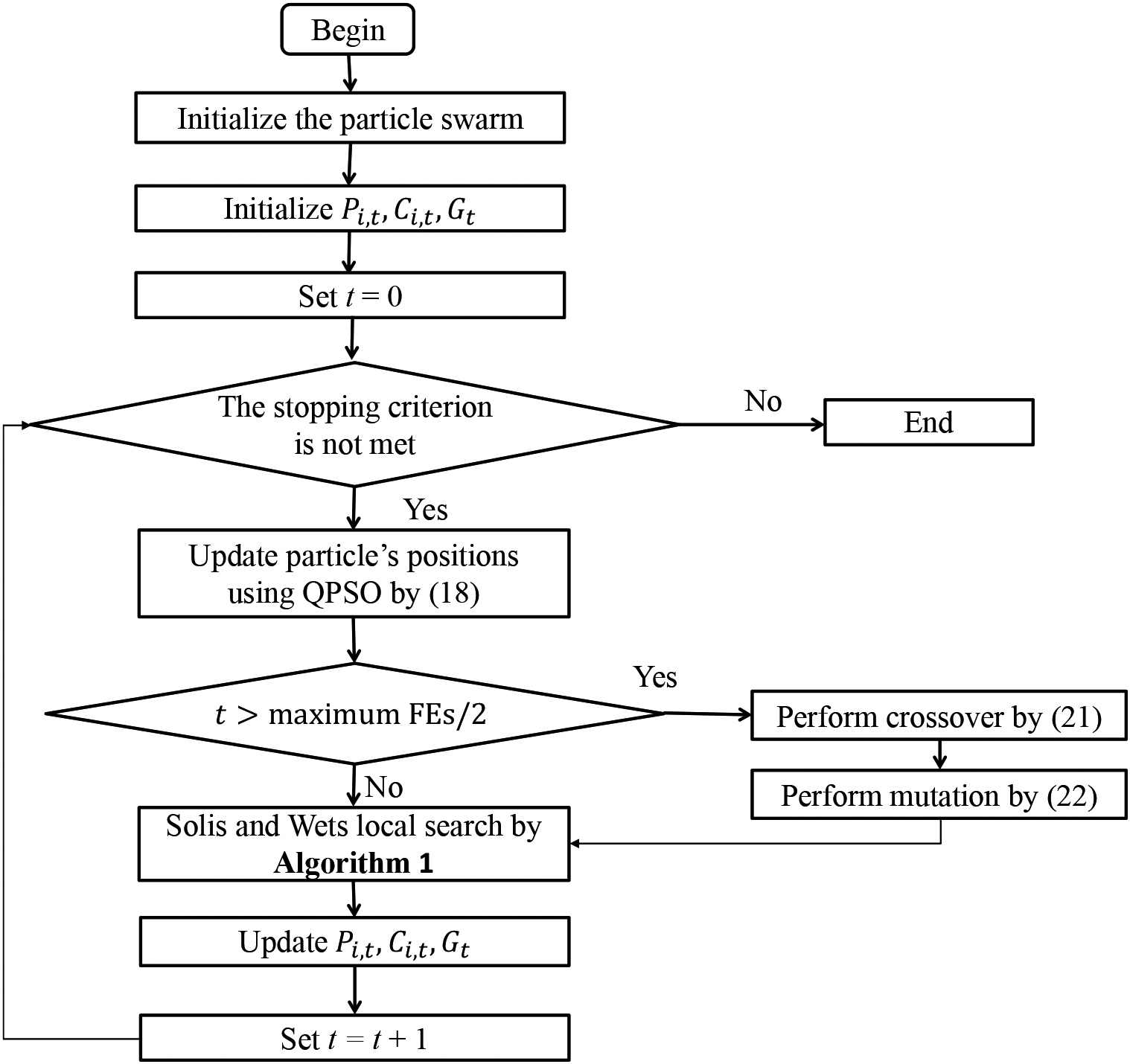
With the above specification, the procedure of HQPSO is shown in Fig. 1. Empirically, the algorithm strikes a balance between local search ability and global search ability when performing the two combined evolution operators if the current iteration
Representations of the individual particle
When solving the ED problem by the HQPSO, we represent the current position of each particle as a candidate solution, with each component of the position vector denoting the power output of a generator. Put it in more detail, if the system with
where
We use a dynamic penalty method to deal with the equality constraints, and consequently the objective function then can be given by:
where
The penalty method can control the candidate solution to approach gradually to the feasible search space. On the one hand, when the candidate solution does not violate the equality constraints, the penalty term equals to zero no matter how large the penalty coefficient is. On the other hand, according to Eq. (24), a larger objective value is given to the candidate solution when it violates the equality constraint.
As for inequality constraints described in Eqs (15)–(17), we also employ a penalty method. Specifically, if the particle’ position is within the feasible intervals, the objective value is given by Eq. (24); otherwise, the objective function value of the particle’s position is penalized with a very large positive constant, which is also a user-specified parameter.
The HQPSO algorithm was tested on four actual power systems to verify its effectiveness in solving ED problems. In these systems, the ramp rate limit, the prohibited zones, the valve-points and multi fuel options of the equipment were taken into consideration in the corresponding experiment. For a comprehensive performance comparison, many optimization algorithms were evaluated on these four systems, including, the standard PSO with shrinkage and inertia weight (SPSO) [38], the hybrid gradient descent PSO (HGPSO) [38], the QPSO [39], the hybrid PSO with mutation (HPSOM) [38], the hybrid PSO with wavelet mutation (HPSOWM) [38], the chaos PSO (CPSO) [40], artificial bee colony algorithm with distance-fitness-based neighbor search (DFnABC) [41], enhanced self-adaptive global-best harmony search (ESGHS) [42], diversity-based parallel PSO (DPPSO) [47] and differential evolution-crossover QPSO (DE-CQPSO) [33]. For each system, all the tested methods used the same objective function. Besides, we carried out an ablation experiment to verify the effectiveness of each incorporated operation in the HQPSO. That is, we made a further performance comparison between two different versions of the HQPSO, namely the HQPSO-t1 and HQPSO-t2, where the HQPSO-t1 only employed the Solis and Wets local search method and the HQPSO-t2 used both the Solis and Wets local search method and the evolution operators. The source code of the HQPSO algorithm can be found in
The four power systems
System 1: The system is a medium-scale system with 15 thermal units, the characteristics of which can be found in [19]. The load demand of the system is 2630 MW, and the generating units 2, 5, 6, and 12 in the system have a total of 11 prohibited operating zones. Therefore, this system has inequality constraints according to Eqs (15)–(17).
System 2: The system contains 40 generating units in the actual Taipower system, which is a high-scale hybrid power system with coal-fired, oil-fired, gas-fired, diesel and combined cycles presented. The load demand of the system is 10500 MW. The details of this system such as the parameters and loss coefficients of the generating unit can be found in [43]. This system has no prohibited zones with a result that has fewer inequalities. However, it does not significantly reduce the difficulty of the problem, since the characteristic of large size and the valve-point effects of this system make the corresponding ED problem hard to solve.
System 3: The system consists of 140 generating units also known as Korean power system, which is a large-scale hybrid power system with coal, LNG_CC, NUCLEAL and OIL presented. The Korean power system is a non-convex problem with valve-points, prohibited operating zones as well as the ramp rate limits considered. The total demand of the system is set to 49342MW, and the dimension of this ED problem is 140. Since the valve point results in the ripples in this system, a cost function contains higher order non-linearity that makes its corresponding ED problem the most difficult to solve among all the four systems. Due to space limitation, one can refer to [44] for the details of the system.
System 4: This system has 320 generating units with both valve-point effect and multi fuel options considered, which is built by duplicating the 10-units system 32 times. The total load demand is set to 86400 MW and the transmission loss is ignored. Due to the limited spaces, the details of the fundamental 10-units system, such as cost efficient and definition of fuel types, can be found in [45]. The cost function of its ED problem is defined by Eqs (4) and (13).
Experimental configuration
The maximum number of FEs for solving the ED problem of the four systems using each of all the tested algorithms was 20000 for the purpose of fair performance comparison, since the most of computational consumption in the optimization task is spent on objective function evaluation. Each algorithm was tested on each system with two different experimental configurations, one with the swarm size
For the former three systems, the penalty coefficient
The main parameters of the other compared algorithms are described as follows. The maximum velocity of the SPSO was set to 0.2, the inertia weight of the CPSO was 0.9, the learning rate of the HGPSO was 0.001, the probability of mutation of the HPSOM and the HPSOWM both was 0.1, the coefficient parameter in the QPSO algorithms declined from 1 to 0.5, and the present number of times in DFnABC equaled to the number of employed bees or onlooker bees times the dimension of the problem.
The parameters setting in the hqpso-t2 algorithms for different systems
The parameters setting in the hqpso-t2 algorithms for different systems
The results on system 1 (15-unit system)
The generating unit ramp rate limits and the generating prohibited zones of the 15-unit system
The best solution obtained by the HQPSO on system 1 (15-unit system) with
Convergence properties of the tested optimization methods with higher objective function values on the 15-Unit system. (a) 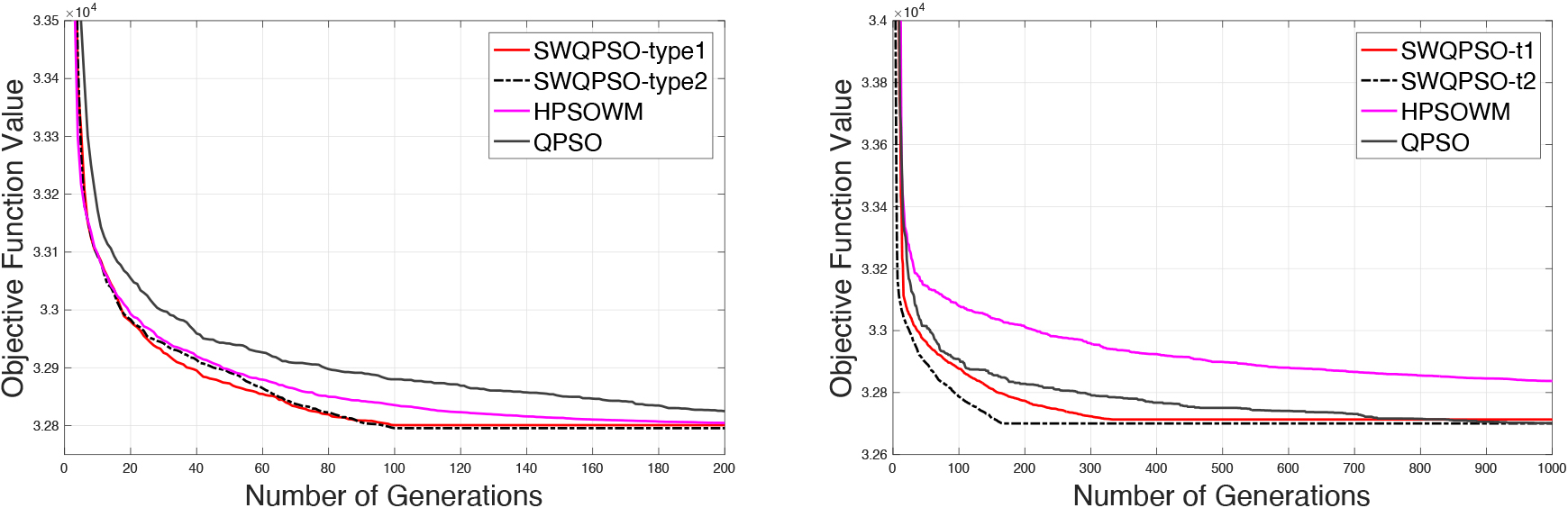
Convergence properties of the algorithms with higher objective function values on the 40-Unit system. (a) 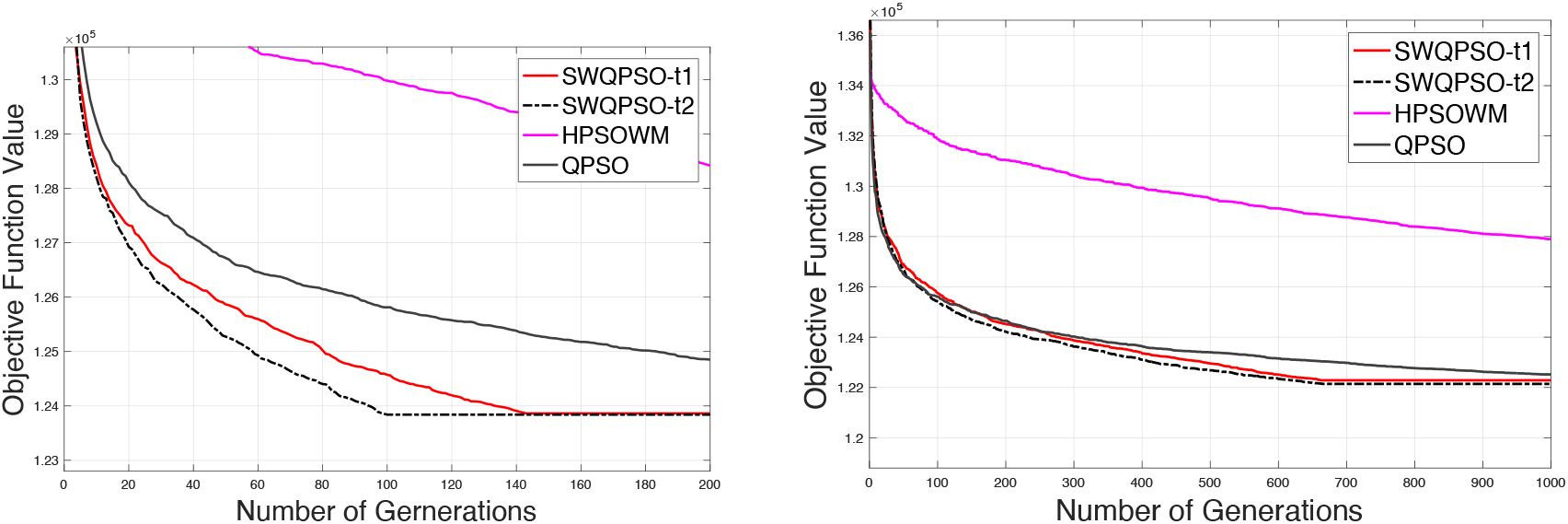
Convergence properties of the algorithms with higher objective function value on the 140-Unit system. (a) 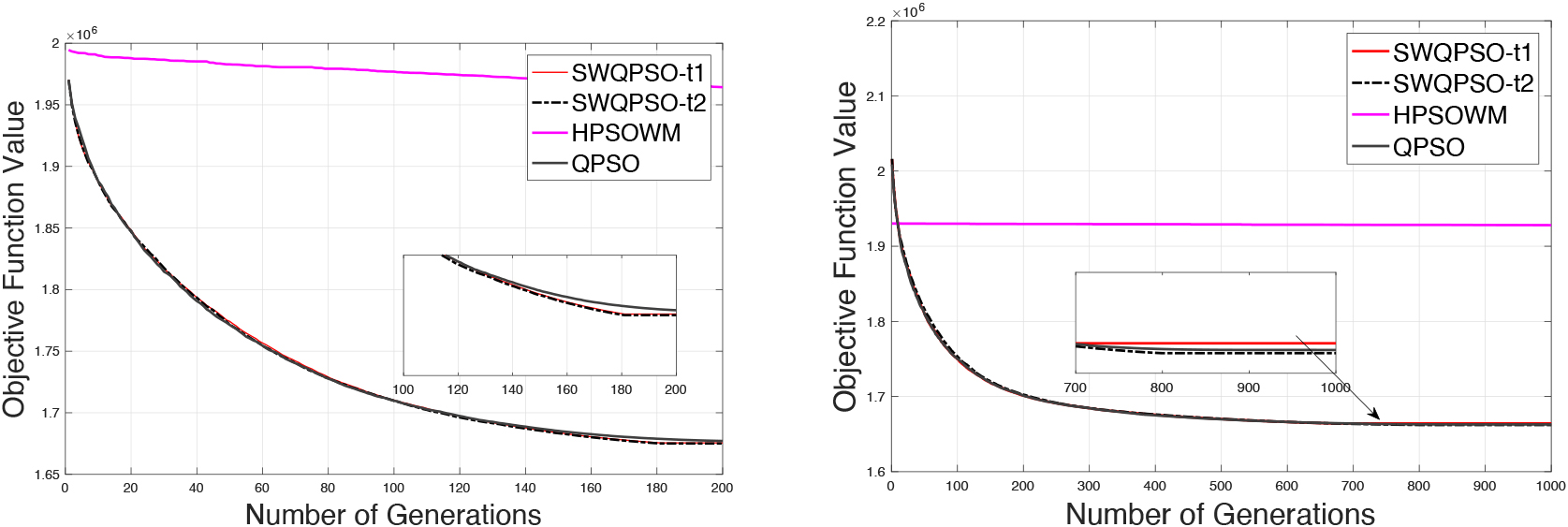
The results on system 2 (40-unit system)
The results on system 3 (140-unit system)
Convergence properties of the tested algorithms with higher objective function value on the 320-Unit system. (a) 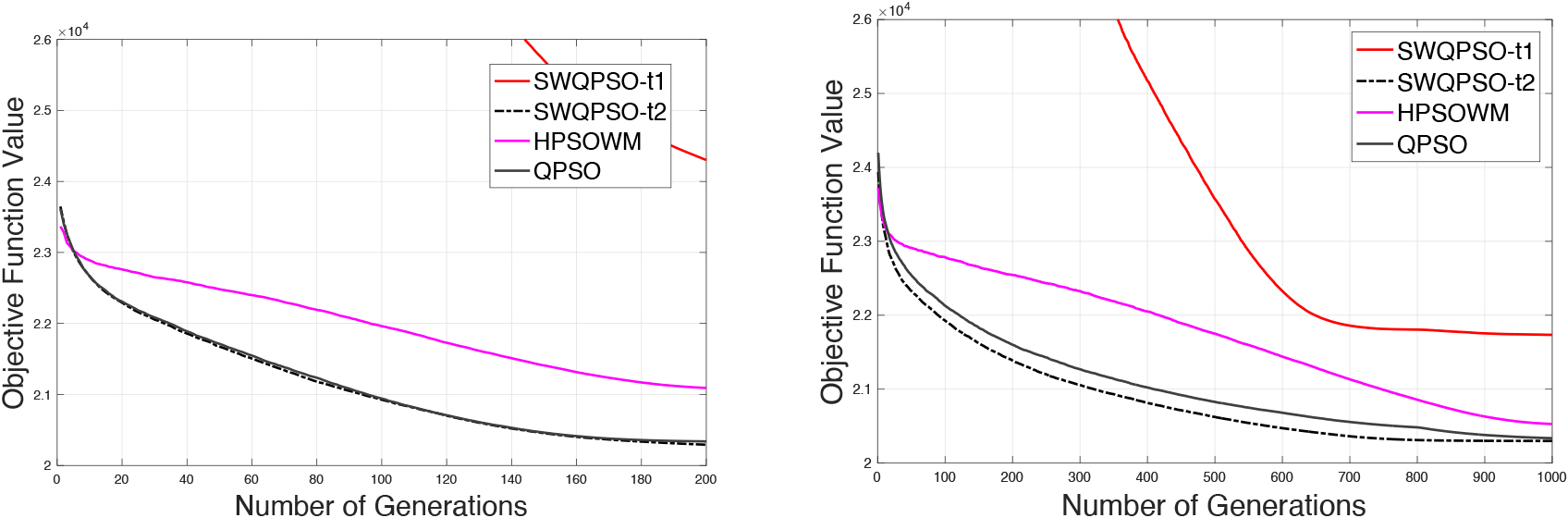
Table 2 gives the results obtained by each tested algorithm over 100 independently trail runs on the ED problem of system 1. As can be observed from the table, the HQPSO-t2 not only found the best solution (the minimum total fuel cost value is 32531.5860
In order to verify the best solution obtained by the proposed method not violate s the constraints, the characteristics of System 1 are given in Table 3. Columns 2–5 in this table describe the generating prohibited zones of the system, where
As we can see in Table 5, the minimum total fuel cost obtained by the HQPSO-t2 with
The ED problem of System 3 taking the valve point effects into consideration that it is harder than the problems of the previous systems, so that there are great differences among the tested algorithms in solving the ED problem as can be seen in Table 6. Similar to the other cases, the minimum fuel cost value was also yielded by the HQPSO-t2, and the HQPSO-t1 is the second-best algorithm in solving this ED problem. Figure 4 shows the convergence properties of four tested algorithms that perform well on the ED problem of this system. It is worth noting that the canonical QPSO and the two different types of the proposed HQPSO converge smoothly and can find final satisfying solutions. However, other algorithms, for example, the HPSOWM algorithm, converges very fast at the early search stage which may make the swarm stuck into a local optimal point. It can be clearly seen from the enlarged picture that the HQPSO-t2 is able to get a better solution than the QPSO and the HQPSO-t1.
Table 7 provides the results of 10 tested algorithms obtaining by 100 trails on the problem of System 4. This problem is the largest and the hardest problem among the four systems, since it has 320 generating units with both valve-point effect and multi fuel options considered. It can be clearly seen from the table that the proposed method HQPSO-t2 outperforms the other competitors under two different configurations. Figure 5 shows the convergence properties of four tested algorithms for the 320-Unit system, and we find that the algorithm may stucks into the local optima area without the help of the single dimension operations of crossover and mutation.
Furthermore, Table 8 provides the results of the unpaired t-test and Wilcoxon rank sum test of the HQPSO-t2 with the other compared algorithms. Due to space limitation, the statistic test results for the other three systems are not given in the paper. From Table 8, we can reach the conclusion that the HQPSO-t2 has an extremely significant difference with all the other competitors. Therefore, it is verified that the HQPSO-t2 performed the best in a significance manner on this ED problem among all the tested approaches.
The results on system 4 (320-unit system)
The changing curve of the swarm diversities of the QPSO, HQPSO-t1 and HQPSO-t2 algorithms on different systems with 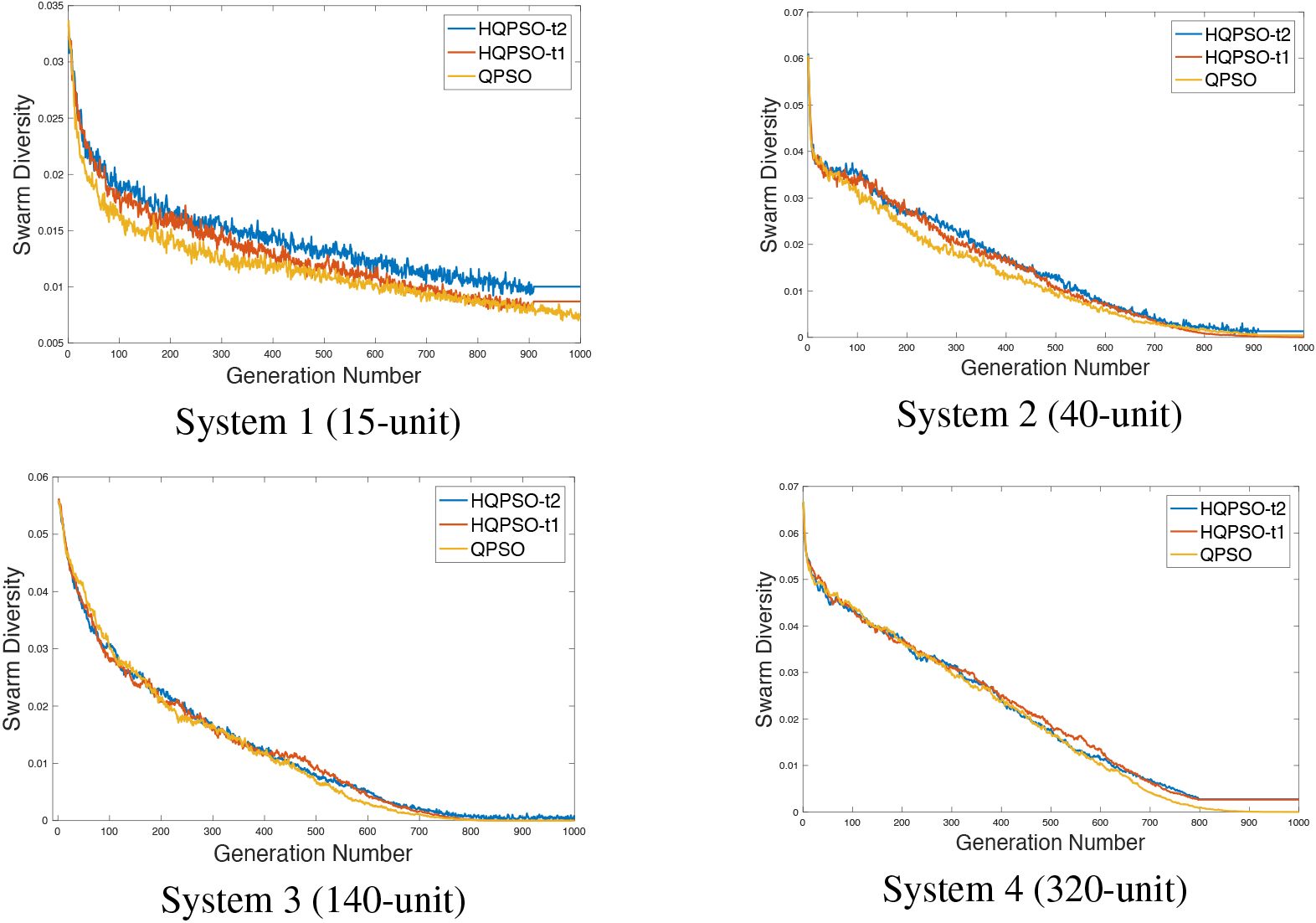
Results of the unpaired
Figure 6 shows the changing curves of the swarm diversity of two types of the proposed algorithms and the canonical QPSO algorithm during the search process. The swarm diversity is calculated by:
with
where
In this paper, we proposed the HQPSO algorithm which couples the Solis and Wets local search and evolution operators with the QPSO, in order to improve the relatively poor local search ability of the QPSO when solving the non-convex ED problems. In the HQPSO, the Solis and Wets local search method enhances the local search ability of the algorithm, and the two evolution operators decrease the probability of premature convergence caused by the Solis and Wets method. Therefore, the HQPSO has a better balance between the local search and global search abilities. The two types of the HQPSO and the other optimization techniques were tested on the ED problems of four power systems, with the nonlinear characteristics of the generators, valve-point effects and multi-fuel options taken into consideration. To guarantee that the candidate solutions provided by the tested algorithms do not violate the constraints, the penalty method was employed.
The experimental results obtained by the tested algorithms on the four well-studied cases indicated that the two different types of HQPSO algorithms were better than the other tested competitors in terms of solution quality and performance robustness. Furthermore, the HQPSO-t2 could yield higher-quality solutions with better convergence properties than the HQPSO-t1, implying that it is a promising optimization technique for solving ED problems. However, the proposed algorithm has many parameters need to be adjusted and converges lower that the other metaheuristic algorithms.
Since the HQPSO incorporates the Solis and Wets local search method and two evolution operators, its computational cost is higher than the other population-based algorithms. Therefore, in the future, we will first implement some gradient based methods into the algorithm to reduce the time complexity of the algorithm. We also will focus on the application of the HQPSO-t2 algorithm to other difficult industrial optimization problems.
Footnotes
Acknowledgments
This work was supported in part by the National Key Research and Development Program of China (grant no: 2018YFC1603303, 2018YFC1604004, Wuxi University Research Start-up Fund for Introduced Talents, and National Science Foundation of China grant no: 61672263).