



Abstract
Utilization of residue is a challenge in engineering practice, because unreasonable cutting causes excess materials wasted and increases the production cost. This work considers the residual two-dimensional cutting stock problem with usable leftover in which unused parts of cutting patterns can be used for future orders. We propose an algorithm that combines the iterative sequential value correction heuristic with the beam search heuristic, considering both the accumulation and the reusability of leftovers to reduce the material consumption. Cutting plans are constructed iteratively and the best one are chosen as the solution. Cutting patterns in the cutting plan are generated sequentially by recursive techniques, and potentially usable leftover are accumulated by beam search heuristic. Item values are corrected after each pattern to diversify cutting plans. Three sets of simulations under different number of periods, over medium and large instances from the literature, are used to demonstrate the effectiveness of the heuristics. Computational results show that the algorithm provides better solutions, which can save a considerable amount of plate in a long-term production period. The utilization of wastages can save a considerable amount of stock plate and contract the production cost of enterprises in the long-term production period.
Keywords
Introduction
The heuristic is a technique used in the problem solving of the thing which is discovered by the man to optimal the approximation of the reaching intermediate of the optimal solution of the cognitive load to make the decision. The multi-dimensional cutting stock problem will help to set the items in the rectangular format for the objective of the number of materials for the manufacturing industries in the paper, wood etc. The ideal cutting design for substances with length & breadth variables can be found by solving the two-dimensional updated periodically sizing slicing supply issue (MSS2DCSP).
To maximize the fewest number of resources possible, the ideal slicing design is required. The restriction that contains the glass industry of the Dimond places which is the formulation the cutting of the different shapes to examine the stock rectangle of the transverse length. The very good property to slice the graph is the demand rectangular in shapes. The variation of the leftover will be able to cut the objects of the stock problems this will help in the CSPUL.
Literature review
The two-dimensional cutting stock problem (2DCSP) is one of the representative combinatorial optimization problems that has many applications in, such as industrial engineering, manufacturing and production process [15]. Given a set of small items and large stock plates, the 2DCSP consists of seeking a cutting plan in which small items of specific demands are completely arranged on the stock plates. The cutting plan is provided by a set of feasible cutting patterns and their frequencies, while the cutting pattern defines the layout of items on the plate.
Minimization of the plate cost is the main objective of the cutting plan of the 2DCSP, and minimizing trim loss is usually the main objective of a cutting pattern [19] In the field of optimization study, the trim loss issue (TLP) is among the trickiest issues. It attempts to satisfy the expectations of consumers so that the waste owing to trim erosion is avoided by selecting the best trimming plan of a variety of products of various heights from a supply of normal sized materials. Though trim loss reduction may save materials, the unused parts of the cutting pattern are not necessarily waste. The steps taken for the utilization of waste are incineration, waste compaction, composting besides vermicomposting. A grinding wheel is used as the milling cutter in the hard turning procedure termed as grinding. Accumulating unused fragments to larger leftovers that can be used for future orders may save a considerable amount of plates in a long-term production period. The period during which a person or investor enhances the worth of their contract or asset is known as the consolidation stage. It is the second stage of the investment decision. The layout of items on minimum plates is already a NP-hard problem, considering the reusability of leftovers increases the complexity of the problem. Within 2 hours of cooking, any remaining meal must be placed in the refrigerator or freezer. This will prevent the further dissemination of dangerous microorganisms. One could also conserve time, work, and expense by reusing the leftovers. Even this, a variety of factors can prevent us from utilising our leftovers, including uncertainty about their safety, forgetfulness, and a negative perception of leftovers.
Though the use of leftovers was first cited by Brown [5], and the first formula was presented by Gradišar et al. (1997), only the 1DCSP with usable leftover (1DCSPUL) has been well-studied recently. The integer linear programming in the wood-processing [13] where unused parts from previous process are selected to fulfil current orders [1] took both the standard objects and the retails as input, trying to minimize waste [7]. Heuristic methods used to find cutting patterns with desirable leftovers and [9] focused on minimizing the pseudo cost including bar cost and leftover profit [8]. The possibility of generating leftovers were considered, and proposed two residual heuristic to use retails. The implementation of a constructive heuristic to solve the 1DCSPUL, and got good solutions with less loss of material [14].
Literature concerned with the 2DCSP considering usable leftovers (2DCSPUL) is scarce and mainly suitable for small-scale problems. The two-dimensional cutting stock issue (2DCSP) calls for chopping all of the rectangle’s objects whilst reducing the wasted region of the utilized supplies provided a collection of rectangular objects as well as an unlimited amount of larger selection rectangle. Vanderbeck [23] offered an option for choosing the length of the used plate, and reserved the remaining sub-plate for future use [18]. [4] Multilevel mathematical programming models to deal with the non-guillotine 2DCSPUL where two leftovers are considered in a cutting pattern. Non-exact 2-staged 2DCSPUL where the cutting plans of minimum plate cost with the maximum area and minimum number of usable leftovers are chosen as the optimal solutions [3].
In this study, we deal with the special two-dimensional cutting stock problem with usable leftovers, in which both the generation and the prioritized utilization of leftovers are considered. According to the typology, this problem can be characterized as a residual cutting stock problem, as for that we call it the residual 2DCSPUL. We propose an algorithm that combines the iterative sequential value correction heuristic with the beam search heuristic to solve the residual 2DCSPUL, considering the accumulation and reusability of leftovers. Both stock plates and usable leftovers from previous periods are used as input material, but leftovers have higher priority [22].
The two-dimensional stock cutting problem leads in the well know optimization problem it has to manage the TDCSP of the complete problem in the polynomial factors of the electronic problems of the DNA molecules which makes the NP problems to solve in the stock cutting. This paper proposes that the DNA computing makes the sticker model which will make the TDCSP in the polynomial considering the formation of the main board [21]. The economic growth of the production cost may happen the formation of the major satisfactory problem in the stock cutting of the glasses. The proposed method needs to reduce the negative product cost for the companies in the reducing waste. The packing of the rectangle and the cutting will be able to find the relaxations, open problems and the exact method [20]. Recursion is a method for solving technical errors that involves writing a procedure that runs oneself again until the program yields the desired outcome.
Article contribution
Cutting patterns in the cutting plan are generated sequentially by recursive techniques. ISVC-BS algorithm with the iterative sequential value correction heuristic with beam search heuristic is achieved. The cutting plan of minimum used plates was used with usable leftovers effectively is obtained. Pattern-procedure is used to obtain the cutting pattern of the stock plate.
The remainder is organized as follows. The definition of residual 2DCSPUL is described in Section 2. The method for solving the residual 2DCSPUL is described in Section 3. And computational results are reported in Section 4, followed by conclusions and future works in Section 5.
The residual 2DCSPUL
In this section, we introduce some of the definition of the residual 2DCSPUL, the main objective of the cutting plan and the detail of accumulation usable leftovers in cutting patterns.
Residual reuse technique.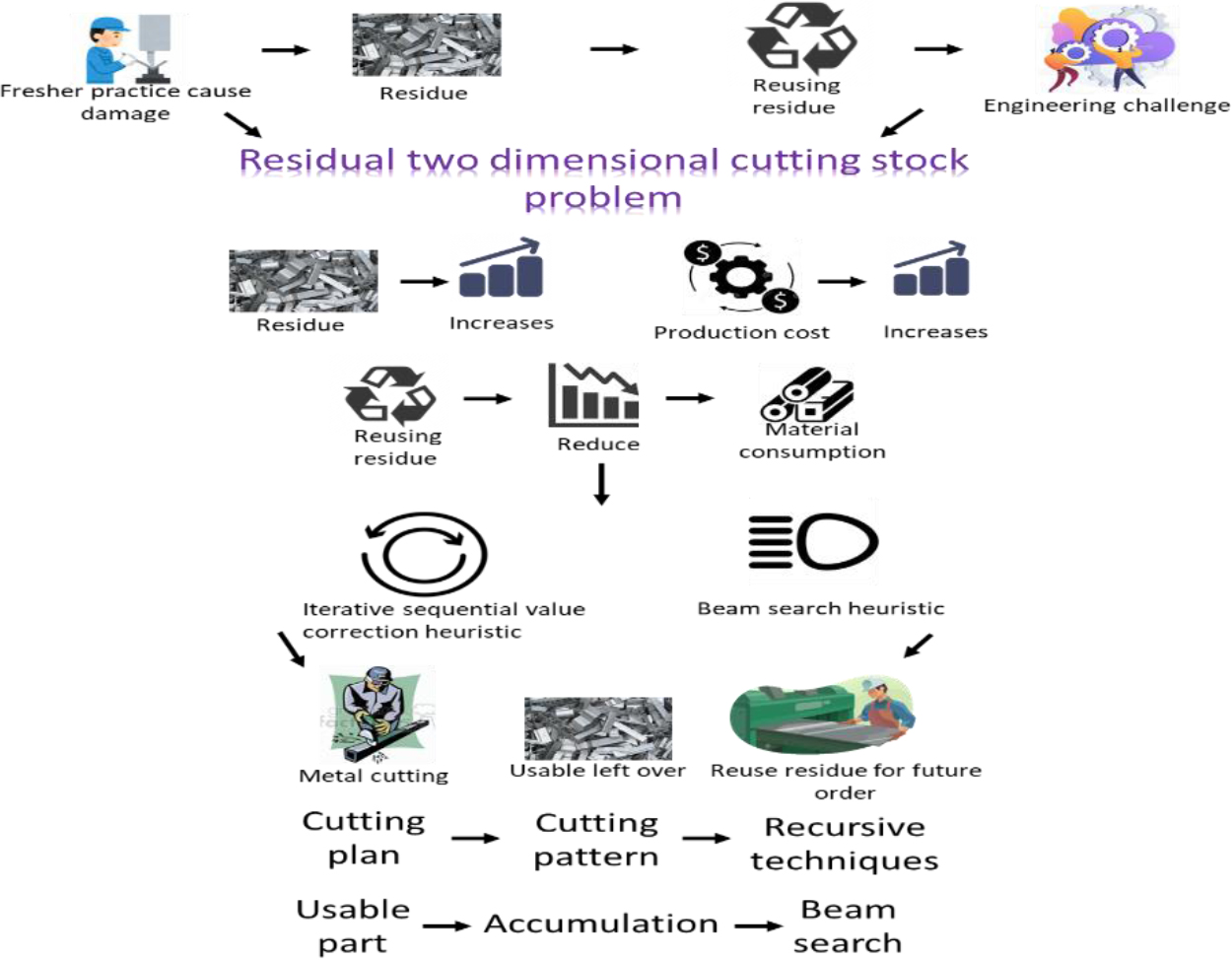
Figure 1 shows residual reuse technique plans set up in the article, and the plan shown good effects.
This is a waste reduction method is achieved by using the adequate leftovers from the process of previous cuttings, thus the problem found in the process of planning with the production of demanded items and leftovers by unknown future demands then to solve this problem a mathematical model has be used for analysing the uncertainty of demand in 2DCSPUL model. Something which lowers wastage by starting with less material is considered a waste reduction. To use both ends of a paperweight, purchasing things in quantity instead of separately packed, or utilising ceramics glasses rather than throwaway ones are all easy ways to reduce trash. Reducing it through better procedures & practises that decrease the quantity we produce is the recommended answer. The second-best option is to recuperate it by producing pet food or even other food items from it, giving excess food to people who need it, or both. Repurposing the outcomes of already training images as sources to a current design is the fundamental goal of the residual reuse method, which seeks to decrease the processing time as well as memory needs of machine learning systems.
On the residual 2DCSPUL, a set of items are produced by cutting a set of strongly heterogeneous large objects. In practice, these large objects are objects of standard size (stock plates bought from suppliers) or the unused parts of input materials (usable leftovers from previous cutting processes). Leftovers have different sizes, or, even if they are equal, treated as distinct types. Since things and garbage are the primary kinds of parts prepared after an operation or procedure, and since they reflect the resources that can be recycled or should be properly discarded since an event or procedure, designs of useable residues often only include things or wastes. The demand of items are given, the supply of each leftover type is 1, and the supply of the stock plates is sufficient. All the item demands must be met by cutting the available objects such that the quantity of used plates is small while the area of usable leftover is large.
On the residual 2DCSPUL, a set of items are produced by cutting stock plates or usable leftovers. Usable leftovers are the unused parts of stock plates from previous cutting processes that are sufficiently large to be cut into at least one item. For simplicity, only the remaining sub-plates that have the same width as the stock plate are considered as potentially usable leftovers. Maintain a current stock, utilize the FIFO approach, identify as well as record things, meal planning round leftovers, become inventive with leftovers, give extra foodstuff, and other techniques can be used to streamline stock administration and enhance the utilisation of leftovers. Other residuals of the stock plate or previous leftovers are different and small in size, which are difficult to be reused, are treated as waste of the cutting process. Only one leftover is considered in one cutting pattern, which simplifies the inventory management and improves the reusability of leftovers.
The solution of the residual 2DCSPUL is defined as a cutting plan that contains a set of cutting patterns, including patterns of both the stock plate and usable leftovers. Patterns of stock plates may contain items, usable leftovers and waste. Patterns of usable leftovers contain only items and waste. The objective of a residual 2DCSPUL is to minimise the number of stock plates necessarily used to satisfy the demand of items and generate valuable usable leftovers.
Given
To model the residual 2DCSPUL, we use the following constants and sets as shown in Table 1 and decision variables as shown in Table 2.
Constants and sets
Constants and sets
Decision variables
Mathematical model for the residual 2DCSPUL:
Subject to:
The objective Eq. (2) minimizes the number of used stock plates. Constraints (2) ensure that the demands of items must be met by cutting from stock plates and usable leftovers. Constraints (3) are non-negative integrity constraints. Constraints (4) are binary constraints.
The solution of the residual 2DCSPUL is a cutting plan, which is the union of pattern set of stock plates and usable leftovers. For simplicity, we consider only the 3-staged patterns of homogenous strips (3H patterns). Relatively uniform strip 3-staged designs are a style of shape descriptors that comprises three phases or parts of a recurring motif. A 3H pattern can be divided into items in three stages: vertical cuts separate the input material into segments, then each segment is split into strips by horizontal cuts, finally strips are divided into items of the same type by another set of vertical cuts. In order to reduce the number of stock plate used in the cutting plan, cutting patterns should be placed more items and usable leftovers. In the next sub-section, we will discuss the cutting pattern of stock plate, patterns of usable leftovers, and the choice of the current pattern.
Only the remaining sub-plate on the right side are considered as the potentially usable leftover. Figure 1 shows a cutting pattern of the stock plate, where the left side sub-plate is cut into demanded items and waste, and the residual sub-plate on right side with slash shadow is the potentially usable leftover. If the residual sub-plate is long enough to contain at least one item, it is called a usable leftover. To get exact items from the plate, we use the 3H cutting pattern with usable leftover where three stages of guillotine cuts are used. As shown in Fig. 1, the first-stage cuts separate the stock plate into some segments and a potentially usable leftover, then the second-stage cuts split each segment into homogenous strips and waste, and finally the third-stage cuts divide each strip into exact items and waste. by segmenting the plate stocks and the leftovers thus the segmented stocks and leftovers of plates were again separated into strips of homogeneous states then each strips will be separated into the exact item shown in Fig. 2.
Pattern with leftover cut from stock plate.
The pattern value of the stock plate is the sum value of both the included items and the potentially usable leftover. To reduce the number of stock plate used in the cutting plan, the cutting pattern should make full use of the stock plate, maximize the sum value of both include items and the leftover:
Where
Where
Compare with the stock plate, unused parts on patterns of usable leftovers from previous cutting process are generally small for use, and are considered as waste of the cutting process. As for that, the pattern value of the usable leftover, maximize the sum value of included items:
Where
The cutting plan is composed of cutting patterns, and patterns are generated sequentially one by one. Each pattern fulfills part of the demands and the solution process is terminated when all the item demands are met. The following are the main stages in a demand and marketplace assessment: Examination of the present condition & determination of goals, the gathering of quantitative information, conducting an analysis of the market. Usable leftovers from previous cutting processes are given priority-in-use compares with that of stock plates, because leftovers are not easy to preserve. The preferential use of leftovers can also reduce the use of stock plates. Here we attach a cost coefficient
Small leftovers are more difficult to use, and should have higher priority than large leftovers, so
In this study, we solve the residual 2DCSPUL, considering both the generation and the prioritized utilization of leftovers. An algorithm that combines the iterative sequential value correction heuristic (ISVC) with the beam search (BS) heuristic (abbreviated to ISVC-BS) is proposed, both stock plates and usable leftovers from previous periods are used as input material and helps in providing the solution for the problem occurred in the cutting plan by the iterative cutting plan. A heuristic search method called beam search constantly increases the W value of the top vertices at every stage. It advances layer by stage, always starting from the top W terminals within every stage. It constructs its tree structure using breadth-first searching. A mathematical improvement method called the Iterative Sequential Value Correction (ISVC) heuristics is employed to increase the precision of importance attributed to objects on an inventory plate. To enables organizations more effectively allocate funds and streamline their processes, the concept is frequently utilised in stock control and supply chain optimization.
The sequential value correction heuristic constructs cutting plans iteratively and chooses the best one as the final solution. Cutting patterns that constitute the cutting plan are generated sequentially. To avoid accumulation of good patterns at the early stage of the iteration, the values of item types are corrected after each pattern, balance the combination of items in the whole iteration [17].
The sequential value correction heuristic is effective in input minimization, but without considering the generation and reuse of leftovers. We modify the iterative sequential value correction heuristic to give priority to leftovers, and use the BS heuristic to effectively accumulate fragments of unused parts into usable leftovers. Algorithm ISVC-BS considers both the accumulation and the reusability of leftovers to minimize the number of used stock plates in long-term period.
Algorithm ISVC-BS
A method for machine learning called ISVC-BS is employed to find and follow things in short videos. Background removal, adaptable training, numerous target tracking, durability, speed, etc. are a few of its key traits. Algorithm ISVC-BS generates a cutting plan in three phases: (1) Generate the first cutting pattern, where a Pattern-procedure is used to generate patterns of both leftovers and stock plates, and choose the pattern of maximum value-to-cost ratio as the first pattern. Consequently, the three steps of designing are style research, specification document layout, then template modelling. By breaking down fresh fashion developments into an intermediary form, they are evaluated. (2) Obtain the best pattern set of remaining demands by the iterative sequential value correction heuristic. The BS-procedure is used to recombine the low usage pattern in the residual pattern set. (3) Combine the first pattern and the best residual pattern set to form the cutting pattern set of the final solution. The Pattern-procedure used in Phase (1) is presented in Section 3.2. The BS-procedure used in Phase (2) is presented in Section 3.3. The value correction formula used in Phase (2) is described in Section 3.4.
The following notations are used as shown in Table 3.
Notations
Notations
Figure 3 shows the pseudo code of algorithm ISVC-BS. Initially, no cutting plan is available, so both Num. and Area in the best cutting plan are set to be infinite (Step 1). The current cutting plan contains no pattern, so the pattern set
Pseudo code of algorithm ISVC-BS.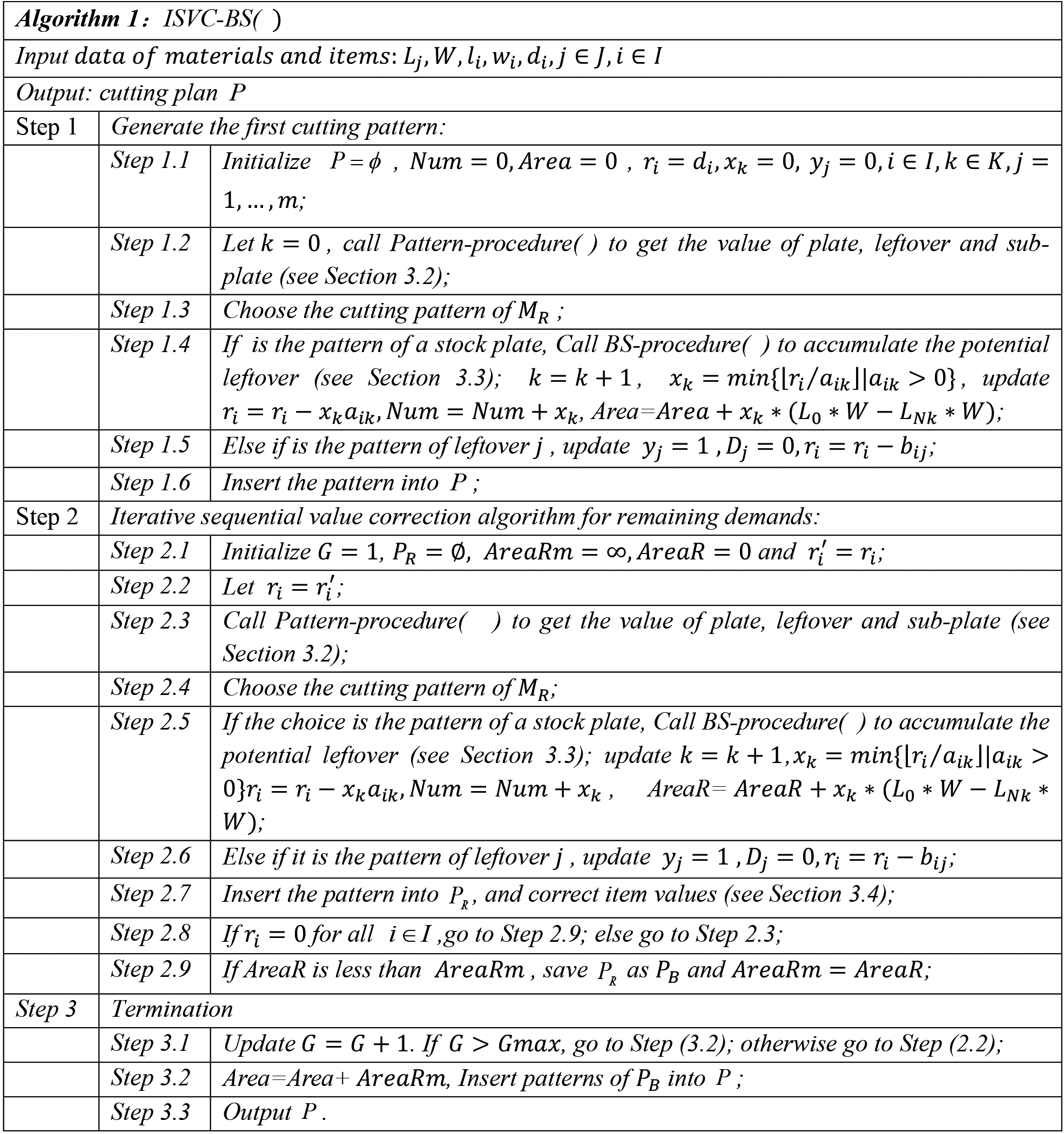
Pattern-procedure is used to obtain the cutting pattern of stock plate and usable. The cutting method uses the angle grinder and the slicer wheel for cutting the thickest steel plates with the minimal amount of effort, it will helpful in making the straight and curve cuts safely. The ability to quickly arrange a cutting blade or angle grinders to cutting is their main benefit. 045 chopping wheel are thinner than piping wheels (called as Kerf) as well as sharpening discs (1/4) and thus are especially made for precision cutting. It’s suitable for performing modest tasks like precision cutting or timber up to 2–3 cm thick. It is not advised that it be utilized to cut cement and pebbles. The cutting pattern is obtained based on implicit enuting all homogenous strips of different items that are combined into segments that are combined into plates. The Pattern-procedure comprises two phases:
(1) solve backpack problem (9) for the value of segments
Subject to:
Where
The segment can be generated through vertical combination of horizontal strips or a sub-segment and a homogenous strip, and the segment value is the total value of the sub-segment and the strip.
Let
Where
After solving recursion Eq. (13), the value of segment
(2) solve backpack problem Eq. (17) for the value of sub-plates
Subject to:
Where
The cutting pattern can be generated through horizontal combination of segments or a segment and a sub-plate. Let
Where
Pseudo code of the Pattern-procedure.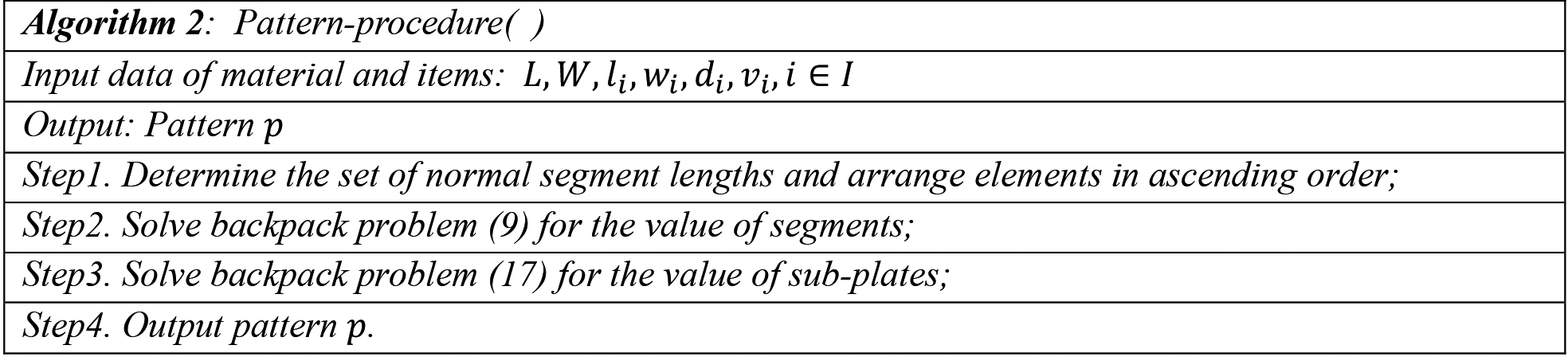
The number of
After solving backpack problem (21), the final result
Beam search heuristic is incomplete derivative of branch and bound algorithm where only elite nodes that have high potential are investigated. It is used to solve combinatorial optimization problems including cutting problems, beam search is a best-first search optimization algorithm that reduces its memory requirement this algorithm produces the graph by the promising nodes in the limited set of data. Hifi et al. [18] described the beam search (BS) heuristic in solving the two-staged cutting problems, Akeb et al. [19]used the BS heuristic in circular packing problems. The circular packaging issue is the task of determining the largest circumference of a certain quantity of identical rounds that may be arranged in a two-dimensional vessel with a stipulated diameter without overlapping. Hexagonal packing, the greatest effective way to package circular, achieves an effectiveness of about 91%. An algorithmic is a step-by-step process that takes a limited number of steps to resolve a specific issue. Using identical settings, an individual’s outcome is foreseeable & repeatable (input). Heuristics are rough estimates that act as a roadmap for further research. The problems are as many circles were packed into a single container the overlapping of the circle takes place and the circle goes out of the boundary this is solved by the beam search heuristics method, and both of them obtain good patterns in a short time. A search procedure called beam search is employed to select the top candidate from a group of solutions in a search process. It may be employed to locate a resolution that maintains the circular inside the bounds when dealing with the issue of a circular straying outside of the border. We use the beam search heuristic to accumulate residues into the large potentially usable. Typically, a beam search is employed in big systems with limited capability to hold the whole tree structure to ensure controllability. For instance, numerous automatic translation platforms have made use of it.
Three basic elements are required for a BS heuristic: node definition, evaluation operator and branching strategy. For a rectangle input material
Pseudo code of the BS-procedure.
Figure 5 provides the pseudo code of BS-procedure. The root node is
The component price adjustment technique allows one to take wastage, depreciation, or expiry into consideration when modifying the valuations of specific objects in an inventory plate. In order to determine how to alter product prices, the process entails examining trends in the stock sheet, like how fast specific things are moving or how often items are all being refilled. A greedy algorithm is a method of problem-solving that chooses the best choice at the time. It is unconcerned about if the most awesome achievement at the moment will produce the final best outcome. The greedy algorithms uses the heuristics for problem solving methods to find the optimal solution at every stages, thus heuristic is the function used in the state of information search by analyzing the correct path. A heuristic algorithm is a process used in numerical methods to find answers to optimization problems that are close to optimum. Yet, this is accomplished by sacrificing quickness for effectiveness, thoroughness, correctness, or accuracy. Due to the combination of UCS with greedy best-first search capabilities, the issue is effectively solved. Applying the heuristic function, it locates the quickest route across the search process. This search method produces ideal outcomes quicker and grows less search trees. There are various methods that can be employed to lessen the influence of this heuristics. They include alternate heuristic algorithms, restrictions, diversity, randomness, and much more. The limits of the goals that traditional heuristic algorithms attempt to emulate frequently result in problems including storage inefficiency, getting stuck in locally global optimal, unpredictable results, and so on. Hence, to reduce the greedy impact heuristic algorithm, the item values are modified after each pattern of stock plate as follows (Chen et al. 2016):
Often a weighted mean seems to be more precise than a basic averaging. In a weighting factor, the allocated weighting is increased by every sample points number, and the results are added together and reduced with the total amount of datasets. Because of this, a weighting can increase the reliability of the information. Equation (24) expresses the new value which is the weighted average of the old value and the over-proportional material-per-item consumption in the current pattern, where
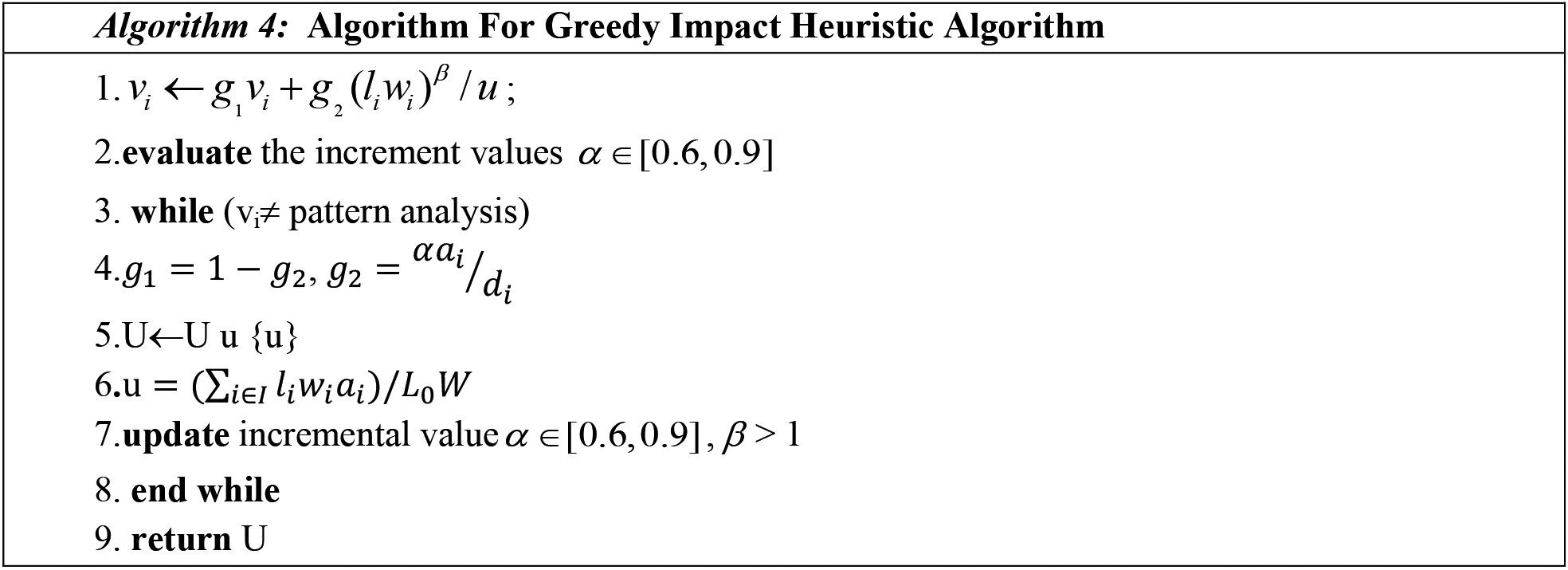
In order to, the item value in the worse pattern increases more. The major expense of inflation is the depreciation of actual earnings, which occurs when costs increase arbitrarily & causes certain customers’ disposable income to decline. As for that, large or odd-sized item types that cannot combine well with other types are considered in the early stage when more combinations can be chosen.
Environment and parameter setting
Algorithm ISVC-BS was implemented in C#, and performed on a 2.53 GHz Intel core Duo processor with 2 GB of RAM memory. Twenty instances (ATP30-ATP49) are used for test. All the items, plates and leftovers are oriented [11].
Figure 7, reports the area consumption under different iteration
Area consumption under different coefficient.
Table 4 shows the results of one single period, compared with algorithms of Silva et al. [1] and Punchiger et al. (2007). Where ID refers to the instance number,
Results of single period
Results of single period
Result of single period.
Shown in Fig. 8, we compare only the number of used plates, because the other two literatures did not consider residual materials. The ISVC-BS uses fewer stock plate in 12 instances and the same in 8 instances (the bold italic font indicates the minimum number). If “–” are taken as the larger number, then the total number of used plate is 211 versus 230 versus 228. The average computational time of the ISVC-BS is 5.88s. Algorithm ISVC-BS used the same number of used plate as that of ISVC, but the area consumption of the stock plate is 52684679 versus 55230800, the plate area consumption is smaller because usable leftovers are saved to subsequent periods.
Usable leftovers cut from the previous period are used in the subsequent period where item data are the same. Table 5 shows results of the second adjacent period, where
Results of the second adjacent periods
Results of the second adjacent periods
Results of multiple periods
Results of second adjacent periods.
In this set of experiments, we used 20 instances, one instance is cut in one period, and the total period is 20. The data of items are the same as previous sub-section, and the stock plate of each instance has the same size which is the longest length and the widest width of all the instances: 931
Cutting stock problem
Cutting stock problem
Iterative sequential value correction
Results of multiple periods.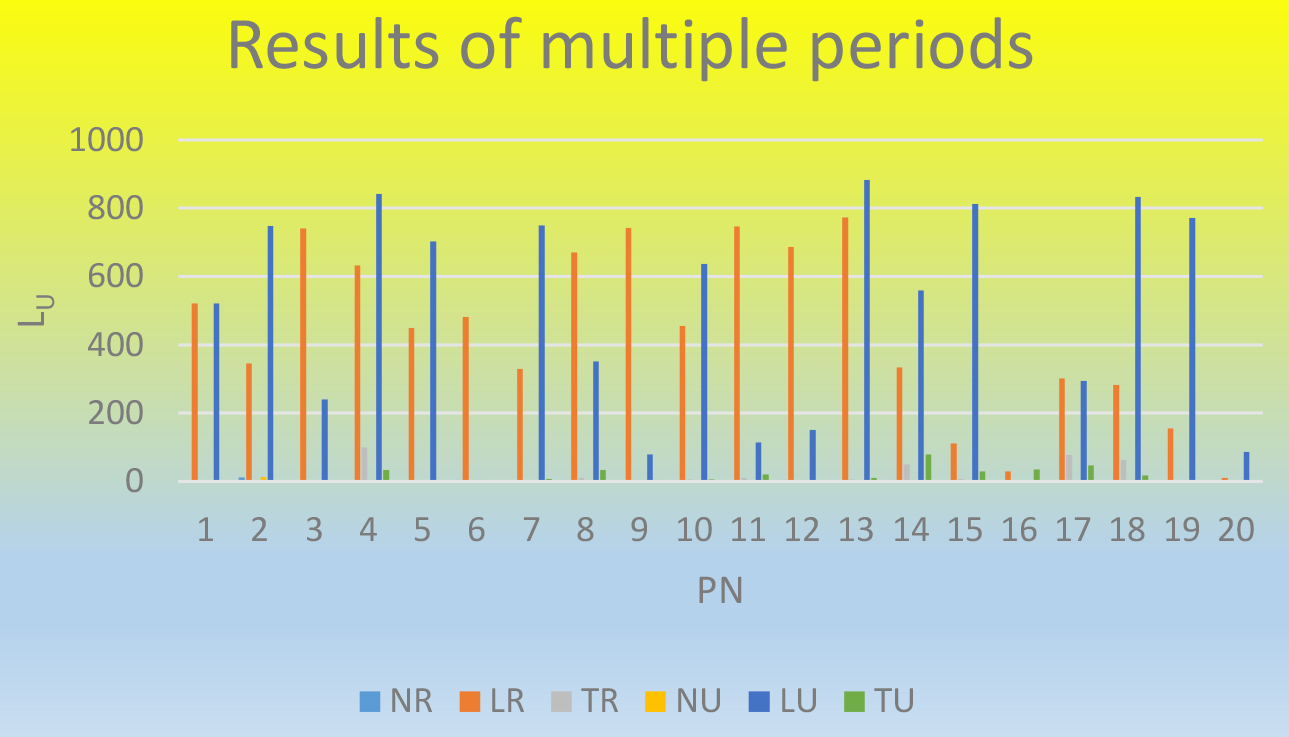
Shown in Fig. 10, The total number of used plate is 71 vs 60, and 11 plates are saved when considering and reusing usable leftovers. The computational time of some instances is quite different, but the average time is similar, which is 18.03s vs 17.1s. Considering and reusing usable leftovers does not increase much time. Shown in Figs 11 and 12.
We show only the results of fixed parameters in all simulations. The results are similar when parameter
Table 7 shows, cutting stock problem, in this table based on, width, quantity and usage.
Cutting stock problem.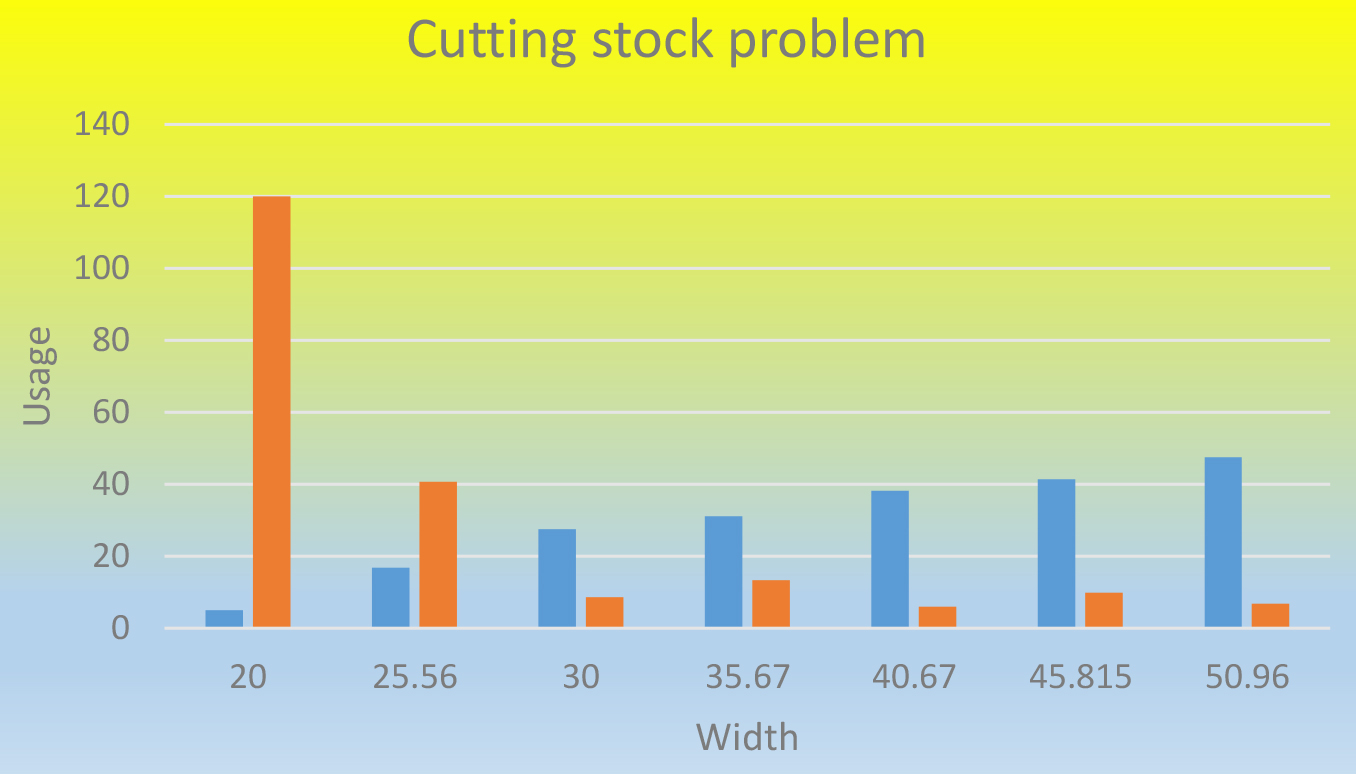
Table 8 shows, iterative sequential value correction, in this table based on, energy block, temperature correction and iteration.
Iterative sequential value correction.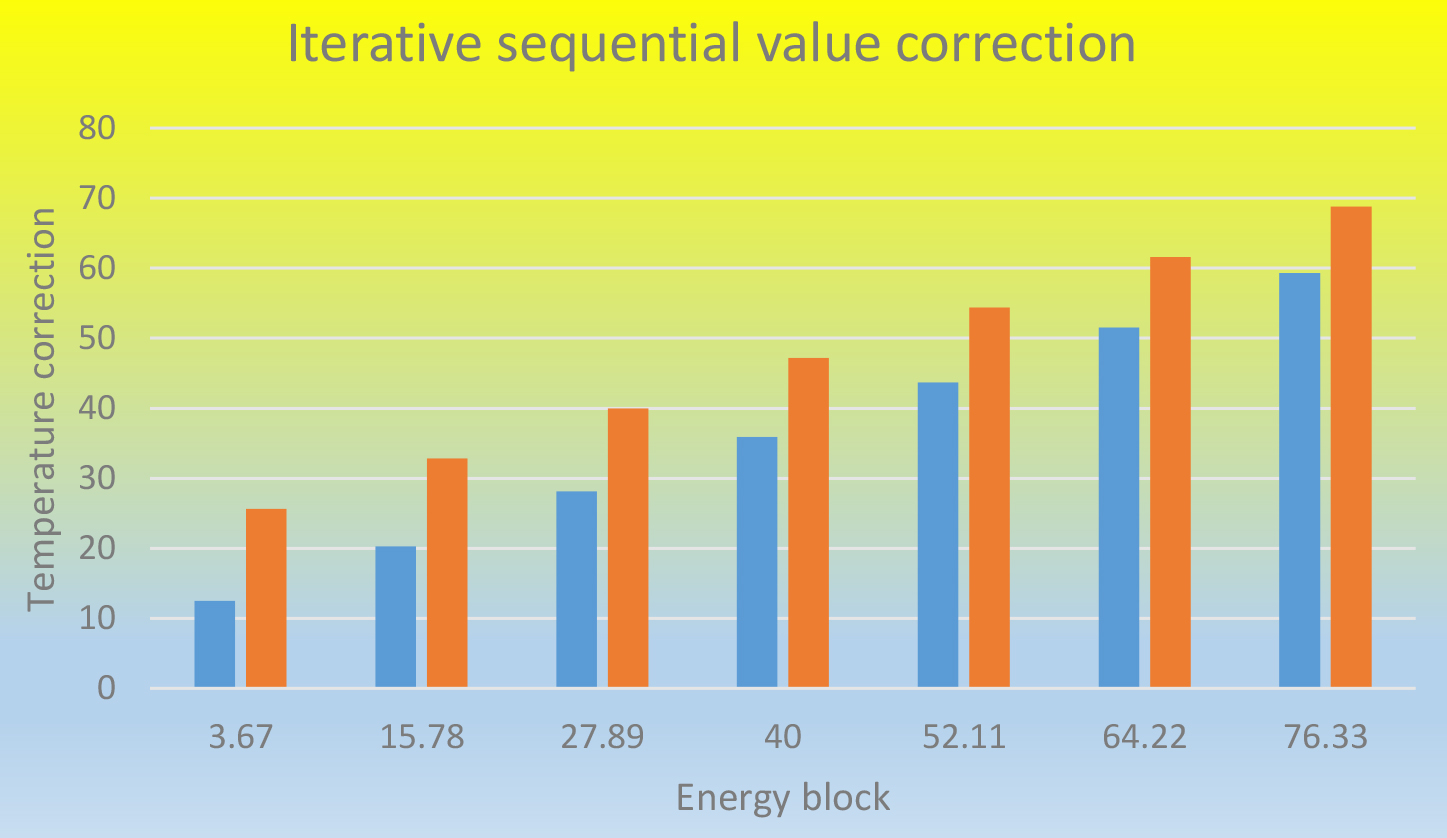
In this paper, we presented the model of the residual two-dimensional cutting stock problem with usable leftover. We designed an algorithm called ISVC-BS that combined the iterative sequential value correction heuristic with beam search heuristic to solve the problem, and obtains the cutting plan of minimum used plates with usable leftovers effectively. The ISVC-BS accumulated fragments into usable leftovers, and reused them as input material in subsequent periods. The utilization of leftovers can save a considerable amount of stock plate and reduce the production cost of enterprises in the long-term production period.
Leftovers should not be remained in stock for a long time. The longer the leftovers kept in stock, the greater the possibility of value loss. Therefore the cost coefficient should be reduced with period. Another interesting perspective for future research is to extend the algorithms to deal with the multi-period cutting processes, considering the benefits of advance cutting of some regular items for future used, instead of generating leftovers for future items.
Funding
This research is part of Project 71371058 supported by National Natural Science Foundation of China, Project 2020GXNSFAA159090 supported by Guangxi Natural Science Foundation and Project 20200371 supported by Guangxi University Foundation. The authors would like to thank for the financial support.
Data availability
All data generated or analysed during this study are included in the manuscript.
Code availability
Not applicable.
Author’s contributions
Qiulian Chen and Yan Chen. contributed to the design and methodology of this study, the assessment of the outcomes and the writing of the manuscript.
Footnotes
Conflict of interest
There is no conflict of interest among the authors.