



Abstract
Large-scale studies indicate that the distinct approach to opinion fusion employed by extreme agents exerts a more potent influence on overall opinion evolution when compared to regular agents. The presence of extreme agents within the network tends to undermine the development of opinion neutrality, which is harmful to the guidance of online public opinion. Notably, prior research often overlooks the existence of opinion extreme agents in social networks. However, existing researches seldom consider the time sunk cost in the evolution of opinions. Building upon this foundation, we introduce a temporal dimension to the opinion evolution, integrating the time sunk cost with the opinion evolution process. Furthermore, we devise an agent partitioning method that categorizes agents into four states based on their opinion values: watch state, subjective state, firm state, and extreme state, with extreme state agents generally expressing radical opinions. We constructed an agent network based on the phenomenon of time sunk costs and proposed a model for the evolution of extreme opinions in this network. Our study found that the information sharing among extreme agents significantly influences the extremization of opinions in various networks. After restricting the exchange of opinions on extreme agents, the number of extreme agents in the network decreased by 40% to 50% compared to the initial situation. Additionally, we also discovered that imposing restrictions on extreme agents in the early stages can help increase the possibility of network opinions moving towards neutral positions. When restriction of extreme agents(REA) was performed at the beginning of the experiment compared to REA in the midway of the experiment, the final number of extreme state agents decreased by 15.57%. The results show that extreme agents have a great influence on the spread and evolution of extreme opinions on platforms.
Keywords
Introduction
Public opinion is composed of thousands of individual opinions. The formation and contention of public opinion must rely on the flow, diffusion and gathering of opinion information [1]. From the perspective of information dissemination, during the traditional media era, news media held most channels of information dissemination and had the power of speech. It is easier to create an organized and influential public opinion atmosphere [2]. Therefore, political parties or groups often set agendas, construct frameworks, provide mainstream opinions and form news opinions through the news media. This guides people toward the ideologies or values they advocate and makes public opinion evolve toward the expected direction [3]. However, in the Internet era, this situation fundamentally changed. With the growing popularity of Internet technology applications, the battlefield of public opinion warfare will inevitably extend from traditional media to the Internet domain. The emerging Internet domain brought about convenient information production technology and content, multiple information distribution channels, and a fast flow of various news information and opinions. It led to the overthrow of the information monopoly status of traditional news media production and distribution, resulting in significant changes in media ecology, audience demand, and public opinion dissemination methods [4]. Its impact on traditional journalism, particularly in the areas of public opinion and issue setting, expanded considerably. Influenced by complex factors at home and abroad, the struggle and competition in the ideological field become increasingly intense. Cyberspace become an important position for competition among various forces. The Internet become the main battlefield of public opinion struggle [5].
Past research on public opinion traditionally held that individual opinions interact with each other in ways that either mutually reinforce, absorb, or ignore one another. However, recent experimental results suggest that there can also be mutual exclusion and antagonism in the process of public opinion dissemination and influence. Extremists are the main group responsible for this type of opinion evolution. Extremists are individuals who are obsessed with their opinions and are too stubborn to consider opinions based on internal psychological factors or external information. Individuals tend to embrace beliefs aligned with their desires, often disregarding factual accuracy [6]. Extremists have a strong preference for theoretical systems and abstract thinking. They would even distort the truth to prove their logic and deny the perceived truth. To achieve their goals, the extremists may resort to ignoring common sense and even falsifying facts. Extremists also quickly radicalize opposing opinions. Their unwavering belief in their own ideas leads them to express themselves assertively, often adopting strong language and positions that can elicit feelings of intense irritation in those they encounter [7]. But this overly intense performance often leads to a different effect: the contactee will experience a psychological phenomenon of extreme impatience or rebellion, forming the opposite opinion of the person who is trying to change their mind.
In the domain of social media, achieving opinion neutrality is a shared objective pursued by both governmental bodies and social media corporations. Opinion neutrality fosters social harmony, promotes the development of civilization, and enhances the overall environment of social media, thereby augmenting user engagement and frequency [8]. In addition, the study of opinion evolution has a potential role in advertising promotion [9, 10], political canvassing [11], and opinion analysis [12]. Controlling online public opinion is becoming more and more important. As a government department, it needs to strengthen the control of online public opinion. The first thing it needs to do is to keep up with media information. It should set up a corresponding organization with competent forces, pay attention to all kinds of media in real time, and pay attention to the events and hot spots of public concern in real time [13].
Past researchers considered extremist studies, Zaller proposed the RAS model as the initial demonstration of this phenomenon [14]. The RAS model does not directly study the interaction process among individuals, but focuses on the influence of the external opinion environment on a particular individual [15]. Many researchers have since developed similar models, however, these methods seldom explore extremists individually. In order to facilitate a separate study of extremists, we define four different states of agents with different opinions. In this work, we focus on extreme state agents of extreme opinions.
In the real world, time sunk costs (TSCs) commonly refers to the cost that people have invested and cannot be recovered, the time sunk cost effect refers to the fact that people choose to persist in their previous behavior in order to avoid the loss of time costs previously invested [16]. We find that few people have conducted research in this direction. In order to study the evolution of opinions in a more realistic way, we propose an opinion dynamics model based on time sunk costs (ODTSC). The evolution rule of social opinions mainly depends on the random connection between agents [17, 18]. In ODTSC, agents with connections will increase their sunk cost if they do not change their opinions after their interaction. Secondly, even if they do not participate in the interaction, the sunk cost will increase after each interaction round driven by time. This sunk cost value will reduce the willingness to change opinions in the subsequent interaction.
The continuous opinion evolution model presents a linear representation of opinion values, which is not conducive to our intuitive observation of extreme agents. We need a way to better identify the extremes among agents. To facilitate understanding the process of opinion evolution, we define four different states of opinion: watch state, subjective state, firm state, and extreme state, based on the values of opinions. We simulate different generative networks to explore how extremists influence social networks.
Specifically, in this paper, we summarizes the main contributions as follows.
We propose a new method that links the evolution of opinions with time sunk costs. It introduces a time mechanism during the evolution process. Defines four different role states based on the opinion values of agents in the social network(i.e. watch state agent, subjective state agent, firm state agent and extreme state agent), and conducts a focused experimental analysis for the extreme agents of them. We propose a new model of opinion dynamics based on time sunk costs. Based on this model, we construct an agent network and do a research on extreme state agents in this network. Through detailed simulation experiments, we prove the harm of extreme state agents to opinion neutralization. The earlier restrictions are imposed on Extreme state agents (ESAs), the more neutral the opinion of the entire social network will be. Delaying REA creates significant costs that are difficult to compensate for.
The rest of this paper is as follows: Section 2 introduces the theory of the bounded confidence model and sunk costs. Section 3 presents a new opinion dynamics model based on the time sunk cost effect. Section 4 conducts simulation experiments by computer, it demonstrates the results and detailed analysis. Section 5 summarizes the conclusions and provides some ideas and suggestions for future research.
Related work
Bounded confidence model
The bounded confidence model is an extension of the DeGroot model, which is considered to be the general classical model [19]. The DeGroot model describes the process of opinion evolution. The common opinion of the people around an agent and the weight of these people for this opinion interaction agent form the agent’s consensus. the DeGroot model [20] has the following opinion evolution process. Let
In the DW model, agent
The two agents accept each other’s opinions when the difference between their opinions is less than or equal to this value, i.e.,
The biggest difference between the HK model and the DW model is the number of other agents in the model when agents conduct opinion interactions. The original DW model typically considers only one person’s idea and opinion when performing opinion fusion. In contrast, the HK model unifies all contacts whose opinion difference is less than the bounded confidence level at that time. Then, it shapes their own ideas based on the opinion difference and their original opinion. This process is called the communication interaction means and mechanism. The following equation gives the HK model:
where
But as the study progressed, researchers found that people do not always agree with and accept others’ opinions or ignore those that are very different from their own, and they also oppose and reject those extreme opinions. However, the previous DW model only considered agents’ acceptance of each other, but not their opposition to each other. When agents are confronted with other agents who are completely opposite and stubborn to them, they will show behaviors that do not accept and deepen their own opinions instead. In order to better study agents’ aversion to the extreme opinions of other extreme agents, we performed a opinion state division for different opinion values.
Sunk costs, also known as retrospective costs, are costs that have already been incurred and cannot be recovered. Arkes and Blumer [27] first proposed sunk costs on the basis of social psychology research. The sunk cost effect is manifested in a greater tendency to continue an endeavor once an investment in money, effort, or time has been made. Persistence owing to prior investment can occur even when the future consequences of an alternative course of action are more favorable [28]. In a field study, researchers found that customers who initially paid more for a season subscription to a theater series attended more plays in the following 6 months. This could be attributed to their higher sunk cost in the season tickets. Similarly, agents who spend more time and effort initially forming a particular opinion tend to pay more attention to information that confirms that opinion in the future. As a result, they are more likely to continue to believe it. Under a rational setting, they should not be considered when evaluating alternative courses of action. However, as a matter of fact, their existence is a driver of organizational inertia and inhibits change [29]. Thereby, sunk costs are generally considered a barrier to innovation [30].
There are many types of sunk costs, but in most cases, in the evolution of opinions, there will only be the impact of time sunk costs. Time is involved in every activity we engage in, and cannot be recovered. Navarro and Fantino [31] provided compelling evidence for the sunk cost effect, particularly in their behavioral experiments where participants invested real time in an activity. The participants completed a jigsaw puzzle with either a short or long time invested, with task completion being either obligatory or voluntary, to assess the role of personal responsibility in the sunk cost effect. Overall, the sunk cost effect was observed, and its occurrence was dependent on a high level of personal responsibility. In the evolution of opinions, this time sunk effect depends on the individual’s attention to the event and the number of interactions.
The framework of opinion dynamics model based on time sunk costs. 
Agent state
Agents in a social network continuously change their opinions through interactions with other agents. Furthermore, agents in different states behave distinctively when interacting with different agents. The opinion value is the centralized reflection of agents’ opinions in the social network [32]. We define four different types of opinion states as follows:
Watch state agents (WSAs) are the most placid group of people in the social network. They are just beginning to understand the event or have not yet formed their own ideas, but have a general understanding of the event. The opinion value of WSAs is Subjective state agents (SSAs) are individuals in a social network who have formed their own opinions after obtaining a certain degree of understanding of an event. These individuals will indicate their initial positions during the communication process. They are good guides for the WSAs and are able to tolerate others’ ideas and opinions in the face of other different opinions. They have a opinion value of Firm state agents (FSAs) are hard to be influenced by others, but they are not incapable of changing their opinions. They are the agents closest to the extreme states and the group of agents most likely to be extremists, with firm attitudes and opinion values of ESAs are the agents with opinion values
[H]
Algorithm 3.1 demonstrates the method of partitioning agent states. Generally, to reach opinion unity, agents exchange opinions with other agents in social networks for the purpose of mutual understanding to reach opinion unity. The bounded confidence model takes into account a specific limitation in the formation of individual opinions, only the opinions of agents within the confidence threshold are considered. However, the exchange with ESAs breaks this rule. When there is opinion interaction between agents beyond the confidence level, the extremists influence the ideas of another agent in reverse. In our analysis, we observed the interactions between agents in each state. When the WSA interacts with the SSA, it evolves towards an intermediate opinion between them. This process has a positive effect on opinion neutralization. Similarly, when the WAS interacts with the FSA, it has a facilitative effect. On the other hand, the interaction between the WSA and the ESA evolves in the opposite direction outside the interval between their opinions. This has a reverse negative effect on opinion neutrality. When interacting with a FSA, the SSA has a positive effect on evolving towards a neutral opinion. Conversely, when interacting with an ESA, the SSA has a negative effect on evolving towards a neutral opinion. The FSA has some negative effect after interacting with the ESA. In this model, extreme agents have a negative effect on opinion neutralization. We incorporated the influence factor of time sunk costs, which had not been considered by previous academic workers. In a simulated network with a social structure, we discuss the interaction of opinions between agents with extreme agents. There are two possibilities for agents to merge their opinions with other agents: neutral evolution of opinions and extreme evolution of opinions. As shown in Fig. 2, the fusion of opinions between A state agents and B state agents is developing towards opinion neutrality. Similarly, there are also A state agents and C state agents, A state agents and A state agents. However, the fusion of opinions between D state agents and other state agents is developing in the direction of extreme opinions. Specially, there is no interaction between two extreme states agents.
Interaction between different state agents.agentA: WSA. agentB: SSA. agentc: FSA. agentD: ESA. 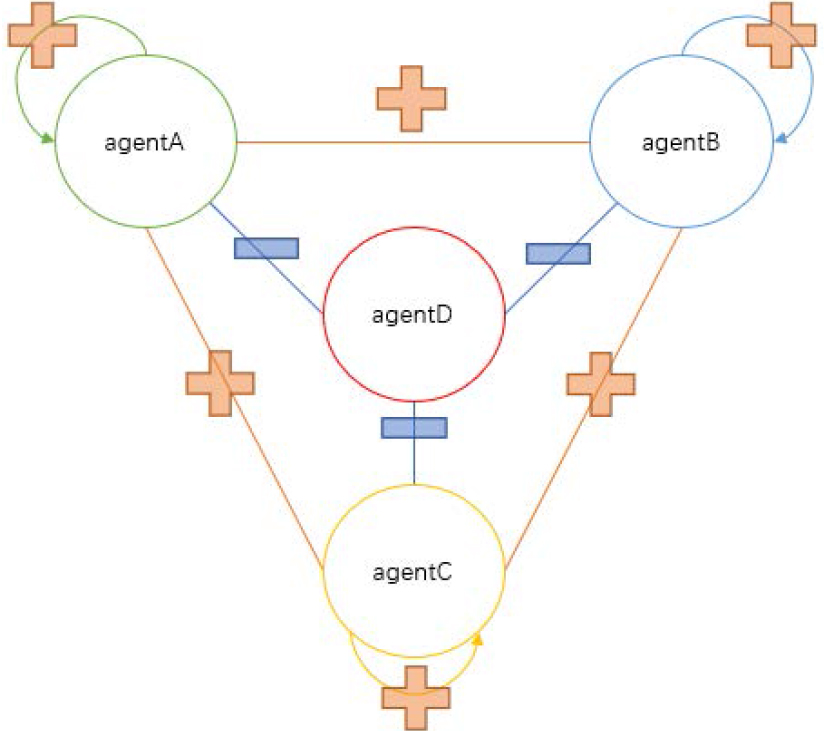
Agents in different states exhibit different behaviors when interacting with other agents. During opinion interaction, when the two agents involved are distant, the sunk cost effect can influence their decision-making as they integrate information. If they choose to accept the opposing agent’s opinion, they would need to abandon their previous preparations for their own opinion, and the cost of this preparation increases with time and the number of interactions. These agents are hesitant to believe each other’s opinions during their interactions, leading to a reduction in the reference to others’ ideas. This ultimately results in a decrease in the learning efficiency of both parties.
An example of opinion evolution structure under time sunk cost.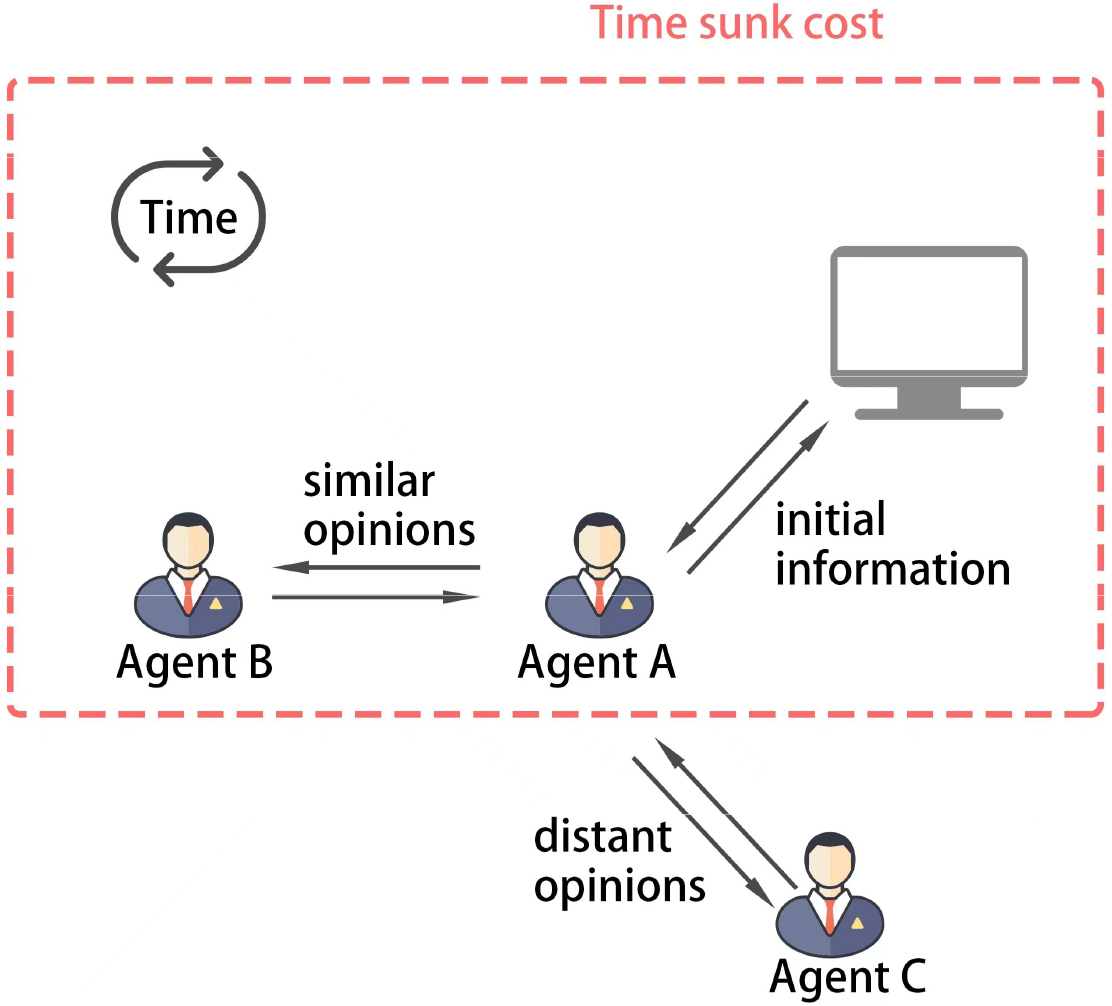
An example of opinion evolution structure under time sunk cost is shown in the Fig. 3. As shown in Fig. 3, Agent A obtains information and then continues to gather relevant information on the Internet to form an initial opinion. Agent A interacts with other agents in the community who share similar opinions, such as Agent B, to update their opinions. This process continues over time and incurs a time cost. When Agent A interacts with Agent C, who holds distant opinions, Agent A’s opinions may be swayed. If Agent A decides to accept the new opinion, he must gives up the time he have invested in this matter, that is, the time sunk cost. We use
where
The network graph in a social network represents a network of relations. Let the undirected graph
The initialization process includes the generation of agents’ initial opinions and the generation of network relations, which both form the initial network. The initial opinion values are generated randomly. The initial time sunk impact factor
Opinion evolution process in opinion agency network
This model considers both learning rate and individual time sunk cost. The first step is to select agents for opinion interaction. Then, calculate the time sunk coefficients and perform opinion fusion. Finally, the next round is initiated by increasing the time cost impact factor. Next is the specific fusion process of various state agents. The first case of opinion fusion process involves agents that belong to the same watch state. WSAs are easily influenced, and they exchange opinions with each other. Assuming that opinion values of two agents at moment t are
where
If there is no change in the direction of their opinions, there is no time sunk cost to consider. In the second case, WSA interacts with SSA. At this point, the WSA is passive. He is not as well informed about the situation as the SSA, and his own trust is not as high as the SSA. The WSA chooses to trust the opinion of the SSA, in this case, SSA holds their own opinions while WSA listens to SSA. WSA absorbs the opinions to a certain extent based on the difference in opinion between the two and combined his original opinion to form a new one:
This is the evolutionary process when two agents have a similar attitude. Here, agent
The firm state is more contagious than the subjective state and has a more assertive attitude. When the WSA interacts with the FSA, it has the same evolutionary rules as when the SSA interacts. Then there is the case of the WSA and the ESA. The interaction with the ESA does not neutralize the opinion. If
This is the process of opinion evolution when similar attitudes are present, where
The above formula describes the interaction process between the WSA and all state agents. Additionally, it introduces Algorithm 3.2.3, a proposed model algorithm that integrates individual and others’ opinions and incorporates time sunk costs.
When both agents are subjective, they interact based on their own opinions. Both agents then revise their opinions based on each other’s opinions. If the opinions are similar, we use the DW model [22]:
FSAs also aim to exchange opinions with SSAs who share similar attitudes. Their update methods are consistent with those between subjective agents, where both sides update their opinions based on each other’s opinions. However, based on the fact that the agents already have certain knowledge and ideas, the learning rate will not be as high as that of the WSAs. When the two agents are distant attitude, both agents need to consider the time sunk cost:
[H]
A FSA already has a clear attitude and will only interact with another FSA with a similar opinion. There will not be any fusion of opinions with a FSA who has a distant opinion. When a FSA
where
The initial and final opinion of agent in subjective state through different evolution with agents in different states
As shown in Table 1, the first column of the table lists the agent nodes in various states throughout the social network. The second column shows the initial opinions of the agents in various states. We randomly choose initial opinions from the range of [
where
In this section, to demonstrate the effect of extremists on opinion polarization, we conducted simulation experiments to represent the values of agents’ opinions of people at different times and analyzed the results of the experiments. In Section 4.2, we examine the impact of introducing REA in different social networks. In Section 4.3, we alter the timing of introducing REA. Within Section 4.3, we investigate the costs associated with compensating for the delayed implementation of REA. Our source code are publicly. available.1
Simulation design
In the interaction of group opinions, different social networks tend to have different evolutionary processes. To explore the influence of extremists in different communities, we utilize three initial social networks: Erdös-Rényi random graph [35], scale-free network [36] and small world network [37] all consisting of 2,000 agents and 200,000 connections. These networks are used to demonstrate the harmfulness of extremists in the evolution of network opinions towards neutralization.
First, experiment 1 demonstrates the evolution of the overall social network perspective at the macro level to demonstrate the harmfulness of extreme agents in various social networks. Specifically, we set the same initial node
Second, the start time of REA is an important time point. If it does not produce significant effects after using REA, the control effect of his application to public opinion will be inefficient. Therefore, we designed experiment 2: a restriction on extreme agents at different time points in the evolution of public opinion to determine the optimal REA time point by observing the convergence of opinions in the social network. We repeated experiment 2 500 times to reduce random errors and presented the numerical averages of all experimental results in a visualized form.
To reduce the evolution of opinion polarization and alert social media to concerns regarding the control of public opinion, it is important to control the intervention time of REA. To achieve this, it is necessary to study the impact of the intervention time of REA on the polarization of overall social network opinions. If delaying the intervention time of REA causes irreversible deterioration of public opinion on social media and public platforms, it leads to the need for platforms to use coercive means to control public opinion. This would inevitably make the platforms’ credibility decline, and such a consequence would be unbearable. Experiment 3 consisted two sets of comparison experiments. The first set intervened in the event at the pre-fermentation stage of public opinion. the second set postponed this REA to intervene and gradually increased the intervention to achieve a similar effect of opinion control as the first set of experiments.
Evolution process of agents’ opinions in various networks.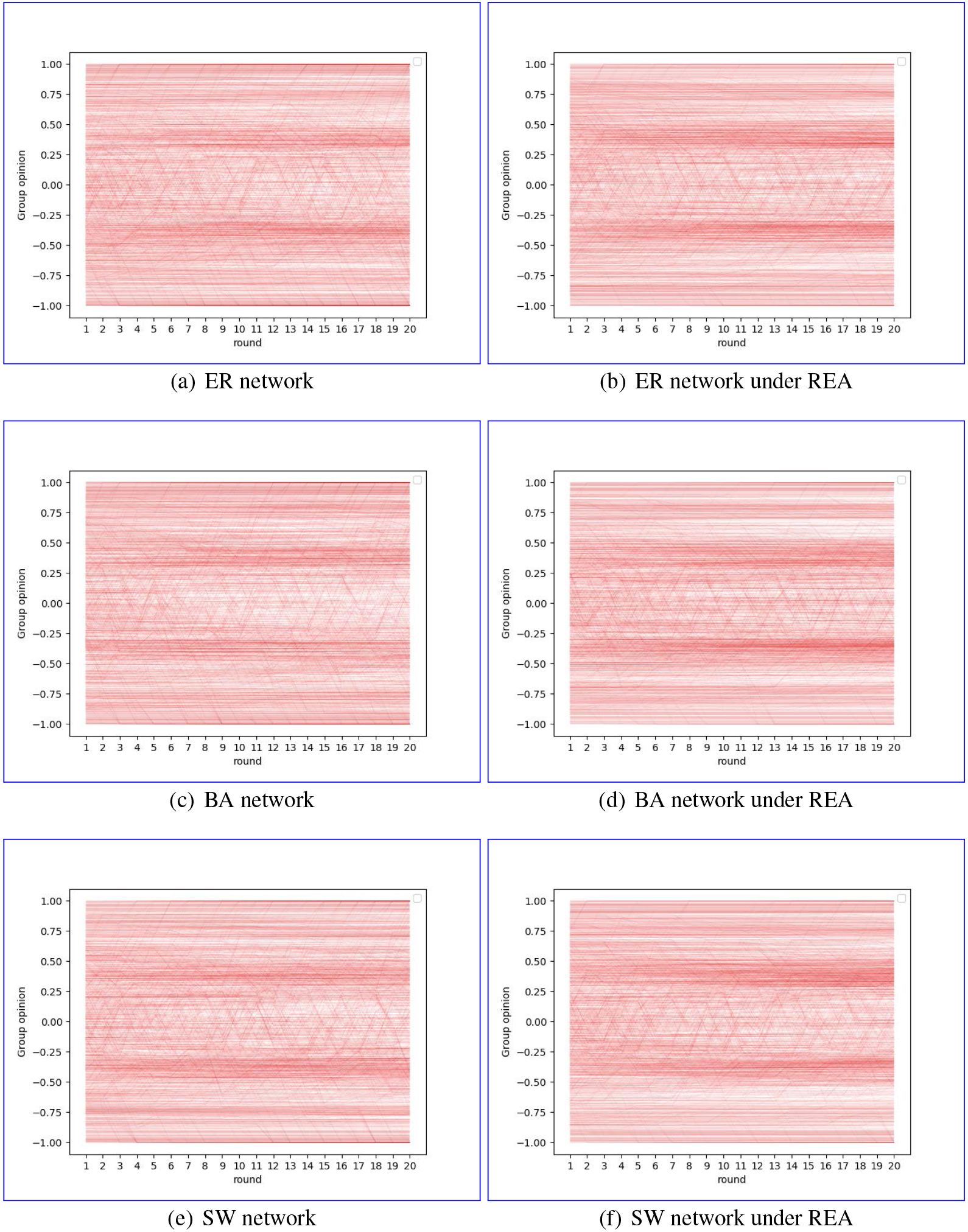
In Fig. 4a and b are the opinions evolution processes of the agents under simulation for the networks generated by ER random graph and ER random graph using REA. In the simulation experiments, the initial distributions in both networks are uniformly distributed so that various opinion values are present in the networks. In Fig. 4b, we changed the treatment of extreme agents to have a 50% chance of terminating opinion interactions when extreme agents are in contact with others.
Number of people in each network and in various states under the influence of REA
Number of people in each network and in various states under the influence of REA
Among them, Fig. 4a and b illustrate that when left untreated in the ER network, some agents’ opinions evolve rapidly toward extremes and some agents’ opinions evolve toward neutrality, but the effect is not significant. When restrictions on extreme agents are imposed, there is a significant decrease in the development of agents’ opinions toward extremes in the network and a substantial increase in the number of agents with opinions
Evolution of network opinions after REA at different time points.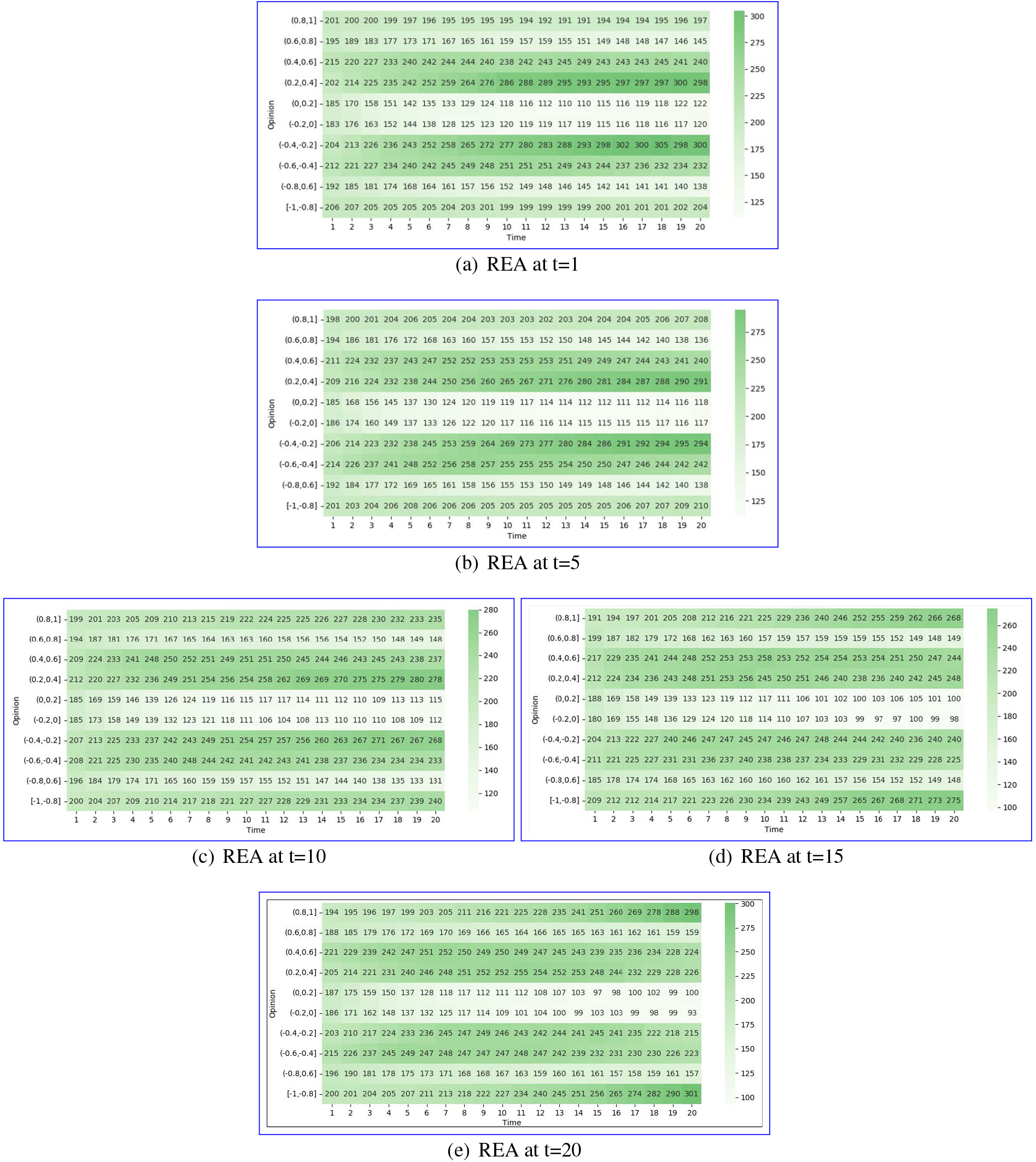
To explore the negative impact of extreme agents on overall opinion evolution over time in a social network, we set different time limits for extreme agents and conducted 100 simulations to eliminate the influence of randomness. We then obtained the average number of overall opinion changes in society after introducing REA at different time points, as shown in Fig. 5. According to Fig. 5a, the number of agents with a final opinion value in the range of (0.8, 1] or [
Delaying intervention time for extreme agents increases the number of agents with polarized opinions in the final network. This result suggests that polarization of opinions in the network increases with time, leading to more negative effects. Therefore, limiting extreme individuals at an earlier time is more effective in controlling public opinion.
Figure 5 illustrates the optimal time period for the REA intervention to slowly increase the number of ESAs across the social network. In Table 3 are the number of ESAs with positive opinions and the number of ESAs with negative opinions after the intervention at different time points. To reduce the randomness, we reduce such effects by averaging 100 simulation experiments. The first column represents different time points, while the second column indicates the number of ESAs who hold a forward opinion. The third column represents the number of ESAs who hold a backward opinion. The social network has 200 ESAs at the initial state. The number of ESAs grows naturally to 286 before
Changes in extreme agents at five time points after different REA interventions
Changes in extreme agents at five time points after different REA interventions
Network opinion distribution.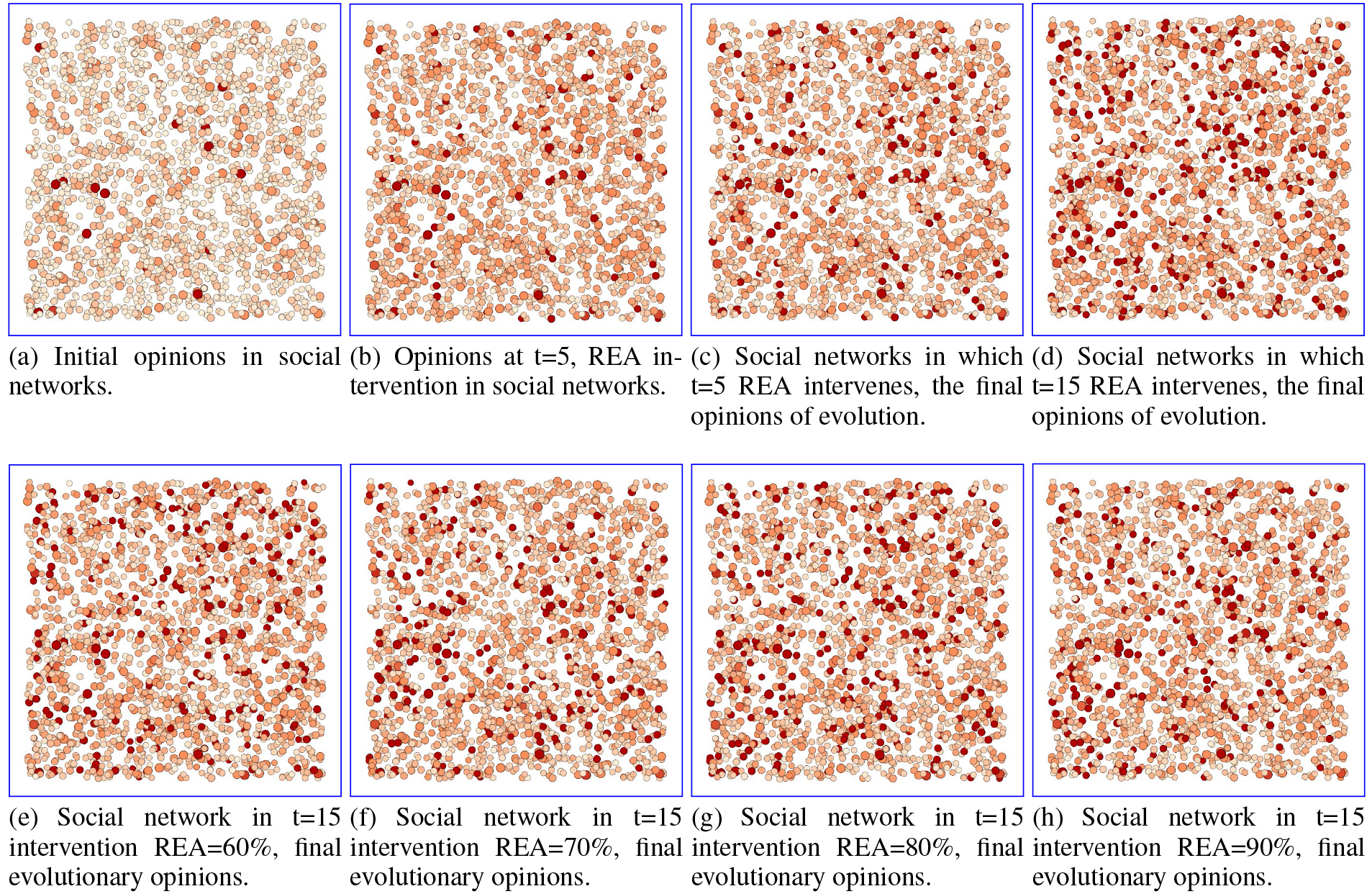
As shown in Fig. 6a, the dots in the figure represent the opinion of each agent. The closer the color of the dot is to red, the more extreme their opinion is, and conversely the closer the color is to white, the more neutral their opinion is, i.e., the closer it is to 0. The size of the dot in the figure represents the size of their initial opinion value, and the more extreme the initial opinion value is, the larger the shape of the dot will be. Figure 6a–c show the initial social network opinion values, the opinion values at
Figure 6e–h shows the results of the evolution of the final opinions of the social network intervening in different REA efficiencies at
In short, delaying REA’s intervention requires more efforts to achieve the public opinion control effect achieved by intervening in the pre-fermentation stage of the event. This is a huge damage to the credibility of the public platform and an irreparable loss to the enterprise. Therefore, public opinion should be controlled by intervening as early as possible. The later the intervention, the more difficult it is to control the direction of public opinion. Social platforms should effectively control the extremists in the early stage when public opinion first starts to achieve a more toward neutralized opinion of public opinion.
This paper defines four different role states based on the opinion values of agents in the social network: watch state, subjective state, firm state, and extreme state. This method provides a more compositional understanding of opinion evolution in a social network among individuals. We propose a model of opinion evolution based on the sunk cost effect. Through computer simulation, we analyze the negative impact of ESAs on the neutralization of opinion evolution in the whole social network. We also examine the impact of restricting ESAs at different points in opinion evolution. The results of the study provide certain reference value for the control strategy of platform opinion in social networks.
In addition, our simulation analysis led to these conclusions: (1) ESAs have certain negative effects on the evolutionary process of opinions toward neutrality in various social networks. With certain restrictions on ESAs, the overall opinions in social networks evolve toward a more neutral aspect. In the process of human-to-human information interaction, extreme agents may behave aggressively and use sharp language that exceeds the effective range of information acceptance of the interaction target. This behavior can lead to dissatisfaction and have negative effects on the interaction target. (2) It was found that restrictions on ESAs would have a positive effect on influencing the overall opinion evolution toward neutral evolution in social networks. Comparative experiments show that placing restrictions on ESAs earlier results in more neutral opinions across the social network, which is helpful for controlling public opinion. (3) Delaying REA creates significant costs that are difficult to recover.
The research on extreme opinions can help the public to enhance their understanding of extreme opinions, promote rational and inclusive discussions and exchanges. It can also help platforms and policy makers to understand the impact of these opinions, so as to formulate more fair and rational policies. However, there are still some limitations. Firstly, the real situation of each country and platform is different, we need more detailed real data for the experiment. Secondly, more in-depth research is needed on how to control the impact of extreme opinions. As future work, it would be a very good research point about how to go about better controlling the negative influence of extremists based on time sunk cost of opinion evolution model.
Footnotes