



Abstract
The paper shows the adaptation of Fuzzy Logic and AHP to recognize Alzheimer’s disease at early stages. Alzheimer disease (AD) is a neurological disease which is mostly seen in the age of 65 years and above, when they have problems like memory loss, decline in cognitive abilities and changes in mood and personality. We all know that human behavior is mostly based on qualitative facts, which are hard to be measured and cannot be judged easily. Fuzzy logic and AI are certain latest methods to approximate and to bring out a decision or an inference. Through this method, certain linguistic terms are used like very high, high, low, very low etc. and the weights are calculated accordingly, via the response. During final interpretation, the identified parameters are diagnosed through mapping and framing a hierarchy of major subareas to arrive at a subsequent decision. A set of governing parameters are framed and then subparametrs been identified, creating a hierarchy. Thus this tool can be used for final diagnosis of the Alzheimer disease as it is Yes Or No for the concerned patient.
Introduction
An expert system or Artificial Intelligence (AI) is defined as the ability of a technology which could take and follow the expertise of a human brain and further use it to solve and act for the various situations through computer system reasonably. An expert system can be designed based on a set of rules to determine what action to be set off when a certain situation is encountered [1]. The objective of this paper is to apply a fuzzy multi criterion approach for approximation and judgment of whether a person is suffering from Alzheimer or not. A fuzzy set is a class of objects with a continuum of grades of membership. Such a set is characterized by a membership function which assigns to each object a grade of membership ranging between zero and on [15]. A substantive departure from the conventional fuzzy techniques of system analysis was given by using linguistic variables in place of numerical values [17]. AD was discovered in 1907 by Alios Alzheimer [6] but was not considered as a major disease until 1970’s. This disease is mostly diagnosed by its known symptoms like impairment of memory, and reasoning, planning, mood, behavior and action It has been believed that AD results from an increase in the production or accumulation of a specific protein beta amyloid in the brain that is dangerous to nerve cells. Mostly it is observed in people in 70’s and may affect to about major population in the age 85 or so.There are special cases though where people do not get any problem of AD or any memory loss though they turn to 100. A substantive departure from the conventional fuzzy techniques of system analysis was proposed by using linguistic variables in place of numerical values [16]. A linguistic variable is defined as a variable whose values are sentences in a natural or artificial language. Thus if tall, not tall, very tall, very very tall, etc. are values of height, then height is a linguistic variable. Similarly a linguistic hedge such as very, more or less, much, essentially, slightly, etc.
May be viewed as an operator which acts on the fuzzy set representing the meaning of its operand. For example, in the case of the composite term very tall man, the operator very acts on the fuzzy meaning of the term tall man [16]. Detailed works on linguistic variable and its applications to approximate reasoning are found in three published papers by Zadeh [16]. Further discussions on extended hedge algebras and their applications to fuzzy logic can be found in Ho and Wechler [13], Lascio et al. [9] and Ho and Nam [12].
Review of Alzhemier disease (AD)
Back to a few decades, it has been observed that many academicians and researchers have started using the expert system for several decision making attributes and knowledge management. At the early stages it was used for basic areas like medicine, geology and computer science [5]. Performance measurement design of management tools [10], customer service management [2], prosthetic sockets [18], cultural heritage [19]. Obi and Imainvan [20] developed a theoretic framework for intelligent expert system in medical evaluation.
Bai and Chen [4] presented a new method for evaluating the performance of students using the fuzzy sets and crisp sets as a means of representing and reasoning of the data that are not clear but are fuzzy. Expert system has been applied in stock market, banking, monitoring systems and medical diagnosis [19]. A fuzzy AHP approach for the determination of importance of weights of customer requirements in QFD can prove to be quite beneficial. The data which is vague and unclear with consistent needs to be compared pair wise using a AHP technique. This approach was used to improve the imprecise rating of the customer requirements [8]. Bayazit [14] presented an application of AHP tool in flexible manufacturing systems and Aktepe and Ersoz [2] applied the fuzzy AHP to an industrial case study for the supplier selection process. The priority weights were calculated using the extent analysis method and the integral value calculation. Similarly Le et al. [10] published a fuzzy AHP application for the selections in a green supply chain for a case study in Daim et al. [3] applied AHP for the selection of 3PL providers.
Alzheimer and dementia
AD is the most common and prevalent disease and is a type of dementia, which is very common for 60 to 80 percent of the masses WHO ARE suffering from AD. There are various types of dementia [20]
Mild cognitive Impairment Vascular Dementia Mixed Dementia Levy Body Dementia Parkinson’s Fronto Temporal Dementia etc.
These several types of dementia together accord for the same condition of the brain disorder and finally the nerve cells of the brain and their connectivity with the other part of the brain are broken. It can be genetic in some cases while it can be caused by taking lot of alcohol, over medication
Personal Medical History (PM) Physical Examination (PE) Diagnostics Tests (DT) Brain Scans (BS) Neurophysiological (NP) Psychological Observation (PO)
PM is further subdivided in following important subdivisions
History Mental Abilities Personality Recent Illness Mood Memory Loss Loss of Coordination
Physical Examination (PE) is further subdivided in following important subdivisions
Respiratory Eye movement Hand and Body Coordination Muscle Strength Posture and Reflex
Diagnostics Test (DT) is further subdivided in following important subdivisions
Blood Count Diabetes Kidney and Liver Vit B 12 deficiency Mysthemia Gravis
Brain Scans (BS) is further subdivided in following important subdivisions
MRI Stroke Diagnosis PET (Position Emission Tomography) Amyloid Deposits Levy Body (DLB)
Definitions of linguistic hedges
Neuropsychological (NP) is further subdivided in following important subdivisions
Interview Intervention from care givers Arthritis Partial Tremors Non Coordination in activities
Psychological Observation (PO) is further subdivided in following important subdivisions
Behavior Mood at evening and morning Walking Talking to Others Response to laugh and sorrow
In a fuzzy logic based system, sometimes the information is described linguistically. The linguistic hedge is an operator like a modifier used to modify the shape of membership functions. Linguistic hedge operators can be classified into three categories: concentration, dilation and contrast intensification. In this paper, only the concentrator and the dilators are used.
Applying a concentration operator to a fuzzy set results in the reduction of magnitude to the grade of membership. In contrast, the effect of dilation is opposite to that of concentration. The reinforcing modifiers provide a characterization which is stronger than the original one. Zadeh [16] proposed the modifier very associated with the transformation tm(
The weakening modifiers provide a new characterization that is less strong than the original one. Zadeh introduced the modifier moreor less, associated with the transformations tm(
Development of membership functions
There are several methods to get reasonable membership functions. Here is an illustration of one such method. Suppose one needs to model the notion of high performance with a fuzzy set as shown in Fig. 1, then the set U with a positive real numbers representing the totality of possible performance of the manufacturing units (as judged by the users).
Membership function development for fuzzy linguistic hedges.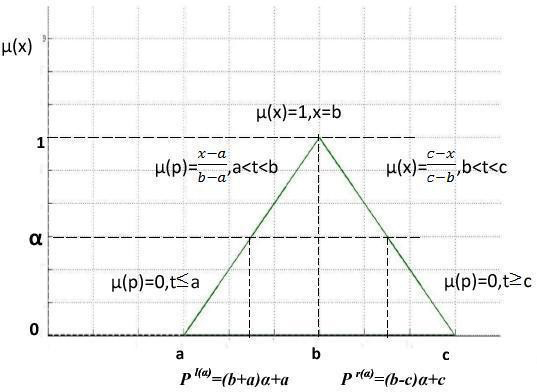
Then by surveying a large number of users and finding out about the performance of the manufacturing process in a particular range, the proportion
Based on a fuzzy output the rankings of the six conditions are framed. We examined 38 patients and 12 doctors and a survey was conducted to know for the importance of the listed parameters which parameter is ranked at which place Fuzzy QFD paper [18] showed the formulation of the calculation which resulted in the ranking as shown in Table 2.
Ranking with concentrator and Dilator coefficients
Ranking with concentrator and Dilator coefficients
Using a set of questions four units of Mental health were surveyed and their average response was tabulated in the range of 1 to 5 is tabulated for the interception of whether Alzheimer or not
Very low Low Moderate High Very high
Taking into account the two main types of manufacturing process for the prosthetic sockets, the data from the four users are collected separately for each product type. Table 3 presents the compiled linguistic data from the users for the various sub-criteria of BRAIN SCAN (BS).
Linguistic data for different parameters of Brain Scans-BS (C1)
Linguistic data for different parameters of Brain Scans-BS (C1)
Similar compiled data for other parameters are given in next section. The membership functions required for computation of performance score for each criterion with respect to alternatives are also developed.
The application of the linguistic fuzzy AHP comprises of the following steps:
Step 1: Structuring the problem as a hierarchy The problem can be structured into a hierarchy as shown in the Table 3. On the top level, there is the overall goal i.e. selection of whether YES AZ or NO AZ. On the second level, there are the six criteria (C1 through C6) that contribute to the goal. On the third level, these six criteria are again decomposed into tirty two sub-criteria and on the bottom (fourth) level are the two alternative choices of YES AZ or NO AZ. Step 2: Construction of membership function Membership functions are constructed using section dilators as reference for each sub criterion represented in Table 4. Membership functions and scores for C1
Step 3: Calculation of performance score
With the help of this membership function, the performance score is calculated for each sub criterion. For example, considering the value of manufacturing type 1 (manual) and manufacturing type 2 (RE) under sub-criterion performance,
The value of membership function for C1 NO
Next all the scores are aggregated corresponding to its sub criterion (Table 4 and 5).
Linguistic data and scores for other parameters
Step 4: Normalization of the score
The decision matrix is normalized to obtain unique membership functions combined with other criteria to select EITHER YES AZ or NO AZ. Here normalization is done by adding individual column elements and then dividing each column element by the sum.
Step 5: Dilation or centralization for each criterion
To determine the power of dilation or centralization for each criterion the various attributes with power of centralization or dilation is given Table 6. Using the power values from this table and applying it on alternative criterion, a set of values represented by a decision matrix is obtained. For example, for C2, the relative weights are obtained by raising the column elements to power of 1.5. In this way a decision matrix is obtained (Table 5) representing scores of all criteria with respect to each alternative.
Step 6: Decision making
To determine the best alternative solution, the max-min principle is applied. First by taking the minimum membership value over all of the criterion for different alternatives and then picking the alternative with maximum value. The ranking of best manufacturing type from Table 6 are found and the minimum values of all alternatives with respect to various criterions in the decision matrix are taken. For the given case study,
Minimum of YES AD
Taking the maximum value between the two alternatives, which comes to be 0.3749 is the best solution and saying as YES AD.
Final selection of best Selection of answer to YES /NO AD using max-min principle
In this paper, a fuzzy linguistic hedges based AHP tool is being used to analyze the responses from the patients as well as the doctors dealing with Alzheimer Disease (AD). The responses from the patients as well as the direct people dealing with the sufferers were taken for the study and the responses for both whether YES AD meaning yes they are suffering from the disease and NO AD meaning they are having less or no symptoms for Alzheimer with their rankings as obtained from a fuzzy QFD analysis earlier by the authors were used in the present work. A hierarchical problem is constructed to select the best alternative of decision support using the max-min principle of the linguistic hedges. Decision matrices are formed after normalization and using concentrators/dilators to the scoring weights. From the decision matrix the YES AD for the present case study was diagnosed and interpreted. In present times major decisions and relevant diagnosis is been done by the AI techniques and AHP models.